

The 7 Best Email Address Search Tools in 2026
Most email address search tools claim 95%+ accuracy. The real numbers tell a different story. A 20,000-contact benchmark that included live email delivery found the best tools top out around 55% real enrichment - meaning nearly half your lookups won't return a valid, deliverable address. Meanwhile, roughly 17% of cold emails never reach the inbox at all, often because the address was bad from the start.
One RocketReach user on r/DigitalMarketing summed up the frustration perfectly: paying $50/month for over a year with consistently low reply rates. That's what happens when the underlying data is stale. Here are seven tools that handle the accuracy gap differently - and how to pick the right one for your workflow.
Our Picks (TL;DR)
| Pick | Tool | Why |
|---|---|---|
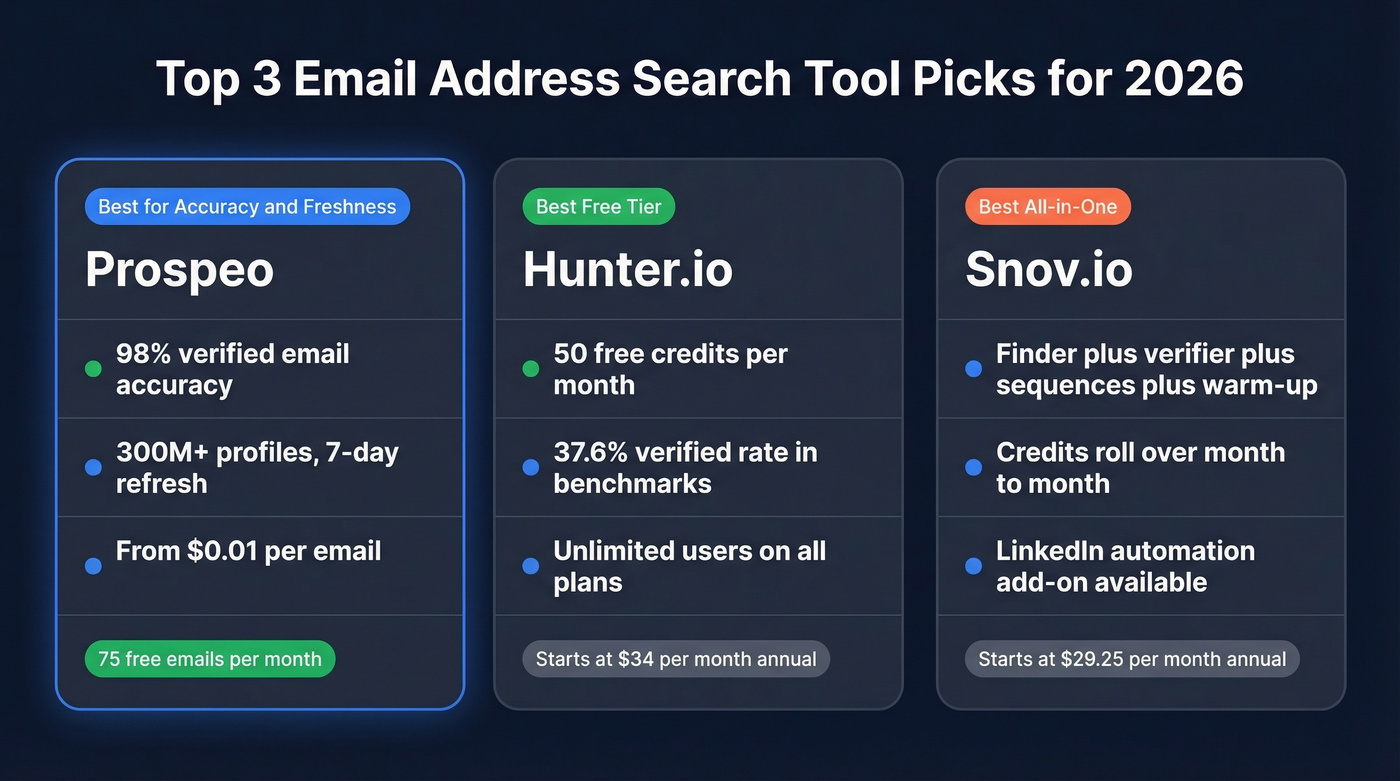
| Best for accuracy & freshness | Prospeo | 98% verified email accuracy, 300M+ profiles, 7-day data refresh |
| Best free tier | Hunter.io | 50 free credits/month, strong verification engine |
| Best all-in-one | Snov.io | Finder + verifier + sequences + warm-up from $29/mo |
What to Look For
Accuracy over database size. A 500M-contact database means nothing if half the emails bounce. In the 20,000-contact benchmark, even the top performer - Dropcontact at 54.9% - left nearly half of lookups without a valid address. Findymail hit 39.9%. Prioritize verified-email rates over raw contact counts. (If you're comparing broader options, see our guide to data enrichment services.)
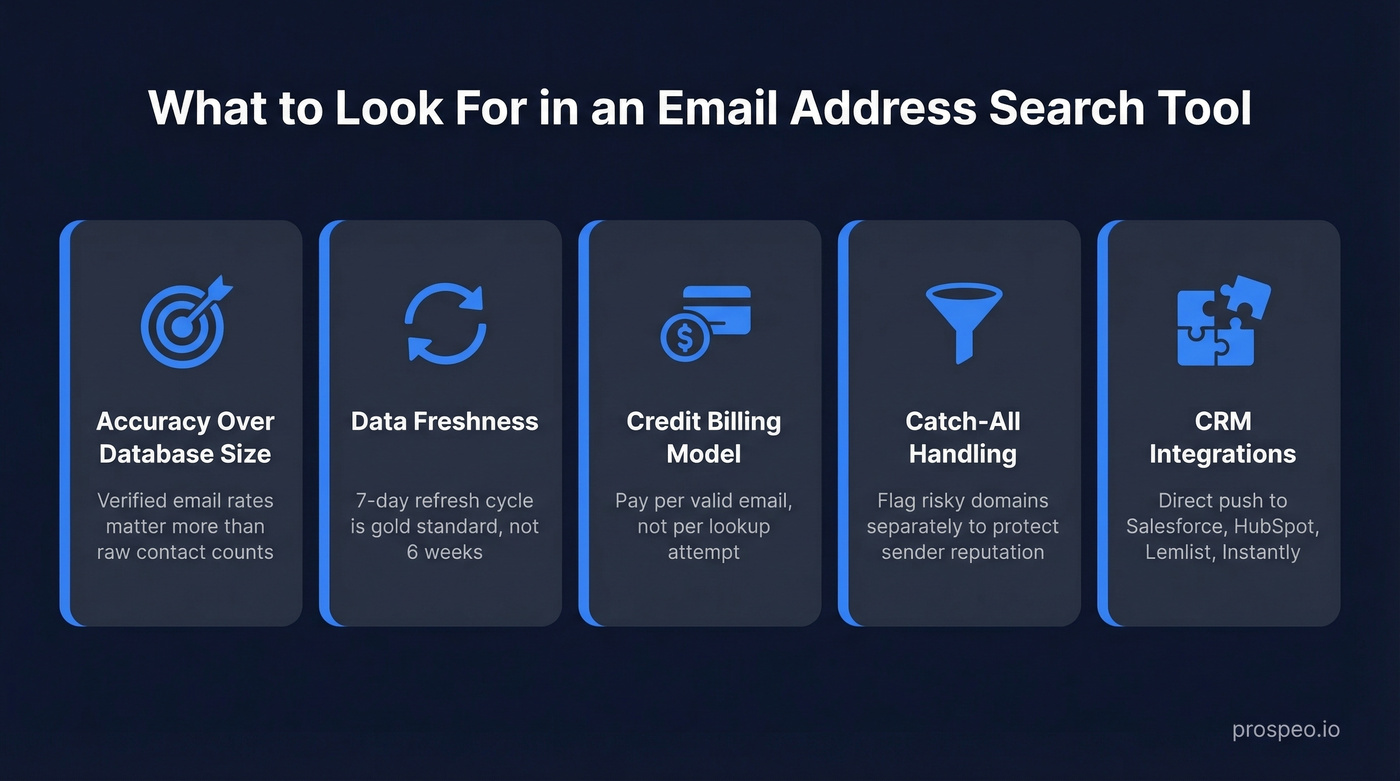
Data freshness. People change jobs constantly. If your tool refreshes data every six weeks, which is a common industry average, you're emailing ghosts. A 7-day refresh cycle is the gold standard, and it's rarer than you'd think.

Credit billing model. Some tools charge per lookup regardless of outcome. Others - like Anymail Finder - charge one credit per valid email, with risky and not-found results free. That distinction matters at scale. (Related: how lead enrichment pricing models work in practice.)
Catch-all domain handling. Catch-all domains accept any address, making verification tricky. Tools that flag catch-all results separately let you route those contacts to dedicated sending infrastructure instead of risking your primary domain.
Integrations. If the tool doesn't push directly into your CRM or sequencer - Salesforce, HubSpot, Lemlist, Instantly - you'll waste hours on CSV gymnastics. If you're standardizing your stack, start with connect outreach tool to CRM.

The benchmark data is clear: most email address search tools leave nearly half your lookups without a valid address. Prospeo's 5-step verification delivers 98% email accuracy across 300M+ profiles - refreshed every 7 days, not every 6 weeks.
Stop paying for emails that bounce. Start with 75 free verified lookups.
The 7 Best Email Address Search Tools
1. Prospeo
Prospeo's database covers 300M+ professional profiles with 143M+ verified emails, all running on a 7-day refresh cycle. The 5-step verification process handles catch-all domains, spam traps, and honeypots, which is why email accuracy sits at 98%.
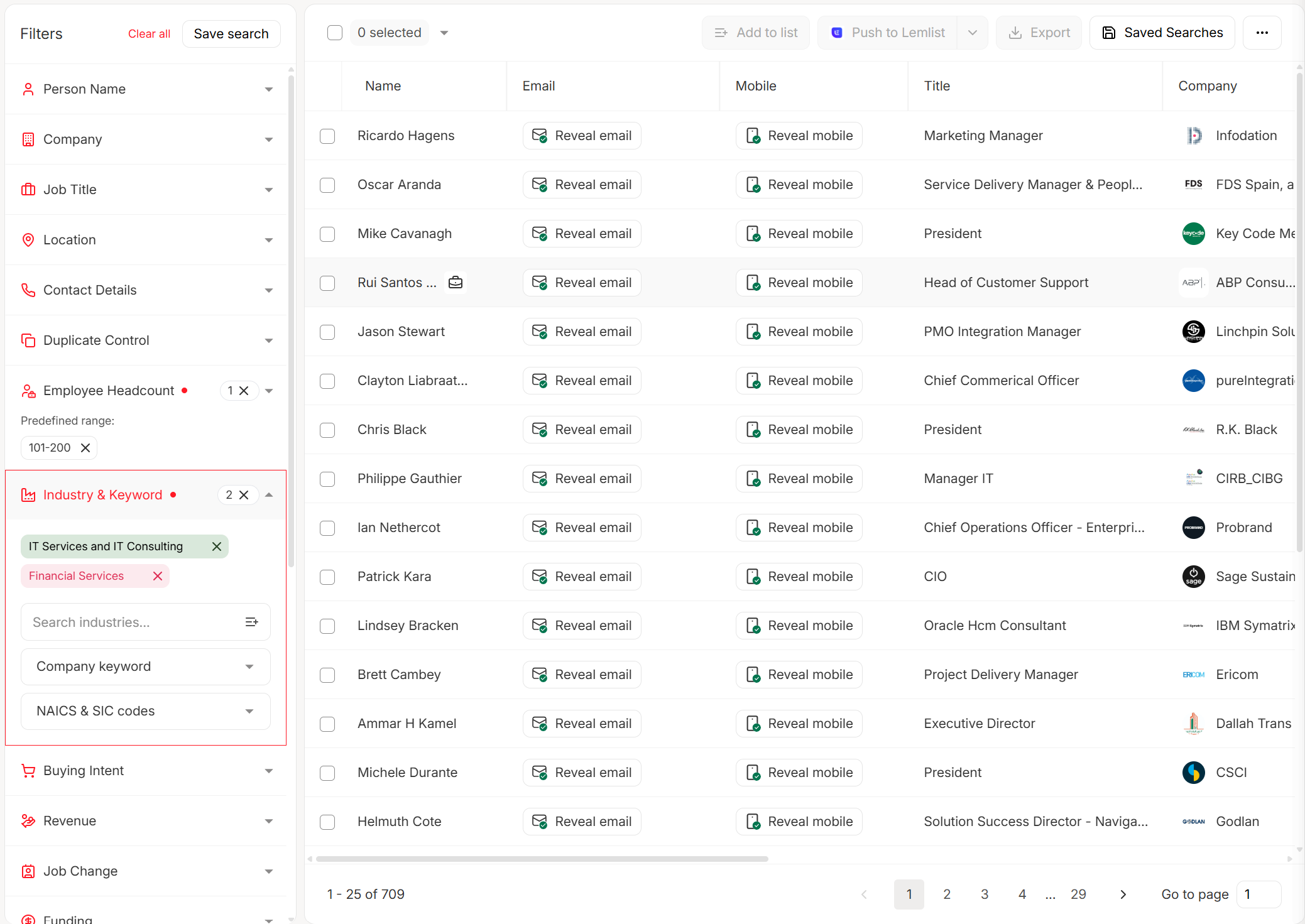
Use this if you're an outbound agency or sales team where bounce rates directly threaten domain reputation. Snyk's team dropped their bounce rate from 35-40% to under 5% after switching, and their AE-sourced pipeline jumped 180%. The Chrome extension with over 40K users makes one-off lookups fast, and 30+ search filters - including Bombora intent data across 15,000 topics - let you build targeted lists without stitching tools together. (For more outbound tactics, see sales prospecting techniques.)
We've run Prospeo against our own prospect lists for months, and the thing that stands out isn't just the accuracy numbers. It's that the data stays accurate. Weekly refreshes mean you're not re-verifying lists every few weeks just to avoid bounces. If you're troubleshooting bounces, use this email bounce rate guide.
Pricing: Free tier gives you 75 verified emails plus 100 Chrome extension credits monthly. Paid plans run about $0.01 per email. No contracts, no sales calls.
2. Hunter.io
Use this if you need a reliable free tier for verification or low-volume prospecting. Hunter's 50 free credits per month and unlimited users make it a zero-risk starting point. The consensus on r/agency is that Hunter's strength is confirming emails, not finding them. If you're evaluating similar tools, compare options in our Hunter alternatives roundup.

Skip this if you need a primary email source at scale. In a 5,000-contact benchmark, Hunter returned a 37.6% verified rate - fine for supplemental use, but you'll run dry fast on larger campaigns.
Pricing: Free at $0/50 credits. Starter at $49/mo ($34/mo annual) for 2,000 credits. Growth at $149/mo ($104/mo annual). Unlimited users on all plans.
3. Snov.io
Snov.io bundles finder, verifier, email sequences, and warm-up into a single platform - especially strong for international leads. The credit system covers both prospecting and verification, and unused credits roll over. The built-in warm-up tool often removes the need for a separate warm-up subscription, which saves $30-50/month on its own. (If warm-up is a priority, see unlimited email warmup.)
The tradeoff: accuracy. Snov.io posted a 20.1% verified rate in a 5,000-contact test. That benchmark was vendor-run by a competitor, so take it directionally - but test against your own ICP before committing.
Pricing: Starter at $29.25/mo annual for 1,000 credits. Pro at $74.25/mo annual for 5,000 credits with unlimited warm-ups. LinkedIn automation add-on runs $69/mo per slot.
4. Apollo.io
Apollo's 250M+ contact database is massive, and the free tier is genuinely useful for getting started. But data quality is the persistent weak spot. Reddit practitioners consistently flag bounces on older contacts - one agency operator described the data as feeling "bad sometimes" with noticeable bounce spikes.
Per-seat pricing of roughly $49-$99/user/month also scales poorly for teams beyond 3-4 reps. Best for high-volume prospecting where you'll run results through a separate verification layer anyway. (If you're building a full outbound stack, start with our SDR tools guide.)
5. GetProspect
A straightforward email finder without the all-in-one complexity. GetProspect posted a 61.9% verified rate in benchmark testing - a strong mid-range showing that beats several bigger names. The Chrome extension handles prospecting workflows cleanly. Good fit for mid-volume teams that want simplicity over features. If you're deciding between platforms, see GetProspect vs Apollo.io.
Pricing: $49/mo for 1,000 valid emails + 2,000 verifications after a 50-email free tier.
6. Anymail Finder
Here's the thing about Anymail Finder: the pay-only-for-valid billing model is a genuine differentiator. You don't burn credits on unverifiable addresses. Their benchmark showed a 77.5% verified rate - the highest in the 5,000-contact test, though that test was run by Anymail Finder themselves. The tradeoff is a smaller feature set with no sequences, no warm-up, and no intent data. Pure email finding, nothing else.
Pricing: Plans start at $14/mo with 100 free credits to test.
7. Voila Norbert
A simple name-to-email lookup tool with catch-all handling. Voila Norbert posted a 36.0% verified rate in benchmark testing - modest, but the tool's value is in its simplicity, not raw volume. Fifty free searches to start, then $49/mo for 1,000 leads on the Valet plan.
Side-by-Side Comparison
| Tool | Starting Price | Free Tier | Accuracy Data | Best For |
|---|---|---|---|---|
| Prospeo | ~$0.01/email | 75 emails + 100 credits/mo | 98% verified | Accuracy & freshness |
| Hunter.io | $34/mo (annual) | 50 credits/mo | 37.6% verified rate | Free tier / verification |
| Snov.io | $29.25/mo (annual) | Trial credits | 20.1% verified rate | All-in-one + intl. |
| Apollo.io | ~$49/user/mo | Yes | Mixed (bounce reports) | High-volume prospecting |
| GetProspect | $49/mo | 50 emails/mo | 61.9% verified rate | Mid-volume simplicity |
| Anymail Finder | $14/mo | 100 credits | 77.5% verified rate | Pay-for-valid model |
| Voila Norbert | $49/mo | 50 searches | 36.0% verified rate | Simple lookups |
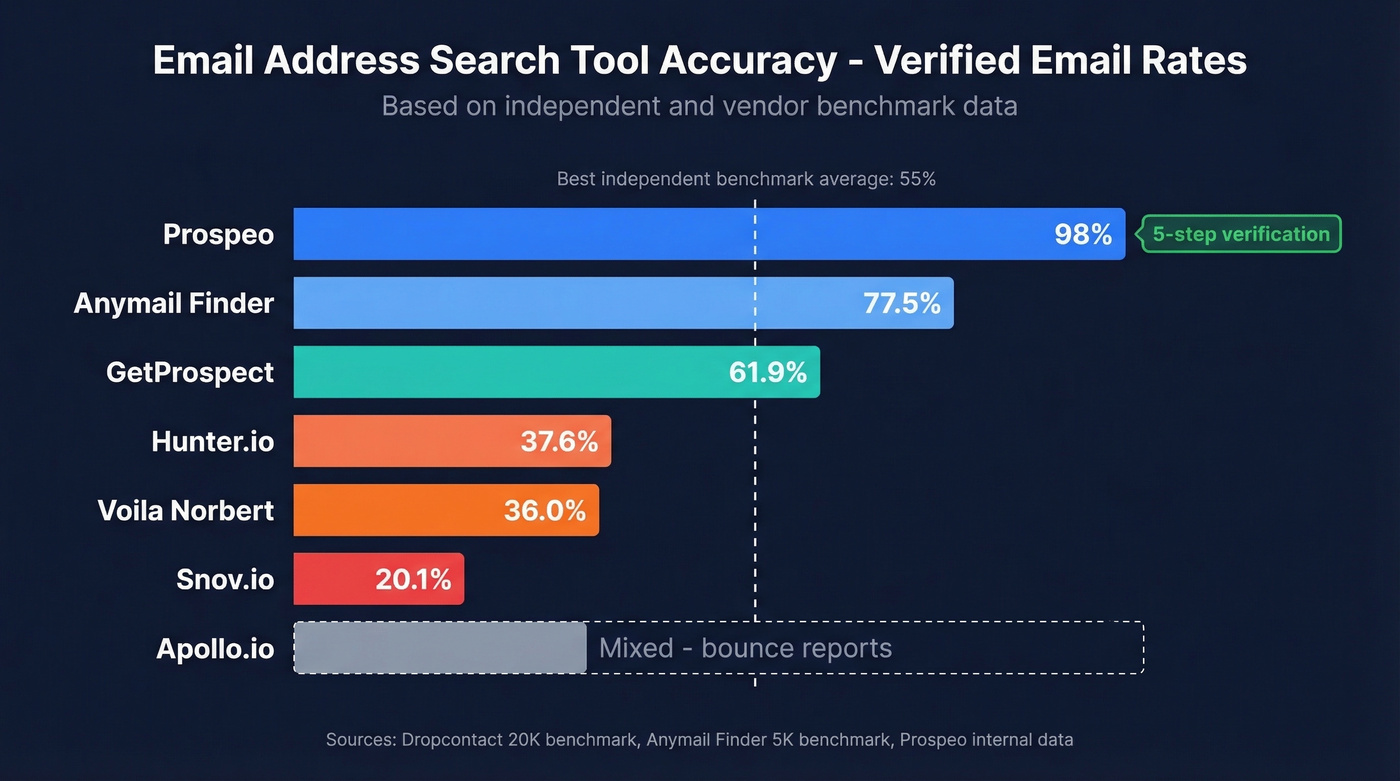
Other tools worth a look: Skrapp.io scored a 42.8% verified rate in benchmark testing, and Findymail hit 75.1% in the 5,000-contact test. Neither made our top seven, but both are solid for specific use cases.
Let's be honest: if your deal sizes sit below $10K, you probably don't need a $99/seat platform like Apollo or ZoomInfo. A focused email address search tool with strong verification will outperform an all-in-one suite you only use at 20% capacity. (If you're building lists from scratch, see how to generate an email list.)
Snyk dropped their bounce rate from 35-40% to under 5% after switching their email search tool to Prospeo. At $0.01 per verified email with catch-all handling, spam-trap removal, and honeypot filtering built in, you don't need a separate verification layer.
Find verified emails at 98% accuracy - no contracts, no sales calls required.
Protect Your Sending Domain
With average cold email reply rates at 3.43%, every bounced email is a wasted opportunity - and 42% of replies come from follow-ups, which you can't send if your domain is flagged. For the full playbook, use our email deliverability guide.
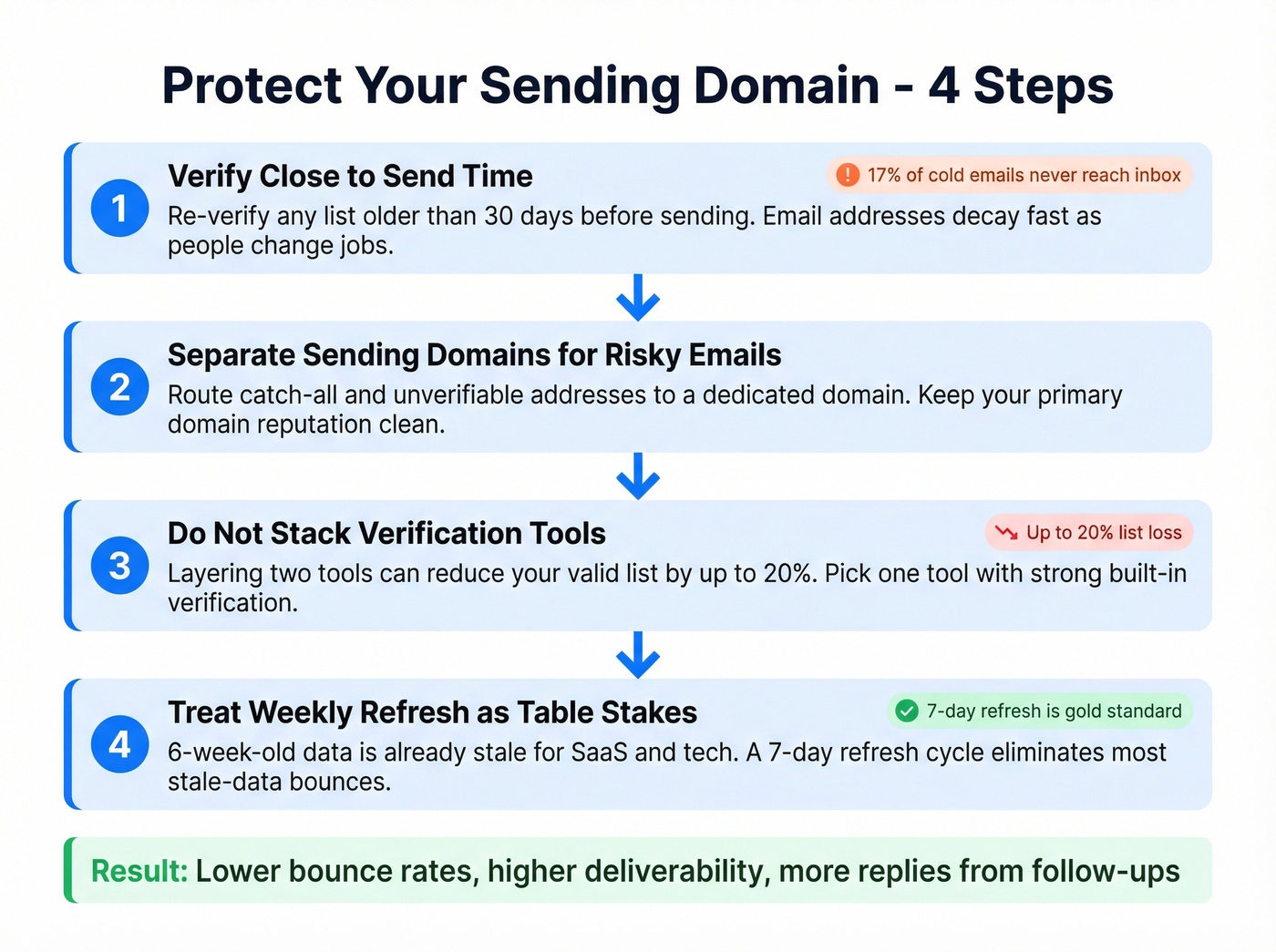
Verify close to send time. Email addresses decay fast. People change jobs, companies restructure. We've seen teams cut bounce rates in half just by re-verifying any list older than 30 days before hitting send. Tools with weekly refresh cycles handle this automatically, but if yours doesn't, build re-verification into your workflow.
Use separate sending domains for risky emails. Catch-all and unverifiable addresses shouldn't touch your primary domain. Set up a dedicated sending domain for anything flagged as risky, and keep your main domain's reputation clean. (More on this in improve sender reputation.)
Don't stack verification tools. Running email finder results through a second verification tool can reduce your valid list by up to 20%, mostly because different tools handle catch-all domains differently. Pick one tool with strong built-in verification rather than layering two mediocre ones.
Treat weekly refresh as table stakes. Data that's six weeks old is already stale for fast-moving industries like SaaS and tech. A 7-day refresh cycle eliminates most stale-data bounces before they happen.
FAQ
How accurate are email finder tools really?
Independent benchmarks show the best tools find valid emails for about 55% of contacts - far below the 95%+ most vendors advertise. In the 20,000-contact benchmark, hard bounces ranged from 0.9% to 3.6% depending on the tool. Always test against your own prospect list before scaling.
Can you find someone's email with just a name and company?
Yes. Most tools on this list accept a first name, last name, and company domain as inputs. The best performers verify around 55-77% of those lookups, while weaker tools dip below 25%. Always run results through built-in verification before sending.
Should I use more than one email finder?
Usually no. Pick one tool with high accuracy and strong built-in verification. Stacking multiple finders adds cost and complexity, and different catch-all handling between tools can actually shrink your usable list by up to 20%.
What's the best free email address search tool?
Prospeo's free tier offers 75 verified emails plus 100 Chrome extension credits monthly with a 7-day data refresh - the most generous option for teams running real outbound. Hunter.io gives 50 free credits per month with solid verification. Both let you test results against your own prospect list before committing to a paid plan.