

10 Email Automation Best Practices That Actually Move Revenue
Automated emails account for roughly 5.3% of total sends but drive ~41% of email revenue. VerifiedEmail's 2026 benchmark synthesis puts automated messages at a 48.57% open rate versus 25.2% for manual sends. That's not a rounding error - it's the entire business case for email automation in one stat.
Every ESP publishes "best practices" that end with "and our tool does all of this." We'll skip that part.
What You Need (Quick Version)
- Build three automations first: welcome series, post-purchase, abandoned cart
- Verify your contact data before it enters any workflow
- Cap total emails at 4-5 per week per contact across all flows
- Authenticate your domain (SPF, DKIM, DMARC) - no longer optional
- Audit every flow quarterly - "set and forget" is the most expensive mistake in email
10 Automated Email Tips for Revenue Growth
Start With a Goal, Not a Tool
Define the outcome before you touch your ESP. Driving first-purchase revenue? Reducing churn? Activating trial users? The sequence should be: goal, then segment, then timing, then follow-ups, then measurement. Teams that skip this end up with generic, disjointed automations that feel like they were built by committee - because they were.
Segment Before You Automate
Segment by behavior, funnel stage, and engagement - not just demographics. For B2B, that means role, company size, industry, and prior interactions. A recurring complaint we hear from practitioners? Blasting the entire list regardless of behavior. If your "segmented" automation sends the same email to a first-time visitor and a repeat buyer, it isn't segmented.
Build Three Flows First
Stop building more flows. Fix the three that matter.
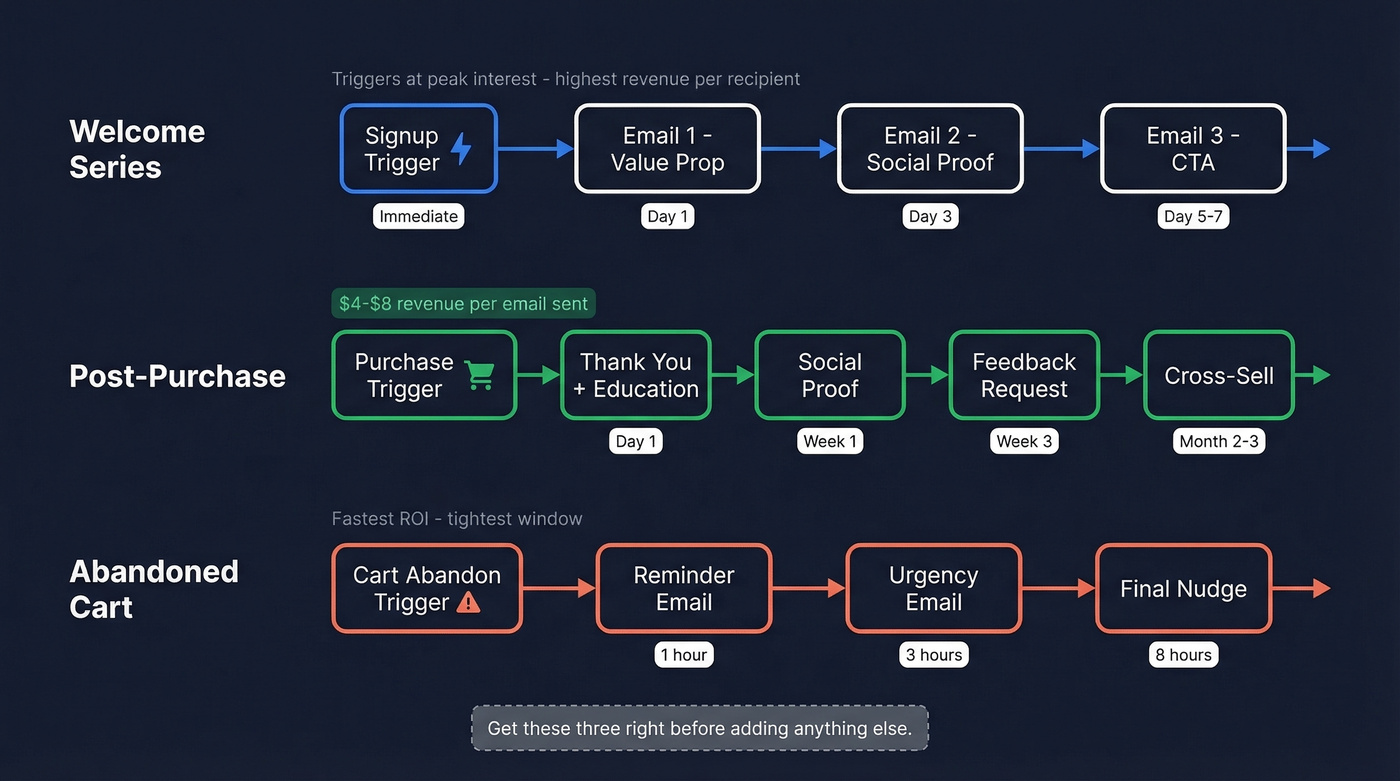
A welcome series triggers on signup with email #1 sent immediately and follow-ups 1-2 days apart. For SaaS, a Day 1/3/5/7 onboarding cadence keeps activation tight. Post-purchase runs about 12 emails over three months, cycling education, social proof, feedback, and cross-sell - practitioners see $4-$8 per email sent on sequences like these. Abandoned cart fires at 1 hour, 3 hours, then 8 hours. Get these three right before adding anything else.
Personalize on Behavior, Not Merge Tags
Dynamic content based on what recipients actually did beats "{FirstName}" filler every time. AI product recommendations lift click rates to 3.75% on average and 8.79% for top performers. The mistake to avoid: the "creepy" abandoned cart email that says "we noticed you were looking at..." Reference the product, not the surveillance.
If you're building longer sequences, use a consistent email cadence so contacts don't get hammered across flows.
Cap Your Frequency
Here's the thing: teams send more because automation makes it easy, not because recipients want it. No more than 4-5 emails per week per contact across all flows combined. In our experience, frequency creep kills more automations than bad copy does. Keep spam complaints under 0.3% and your entire domain reputation stays safer.
If you're unsure what your ceiling should be, align it with sequence email send limits by tool and mailbox type.
Verify Your Contact Data
Automation is only as good as the data feeding it. Bad emails mean bounces, and bounces compound into a deliverability death spiral fast - we've watched teams lose months of sender reputation in a single campaign. Run your list through a verification tool before importing contacts into any workflow. Prospeo checks emails with 98% accuracy on a 7-day refresh cycle, catching dead addresses before they tank your sender score.
If you're doing this for outbound too, follow a dedicated cold email verification process (it’s stricter than newsletter hygiene).

Authenticate Your Domain
SPF, DKIM, and DMARC are enforced by Google and Yahoo, and Microsoft has similar bulk-sender requirements. Litmus found 70% of emails show at least one spam-related issue - authentication closes the most common gaps. VerifiedEmail's data shows 16.9% of emails never reach the inbox and 10.5% land in spam. Add RFC 8058 one-click unsubscribe headers, keep bounces under 2%, and if you haven't done this yet, stop reading and go do it now.
If you want the next step after DMARC, BIMI & DMARC can help reinforce brand trust in the inbox.
New domains should warm up gradually. Start at 5-10 sends per day and ramp over 4-6 weeks.
Test One Variable at a Time
A/B test subject lines, send times, or CTAs - never all three simultaneously. 64% of marketers now use AI in email, and 41% specifically for subject line optimization. Let the AI test one variable per experiment or you'll never know what moved the needle. We ran a subject line test last quarter where a two-word change lifted opens by 11% - but we only caught it because nothing else changed between variants.
If you need a tighter testing framework, follow email A/B testing best practices to avoid false wins.
Design Mobile-First
Over 80% of emails won't get opened if they don't display correctly on mobile. Tiny text, broken layouts, and hard-to-tap CTAs remain a top complaint heading into 2026. Use semantic HTML, sufficient contrast, and tap targets of at least 44x44px. Test every automated email on a real phone before activating the flow.
Audit Flows Quarterly
Audiences change. Products change. Benchmarks shift.
We've seen teams running welcome sequences with two-year-old discount codes and dead product links. Schedule quarterly reviews: check open and click rates against current benchmarks, prune underperformers, update copy and offers. A flow that performed well 12 months ago might be actively hurting you today.
To make audits faster, keep a simple email workflow map so you can spot overlap and dead ends quickly.

You just read it: bad emails trigger a deliverability death spiral that wrecks months of sender reputation. Prospeo's 5-step verification catches dead addresses with 98% accuracy on a 7-day refresh cycle - so every contact entering your automation is real, current, and safe to send.
Stop feeding bad data into good automations. Verify first.
2026 Benchmarks - Know Your Numbers
| Metric | Automated | Campaigns / Manual | Source |
|---|---|---|---|
| Open rate | 48.57% | 25.2% | VerifiedEmail 2026 |
| Click rate | 5.58% | 1.69% | Klaviyo 2026 |
| Conversion rate | 12% | 3% | VerifiedEmail 2026 |
| Revenue share | ~41% | ~59% | Klaviyo 2026 |
| Send volume share | ~5.3% | ~94.7% | Klaviyo 2026 |
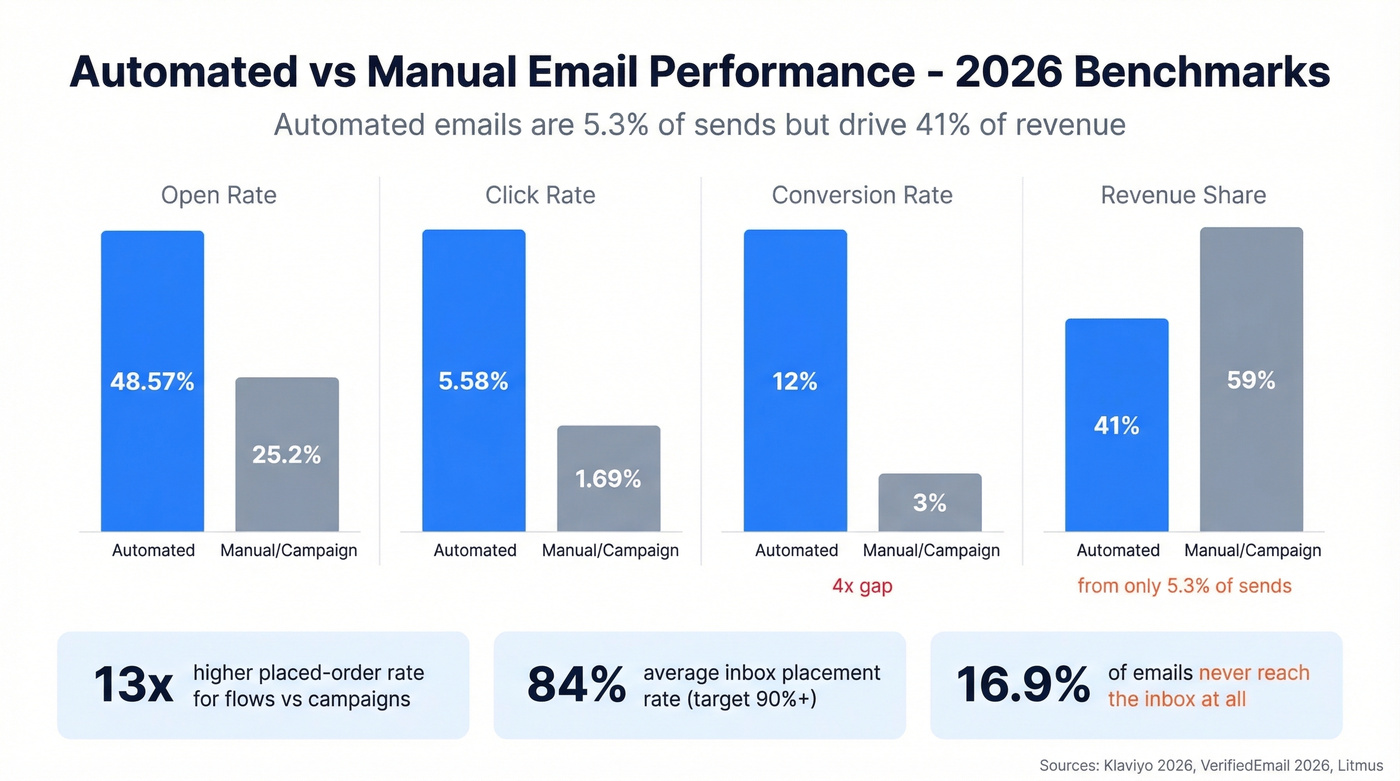
Automated messages convert at 4x the rate of manual campaigns. Klaviyo's dataset of 183,000+ customers shows flows generate 13x higher placed-order rates than campaigns. That gap is widening, not shrinking.
If you want to benchmark beyond opens, track email click rate and conversion rate together (CTR without revenue is a vanity metric).
For industry context, ActiveCampaign's 2026 send data shows overall averages of 39.26% open and 6.21% click. Software sits at 36.20% open, ecommerce at 35.66%, healthcare at 41.48%, and non-profits at 42.68%. If your flows are significantly below these numbers, something's broken. Litmus recommends investigating immediately if inbox placement drops below 90% - the current average is just 84%.
Hot take: If your deal sizes are modest - say under $15k - you don't need a 15-email nurture sequence. Three tight flows will outperform ten mediocre ones every single time.
If you do need a nurture build, start with proven drip campaign templates and adapt them to behavior.
Automation Mistakes That Kill ROI
Automating without strategy. "Personalized" recommendations that don't match actual behavior are worse than no personalization at all. One team I spoke with at a conference last year had built 23 flows and couldn't tell me what a single one was supposed to accomplish.
If you're building for pipeline, not ecommerce, use a B2B email funnel so each flow has a job.
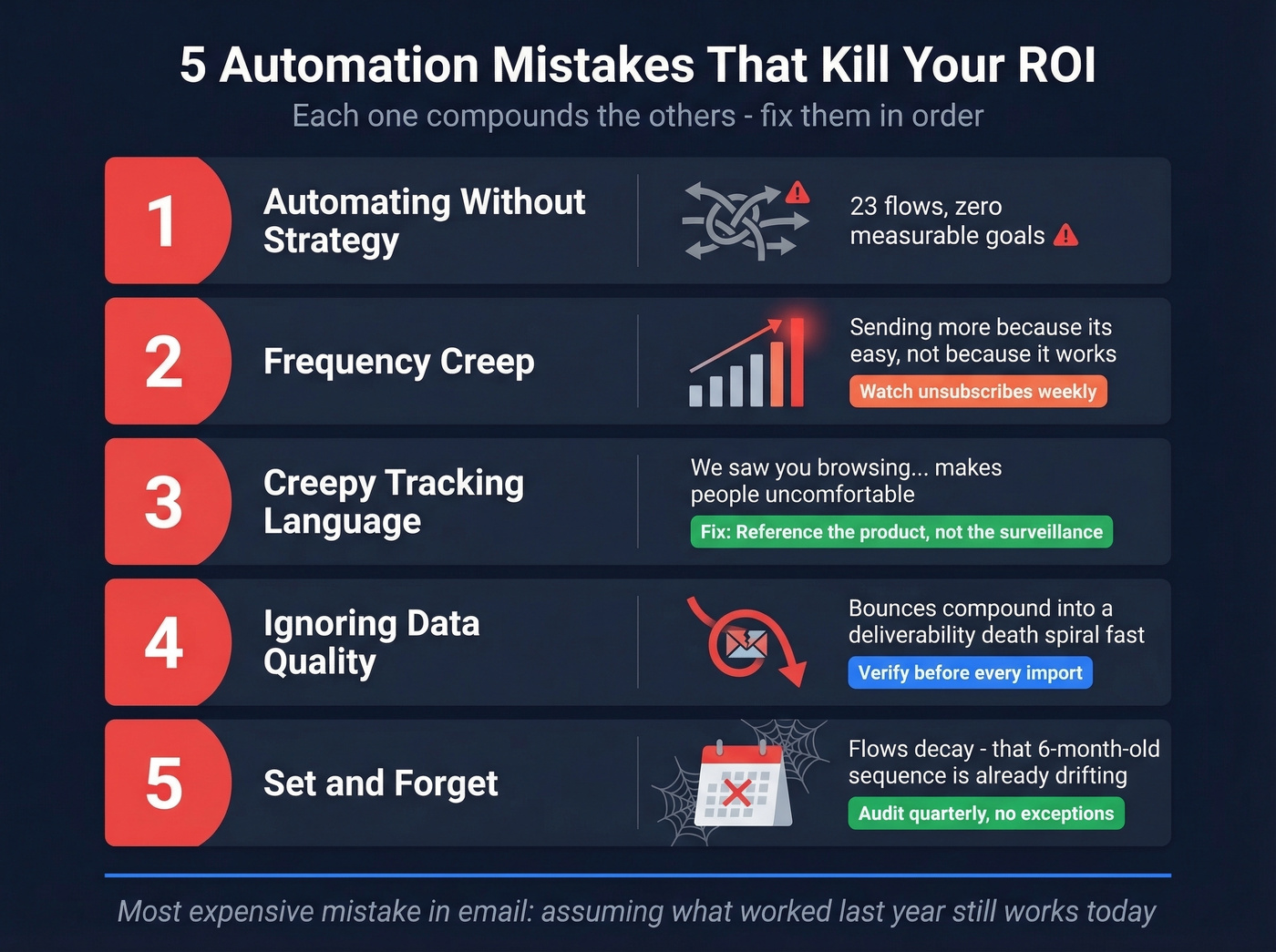
Frequency creep. Sending more because it's easy, not because it's working. Watch your unsubscribe rate weekly.
Creepy tracking language. "We saw you browsing..." makes people uncomfortable. Reference the product, not the surveillance.
Ignoring data quality. Bounces compound fast. If you're feeding unverified contacts into automations, you're building on sand. Run verification before any import - tools like Prospeo flag invalid emails in real time so bad data never enters your CRM.
Set-and-forget. Flows decay. The automation you built six months ago is already drifting. Skip this section if you're already doing quarterly audits - but let's be honest, most teams aren't.
Compliance You Can't Skip
CAN-SPAM applies to B2B - penalties run up to $53,088 per email. Honor opt-outs within 10 business days and keep the opt-out mechanism working for 30 days after send. Include a valid physical postal address in every email.
If you need the fine math and updated thresholds, see CAN-SPAM penalties per email.
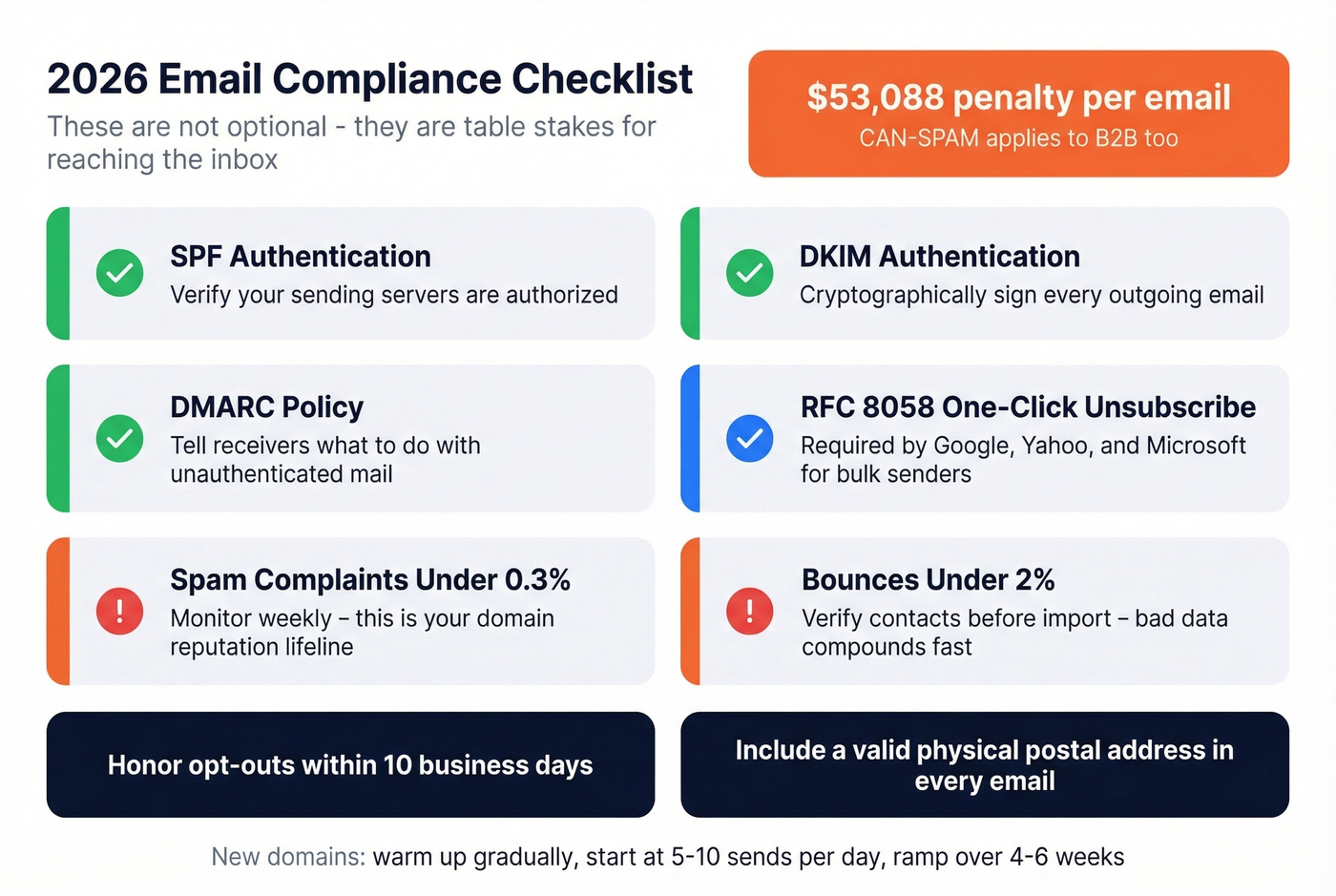
Google and Yahoo enforce RFC 8058 one-click unsubscribe headers for bulk senders, and Microsoft has similar requirements. Keep spam complaints under 0.3% and bounces under 2%. This isn't optional anymore - it's table stakes for reaching the inbox in 2026.
Segmenting by role, company size, and behavior means nothing if half your list bounces. Prospeo gives you 300M+ verified profiles with 30+ filters - buyer intent, technographics, job changes, funding - so your automated flows reach real decision-makers, not dead inboxes. All at roughly $0.01 per email.
Build segments that actually convert - starting with data you can trust.
FAQ
What are the top email automation best practices for beginners?
Build a welcome series first - it triggers at peak interest and consistently generates the highest revenue per recipient. Get that working, then add post-purchase and abandoned cart. Most teams try to build everything at once and end up with three mediocre flows instead of one great one.
How often should I audit automated email flows?
Quarterly at minimum. Check open and click rates against current benchmarks - 39.26% open and 6.21% click per ActiveCampaign's 2026 data - prune underperformers, and update offers. Email lists degrade 25-30% per year, so contact verification should be part of every audit.
How do I prevent automated emails from landing in spam?
Authenticate your domain with SPF, DKIM, and DMARC - non-negotiable in 2026. Keep spam complaints under 0.3%, bounces under 2%, and verify contact data before it enters any workflow. A free verification tier is enough to test the process before scaling.