

How to Build Email Automation Drip Campaigns That Actually Convert
Triggered messages generate 37% of email-driven sales from just 2% of total send volume. That's not a rounding error - it's the entire case for running an email automation drip campaign. The gap between teams running automated sequences and teams blasting one-off campaigns isn't closing. It's widening.
Here's what you need:
- A clean, verified contact list - bad data kills drip campaigns before they start
- 3-5 emails per sequence with specific timing per campaign type (templates below)
- A drip email tool that supports behavioral triggers and branching logic - our picks: ActiveCampaign for B2B, Klaviyo for ecommerce, Brevo for budget
What Is a Drip Campaign?
A drip campaign sends a pre-written sequence of emails on a fixed schedule - Day 1, Day 3, Day 7. An automation workflow triggers emails based on what someone does: visits a pricing page, abandons a cart, downloads a PDF. Most modern campaigns blend both, but the distinction matters when you're choosing tools and mapping sequences.
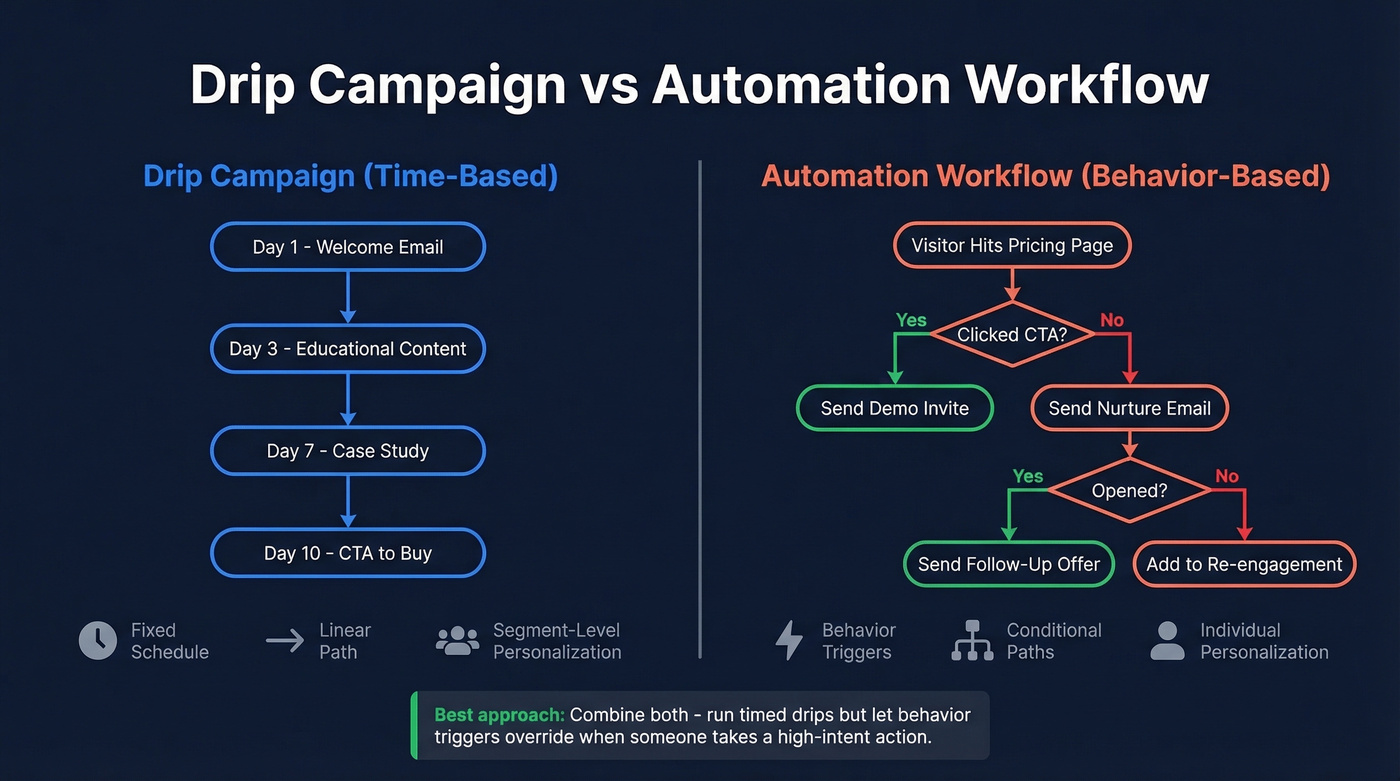
Here's the terminology that trips people up. Most ESPs use "campaigns" to mean manual, one-off sends and "workflows" or "flows" to mean automated sequences. When someone says "drip campaign" today, they usually mean any automated email sequence, whether it's time-based, behavior-based, or both.
| Dimension | Drip Campaign | Automation |
|---|---|---|
| Trigger | Time-based (Day 1, 3, 7) | Behavior-based (page visit, cart abandon) |
| Path | Linear, fixed sequence | Conditional, branching |
| Personalization | Typically segment-level | Typically individual-level |
| Best for | Onboarding, nurture | Cart recovery, re-engagement |
The best campaigns combine both approaches. Run a timed drip, but let behavior triggers override the sequence when someone takes a high-intent action.
Why Drip Campaigns Outperform Batch Emails
The numbers aren't subtle. Automated flows average a 48.57% open rate while one-off campaigns sit closer to the ~23.44% industry average. Click rates follow the same pattern, and the ROI on email marketing overall runs 36:1 to 40:1 - up to 68:1 in the U.S. market.
Drip campaigns win because they hit people at the right moment with the right message. A welcome email sent immediately after signup catches someone while they're still engaged. A cart abandonment email at the 1-hour mark catches someone before they've forgotten what they wanted. Timing is the whole game.
Let's be honest about open rates, though. They're a vanity metric now. Apple's Mail Privacy Protection inflates them by 15-20 points. Judge your drips on clicks and conversions. If you're reporting open rates to leadership without that asterisk, you're painting a misleading picture.
Types of Automated Drip Sequences
Not every drip sequence follows the same cadence.
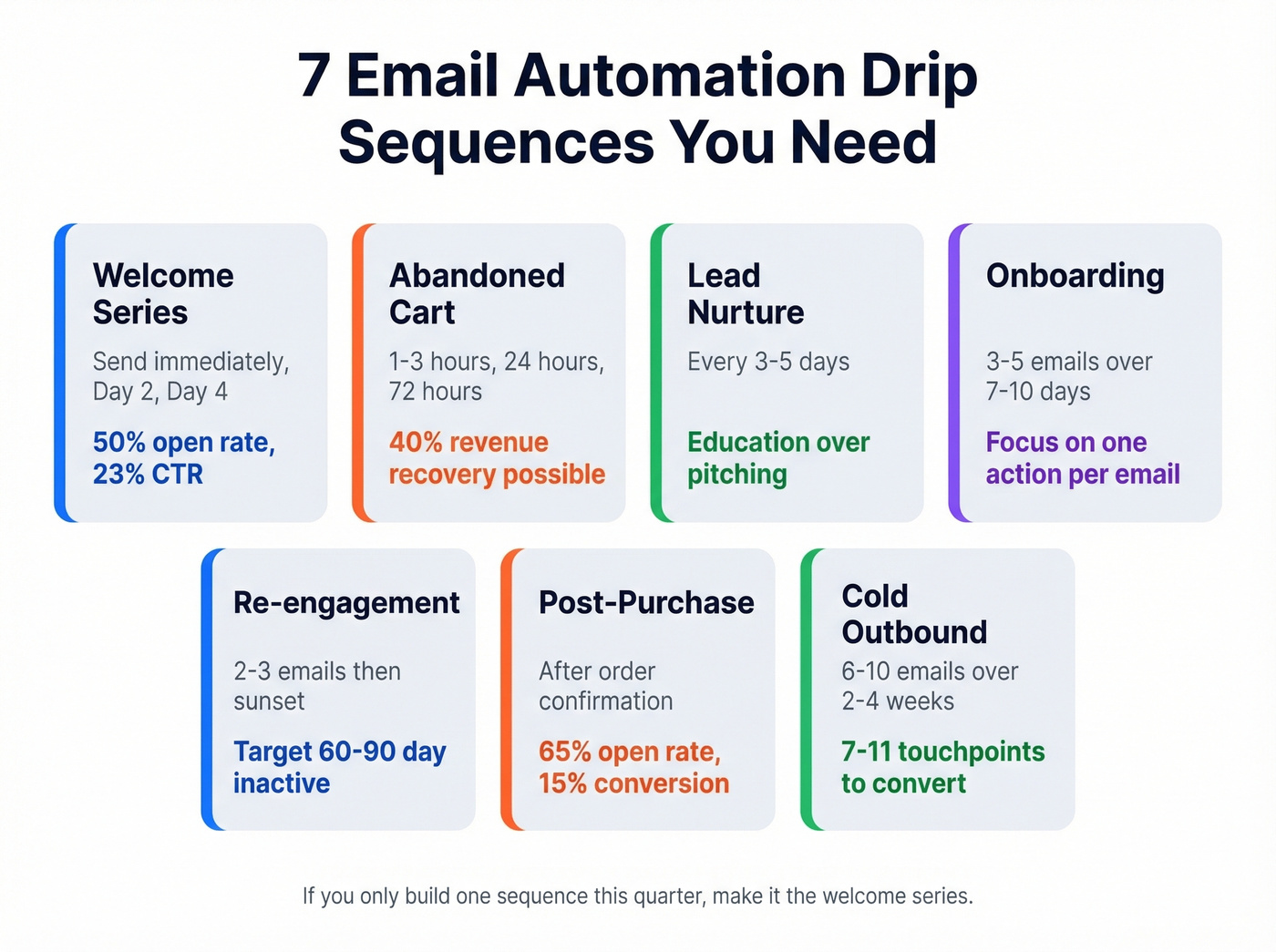
Welcome series - The highest-performing automated flow, period. Send immediately after signup, then at Day 2 and Day 4. Welcome emails hit 50% open rates and 23.33% CTR. If you only build one automated sequence this quarter, make it this one.
Abandoned cart - Time-sensitive by nature. First email within 1-3 hours, second at 24 hours, third at 72 hours. The first email should skip the discount - test whether a simple reminder converts before you start giving margin away.
Lead nurture - For prospects who aren't ready to buy. Space emails 3-5 days apart, focusing on education and social proof rather than product pitches. We've seen nurture sequences that run too aggressively push prospects to unsubscribe before they ever reach a buying decision.
Onboarding - Guide new users to their first "aha moment." Three to five emails over 7-10 days, each focused on one specific action. Don't try to explain your entire product in Email 1.
Re-engagement/win-back - Target contacts who haven't opened or clicked in 60-90 days. Two to three emails, then sunset them. Keeping dead contacts on your list hurts deliverability.
Post-purchase - The most underused flow. Post-purchase emails hit 65% open rates and 15% conversion rates. Use them for cross-sells, reviews, and referral asks.
Pre-event sequence - Send a countdown series before webinars, conferences, or product launches. Three emails - a confirmation, a reminder at 24 hours, and a "starting soon" nudge - dramatically reduce no-show rates.
Cold outbound follows different rules entirely. Plan on 6-10 emails over about 2-4 weeks, plain text, one CTA per email. We'll cover the specifics in the templates section.
Drip Campaign Templates You Can Steal
One principle applies to every template below: design each email to work as a standalone. Some contacts will open Email 3 first. Include enough context that they don't need to have read Emails 1 and 2.
Welcome Series (3 Emails, 5 Days)
Email 1 - Immediately after signup. Deliver whatever you promised - the PDF, the checklist, the free trial access. Subject line: "Welcome! Here's Your [Asset Name]." Keep it short. One CTA: access the resource.
Email 2 - Day 2. Educational content that builds on the asset. "Did you know these 3 common [topic] mistakes?" Include a stat or quick tip that demonstrates expertise, plus a testimonial or client logo for social proof.
Email 3 - Day 4. Case study with a clear outcome. "[Client Name] grew their traffic 3x in 90 days - here's how." CTA: book a call, start a trial, or make a purchase. This is where you make the ask.
Abandoned Cart (3 Emails, 72 Hours)
Email 1 - Within 1-3 hours. Simple reminder with the product image and a link back to cart. No discount. Subject line: "You left something behind."
Email 2 - 24 hours. Add urgency and social proof. "1,200 people bought this last month" or "Only 3 left in stock." Still no discount if you can avoid it.
Email 3 - 72 hours. If the first two didn't convert, now's the time for an incentive - 10% off, free shipping, whatever your margins allow. Slazenger recovered 40% of abandoned revenue in a single campaign, generating 49X ROI with this approach.
Pre-Meeting Sequence (3 Emails, 3 Days)
Day -3: Confirmation email with the meeting agenda, attendee names, and a link to reschedule if needed. Attach any relevant one-pagers or case studies.
Day -1: Brief reminder with a single question to prime the conversation - "What's the biggest challenge you're facing with [topic] right now?" This gets prospects thinking before the call.
Day 0 (morning of): A short nudge with the meeting link and a note that you're looking forward to connecting. Keep it under three sentences.
Cold Outbound Nurture (4 Emails, 14 Days)
Day 1: Personalized intro. Reference something specific - a recent hire, a funding round, a tech stack signal. Ask one question. No pitch.
Day 3: Value-add. Share an insight, a relevant benchmark, or a resource. Position yourself as useful, not salesy.
Day 7: Brief follow-up from a different angle. If Email 1 led with a pain point, this one leads with a result. "Teams using [approach] are seeing [outcome]."
Day 14: Breakup email. "Looks like the timing isn't right - no hard feelings. Reply if anything changes." Breakup emails often get the strongest reply rates in cold sequences.
The heuristic most outbound teams use: it takes 7-11 touchpoints across channels to convert a cold prospect. Four emails won't close the deal alone, but they start the relationship.
How to Build a Drip Campaign
1. Clean your data. Verify your contact list before building anything. Invalid emails lead to bounces, bounces wreck your sender reputation, and a damaged sender reputation means fewer of your emails reach the inbox. Prospeo's 5-step verification catches invalid addresses, spam traps, and catch-all domains before they do damage. If you need a broader view of tools, start with email verification options.
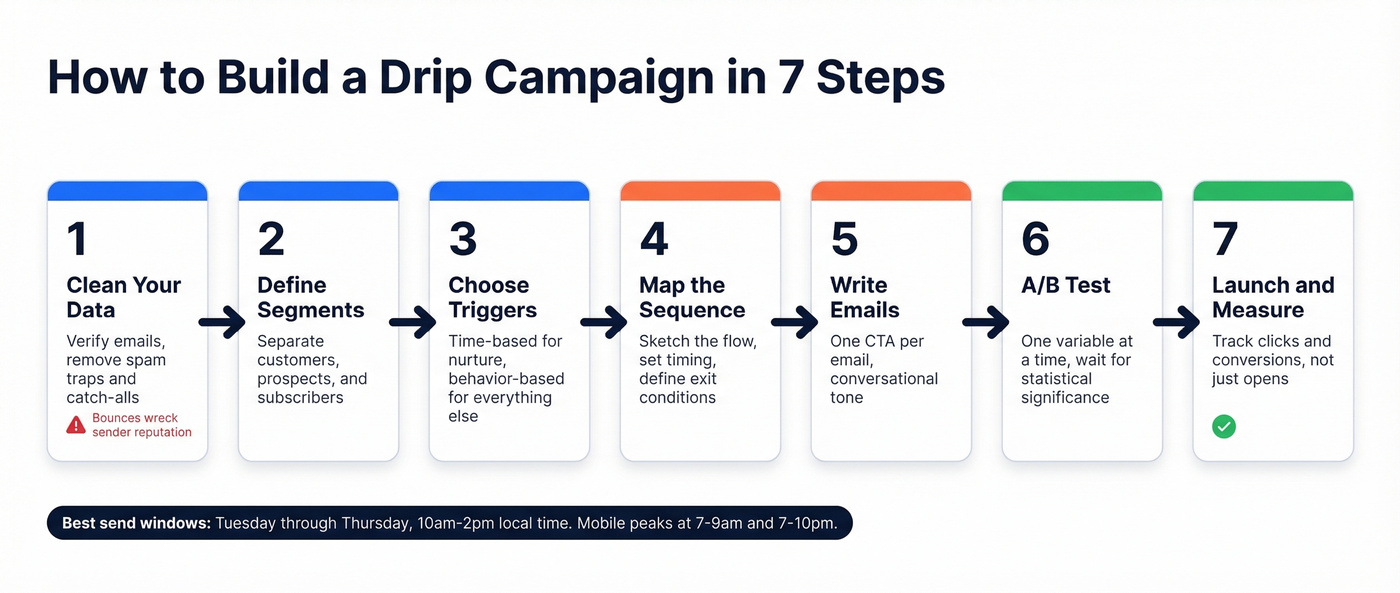
2. Define your audience segment. Don't lump customers, prospects, and blog subscribers into the same sequence. Build segments: engaged contacts, unengaged (sunset these), opened-but-didn't-click, and new subscribers. Industry-specific sequences perform even better - a drip sequence for financial advisors will look nothing like one built for SaaS onboarding. If you're formalizing this, use an ideal customer profile to keep segments clean.
3. Choose your trigger. Time-based triggers work for welcome series and nurture sequences. Behavior-based triggers - pricing page visits, cart abandons, content downloads - work for everything else.
4. Map the sequence. Sketch the flow before you write a word. How many emails? What timing between each? What are the exit conditions? Someone who converts on Email 2 shouldn't receive Email 3's discount offer. This is basic sequence management.
5. Write the emails. One CTA per email. Conversational tone. Use personalization tokens, but don't overdo it - "[First Name], I noticed your company [Company Name] recently..." reads like a mail merge, not a human. For more examples, pull from these email subject line examples.
6. Set up A/B testing. Test one variable at a time: subject line, send time, CTA placement. Running multivariate tests without statistical significance is just guessing with extra steps.
7. Launch and measure. Clicks are the gold standard. Open rates are directional only. Track post-click behavior - purchases, demo bookings, downloads - to prove actual ROI. If you want to standardize reporting, use a consistent click rate formula. Best-performing send windows cluster around Tuesday through Thursday, 10am-2pm local time, while mobile opens peak at 7-9am and 7-10pm. Schedule your drip triggers accordingly.

Your drip campaign is only as good as the list behind it. Bad emails mean bounces, domain damage, and wasted sequences. Prospeo delivers 98% email accuracy with a 7-day refresh cycle - so every drip hits a real inbox.
Stop dripping into the void. Start with verified contacts.
2026 Drip Email Marketing Benchmarks
| Campaign Type | Open Rate | Click Rate | Conversion Rate |
|---|---|---|---|
| Welcome series | 50% | 23.33% | 10.7% |
| Abandoned cart | 39.07% | 23.33% | 10.7% |
| Post-purchase | 65% | 12% | 15% |
| All automated flows (avg) | 48.57% | 4.67% | 1.42% |
| All automated flows (top 10%) | 65.74% | 12.22% | 4.93% |
| One-off campaigns (industry avg) | 23.44% | 2.62% | - |
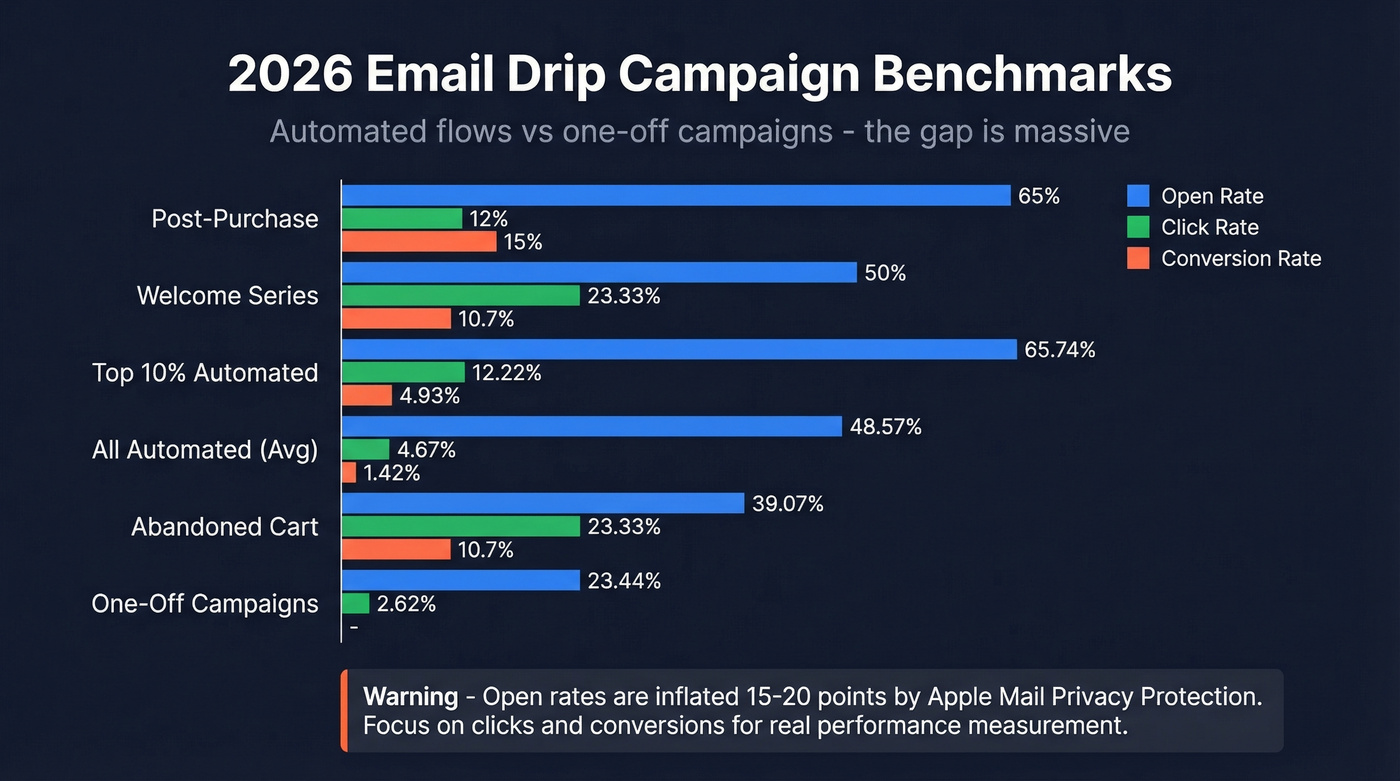
These benchmarks combine Klaviyo's flow data (which skews ecommerce) with broader automation-type benchmarks. B2B drip campaigns typically see lower open rates but higher per-conversion value.
The top 10% numbers are what ambitious teams should target. If your automated flows are hitting average benchmarks, you're leaving money on the table. And remember - a 48% open rate might really be 30% in terms of actual human opens thanks to Apple MPP. Focus on clicks and conversions.
Look, if your deals average under $15k, you probably don't need a $2,000/month marketing automation platform. A $20/month tool with clean data will outperform an enterprise suite fed with garbage contacts. The bottleneck is almost never the software - it's the list.
Deliverability - The Part Everyone Skips
Most marketers confuse delivery with deliverability. Delivery means the receiving server accepted your email. Deliverability means it actually reached the inbox instead of spam or promotions. Big difference.
The numbers are sobering: 70% of emails show at least one spam-related issue, and marketers who describe their programs as successful are 22% more likely to actively monitor deliverability. That's not a coincidence.
Set up SPF, DKIM, and DMARC on every sending domain. No exceptions. If you haven't done this, stop reading and do it now. If you need a deeper walkthrough, use this email deliverability guide.
List hygiene is the other half of the equation. One customer, Meritt, dropped their bounce rate from 35% to under 4% after cleaning their data with Prospeo - their pipeline tripled from $100K to $300K per week in the same period. That's the kind of impact clean data has on deliverability. Track and fix issues like email bounce rate before they compound.
For cold outreach specifically, the rules are tighter. The consensus on r/coldemail is consistent: cap sends at 20 emails per inbox per day, use a maximum of 3 inboxes per domain, turn off open tracking (the tracking pixels get flagged by spam filters), avoid images in the email body, and space your sends to mimic human patterns. If you're building a full system, follow a proven B2B cold email sequence.
If your inbox placement drops below 90%, investigate immediately. Don't wait for bounce rates to spike. By then, the damage to your sender reputation is already done. Here’s how to improve sender reputation before it becomes a fire drill.
Running Drip Sequences from Your Inbox
Not every team needs a full-featured ESP. If you're running small-volume outbound or personal nurture sequences, you can run drip campaigns from inbox tools like Gmail or Outlook directly.
For Gmail-based sequences, tools like Streak, GMass, or Woodpecker connect to your Google Workspace account and let you build simple flows without leaving your inbox. The advantage is better deliverability - emails sent from your actual inbox domain carry more trust than those routed through a third-party ESP.
Outlook and Office 365 follow a similar pattern. Plugins like Reply.io or Mailshake integrate with your Microsoft account, letting you schedule sends natively. The send limits are lower than dedicated platforms, but for teams sending under 100 emails per day, it's often the smarter approach.
The tradeoff: inbox-based tools lack the branching logic and advanced segmentation of standalone platforms. They're best for cold outbound and simple nurture flows, not complex ecommerce automations. If you need conditional branching based on five different user behaviors, you'll outgrow these tools fast.
Common Drip Campaign Mistakes
1. Sending to unverified lists. Dirty data damages your domain reputation, which affects every email you send going forward. We've watched teams spend weeks crafting the perfect sequence only to torch their sender reputation on launch day because they skipped verification.
2. No segmentation. The same sequence for prospects, customers, and blog subscribers guarantees irrelevant messaging for at least two groups.
3. Too many emails too fast. B2C can handle 2-3 per week. B2B maxes out at 1-2. Push past that and unsubscribe rates spike.
4. No exit conditions. Someone who buys on Email 2 shouldn't get Email 3's "still thinking about it?" message. This is embarrassingly common and completely avoidable.
5. Self-focused copy. "Our product does X, Y, Z" loses to "You're probably dealing with [problem] - here's how to fix it" every time.
6. Skipping A/B testing. Your first subject line is almost never the best one.
7. Ignoring compliance. CAN-SPAM, GDPR, CCPA - every email needs an unsubscribe link, and you need to honor opt-outs within the legally required window.
8. Measuring opens instead of clicks. Apple MPP made open rates unreliable. Build dashboards around CTR and conversion rate.
9. Not reviewing sequences quarterly. Copy goes stale, links break, offers expire. Put a recurring calendar reminder to audit every active flow.
10. No crisis-specific messaging. A drip marketing campaign during a crisis - economic downturn, industry disruption, PR incident - needs adjusted tone and timing. Pausing or softening sequences during sensitive moments protects your brand.
Best Drip Campaign Tools in 2026
Before you pick a tool, make sure it has these five things: a visual workflow builder, branching logic, A/B testing within sequences, automated segmentation, and transparent pricing. Anything missing from that list will cost you time or money later.
| Tool | Best For | Starting Price | Free Tier |
|---|---|---|---|
| ActiveCampaign | B2B, deep automations | $15/mo (1K contacts) | No |
| Klaviyo | Ecommerce | $20/mo | - |
| Brevo | Budget-friendly | $9/mo | 2K contacts |
| Mailchimp | Beginners | $13/mo | 500 contacts |
| Omnisend | Ecommerce multichannel | $16/mo | Yes |
| MailerLite | Simplicity | $10/mo | 1K subscribers |
| Kit (ConvertKit) | Creators | $39/mo | 10K contacts (limited) |
| Drip | Ecommerce (advanced) | Custom | 14-day trial |
ActiveCampaign has the deepest automation builder on this list - behavioral targeting, built-in CRM, known for solid deliverability. The tradeoff is a brutal learning curve and pricing that ramps aggressively as your contact list grows. Worth it for B2B teams who'll actually use the advanced features. Skip it if you just need a welcome series and a couple of nurture flows.
Klaviyo is the obvious choice for ecommerce, purpose-built for Shopify and WooCommerce flows. Outside of ecommerce, it's overpriced and the editor feels dated.
Brevo is the best value play. The free tier covers 2,000 contacts and 9,000 emails per month, with unlimited automation starting at $18/mo. The email editor is basic, but for teams watching their budget, nothing else comes close.
Mailchimp works for absolute beginners who want to get a simple drip running in an afternoon. The free tier is restrictive (500 contacts), and you'll outgrow it fast. Think of it as training wheels.
Omnisend combines email, SMS, and push notifications in one platform - useful if you're running multichannel ecommerce campaigns and don't want to stitch together three separate tools.
Kit (ConvertKit) is built for creators and newsletter operators. The visual automation builder is clean, but it lacks the ecommerce depth of Klaviyo or the CRM features of ActiveCampaign.
Drip targets ecommerce teams who've outgrown Mailchimp but don't need Klaviyo's full stack. Strong segmentation, reasonable pricing, smaller community.
FAQ
How many emails should a drip campaign have?
Three to five for most sequences. Welcome series work best at 3 over 5 days. Cold outbound often runs 6-10 over 2-4 weeks. Good timing beats volume - exit contacts who convert early.
What's a good click rate for automated email sequences?
Average automated flows hit 4.67% CTR. Top 10% reach 12.22%. Ignore open rates - Apple MPP inflates them by 15-20 points. Build your reporting around clicks and downstream conversions instead.
Drip campaign vs. automation - what's the difference?
Drip campaigns are time-based and linear. Automations are behavior-triggered with conditional branching. The best sequences combine both: run a timed drip, but let behavior triggers override when someone takes a high-intent action.
Do drip campaigns work for cold outreach?
Yes, but cap sends at 20 per inbox per day, use separate domains, and turn off open tracking. Verify every address before sending - a single batch of bad emails can tank your domain reputation for weeks.
How do I keep drip emails out of spam?
Set up SPF, DKIM, and DMARC on every sending domain. Verify your list before launching any sequence to remove invalid addresses and spam traps. Monitor inbox placement - if it drops below 90%, investigate immediately.
Cold outbound drips need more than good copy - they need real contact data. Prospeo gives you 300M+ verified profiles with buyer intent signals, technographics, and job change filters to target exactly who belongs in your sequence.
Fill your cold outbound sequences with contacts that actually convert.