

Email Campaign Strategies: What the Data Actually Says in 2026
You sent 5,000 emails last quarter. You got 12 clicks. The email was fine - decent subject line, clean design, clear CTA. The problem wasn't creative. It was everything underneath: bad data, zero segmentation, and a sender reputation already on life support.
Email still returns $36 for every $1 spent, but only if the fundamentals are right. Most email campaign strategies fail before the recipient ever sees the subject line.
Here's the thing: the biggest waste of time in email marketing isn't bad copy - it's good copy sent to an unverified list through an unauthenticated domain. We've watched teams spend weeks perfecting email creative that never reached a single inbox.
What You Need (Quick Version)
- Fix your data and deliverability before touching creative. Most campaigns die here.
- Segment smaller than you think. 50 people contacted 3x beats 5,000 people contacted once. 78% of marketers call segmentation their most effective email strategy.
- Track click-to-open rate and revenue per recipient, not open rate. Opens are inflated and unreliable.
2026 Email Benchmarks
Before optimizing anything, you need to know what "normal" looks like. Two major platforms published fresh benchmarks worth comparing - but the methodology differences matter.
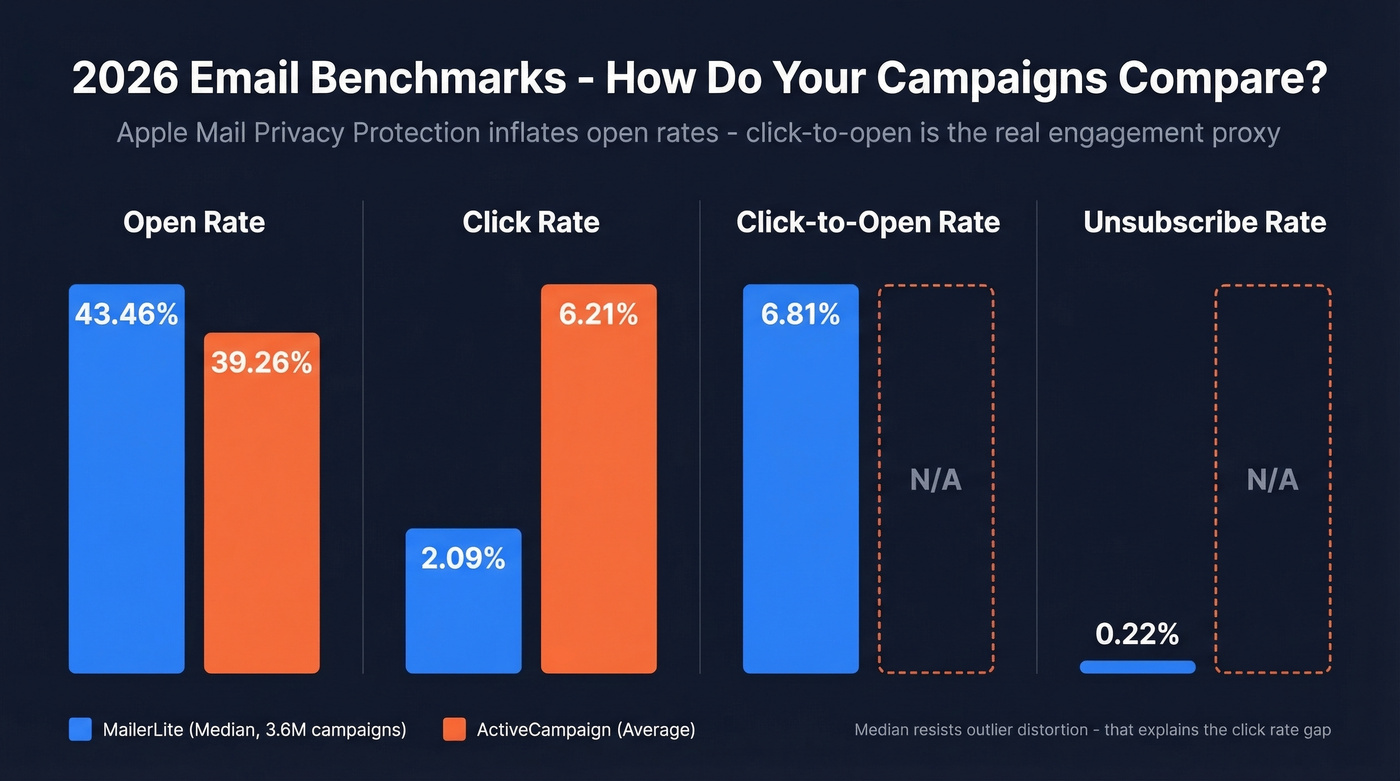
MailerLite's benchmarks analyzed 3.6M campaigns across 181,000 accounts and reported medians. ActiveCampaign's benchmarks cover a similar period but report averages. Medians resist outlier distortion, while ActiveCampaign's click rates look higher partly because of that methodological gap.
| Metric | MailerLite (Median) | ActiveCampaign (Avg) | Context |
|---|---|---|---|
| Open Rate | 43.46% | 39.26% | Apple MPP inflates both |
| Click Rate | 2.09% | 6.21% | Median vs. mean gap |
| Click-to-Open | 6.81% | - | Best engagement proxy |
| Unsubscribe | 0.22% | - | Up from 0.08% YoY |
Open rates climbed year-over-year, but Apple Mail Privacy Protection pre-loads pixels - real human opens are lower. The unsubscribe rate nearly tripled, helped by Gmail UI changes that made unsubscribing easier. That's actually healthy: cleaner lists lift everything else.
Industry spread is wide. Nonprofits hit 52.38% opens; ecommerce sits at 32.67%. ActiveCampaign's data tells a similar story, with Media and Publishing leading at 43.16% opens while Bloggers and Authors see the highest click rates at 7.73%. The gap between industries is bigger than the gap between most "optimization" tactics, so benchmark against your vertical, not the global average.

Every strategy in this article falls apart if your emails bounce. Prospeo's 5-step verification delivers 98% email accuracy - one customer dropped their bounce rate from 35% to under 4%. At $0.01 per verified email, clean data costs less than a single wasted campaign.
Stop perfecting copy that never reaches the inbox.
Strategies That Actually Move the Needle
Start With Your Data, Not Your Copy
70% of emails show at least one spam-related issue before they even leave your outbox. Bad addresses bounce. Bounces destroy sender reputation. A wrecked sender reputation means even your good emails land in spam. It's a death spiral, and no amount of copywriting genius fixes it.
Before you write a single subject line, verify your list. Prospeo runs every address through a 5-step verification process - catching invalid emails, spam traps, honeypots, and catch-all domains that other tools miss, delivering 98% email accuracy. One customer, Meritt, went from a 35% bounce rate to under 4% after switching their verification workflow. That's the difference between a campaign that builds pipeline and one that gets your domain flagged.

Segment Smaller Than You Think
The consensus on r/b2bmarketing is clear: the "sniper approach" is crushing the shotgun blast. One practitioner who sent just over 17 million emails in 2024 reported that top-performing campaigns used segments of 20-50 people, sent three times with tailored variations. The single blast to 5,000? It underperformed every time.
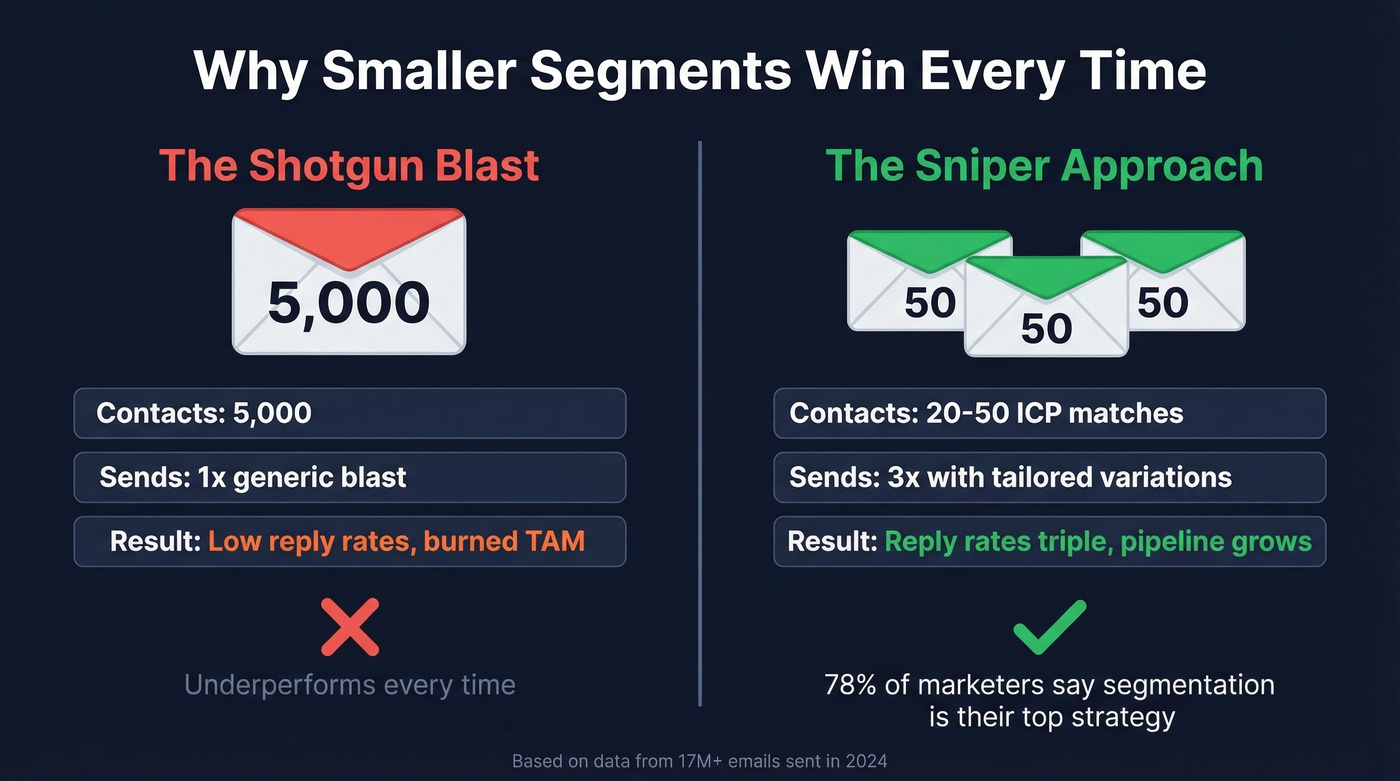
This feels counterintuitive. Smaller lists mean less reach, right? Not when reply rates triple. Fifty people who match your ICP, receiving a message that speaks to their specific pain point, will generate more pipeline than 5,000 people receiving something generic. The math isn't close.
For teams with modest deal sizes - say sub-$10k ACV - you might question whether micro-segmentation is worth the effort. It is, because the alternative is burning through your total addressable market with emails nobody reads. This principle holds whether you're running B2C promotions or refining outbound sequences for B2B.
Kill Your Templates (In B2B)
Use plain-text if you're running B2B outbound, selling to directors and above, or sending from a personal email address. Short, conversational, no images. It reads like a real email from a real person - because that's what gets replies.
Keep designed templates if you're running B2C ecommerce, sending newsletters with product imagery, or your brand identity is part of the value proposition. Visual emails still work when the recipient expects them.
The Reddit practitioner community has been beating this drum for over a year. In B2B, the era of the pretty template is over. Plain-text wins because it doesn't look like marketing.
Subject Lines That Earn the Open
Every top-performing email campaign starts with a subject line that doesn't smell like marketing. The patterns that consistently win across B2B and B2C are simpler than most marketers think.
Curiosity gaps work: "What if your bounce rate was under 4%?" outperforms "How to reduce your bounce rate." Urgency without desperation works: "Last call" beats "HURRY - FINAL HOURS!!!" The 9-word re-engagement email - literally just "Are you still interested in [specific thing]?" - pulls disengaged contacts back at rates that longer, more polished emails can't touch.
A/B test your subject lines before rolling a winner out to the rest of your list. This single habit will teach you more about your audience in a month than any best-practice guide. Skip the swipe files - your own top-clicked campaigns from the last six months are a better starting point.
If you need a starting library, pull from proven subject line examples and adapt them to your segments.
Personalize With Behavior, Not Merge Tags
Dropping someone's first name into a subject line isn't personalization - it's a merge tag. Real personalization means the content changes based on what the recipient has actually done: pages visited, emails clicked, products browsed, content downloaded.
Deloitte ran a case study with a pharmaceutical company that analyzed 5 years of data across 700,000 healthcare providers and built one-to-one engagement plans using machine learning. The result: a 50% decrease in email opt-out rates. That's not a marginal improvement - it's a fundamentally different relationship with the audience.
You don't need an ML platform to get started. Track what people do and let that data drive content. Even basic personalized drip sequences triggered by a single behavioral signal - like visiting a pricing page - outperform batch sends built on demographic data alone.
Automate the Right Three Flows
Not everything needs automation. But three email sequences consistently outperform manual campaigns, and the revenue gap is staggering.
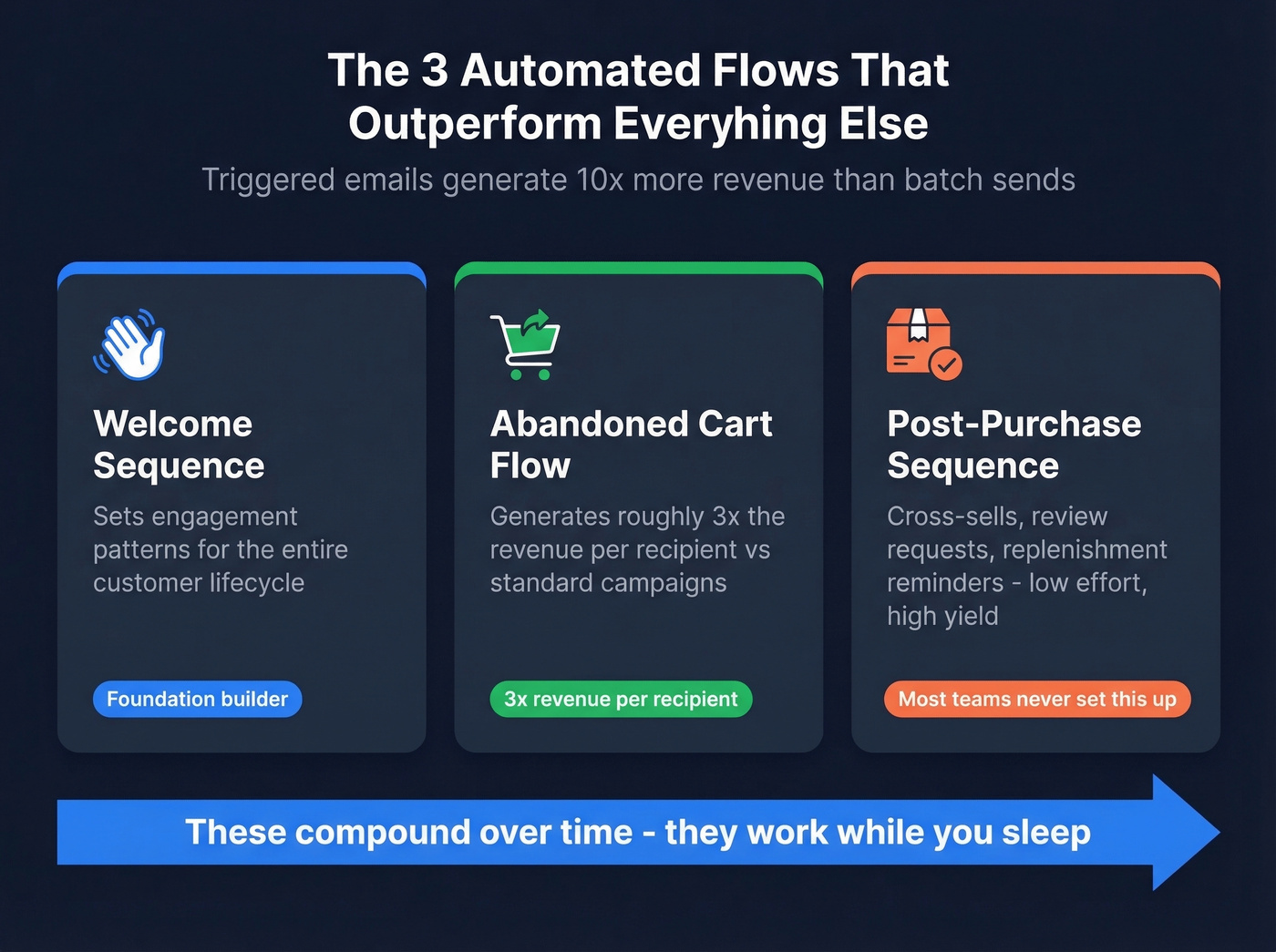
Welcome sequences set engagement patterns for the entire lifecycle. Abandoned cart flows generate roughly 3x the revenue per recipient compared to standard campaigns. Post-purchase sequences - cross-sell, review requests, replenishment reminders - are low-effort, high-yield, and most teams never set them up.
Triggered emails generate 10x greater revenue than batch sends. The gap between teams that automate these three flows and teams that don't is enormous, and it compounds over time as your automated sequences keep working while you sleep.
Use AI for Send Times, Not Strategy
AI in email marketing is mostly hype - except for send-time optimization, where the data is genuinely compelling. One platform tested AI-driven 1:1 send times with built-in control groups during late 2025 and saw top-performing campaigns hit a 35% increase in click rates. Shady Rays tested across 30+ campaigns and saw a 10%+ increase in placed order rates. That's real lift, measured properly.
Among marketers using generative AI, 34% apply it to email copy. It's useful for drafting variations at speed and A/B testing subject lines, but it won't rescue a campaign built on bad data or lazy segmentation. AI accelerates execution on a solid foundation - it doesn't replace the foundation.
If you're evaluating tooling, compare options in an AI bulk email sender stack before you commit.
Fix Deliverability Before You Optimize
Delivery and deliverability aren't the same thing. Delivery means the server accepted your email. Deliverability means it landed in the inbox, not the spam folder or promotions tab. You can have high delivery while inbox placement is much lower.
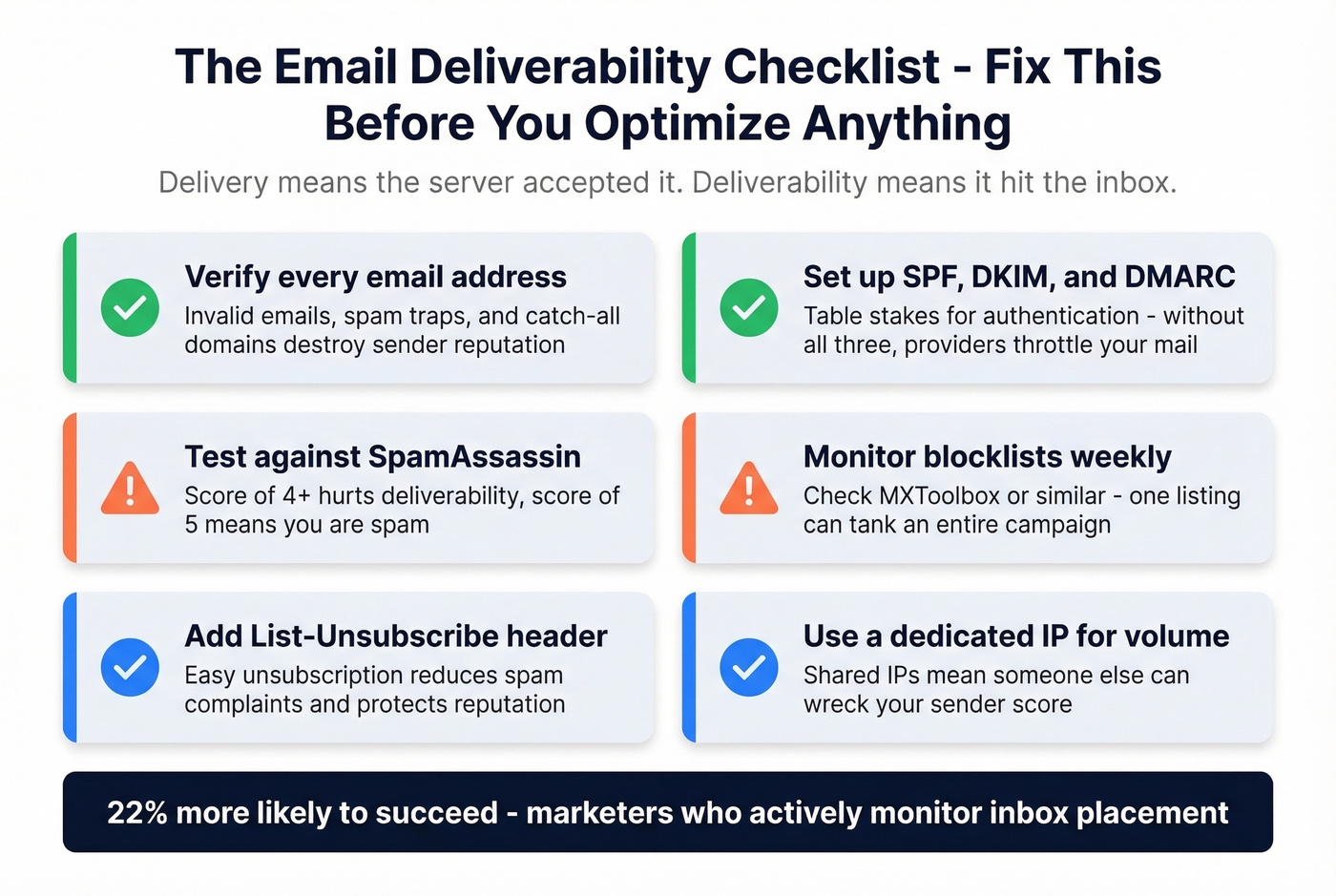
The non-negotiable checklist:
- Verify every address on your list. Invalid emails, spam traps, and catch-all domains will damage your sender reputation before you send a single campaign.
- Set up SPF, DKIM, and DMARC. These are table stakes for authentication. Without all three, major providers will throttle or reject your mail. (If you need a quick diagnostic, see how to verify DKIM is working.)
- Test against SpamAssassin. A score of 4+ starts hurting deliverability; 5 means you're spam.
- Monitor blocklists. Check MXToolbox or similar services weekly. One listing can tank an entire campaign.
- Include a List-Unsubscribe header. Making unsubscription easy reduces spam complaints, which protects your reputation.
- Avoid shared IPs if you're sending volume. A dedicated IP gives you full control over your sender score.
Marketers who call their programs successful are 22% more likely to actively monitor inbox placement. That's not a coincidence - it's cause and effect.
For a deeper teardown, use a full email deliverability guide to audit your setup end-to-end.
Micro-segmentation only works when you can find the right 50 people. Prospeo's 30+ search filters - buyer intent, technographics, job changes, headcount growth - let you build hyper-targeted segments from 300M+ verified profiles. Teams using Prospeo book 35% more meetings than Apollo users.
Build the segment that triples your reply rate.
Measure What Matters
Stop obsessing over open rates. Apple Mail Privacy Protection pre-loads tracking pixels, which means a significant chunk of your "opens" are machines, not humans.
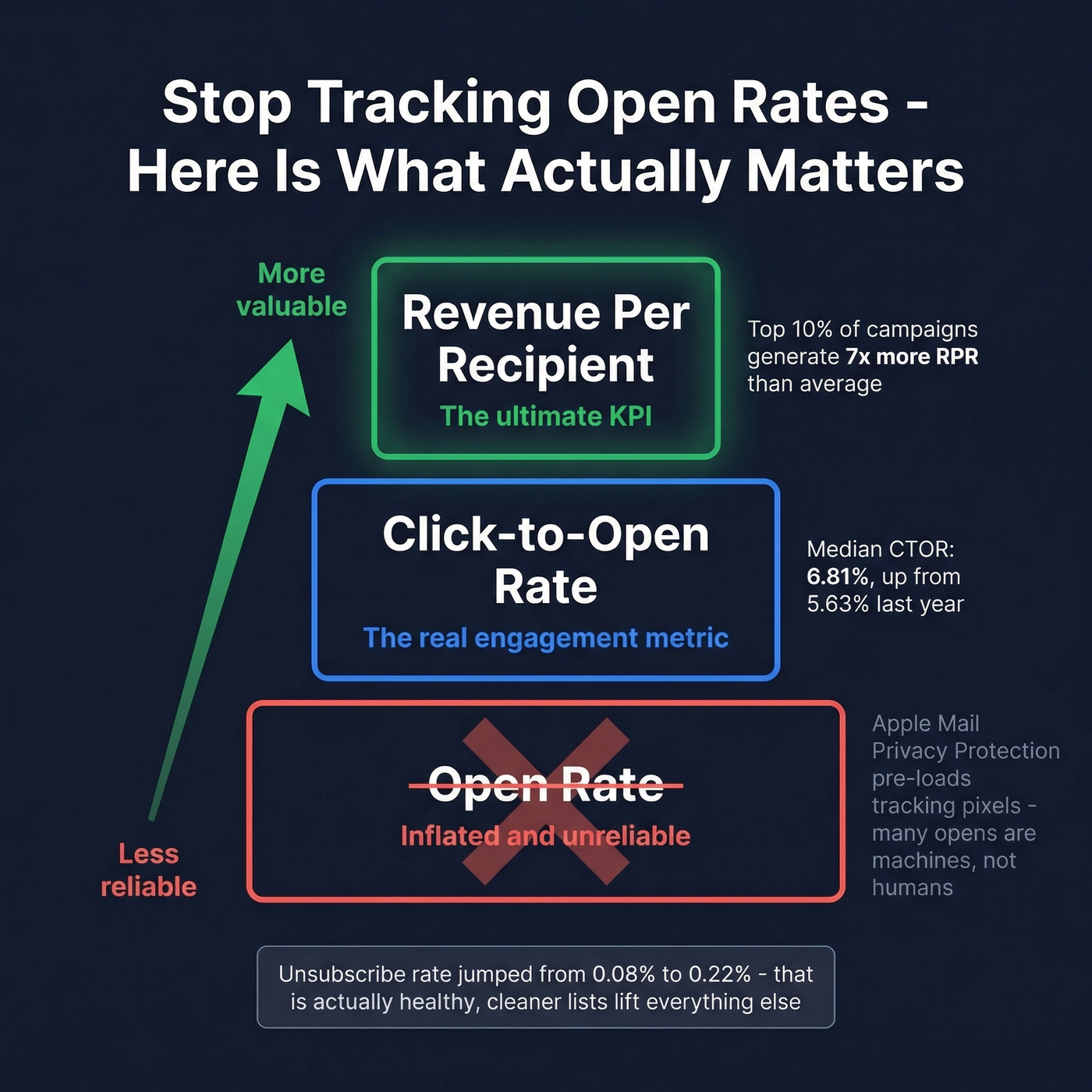
Click-to-open rate is the real engagement metric - it tells you what percentage of people who actually opened your email found the content compelling enough to click. The median sits at 6.81%, up from 5.63% the year before. But the ultimate KPI is revenue per recipient. The top 10% of campaigns generate up to 7x more RPR than average. If you're not tracking RPR, you're optimizing for vanity metrics while actual revenue goes unmeasured.
The unsubscribe rate jump from 0.08% to 0.22% looks alarming until you realize UI changes made unsubscribing easier, cleaning your list for free. Losing disengaged subscribers improves every metric that matters.
A/B testing is how you turn these metrics into action. Test one variable at a time - subject line, send time, CTA placement - and let statistical significance, not gut feeling, drive your next campaign. The teams that test consistently are the teams whose benchmarks keep climbing.
If you want to get more precise, use a consistent click rate formula and track it the same way across campaigns.
Mistakes That Kill Campaigns
Automating without behavioral relevance. "Personalized" product recommendations that don't match actual browsing history are worse than no personalization at all.
Ignoring mobile. Tiny text, broken layouts, and CTAs you can't tap with a thumb. We've seen campaigns where 60%+ of opens are mobile - and the email was designed for desktop only.
Frequency creep. Sending more because you can, not because you should. The result is audience fatigue, higher unsubscribes, and spam complaints that wreck deliverability.
Zero segmentation. Blasting your entire list with the same message regardless of interest, behavior, or purchase history. This is one of the most common mistakes discussed on r/EmailWhisperers.
Skipping deliverability entirely. Spending hours on copy and design, then sending from an unverified list through an unauthenticated domain. The email never reaches the inbox. Everything else was wasted. Most of these mistakes stem from jumping straight to execution without auditing data quality, defining segments, or mapping the customer journey first.
FAQ
How often should I send campaigns?
Weekly newsletters average a 48.31% open rate and 5.71% CTR - a strong baseline for most brands. B2B outbound should match segment size and relevance; smaller, targeted sends outperform high-frequency blasts. Monitor your unsubscribe rate. If it's climbing past 0.3%, you're over-sending.
What's a good open rate in 2026?
Industry medians range from 32% for ecommerce to 52% for nonprofits, but Apple Mail Privacy Protection inflates all of them. Track click-to-open rate instead - the median is 6.81% across MailerLite's dataset of 3.6M campaigns. That's the metric that reflects real engagement.
How do I improve email deliverability?
Set up SPF, DKIM, and DMARC on your sending domain, then verify your entire list to remove invalid addresses and spam traps. Monitor blocklists weekly and use a dedicated IP for high-volume sends. Google's Postmaster Tools is free and gives you direct visibility into how Gmail treats your domain.
Does AI actually help with email campaigns?
For send-time optimization, yes - controlled tests produced a 35% click-rate lift. For copy generation, it's useful for drafting variations and running A/B tests on subject lines at speed. AI won't fix bad data or poor segmentation, but it meaningfully accelerates execution when the foundation is solid.
What's the best approach for B2B email?
Micro-segmentation paired with plain-text emails consistently outperforms every other approach. Build tight segments of 20-50 contacts who share a specific pain point, verify every address before sending, and write short, conversational messages. Layer in behavioral triggers - like pricing page visits - and you'll generate more pipeline than any high-volume blast. Let's be honest: most B2B teams already have the contacts they need, they just haven't cleaned or segmented them yet.