

Email Copywriting Best Practices: The Guide With Actual Numbers
You sent 5,000 emails last quarter and got three replies. Every guide you've read told you to "write a compelling subject line." Thanks. That's like telling a chef to "make the food taste good."
Let's skip the obvious and talk about email copywriting best practices that actually move numbers - with benchmarks, frameworks, and a template you can steal today.
The Quick Version
- Fix your subject line. Spend 50% of your writing time here - it determines whether anything else matters.
- Use the PAS framework to structure every email body.
- Verify your list before you send. Bad data kills good copy before it reaches anyone.
Cold Email vs. Marketing Email
Writing a cold email like a marketing email (or vice versa) is the single fastest way to tank performance. The differences, adapted from Woodpecker's breakdown:
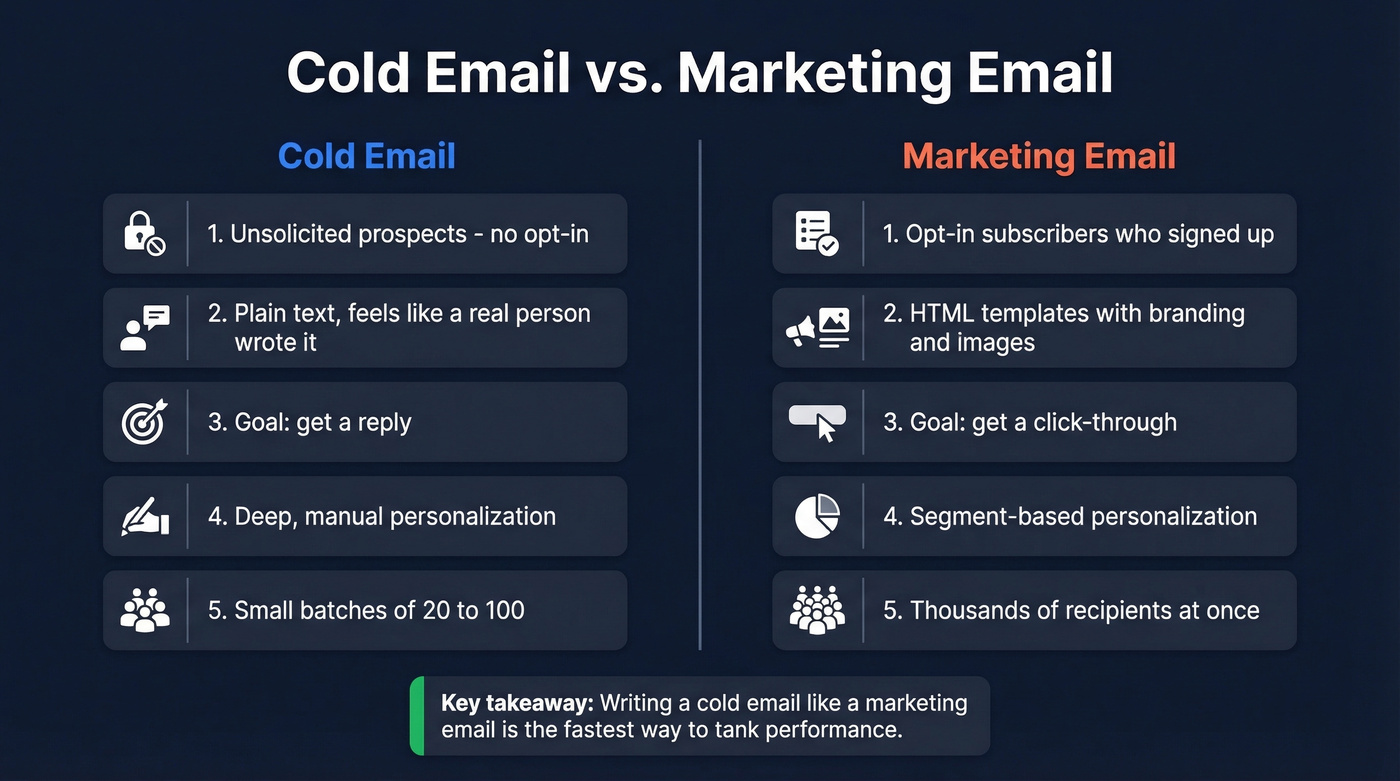
| Dimension | Cold Email | Marketing Email |
|---|---|---|
| Recipients | Unsolicited prospects | Opt-in subscribers |
| Format | Plain text, 1:1 feel | HTML templates, branded |
| Goal | Get a reply | Get a click-through |
| Personalization | Deep, manual, specific | Segment-based |
| Volume | Small batches (20-100) | Thousands at once |
Here's what we've been seeing across B2B outbound right now: branded HTML templates are getting ignored. Plain-text emails that look like a real person wrote them outperform polished designs consistently. Save the HTML for ecommerce lifecycle sequences.
2026 Email Benchmarks
Before optimizing anything, you need to know what "good" looks like. MailerLite's benchmark report analyzed 3.6M campaigns across 181,000 accounts:
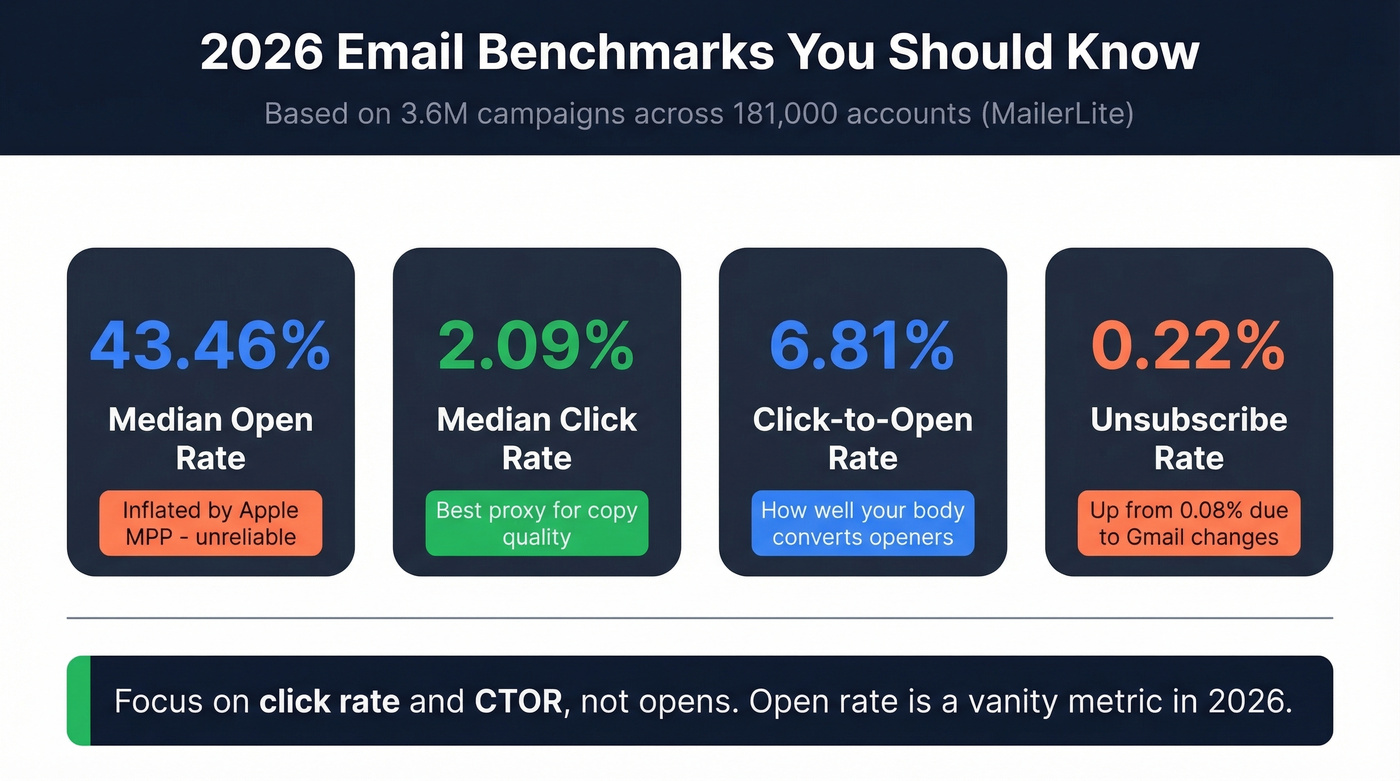
| Metric | Median | What It Means |
|---|---|---|
| Open rate | 43.46% | Inflated by Apple MPP |
| Click rate | 2.09% | Best proxy for copy quality |
| Click-to-open | 6.81% | How well body converts openers |
| Unsubscribe rate | 0.22% | Up from 0.08% (Gmail changes) |
Industry ranges tell a more useful story:
| Industry | Open Rate | Click Rate |
|---|---|---|
| Non-profits | 52.38% | 2.90% |
| Software & Web Apps | 39.31% | 1.15% |
| E-commerce | 32.67% | 1.07% |
Open rate is a vanity metric now. Apple Mail Privacy Protection pre-loads tracking pixels, inflating opens across the board. Click rate and CTOR are the metrics that actually reflect whether your copy is working.
Tips That Actually Move Metrics
Subject Lines Deserve Half Your Time
Mobile truncates subject lines after 33-43 characters. If your hook lives in character 44, nobody sees it.
Personalized subject lines can hit 46% opens vs. 35% without - an 11-point increase (about a 31% relative lift) from dropping in a company name or relevant detail. And if you spend four hours total writing emails, two of those hours should go to the subject line. It's the only piece of copy that 100% of recipients see.
If you need ideas fast, steal from proven subject lines and adapt them to your offer.
Use Preview Text as a Second Hook
Most senders leave preview text to auto-populate from the email body, which usually means the reader sees "Hi [First Name], I wanted to reach out because..." That's wasted space. Treat the preheader as a subtitle - it's prime real estate on mobile. Use it to reinforce or expand the subject line, not repeat it.
Lead With the Offer, Not Your Intro
Cold emails should be 40-60 words. No "we don't know each other" preamble. No company pitch. Your first sentence is your offer - specific, low-friction, and immediately valuable.
We've watched teams see big reply-rate lifts just by cutting length and leading with a concrete result instead of a self-introduction.
Before:
Hi Sarah, my name is Jake and I'm the Head of Partnerships at Acme. We're a leading provider of email verification solutions and I wanted to reach out because I think we could help your team improve deliverability. Would you be open to a quick chat?
After:
Hi Sarah - if your SDR team is seeing double-digit bounces, it's torching your domain. We've helped teams cut bounce rates from 35% to under 4% in 6 weeks. Worth a conversation?
The second version leads with the prospect's pain and includes proof. The first is mostly throat-clearing.
If you're building a full sequence (not just a first touch), use these sales follow-up templates to keep the same offer-first logic across touches.
Pick One Framework and Master It
PAS (Pain-Agitate-Solution) is the most versatile starting point for any email type. It works because it mirrors how people actually process problems:
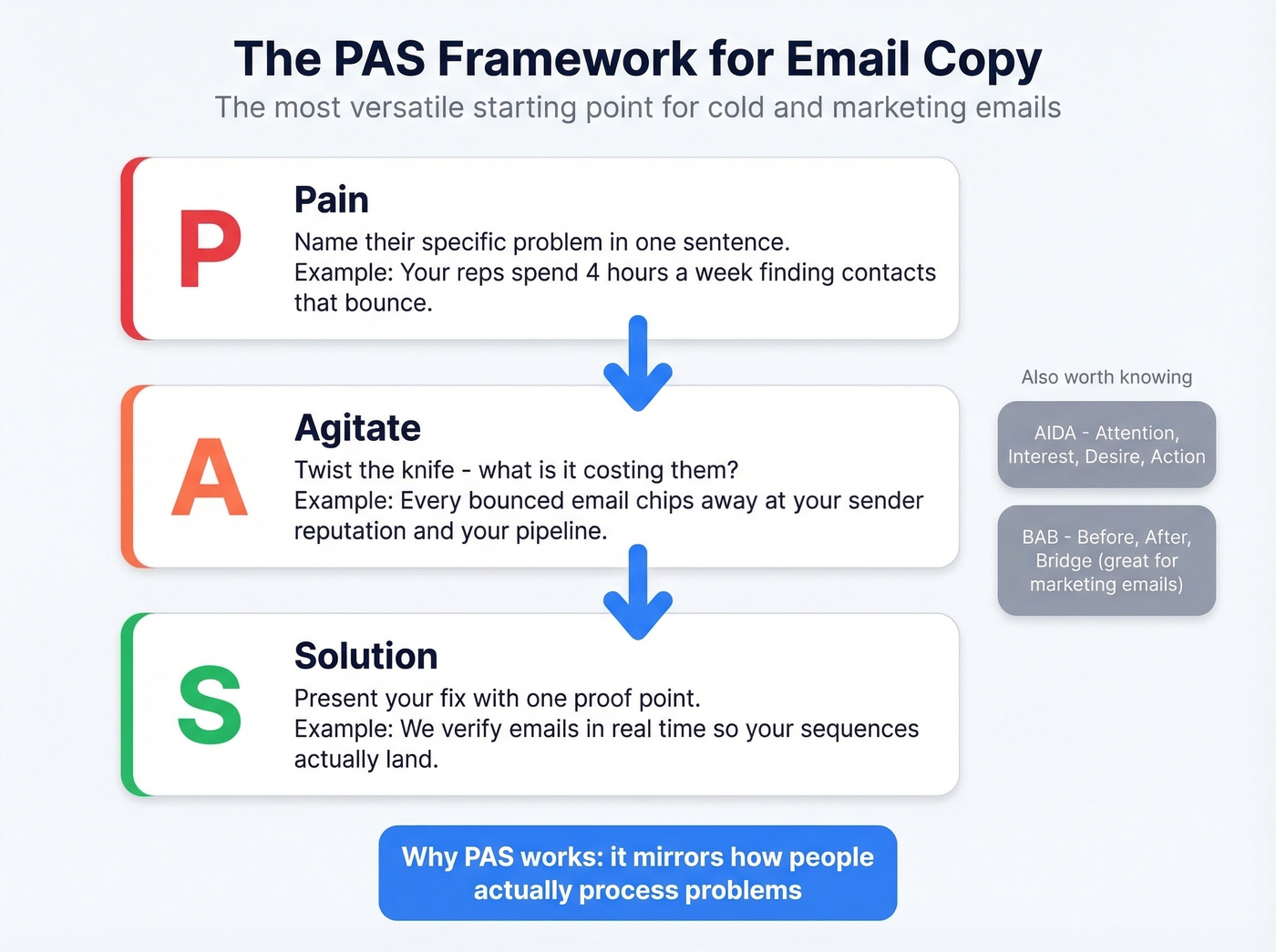
Pain: Your reps are spending 4 hours a week finding contacts that bounce. Agitate: Every bounced email chips away at your sender reputation - and your pipeline. Solution: We verify emails in real time so your sequences actually land.
AIDA and 4Ps have their place, but PAS is where we'd start. For marketing emails where you're painting a transformation, BAB (Before-After-Bridge) works well. Pick one framework and get good at it before experimenting with others.
One CTA Per Email
Cold emails get a soft CTA: "Worth a conversation?" or "Interested?" Marketing emails get a direct button. Either way, don't split attention with two competing asks. One email, one action. The moment you add a second CTA, conversion drops on both.
If you want to tighten your ask, use these email call to action rules and examples.
Segment Ruthlessly
The consensus on r/coldemail is pretty clear on this: sending to 50 people three times with tailored variations beats one mass blast to 5,000. Sniper, not shotgun.
Klaviyo's 2026 benchmarks back this up - automated flows account for just 5.3% of send volume but generate roughly 41% of total email revenue. Their data also shows AI-powered product recommendations lift click rates to 3.75% on average, with top performers hitting 8.79%. Small, targeted, behavior-triggered beats big and generic every time.
For cold sequences, 3-4 touches over 2-3 weeks is the sweet spot. More than that and you're training recipients to ignore you.
If you're struggling to define who gets what version, start with an Ideal Customer Profile and segment from there.
Verify Your Data First
None of the tips above matter if your list is bouncing hard. A high bounce rate doesn't just waste your copy - it destroys your sender reputation, pushing future emails to spam even when the addresses are valid. We've seen teams with genuinely good copy get 0.5% reply rates because a third of their list was dead on arrival.
Prospeo runs a 5-step verification process with 98% email accuracy and refreshes data every 7 days, so you're not sending to stale addresses. The free tier gives you 75 verified emails per month to test before committing.
If you want the benchmarks and fixes behind that, start with email bounce rate and then work through a full email deliverability guide.

You just learned how to write emails that earn replies. But the best subject line in the world can't save you from a 35% bounce rate. Prospeo's 5-step verification delivers 98% email accuracy with a 7-day refresh cycle - so every perfectly crafted cold email actually reaches a real inbox.
Fix your list before you fix your copy. Start with 75 free verified emails.
Cold Email Template
Here's a fill-in-the-blank template using the offer-first, PAS structure at 40-60 words:
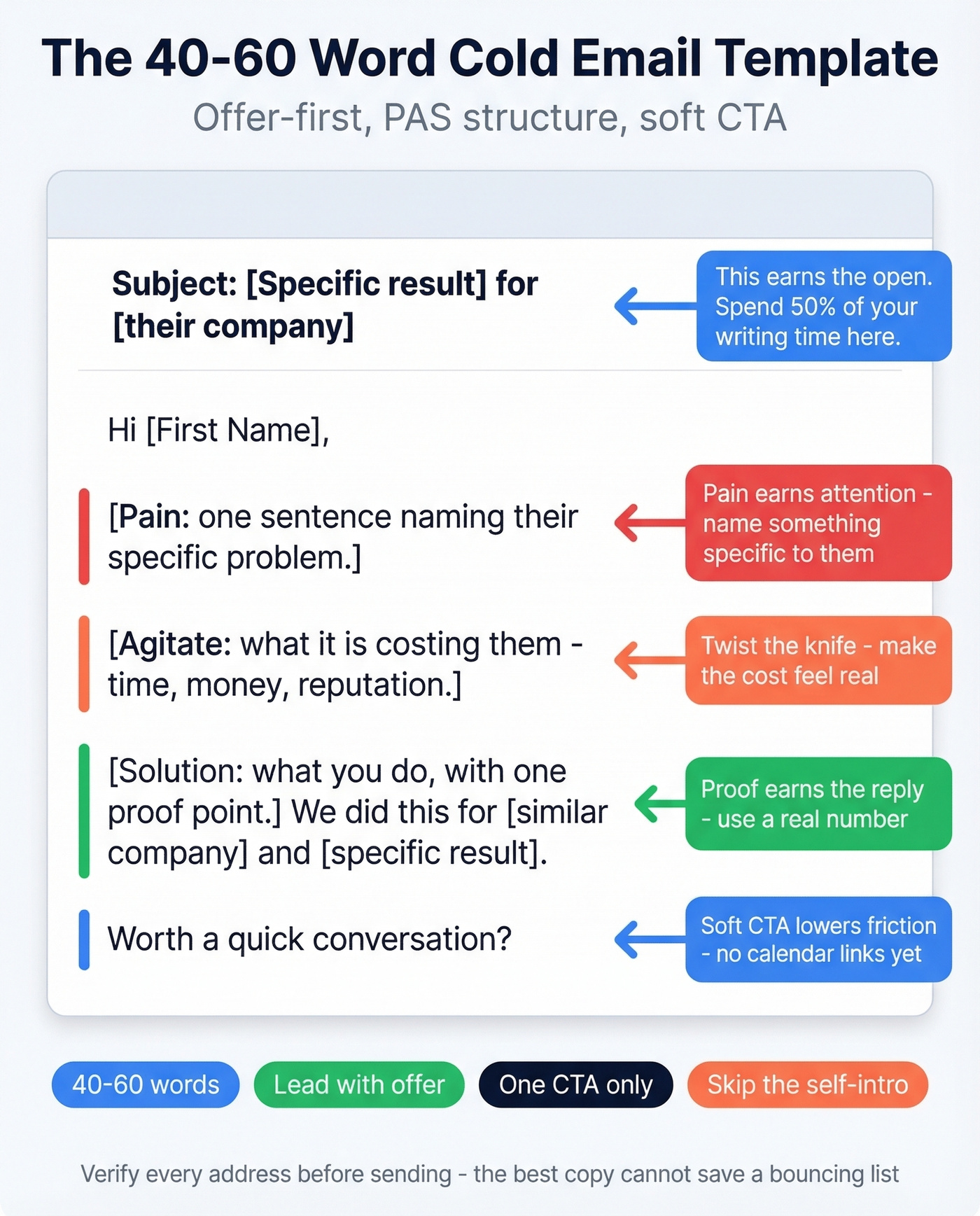
Subject: [Specific result] for [their company]
Hi [First Name],
[Pain: one sentence naming their specific problem.]
[Agitate: what it's costing them - time, money, reputation.]
[Solution: what you do, with one proof point.] We did this for [similar company] and [specific result].
Worth a quick conversation?
The subject line earns the open. The pain earns attention. The proof earns the reply. The soft CTA lowers friction.
If you want to turn this into a multi-touch system, build it as a B2B cold email sequence.
How to Test and Measure
Don't guess - test. But test correctly.
Sample size matters more than most people realize. You need 250+ contacts per variant minimum, and 500+ is better. Anything less and you're reading noise, not signal.
For cold email, measure positive reply rate, not opens. Aim for 5%+; 1-5% is a typical range depending on targeting quality. For marketing email, track click rate - opens are unreliable post-Apple MPP. Keep bounce rate at or below 1% regardless.
What to test first: subject lines. They're the highest-leverage variable and the easiest to isolate.
Look, if your bounce rate is above 5%, stop testing copy and fix your list. You're optimizing the wrong thing entirely.
Mistakes That Kill Performance
Personalization theater is the worst offender. Automated "personalized" product recs that don't match actual behavior erode trust faster than no personalization at all. Recipients notice when your "just for you" recommendation has nothing to do with them - and they remember.
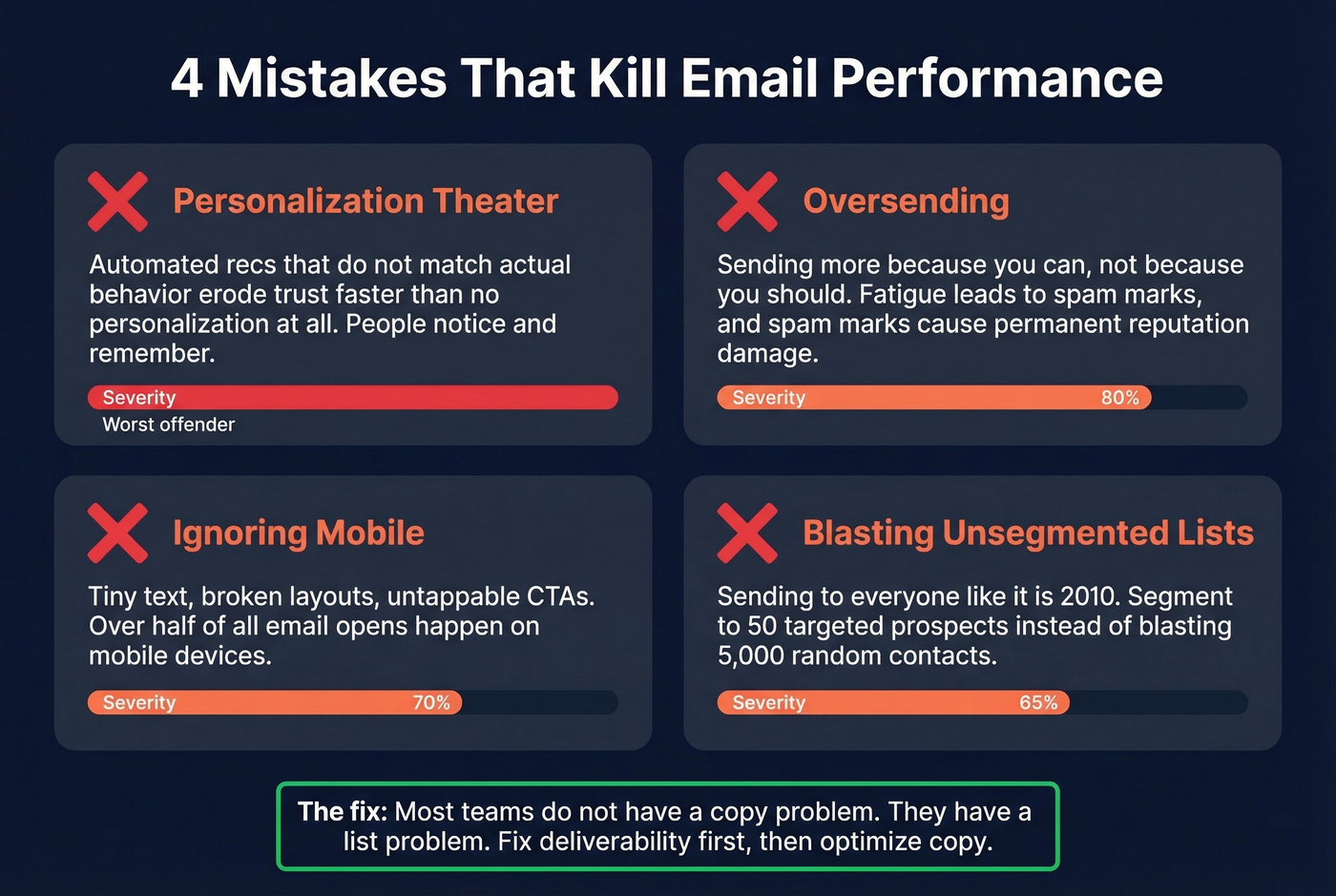
Oversending is the second killer. Sending more because you can, not because you should. Fatigue leads to spam marks, and spam marks are permanent reputation damage.
Then there's ignoring mobile - tiny text, broken layouts, untappable CTAs. Over half of all email opens happen on mobile devices. Skip this if you enjoy watching your click rates flatline.
Blasting unsegmented lists like it's 2010 rounds out the list. Segment or accept mediocre results.
Most Teams Don't Have a Copy Problem
In our experience, the biggest improvement comes from fixing the list, not the words. We've watched teams agonize over subject line A/B tests while 30% of their emails bounced before reaching anyone. If your data is bad, Shakespeare couldn't save your reply rate.
Fix deliverability first, then optimize copy. That hierarchy - subject line, offer-first structure, verified list - will outperform most teams regardless of what formulas you use or how clever your preheader is. Following email copywriting best practices consistently matters far more than any single hack.
Segmenting to 50 prospects beats blasting 5,000 - but only if those 50 contacts are real. Prospeo gives you 30+ filters to build hyper-targeted lists from 300M+ profiles, then verifies every email before you hit send. Teams using Prospeo cut bounce rates from 35% to under 4% and tripled their pipeline.
Send fewer emails to better contacts. That's the real best practice.
Email Copywriting FAQ
What's a good open rate in 2026?
The median across 3.6M campaigns is 43.46%, per MailerLite. But Apple Mail Privacy Protection inflates opens significantly - click rate (2.09% median) is a more reliable measure of copy performance. Judge results on clicks and replies, not opens.
How long should a cold email be?
40-60 words. Lead with your offer in the first sentence, skip the self-introduction, and close with a soft CTA like "Worth a conversation?" Shorter consistently outperforms longer in cold outreach - every extra sentence is a reason to stop reading.
What's the best email copywriting framework?
PAS (Pain-Agitate-Solution) is the most versatile starting point. Name the pain, twist it, then present your solution with a proof point. BAB (Before-After-Bridge) works well for marketing emails painting a transformation rather than solving an immediate problem.
How do I improve my email reply rate?
Verify your list first - bounces destroy sender reputation and push future emails to spam. Then fix your subject line, lead with a specific offer, and segment into small batches. A/B test with 250+ contacts per variant and measure positive replies, not opens.