

Email Enrichment API: How to Choose the Right One in 2026
You send 10,000 cold emails. 1,800 bounce. Your domain reputation tanks, your sequences stall, and your deliverability crater takes weeks to recover. That 18% bounce rate didn't come from bad targeting - it came from a bad email enrichment API feeding you stale and guessed emails. The line between a productive outbound engine and a domain reputation disaster is your enrichment layer: total bounces need to stay below 2%, with hard bounces under 1%.
Our Top 3 Picks
| Pick | Best For | Key Stat |
|---|---|---|
| Prospeo | Accuracy + freshness | 98% accuracy, 7-day refresh |
| Hunter | Developer experience + free tier | 100+ attributes, $0 entry |
| FullEnrich | Waterfall pay-on-success | ~80% find rate, pay only on success |
Prospeo is the pick when deliverability protection is the priority - 98% verified emails at ~$0.01 each, with a 7-day data refresh cycle that keeps records current. Hunter gives developers a generous free tier and deep attribute coverage per enrichment call. FullEnrich removes the financial risk of bad data entirely with its pay-on-success model across multiple waterfall providers.
What Email Enrichment Actually Does
The term "email enrichment" gets thrown around loosely. Four distinct API operations often hide under one label.
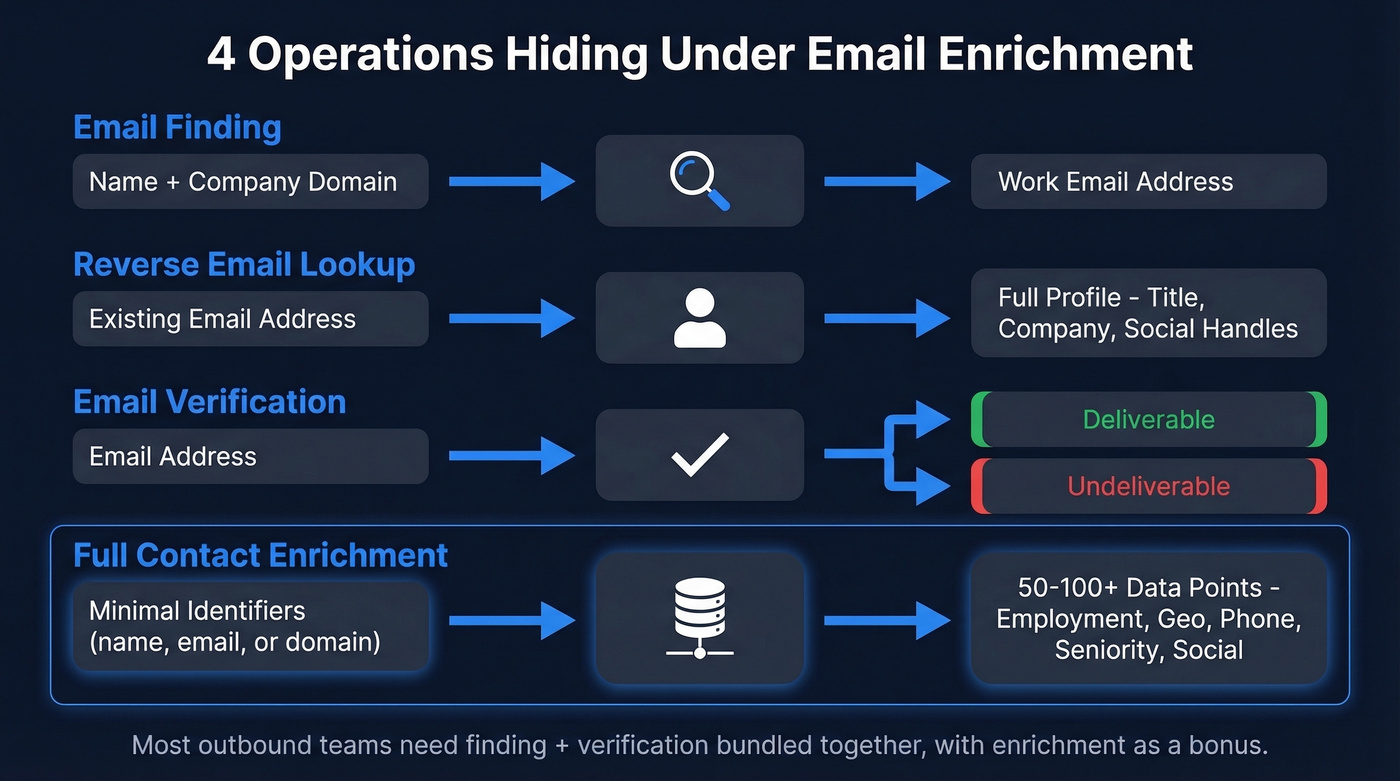
Email finding takes a name and company domain and returns a work email address. Reverse email lookup takes an existing email and returns the person's profile - title, company, social handles. Email verification checks whether an address is deliverable without sending a message. Full contact enrichment combines all of the above: you pass in minimal identifiers and get back a complete profile with dozens of data points.
Hunter's Lead Enrichment API shows what "full" looks like - 100+ attributes returned per call, including employment details, geo, seniority, social handles, and freshness metadata like indexedAt and activeAt timestamps. When evaluating any provider, know which of these four operations you actually need. Most teams want finding + verification bundled together, with enrichment as a bonus.
How to Evaluate a Provider
Every vendor will pitch you on database size. Ignore that number - what matters is output quality. We've run bake-offs across dozens of enrichment providers, and this is the scorecard that actually predicts results.
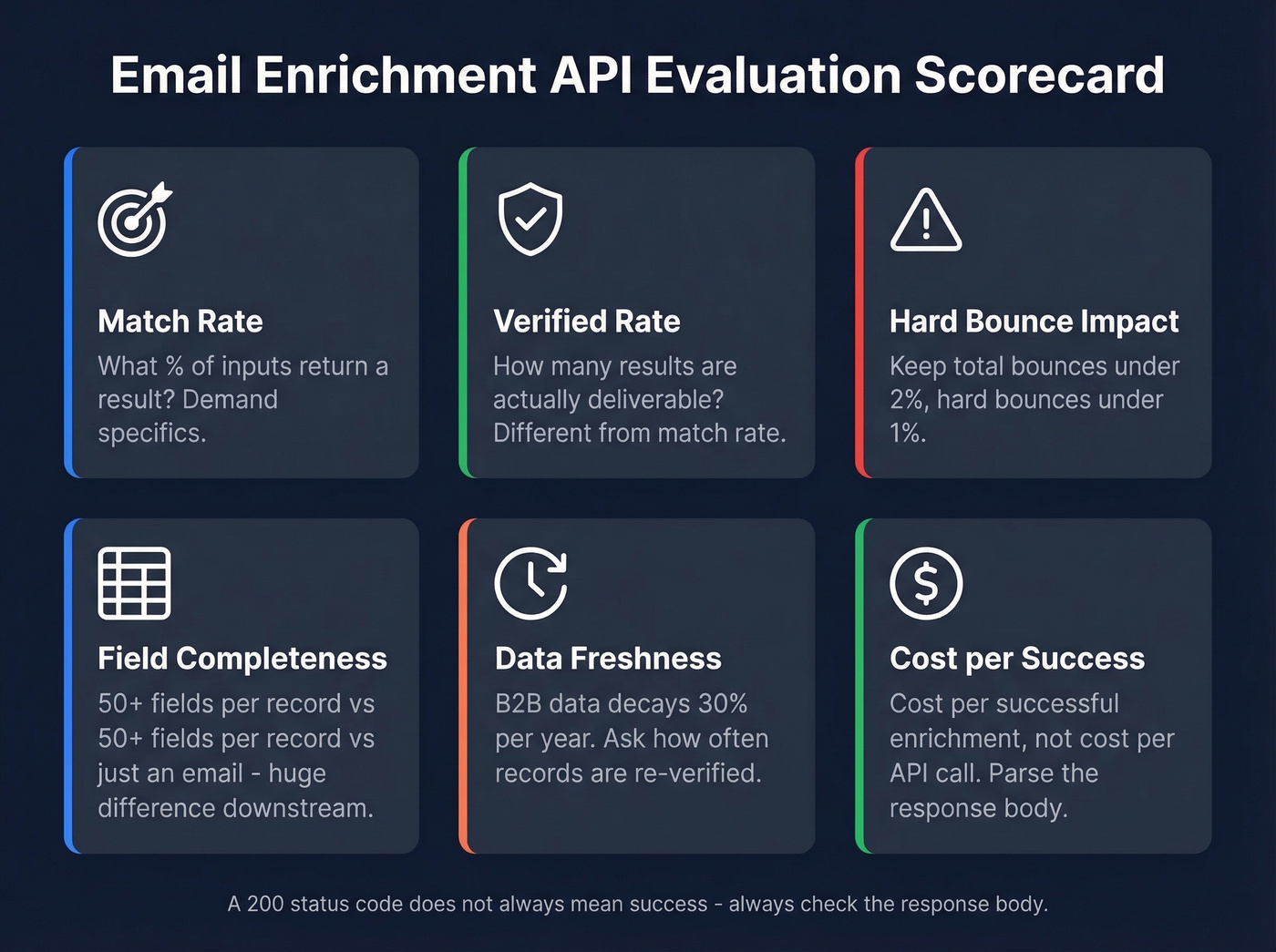
Match rate and verified rate are different metrics, and conflating them will burn you. Match rate measures what percentage of input records return a result. Verified rate measures how many of those results are actually deliverable. A tool can "find" an email by guessing the format - that inflates match rate while destroying your bounce metrics. Demand both numbers from every vendor. If they can't give you specifics, walk away.
Hard bounce impact is your ceiling: 2% total bounces, 1% hard bounces. Above that, deliverability and sender reputation degrade fast. Google's Postmaster Tools documentation confirms that persistent high bounce rates directly impact sender reputation scoring.
Field completeness matters more than most teams realize. Getting 50+ fields back per record versus just an email address are very different products at similar price points - and the richer your data, the better your segmentation and personalization downstream. The best providers function as a verified contact data API, returning not just an address but a complete, confirmed profile you can act on immediately. (If you're comparing vendors beyond email, start with our breakdown of data enrichment tools.)
Freshness is the silent killer. B2B contact data decays roughly 30% per year. Ask every vendor how often they re-verify their records. Prospeo refreshes records on a 7-day cycle versus a 6-week industry average, and that gap compounds fast over a quarter.
Cost per successful enrichment - not cost per API call - is the number that matters. And don't forget compliance: [GDPR fines can hit EUR 20M](https://gdpr-text.com/read/article-83/), and [CCPA penalties run $7,988](https://privacy.ca.gov/2024/12/california-privacy-protection-agency-announces-2025-increases-for-ccpa-fines-and-penalties/). Confirm DPA availability and opt-out enforcement before you integrate. For a deeper compliance checklist, see our guide to B2B compliance and what a GDPR Compliant Database should include.
Here's the thing most guides skip: a 200 status code doesn't always mean success. Some APIs return HTTP 200 with empty fields or a "not found" status in the response body - and charge you for the call regardless. Always parse the response body, not just the status code.
Here's what a typical enrichment call looks like:
GET /v2/enrich?email=jane@acme.com

{
  "status": "found",
  "name": "Jane Smith",
  "title": "VP of Marketing",
  "company": "Acme Corp",
  "seniority": "VP",
  "verified": true,
  "phone": "+1-555-0123",
  "linkedin_url": "...",
  "indexed_at": "2026-01-15"
  // ... 40+ additional fields
}
Check that your provider returns a verified flag and a freshness timestamp. If the response doesn't tell you when the data was last confirmed, you're flying blind. (If you're troubleshooting deliverability, our email reputation check guide pairs well with this.)

You just read that bounce rates above 2% tank your domain reputation. Prospeo's enrichment API returns 50+ data points per contact at a 92% match rate - with 98% email accuracy and a 7-day refresh cycle that keeps every record current. At ~$0.01 per email, you pay less for data that actually protects your sender reputation.
Get 75 free enrichments and see your match rate in minutes.
Single-Source vs. Waterfall vs. Unified API
| Approach | How It Works | Typical Bounce Rate |
|---|---|---|
| Single-source | One provider, one database | ~20-38% |
| Waterfall | Multiple providers queried sequentially | 10-14% |
| Unified API | Single integration, multiple providers normalized | Depends on underlying providers |
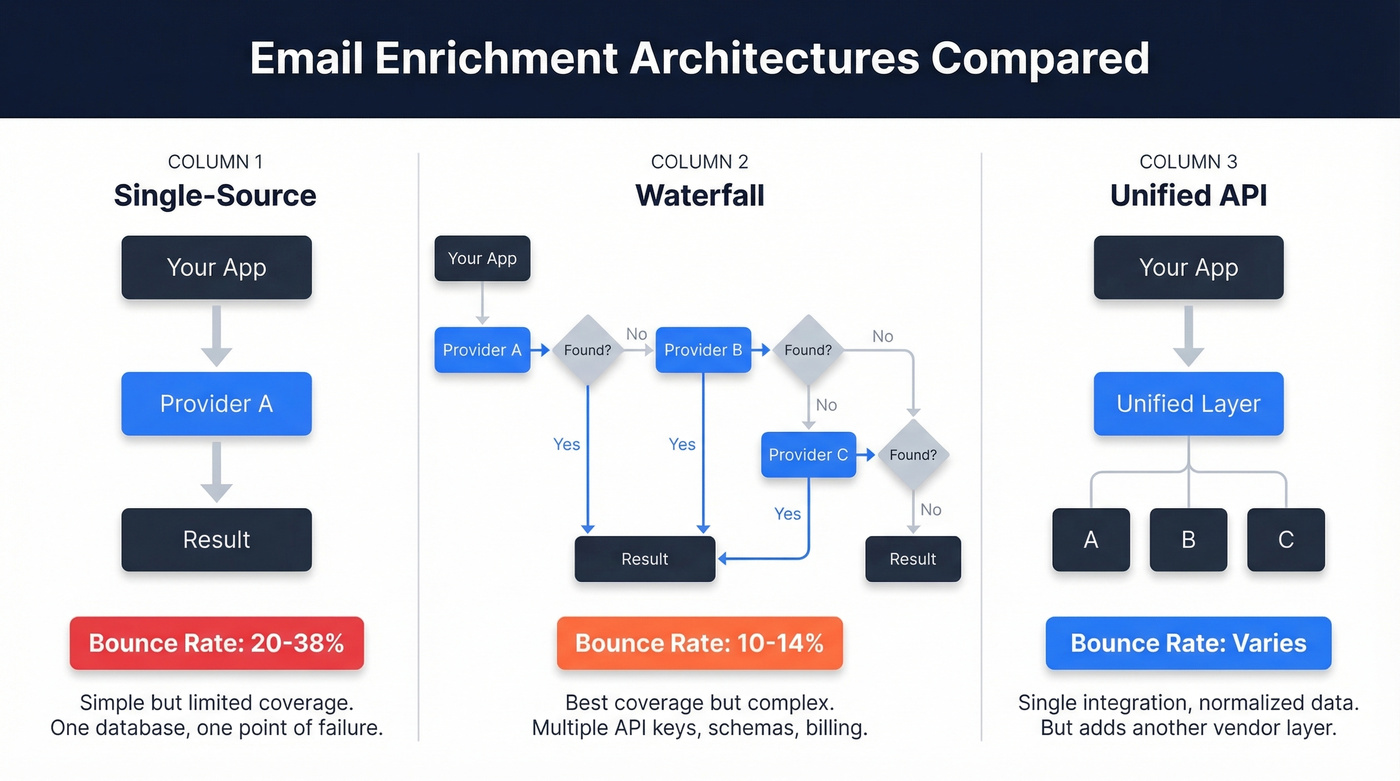
Single-source enrichment is the default for most teams, and it's the reason most teams have bounce problems. One provider's database typically leaves 40-60% of qualified prospects unreachable. A practitioner on r/coldemail ran a bake-off across six tools and found Apollo bouncing at 32-38%, while a Clay waterfall setup dropped to 10-14%.
Waterfall enrichment queries multiple providers in sequence until a verified result is found. It delivers the highest coverage, but introduces complexity: multiple API keys, schemas, rate limits, and billing models. That's where unified APIs come in - a single integration layer that normalizes auth and data models across providers. The tradeoff is another abstraction layer (and another vendor) between you and your data.
Let's be honest: most teams don't need waterfall. It's the right architecture when your primary source is weak. But if your primary source already delivers 92%+ match rates with 98% email accuracy, the marginal gain from adding three more providers doesn't justify the orchestration overhead. Waterfall is a patch for bad primary data, not a strategy. (If you're building lists at scale, pair enrichment with a B2B database or vetted B2B list providers.)
The Best Email Enrichment APIs in 2026
Prospeo
Prospeo's enrichment API returns 50+ data points per contact at a 92% match rate, with 83% of leads coming back with usable contact data. The 98% email accuracy comes from a 5-step verification process that includes catch-all domain handling, spam-trap removal, and honeypot filtering - all running on proprietary infrastructure rather than third-party email providers. (If you want to compare verification layers specifically, see our roundup of the best email verifier tools.)
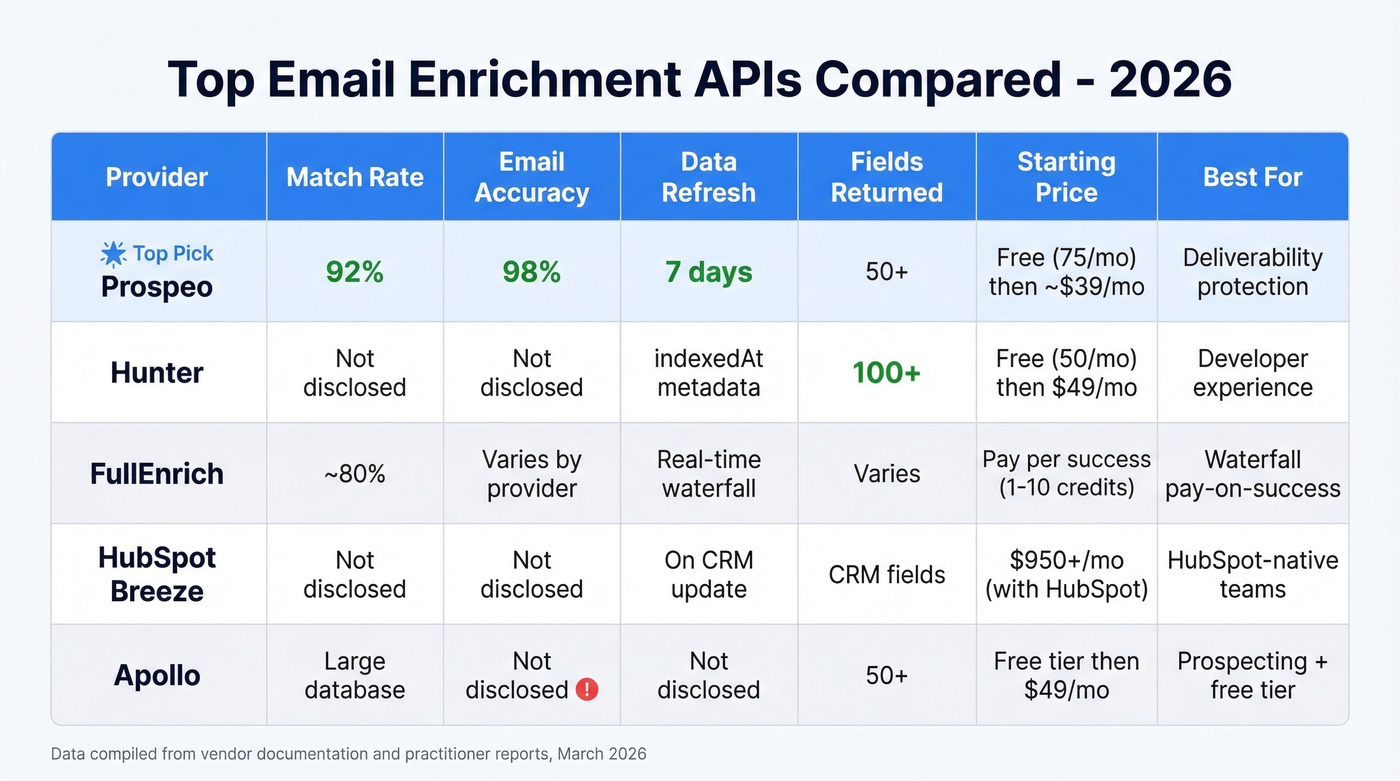
The 7-day refresh cycle is the real differentiator. While most providers re-verify records every 4-6 weeks, Prospeo's weekly cycle means the data you pull today was verified within the last week. For outbound teams, that translates directly to deliverability. Meritt, a Prospeo customer, tripled their pipeline after switching - bounce rate dropped from 35% to under 4%. Stack Optimize maintains 94%+ deliverability with bounce rates under 3% across all their clients.
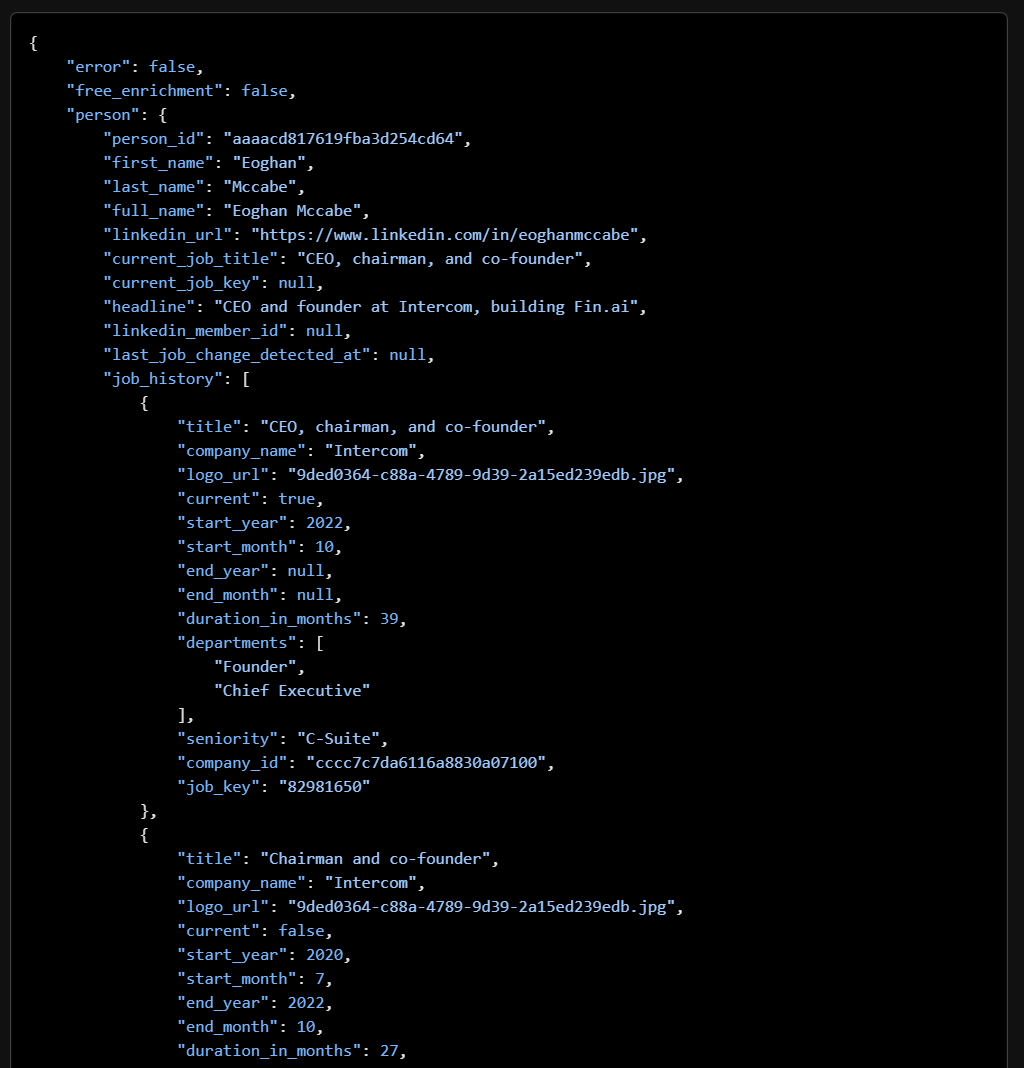
Use this if: Deliverability protection is non-negotiable and you want self-serve enrichment without enterprise pricing. Starts free (75 emails/mo), paid plans from ~$39/mo.
Skip this if: You specifically need waterfall multi-provider orchestration built in - pair Prospeo with Clay or Make for that workflow.
Hunter
Hunter built its reputation on email finding, but the Lead Enrichment API is the real product for developers. Pass in an email address and get back 100+ attributes: employment details, location, timezone, seniority, social handles, plus indexedAt and activeAt metadata so you can assess freshness yourself.
The developer experience is genuinely good. RESTful API, free API key without requiring a paid plan, and transparent pricing that scales predictably: Free at 50 credits/mo, Starter at $49/mo ($34/mo billed annually) for 2,000 credits, Growth at $149/mo for 10,000, Scale at $299/mo for 25,000. Verification costs half a credit per email. (If you're evaluating alternatives, our list of Hunter alternatives can speed up shortlisting.)
Use this if: Developer experience and a generous free tier matter, or you need deep attribute coverage beyond just email and phone.
Skip this if: You need verified mobile numbers at scale. Hunter is email-first - mobile coverage is thin.
FullEnrich
FullEnrich takes a different approach entirely. Instead of maintaining its own database, it queries multiple providers in a waterfall sequence and only charges credits when it successfully finds data - 1 credit for a work email, 10 for a mobile, 3 for a personal email. Failed lookups cost nothing.
The ~80% find rate is solid for a waterfall approach, and unused credits roll over (3 months on monthly plans, 1 year on annual). FullEnrich is GDPR and CCPA compliant and doesn't store contact information.
Use this if: You want waterfall coverage without building the orchestration yourself, and pay-on-success economics matter to your unit economics.
Skip this if: You need a searchable database for prospecting. FullEnrich enriches existing leads - it's not a discovery tool.
HubSpot Breeze Intelligence
Clearbit was acquired by HubSpot in late 2023 and now lives as Breeze Intelligence. If you're already on HubSpot, the CRM-native enrichment is automatic - records enrich on create or update. The problem is cost. Credits expire monthly with no rollover, and total costs stack up fast: Professional + 1,000 credits runs ~$950-$1,040/mo, Enterprise + 10,000 credits hits $4,000-$5,500/mo. It's HubSpot or nothing - there's no standalone option anymore. (If you're rethinking your stack, start with how to choose a CRM and a shortlist of CRM automation software.)
Apollo
Apollo's database is massive and the free tier is generous, which is why so many teams start there. The deliverability problem is real, though - practitioners on Reddit consistently report bounce rates in the 32-38% range on exported lists, driven by "guessed" email formats that haven't been verified. In our testing, Apollo works best when paired with an external verification layer. Run every export through a dedicated verification API before loading into your sequencer.
Quick Mentions
Clay isn't an enrichment API itself - it's a workflow orchestrator that chains multiple providers in a waterfall. Powerful for teams that want maximum coverage, but you're paying for Clay plus every underlying provider. Expect $150-500/mo depending on volume. (If you're considering it, our Clay list building guide breaks down real costs and workflow steps.)
Enrich.so handles lightweight profile enrichment well, pulling social and professional data from public web sources. Good fit for marketing teams that need firmographic context without the full sales intelligence stack.
SalesQL specializes in direct contact extraction from professional profiles, with a Chrome extension workflow that's fast for individual lookups but lacks the verification rigor of the Tier 1 options above.
Pricing at a Glance
| API | Entry Price | ~Cost per 1K Enrichments | Pay-on-Success? |
|---|---|---|---|
| Prospeo | Free (75/mo) | ~$10 | No (98% accuracy minimizes waste) |
| Hunter | Free (50/mo) | ~$24.50 | No |
| FullEnrich | Credit-based | $10-$100 (varies by data type) | Yes |
| HubSpot Breeze | ~$950/mo+ | ~$150+ | No |
| Apollo | Free tier, paid from $49/mo | ~$20-$50 | No |
Waterfall enrichment exists to patch weak primary sources. Prospeo's API delivers 92% match rates and 83% of leads returned with verified contact data - so you skip the orchestration overhead of stitching together multiple providers. One integration, 50+ fields per record, 7-day freshness.
Replace your waterfall stack with one API that actually delivers.
FAQ
What's the difference between email enrichment and email verification?
Enrichment takes an email (or name + domain) and returns additional data - job title, company, phone, social profiles - while verification only checks whether an address is deliverable. You need both: enrichment without verification leads to bounces that damage sender reputation. Look for APIs that bundle real-time verification into the enrichment response rather than billing them as separate steps.
How often should I re-enrich my database?
Re-enrich critical contacts monthly and your general database quarterly, since B2B contact data decays roughly 30% per year. Providers with a 7-day refresh cycle deliver already-current data on every call, reducing the urgency of manual re-enrichment. The difference between weekly and monthly re-verification is catching a job change before your email bounces versus after your domain takes the hit.
What bounce rate should I expect from a good enrichment API?
Keep total bounces below 2% and hard bounces under 1%. If your provider consistently produces bounce rates above 5%, it's serving guessed or stale emails. Run a 1,000-record test with an independent verification tool like NeverBounce or ZeroBounce before committing - that single test tells you more than any vendor's marketing page.
What's a good free option for small teams?
Prospeo offers 75 free email credits per month with full enrichment (50+ data points per contact), which is enough for early-stage outbound. Hunter's free tier gives 50 credits/mo with 100+ attributes per lookup. For teams running under 100 enrichments monthly, either free plan delivers production-quality data without a credit card.