

Best Email Enrichment Tools in 2026, Ranked by Accuracy
Your enrichment tool is probably lying to you. Not maliciously - but the math doesn't care about intent. A tool that matches 90% of your list sounds great until you realize only 60% of those emails are actually deliverable. Run 1,000 leads through that pipeline: 900 matches x 60% validity = 540 usable emails. Now take a tool with 70% coverage but 98% validity: 700 matches x 98% = 686 usable emails. The "worse" coverage tool just gave you 27% more usable contacts.
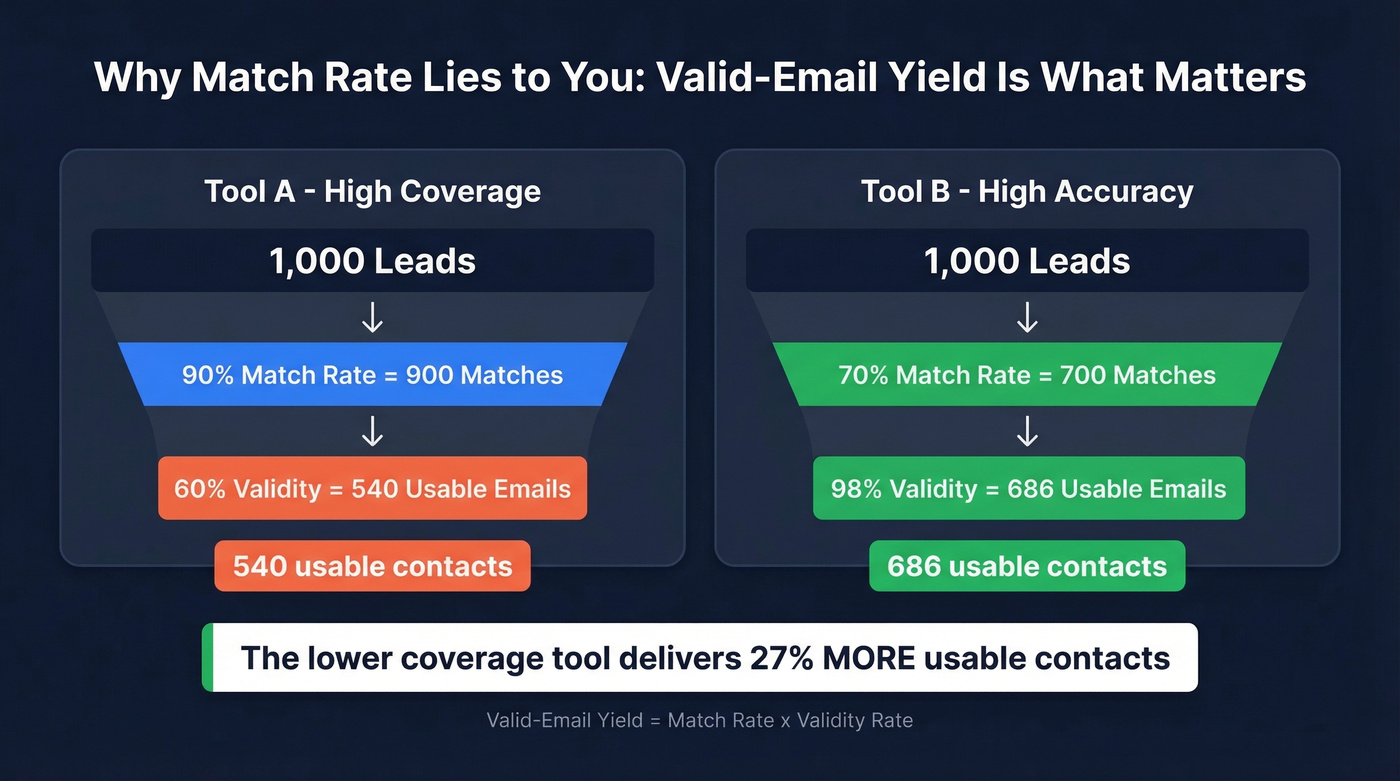
This is the core problem with how most teams evaluate an email enrichment tool. They optimize for match rate - the big number on the vendor's homepage - when the only metric that matters is valid-email yield. Global inbox placement sits around 84% according to Validity's 2024 benchmark, meaning roughly one in six emails never reaches the inbox even under normal conditions. Stack a 30%+ bounce rate from bad enrichment data on top of that, and you're actively destroying your sender reputation.
We've spent the last year testing enrichment tools against real contact lists, tracking bounce rates, and comparing cost-per-usable-contact. Here's what actually performs.
Our Top Picks
| Use Case | Tool | Why |
|---|---|---|
| Best email accuracy | Prospeo | 98% accuracy, ~$0.01/email |
| Best waterfall orchestration | Clay | Multi-source cascade, ~10-14% bounce |
| Best hands-off waterfall | FullEnrich | Auto-cascade, pay only when found |
Prospeo wins on raw accuracy and cost-per-valid-email. Clay wins when you need to orchestrate multiple data sources with custom logic. FullEnrich wins when you want waterfall results without building the waterfall yourself.
Email Enrichment vs. Data Enrichment
These terms get conflated constantly, and the confusion costs teams money.
Email enrichment means finding and verifying email addresses you don't have. You feed in a name and company; you get back a deliverable work email. The output is an actionable contact point.
Data enrichment is broader - appending firmographic, technographic, and intent signals to records that already exist in your CRM. Think company revenue, tech stack, funding stage, headcount growth. Clearbit (now Breeze Intelligence) is the classic example: it enriches records that already have email addresses but doesn't actually find new emails. If you're searching for a contact enrichment platform and land on Breeze, you're in the wrong aisle.
Most comparison articles lump these together. If you need emails, you need a dedicated email finder. If you need firmographic context on existing contacts, you need data enrichment. Some platforms do both, but most are stronger at one than the other. For a deeper breakdown, see our guide to data enrichment.
What Bounce-Rate Data Actually Shows
Here's the thing most vendor pages won't show you: real bounce rates from practitioners who tested these tools on actual prospect lists.
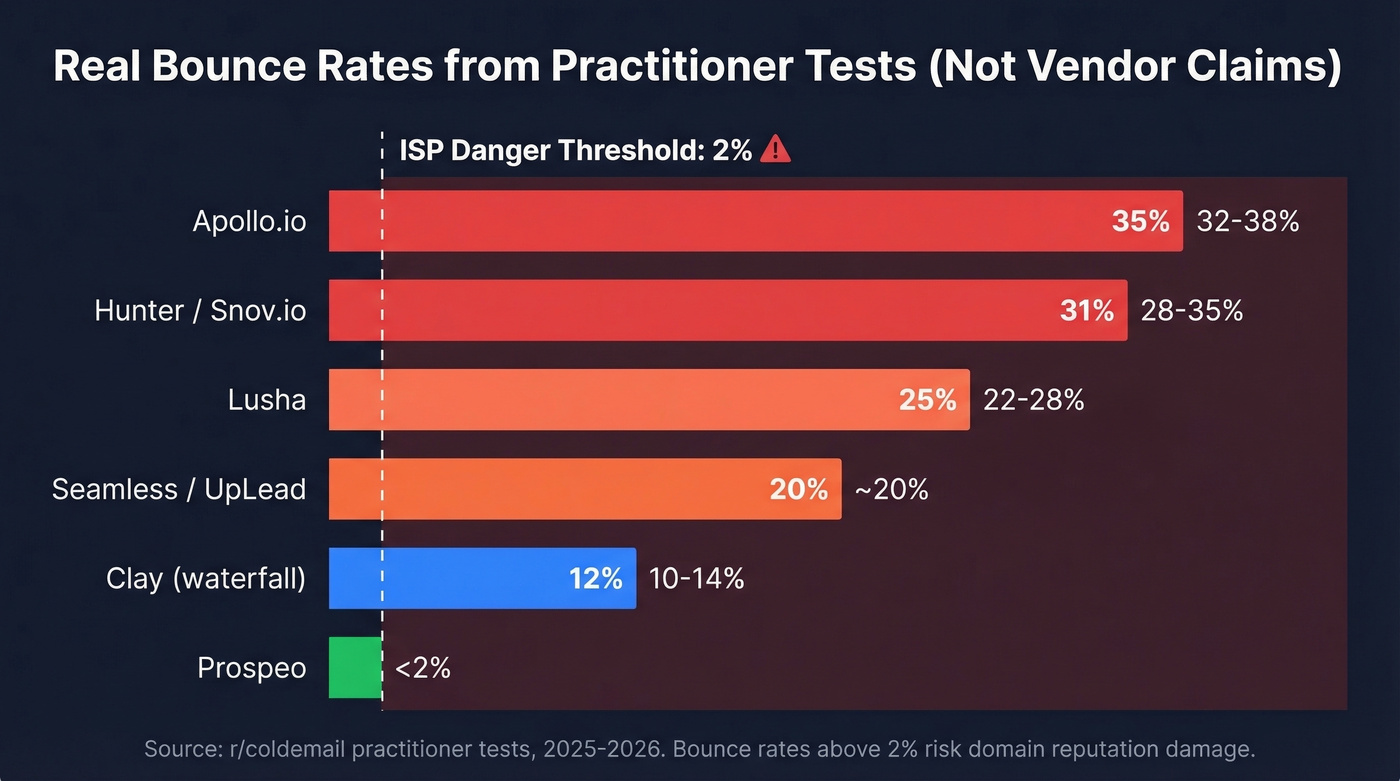
| Tool / Approach | Reported Bounce Rate | Source |
|---|---|---|
| Apollo.io | ~32-38% | Practitioner test |
| Hunter / Snov.io | ~28-35% | Same test |
| Lusha | ~22-28% | Same test |
| Seamless / UpLead | ~20% | Same test |
| Clay (waterfall) | ~10-14% | Same test |
| Industry threshold | <2% | Instantly benchmark |
That 2% threshold isn't aspirational - it's the line where ISPs start throttling you. Top performers keep hard bounces under 1%. A 32% bounce rate from Apollo doesn't just waste credits; it actively damages your domain reputation. If you’re troubleshooting deliverability, start with an email reputation check and an inbox placement audit.
A 9,806-contact benchmark study across 10 providers confirmed the pattern: providers with the highest coverage often had the worst validity. Wiza showed 67-85% coverage but validity as low as 15% in some segments. Hunter flipped the script - lower volume but 89-96% validity.
The ISP breakdown matters too. Gmail inbox placement runs about 87.2%, while Microsoft sits at 75.6%. If your prospects are mostly on Outlook, you have even less margin for error on bounces. (More on Gmail inbox placement if you’re seeing sudden drops.)
The consensus on r/coldemail is clear: single-source databases are the primary driver of high bounce rates. Verification layers and multi-source approaches consistently produce better outcomes. If you’re building lists at scale, compare options in our roundup of the best B2B databases.
How Waterfall Enrichment Works
Waterfall enrichment queries multiple data providers sequentially until a verified result is found. Provider A doesn't have the email? Try Provider B. Still nothing? Provider C. Each step fills gaps the previous one missed.
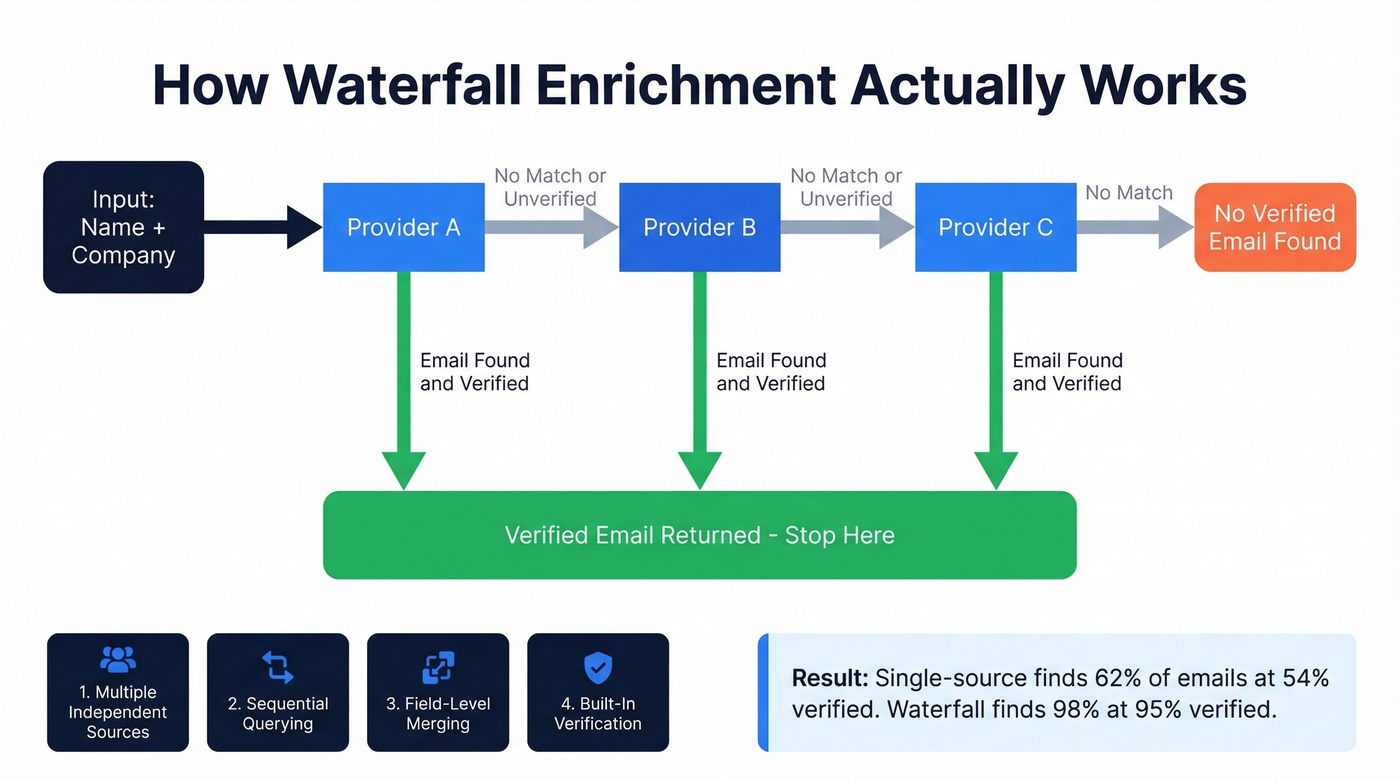
True waterfall enrichment requires four things: multiple independent data sources, sequential querying that stops when verified data is found, field-level merging that picks the best result from each provider, and built-in verification. Many tools that market "waterfall" are actually single-database products with a marketing label. Some newer entrants like Gumloop wrap this in an "AI orchestration" layer, but the fundamentals - sequential querying with verification - matter more than the wrapper.
The lift is real. In a 1,000-record test, single-source enrichment found emails for 62% of records with 54% verified. Waterfall pushed that to 98% found and 95% verified. Across multiple studies, waterfall approaches boost enrichment rates by 35-40% on average.
But waterfall isn't free lunch. More providers means more compliance surface area - each vendor needs to be GDPR-compliant independently. Data conflicts arise when Provider B overwrites Provider A's verified data with a stale record. And implementation complexity scales with every integration you add.
Let's be honest: most teams overthink this. Start with one high-accuracy primary source, then layer in a secondary provider for gaps. You probably don't need a third source. If you're enriching fewer than 1,000 contacts a month, a single accurate tool beats a complex waterfall every time. Save the orchestration budget for when your volume actually demands it.
One thing competitors cover that most teams forget: re-enrich active prospect lists every 30-90 days. For cold or dormant lists, every 90-180 days. Data decays faster than you think. If you need a system for list building, start with cold email lead list building.

You just saw the bounce-rate data: single-source tools hit 28-38% bounces while the ISP threshold is under 2%. Prospeo's 5-step verification with catch-all handling, spam-trap removal, and honeypot filtering delivers 98% email accuracy - no third-party email providers in the chain. At ~$0.01 per email, your cost-per-valid-contact drops to a fraction of what Apollo or Hunter charges after accounting for bounces.
Stop paying for emails that bounce. Start with 75 free verified contacts.
Best Email Enrichment Tools in 2026
Prospeo - Best for Accuracy
Prospeo's database covers 300M+ professional profiles with 143M+ verified emails and 125M+ verified mobile numbers. The differentiator is its proprietary email-finding infrastructure - it doesn't rely on third-party email providers, which means the verification chain is controlled end-to-end. Every email goes through a 5-step verification process with catch-all handling, spam-trap removal, and honeypot filtering.

The numbers: 98% email accuracy with a 92% API match rate. Each enrichment returns 50+ data points per record, with an 83% match rate across bulk uploads. Data refreshes every 7 days, compared to the 6-week industry average. The Chrome extension has 40K+ users, and native integrations cover Salesforce, HubSpot, Clay, Instantly, Lemlist, Zapier, and Make. Intent data tracks 15,000 Bombora topics for in-market buyer signals.
Real-world proof: Meritt tripled their pipeline from $100K to $300K/week after switching, with bounce rates dropping from 35% to under 4%.
Use it if you want the highest valid-email yield per dollar and don't need to build complex orchestration workflows. The free tier (75 emails + 100 Chrome extension credits/month) lets you test before committing. Paid plans run ~$0.01/email with no contracts.
Skip it if you need a built-in dialer or full sequencing platform - pair Prospeo with Instantly or Lemlist for that. If you’re choosing a sequencer, see our picks for outbound email automation.
The article math doesn't lie: valid-email yield is the only metric that matters. Prospeo's 92% API match rate with 98% accuracy means enriching 1,000 records returns ~920 matches and ~901 deliverable emails. Compare that to a tool with 90% coverage and 60% validity giving you 540. That's 67% more usable contacts from the same list - refreshed every 7 days, not the industry-standard 6 weeks.
Get the highest valid-email yield in the market. No contracts, cancel anytime.
Clay - Best for Orchestration
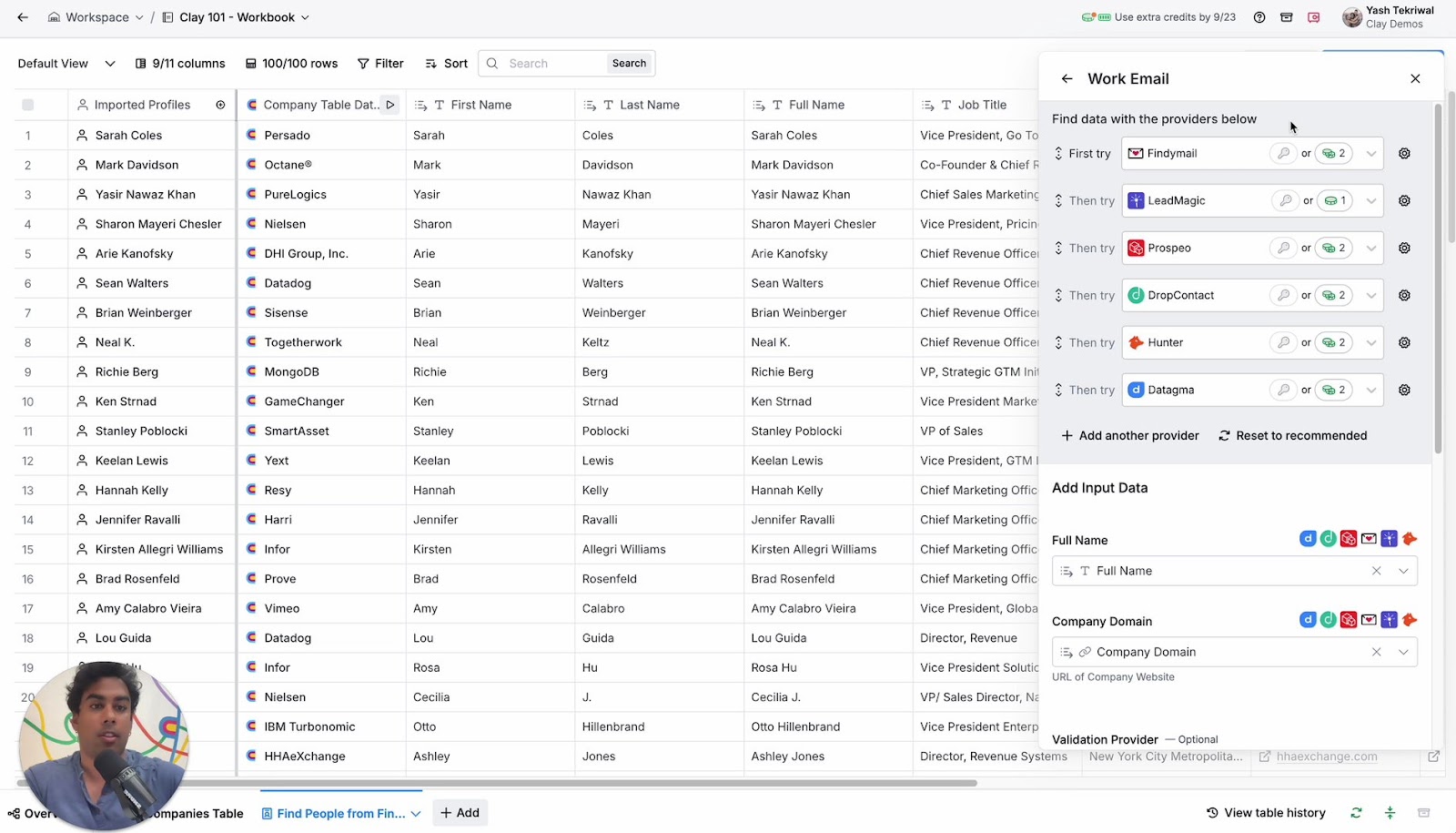
Clay isn't an enrichment database - it's the orchestration layer that sits on top of multiple databases. You build waterfall workflows that query providers sequentially, and Clay merges the best results into a single record. In practitioner tests, this approach produces ~10-14% bounce rates, dramatically better than any single source.
Clay overhauled pricing on March 11, 2026. The new structure uses two currencies: data credits (for buying data from providers) and actions (for platform orchestration). Launch runs $185/mo for 2,500 data credits and 15,000 actions. Growth is $495/mo for 6,000 data credits and 40,000 actions. The big change: failed lookups no longer cost credits - you're only charged when data is found. CRM integrations moved down to the Growth tier.
We've found Clay's flexibility is unmatched for teams that want full control over which providers get queried and in what order. But the two-currency system takes real time to optimize, and there's a genuine learning curve before you're getting value from it. For smaller teams enriching under 5,000 contacts a month, the complexity isn't worth it. If you want a deeper cost/workflow breakdown, see our guide to Clay list building.
FullEnrich - Best Hands-Off Waterfall
FullEnrich runs a multi-provider cascade behind the scenes - Hunter, Datagma, ContactOut, and others - so you get waterfall benefits without building the waterfall yourself. The credit model is clean: 1 credit per work email, 3 per personal email, 10 per mobile number. You're only charged when data is actually found.
Regional find rates are transparent: US/Canada email hits 89%, EMEA 84%, LATAM and APAC both 78%. Triple email verification keeps bounce rates low. Users on r/EmailProspecting report valid-email yield jumping from 60-70% with single-source tools to ~90% with FullEnrich's cascade. FullEnrich holds SOC 2 Type II, GDPR, and CCPA compliance certifications. Pricing starts around $29/mo, and credits roll over (3 months on monthly plans, 1 year on annual).
Skip it if you need granular control over which providers are queried or want to build custom enrichment logic. FullEnrich's cascade is a black box - effective, but you can't reorder or exclude specific providers.
Apollo.io - All-in-One Losing Trust
Apollo's 275M+ contact database and built-in sequencing make it the default starting point for SMB outbound teams. Pricing is accessible: free tier, Basic at $59/user/mo, Professional at $99/user/mo, Organization at $149/user/mo.
But the enrichment quality has been slipping badly. Practitioner-reported bounce rates of 32-38% put Apollo well above the 2% danger zone, and the r/coldemail consensus is that data quality is declining while prices creep up. Apollo is still a solid prospecting and sequencing platform, but don't rely on it as your primary source for verified emails. Verify everything Apollo gives you before it hits a sequence.
Hunter.io - Precision Over Volume
Hunter is the quiet accuracy leader in domain-based email search. A third-party benchmark showed 89-96% validity - the highest in the study, though at lower volume than competitors. Pricing is transparent: free tier with 50 credits/mo, Starter at $34/mo, Growth at $104/mo, Scale at $209/mo with built-in verification included.
Hunter works best when you know the company domain and need reliable emails for specific contacts. It's a precision tool, not a database. If you’re evaluating alternatives, see our list of Hunter alternatives.
ZoomInfo - Enterprise Price Tag
ZoomInfo is the tool your CFO will eventually question. Contracts run $15-40k/year with annual commitments, and you'll need a sales call just to see pricing. The database is deep - particularly for US firmographic and technographic data - and the platform's breadth (intent, chat, workflow automation) is unmatched. Data refreshes around every 4-6 weeks, and at roughly $1/lead, the cost-per-contact is about 100x what you'd pay with a self-serve tool at ~$0.01/lead. For enterprise teams running full-stack ABM, ZoomInfo still makes sense. For everyone else, it's an expensive habit.
Cognism - GDPR-First, EU Strength
Cognism is the go-to for teams selling into Europe. GDPR-first positioning, Bombora intent data included, and strong EU/UK mobile coverage make it the obvious choice for EMEA-heavy pipelines. Pricing typically starts at $15k+/year on annual agreements. Where Cognism wins over ZoomInfo: European compliance and mobile verification. Where ZoomInfo still wins: US database depth and workflow breadth.
Lusha
Chrome extension-focused tool with a free tier (50 emails + 5 phones/mo), Pro at $36/user/mo, and Premium at $59/user/mo. Bounce rates of 22-28% in practitioner tests are better than Apollo but still well above the 2% threshold without additional verification.
Snov.io
Budget-friendly email finder with built-in cold email sequencing. Free option available, Starter at $30/mo. Bounce rates of 28-35% in practitioner tests place it alongside Apollo in raw bounce performance. Best for early-stage teams who want email finding and basic outreach in one tool without paying for Clay or Apollo.
Clearbit / Breeze Intelligence
Now a HubSpot add-on starting at $45/mo (annual) for 100 credits. The critical caveat: Breeze Intelligence doesn't find email addresses. It enriches records that already have them - appending firmographic and technographic data. Expect around $450/mo for 1,000 credits, plus a HubSpot subscription. If you need to find new contacts, this isn't the right category.
Kaspr
Chrome extension for quick prospecting lookups, starting around $45/mo with credit-based pricing and EU-focused data. Best for individual reps who need fast contact data from professional profiles rather than bulk enrichment workflows.
Choosing the Right Platform
| Tool | Starting Price | Credit Model | Free Tier | Transparent Pricing? |
|---|---|---|---|---|
| Prospeo | ~$0.01/email | Per-credit | Yes (75/mo) | Yes |
| Clay | $185/mo | Credits + actions | Yes (100) | Yes |
| FullEnrich | ~$29/mo | Per-result | Limited | Yes |
| Apollo.io | $59/user/mo | Included | Yes | Yes |
| Hunter.io | $34/mo | Per-credit | Yes (50/mo) | Yes |
| ZoomInfo | ~$15k+/yr | Bundled | No | No (sales call) |
| Cognism | ~$15k+/yr | Bundled | No | No (sales call) |
| Lusha | $36/user/mo | Per-credit | Yes | Yes |
| Snov.io | $30/mo | Per-credit | Yes | Yes |
| Breeze Intel | $45/mo + HubSpot | Per-credit | No | Partially |
| Kaspr | ~$45/mo | Per-credit | Yes | Yes |
ZoomInfo and Cognism still require a sales call to see pricing in 2026. Most other tools on this list publish starting prices. Watch for providers that charge credits on failed lookups - you're paying for nothing. Clay and FullEnrich both eliminated this practice; make sure any tool you evaluate has done the same.
How to Run a 500-Record Bake-Off
Don't trust vendor claims. Test them. This takes about two weeks, and in our experience it's the single best investment you can make before signing an annual contract.
1. Export 500 contacts from your CRM - pick records where you already know the correct email (past replies, meeting attendees). This is your ground truth.
2. Strip the email field and run the list through 2-3 enrichment tools. Use the Prospeo enrichment API and one other tool. You can compare valid-email yield in about an hour.
3. Verify results independently with a dedicated verifier like NeverBounce or ZeroBounce. Don't trust the enrichment tool's own verification - use a neutral third party. (If you’re shopping, start with our roundup of the best email verifier tools.)
4. Calculate cost-per-usable-contact - total spend divided by the number of verified-valid emails returned. This is the only metric that matters.
5. Compare against your ground truth - what percentage of known-good emails did each tool find correctly?
The tool with the lowest cost-per-usable-contact wins. Not the one with the highest match rate or the slickest UI.
Compliance Checklist
GDPR enforcement has hit ~EUR 5.88B in cumulative fines across 2,245 actions. The penalty ceiling is EUR 20M or 4% of global annual turnover. This isn't theoretical risk.
For B2B email enrichment under GDPR, you need:
- Legal basis: legitimate interest is the standard for B2B outreach, but it must be relevant to the recipient's professional role
- Self-identification: your first email must clearly state who you are
- Purpose statement: explain why you're reaching out
- Easy opt-out: one-click unsubscribe, honored immediately
- Data source transparency: be prepared to tell recipients where you got their data
Under CCPA, California residents can request data deletion and opt out of data sales. Simpler than GDPR but still enforceable.
When evaluating tools, look for SOC 2 Type II certification, available DPAs (Data Processing Agreements), and documented opt-out enforcement. A tool that can't produce a DPA on request is a red flag. For a deeper audit framework, see our GDPR compliant database checklist.
FAQ
What's the difference between email enrichment and email verification?
Email enrichment finds addresses you don't have - input a name and company, get a deliverable email back. Verification checks whether emails you already possess are valid and won't bounce. Most outbound teams need both: enrichment to build the list, verification to clean it before sending.
What bounce rate should I target?
Keep total bounces below 2% - that's the ISP throttling threshold. Top performers target hard bounces under 1%. At 5%+, you're actively damaging your domain. Run every enriched list through independent verification before sending, no exceptions.
Is waterfall enrichment worth the complexity?
For teams enriching 1,000+ contacts per month, yes - waterfall produces 35-40% more valid results than single-source tools. Below that volume, one accurate provider with 98% accuracy at $0.01/email is enough. The overhead of managing multiple vendors only pays off at scale.
How often should I re-enrich my lists?
Re-enrich active prospect lists every 30-90 days and dormant lists every 90-180 days. Job changes, company merges, and email deactivations cause roughly 30% annual data decay. Providers with faster refresh cycles (7 days vs. the 6-week industry average) reduce this risk significantly.
Can I use enrichment tools under GDPR?
Yes, with a legal basis - typically legitimate interest for B2B outreach. You must identify yourself, state your purpose, provide a one-click opt-out, and disclose where you sourced the data. Choose tools with SOC 2 certification and available DPAs. GDPR doesn't ban cold outreach; it regulates how you do it.