

Best Email Existence Checkers in 2026: Compared and Ranked
You upload 10,000 contacts to your sequencer, hit send, and watch 1,500 bounce before lunch. Your domain reputation tanks. Your next campaign lands in spam. And the "verified" list you bought last quarter - full of false positives that passed a basic syntax check - is costing you deals instead of generating them. A study analyzing nearly 1 billion emails across 23 industries found only 80.94% were valid, meaning roughly 1 in 5 addresses on any given list is dead weight.
That's a pipeline killer, not a minor hygiene issue. The global inbox placement rate sits around 83.5%, so even legitimate emails struggle to reach the inbox. Layer a dirty list on top of that and you're fighting two battles at once. An email existence checker solves the first one - confirming whether a mailbox is real before you burn a send on it. The difference between a 15% bounce rate and a 2% bounce rate is often just one verification step.
Not all checkers are equal, though. Some choke on catch-all domains. Some charge 6x what others do for the same result. And the free tools floating around Reddit? Most cap at 100-200 checks and call it a day.
Our Top Picks
| Pick | Use Case | Why |
|---|---|---|
| Prospeo | Accuracy & freshness | 98% accuracy, catch-all handling, 7-day refresh |
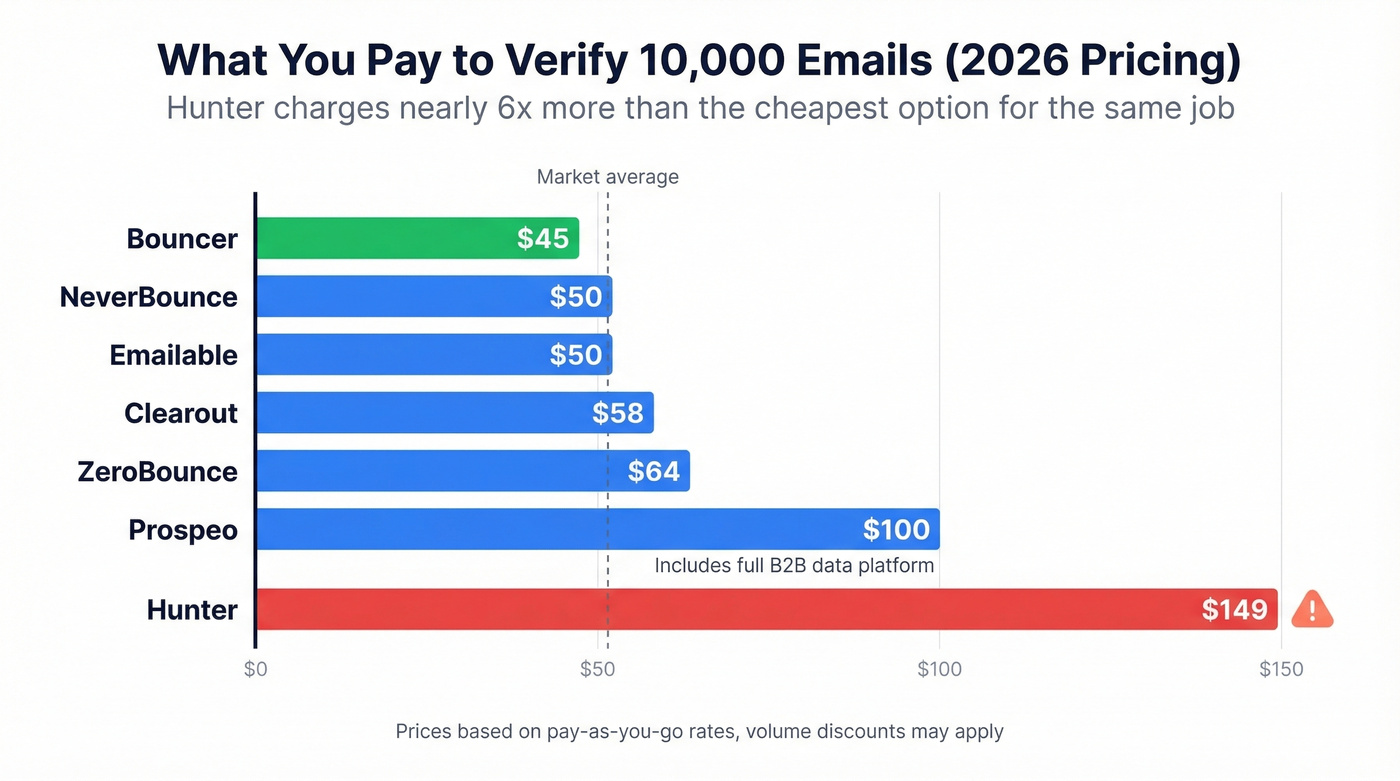
| Bouncer | Budget bulk verification | $45 per 10K, G2 4.8, generous free trial |
| ZeroBounce | Enterprise compliance | SOC 2 + ISO 27001, 100 free/month |
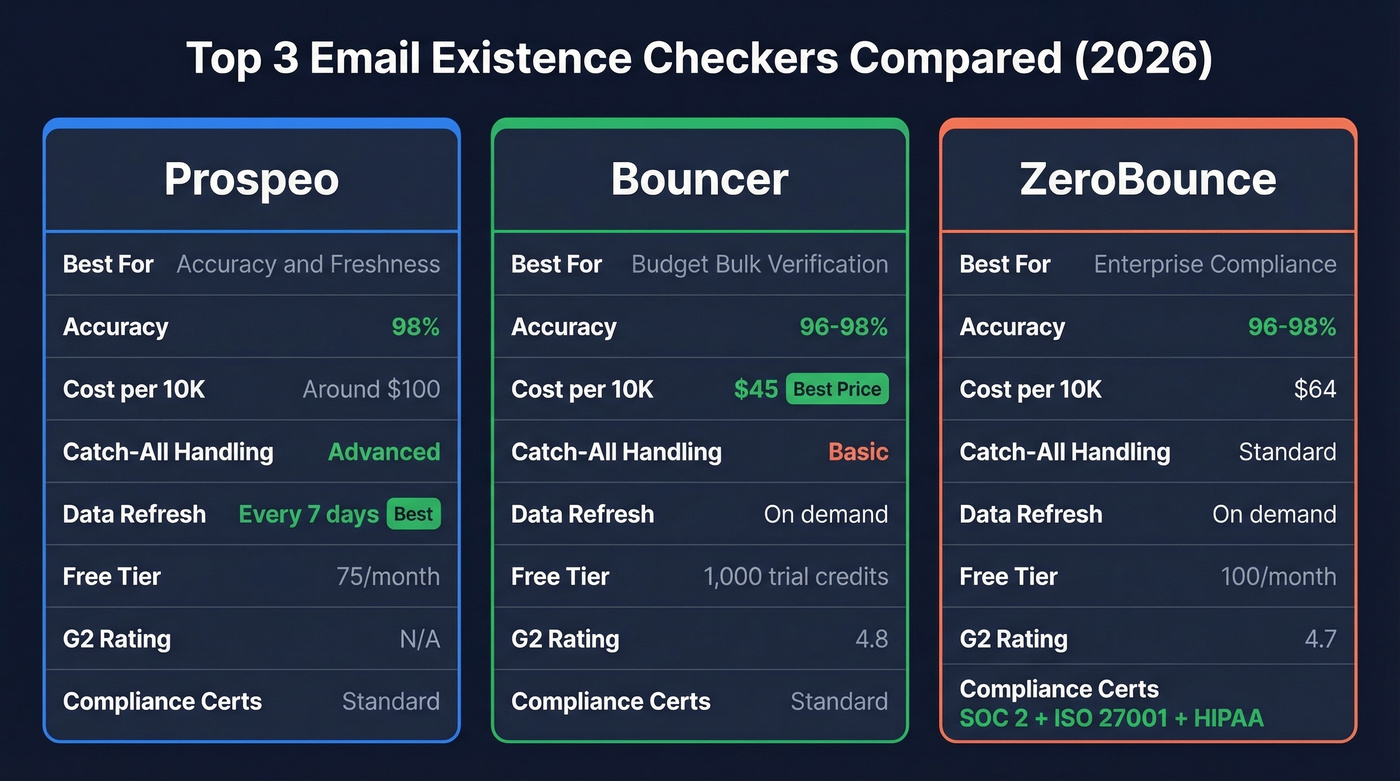
Prospeo wins on raw accuracy and data freshness. Bouncer wins on price-to-quality ratio for large lists. ZeroBounce wins when your compliance team needs certifications on file. Most teams need one of these three - the rest of this article helps you decide which.
How Email Verification Actually Works
Every serious email existence checker runs a multi-step technical process, though thoroughness varies wildly between tools. G2's category definition describes the core signals: syntax validation, domain verification, SMTP checks, and spam-trap identification. Here's what each step does and why it matters.
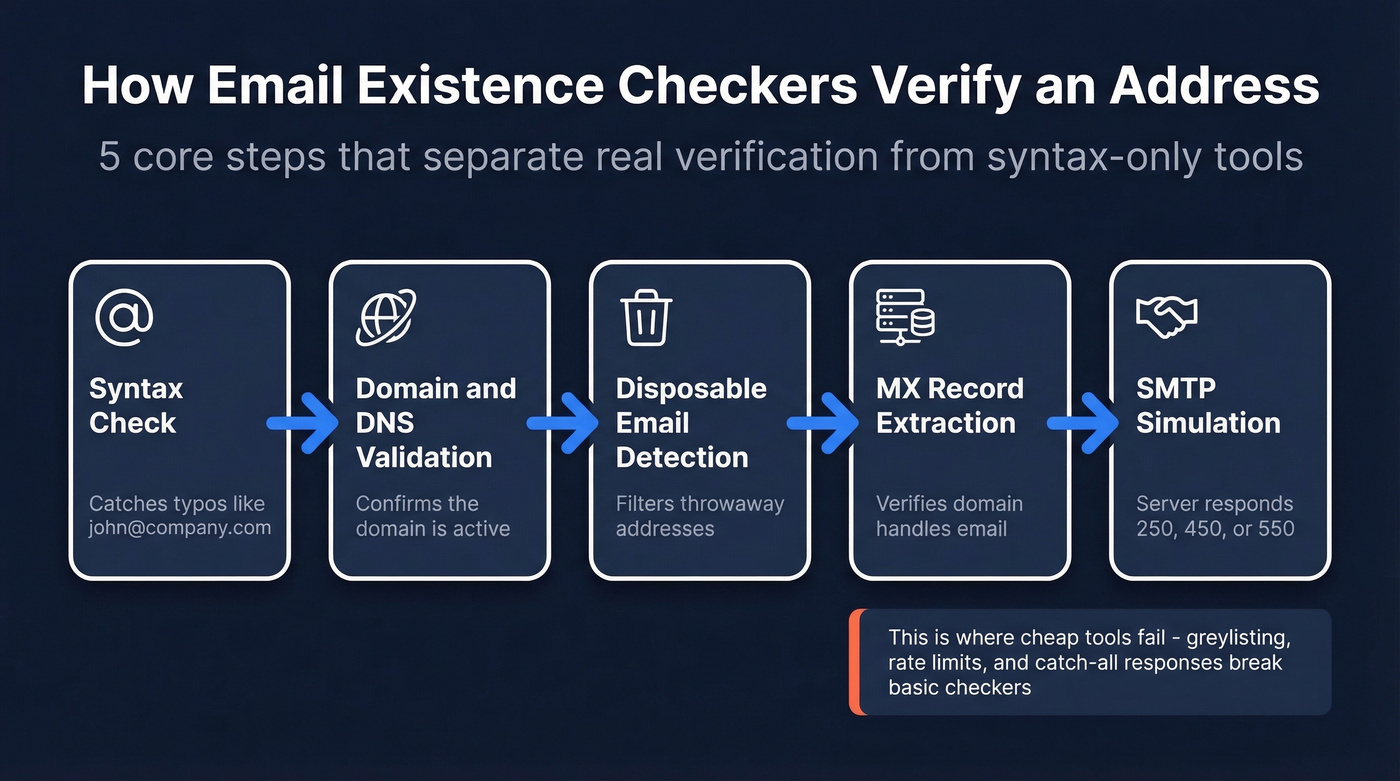
- Syntax check - Does the address follow valid formatting rules? Catches typos like
john@@company.comor missing TLDs. - Domain and DNS validation - Does the domain exist and is it active? A perfectly formatted email at a dead domain is still worthless.
- Disposable email detection - Is this a throwaway address from Guerrilla Mail or Temp-Mail? Dead ends for B2B outreach.
- MX record extraction - Pulls mail exchange records to confirm the domain handles email. No MX records, no inbox.
- SMTP simulation - Connects to the mail server and simulates sending without actually delivering. The server responds with a code: 250 means accepted, 550 means the recipient doesn't exist, 450 means a temporary issue like greylisting.
Step 5 is where cheap tools fall apart. The SMTP handshake requires handling greylisting, rate limiting, and catch-all responses - most free checkers bail at the first complication. Some tools claim 30+ verification steps, but the five core checks above are what actually matter. Everything beyond them is sub-routine detail.
Here's the thing: a 250 code doesn't always mean a real person reads that inbox. On catch-all domains, the server accepts everything. Understanding that a successful SMTP handshake is necessary but not sufficient is the key to evaluating any verification tool - and it leads directly to the biggest blind spot in the space.
The Catch-All Problem
A catch-all domain accepts every incoming email regardless of whether the specific mailbox exists. Send to totally.fake.person@catchall-company.com and the server returns a 250 - accepted. Your verification tool marks it "valid." Nobody's reading that email.
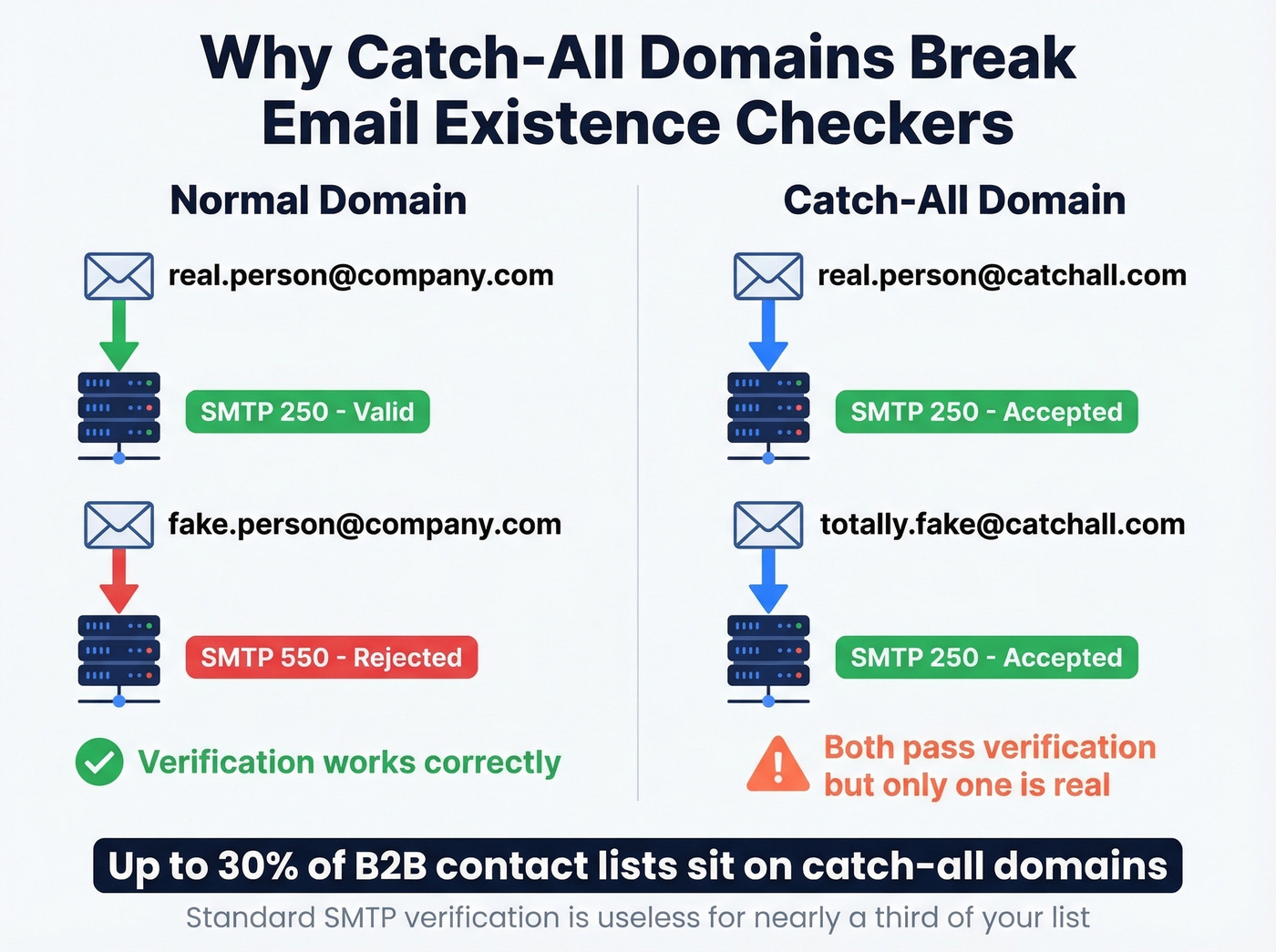
This matters more than most teams realize. Up to 30% of a typical B2B contact list sits on catch-all domains. That's nearly a third of your list where standard SMTP verification is essentially useless - you can't reliably confirm if an email address exists just because the server accepted the connection.
Why "valid" doesn't mean deliverable: A 250 SMTP response on a catch-all domain only confirms the server accepted the connection. It says nothing about whether the recipient exists or whether your email will arrive. Treat catch-all results as "risky," not "verified."
When you're evaluating any email existence checker, catch-all handling is the single best proxy for how seriously the vendor takes accuracy. Tools like Email Hippo offer free single-check lookups but don't scale for bulk workflows. If a tool doesn't mention catch-all handling on its site, it's probably not doing it.

Catch-all domains fool most email existence checkers. Prospeo's 5-step verification handles catch-alls, spam traps, and honeypots - delivering 98% accuracy across 143M+ emails refreshed every 7 days, not 6 weeks.
Drop your bounce rate below 4% like Meritt did - start free.
Best Tools to Check If an Email Exists - Ranked
Prospeo - Best for Accuracy and Freshness
Prospeo runs 98% email accuracy across 143M+ verified emails through a 5-step verification process that includes catch-all handling, spam-trap removal, and honeypot filtering. Where most tools verify once and move on, Prospeo refreshes its entire database every 7 days - the industry average is closer to 6 weeks. That gap matters when you're running sequences against lists that are even a month old.
We've seen the difference firsthand. Meritt went from a 35% bounce rate to under 4% after switching - that's the difference between a domain that's flagged and one that's healthy. Beyond verification, Prospeo is a full B2B data platform with 300M+ professional profiles, intent data across 15,000 topics, and a Chrome extension used by 40,000+ people. The proprietary email-finding infrastructure doesn't rely on third-party email providers, which is a meaningful distinction when you're troubleshooting data quality issues.
Pricing starts at ~$0.01 per email with volume discounts on higher tiers, plus a free tier of 75 emails per month. No contracts, no annual commitments. The API runs a 92% match rate, and native integrations cover HubSpot, Salesforce, Zapier, Make, Smartlead, Instantly, and Lemlist.
Best for: Sales teams and outbound agencies who can't afford bounces or domain reputation damage. If you're also tightening your sending stack, pair verification with an email deliverability guide and a clear email velocity policy.
Also useful: if you're comparing vendors beyond this shortlist, see our breakdown of Bouncer alternatives and Hunter alternatives.
Every bounced email chips away at your domain reputation. Prospeo's proprietary verification infrastructure catches the dead addresses other tools mark as valid - at $0.01 per email with no contracts.
Verify 75 emails free and see the accuracy difference yourself.
ZeroBounce - Best for Enterprise Compliance
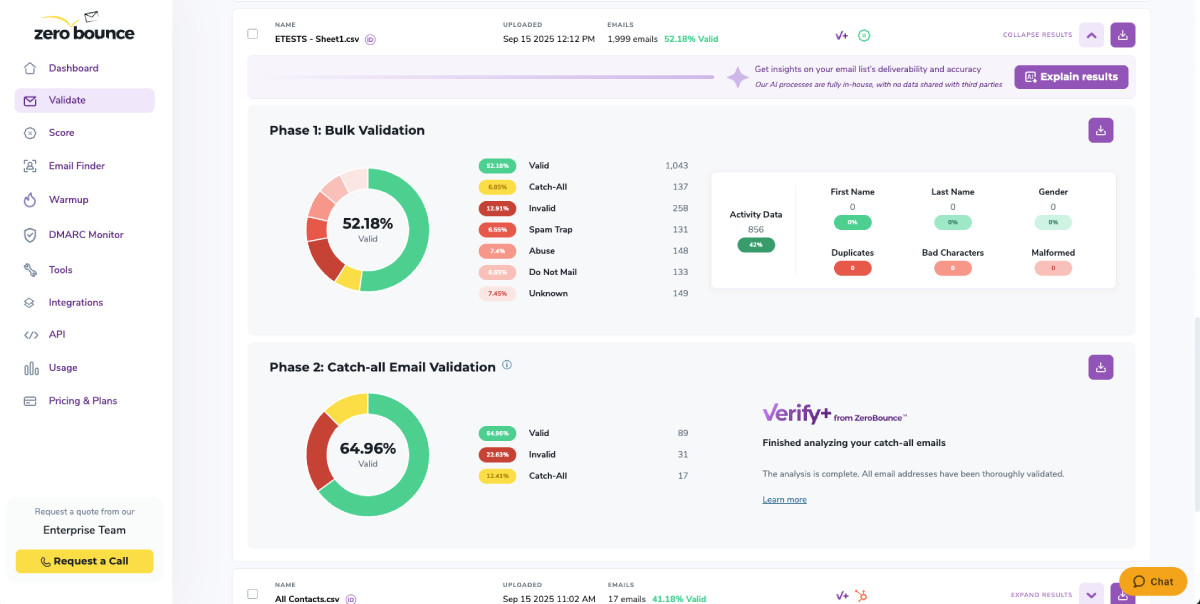
ZeroBounce is the checker you pick when your legal or compliance team needs certifications on file. SOC 2 Type 2, ISO 27001, and HIPAA compliance - that's a stack most competitors can't match. The G2 rating sits at 4.7 across 515+ reviews, a massive review base for this category.
The tradeoff: You're paying a premium for those certifications. ZeroBounce runs $64 per 10K verifications on pay-as-you-go, or $18/month for a 2,000-email subscription. Accuracy lands in the 96-98% range on mixed lists - strong, but not meaningfully better than tools costing half as much. You get 100 free verifications per month, and enterprise plans include dedicated support.
Best for: Mid-market and enterprise teams where compliance documentation is a procurement requirement. Skip if: You're budget-conscious and don't need SOC 2 paperwork. You're paying for certifications, not better accuracy.
Bouncer - Best for Budget Bulk
We've watched teams burn through verification budgets in a week because they picked a tool charging $10+ per thousand. Bouncer solves that. At $45 per 10K verifications with volume discounts, it's one of the most cost-effective options in the category - and it doesn't sacrifice quality to get there.
The G2 rating is 4.8 with a Capterra score of 4.9, making it the highest-rated tool by user reviews in this space. Bouncer processes up to 180K emails per hour, and the free trial typically includes 1,000 credits - enough to test a real sample list before committing.
Best for: Cleaning large lists (50K+) on a budget without sacrificing accuracy. Skip if: You need granular catch-all domain handling. Bouncer's detection is decent but not as thorough as the top tier.

NeverBounce
For teams already using Validity products, NeverBounce is the path of least resistance. It plugs into most major ESPs and CRMs natively, making it the easiest tool to add to an existing stack without integration headaches. Pricing runs $8 per 1K or $50 per 10K, with 1,000 free trial credits. Expect real-world accuracy in the 95-98% range on mixed lists. Skip this if you're optimizing purely on price or need advanced catch-all handling.
Emailable
Two million emails per hour. That's Emailable's headline claim, and if it holds in production, it's the fastest checker in the category by a wide margin. For teams running time-sensitive bulk jobs - think a product launch where you need a 200K list cleaned by end of day - that speed is the entire value proposition.
G2 rating is 4.8, Capterra 4.7, and pricing comes in at $50 per 10K with 250 free credits. You're paying a slight premium over Bouncer for the velocity. Worth it if speed is your bottleneck. Not worth it if it isn't.
Clearout
Think of Clearout as ZeroBounce Lite. It offers GDPR plus ISO/SOC 2 compliance at a lower price point - $21/month for 3,000 credits on a subscription model, or $58 per 10K on pay-as-you-go. G2 and Capterra both rate it 4.7. The subscription model appeals to teams that want predictable monthly costs instead of pay-as-you-go math, but for high-volume bulk work the per-email cost adds up fast compared to Bouncer or EmailListVerify.
Hunter - Overpriced for Verification
Hunter is famous for email finding, not verification. The pricing reflects that split identity: $149 per 10K verifications - nearly 6x what EmailListVerify charges and over 3x Bouncer. The free plan gives you 100 verifications per month. Hunter's email verifier is fine for spot-checking addresses you've already found through their platform, but if verification is your primary need, you're massively overpaying. Skip this for verification-only workflows.
If you're using verification as part of a broader outbound workflow, it also helps to standardize your sales prospecting techniques and keep a clean lead generation workflow so bad data doesn't re-enter the system.
EmailListVerify
The cheapest bulk option in the category at $24 per 10K. No frills, no compliance certifications, no speed claims. It does the job. Best for cost-sensitive teams verifying 50K+ emails who don't need advanced catch-all handling or enterprise-grade security.
Snov.io
At $189 per 10K verifications, Snov.io is the most expensive per-10K option on this list. The verification is bundled into a broader sales engagement suite - email finding, drip campaigns, CRM features - whether you use them or not. Only consider Snov.io if you're already paying for their full platform and want verification built in. Otherwise, you're subsidizing features you don't need.
Verifalia
Verifalia offers a free email checker and a validation process involving over 30 steps. It also supports a Google Sheets integration, which is useful for non-technical users who want to verify an email address without leaving their spreadsheet. Pricing falls in the $40-80 per 10K range depending on tier and volume.
Pricing at a Glance
| Tool | Per 1K | Per 10K | Free Tier | API |
|---|---|---|---|---|
| Prospeo | ~$10 | ~$100 (volume discounts) | 75/month | Yes (92% match) |
| Bouncer | $7-8 | $45 | ~1,000 trial | Yes |
| ZeroBounce | ~$7.50 | $64 | 100/month | Yes |
| NeverBounce | $8 | $50 | 1,000 trial | Yes |
| Emailable | ~$5 | $50 | 250 credits | Yes |
| Clearout | ~$5.80 | $58 | 100 credits | Yes |
| Hunter | ~$14.90 | $149 | 100/month | Yes |
| EmailListVerify | ~$2.40 | $24 | 100 credits | Yes |
| Snov.io | ~$18.90 | $189 | Limited | Yes |
| Verifalia | ~$4-8 | ~$40-80 | Limited | Yes |
The cheapest option isn't always the best deal. EmailListVerify at $24/10K looks great until you realize catch-all handling is basic and you're re-verifying risky addresses manually. A single domain reputation hit costs more than a year of verification credits from an accuracy-focused tool. If you're diagnosing bounces, use an email bounce rate playbook to map codes to fixes.
Mistakes That Kill Deliverability
Let's be honest: if your deal sizes are modest - say, under five figures - you probably don't need the most expensive verification tool on the market. But you absolutely need one. And you need to avoid these five operational mistakes that wreck sender reputation regardless of which tool you pick.
Not re-verifying regularly. Average professional turnover hit 41% in recent years. A list verified in January is significantly decayed by April. Re-verify every 30-90 days before your next campaign.
Trusting random free tools. There's a Reddit thread where someone built a free Streamlit validator and posted it for public use. No security audit, no data handling policy. You're feeding your prospect list into a stranger's server.
Ignoring catch-all results. Marking catch-all addresses as "valid" and blasting them is how you hit a 15% bounce rate on a "clean" list. Treat catch-all as risky and send cautiously - or skip entirely.
No lifecycle integration. Verification should happen at point of capture, before every campaign, and on a recurring schedule. A one-time bulk clean doesn't cut it when 38% of employees leave within their first year. If you're building this into your stack, start with data enrichment services and a consistent lead enrichment process.
Exceeding safe thresholds. Keep bounce rates under 2% and spam complaints under 0.1%. Some sources cite 5% as the danger zone, but major ESPs start throttling well before that. Don't exceed 50 emails per day per inbox during warmup. For deeper remediation, see how to improve sender reputation and email reputation tools.
FAQ
How accurate are email existence checkers?
Most tools hit 90-99% accuracy on standard domains. Catch-all domains are where accuracy diverges - some tools return "unknown" for 20-30% of a B2B list. Self-reported "99%" claims are marketing. Look for tools that specifically address catch-all handling with spam-trap removal and honeypot filtering.
How often should I re-verify my list?
Every 30-90 days minimum. With 41% annual professional turnover, lists decay faster than most teams expect. Tools with automatic refresh cycles reduce the manual burden, but run full list cleans quarterly regardless.
What's a catch-all domain and why does it matter?
A catch-all domain accepts all incoming email regardless of whether the recipient exists. The server returns a 250 SMTP code for any address, making standard verification unreliable. Up to 30% of B2B lists sit on catch-all domains - it's the single biggest accuracy differentiator between tools.
How do I check if an email exists without sending a message?
Every tool in this list uses SMTP simulation - they initiate a connection to the mail server and check the response code without completing delivery. This lets you validate addresses at scale without triggering bounces or alerting the recipient. The limitation is catch-all domains, where the server accepts everything regardless of whether the mailbox is real.
Is a free email existence checker enough for outbound?
For spot-checking 10-20 addresses, free tools work fine. For cleaning a campaign list, no. Most free tiers cap at 100-200 checks - useless for real outbound volume. Paid verification starts at $7-10 per thousand emails, which is trivial compared to a burned domain that takes weeks to recover.