

Email Marketing Personalization: The Practitioner's Guide for 2026
A practitioner who managed email for 40+ ecommerce brands put it bluntly on r/EntrepreneurRideAlong: the brands that personalized with just a first name in the subject line and nothing else saw no lift - sometimes negative lift. Chad White, formerly of Oracle, said it even more directly: first-name-only personalization is "as likely to hurt performance as to help it" because recipients feel tricked when the body doesn't follow through.
Most email marketing personalization advice stops at merge tags. This guide doesn't.
What You Need (Quick Version)
- Stop personalizing with just first names - it backfires when the email body is generic. People feel baited.
- Automated flows deliver 18x more revenue per recipient than campaigns - set them up before you optimize anything else.
- Open rates are broken post-MPP - Apple Mail Privacy Protection inflates them. Measure clicks and revenue instead.
- Personalization built on dirty data damages your sender reputation - verify your list before you personalize it.
What Personalization Actually Means
Email personalization isn't a feature you toggle on. It's a spectrum, and most teams are stuck at the shallow end.
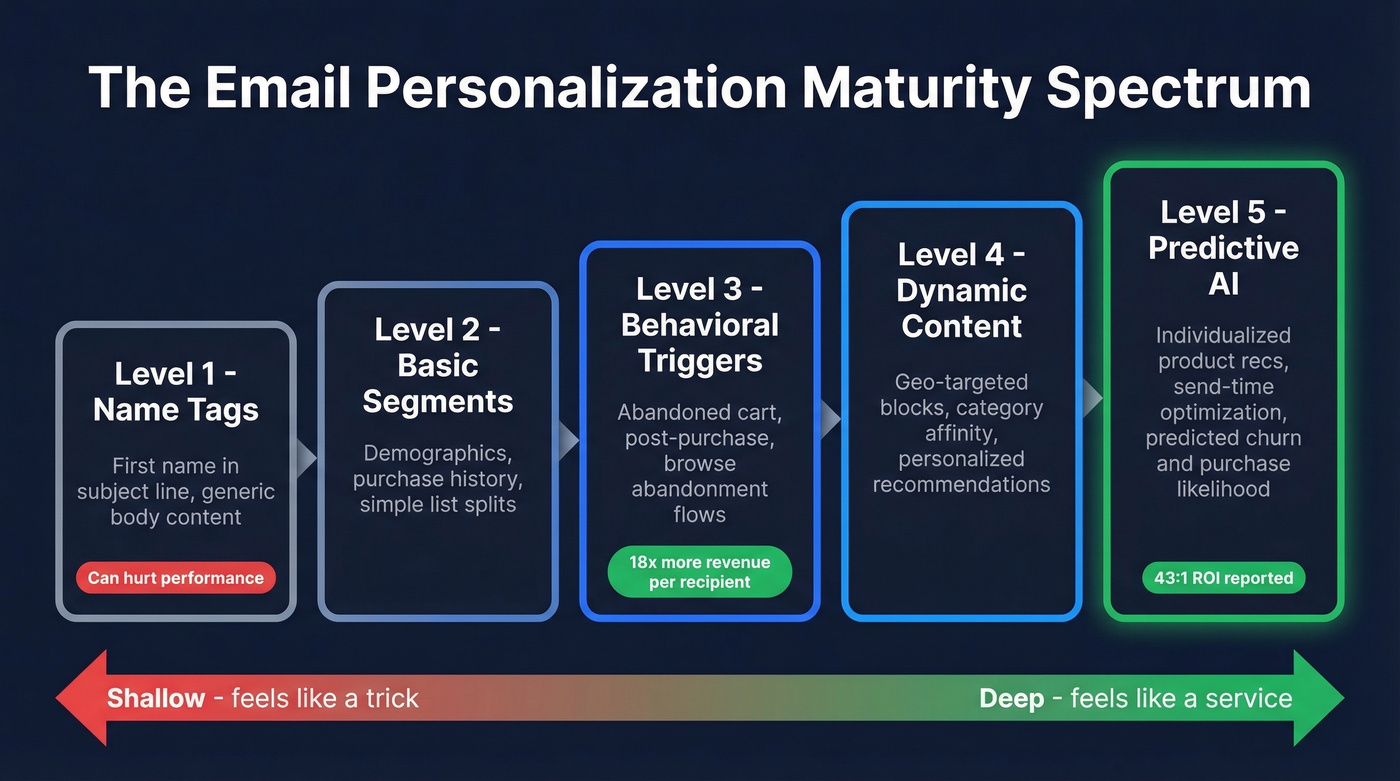
At the bottom: name insertion - {{first_name}} in the subject line. One step up: basic segmentation by demographics or purchase history. Then behavioral triggers like abandoned cart and post-purchase flows. At the top: predictive AI serving individualized product recommendations, dynamic content blocks, and send-time optimization tuned to each recipient's engagement patterns.
The data foundations that power real personalization go deeper than most teams realize. You need clean identity resolution across channels, documented consent status, behavioral event streams from your site, commerce data tied to individual profiles, and - ideally - predicted likelihoods for purchase, churn, and engagement. Without those inputs, even the best personalization engine is guessing.
Here's the principle that matters: personalization without substance is worse than no personalization at all. A generic email that's honest about being a broadcast is fine. An email that pretends to know you but clearly doesn't erodes trust. The goal isn't more merge tags - it's delivering content that matches the recipient's actual context and needs.
The ROI Numbers You Need to Know
The gap between personalized and non-personalized email is hard to ignore.
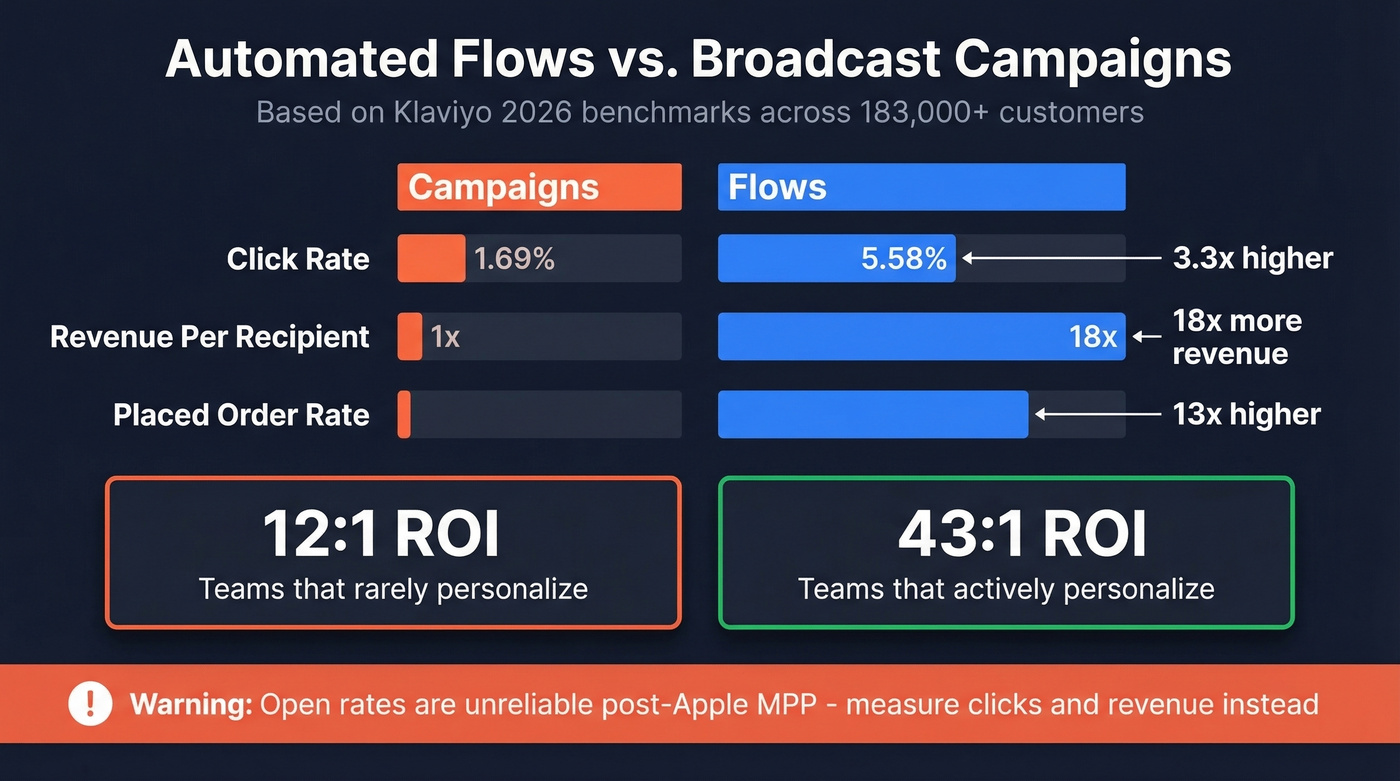
Klaviyo's 2026 benchmark dataset - covering 183,000+ customers - shows automated flows generate roughly 41% of total email revenue from just 5.3% of sends. Revenue per recipient is nearly 18x higher for flows than campaigns. Flow click rate is 5.58% versus 1.69% for campaigns. Placed order rates? 13x higher.
On the ROI side, a Litmus survey of 2,000+ marketers found that teams who actively personalize report 43:1 ROI. Teams who rarely or never personalize report 12:1. That's not a marginal difference - it's a completely different business case.
One critical caveat: open rates aren't reliable anymore. Apple Mail Privacy Protection has inflated open rates by roughly 3.5% year-over-year while click-to-open rates dropped 3.6%. If you're measuring personalization success by opens alone, you're measuring noise. Track clicks, conversions, and revenue per recipient instead.
Mistakes Killing Your ROI
Before the tactics, let's kill the bad habits - the patterns we see repeatedly and the ones practitioners on Reddit flag most often.
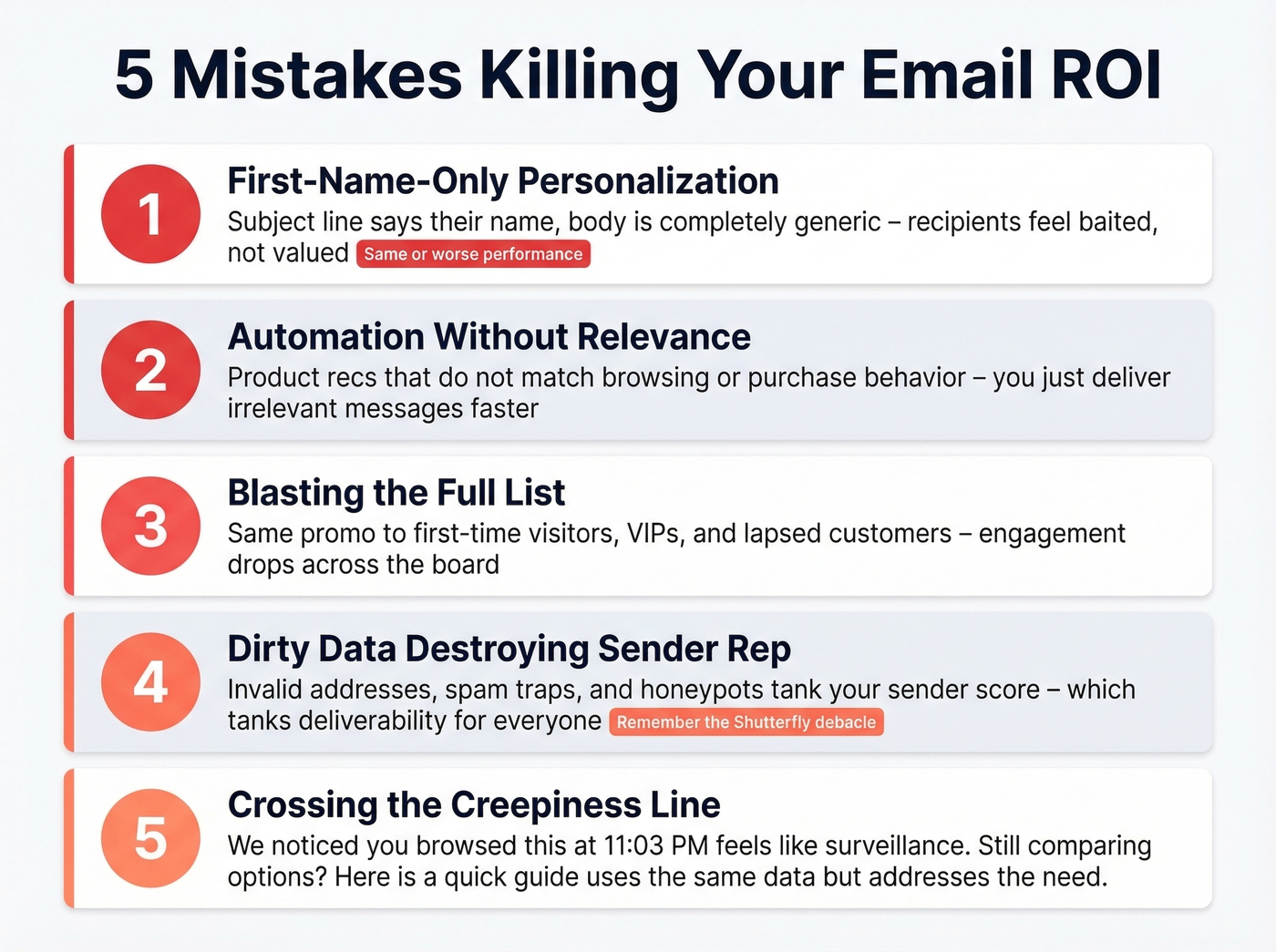
1. First-name-only personalization. Chad White's research at Oracle found that emails personalized with only a first name - where the body content is completely generic - perform the same or worse than unpersonalized emails. If you personalize the subject line, the body needs to follow through with something relevant.
2. Automation without relevance. A common practitioner takeaway on r/EmailWhisperers is blunt: too many brands set up automated flows that serve "personalized" product recommendations that don't match actual browsing or purchase behavior. Automation without relevance just delivers irrelevant messages faster.
3. Blasting the full list. Still happening everywhere. Brands sending the same promotional email to their entire database - first-time visitors, VIPs, lapsed customers - and wondering why engagement drops. Segmentation isn't optional anymore.
4. Dirty data destroying sender reputation. Every tactic in this article fails if your contact list is full of invalid addresses, spam traps, and honeypots. Remember the Shutterfly debacle - a "new baby" congratulations email blasted to people who hadn't had babies, because the targeting data was wrong? The everyday version is subtler and just as damaging. Bounced emails tank your sender score, which tanks deliverability for everyone on your list. Verify before you personalize.
5. Crossing the creepiness line. There's a difference between helpful personalization and surveillance. "We noticed you browsed this at 11:03 PM" makes people feel watched. "Still comparing options? Here's a quick guide" uses the same data but addresses the underlying need. Same signal, vastly different recipient reaction.
9 Tactics That Actually Work
Behavioral Segmentation
Split your list by what people actually do, not just who they are. Purchase frequency, lifecycle stage, value tier, category affinity - these behavioral signals predict future behavior far better than demographics alone. One practitioner managing 40+ brands reported that segmenting a free-shipping campaign into three variants for first-time buyers, VIPs with 2+ purchases, and non-buyers lifted open rates and revenue while dropping unsubscribes. We've seen similar patterns in our own outreach - the moment you stop treating your list as one blob, everything improves.
Geo-Personalization
Using the customer's city in the subject line - something like "Free shipping for customers in {{city}}" - consistently doubled open rates versus generic subject lines across 40+ brands. It requires only a city field in your data, and it works because it signals relevance immediately. Campaign Monitor's own testing found dynamic imagery by location lifted CTR by 29%, reinforcing the same principle.
Automated Flows
The benchmark data makes this non-negotiable: flows deliver a 5.58% click rate versus 1.69% for campaigns, and 18x more revenue per recipient. Welcome series, abandoned cart, post-purchase, browse abandonment, winback - set these up before you optimize anything else. If you're building these for outbound or prospecting-style sequences too, see our guide to personalized drip campaigns.
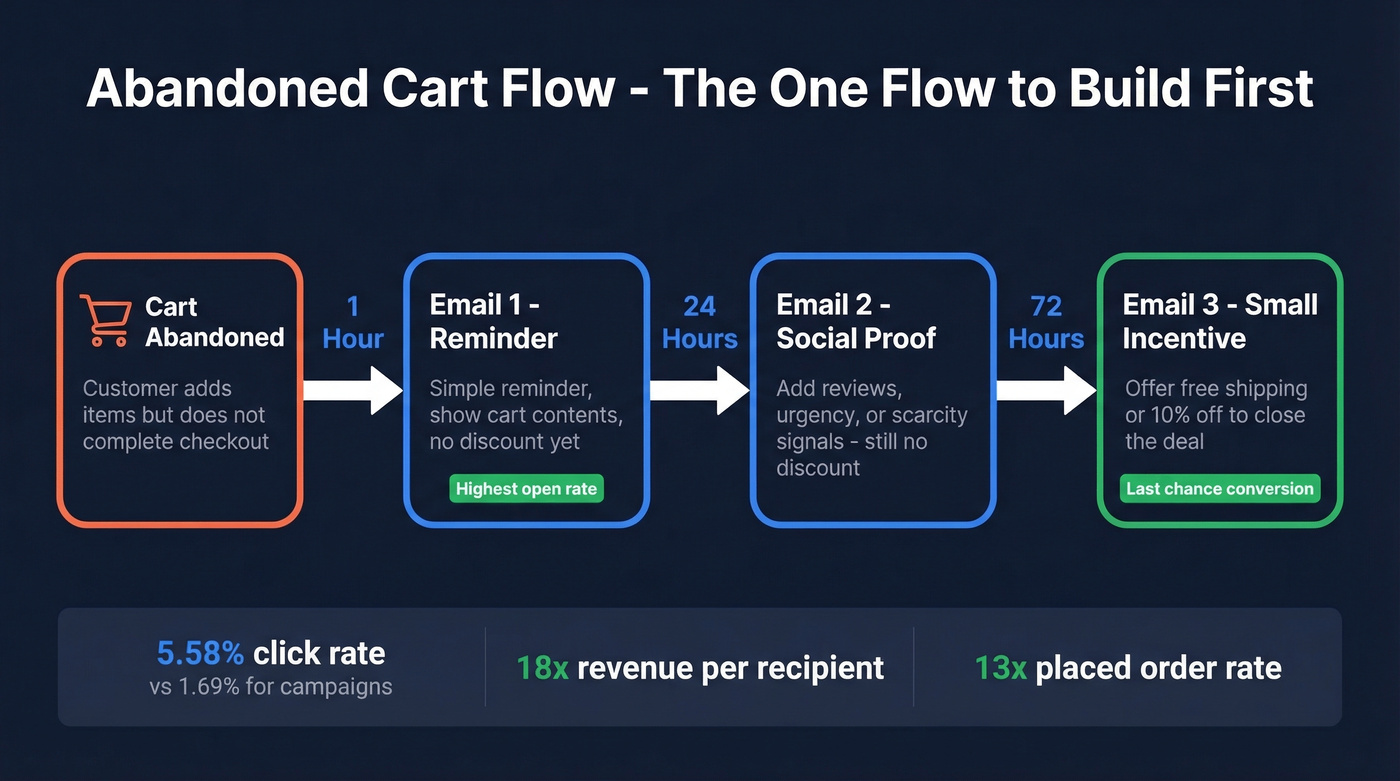
A practical starting cadence for abandoned cart: send the first email 1 hour after abandonment, a second at 24 hours, and a third at 72 hours with a small incentive. Three emails over three days is the sweet spot most practitioners land on. If you're only going to build one flow this quarter, make it this one.
Dynamic Content Blocks
Same email, different content for different segments. Show winter coats to subscribers in Minnesota and light jackets to subscribers in Texas. Show product recommendations based on past purchases rather than bestsellers. Dynamic blocks let you personalize the body without building separate campaigns for every segment.
Send-Time Optimization
| Do This | Not This |
|---|---|
| Use per-recipient send-time optimization based on historical engagement | Blast everyone at 10 AM Tuesday because a blog said so |
| Measure success by click rate and revenue | Measure by open rate (inflated by MPP) |
| Test your own audience's patterns | Copy generic "best time to send" benchmarks |
MailerLite research points to Monday and Tuesday between 3-7 PM as a baseline, but the real win is per-recipient optimization - sending when each individual is most likely to engage. Most modern ESPs offer this. Use it. (If you're doing this for outbound, the best time to send cold emails is a different set of constraints.)
"From" Name Personalization
68% of people decide whether to open an email based on the "from" name. Sending from a real person's name - your account manager, a founder - instead of a generic brand name increases perceived relevance. Small change, outsized impact, especially in B2B where trust is everything. If you need ideas, pull from these email subject line examples and adapt them to your sender persona.
AI Product Recommendations
Benchmark data shows AI-powered product recommendations lift average email click rates to 3.75%, with top performers hitting 8.79%. The key is feeding the algorithm enough behavioral data so the recommendations actually match what each recipient wants. Bad recommendations are worse than no recommendations - they train people to ignore your emails.
Resend Winners
This is the lowest-effort, highest-return tactic on the list. Three steps:
- Identify your best-performing campaign by click rate and revenue.
- Write a new subject line.
- Resend to non-openers 48-72 hours later.
Practitioners report this adds 25-50% more revenue every time, especially during high-stakes periods like Black Friday. We've tested this ourselves and the results hold up - it's almost embarrassingly simple.
Winback Campaigns
Generic "we miss you" emails don't cut it. Dynamic cancellation-reason messaging - where the winback content addresses why each customer left - drove +14% CTR and a 50% reduction in unsubscribe rates in one agency case study. Pair that with location-based pricing or a personalized offer and you've got a real re-engagement engine. If you're building winbacks around churn signals, our churn analysis guide can help you pick the right triggers.

This article makes it clear: personalization on dirty data destroys sender reputation. Prospeo's 5-step verification - with spam-trap removal and honeypot filtering - delivers 98% email accuracy. Stop bouncing. Start personalizing.
Clean data is the foundation. Personalization is the payoff.
B2B: A Different Playbook
Everything above skews ecommerce. Personalizing email in B2B is a fundamentally different game.
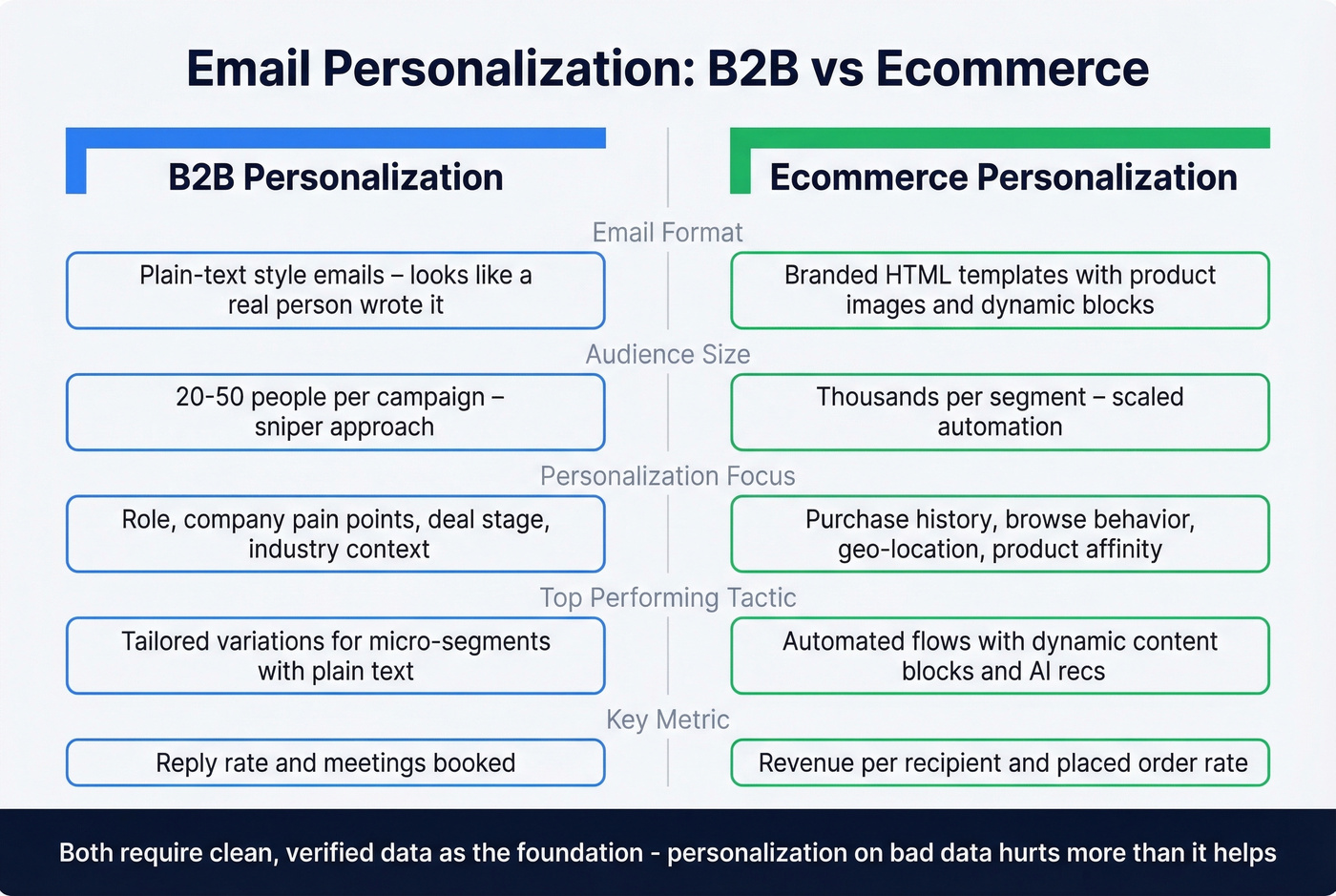
The practitioner framing on r/b2bmarketing is clear: the era of pretty HTML newsletters in B2B is over. Plain-text-style emails sent to highly specific groups outperform polished branded templates. One practitioner who sent over 17 million emails in 2024 confirmed the "sniper vs shotgun" framing - the best results came from campaigns targeting 20-50 people with tailored variations, not blasts to 2,000.
Here's the thing: if your average deal size is under $15K, you probably don't need enterprise-level personalization engines. What you need is accurate contact data and a willingness to write 3-5 email variants instead of one. Sending to 50 people three times with relevant, role-specific messaging beats one mass blast to 5,000 every time. The math works because reply rates and conversion rates are dramatically higher when the recipient feels like the email was written for them specifically - not pulled from a template library and sprayed across an industry vertical.
The prerequisite is that every address in your micro-segment actually reaches a real person. A 20-person campaign with 3 bounces is a 15% failure rate that damages your sender score. Prospeo's 5-step verification catches invalid addresses, spam traps, and honeypots with 98% accuracy, and the 7-day refresh cycle means your data doesn't go stale between campaigns. If deliverability is a recurring issue, start with an email deliverability guide and then tighten your list hygiene.
B2B personalization isn't about dynamic content blocks or AI recommendations. It's about knowing your recipient's role, industry, and pain point - then writing an email that sounds like a human who did their homework. For more on that style, see our personalized outreach playbook.
Case Studies With Real Numbers
Ecommerce practitioner (40+ brands). Geo-personalization - city in the subject line - doubled open rates across the portfolio. During BFCM, resending top-performing campaigns with new subject lines added 25-50% more revenue per resend. The practitioner's takeaway: simple segmentation and smart resends outperformed complex AI-driven personalization every time.
Home services brand. A multi-tactic program combining hyper-localization with +3% YoY CTR, tailored landing pages delivering +300% sales versus generic pages, Salesforce Einstein AI targeting with +34% CTR and +48% gift card redemption, and dynamic winback messaging with +14% CTR and 50% fewer unsubscribes. No single tactic drove the result - the compounding effect of layering them did.
Litmus-published examples. Pond Planet saw +61% CTR and +14.5% conversions after implementing behavioral personalization. icelolly.com achieved a +201% CTR lift through dynamic content tailored to browsing behavior. Both reinforce the same lesson: tailoring emails to reflect actual behavior dramatically outperforms demographic-only targeting.
Your 30-60-90 Day Plan
Most teams stall because they try to do everything at once. Here's the phased rollout. (If you want a similar structure for outbound teams, adapt this into a 30-60-90 day plan for sales reps.)
Days 1-30: Fix the foundation. Verify your entire email list - remove invalids, spam traps, and duplicates. Set up three core automated flows: welcome series, abandoned cart (1hr / 24hr / 72hr cadence), and post-purchase. Segment your list into at least three behavioral tiers by purchase history. Skip this if your list is under 500 contacts - just clean it manually and focus on the flows.
Days 31-60: Layer in personalization. Add geo-personalization to subject lines. Build dynamic content blocks for your top two segments. Turn on send-time optimization. Resend your best-performing campaign to non-openers with a fresh subject line.
Days 61-90: Optimize and scale. Launch AI product recommendations. Build winback flows with cancellation-reason targeting. A/B test "from" name personalization. Review click and revenue metrics - not opens - and double down on what's working. Cut what isn't. Let's be honest: half the tactics you test won't move the needle for your specific audience, and that's fine. The point is finding the two or three that do.
Compliance: GDPR, CCPA, and Your Data
Personalization requires data. Data requires compliance.
Email addresses are personal data under GDPR. Engagement tracking data - opens, clicks, browsing behavior - counts as personal information under both GDPR and CCPA. You're collecting both the moment you send a personalized email.
GDPR requirements: Explicit opt-in consent with no pre-checked boxes and no implied consent. Document how consent was obtained and honor opt-outs immediately. This applies to any organization processing EU residents' data, regardless of where you're based. Fines reach up to EUR20M or 4% of global annual revenue - and by early 2025, cumulative enforcement had already reached ~EUR5.88B across 2,245 actions.
CCPA requirements: Email addresses and engagement data are personal information. Consumers have the right to know what data you collect and to request deletion. Opt-out mechanisms must be clear and functional.
Tools and Pricing
The right tool depends on your use case and budget.
| Tool | Best For | Starting Price | Key Strength |
|---|---|---|---|
| Klaviyo | DTC ecommerce | Free up to 250 contacts | Flows, AI recs |
| ActiveCampaign | B2B / services | ~$29/mo | Automation + CRM |
| Prospeo | B2B data quality | Free tier; ~$0.01/email | 98% email accuracy, 7-day refresh |
| HubSpot | CRM-integrated | Free CRM; ~$20-$50/mo | All-in-one ecosystem |
| Brevo | Budget SMBs | Free (300/day); ~$25/mo paid | Generous free tier |
| Mailchimp | Beginners | Free up to 500; ~$13/mo paid | Easiest onboarding |
| MailerLite | Cheapest option | Free tier; ~$10-$20/mo | Simple, affordable |
| Bloomreach | Mid-market ecommerce | ~$19K/yr per module + $4K+ setup | Lifecycle orchestration |
| Salesforce MC | Enterprise | ~$12K-$100K+/yr | Einstein AI, scale |
| Dynamic Yield | Enterprise | Starts around ~$35K/yr | Personalization engine |
For DTC ecommerce, Klaviyo is the obvious choice - purpose-built flows, AI product recommendations, and the deepest ecommerce integration ecosystem. For B2B and service businesses, ActiveCampaign or HubSpot, depending on whether you need a standalone automation tool or a full CRM. On a tight budget, Brevo and MailerLite both offer generous free tiers that handle basic personalization well. The consensus on r/MarketingAutomation consistently recommends these same splits. For enterprise, Salesforce Marketing Cloud, Bloomreach, and Dynamic Yield play in a different league - expect $19K-$200K+ annually.
Before you personalize anything, verify your list. Prospeo sits upstream of your ESP as the data quality layer - upload a CSV, run bulk verification, and catch invalid addresses before they damage your sender reputation. If you're actively monitoring bounces and inboxing, add email reputation tools to your stack.
Behavioral segmentation and automated flows only work when your contacts are real. Prospeo refreshes 300M+ profiles every 7 days - so your geo-targeting, lifecycle triggers, and product recs reach actual inboxes, not dead addresses.
Every bounced email tanks your sender score. Fix it at the source.
FAQ
Does personalized email actually increase revenue?
Yes. Personalizers report 43:1 ROI versus 12:1 for non-personalizers, and automated flows deliver 18x more revenue per recipient than broadcast campaigns. The lift compounds as you layer tactics like segmentation, dynamic content, and send-time optimization.
What's the easiest personalization tactic to start with?
Behavioral segmentation. Split your list by purchase history or engagement level and send different messages to each group. No special tooling required - every major ESP supports basic segments out of the box.
Is personalized email GDPR compliant?
It can be, provided you collect explicit opt-in consent, document how consent was obtained, and honor opt-out requests immediately. GDPR fines reach EUR20M or 4% of global revenue, so compliance isn't optional.
How do I personalize B2B emails without a big tech stack?
Send plain-text-style emails to micro-segments of 20-50 people, tailored by role, industry, and pain point. Verify contact data first so every address reaches a real inbox - bouncing 15% of a 20-person campaign is a fast way to wreck your sender score.
Why aren't my personalized emails improving metrics?
Three likely causes: subject-line-only personalization without matching body content, open rates inflated by Apple MPP masking real engagement, or data quality issues causing bounces that tank deliverability. Fix the data first, then measure clicks and revenue instead of opens.