

Email Quality Score: 5 Types, Formulas, and Benchmarks
Why "Email Quality Score" Confuses Everyone
Run the same email through three different tools and you'll get three different numbers. One says you're fine. Another flags you for spam. The third hands you a score out of 100 with zero explanation.
This confusion shows up constantly in r/Emailmarketing threads - senders get contradictory results and have no idea which to trust. The problem isn't the tools. It's that "email quality score" refers to five completely different things, and nobody tells you which one they're measuring.
Here's the quick version. Running email campaigns? You care about Campaign Engagement Score and Sender Reputation. Building a prospect list? Address-Level Quality Scoring. Emails landing in spam? Infrastructure Health Score and Content Spam Score.
The 5 Types of Email Quality Scores
These aren't interchangeable. Each measures something different, uses different inputs, and requires different fixes.

Campaign Engagement Score (EQS)
EQS measures whether your recipients are happy or annoyed. The formula, from Tony Wagner at Only Influencers:
EQS = 1 - (Unsubscribes / Unique Clicks)
A perfect 1.00 means zero unsubscribes. Zero or negative means you're actively driving people away. An unsubscribe rate above 0.5% warrants investigation, a spam complaint rate above 0.10% puts deliverability at risk, and above 0.30% the damage is almost unavoidable.
Don't confuse the 0.3% complaint rate ceiling with EQS - that's a sender reputation metric, not an engagement score. And a positive EQS isn't automatically "good." Most unhappy recipients just ghost you. Ghosting doesn't show up in this formula. Treat EQS as a floor, not a ceiling.
Sender Reputation Score
This is the 0-100 number deliverability tools surface to summarize reputation signals - essentially a credit score for your sending domain and IP.
Reputation models weigh spam complaints, bounce rates, engagement signals like clicks, replies, and forwards, sending volume consistency, blacklist presence, spam trap hits, and authentication status. An 80+ is strong. A 90+ is excellent. Below 70, you've got real work to do. Two staples are Sender Score, which focuses on IP reputation, and Google Postmaster Tools for Gmail-specific domain and IP reputation signals. Some tools like AtData go further by scoring the engagement quality of a specific email address on a 0-10 scale using opens, clicks, web activity, and ecommerce purchase signals.
Address-Level Quality Score
This is the one that matters before you send a single email.
Address-level scoring evaluates whether a specific email address is valid, risky, or dead - often as a 0-10 score or categories like valid, catch-all, disposable, invalid, and unknown. Catch-all domains are the tricky ones. These servers accept mail to any address at the domain, so a standard SMTP check can't tell you if the mailbox actually exists. You need verification that handles catch-alls specifically. If you're comparing tools, start with a shortlist of email verification options and test them on your own list.
Prospeo's 5-step verification process includes catch-all handling, spam-trap removal, and honeypot filtering - delivering 98% email accuracy across 143M+ verified addresses. Whatever tool you use, recheck your list every 60-90 days. Email addresses decay faster than most teams realize. If you're seeing hard bounces creep up, use a dedicated bounce rate playbook to diagnose the cause.
Content Spam Score
SpamAssassin-style tools measure how "spammy" your email content looks to filters. The triggers are well-documented:
- Content flags: words like "free," "urgent," "call now"; ALL CAPS; excessive symbols; misleading subject lines; subject/body mismatch
- Technical flags: image-only emails, missing alt text, no plain-text version, uncompressed images bloating email weight, and the 80/20 text-to-image ratio commonly cited as a legacy safe zone
Run your emails through Mail-Tester before sending. It's free and catches most issues in seconds. For a deeper checklist, use an email spam checker workflow before every major send.
Infrastructure Health Score
Authentication isn't optional anymore. Google and Yahoo started enforcing SPF, DKIM, and DMARC for bulk senders in February 2024. Microsoft followed in May 2025, and La Poste in September 2025. Non-compliant mail gets rejected or routed to spam.
The numbers are stark: only 18.2% of top domains have valid DMARC, and just 7.6% enforce it. Fully authenticated senders are 2.7x more likely to reach the inbox than unauthenticated ones. Check your setup with MxToolbox and you'll see exactly what's missing. Think of infrastructure health as the baseline every other metric depends on - without proper authentication, nothing else matters. If you're troubleshooting alignment issues, start with DMARC alignment and then validate your SPF record.

Address-level quality is the score you control before you send. Prospeo's 5-step verification - with catch-all handling, spam-trap removal, and honeypot filtering - delivers 98% email accuracy across 143M+ verified addresses. Teams like Meritt cut bounce rates from 35% to under 4% overnight.
Stop guessing which addresses are real. Verify them at $0.01 each.
Benchmarks That Actually Matter
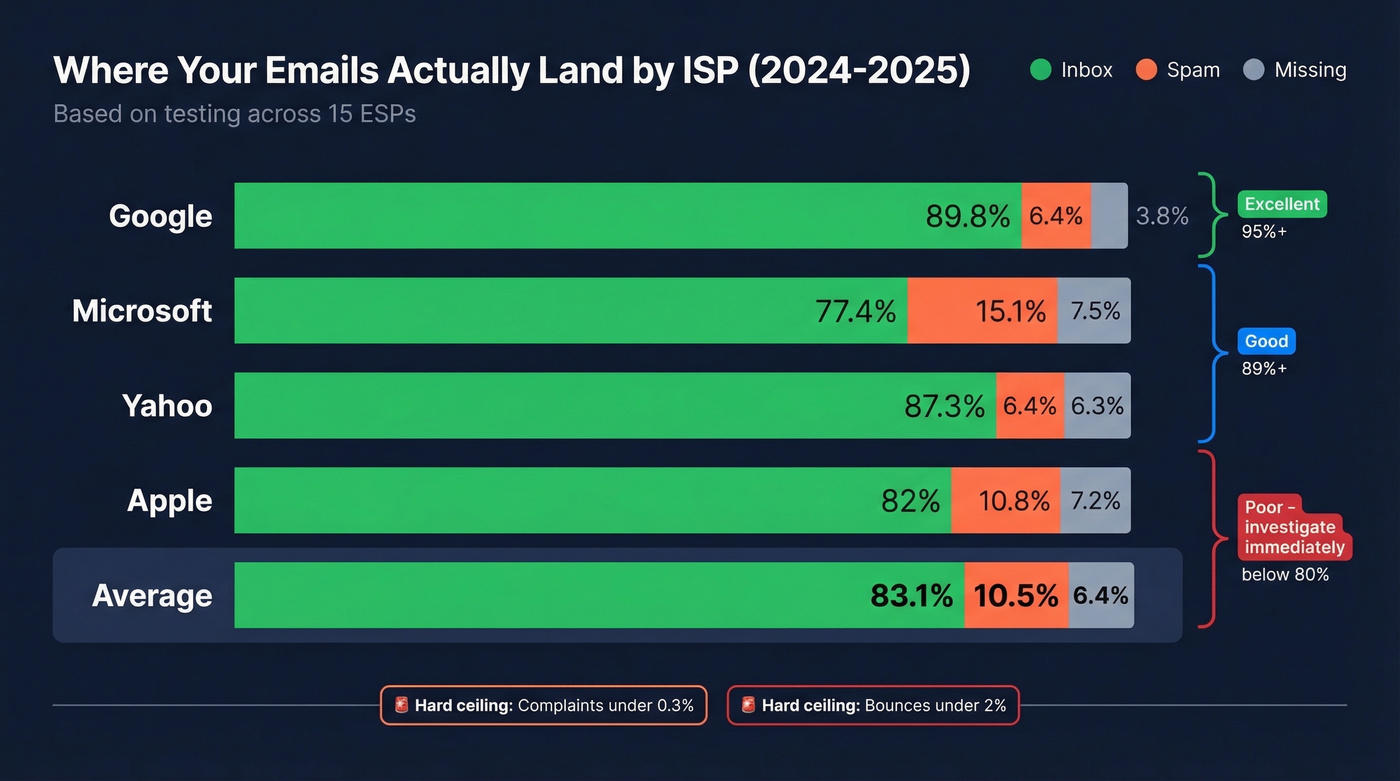
Here's where your emails actually land, based on 2024-2025 testing across 15 ESPs:
| ISP | Inbox | Spam | Missing |
|---|---|---|---|
| 89.8% | 6.4% | 3.8% | |
| Microsoft | 77.4% | 15.1% | 7.5% |
| Yahoo | 87.3% | 6.4% | 6.3% |
| Apple | 82% | 10.8% | 7.2% |
| Average | 83.1% | 10.5% | 6.4% |
Above 95% inbox placement is excellent, above 89% is good, below 80% is poor. Litmus recommends investigating immediately if you drop below 90%. For bulk senders, the hard ceilings are complaints under 0.3% and bounces under 2%. If you're scaling volume, keep an eye on email velocity so you don't spike reputation signals.
Why Open Rates Lie in 2026
Apple's Mail Privacy Protection preloads email content, which means your "opens" include a massive number of phantom events. In some segments, up to 75% of reported opens are artificial. Any engagement-based score that relies on open rates is measuring noise.
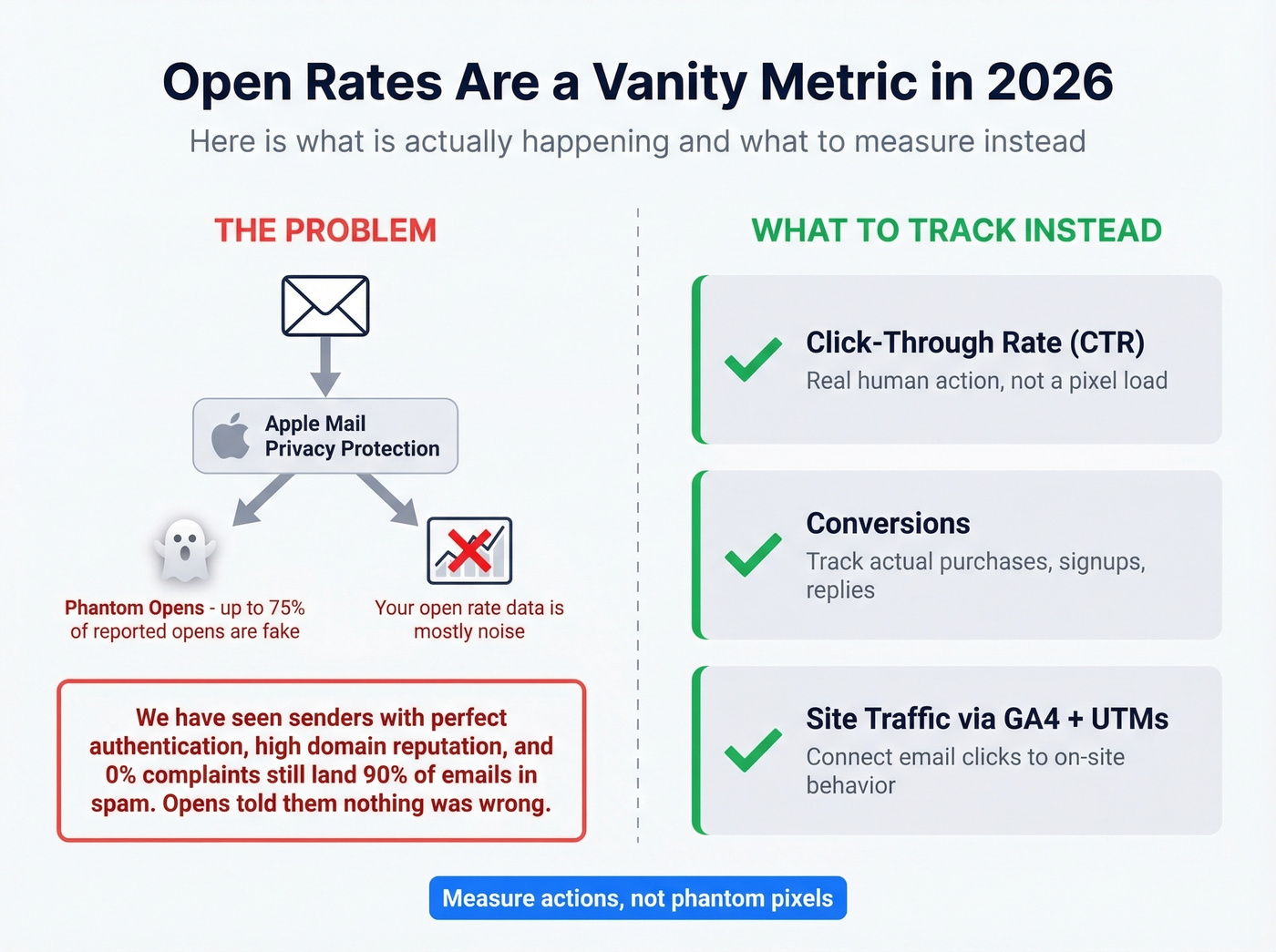
Here's the part that surprises people: we've seen senders with perfect SPF/DKIM/DMARC, Google Postmaster showing "High" domain reputation, and 0% complaint rates - yet Gmail still routed 90% of their abandoned checkout emails to spam. Campaign type and content signals matter as much as infrastructure. Track CTR, conversions, and site traffic via GA4 with UTM parameters instead. Opens are a vanity metric now. If you're building reporting, use a clean click rate formula and standardize it across campaigns.
How to Improve Your Email Quality Score
Most deliverability problems share the same root causes. Fix them in this order:
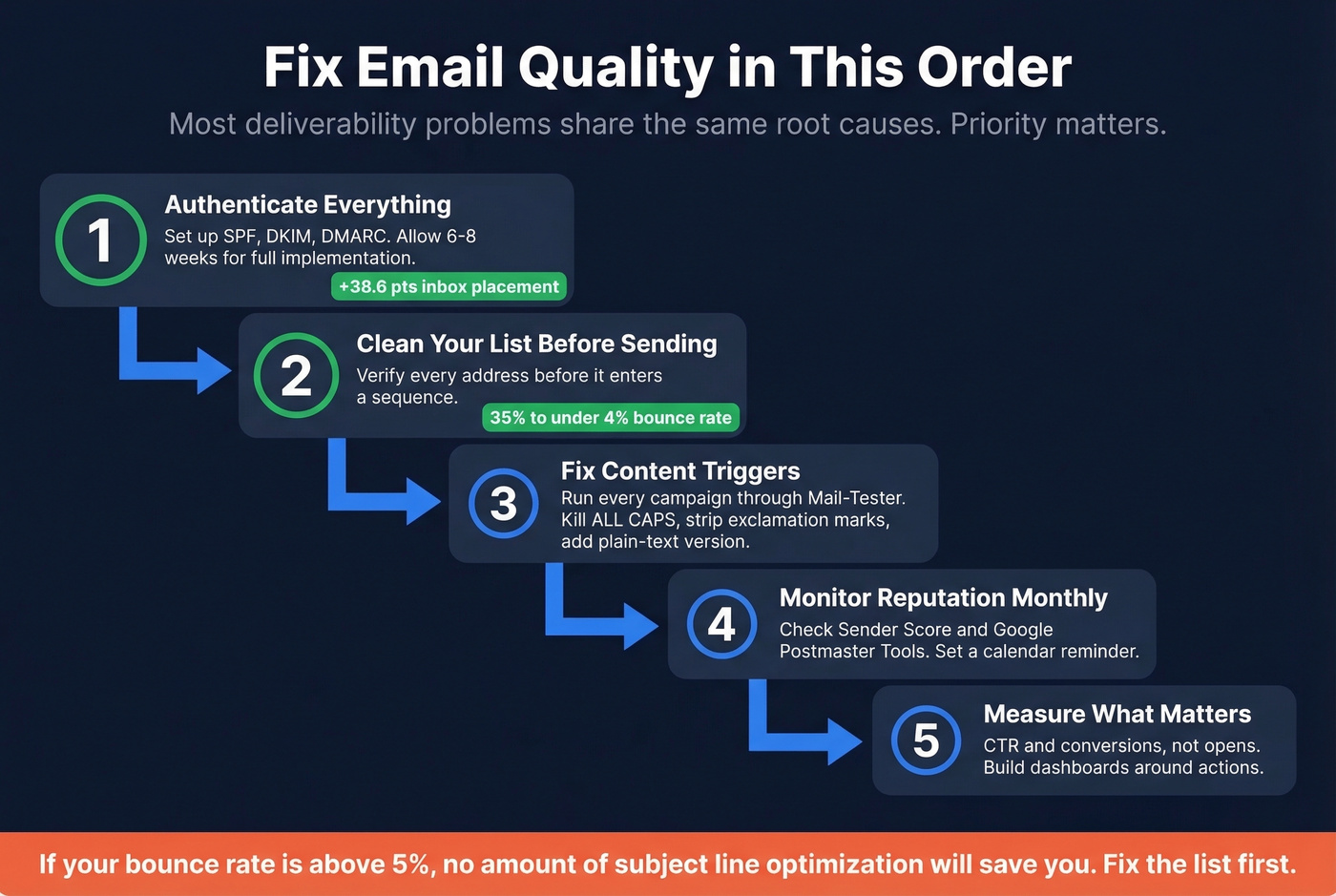
1. Authenticate everything. Set up SPF, DKIM, and DMARC. Expect 6-8 weeks for full implementation and warm-up. One benchmark report puts the combined authentication lift at +38.6 percentage points on inbox placement. If you need a quick diagnostic, follow a step-by-step guide to verify DKIM is working.
2. Clean your list before sending. Verify every address before it enters a sequence. We've watched teams cut bounce rates from 35% to under 4% just by running verification before the first send - Meritt tripled their pipeline after making that single change.
3. Fix content triggers. Run every campaign through Mail-Tester before hitting send. Kill the ALL CAPS, strip the exclamation marks, add a plain-text version. If you're iterating on copy, pull from proven email subject lines and test systematically.
4. Monitor sender reputation monthly. Check Sender Score and Google Postmaster Tools. Set a calendar reminder - this isn't a one-time task. When reputation dips, use a dedicated guide on how to improve sender reputation.
5. Measure what matters. CTR and conversions, not opens. Build dashboards around actions, not phantom pixels.

Let's be honest: if your bounce rate is above 5%, no amount of subject line optimization or send-time testing will save you. Data quality is the foundation every other score sits on. Fix the list first, then worry about everything else.
Every email quality score in this article depends on one thing: sending to real people at real addresses. Prospeo refreshes its 300M+ profiles every 7 days - not every 6 weeks like competitors - so your list quality doesn't decay between campaigns.
Clean data fixes deliverability faster than any content tweak ever will.
FAQ
What's a good email quality score?
For sender reputation, 80+ out of 100 is strong and 90+ is excellent. For inbox placement, above 89% is good and above 95% is excellent. For EQS, any positive number means more clicks than unsubscribes - aim for 0.7+.
Why do different tools give different scores?
They're measuring different things entirely. Mail-Tester checks content for spam triggers, Sender Score evaluates IP reputation, and seed-list tools test actual inbox placement. Use at least two types - one for reputation and one for content - to get a complete picture.
How often should I verify my email list?
Re-verify every 60-90 days minimum. Email addresses decay at roughly 2-3% per month due to job changes and domain closures. A 7-day data refresh cycle keeps records current between bulk verifications, which is how teams in our network consistently keep bounce rates under 4%.
Can a high sender score still land in spam?
Yes. Gmail weighs campaign-level content signals independently of domain reputation. We've seen senders with 95+ Sender Scores and perfect authentication still hit spam on promotional email types. Infrastructure gets you to the door - content and engagement get you through it.