

Best Email Sign-Offs That Get Replies (2026 Data)
You're drafting a cold email to a VP of Engineering. The subject line is sharp, the body is tight, the ask is clear. Then you freeze. "Best"? "Thanks"? "Kind regards"? You've spent 20 minutes on a two-paragraph email and now you're agonizing over your email sign-off.
Here's the thing: you don't need a list of 100 options. You need four. Maybe five. A study of 350,000 email threads found that the right closing can lift your response rate by 18 percentage points over baseline. The wrong one - or no sign-off at all - can make you sound cold, passive-aggressive, or forgettable.
The Only Four You Need
Memorize these and you're covered for 90% of situations:
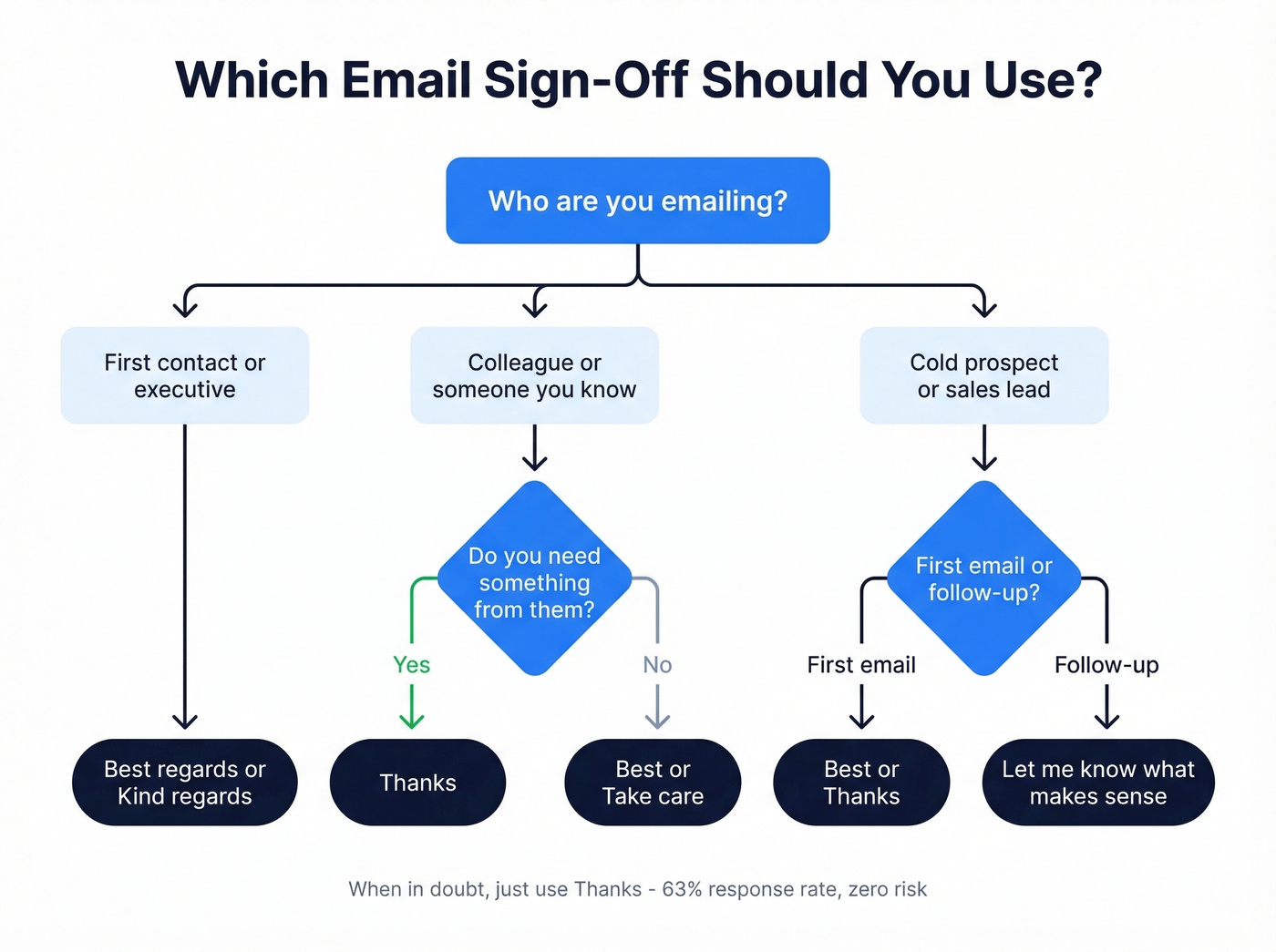
- Default for everything: "Thanks" - 63% response rate, universally warm, impossible to misread.
- Formal or first contact: "Best regards" or "Kind regards" - safe, professional, globally understood.
- Need a reply badly: "Thanks in advance" - 65.7% response rate, though it annoys some people.
- Cold email or sales: "Best" or "Looking forward to hearing from you" - short and action-oriented.
The baseline response rate across all emails sits at 47.5%. Every closing above clears that bar by double digits.
Sign-Offs That Actually Get Replies
The 350,000-thread dataset gives us one of the clearest public looks at which closings drive responses:
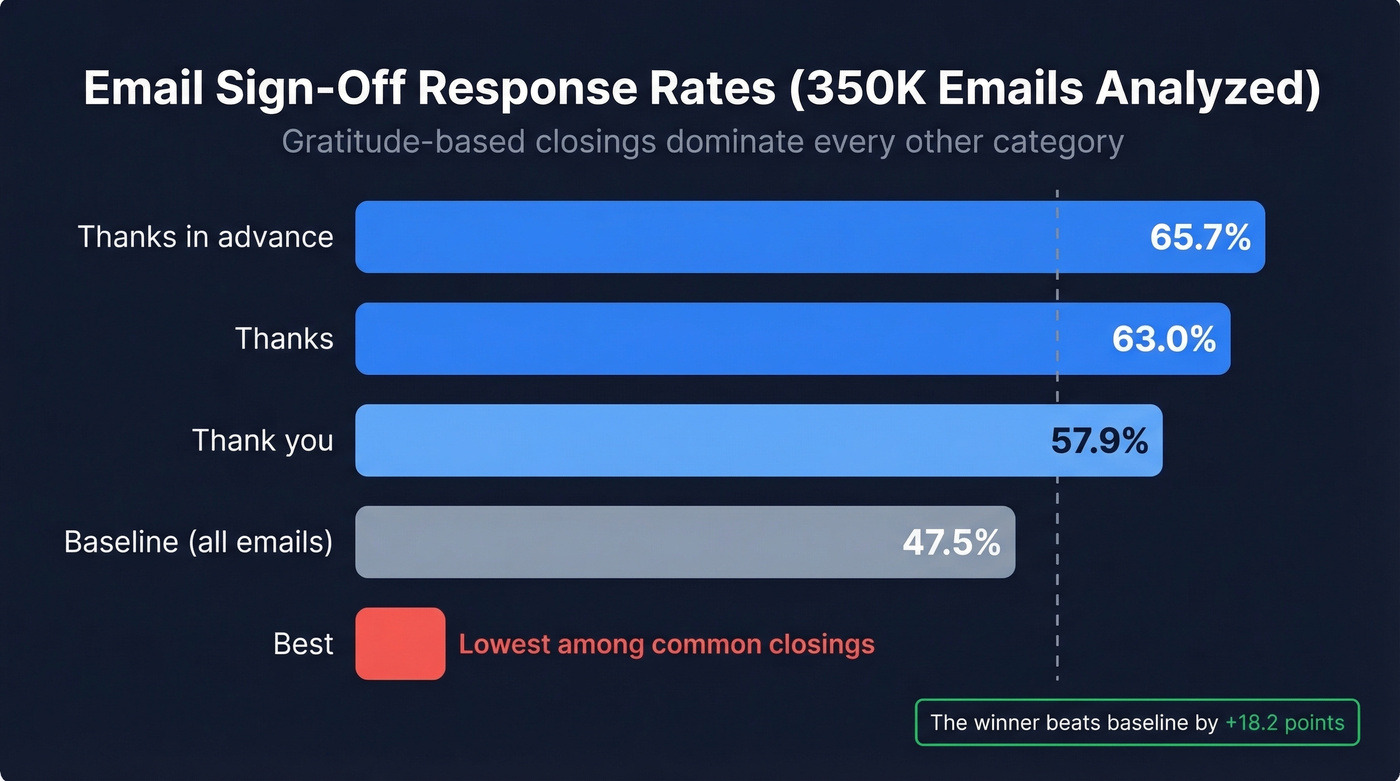
| Sign-Off | Response Rate |
|---|---|
| Thanks in advance | 65.7% |
| Thanks | 63.0% |
| Thank you | 57.9% |
| Baseline (all emails) | 47.5% |
| Best | Worst performer among common closings |
The pattern is obvious: gratitude-based closings dominate. "Thanks," "Thank you," and "Thanks in advance" all outperform the baseline by at least 10 points. "Best" - a common default in professional email - is the worst performer among common closings.
Now here's the paradox. "Thanks in advance" gets the highest response rate at 65.7%, but a survey of 1,005 Americans by Preply found that only 5% of people actually prefer receiving it. 41% of respondents said they use it - but it reads as presumptuous. You're thanking someone for something they haven't agreed to do yet.
It works because it creates a subtle obligation. People reply because they feel they have to, not because they want to. Use "Thanks in advance" when you genuinely need action and the relationship can absorb a little pushiness. For everything else, plain "Thanks" gets you 63% without the baggage.
Two more data points worth knowing: the same analysis found that emails written at a 3rd-grade reading level got 36% more responses than college-level writing, and slightly emotional emails outperformed neutral ones by 10-15%. Your sign-off is the cherry - the sundae is clarity and tone. The sweet spot for email length is 50-125 words, which yielded response rates above 50%.
How to Choose the Right Closing
Data gives you a starting point. Context tells you which closing to actually use.
Mirror the sender's tone. If someone signs off with "Cheers," don't reply with "Respectfully yours." Tone-matching is one of the simplest ways to build rapport - when you mirror someone's formality level, you signal you're on the same wavelength.
Capitalize only the first word. It's "Kind regards," not "Kind Regards." Small convention, big signal that you know what you're doing. Same for "Best regards," "With appreciation," and "Many thanks."
Match formality to the relationship. First email to a C-suite exec? "Best regards." Third reply in a thread with a colleague? "Thanks" or even just your name. The Preply survey found that 46% of people infer a coworker's mood from their sign-off. Your closing phrase is doing emotional work whether you intend it to or not.
Lead with the bottom line. Put your ask or key point at the top of the email (the military calls this BLUF - Bottom Line Up Front) - Bottom Line Up Front). When the body is structured well, your sign-off doesn't have to do heavy lifting. And keep mobile previews in mind: many email clients show around the first 140 characters before someone decides to open, so a bloated closing eats into the body of short emails.
Override your AI defaults. If you use an AI writing tool, it probably slaps "Best regards" on every email. We've seen teams send 50 emails in a row with identical AI-generated closings. Vary your signoffs manually - repetition signals automation, and recipients notice.

The data is clear: the right sign-off lifts reply rates by 18 points. But none of that matters if 35% of your emails bounce. Prospeo's 5-step verification delivers 98% email accuracy - teams using it cut bounce rates from 35% to under 4%.
Fix your list before you fix your sign-off. 75 free verifications included.
Sign-Offs for Every Situation
Professional and Formal
These are your safe choices for first contacts, executive communication, and client-facing emails. "Best regards" and "Kind regards" are close cousins - the former is slightly more neutral, the latter slightly warmer and more popular across Europe. Either works everywhere.
- Sincerely - traditional, almost old-fashioned. Best for cover letters and formal correspondence.
- Respectfully - reserved for someone significantly senior or in government/military contexts.
- With appreciation - good when someone's done you a favor or you're acknowledging their time.
- Thank you for your time - specific and gracious after meetings or interviews.
- Warm regards - a notch warmer than "Kind regards." Good for clients you've built rapport with.
- With gratitude - slightly more personal, best for mentors or people who've gone out of their way.
Casual and Friendly
For colleagues, peers, and anyone you've exchanged more than three emails with:
- Thanks - the default for a reason. Warm, brief, universally safe, and backed by data.
- Cheers - reads as friendly and relaxed in the UK and Australia. Know your audience.
- Best - inoffensive but forgettable. The khaki pants of sign-offs.
- Talk soon - implies ongoing relationship. Good for people you actually will talk to soon.
- Take care - warm and human. Works well as a thread-ender.
- Catch you later - peers only. This is texting-level casual.
Sales and Cold Emails
In cold email, your sign-off is a conversion lever. It's the last thing someone reads before deciding whether to reply, ignore, or delete.
First cold email: Keep it neutral and low-pressure. "Best" or "Thanks" works. You haven't earned familiarity yet, so don't fake it with "Cheers" or "Talk soon." If you're building a sequence, pair the right closing with proven cold email structure.
Follow-up after interest: Shift to action-oriented closings. "Happy to walk through this whenever works" or "Let me know what makes sense" signals you're ready to move without being pushy. You can also borrow phrasing from these sales follow-up templates.
No-response follow-up: Go soft. "No pressure at all" or "Happy to pause if priorities have shifted" gives the prospect an out - and paradoxically makes them more likely to reply. End with a clear next step like "I'll follow up Thursday if I don't hear back" so the sign-off isn't doing all the work. If you need more options, use these cold email follow-up templates.
Let's be honest, though: we've seen sales teams agonize over sign-offs when their real problem was a 35% bounce rate. Your closing phrase is irrelevant if the email bounces. The consensus on r/coldemail is that list hygiene matters more than copy polish - and our experience backs that up. Prospeo verifies emails in real time with 98% accuracy, and the free tier covers 75 emails per month, enough to test whether your list is clean before scaling. If you're troubleshooting deliverability, start with email bounce rate benchmarks and fixes, then work through a full email deliverability guide.
You just learned which closings drive replies. Now make sure those emails actually land. Prospeo gives you verified emails at $0.01 each with a 7-day data refresh cycle - so you're never sending to stale addresses.
Perfect sign-off, wrong email address? That's a 0% reply rate.
Funny and Creative
Humor in email closings is a high-risk, high-reward play. Among peers and close colleagues, a well-placed funny sign-off can make you memorable: "May the force be with you," "Sent from a potato," "This email will self-destruct," "Virtually yours," or "Your favorite coworker (don't tell the others)."
The caution is real, though. Business Insider's reporting on Gen Z workplace trends notes that humor works among peers but can be seen as disrespectful by managers and clients. A funny closing to your team Slack buddy? Great. To the CFO you've met once? Skip it.
Sign-Offs to Avoid
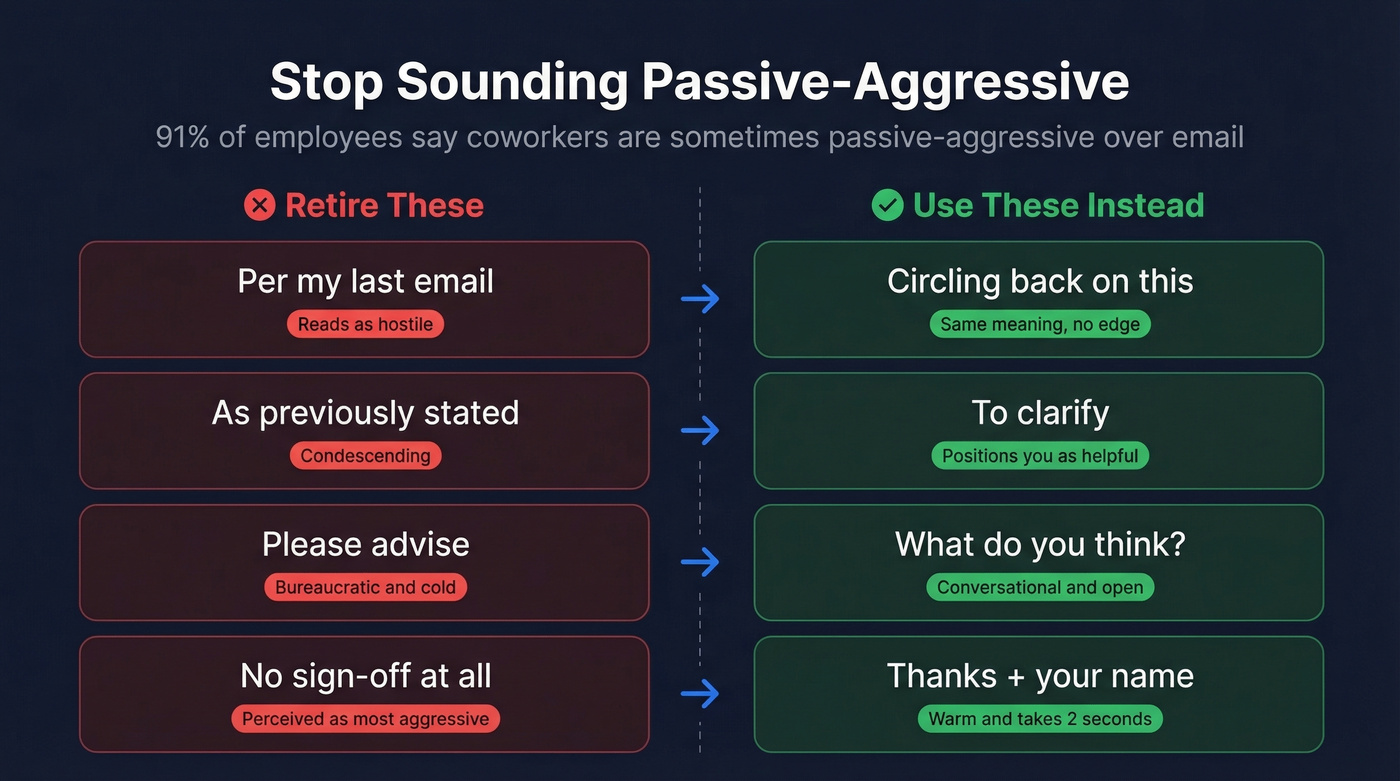
A Preply survey found that 91% of employees say coworkers are sometimes passive-aggressive over email. Your sign-off is one of the biggest tells.
Picture this: your new manager signs every email with "Regards." Just "Regards." No "Kind," no "Best," no warmth modifier. It reads like a door closing. In the UK especially, bare "Regards" can feel borderline hostile.
Retire these:
- "Per my last email" - swap to "Circling back on this." Same meaning, less aggression.
- "As previously stated" - try "To clarify." Positions you as helpful rather than annoyed.
- "Please advise" - use "What do you think?" Conversational instead of bureaucratic.
And then there's the nuclear option: no sign-off at all. Preply's data shows that skipping the closing entirely is perceived as the most aggressive move you can make in email. 47% of people sign off with just their name - no closing phrase. That's a middle ground, but it still reads colder than a simple "Thanks."
Sometimes no sign-off works. Deep in a rapid back-and-forth thread where you're exchanging one-liners? Nobody needs "Kind regards" on message number fourteen. But on a standalone email to someone you don't know well? Always include one.
Email Closings Around the World
If you're emailing across borders, your perfectly polished sign-off might land completely wrong. A BBC analysis of cross-cultural email norms highlights just how much conventions vary.
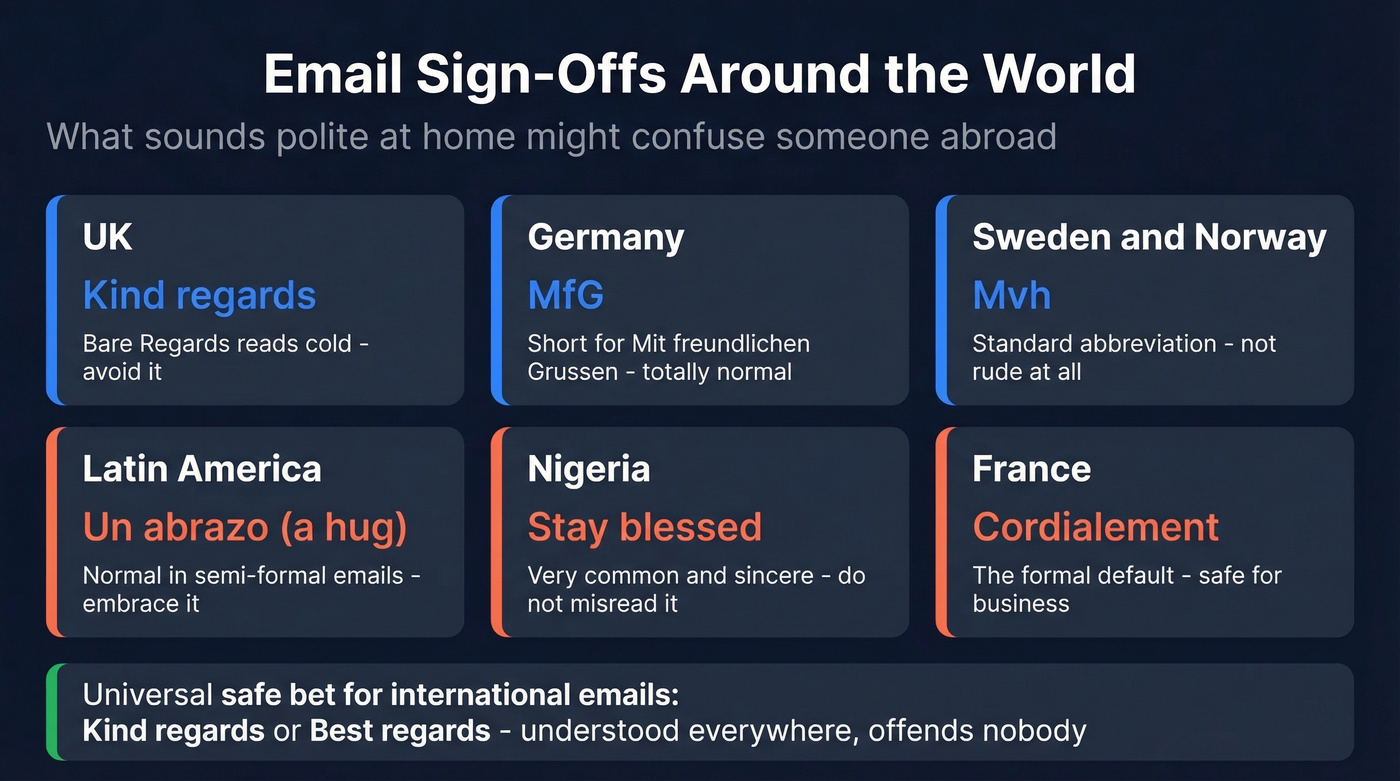
| Region | Convention | Watch Out For |
|---|---|---|
| UK | "Kind regards" standard | Bare "Regards" reads cold |
| Germany | "MfG" (abbreviation) | Very common, not rude |
| Sweden/Norway | "Mvh" (abbreviation) | Standard, not curt |
| Latin America | "Un abrazo" (a hug) | Normal in semi-formal |
| Nigeria | "Stay blessed" | Common; don't misread it |
| France | "Cordialement" | Formal default |
The politeness gap is real and measurable. A comparative study of Korean and Australian academics found that 40% of Koreans perceived Australian emails as impolite, versus only 28% of Australians who felt the same about Korean emails. Same content, different cultural lenses. Translation pitfalls can be genuinely embarrassing - the French "Mille baisers" literally translates to "A thousand kisses," perfectly normal in personal French correspondence, wildly inappropriate in an English business email.
For outbound across regions, default to "Kind regards" or "Best regards" internationally. They're understood everywhere and offend nobody.
Gen Z Is Rewriting the Rules
A Barclays survey found that 71% of workers believe Gen Z is changing workplace language formality, and 73% say the shift is making communication more casual overall. Informal out-of-office messages, emoji in sign-offs, puns where "Sincerely" used to live - it's happening.
Preply's data adds a sharper edge: Gen Z is the generation most likely to tweak their email sign-off specifically to express frustration. Where a Boomer keeps "Best regards" regardless of mood, a Gen Z employee might switch from "Thanks!" to "Thanks." - and expect you to notice the missing exclamation point. The words you use to end an email are becoming a subtle emotional signal, not just a formality.
Casual closings are fine among peers and can make workplace communication feel more human. But audience awareness still matters. A joke sign-off to your VP of Sales during a tense quarter? Read the room. If you're tightening the rest of your message, use these email subject line examples and a stronger email call to action.
FAQ
What's the best email sign-off for professional use?
"Thanks" leads with a 63% response rate across 350,000 analyzed threads, making it the strongest all-purpose professional closing. "Best regards" and "Kind regards" are universally safe for formal contexts. Match your closing to the relationship - gratitude-based options consistently outperform neutral ones.
Is "Best" too cold for emails?
Yes. "Best" is the worst performer among common closings in the 350,000-thread analysis. It's not offensive, but it's forgettable - the email equivalent of a limp handshake. Switch to "Thanks" for a warmer option that statistically outperforms it with no extra effort.
Should I always include a sign-off?
Always on standalone messages. Preply found that skipping the closing entirely is perceived as the most aggressive move in email. The only exception is deep in a rapid back-and-forth thread where formality would feel absurd - even then, your name alone is safer than nothing.
Is "Thanks in advance" rude?
It gets the highest response rate at 65.7%, but only 5% of people prefer receiving it. It creates a subtle obligation - you're pre-thanking someone for something they haven't agreed to do. Use it when you genuinely need action and the relationship can handle presumption. Avoid it when you're building rapport.
Does your email closing matter if the email bounces?
Not at all. For cold outreach, bounce rates above 5% damage sender reputation and tank deliverability. Clean your list first, then worry about your closing line.