

The Best Email Warm Up Tools in 2026 - And What Actually Matters More
A RevOps lead we know ran warmup on 15 inboxes for three weeks straight. Dashboard scores looked great - 92% inbox placement across the board. Then the first real campaign went out and 19% of emails bounced. The warmup tool was working fine. The contact list was garbage.
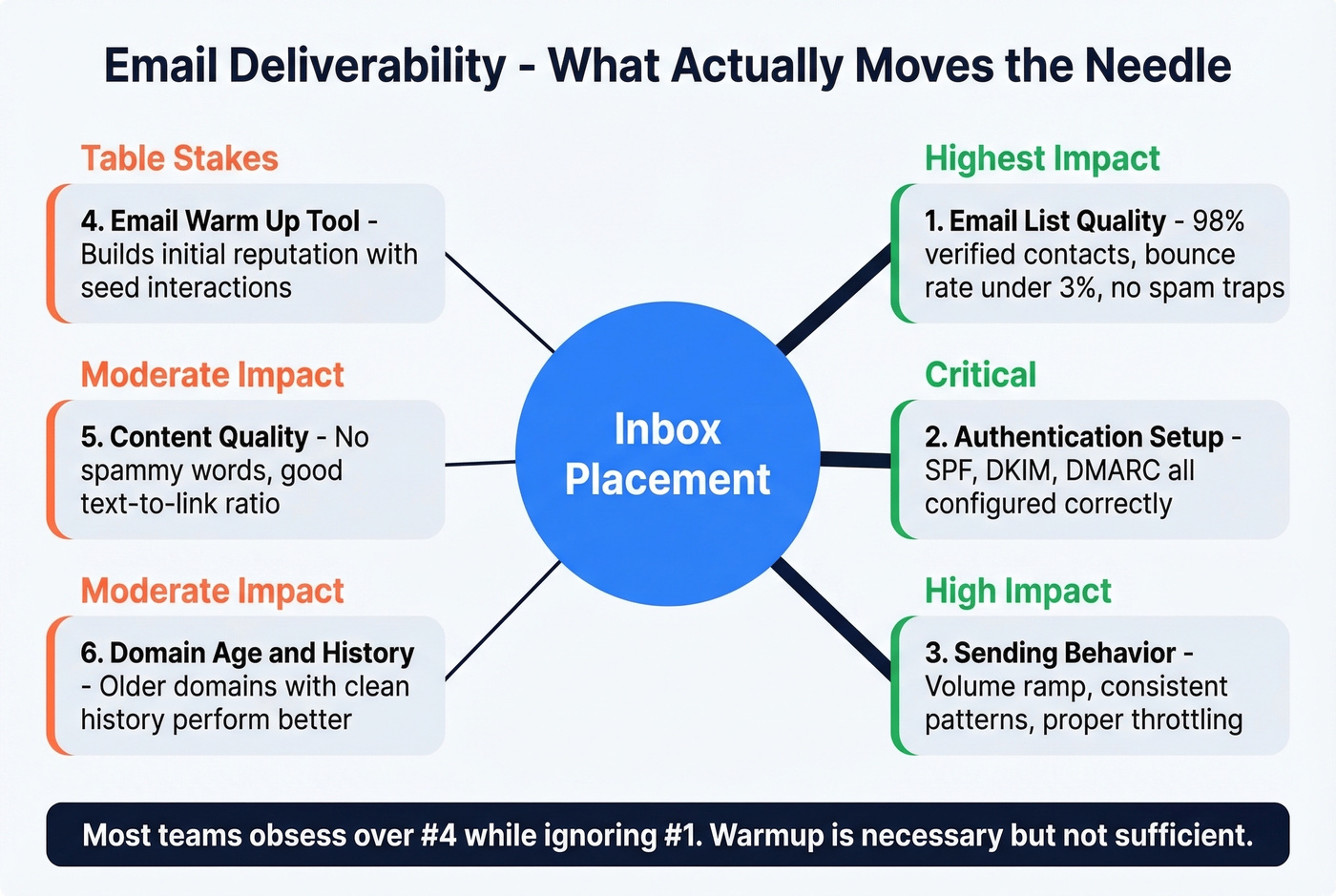
That's the dirty secret of email warm up tools: they're table stakes, not a silver bullet. Gmail now outright rejects non-compliant emails at the SMTP level, and Outlook retired Basic Auth entirely. The bar for deliverability keeps rising. But most teams obsess over which warmup solution to pick while ignoring the thing that actually tanks their sender reputation - bad data.
The average cold email reply rate sits at 3.43%, and 58% of replies come from the first touch. If that first email bounces, you've already lost the majority of your reply potential.
Our Picks (TL;DR)
You need one warmup tool and one verification tool. Don't overthink the warmup - the market's commoditized. Pick based on inbox count and budget:
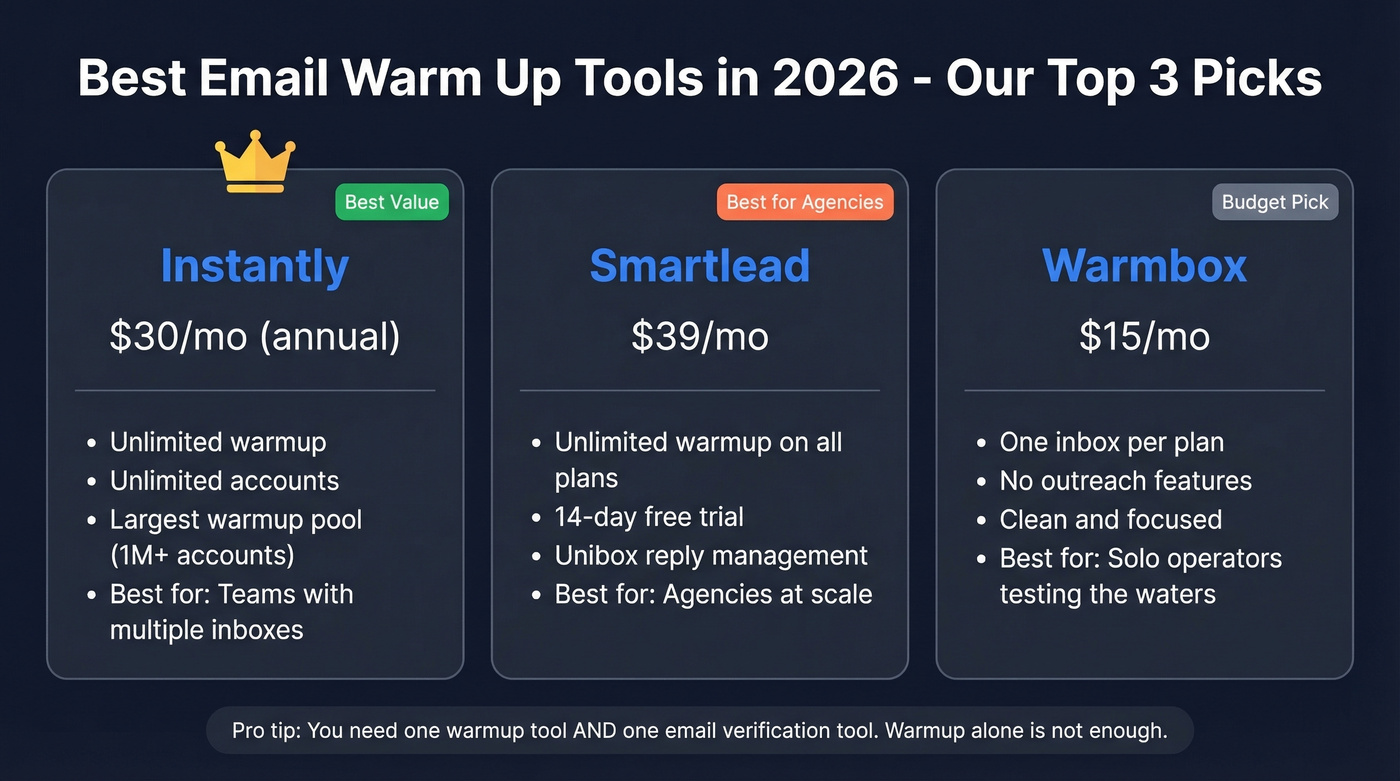
- Instantly - Best all-in-one value. Unlimited warmup + unlimited accounts in its Outreach plans. $30/mo annual. The default choice for most teams.
- Smartlead - Best for agencies managing client campaigns at scale. $39/mo with a 14-day free trial.
- Warmbox - Best budget option for solo operators testing the waters. $15/mo for one inbox.
Here's the thing: if your deal sizes are small and you're running fewer than three inboxes, you probably don't need a paid warmup tool at all. Manual warmup works. What you absolutely need is verified data - that's the variable that determines whether warmup effort pays off or gets torched in 48 hours.
What Good Deliverability Actually Looks Like
Most warmup dashboards show you 90%+ inbox placement and let you feel great about yourself. Don't trust those numbers. They're based on controlled seed tests within the warmup network - not real-world sends to cold prospects.

Actual inbox placement rates across major ISPs tell a different story:
| Provider | Inbox Placement |
|---|---|
| Gmail | 87.2% |
| Yahoo/AOL | 86.0% |
| Apple Mail | 76.3% |
| Microsoft | 75.6% |
| Global Average | ~84% |
One in six emails never reaches the inbox. Gmail's complaint-rate threshold is 0.3% - cross that line and your inbox placement drops fast. No warmup solution can fix a reputation torched by bounces and spam complaints.
If you want the full framework behind those numbers, start with an email deliverability baseline and then layer warmup on top.
Warmup Tools Compared: Features and Pricing
Every tool worth considering, side by side.
| Tool | Starting Price | Model | Free Trial | Best For |
|---|---|---|---|---|
| Instantly | $30/mo (annual) | Bundled unlimited | No | Teams, multiple inboxes |
| Smartlead | $39/mo | Unlimited | 14-day | Agencies |
| Warmbox | $15/mo | Per-inbox tiers | No | Solo operators |
| TrulyInbox | $29/mo | Unlimited | Free plan | Budget unlimited |
| Mailivery | $29/mo | Unlimited | 7-day | Large warmup pool |
| Warmup Inbox | $19/mo (or $15/mo annual) | Per mailbox | 7-day | Simple standalone |
| Lemwarm | $29/mo | Per mailbox | Free w/ Lemlist | Lemlist users |
| Mailreach | $20/mo (annual) | Per account | No | Monitoring |
| Warmy.io | $49/mo | Per mailbox | Free trial | Diagnostics suite |
| Mailwarm | $69/mo | Per mailbox | No | Nobody, honestly |
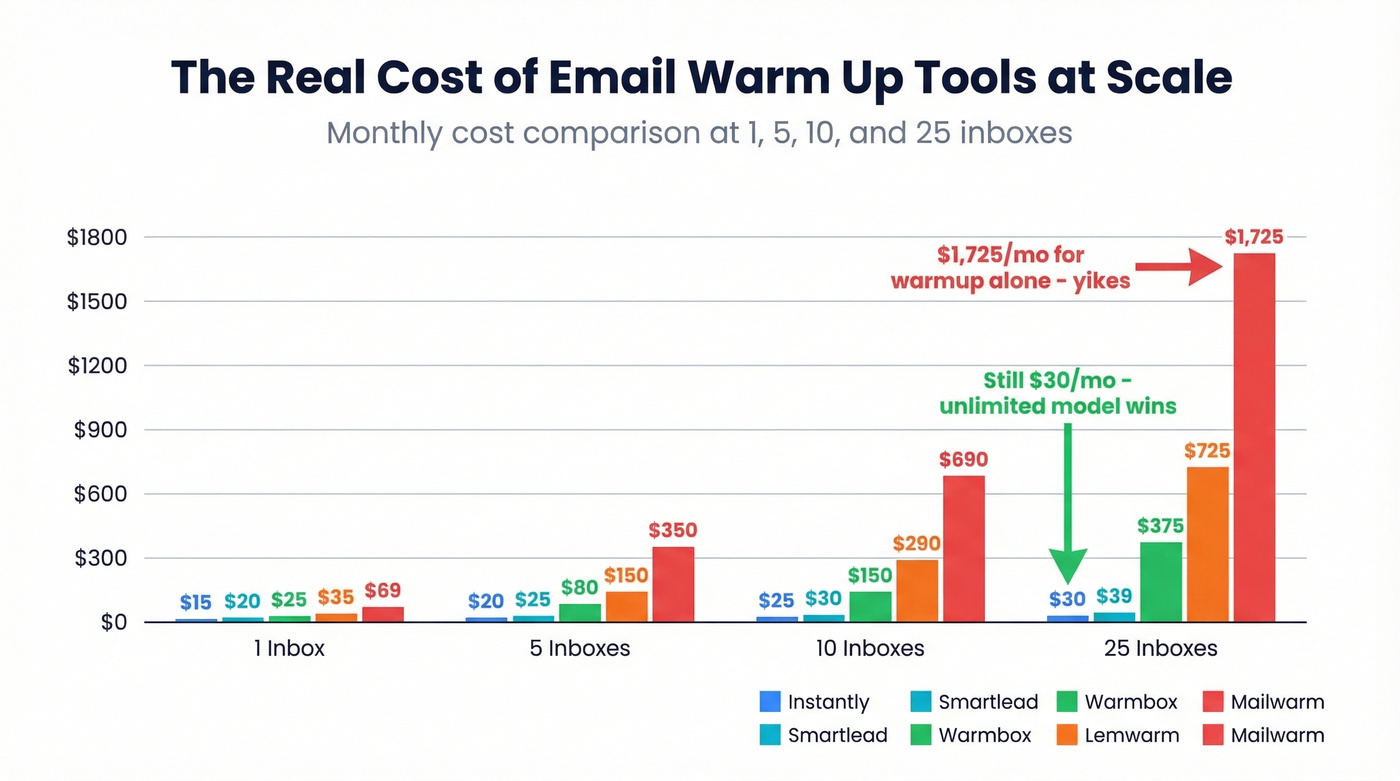
Now the math that matters - cost at 1, 5, 10, and 25 inboxes:
| Tool | 1 Inbox | 5 Inboxes | 10 Inboxes | 25 Inboxes |
|---|---|---|---|---|
| Instantly | $30 | $30 | $30 | $30 |
| Smartlead | $39 | $39 | $39 | $39 |
| TrulyInbox | $29 | $29 | $29 | $29 |
| Mailivery | $29 | $29 | $29 | $29 |
| Warmbox | $15 | $49 | $99 | $99 |
| Warmup Inbox | $19 | $95 | $190 | $475 |
| Lemwarm | $29 | $145 | $290 | $725 |
| Mailreach | $20 | $100 | $200 | $500 |
| Mailwarm | $69 | $345 | $690 | $1,725 |
Per-inbox pricing is a trap at scale. We've run the numbers across dozens of client setups - the break-even point is always around inbox three. After that, unlimited models win every time. Lemwarm at 10 inboxes costs $290/mo. Instantly does the same job for $30. The math speaks for itself.
If you're scaling volume, you also need to understand email velocity limits so you don't undo your warmup with aggressive sending.
Leading Warmup Platforms Reviewed
Instantly
Use this if: You're running multiple inboxes and want warmup bundled with your outreach platform. This is the default choice for most teams, and for good reason.
Skip this if: You only need warmup with zero outreach features - you'd be paying for capabilities you won't use.
Instantly includes unlimited warmup and unlimited email accounts in its Outreach plans, starting at $30/mo on annual billing. Their warmup network runs 1M+ real accounts - the largest pool in the category - and smart warmup targets specific providers. If your prospects are mostly on Gmail, it prioritizes Gmail-to-Gmail interactions. In our testing, that provider targeting made a measurable difference on Gmail-heavy prospect lists, and the r/automation crowd consistently calls out the UX as the most polished in the category.
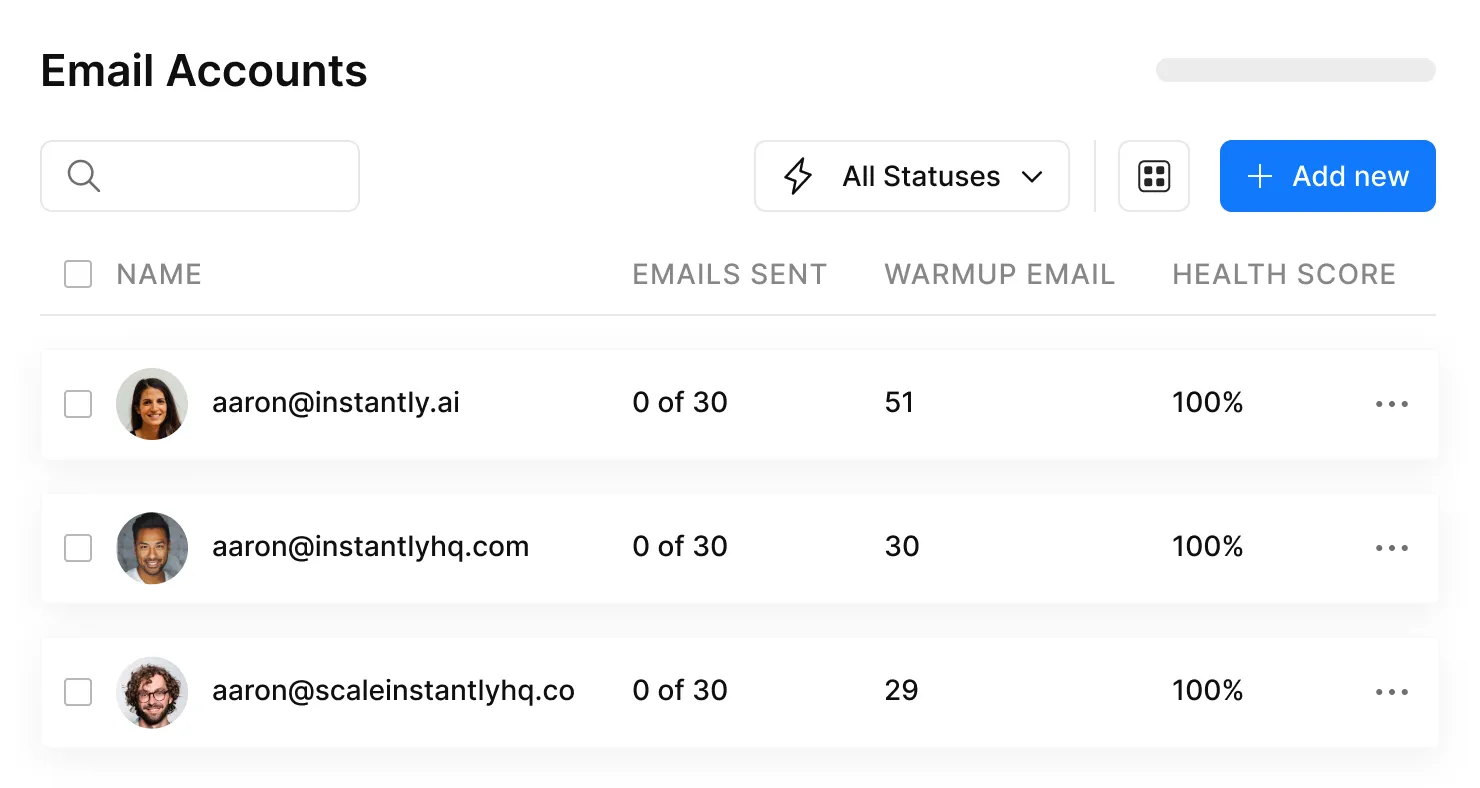
At 5,000 emails/month on the Growth plan and 100,000 on Hypergrowth at $77.6/mo annual, you're getting warmup as a free add-on to a full cold email platform. For any team running more than two inboxes, Instantly is the obvious starting point.
If you're building sequences inside an outreach platform, pair warmup with a solid B2B cold email sequence so your first real sends don't look like spam.
Smartlead
Smartlead is built for agencies, and it shows. The $39/mo price tag gets you unlimited warmup on all paid plans, a 14-day free trial, and the real differentiator: reply management at scale. Unibox pulls replies from every connected inbox into one stream, and auto-rotation distributes sends across accounts to protect individual sender reputations.

The consensus on r/sales is that it's "overkill for small teams," but agencies managing five or more client campaigns swear by it. In stress tests, Smartlead restored inbox placement within 48 hours after a spam trigger - faster than most competitors. Solo operators and small teams should stick with Instantly.
Warmbox
Warmbox is the cheapest standalone warmup tool that actually works. Solo plan at $15/mo covers one inbox. Pro jumps to $49/mo for five inboxes, and Growth hits $99/mo for 25. It's a clean, focused product with no outreach features and no bells and whistles - good for testing whether warmup moves the needle before committing to a bigger platform.
TrulyInbox
TrulyInbox charges a flat $29/mo for unlimited mailboxes, which makes it a strong budget pick for teams scaling past five inboxes. They offer a free-forever plan limited to one account and 10 emails per day if you want to test first. The trade-off: some community discussions flag bot-based warmup as a concern here, suggesting interactions don't look as human as competitors' networks.
Mailivery
Mailivery starts at $29/mo with unlimited mailboxes and 200 warmup emails per day. Their network runs 50K+ active mailboxes - one of the larger pools in the space - and includes blacklist monitoring across 70+ lists. The 7-day free trial lets you test before committing. Professional at $79/mo and Business at $199/mo scale the daily warmup volume to 800 and 2,500 emails respectively.
Lemwarm
Lemwarm makes sense if you're already paying for Lemlist - it's included free with your subscription. As a standalone warmup product, it's $29/mo per mailbox, which gets expensive fast. Ten inboxes means $290/mo for warmup alone. That's nearly 10x what Instantly charges for the same job. Good ecosystem integration, bad standalone economics.
Mailreach, Warmy.io, and Mailwarm
Mailreach runs $20/mo per account on annual pricing and includes 20 spam test credits. It's monitoring-focused - better for diagnosing deliverability issues than pure warmup.
Warmy.io packs in AI templates, a deliverability checker, and seed testing, but starts at $49/mo per mailbox and scales to $429/mo on Premium. Hard to justify for warmup alone.
Mailwarm charges $69/mo per mailbox. At 10 inboxes, that's $690/mo. There's no scenario where this math works in Mailwarm's favor.
Folderly (typically ~$96/mailbox/mo annual) and InboxAlly (starts at $149/mo) aren't included in the tables above - they're enterprise deliverability audit tools, not warmup tools. If you're spending that much on warmup alone, something else is broken.
If you're specifically looking for flat-rate options, compare against our roundup of unlimited email warmup tools.

That 19% bounce rate in the intro? It happens when you warm up inboxes but skip email verification. Prospeo's 5-step verification delivers 98% email accuracy - keeping bounce rates under 4% and protecting the sender reputation your warmup tool worked so hard to build.
Stop warming up inboxes just to burn them with bad data.
Why Bad Data Kills Your Warmup
Running warmup while sending to unverified lists is like mopping the floor while the faucet's running. ESPs start penalizing your domain once bounce rates cross 5%. Even the best warmup software can't outrun that damage.
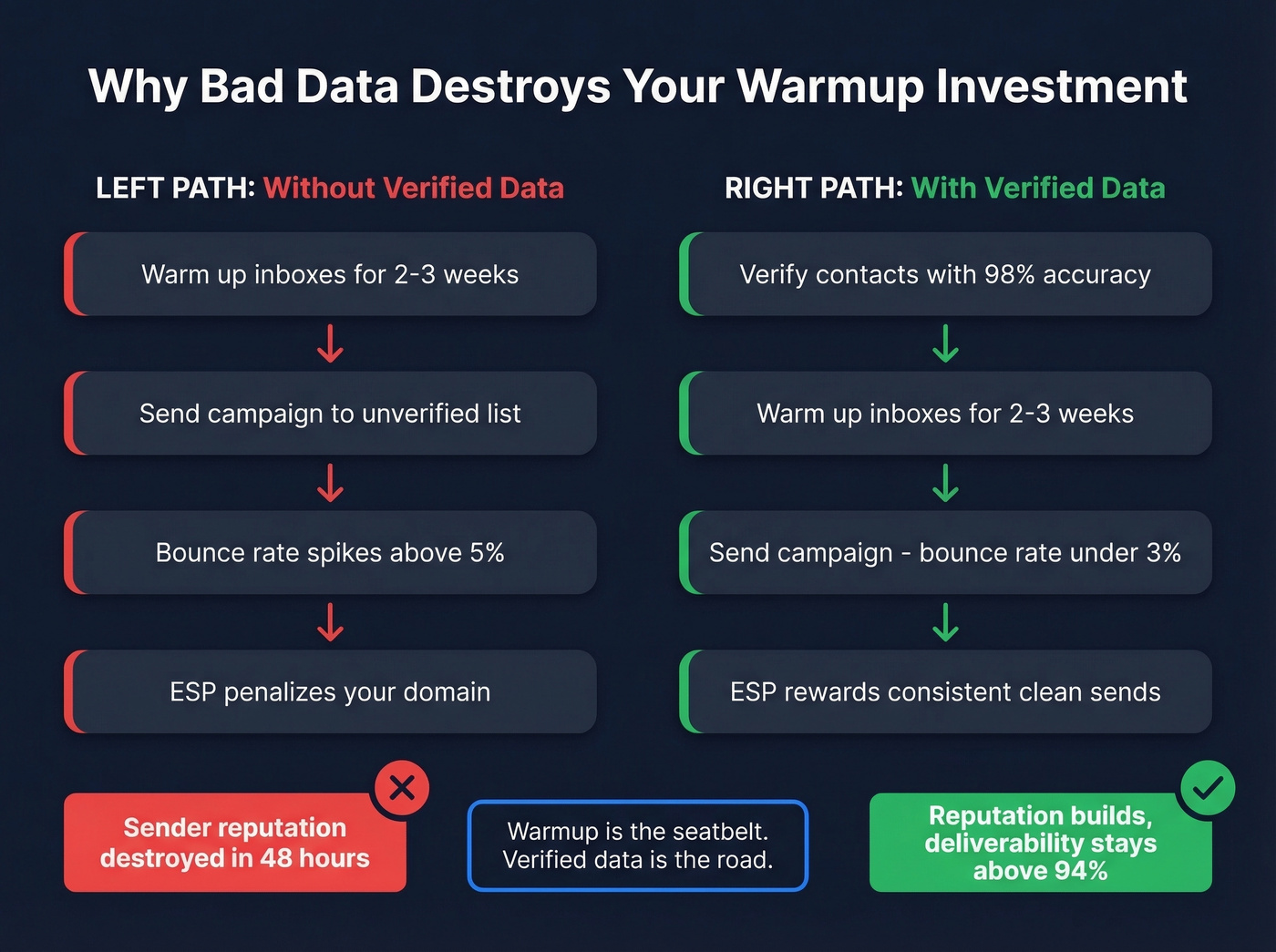
We've seen teams spend months warming up inboxes, launch their first campaign with a purchased list, and watch their sender reputation crater in 48 hours. The warmup wasn't the problem. The data was.
If you're diagnosing the damage, start with email bounce rate benchmarks and codes so you know what you're actually seeing.
Prospeo delivers 98% email accuracy versus 87% at ZoomInfo and 79% at Apollo - a gap that's the difference between a campaign that builds your reputation and one that destroys it. The platform runs a 5-step verification process with spam-trap removal and honeypot filtering, refreshing data every 7 days against an industry average of 6 weeks. Stack Optimize built from $0 to $1M ARR on that data, maintaining 94%+ deliverability, under 3% bounce rates, and zero domain flags across all their clients.
If you're building lists in the first place, use a workflow that includes lead enrichment and verification before you ever hit send.
That's the kind of result that makes warmup actually effective - it's maintaining a reputation that clean data built, not trying to repair damage from bad data. Prospeo integrates natively with Instantly, Smartlead, Lemlist, HubSpot, Salesforce, and 10+ other platforms, so verified contacts flow directly into whatever warmup and outreach stack you're running.
You just picked a warmup tool. Now pick the data source that won't wreck your deliverability. Prospeo verifies 143M+ emails on a 7-day refresh cycle - so the contacts you send to actually exist when your campaign goes live. At $0.01 per email, it costs less than a single bounced lead.
Warmup is the seatbelt. Verified data is the road.
Do Warmup Tools Actually Work?
Let's be honest. Warmup tools operate in a gray area, and the evidence for their effectiveness is murkier than vendors want you to believe.
The core issue: warmup pools use cloud infrastructure with predictable IP patterns. Gmail's spam detection is sophisticated enough to identify non-human interaction patterns - automated opens, formulaic reply content, consistent timing. If Gmail detects these interactions as artificial, it simply ignores them when calculating your sender reputation. A dashboard showing 95% inbox placement means your warmup emails are landing - not that your cold outreach will.
There's also the enforcement risk. Artificial engagement patterns can get flagged, and you don't want your main domain anywhere near that blast radius. Use a separate domain for cold email. Always.
If you want to go deeper on protecting reputation signals, this ties directly into how to improve sender reputation (beyond warmup scores).
Does this mean warmup is useless? Not entirely. Gradual volume ramping on a new domain is legitimate and helpful - for most teams running 5+ inboxes, the automation is worth $30/mo. Just don't expect miracles.
How to Verify Warmup Is Working
Don't trust your warmup tool's dashboard. Measure independently:
- Run independent inbox placement tests. GlockApps offers two free deliverability tests. Send to their seed list and see where your emails actually land across Gmail, Outlook, and Yahoo.
- Check Google Postmaster Tools. This is the only source of truth for your domain reputation with Gmail. If Postmaster shows no improvement after three weeks of warmup, your tool isn't working.
- Track real campaign metrics. Open rates and reply rates on actual cold outreach matter more than warmup scores. If your first real campaign bounces above 5% or opens below 30%, something's broken.
- Set a 3-week evaluation window. No measurable improvement in Postmaster reputation or independent seed tests within three weeks? Stop paying.
To keep those tests honest, also run a quick email spam checker pass on your templates before you blame the warmup tool.
The Manual Alternative
You don't necessarily need a paid tool. The manual warmup playbook works well for small operations.
Set up a separate domain for cold email - never warm up your primary domain. Configure SPF, DKIM, and DMARC before sending a single email. Start with 2-5 emails per day to people you actually know and get real replies. Send across a mix of providers - Gmail, Outlook, Yahoo - to build cross-provider credibility.
If you need a reference point for setup, use these SPF record examples and then validate your auth is correct.
Increase volume by 5-10 emails per day each week. Don't send any cold emails during the first two weeks, and don't take long breaks - warmup progress decays if you go silent. This approach takes more effort but avoids the warmup-network risk entirely. For teams running fewer than three inboxes, it's often the smarter play.
FAQ
How long does email warmup take?
Most tools need 2-4 weeks to build baseline sender reputation on a new domain. Warmup isn't a one-time setup - it should run continuously. Stopping often causes deliverability to drop within days as engagement signals decay. Budget for ongoing warmup as long as you're sending cold email.
Are email warmup tools safe to use?
They're legal, but they carry deliverability risk: artificial engagement patterns can get flagged by major ISPs. Always use a separate domain for cold outreach to protect your primary domain's reputation. Pair warmup with verified contact data to avoid bounce-rate penalties that no warmup tool can reverse.
Is there a free warmup option?
TrulyInbox offers a free-forever plan with one account and 10 emails per day. Mailivery and Warmup Inbox offer 7-day free trials. Instantly includes unlimited warmup in its paid Outreach plans at $30/mo annual - not free, but the best value for multiple inboxes. For data verification, Prospeo's free tier includes 75 email credits per month.
Per-inbox or unlimited pricing - which is better?
Unlimited wins decisively at scale. At 10 inboxes, per-inbox tools like Lemwarm cost $290/mo while Instantly, Smartlead, TrulyInbox, and Mailivery charge flat rates regardless of inbox count. Per-inbox pricing only makes sense if you're warming a single mailbox and want the cheapest possible option - typically Warmbox at $15/mo.
Does warmup matter if my email list is clean?
Yes - warmup builds sender reputation, which is separate from list quality. But clean data is what keeps that reputation intact once you start sending real campaigns. Verified emails, no spam traps, no honeypots. Warmup and verification solve different problems that compound when either one fails.