


Enlyft Review 2026: Pricing, Pros, Cons, and Who It's Actually For
Twenty user licenses minimum. Twenty thousand credits per year minimum. Custom pricing with no public numbers. Enlyft doesn't make it easy to figure out what you're signing up for - or what you'll pay.
We dug through G2 reviews, Enlyft's product pages, and category benchmarks to put together the full picture: what Enlyft costs, where it shines, where it falls short, and whether it's the right fit for your team.
30-Second Verdict
Enlyft holds a 4.4/5 on G2 across 79 reviews - 72% five-star, 25% four-star, just 2% one-star. If you're running an enterprise team with 20+ reps, a five-figure data budget, and a Dynamics 365 or Salesforce stack, Enlyft's technographic and buying-signal intelligence is genuinely strong. Fewer than 20 users or more interested in verified contact data than account intelligence? Skip the custom-quote process entirely.
What Is Enlyft?
Enlyft is an AI-driven account intelligence platform built around the Enlyft Company Graph. Depending on which page you look at, it covers 30M+ to 40M+ companies, 18K+ to 20K+ technologies, and 300M+ contacts.
The standout feature is Buying Signals: a proprietary layer that pulls in signals like technology usage, hiring activity, news and events, job changes, and corporate announcements, then converts them into predictive scores, context, and alerts your team can use for account prioritization. It's less a contact database and more an account prioritization engine that tells reps which companies are likely in-market right now. One niche edge worth noting: Enlyft includes MSP-focused modeling and scoring, which is useful if you sell into managed service providers.
The B2B intent data market hit $4.49B in 2026 and is projected to reach $20.89B by 2035. Enlyft is betting that AI-driven buying signals - not just raw firmographic data - will be the differentiator in that race.
Enlyft Pricing Breakdown
Here's the thing: Enlyft doesn't publish pricing. The plans page shows two editions and a lot of "Custom" labels, but no dollar figures. What it does show clearly is that annual credits start at 20,000 and user licenses start at 20.
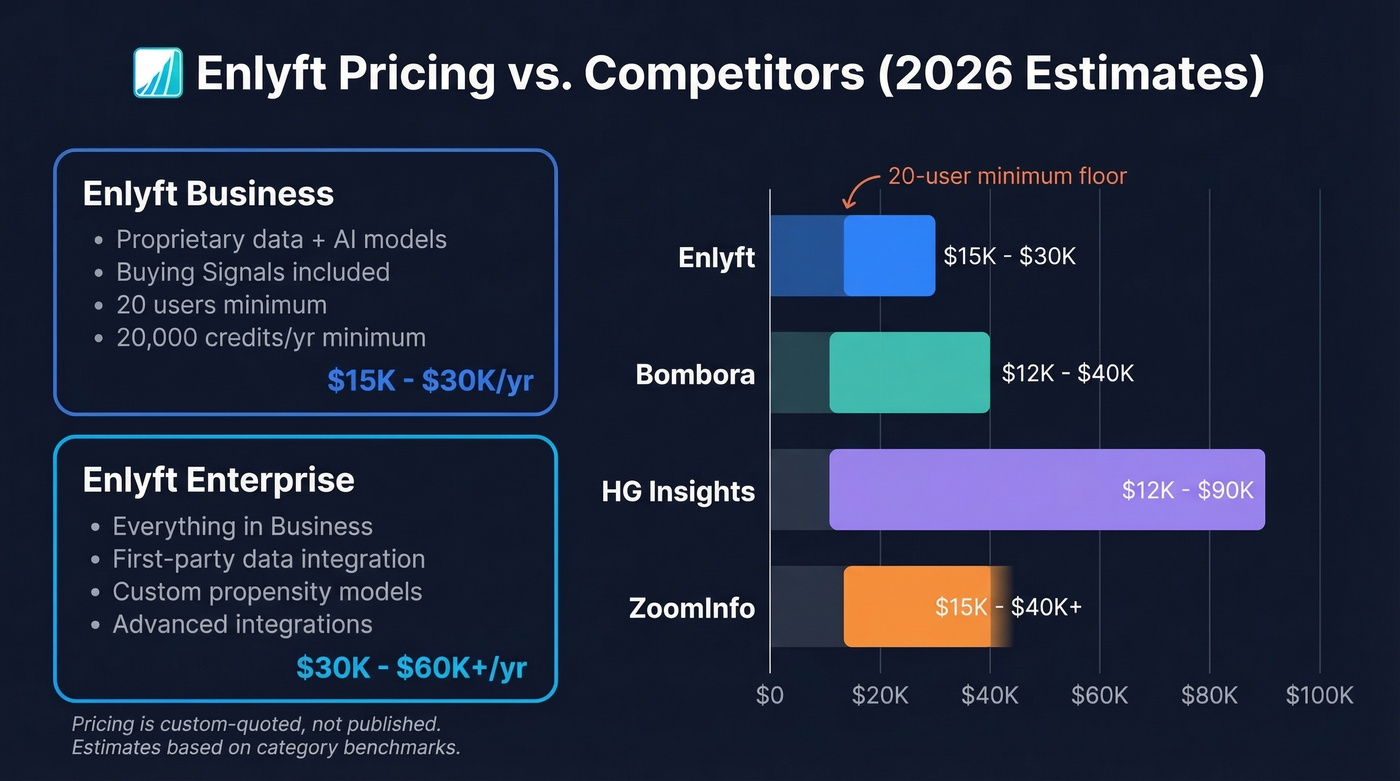
Based on that packaging and category benchmarks, entry-level contracts land in the $15,000-$30,000/year range for mid-market teams. Enterprise deals with first-party data integration and custom propensity models push well above that.
| Edition | What's Included | Starting Point | Est. Annual Cost* |
|---|---|---|---|
| Business | Enlyft proprietary data, AI models, Buying Signals | 20 users, 20K credits/yr | ~$15K-$30K |
| Enterprise | Business + first-party data, custom models, advanced integrations | 20 users, 20K credits/yr | ~$30K-$60K+ |
\Enlyft doesn't publish pricing; estimates based on category benchmarks.*
For context, Bombora runs $12K-$40K/year and HG Insights ranges from $12K-$90K/year. Enlyft sits squarely in that enterprise intent/intelligence tier.
Some directories list Enlyft at $12,000/year under a "Basic" plan label. But Enlyft's current plans page is clear that pricing is custom-quoted, with 20 users and 20,000 annual credits as the floor.
One detail most reviews miss: Enlyft promotes a free browser extension for basic prospecting - no credit card required. It won't replace the full platform, but it's a legitimate way to get a feel for the data before committing to a custom-quote sales cycle.

Enlyft's biggest weakness is contact data - users flag it as limited and outdated in review after review. Prospeo fills that exact gap: 143M+ verified emails and 125M+ verified mobiles on a 7-day refresh cycle, with 98% email accuracy. At ~$0.01 per email, you get enterprise-grade contact data without the $15K minimum or 20-user floor.
Start with 75 free verified emails - no contracts, no sales calls.
Pros and Cons From Real Users
What Users Like
CRM integration is a standout. Dynamics 365 gets called out repeatedly in G2 reviews, and it's listed as an integration on major review directories. If your org runs on Dynamics, this matters.
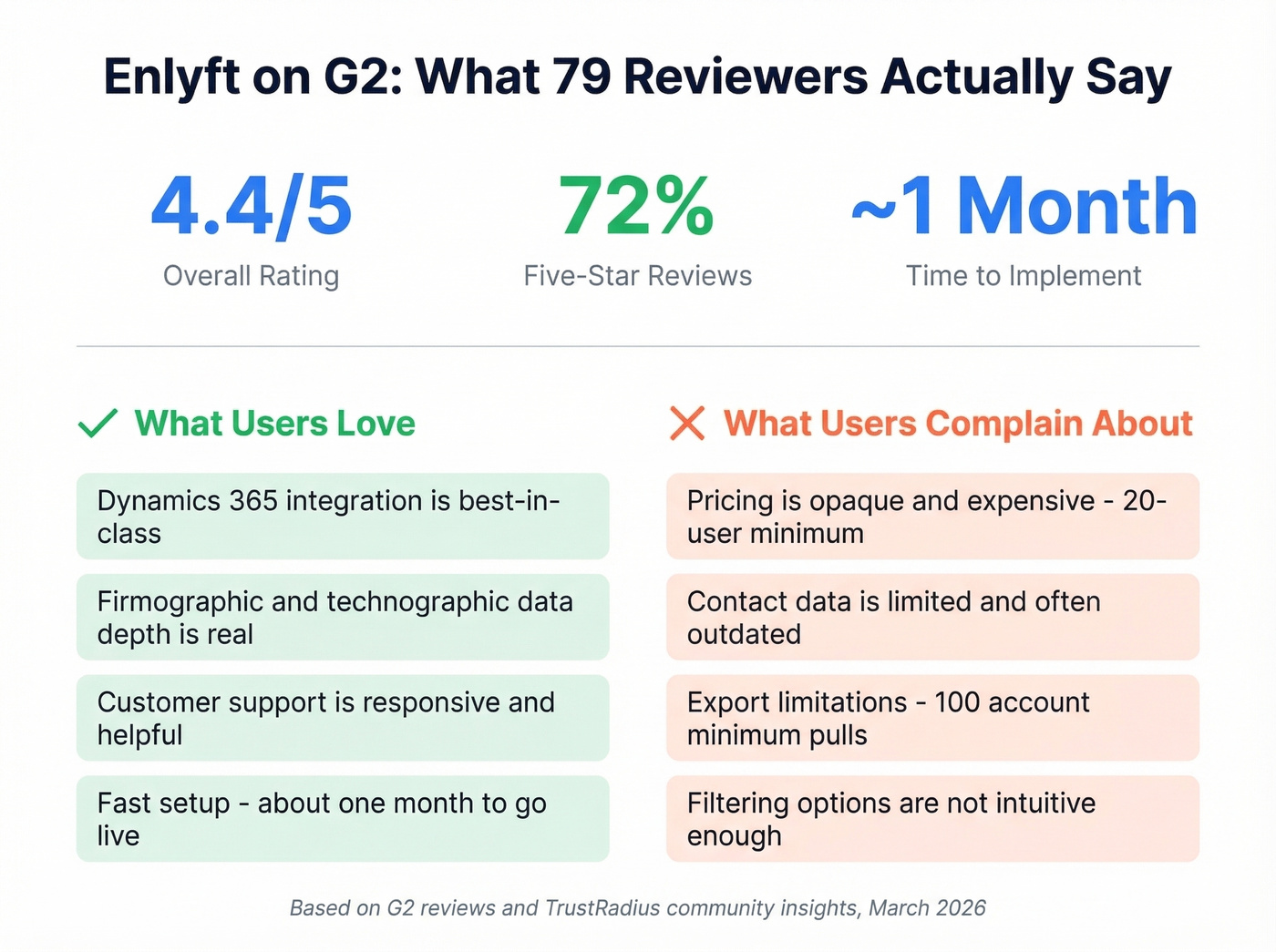
Firmographic and technographic data quality. This is what Enlyft was built for. Users lean on the account-level intelligence for segmentation and TAM analysis, and the depth here is real. (If you want the framework behind this, see firmographic and technographic data.)
Responsive customer support. G2 reviewers highlight this as a genuine differentiator - not just "they respond," but "they help us get value faster."
Fast implementation. G2 benchmarks peg time-to-implement at roughly one month, which is fast for an enterprise intelligence platform.
What Users Don't Like
Opaque and expensive pricing. Cost is a top con theme on G2, and smaller teams can't justify the 20-user starting point plus a custom-quote process. If you're a 5-person SDR team, this isn't built for you.
Contact data is the weak link. G2 pros/cons themes flag limited and outdated contacts. If you're buying Enlyft expecting a pure contact database, you'll be disappointed. This came up again and again in our research. If this is your bottleneck, compare data enrichment services or a dedicated email verification workflow.
Export limitations. One G2 reviewer cites a "100 minimum account pull at a time," and structured pros/cons also flag contact import/export friction.
Limited filtering. TrustRadius community insights call out filtering as a recurring friction point - the data is there, but slicing it the way you want isn't always intuitive. (Related: firmographic filters.)
API access isn't self-serve. Enlyft offers API and data delivery options, but access is typically packaged as a custom/enterprise item rather than something you just turn on.
Who Enlyft Is For (and Who It's Not)
Use Enlyft if you:
- Run a 20+ rep sales org with a six-figure annual data budget
- Need technographic intelligence and buying signals piped into Dynamics 365 or Salesforce
- Care more about account prioritization than individual contact discovery
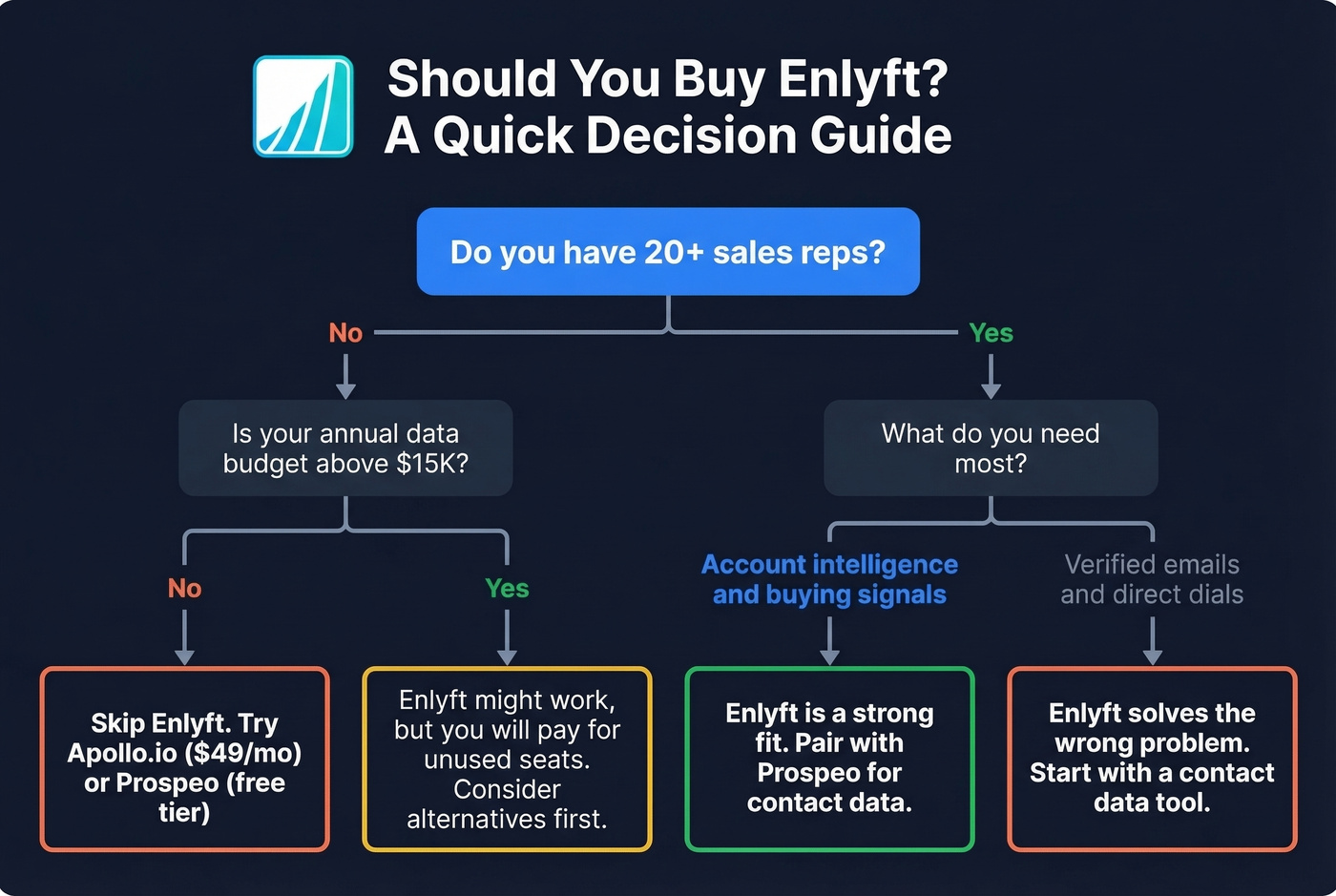
Skip Enlyft if you:
- Have fewer than 20 users or a sub-$15K data budget
- Primarily need verified emails and direct dials for outbound sequences
- Want self-serve access without a custom-quote sales cycle
We didn't find meaningful Reddit threads about Enlyft during this research - most practitioner discussions about account intelligence tools center on ZoomInfo, 6sense, and Bombora. That's telling in itself. Enlyft has a loyal user base, but it doesn't have the community mindshare of the bigger players.
Let's be honest about something: Enlyft's account intelligence is legitimately good, but most sales teams don't have a "which accounts to target" problem. They have a "we can't reach anyone at those accounts" problem. If your reps already know their ICP and just need verified contact data to fill sequences, a $15K+ account intelligence platform is solving the wrong bottleneck. (If you're tightening your outbound motion, start with sales prospecting techniques.)
Alternatives Worth Considering
Enlyft's account intelligence is strong, but its contact data gets the most complaints. Here's how the alternatives stack up depending on what you actually need:
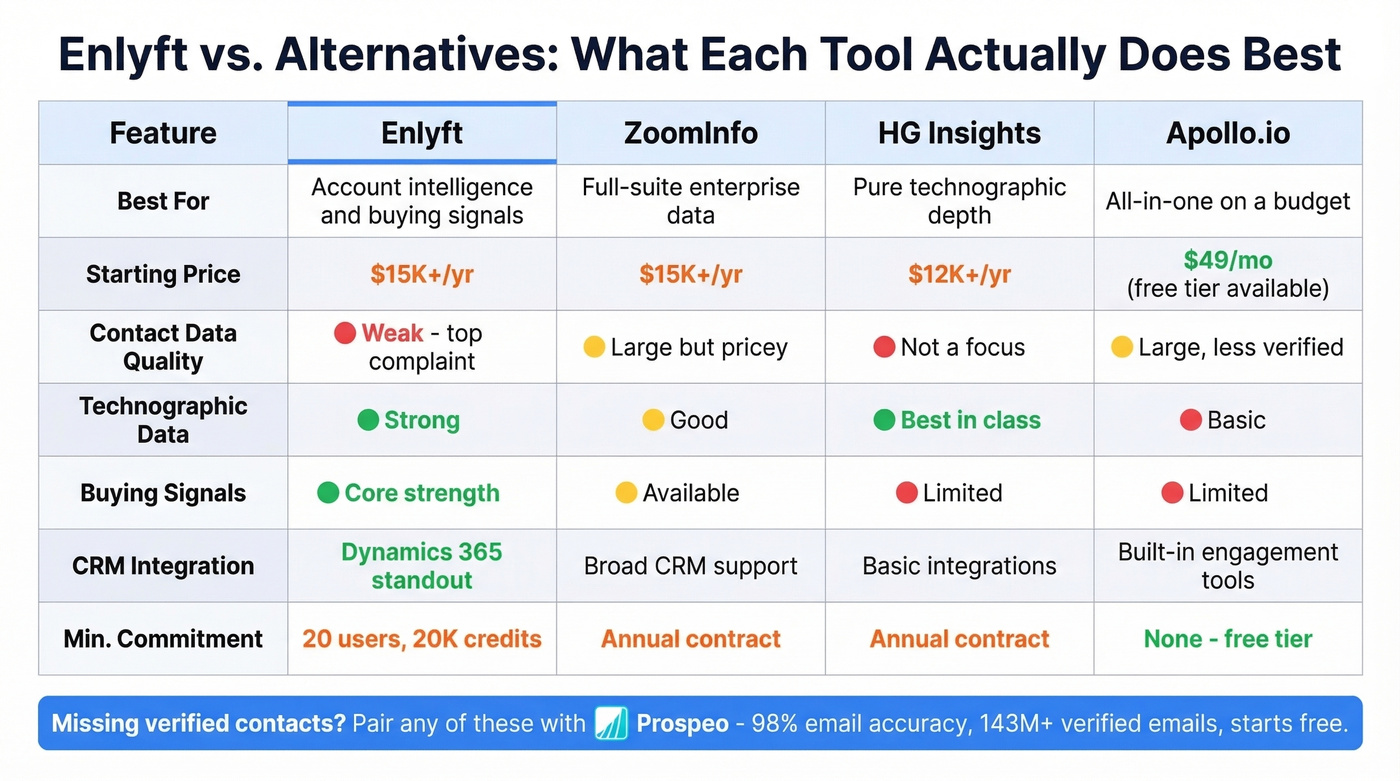
| Tool | Best For | Starting Price | Contact Data | Key Differentiator |
|---|---|---|---|---|
| ZoomInfo | Full-suite enterprise | ~$15K+/yr | Large but pricier | Broadest feature set |
| HG Insights | Technographic depth | ~$12K+/yr | Limited contact focus | Best pure technographics |
| Apollo.io | All-in-one on a budget | Free tier; $49/mo+ | Large, less verified | Data + engagement combined |
If you go with Enlyft for account intelligence, pair it with Prospeo for the contact layer. Its 143M+ verified emails and 125M+ verified mobiles run on a 7-day refresh cycle, and the 98% email accuracy means your sequences don't bounce. The free tier includes 75 emails per month - no contracts, no minimums. Teams like Meritt saw bounce rates drop from 35% to under 4% after switching, and their pipeline tripled from $100K to $300K per week.
ZoomInfo is the enterprise alternative for teams that want everything in one platform. G2 reviewers rate it as easier to set up than Enlyft, but slower to reach ROI - and you'll pay $15K-$40K+ annually for modules you'll never touch. Don't buy an all-in-one if you only need two features.
HG Insights is the closest pure-play technographic competitor. If all you care about is technology install data and you don't need buying signals, it's worth evaluating - but it's even less focused on contacts than Enlyft.
Apollo.io flips the script entirely. For teams that want data and engagement tools in one place at $49/month, it's hard to beat on value. Verification rigor is lower though, so expect more bounces if you're running high-volume outbound. If you're building a stack around this, start with a shortlist of SDR tools.

The Bottom Line
Enlyft is a legitimate account intelligence platform with a 9-month ROI timeline per G2 benchmarks. It's built for enterprise teams that need buying signals and technographic depth - not for SMBs or teams hunting for contact data.
We reviewed the G2 data and Enlyft's product materials, and the account intelligence delivers. But the contact gap is real, and it's the single biggest complaint from users. If verified emails and direct dials are what you actually need to hit quota, you'll get better results and faster time-to-value with a purpose-built contact data tool rather than an account intelligence platform that treats contacts as an afterthought. (To reduce bounces fast, use an email deliverability guide.)
Enlyft tells you which accounts to target. Prospeo tells you exactly how to reach them. Pair Enlyft's buying signals with Prospeo's 98% accurate emails and 125M+ verified mobile numbers. Teams like Meritt dropped bounce rates from 35% to under 4% and tripled their pipeline - same team, better data.
Stop bouncing emails. Start booking meetings with data that connects.