

Enterprise Deals: How to Close Them in 2026
You got a verbal yes on a six-figure expansion last quarter. Then legal went silent for three weeks. Your champion stopped responding. The deal sat at "commit" in the CRM for two months before someone quietly moved it to "closed-lost."
That's the reality of enterprise deals - the quiet phase kills more of them than any competitor ever will.
What You Need (Quick Version)
Enterprise deals are B2B contracts worth $100K+ annually, involving 6-10+ stakeholders, with cycles stretching 3-12 months. Three things prevent stalls:
- MEDDPICC qualification from day one - not BANT.
- A mutual close plan with dated milestones and named owners.
- A stakeholder map with verified contacts for every decision-maker by week two.
The rest of this guide is the how.
What Counts as an Enterprise Deal
Enterprise means different things to different orgs, but here's the working definition most B2B sales teams use: you're selling to a company with 1,000+ employees or $1B+ revenue. The deal itself is six to seven figures annually, typically structured as a 2-3 year contract with SLAs, implementation services, and complex procurement.
What makes these contracts structurally different from mid-market isn't just the dollar amount. It's the buying committee. Enterprise purchases involve 6-10+ decision-makers spanning IT, procurement, finance, legal, security, and the business unit that actually wants your product. Each of those stakeholders has different evaluation criteria, different risk tolerances, and different internal politics. Your champion in the business unit might love you, but the CISO has never heard your name.
Why Large B2B Sales Are Harder Now
The buying side has changed fundamentally. 61% of B2B buyers now prefer a rep-free buying experience. They're doing research before you even know they're in-market. And when they do engage sellers, 69% report inconsistencies between what they find on vendor websites and what reps tell them. That gap erodes trust before your first discovery call.
The committee problem has gotten worse, not better. The average buying decision involves 13 people, and 74% of those buying teams exhibit unhealthy conflict during the decision process. Your deal isn't competing against a rival vendor - it's competing against internal disagreement about whether to do anything at all. Here's the stat that should keep every enterprise AE up at night: 86% of B2B purchases stall at some point in the process. Not some deals. Not the hard ones. Nearly all of them.
We've watched reps lose six-figure deals because they couldn't name the procurement owner in month three. 58% of B2B professionals say sales cycles got longer over the past year. Your deal is "commit" every week in the forecast, but nobody can name the signature path. The consensus on r/sales echoes this - reps describe deals that "evaporate without a clear loss reason," just slowly fading from the pipeline. The real competitor in every large contract isn't the other vendor on the shortlist. It's inertia.
Enterprise Deal Benchmarks
Numbers kill ambiguity. Cycle length scales predictably with deal size, and knowing the benchmarks helps you spot deals that are dragging before they die.
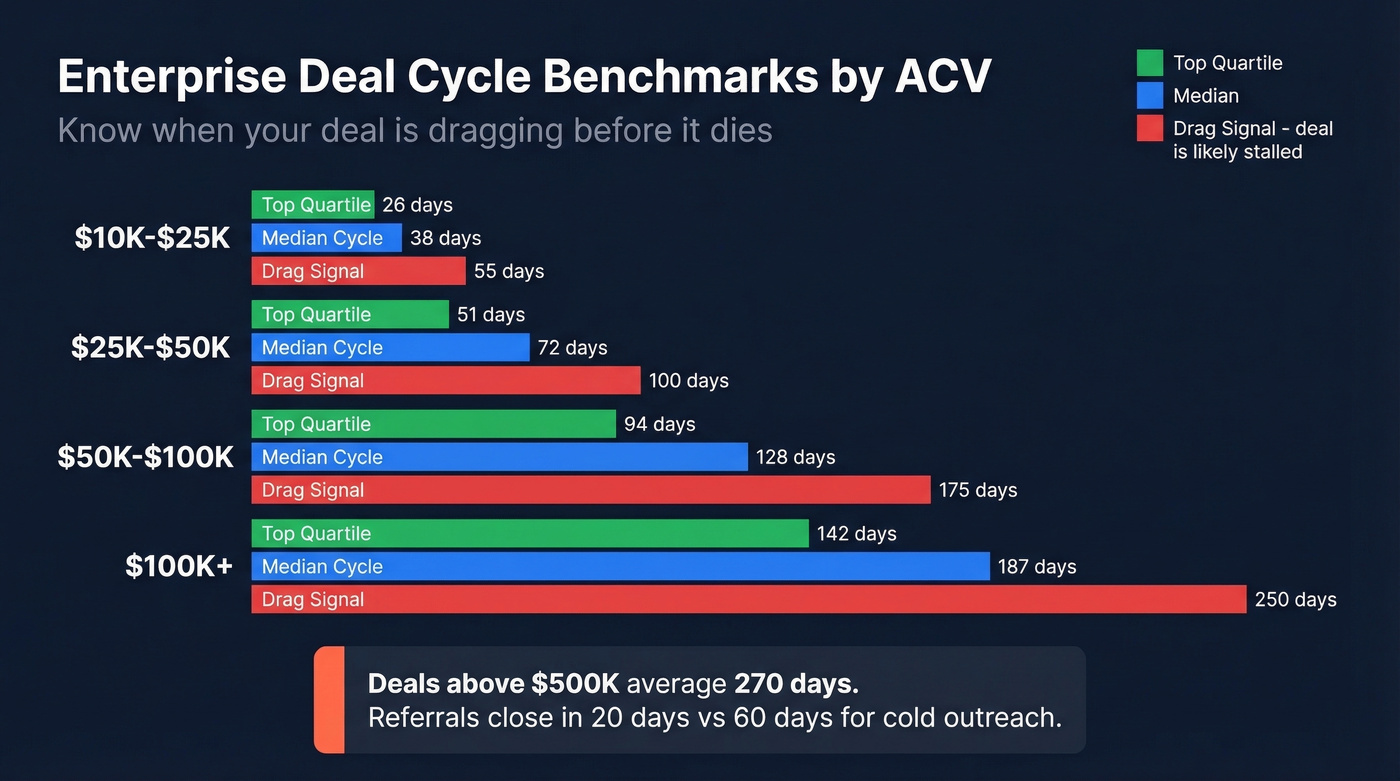
| ACV Band | Median Cycle | Top Quartile | Drag Signal |
|---|---|---|---|
| $10K-$25K | 38 days | 26 days | >55 days |
| $25K-$50K | 72 days | 51 days | >100 days |
| $50K-$100K | 128 days | 94 days | >175 days |
| $100K+ | 187 days | 142 days | >250 days |
Deals above $500K average 270 days. Cycle length also scales with the buyer's headcount - selling to a 1-10 person company averages 38 days, while crossing the 10,001+ employee threshold stretches the median to 185 days, driven almost entirely by procurement layers, security reviews, and legal redlines that don't exist at smaller orgs.
The "drag signal" column is where you should pay attention. If your $50K deal has been open for 175+ days without a clear next step, it's not "still in play." It's stalled. Win rates for enterprise sit around 20-30%, with opportunity-to-close conversion at 31% for enterprise versus 39% for SMB. That gap isn't about skill - it's about structural complexity.
One bright spot: referrals close in 20 days on average versus 60 days for cold calling. If you're not systematically generating warm intros into enterprise accounts, you're playing the game on hard mode.

86% of enterprise deals stall - usually because reps can't reach the right stakeholders. Prospeo gives you verified emails and direct dials for every decision-maker on the buying committee, from the CISO to procurement. 300M+ profiles, 98% email accuracy, 125M+ verified mobiles.
Stop losing six-figure deals to stakeholders you never contacted.
Qualifying with MEDDPICC
BANT - Budget, Authority, Need, Timeline - works fine when you're selling a $15K/year tool to a single decision-maker. For enterprise, it's dangerously shallow. You'll qualify a deal as "has budget" and "has authority" only to discover three months later that the economic buyer you never met has completely different decision criteria than your champion.
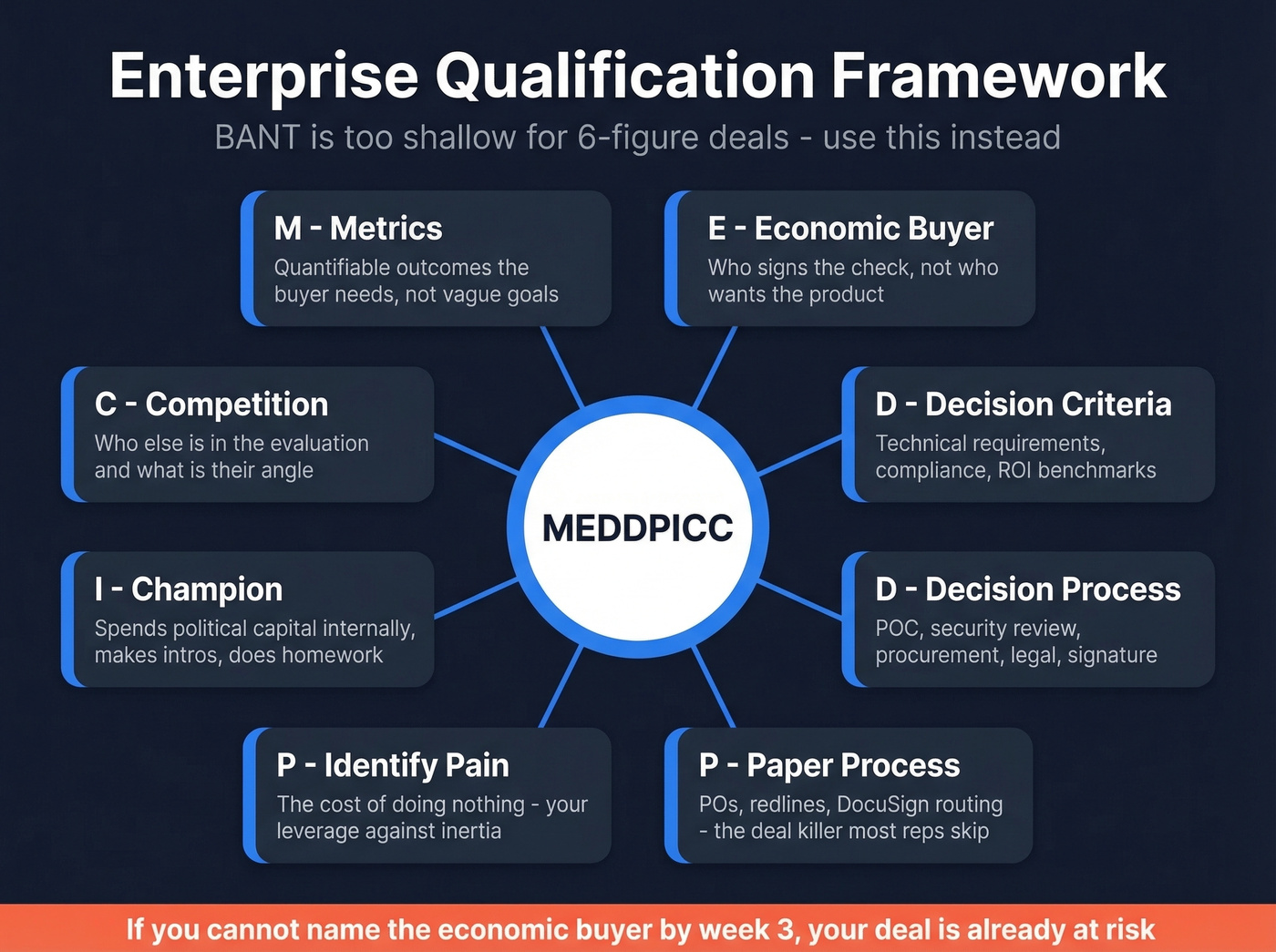
MEDDPICC is the enterprise standard for a reason:
Metrics - What quantifiable outcomes does the buyer need? Not "better efficiency" - actual numbers. "Reduce onboarding time from 8 weeks to 4" gives you something to build an ROI case around.
Economic Buyer - Who signs the check? Not who wants the product. Who controls the budget. If you can't name this person by week three, your deal is already at risk. (If you want a deeper breakdown, start with the economic buyer.)
Decision Criteria and Process - What are they evaluating against, and what's the actual sequence? Technical requirements, compliance thresholds, ROI benchmarks - then POC, security review, procurement, legal, signature. Get this mapped early or you'll be surprised late.
Paper Process - How does the contract physically get approved? Purchase orders, redlines, DocuSign routing. This is the step most reps skip asking about, and it's the step that kills the most deals in Q4.
Identify Pain - What's the cost of doing nothing? This is your leverage against inertia.
Champion - Who's spending political capital internally to push this deal? A real champion makes introductions, does homework between meetings, asks implementation questions, and responds quickly. If they're just enthusiastic but won't stick their neck out, they're a fan, not a champion.
Competition - Who else is in the evaluation, and what's their angle?
Three qualifying questions to ask in the first two calls: "Walk me through your procurement process for a purchase of this size." "What's the typical legal review timeline?" "Who else needs to be looped in before this moves to a formal evaluation?" If your contact can't answer these, you don't have a champion yet.
Multi-Threading and Stakeholder Mapping
Above ~$30K ACV, a second stakeholder reliably appears in the buying process. Multi-threading isn't a best practice - it's structurally necessary. Deals with three or more contacts engaged close 2.4x faster than single-threaded ones.
If you're building this motion across named accounts, align it with account-based selling so outreach and stakeholder coverage stay coordinated.
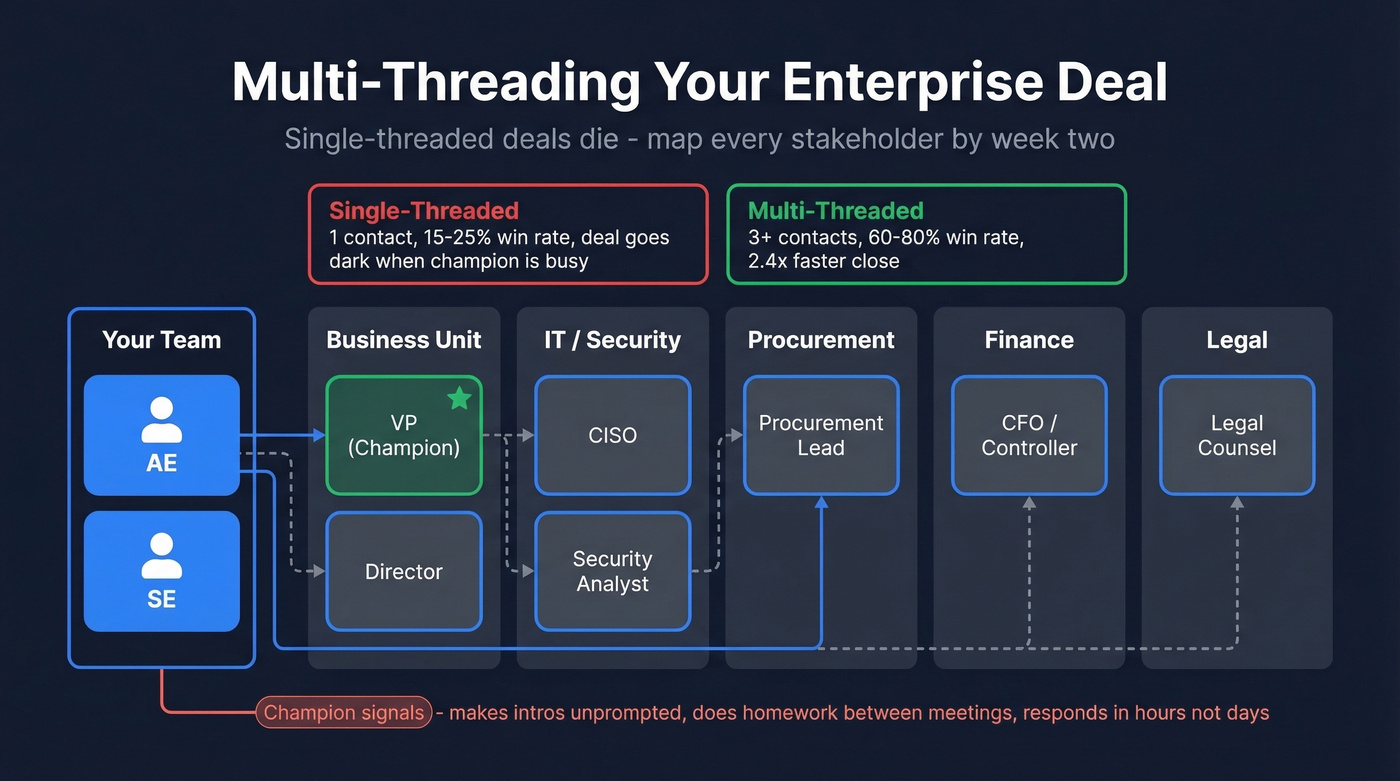
Here's a scenario we see constantly: the rep builds a strong relationship with one VP and ignores procurement, legal, and IT. Month four arrives, the VP says "we're almost there," and then the deal goes dark for six weeks because security had questions nobody anticipated. The VP wasn't sandbagging - they just didn't control the process.
For six-figure deals, expect to map stakeholders across legal, procurement, IT/security, finance, and the business unit. Your champion should be coaching you on who matters and making introductions. The engagement signals that separate a real champion from a friendly contact: they introduce you to other stakeholders unprompted, they do homework between meetings, they ask implementation questions, and they respond within hours, not days. Deals with engaged champions close at 60-80%; without one, you're looking at 15-25%.
The practical problem is finding verified contact information for every stakeholder fast enough to keep the deal moving. When you identify missing roles - procurement, security, finance - and need to reach them this week, not next month, Prospeo's leads database lets you search by company, filter by department and seniority across 30+ filters, and push verified contacts into your CRM through native integrations with Salesforce and HubSpot.
The Quiet Phase Playbook
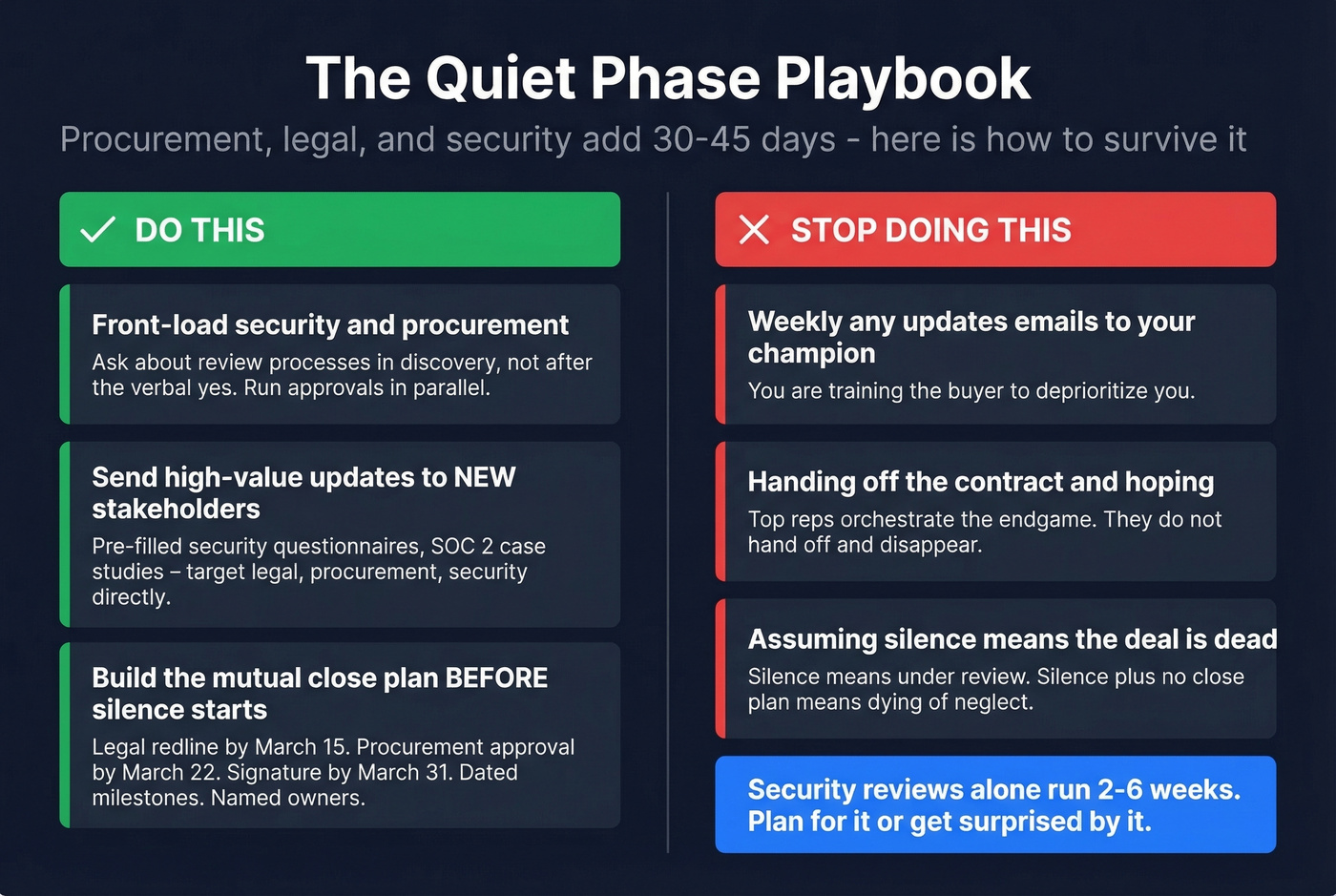
Look, the most frustrating part of enterprise sales is the quiet phase - that stretch after verbal interest where legal, procurement, and security take over and your champion goes dark. Procurement, legal, and security add 30-45 days in the $50K-$100K band. Security reviews alone run 2-6 weeks depending on the buyer's maturity and industry.
What to do
Front-load security and procurement. Ask about their review process in discovery, not after the verbal yes. Top performers run approvals in parallel via mutual close plans.
Send fewer, higher-value updates aimed at the new stakeholders - legal, procurement, security - not your champion. A relevant case study about your SOC 2 compliance or a pre-filled security questionnaire moves the deal. "Just checking in" doesn't. (If you need language that doesn't sound like a ping, use these sales follow-up templates.)
Build the mutual close plan before the quiet phase starts. "Legal redline by March 15, procurement approval by March 22, signature by March 31." Dated milestones. Named owners. No ambiguity.
What not to do
Don't send weekly "any updates?" emails to your champion. In enterprise, that's how you train the buyer to deprioritize you. Don't disappear after handing over the contract - top reps orchestrate the endgame, they don't hand off and hope. And don't assume silence means the deal is dead. Silence means it's under review. But silence plus no mutual close plan? That's a deal dying of neglect.
Closing the Endgame
Here's the thing: if your contract value is under $50K, you probably don't need a dedicated "closing strategy." The deal closes itself when qualification and multi-threading are done right. But above $100K, the hardest part isn't negotiation - it's managing the risk shift. Early in the cycle, the buyer evaluates value: "Will this solve our problem?" Late in the cycle, the question changes to career risk: "What if this doesn't work and I'm the one who signed off?"
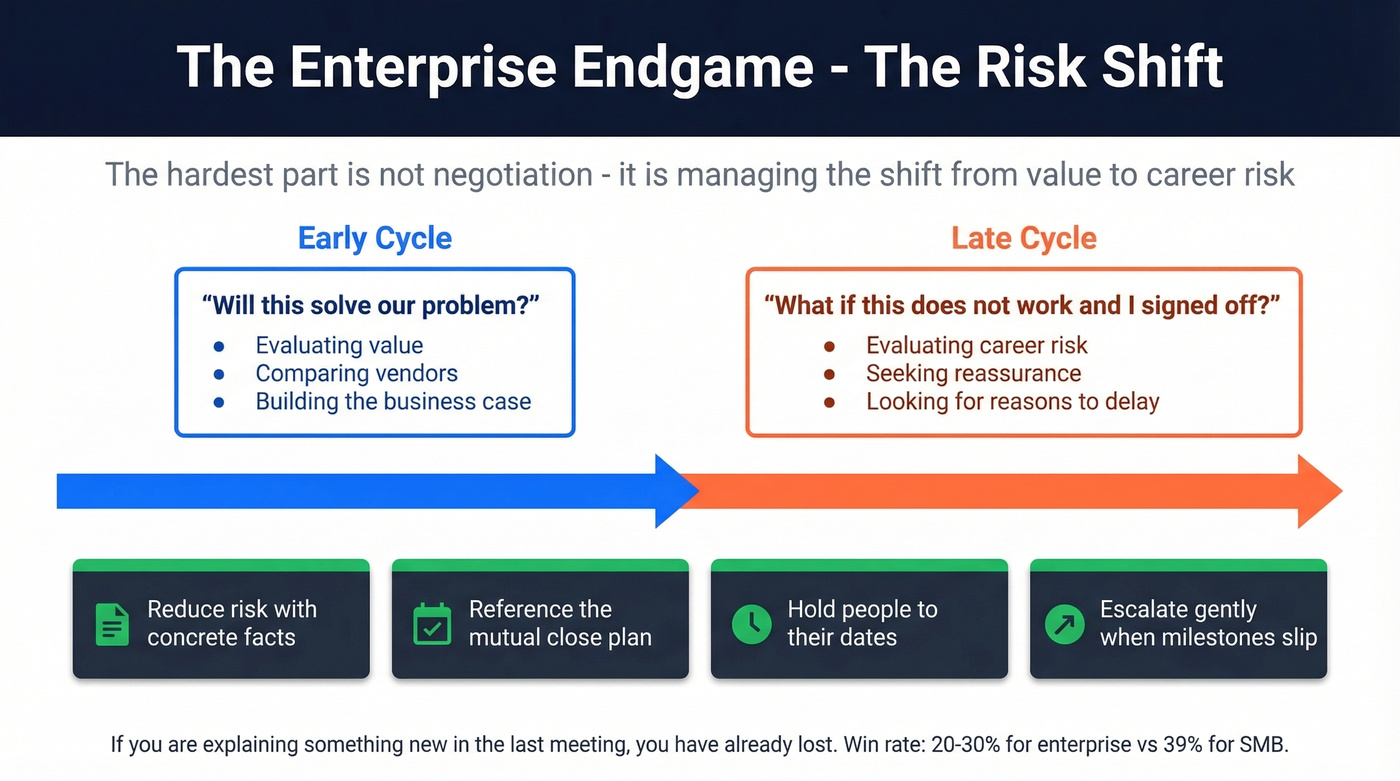
Your job in the endgame is to reduce perceived risk with concrete facts, responsiveness, and clarity. Not pressure. If you're explaining something new in the last meeting, you've already lost.
The mutual close plan you built during the quiet phase is your single most important closing tool. Reference it, hold people to their dates, and escalate gently when milestones slip. This isn't bureaucracy - it's how enterprise deals actually close.
On pricing negotiation: industry norms run 10-20% off list price for a 2-year commitment and 20-30% for 3-year terms. Smart buyers negotiate the whole package - implementation, support, training, SLAs - not just the subscription rate. Smart sellers know this and build concession room into the non-subscription line items. (If you want a tighter framework for discounting, see anchor in negotiation.)
The Enterprise Deal Stack
You don't need 12 tools. You need the right five or six, integrated tightly.
CRM: Salesforce remains the default for enterprise at $165/user/mo and up. Everything else plugs into it. HubSpot works for mid-market but gets stretched at true enterprise scale. (If you're standardizing your CRM approach, compare examples of a CRM.)
Engagement: Outreach or Salesloft for sequencing, typically $100-150/user/mo. The value isn't the email templates - it's the multi-channel orchestration across a 6-month deal cycle. Reddit's r/sales community remains split on which is better; pick whichever your team already knows.
Conversation Intelligence: Gong for call recording, deal intelligence, and coaching. Typically $100-150/user/mo depending on team size. Worth it if your team runs 10+ discovery calls per week. Skip it if your team is under five reps - the ROI doesn't justify the cost at that scale.
Forecasting: Clari for pipeline visibility and revenue intelligence, typically $40-80K/yr for enterprise teams. By 2026, over 60% of B2B sales teams use ML-derived intent scoring as core pipeline qualification. (If you're evaluating options, start with sales forecasting solutions.)
Intent Data: 6sense at roughly $60K/yr for account-level intent and predictive scoring. Expensive, but powerful for prioritizing which accounts are actually in-market.
Data Enrichment and Verification: This is where most stacks have a gap. Prospeo fills it at ~$0.01/email - self-serve, no contracts - with 98% email accuracy on a 7-day refresh cycle. For context, ZoomInfo starts at $15K+/yr for comparable data. When you're building stakeholder maps across 8-13 decision-makers per deal, the cost difference compounds fast. (If you're comparing vendors, see data enrichment services.)
For any tool in this stack, check for CRM integration depth, automation capabilities, analytics, and security compliance. SOC 2, GDPR, SSO, and RBAC are table stakes for enterprise procurement.
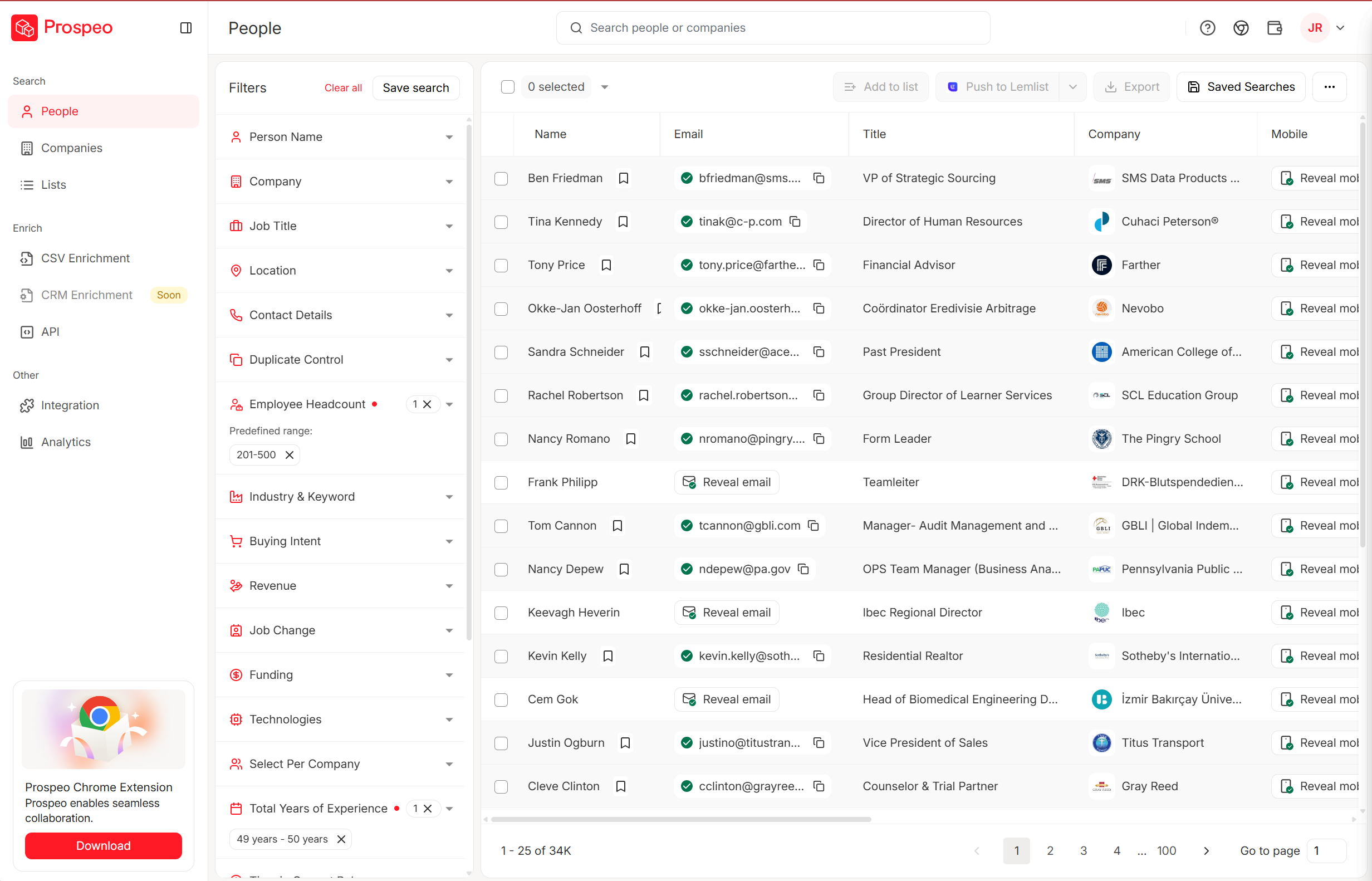
Multi-threading closes enterprise deals 2.4x faster - but only if you have contact data for every person on the committee. Prospeo's 30+ search filters let you map entire org charts by department, seniority, and company size. Verified contacts at $0.01/email, refreshed every 7 days.
Build your full stakeholder map in minutes, not weeks.
FAQ
How long does an enterprise deal take to close?
Median cycle for $100K+ ACV deals is 187 days; deals above $500K average 270 days. Top-quartile teams close $100K+ deals in 142 days by front-loading procurement and security reviews and running approvals in parallel via a mutual close plan.
What's the typical discount on a multi-year contract?
Industry norms are 10-20% off list price for a 2-year commitment and 20-30% for 3-year terms. Smart buyers also negotiate implementation, support, training, and SLA terms - not just the subscription rate.
How do you find contact info for every stakeholder in a large deal?
Use a B2B data platform with verified emails and direct dials. Prospeo covers 300M+ profiles at 98% email accuracy with a 7-day refresh cycle - search by company, filter by department and seniority, and export directly to your CRM. The free tier includes 75 verified emails per month.
Why do most enterprise deals stall?
86% of B2B purchases stall at some point, usually during the quiet phase when legal, procurement, and security take over. Build a mutual close plan with dated milestones before the quiet phase begins, multi-thread across every stakeholder group, and send high-value updates to new decision-makers rather than pinging your champion for status.