

The Enterprise GTM Playbook: Benchmarks, Tactics, and What Actually Works in 2026
Your CEO just walked out of a board meeting and said, "We're going enterprise." Six words that sound like a promotion but feel like a cliff. Enterprise GTM isn't scaled-up mid-market. It's a fundamentally different strategy built on precision targeting, multi-threaded relationships, and verified data across a finite TAM. Get it wrong and you've burned 12-18 months and millions in headcount, tooling, and opportunity cost that you won't get back.
Here's the math that frames everything: 95% of potential buyers are out of market at any given time. In enterprise, where your total addressable market might be 200-500 accounts, that 5% means 10-25 accounts are ready to buy right now. Miss them, and you're waiting quarters for the next window. Plan for 6-9 month sales cycles and roughly 15-20% win rates for $100K+ ACV motions, with buying committees that make mid-market deals look like impulse purchases.
Why Enterprise Go-to-Market Is Structurally Different
Every dimension of the sale changes when you move upmarket - who's involved, how long it takes, and how likely you are to win.
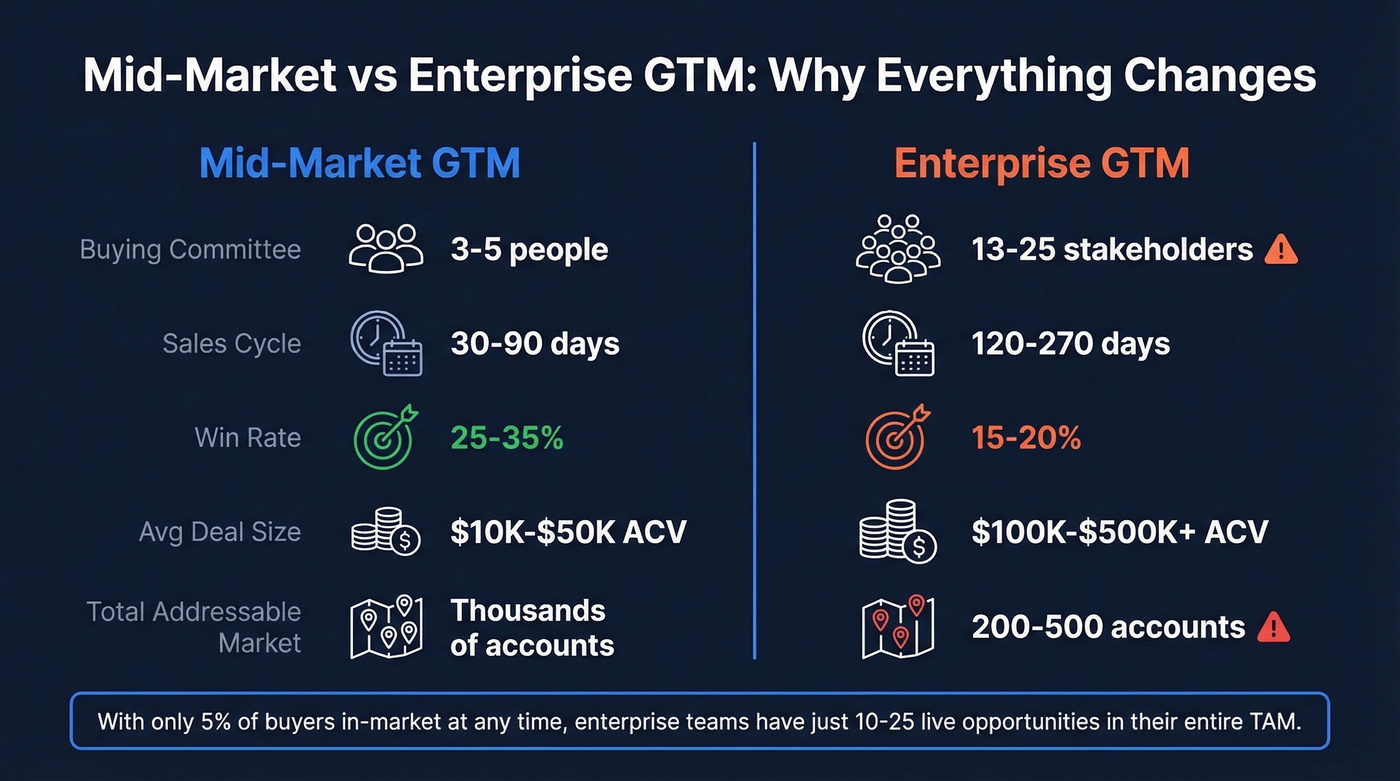
Forrester's "State of Business Buying" puts the average B2B purchase at 13 stakeholders. Salesforce research pushes that to 25 stakeholders, up from 16 in 2017. You're not selling to a person. You're selling to a committee that spans departments, budgets, and competing agendas.
Sales cycles have stretched to 6.5 months on average, up from 4.9 months in 2019. Win rates for $100K+ ACV deals fell from roughly 26% to 17% between 2022 and 2023, and haven't meaningfully recovered. Only 16% of reps are hitting quota. That's the new baseline.
The constraint that changes everything is TAM. Mid-market teams can burn through thousands of accounts with volume-based outbound. Enterprise teams might have 200-500 target accounts total. Every bounced email, every bad phone number, every single-threaded deal is a wasted shot at a market you can't replenish.
| Dimension | Mid-Market | Enterprise |
|---|---|---|
| Buying committee | Smaller committees | 13-25 stakeholders |
| Sales cycle | Faster cycles | 120-270 days |
| Win rate | Higher win rates | ~15-20% on $100K+ ACV deals |
| ACV | Lower ACV | $100K-$500K+ |
| TAM | Larger account pools | Hundreds of accounts |
Choosing Your GTM Model
Not every company should run a full sales-led approach. The right model maps directly to your ACV:
| ACV Range | Recommended Approach |
|---|---|
| Under $1K | Product-led growth |
| $1K-$50K | Hybrid (PLG + sales) |
| Over $50K | Sales-led |
If you're reading this, you're probably in the $50K+ range - which means sales-led is the default. But here's the opinion most consultants won't give you: stage fit matters more than logo fit. Hiring a CRO from Salesforce when you're a 30-person Series A isn't strategy. It's an expensive mistake.
A single bad GTM hire can cost $1.5M-$3M+ when you factor in direct comp, lost revenue, team turnover, and opportunity cost. We've seen this pattern repeatedly: a company brings in a "proven enterprise leader" from a company 10x their size, and that person spends six months building infrastructure the company doesn't need yet while pipeline stalls. Start manual. Validate the playbook with a small team before you automate or scale anything. The best teams run a "zero automation" pilot phase where founders or early AEs close the first 5-10 deals by hand to learn the real buying process.
Sales Cycle Benchmarks
Calibrate your expectations before you build pipeline forecasts. These numbers are your baseline, not your aspirational targets.
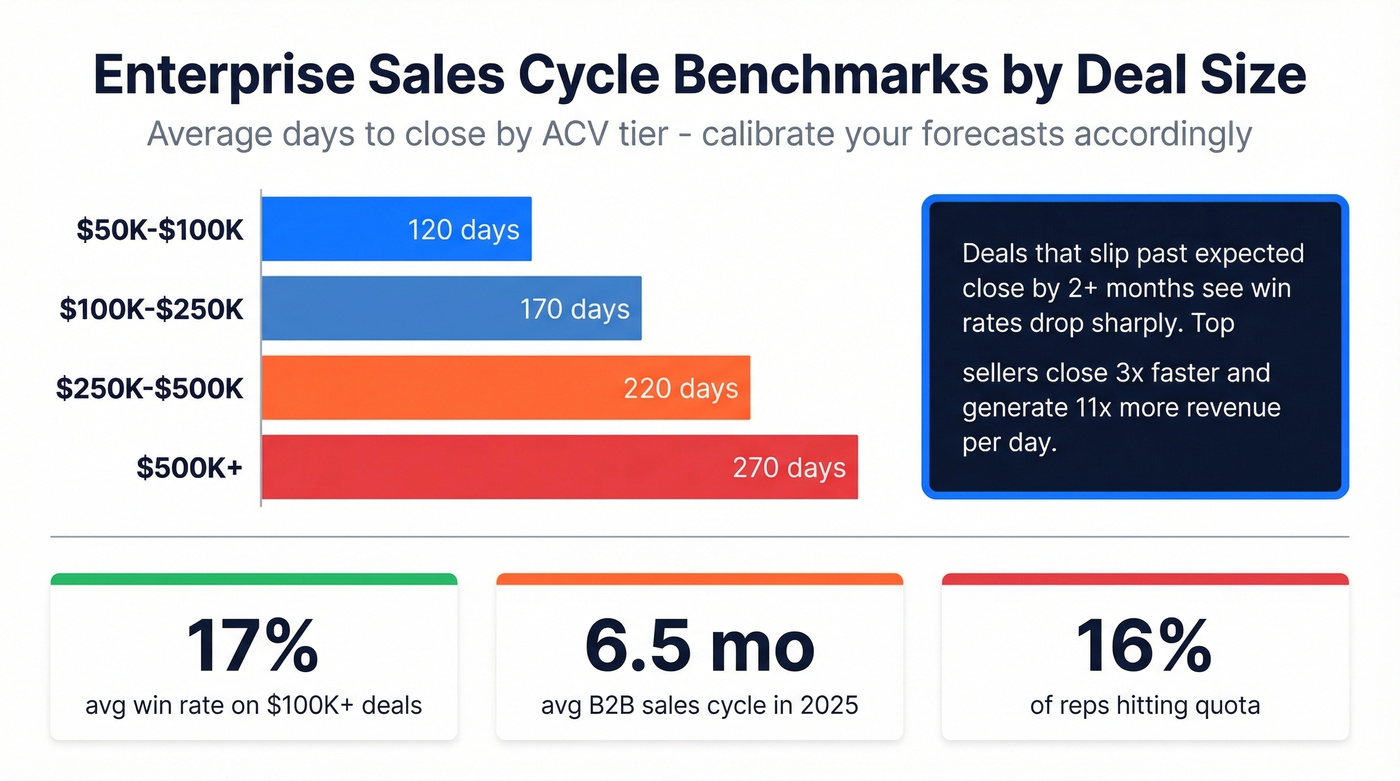
By ACV tier:
| ACV Range | Avg. Cycle (Days) |
|---|---|
| $50K-$100K | 120 |
| $100K-$250K | 170 |
| $250K-$500K | 220 |
| $500K+ | 270 |
By prospect company size:
| Company Size | Avg. Cycle (Days) |
|---|---|
| 1-10 employees | 38 |
| 201-500 | 95 |
| 1,001-5,000 | 135 |
| 5,001-10,000 | 158 |
| 10,001+ | 185 |
These are averages. Deals that slip past their expected close date by more than two months see win rates drop sharply - top sellers close deals 3x faster and generate 11x more revenue per day than their peers. Speed isn't about rushing the buyer. It's about removing friction, maintaining momentum, and never letting a deal go dark. If you're modeling a $200K ACV deal at 60 days, you're lying to your board.

With 200-500 target accounts, every bounced email is a wasted shot. Prospeo's 98% email accuracy and 125M+ verified mobiles mean your reps actually reach the 13-25 stakeholders on each buying committee - not their spam folders.
Stop burning your finite TAM on bad data. Start connecting.
The Playbook - 5 Pillars
ICP and Account Selection
Firmographics alone won't cut it. "Fortune 500 companies in financial services" isn't an ICP - it's a wish list. Signal-based targeting separates teams that hit quota from those that burn through their TAM in two quarters.
If you need a scoring rubric, start with an Ideal Customer Profile template before you buy more tools.
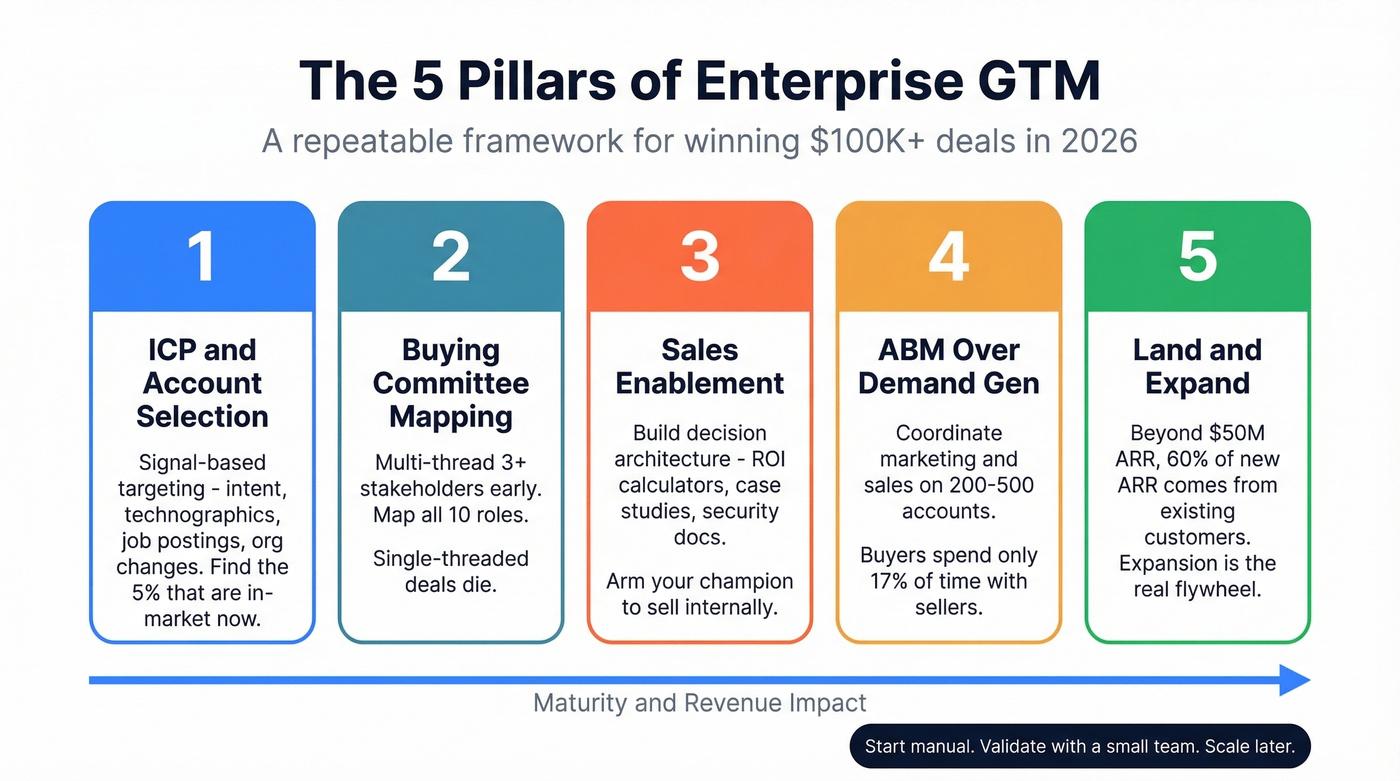
Layer these signals to find accounts that are actually in-market:
- Buyer intent - which accounts are researching your category right now? Layer Bombora-powered intent topics with job change and headcount growth signals to surface in-market accounts before they hit your competitor's inbound form.
- Technographic signals - what's in their current stack? A competitor install or a complementary integration makes for a warmer conversation.
- Job posting signals - hiring for roles your product supports means budget exists and pain is real.
- Headcount growth and funding - expanding companies buy more software, full stop.
- Organizational change - new CRO, new VP of Engineering, new CFO. Leadership transitions create buying windows.
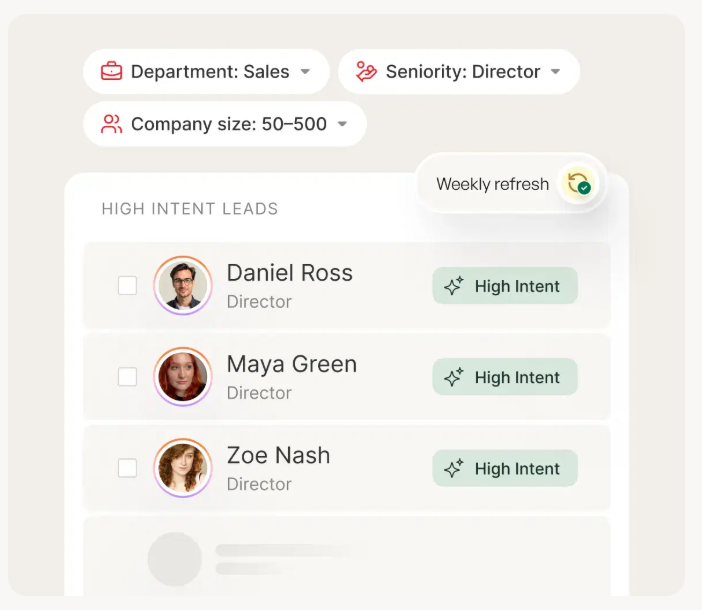
This matters because 41% of buyers already have a preferred vendor before formal evaluation begins. You need to be that vendor. Signal-based targeting gets you into conversations before the RFP drops.
Buying Committee Mapping
Most salespeople are single-threaded. They find one champion and ride that relationship until the deal dies - which it does, because that champion goes on vacation, changes roles, or loses an internal political battle.
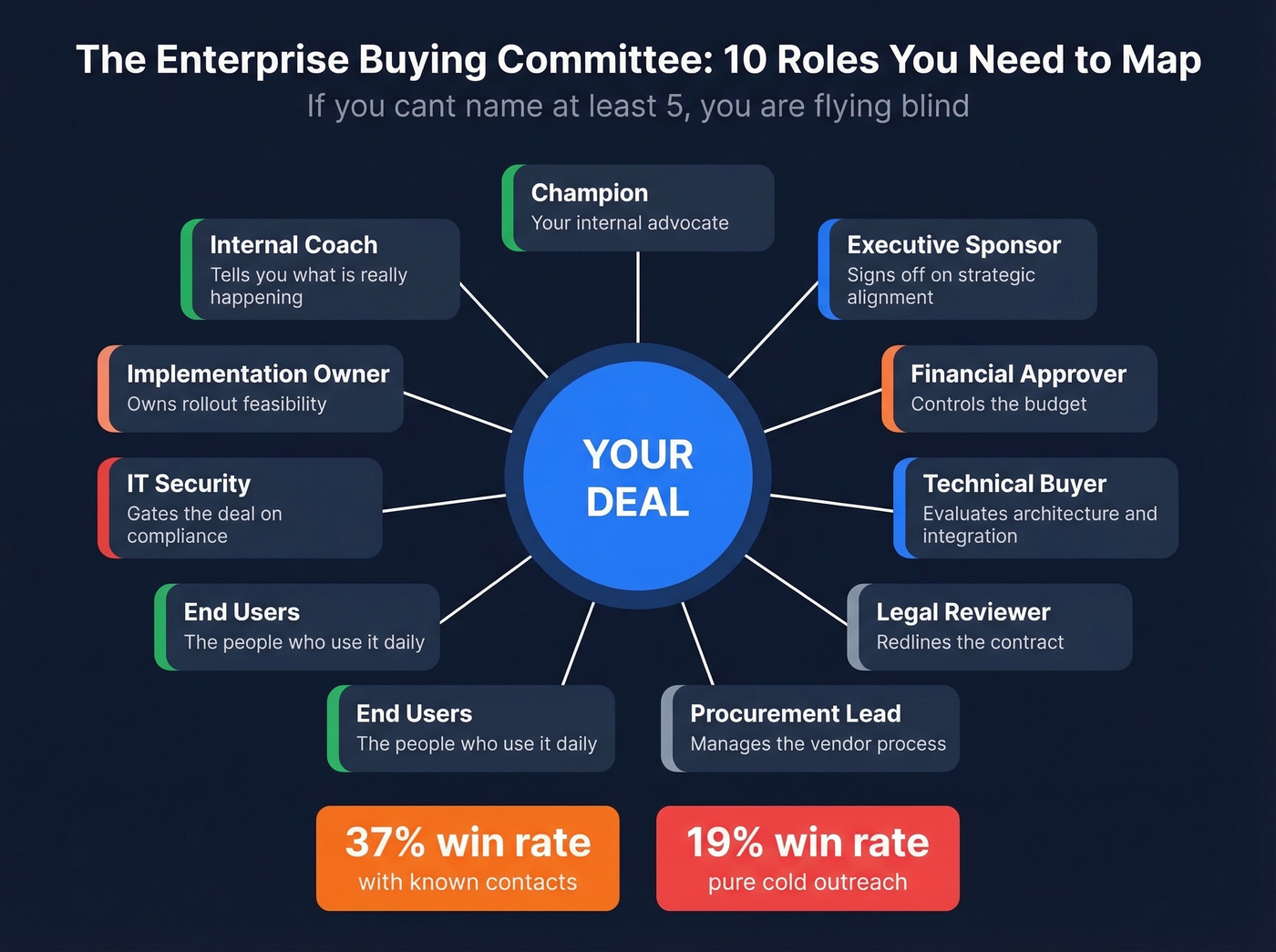
Multi-threading improves win rates. Deals with a known contact close at 37% versus 19% for pure cold outreach. Simple math: you need 3+ stakeholders engaged early in every enterprise deal.
Gartner's research shows complex B2B solutions involve 6-10 decision makers, each bringing 4-5 pieces of independent research to share with the group. You're not just selling to these people - you're arming them to sell internally on your behalf. Here's who you need to map:
- Champion - your internal advocate
- Executive sponsor - signs off on strategic alignment
- Financial approver - controls the budget
- Technical buyer - evaluates architecture and integration
- Legal reviewer - redlines the contract
- Procurement lead - manages the vendor process
- End users - the people who'll use it daily
- IT security - gates the deal on compliance
- Implementation owner - owns rollout feasibility
- Internal coach - tells you what's really happening
Not every deal has all ten, but if you can't name at least five, you're flying blind. The consensus on r/sales is that champion risk and procurement/security reviews are the two most underestimated deal-killers - and both are multi-threading problems at their core.
The loop-in script that works: "[Champion], I want to make sure we're building this business case in a way that resonates with your CFO and IT team. Would it make sense to bring [Name] into our next call so we can address their requirements directly?"
Use a qualification framework like MEDDPICC to systematically track each stakeholder's role, influence, and concerns. Without it, multi-threading becomes a vague aspiration instead of a repeatable process.
None of this works if your contact data is garbage. Snyk's enterprise sales team was running bounce rates of 35-40% before switching their data provider. After the switch, bounce rates dropped under 5%, and AE-sourced pipeline jumped 180% with 200+ new opportunities per month. When your TAM is finite, every bounced email is a wasted shot at an account you can't replace.
Sales Enablement and Decision Architecture
Enterprise buyers don't need another product demo. They need ammunition to justify the purchase internally - what we call "decision architecture," the scaffolding that reduces executive risk and makes saying yes easier than saying no.
Your enablement stack should include white papers and reference architectures that technical buyers can forward to their teams, ROI calculators with inputs the CFO's team can validate independently, customer case studies from companies in the same industry and size band, security documentation (SOC 2 Type II is often a prerequisite), and implementation timelines with realistic resource requirements.
If your team is still defaulting to “show up and wing it,” use a product demo checklist to standardize what “good” looks like.
Here's the thing: 86% of B2B purchases stall at some point. One of the most common stalls is security review. We've watched deals die because a CISO blocked a vendor that didn't have SOC 2 Type II certification. Build your deal architecture before you need it - by the time a CISO asks for your penetration test results, it's too late to start the process. SOC 2 takes 6-12 months to complete, so start now.
ABM Over Demand Gen at Scale
Enterprise marketing isn't demand gen with bigger budgets. Running webinars and gated content to a list of Fortune 500 email addresses isn't ABM - it's spam with better targeting.
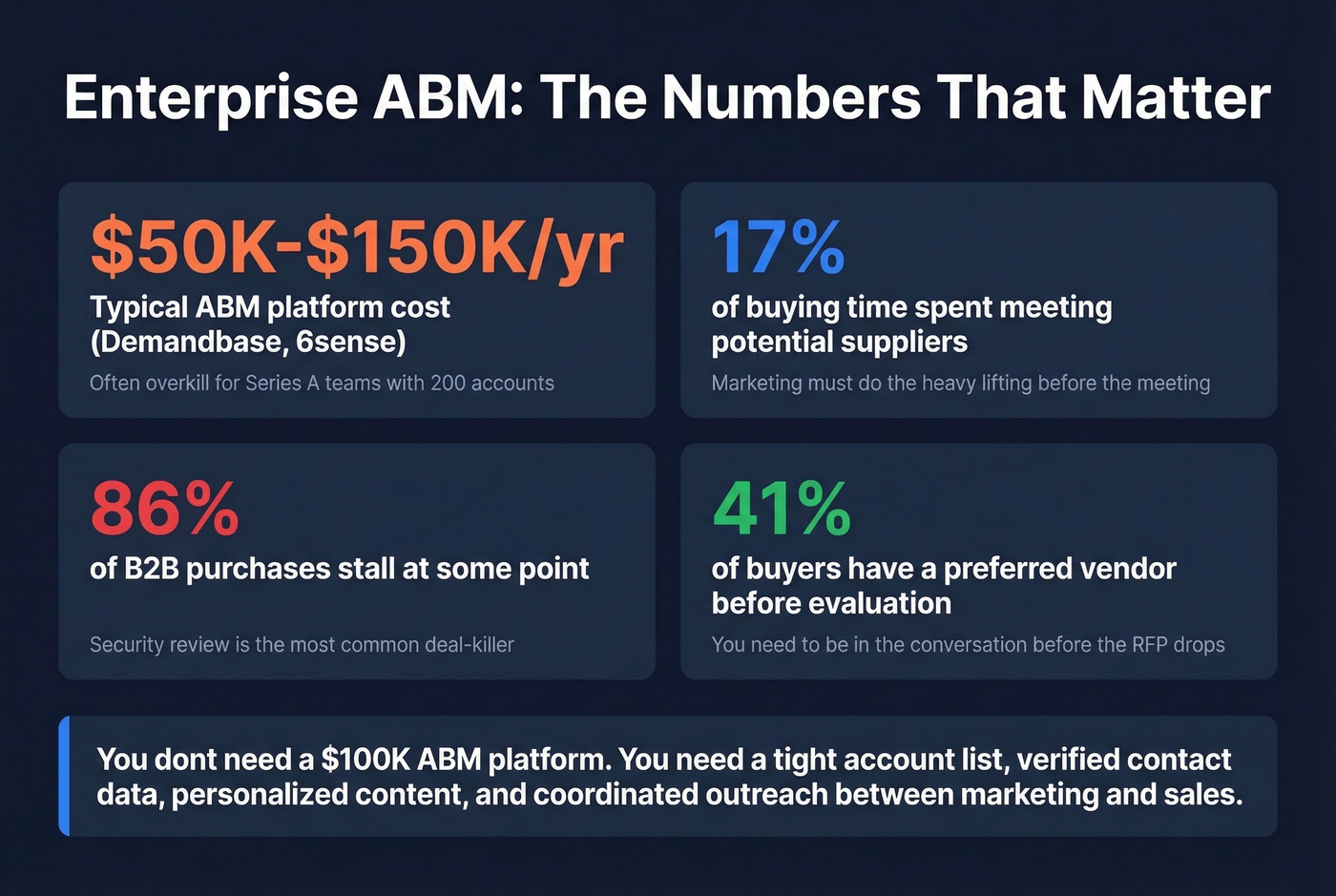
Account-based marketing is the default for enterprise go-to-market because the math demands it. Buyers spend only 17% of their purchasing time meeting with potential suppliers. Your marketing needs to do the heavy lifting before the meeting ever happens - building awareness, establishing credibility, and shaping the narrative your champion uses internally.
If you want the sales side of ABM to actually work, borrow from account-based selling best practices instead of “spray and pray” outbound.
Let's be honest about tooling costs, though. Most ABM platforms are overpriced for early enterprise teams. Demandbase and 6sense run $50K-$150K/year. If you're a Series A company with 200 target accounts, you don't need a $100K ABM platform. You need a tight account list, verified contact data, personalized content, and a coordinated outreach approach between marketing and sales. The tooling can scale later.
Land-and-Expand as a Growth Engine
The real flywheel isn't new logos - it's expansion revenue. Beyond $50M ARR, 60% of new ARR comes from existing customers. Companies running hybrid pricing models average roughly 105% net revenue retention.
Your post-sale strategy is a go-to-market strategy. Customer success isn't a cost center - it's your most efficient pipeline source. The enterprise AE who closes a $200K deal and hands it off to a CSM who never upsells is leaving money on the table.
If you’re trying to operationalize expansion, start by clarifying cross-selling vs up-selling so CS and Sales aren’t working at cross purposes.
Plan CS capacity accordingly: one CSM handling 30 enterprise accounts can't drive expansion. The ratio needs to be tight enough that your CS team knows every stakeholder, every renewal date, and every expansion trigger in their book. A single well-managed account can generate more lifetime revenue than five new logos.
Tech Stack With Actual Costs
You need 4-5 tools that talk to each other, not 15. Reps already spend only 28-30% of their time actually selling, with roughly 18% of the week lost to CRM and admin tasks. Every redundant tool in your stack makes that worse. We've seen teams stack so many point solutions that their RevOps person spends more time maintaining integrations than analyzing pipeline.
| Category | Tool | Pricing |
|---|---|---|
| CRM | Salesforce | ~$150/user/mo (varies by edition) |
| CRM | HubSpot | From ~$90/seat/mo |
| Data / Verification | Prospeo | Free tier, ~$0.01/email |
| Data Platform | ZoomInfo | $15K-$40K/yr |
| Data / Outbound | Apollo | Free, $49-$119/user/mo |
| Intent / ABM | 6sense | $50K+/yr |
| Intent / ABM | Demandbase | $50K-$150K/yr |
| Intent Data | Bombora | $25K-$75K/yr |
| Conversation Intel | Gong | ~$1,600/user/yr + platform fee |
| Sales Engagement | Outreach | $100-$200/user/mo |
| Enrichment | Clay | $149-$720/mo |
For a 10-person enterprise sales team, expect to spend $75K-$250K/year on your tech stack before headcount.

The foundation of this stack is data quality. Enterprise data decays fast - people change roles, companies restructure, and phone numbers go stale. A 7-day data refresh cycle versus the 6-week industry average is the difference between reaching a VP of Engineering and leaving a voicemail for someone who left six months ago. Tools like Prospeo deliver 98% email accuracy at roughly $0.01 per email with no annual contracts, and native Salesforce and HubSpot integrations keep your CRM clean automatically. For teams that don't want a six-week procurement process just to start verifying contacts, that self-serve model matters.
If you’re troubleshooting bounces and deliverability, start with email bounce rate benchmarks and root causes before you blame copy.
Multi-threading a 25-person buying committee requires verified contact data for every stakeholder - champion, CFO, technical buyer, procurement. Prospeo surfaces emails and direct dials across entire org charts with 30+ filters including intent data, job changes, and headcount growth - refreshed every 7 days, not 6 weeks.
Map the full committee at $0.01 per email. No contract required.
5 Mistakes That Kill Enterprise Deals
1. Single-threading. Your champion leaves, gets promoted, or loses political capital - and your deal dies with them. Engage 3+ stakeholders from the first month.
2. Volume-based outbound on a finite TAM. If you have 300 target accounts and you're blasting 5,000 emails a month, you're burning domain reputation and exhausting your market simultaneously. Enterprise outbound is precision, not volume. If you need a refresher on what “precision” looks like, use these sales prospecting techniques.
3. Bad data and unverified contacts. Every bounced email burns a relationship in a market you can't replenish. If your bounce rate is above 5%, your data provider is actively sabotaging your go-to-market motion. Bad data doesn't just waste one touchpoint - it damages your sender reputation for every future email to that domain.
4. Skipping security and compliance readiness. SOC 2 Type II certification takes 6-12 months to complete. If you start the process after a CISO asks for it, you've already lost the deal. Get certified before you need it.
5. Scaling before validating the playbook. Hiring five enterprise AEs before you've closed your first 10 deals is the $1.5M mistake. Run a manual-first pilot: founders or early AEs close the first 5-10 deals by hand, document the real buying process, prove the sales cycle and win rate, then scale. Pouring fuel on an unvalidated model just makes the fire bigger.
AI and the 2026 Shift
The macro shift isn't just AI tooling - it's the move from "growth at all costs" to capital-efficient, defensible revenue. The era of hiring 50 SDRs and hoping the math works is over.
Gartner predicts that by 2028, 90% of B2B buying will be AI-agent intermediated, pushing more than $15 trillion in B2B spend through AI agent exchanges. That's two years away.
What does this mean practically? Your product pages, pricing structures, integration documentation, and security certifications need to be machine-readable. AI-search leads already convert 40% better than traditional search leads. "Agent engine optimization" - making your product discoverable and evaluable by AI agents, not just human buyers - is becoming a real requirement. For teams building an enterprise GTM strategy, this means treating structured data and parseable documentation as first-class priorities alongside traditional sales enablement.
Your content doesn't just need to convince a human champion. It needs to survive an AI agent's evaluation criteria when a procurement team asks their AI to shortlist vendors. Structured data, clear pricing signals, and parseable documentation aren't SEO tactics anymore - they're GTM infrastructure.
Skip this section if your deal size is under $50K. Seriously. The companies that struggle most with enterprise GTM aren't the ones with bad execution - they're the ones whose product economics don't justify the sales cycle. A 220-day sales cycle for a $30K deal is a losing proposition no matter how good your data or your AEs are. Fix the pricing before you fix the playbook.
FAQ
How long does enterprise GTM take to show results?
Plan for 6-9 months minimum. Sales cycles average 170-270 days for $100K+ ACV deals, and your first quarter will be spent building pipeline, not closing it. Model ~15-20% win rates in year one and staff accordingly - early enterprise go-to-market is an investment, not a revenue engine.
What's the minimum team size to go upmarket?
Start with 2-3 people: one enterprise AE, one SDR focused on multi-threaded outbound, and a marketing/content person building ABM assets. Add a solutions engineer once you're past your first 5 deals. Resist the urge to hire ahead of validated demand.
How do I know if my contact data is enterprise-ready?
Check your bounce rate. If it's above 5%, your data provider is burning your domain reputation on a finite market. Run a test batch of 500 contacts through real-time verification before launching any sequence. A 7-day data refresh cycle and 98%+ email accuracy should be your minimum bar - anything less and you're gambling with accounts you can't replace.
What separates winning enterprise GTM teams from the rest?
Discipline around TAM preservation. Winning teams treat their finite account list as a non-renewable resource - they verify every contact before outreach, multi-thread every deal from day one, and resist scaling headcount before the playbook is proven. Companies that fail typically import mid-market habits like volume outbound into an environment where those tactics destroy more pipeline than they create.