

Enterprise Sales Methodology: How to Choose, Implement, and Actually Inspect It
Your VP mandates MEDDPICC. Reps dutifully fill in CRM fields. The forecast still misses by 30%.
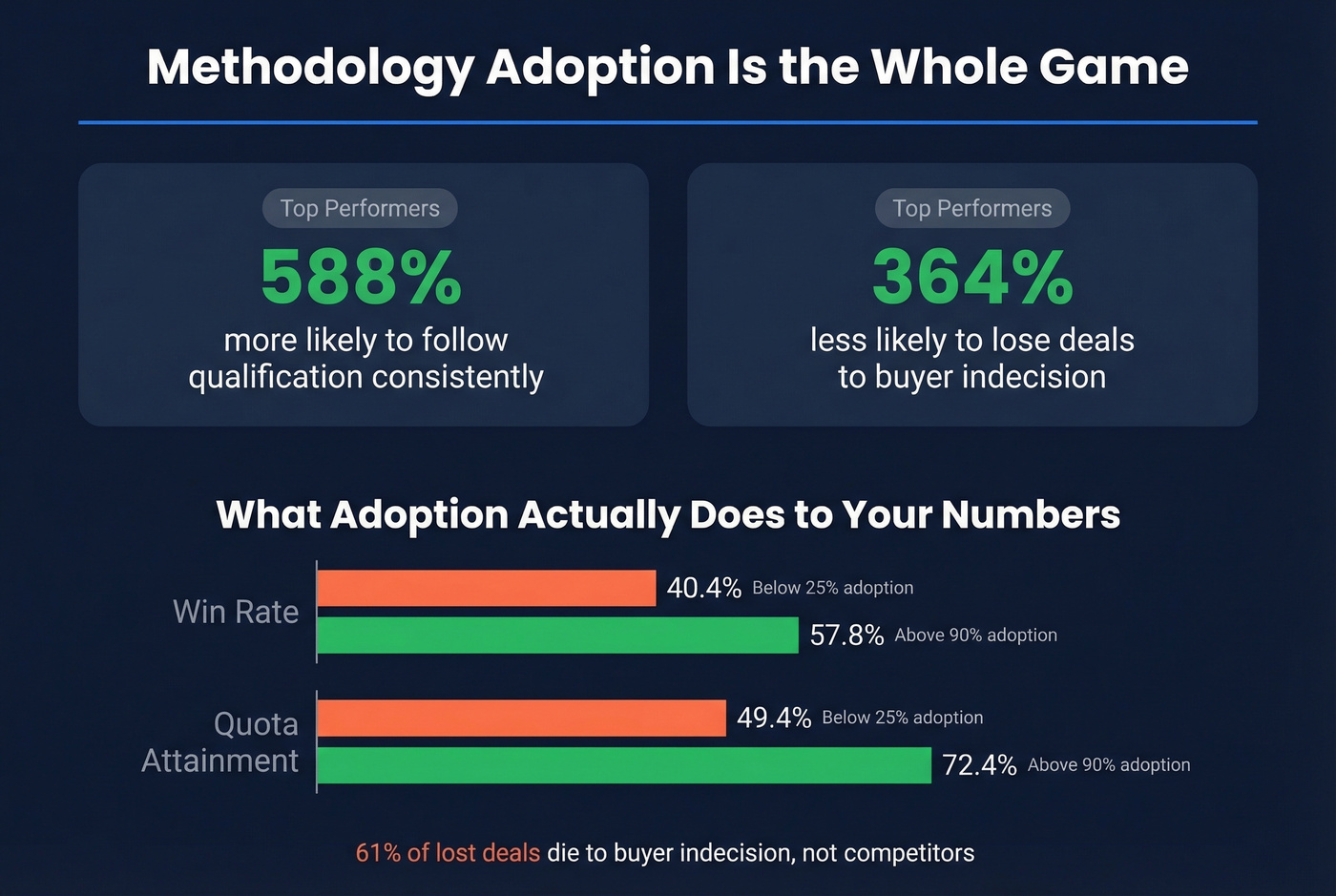
Meanwhile, 61% of your lost deals aren't going to competitors - they're dying to buyer indecision. The enterprise sales methodology wasn't the problem. The execution was.
What You Need (Quick Version)
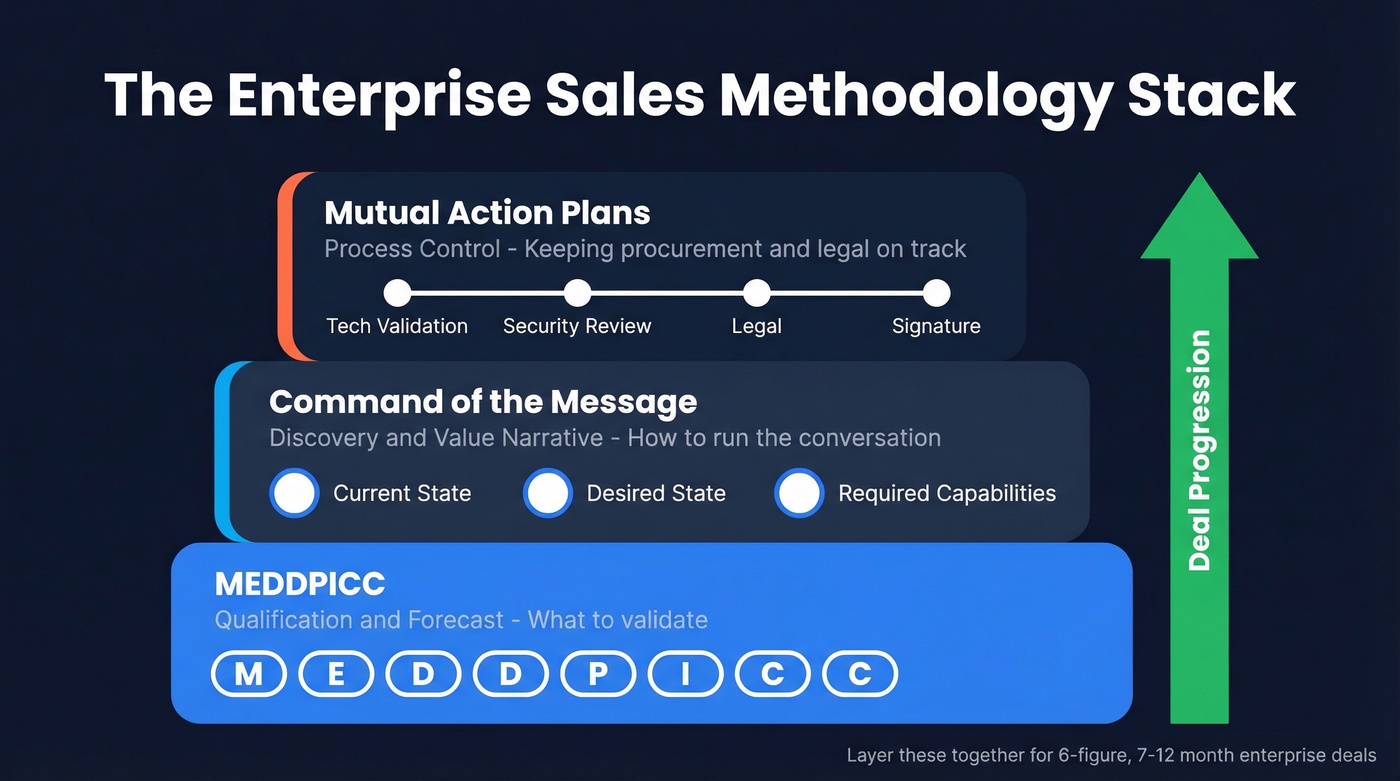
For enterprise deals - often six-figure ACV, 6-10 stakeholders, 7-12 month cycles - the winning combination is MEDDPICC for qualification, Command of the Message for discovery and value narrative, and Mutual Action Plans for process control through procurement and legal.
Here's the thing: the framework you pick matters far less than whether it produces inspectable CRM outputs your managers can review weekly. If your pipeline reviews are jargon audits instead of deal understanding sessions, no methodology will save your forecast.
What Enterprise Buying Demands
Enterprise buying has gotten structurally harder. Forrester's 2026 data shows the average B2B purchase now involves 13 internal stakeholders and 9 external participants. If the purchase includes generative AI features, that buying group doubles. Procurement is identified as a decision-maker by 53% of respondents, and they're showing up earlier in the cycle than ever.
Decision-makers spend only 16-17% of their time with vendors. Buyers spend 67% of their research time internally before they'll even pick up the phone. And here's the stat that should shape your entire go-to-market: 78% of buyers (86% of enterprise buyers) shortlist products they already knew before research began, with 96% keeping five or fewer products on that list. If you're not already on the radar, no framework will save you.
This is why SMB playbooks break in enterprise. You're not selling to a person. You're navigating an organization with its own politics, procurement gates, security reviews, and budget cycles. Your qualification framework needs to handle all of it - or it's just a vocabulary lesson.

Enterprise deals die when you can't reach the full buying committee. With 13+ stakeholders per deal, you need verified contact data for every decision-maker - not just the champion. Prospeo gives you 98% accurate emails and 125M+ verified mobile numbers so your multi-threading strategy actually connects.
Stop qualifying deals you can't even reach. Start with real contact data.
The Methodology Stack for Complex Deals
MEDDPICC - Qualification & Forecast
Use this if you're running deals above $100K ARR with multiple stakeholders. 73% of SaaS companies selling above that threshold use some version of MEDDPICC, reporting 18% higher win rates and 24% larger deal sizes.
Skip this if you're running shorter cycles with one or two decision-makers - it'll feel like overhead without payoff.
The framework originated at PTC in 1996, helping the company grow from $300M to $1B in four years. MEDDPICC adoption across B2B sales orgs doubled from 11% to 21% between 2021 and 2022, and the reason it's winning the AI age is straightforward: each MEDDPICC element maps cleanly to a distinct CRM field, making it far more automatable than conversational frameworks. 28% of deals fail specifically when buyers can't secure internal approval - MEDDPICC's Paper Process element exists to catch that before it kills your quarter.
If you want to go deeper on qualification, start with MEDDIC and keep a tight view on the economic buyer.
Command of the Message - Discovery & Value
Created by Force Management and used at Databricks, MongoDB, and Snowflake, Command of the Message tells you how to run the conversation where MEDDPICC tells you what to qualify. The practical rule that separates good reps from great ones: spend 15-20 minutes on Current State before you pitch anything.
After every discovery call, send a "mantra email" summarizing what you learned and the agreed next steps. It forces rigor and creates a paper trail your champion can forward internally. We've seen this single habit shorten deal cycles by weeks because it eliminates the "wait, I thought we agreed on..." conversations that stall procurement.
To standardize this, use a consistent set of discovery questions and a repeatable set of sales follow-up templates.
Mutual Action Plans - Process Control
Mutual Action Plans exist because enterprise deals don't die in discovery - they die when procurement and legal enter the process and reset your timeline. A shared document with milestones, owners, and dates for every step from technical validation through legal review keeps both sides accountable.
It's the simplest framework here and the one most teams skip. That's a mistake.
MAPs work best when they’re tied to your sales process optimization and reviewed alongside pipeline health.
Challenger and SPIN - Worth Knowing
Challenger works well when your buyers don't yet understand their own problem. But it's notoriously hard to coach at scale and nearly impossible to inspect in CRM. SPIN remains a solid consultative discovery framework, though it feels dated against modern multi-threaded enterprise deals. Both belong in your training library, not necessarily your operating system.
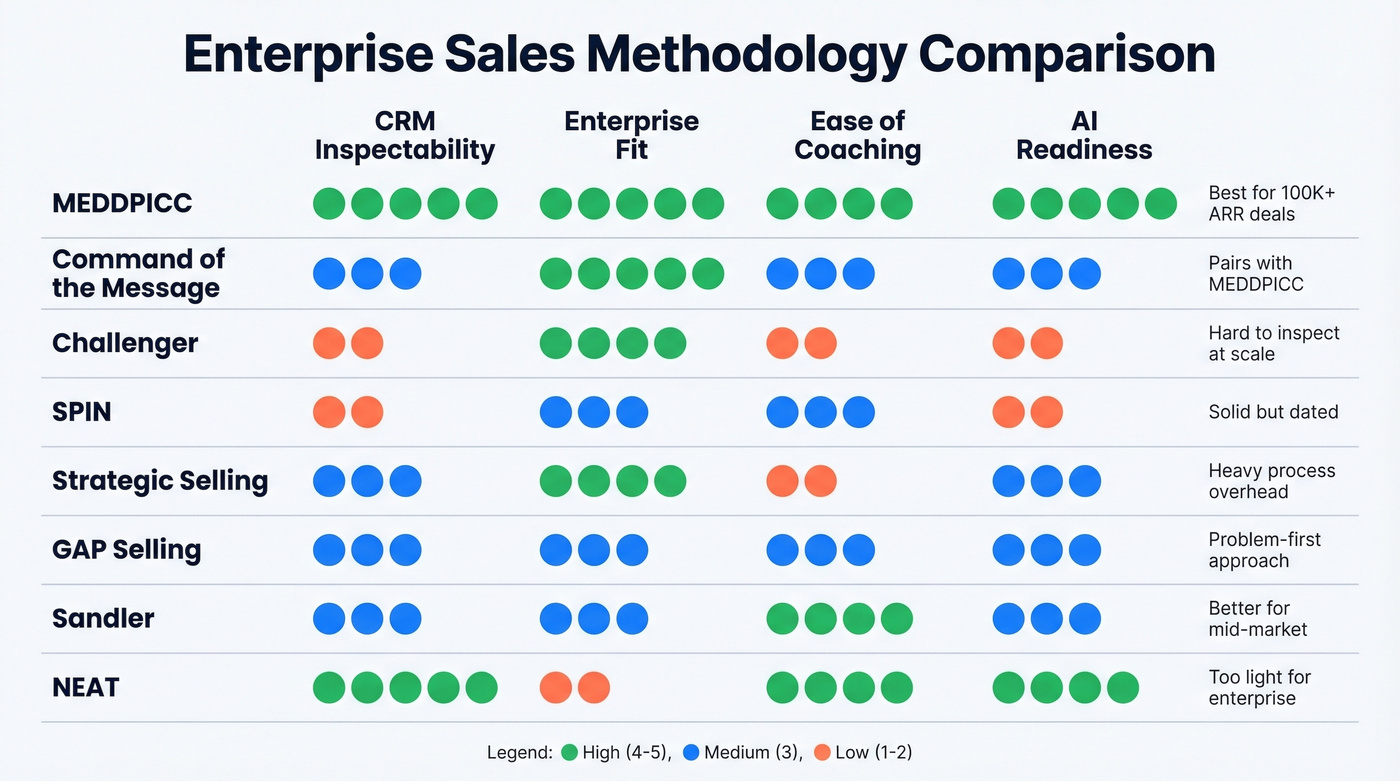
Selection Matrix
| Methodology | Best For | CRM Inspectability | Enterprise Fit | Weakness |
|---|---|---|---|---|
| MEDDPICC | Qualification, forecast | High - maps to fields | Excellent | Doesn't teach messaging |
| Command of the Message | Discovery, value narrative | Medium - needs notes | Excellent | $1K-$5K/rep training cost |
| Challenger | Insight-led selling | Low - hard to inspect | Good | Difficult to coach at scale |
| SPIN | Consultative discovery | Low - conversational | Good | Dated; less structured |
| Strategic Selling | Complex deal navigation | Medium | Good | Heavy process overhead |
| GAP Selling | Problem-first discovery | Medium | Good | Less enterprise adoption |
| Sandler | Shorter complex cycles | Medium | Moderate | Better for mid-market ACV |
| NEAT | Fast qualification | High - simple fields | Low | Too light for enterprise |
Why Methodology Rollouts Fail
The consensus on r/sales is that most methodologies are basically the same - they all converge on need, budget, stakeholders, and timeline. The frustration isn't with the frameworks. It's with how organizations jam them into teams before fundamentals are solid.
The result is checkbox compliance. Reps fill in MEDDPICC fields to pass inspection, not because they understand the deal. Pipeline reviews become jargon audits where managers ask "Who's the EB?" and reps recite a name they found on the org chart. Real talk: if your reps can't explain a deal in plain English without using a single acronym, they don't understand it.
This is also where sales execution breaks down: the org confuses “having a framework” with “running a system.”
The data on this is stark. Top-performing reps are 588% more likely to follow a qualification methodology consistently - and 364% less likely to lose deals to indecision. Teams with less than 25% methodology adoption hit a 40.4% win rate and 49.4% quota attainment. Push adoption above 90% and those numbers jump to 57.8% win rates and 72.4% quota attainment. That's not marginal. Adoption beats training every single time.
How to Make It Stick
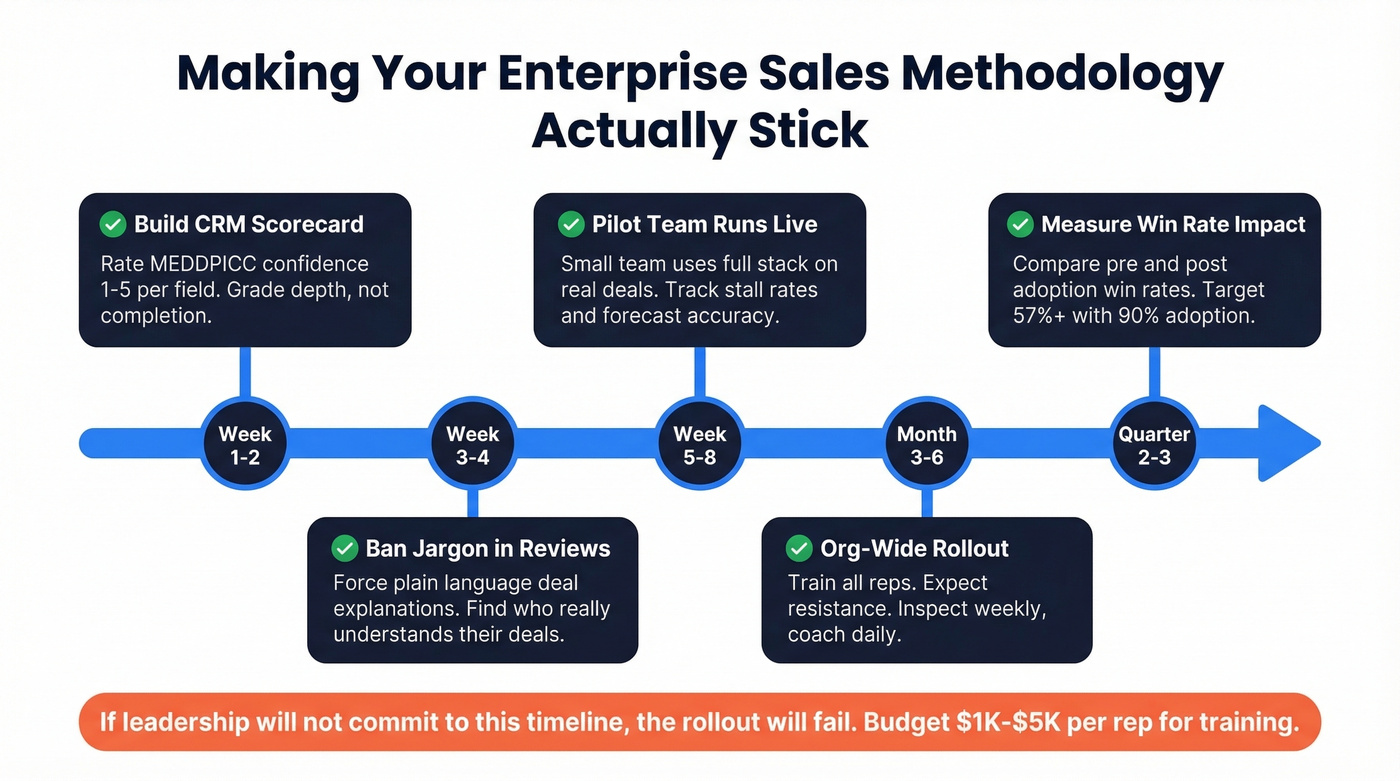
Build a MEDDPICC scorecard in CRM. Rate confidence 1-5 on each element. Grade field depth, not completion - a one-word answer in the Champion field is worse than leaving it blank because it creates false confidence.
If you need to tighten the plumbing, start with your CRM and the right sales forecasting solutions.
Validate your stakeholder map with your champion. Don't just ask "Who's the economic buyer?" Ask "Walk me through how money moves at your company for a purchase this size." A deal where nothing changes for three weeks isn't progressing - it's stalling. More than 7 days of inactivity cuts win rates by 65%.
Run the champion risk test. We've seen this single question reveal more about deal health than any scorecard: "If our champion left tomorrow, would this deal still happen?" If the answer is no, you don't have a deal - you have a relationship.
Ban methodology jargon in pipeline reviews for a month. Force reps to explain deals in plain language. In our experience, forecast accuracy improves around 20% just from this change. When reps can't hide behind acronyms, you find out fast who actually understands their deals and who's been copy-pasting from the org chart.
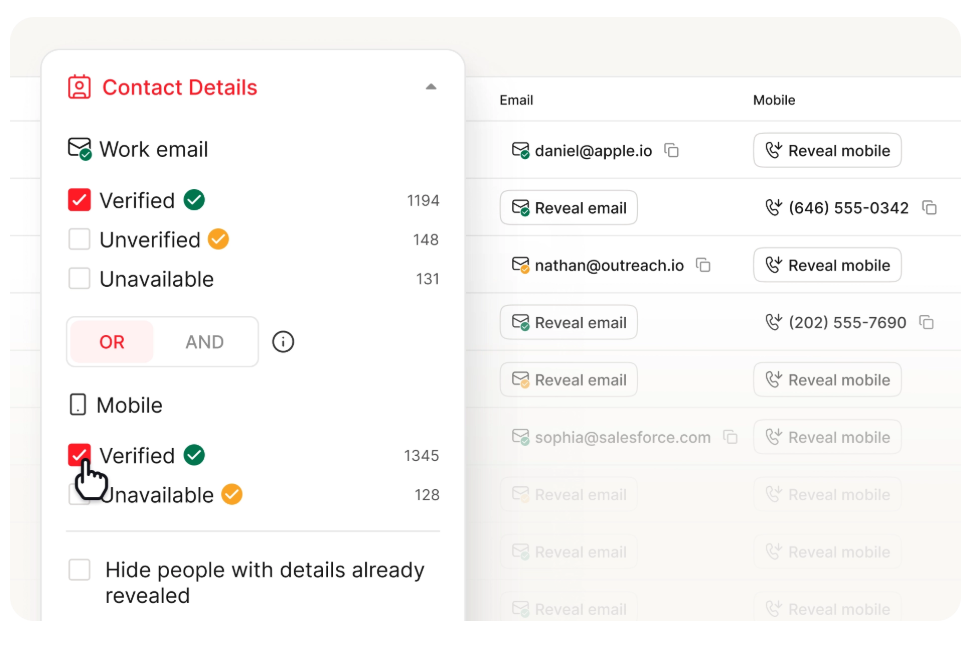
Keep your stakeholder map alive. Over a 7-12 month cycle, champions leave, contacts change roles, and buying committees shift. Prospeo's 7-day data refresh across 300M+ profiles with 98% email accuracy means your MEDDPICC fields map to real, reachable stakeholders - not stale records from six months ago.
Budget for enablement realistically. Expect 6-12 weeks for a pilot team, 3-6 months for org-wide adoption, and 2-3 quarters before measurable win-rate impact. Training runs $1K-$5K per rep for programs like Force Management or MEDDIC Academy, with org-wide engagements ranging $25K-$250K depending on team size and certification depth. Let's be honest - if leadership isn't willing to commit to that timeline, they're not serious about the rollout, and you'll end up with another abandoned initiative and a more cynical sales floor.
Your methodology adoption jumps from checkbox compliance to real pipeline impact when reps spend time selling - not hunting for contact info. Prospeo's 30+ search filters let you map entire buying committees by job title, department, and seniority in minutes, not hours. At $0.01 per email, data quality stops being a budget conversation.
Map every stakeholder in the buying committee before your first discovery call.
FAQ
What's the difference between a sales process and a sales methodology?
A sales process is the sequence of stages a deal moves through - discovery, demo, proposal, close. A methodology is the framework for how reps execute within each stage: what questions to ask, how to qualify, and what inspectable outputs to produce. The process is the map; the methodology is how you navigate.
Is MEDDPICC overkill for deals under $50K ACV?
Usually yes. MEDDPICC's value scales with deal complexity - multiple stakeholders, procurement involvement, and long cycles. For shorter cycles with fewer decision-makers, lighter frameworks like NEAT or BANT deliver faster without the overhead. Save MEDDPICC for the deals where losing means losing a quarter.
Which enterprise sales methodology works best for 2026?
For six-figure deals with 10+ stakeholders, MEDDPICC layered with Command of the Message consistently produces the highest win rates - 57.8% at teams with 90%+ adoption. Match the framework's weight to your deal complexity; overengineering a simple sale creates friction, and underengineering a complex one creates lost revenue.
How do I keep stakeholder data accurate across a long enterprise cycle?
Champions leave, contacts change roles, and buying committees shift mid-deal. Use a data platform with frequent refresh cycles and validate your stakeholder map with your champion at every major milestone. Stale data is how "closed-won" forecasts become "closed-lost" surprises.