

Enterprise Sales Pipeline Management: The Operational Playbook for 2026
It's Thursday afternoon. The CRO is building the board deck. The pipeline report says $12M. But after you strip out the zombie deals where reps haven't talked to anyone in six weeks, the "opportunities" where nobody's met the economic buyer, and the deals stuck in legal with no procurement timeline - you're looking at $4.5M. Maybe less.
The pipeline number is lying, and everyone in the room knows it.
Enterprise sales pipeline management isn't a CRM feature or a dashboard you glance at on Mondays. It's a governance discipline. You need three things: MEDDPICC-based stage exit criteria that force honest qualification, a multi-threading playbook for buying committees of 6-10 people, and a structured review cadence from weekly 1:1s to quarterly planning sessions. Everything else - the tools, the metrics, the dashboards - is downstream of those three.
Teams that track pipeline weekly see 87% forecast accuracy versus 52% for those doing it ad-hoc. That's not a marginal improvement. That's the difference between a board meeting where you defend your number and one where you're explaining why you missed by 30%.
Why Enterprise Pipelines Differ from SMB
Most pipeline advice on the internet is written for teams selling $15K deals to a single decision-maker on a 30-day cycle. "Move deals from Demo to Proposal to Close." That's not enterprise.
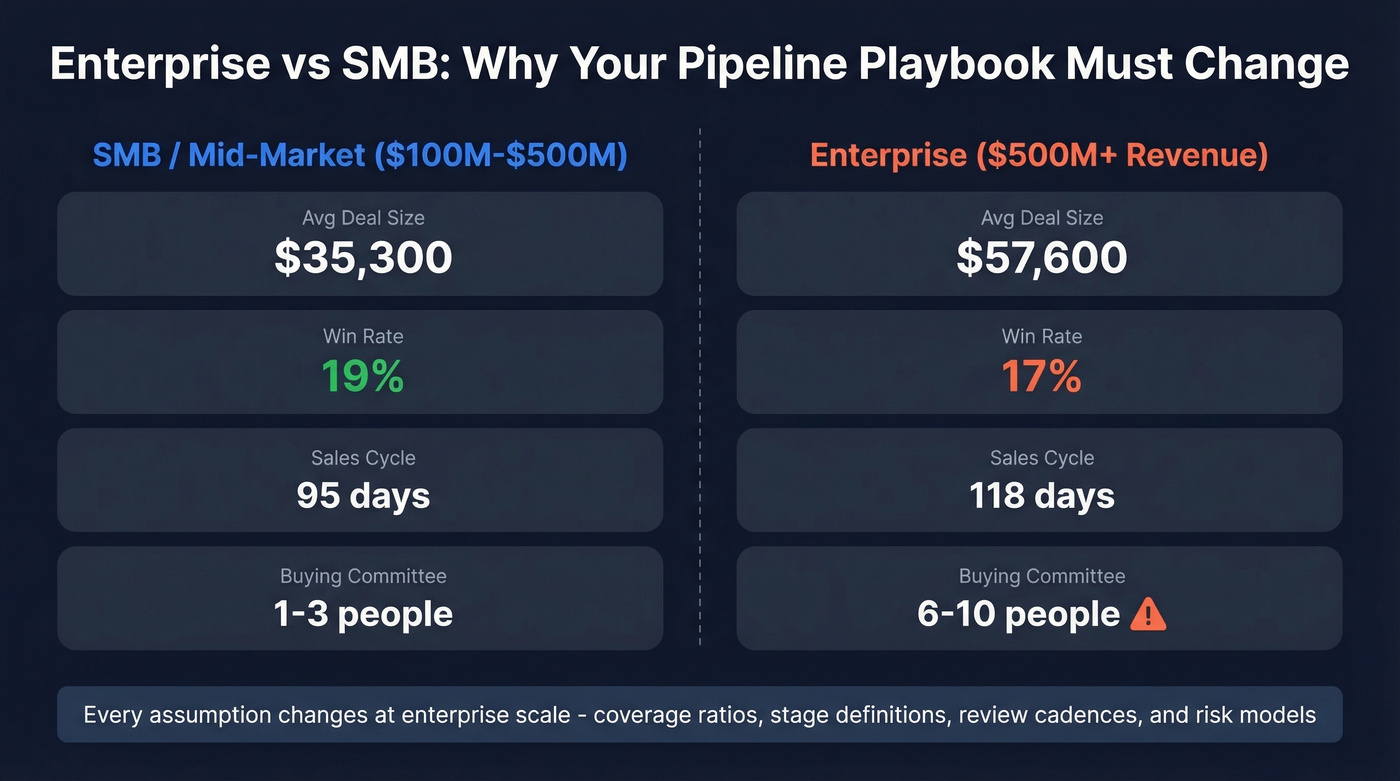
The numbers tell the story. Companies above $500M in revenue see average deal sizes of $57,600, win rates of 17%, and sales cycles of 118 days. Mid-market ($100M-$500M) runs $35,300 deals at 19% win rates over 95 days. Every assumption changes at this scale: coverage ratios, stage definitions, review cadences, and how you think about risk.
Then there's the buying committee. Complex B2B solutions involve 6 to 10 decision-makers. Your AE isn't selling to a person - they're navigating internal politics where the technical buyer wants one thing, procurement wants another, and the economic buyer hasn't been in a meeting yet. Generic pipeline stages like "Demo, Proposal, Negotiation" don't capture this complexity. They hide it.
If you've transitioned from SMB to enterprise, you know the shock: longer cycles, more stakeholders, and way more parallel deals to keep alive at once. The playbooks that worked in SMB don't just underperform in enterprise. They actively mislead.
Managing an enterprise pipeline means building a system that accounts for longer cycles, more stakeholders, additional approval gates like security review, legal, and procurement, and the reality that 17% win rates mean most of your pipeline won't close. If your process doesn't reflect that, your forecast is fiction.
Enterprise Pipeline Stages Redefined
The standard five-stage pipeline model breaks down in enterprise. You need eight stages, and each one needs exit criteria based on customer evidence - not seller activity. "Sent proposal" isn't a stage gate. "Customer confirmed budget allocation with finance" is.
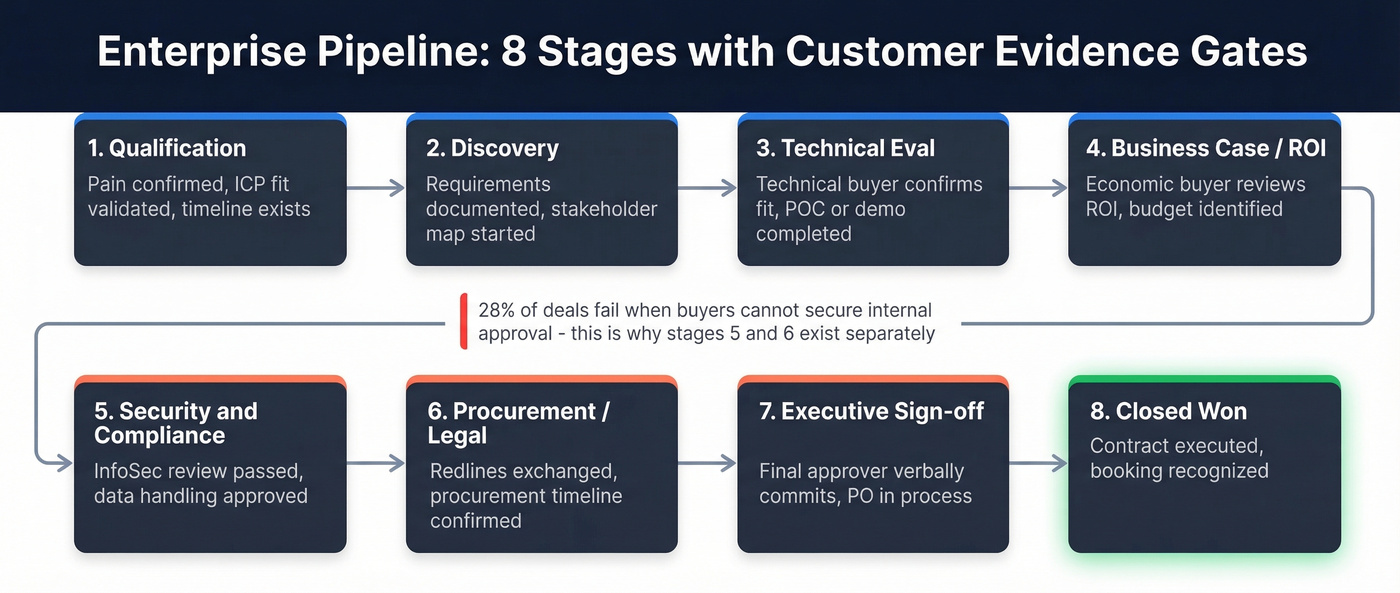
| Stage | Exit Criteria (Customer Evidence) |
|---|---|
| Qualification | Pain confirmed; ICP fit validated; timeline exists |
| Discovery | Requirements documented; stakeholder map started |
| Technical Eval | Technical buyer confirms fit; POC/demo completed |
| Business Case/ROI | Economic buyer reviews ROI; budget identified |
| Security & Compliance | InfoSec review passed; data handling approved |
| Procurement/Legal | Redlines exchanged; procurement timeline confirmed |
| Executive Sign-off | Final approver verbally commits; PO in process |
| Closed Won | Contract executed; booking recognized |
Here's the thing: 28% of deals fail when buyers can't secure internal approval. That's why Security & Compliance and Procurement/Legal are separate stages, not afterthoughts lumped into "Negotiation." The Decision Process in enterprise breaks into three distinct phases - Technical Decision Making, Business Decision Making, and Paper Process. Each phase has different stakeholders, different timelines, and different failure modes. A deal that sails through technical evaluation can die in procurement three weeks later if nobody mapped the approval chain.
When reps define stages by their own activity, pipeline bloat is inevitable. When stages are defined by customer evidence, you get a pipeline that reflects reality.
MEDDPICC as Pipeline Governance
What MEDDPICC Actually Is
MEDDPICC isn't a checklist your reps fill out after calls. It's a disqualification framework - a systematic way to figure out which deals are real and which ones are wasting everyone's time.
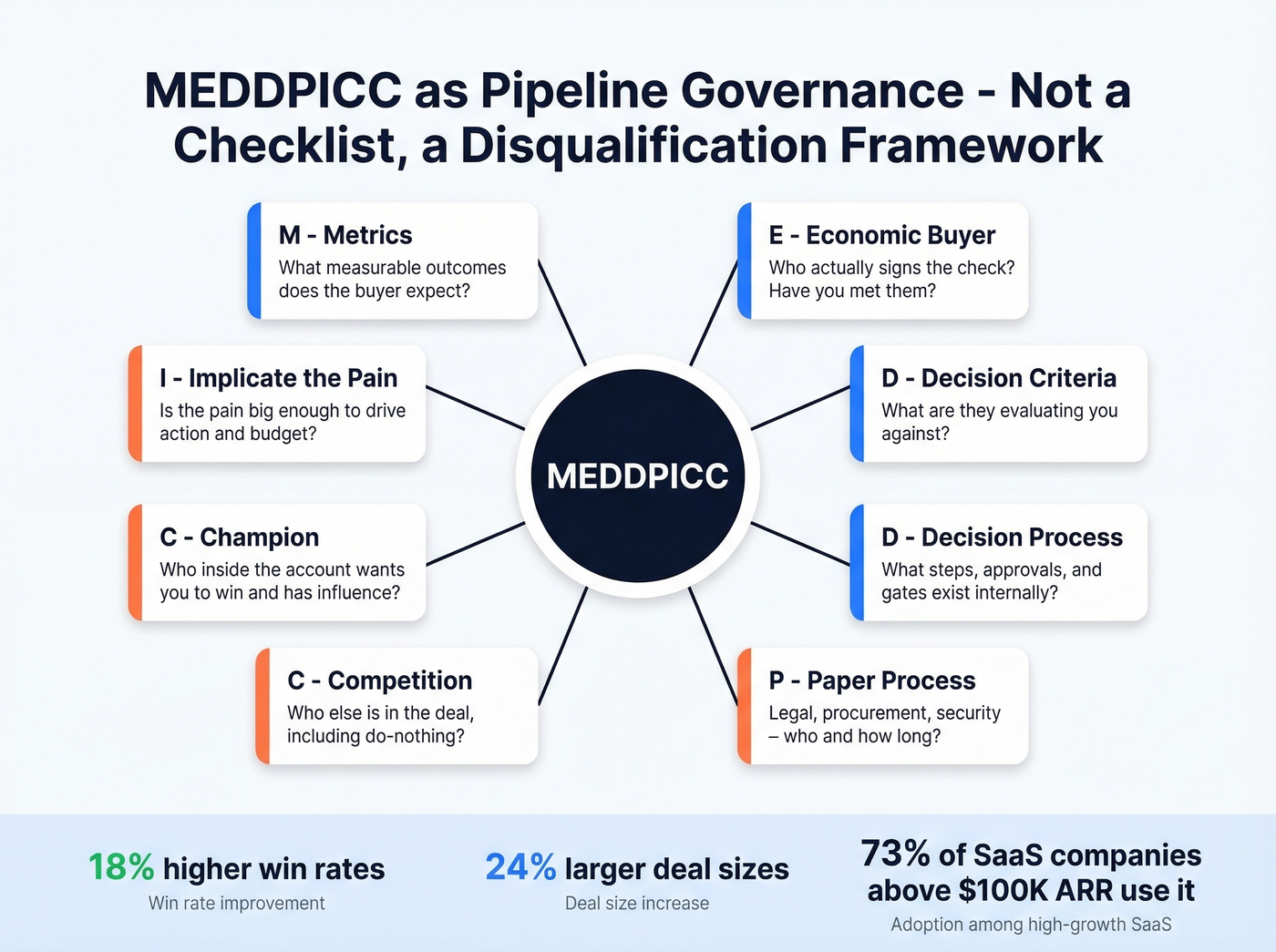
The framework covers eight elements: Metrics, Economic Buyer, Decision Criteria, Decision Process, Paper Process, Implicate the Pain, Champion, and Competition. It originated at PTC in 1996, where it's credited with helping the company grow from $300M to $1B in revenue over four years. Adoption doubled from 11% to 21% between 2021 and 2022, and today 73% of SaaS companies selling above $100K ARR use some version of it. Organizations that fully adopt MEDDPICC report 18% higher win rates and 24% larger deal sizes.
MEDDPICC isn't linear. You don't march through M-E-D-D-P-I-C-C in sequence. You weave these questions into every discovery call, every executive meeting, every technical review. The framework tells you what you don't know yet - and what you don't know is what kills deals.
Stage Exit Criteria That Enforce It
The operational challenge is enforcement. We've seen this pattern repeatedly: reps fill MEDDIC fields in the CRM after calls based on guesses, not evidence. "Economic Buyer: VP of Sales" - but the rep has never actually met the VP of Sales. That's how zombie deals are born. They look alive in the pipeline, they inflate your coverage ratio, and they die quietly three months later.
If you haven't met the Economic Buyer, your chance of closing on time drops below 50%. That's not a soft guideline - it's a hard gate. No verified Economic Buyer meeting? The deal doesn't advance past Business Case/ROI. Period. (If you want a tighter operational definition of who counts as EB, use this Economic Buyer breakdown.)
The enforcement mechanism matters more than the framework itself. Build MEDDPICC validation into your CRM stage transitions. Require evidence fields, not text boxes. A link to the meeting recording where the Economic Buyer confirmed budget is evidence. "Spoke with EB" typed into a text field is a guess. Treat them differently.
Multi-Threading: The Enterprise Survival Skill
Here's a stat that should terrify every enterprise sales leader: 78% of reps take a single-threaded approach, and only 7% connect with 6+ people at an account. In a world where buying committees run 6-10 deep, single-threading is a coin flip at best.
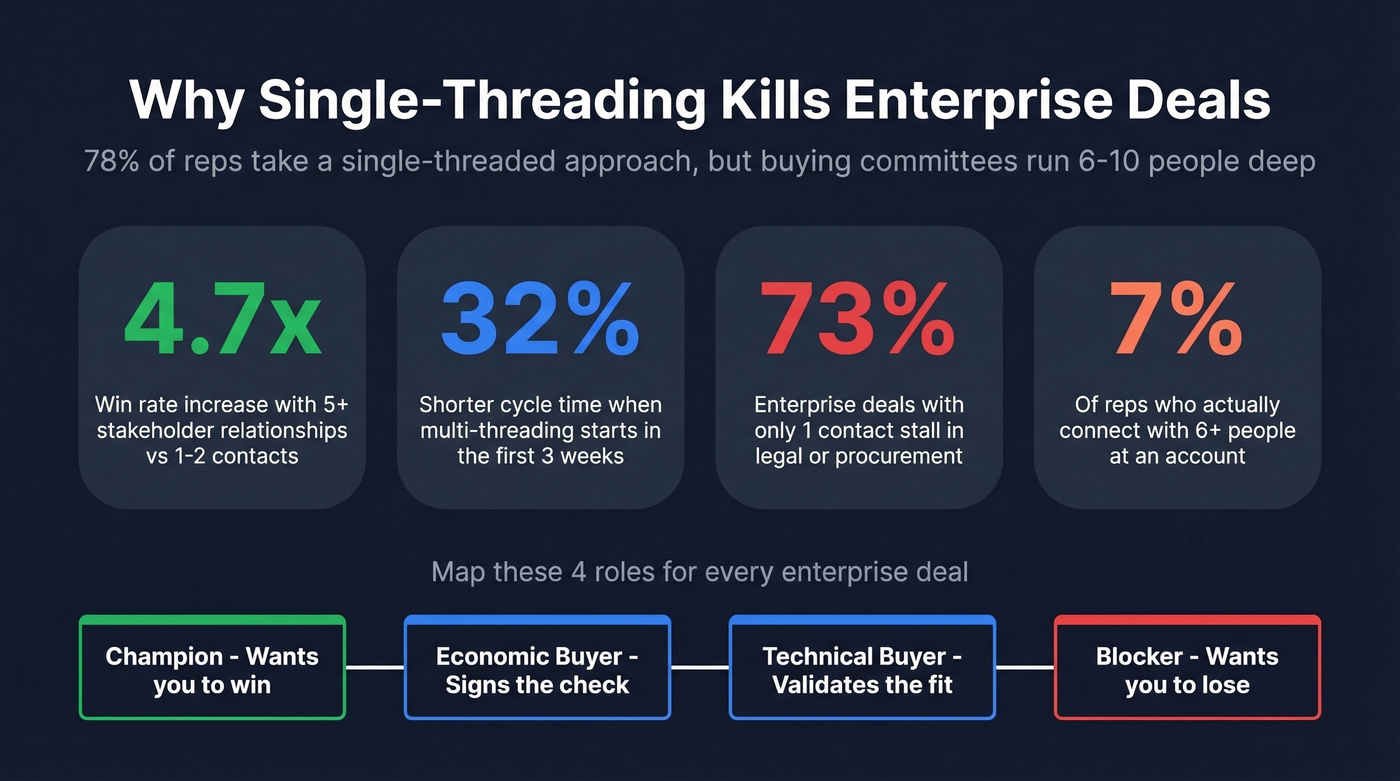
Deals with 5+ stakeholder relationships see a 4.7x win rate increase versus deals with only 1-2 contacts. Starting multi-threading in the first three weeks of an opportunity cuts cycle time by 32%. And 73% of enterprise deals with only one active contact stall in legal or procurement - because there's nobody inside the account pushing the deal forward when your champion goes on vacation or changes roles.
I watched a team lose a $400K deal last year because the AE built the entire relationship with a director who loved the product but had zero budget authority. The Economic Buyer - a SVP two levels up - had never heard of the project until it landed on her desk for approval. She killed it in a week. That deal sat in the pipeline for five months, inflating the forecast the entire time. Strong stakeholder mapping across the entire buying committee would've surfaced that gap months earlier.
The playbook is straightforward. Map four roles for every enterprise deal: Economic Buyer, Technical Buyer, Champion, and Blocker. Your Champion is the person who wants you to win. Your Blocker is the person who doesn't - and you need to know who they are before they surface in a procurement review. (This is also where team selling becomes a force multiplier.)
The navigation strategy is "up then sideways." If your primary contact goes cold, don't email them seven more times. Go up to their boss or a VP in the same org. Then go sideways to adjacent departments that your solution touches. Create enough internal momentum that the deal doesn't depend on any single relationship.
Multi-threading is uncomfortable. Reps worry about going around their contact. But 80% of deals require 5+ touches across the buying committee, and the alternative - single-threading into a stall - is worse than a slightly awkward introduction request.

Multi-threading a 6-10 person buying committee means nothing if you can't reach them. Prospeo gives you 98% verified emails and 125M+ direct dials across every stakeholder - from technical buyers to economic decision-makers. At $0.01 per email, you can map entire enterprise accounts without blowing your budget.
Stop single-threading deals because you only have one contact's email.
Pipeline Metrics That Matter
Coverage, Velocity, and Win Rate
Pipeline coverage is the metric everyone knows and almost everyone calculates wrong. The generic guidance is 3:1 pipeline-to-quota ratio. For enterprise, that's not enough. With 17% win rates and 118-day cycles, you need 4-5x coverage to hit your number with any confidence. A team carrying 3x coverage on enterprise deals is one bad quarter away from a miss.
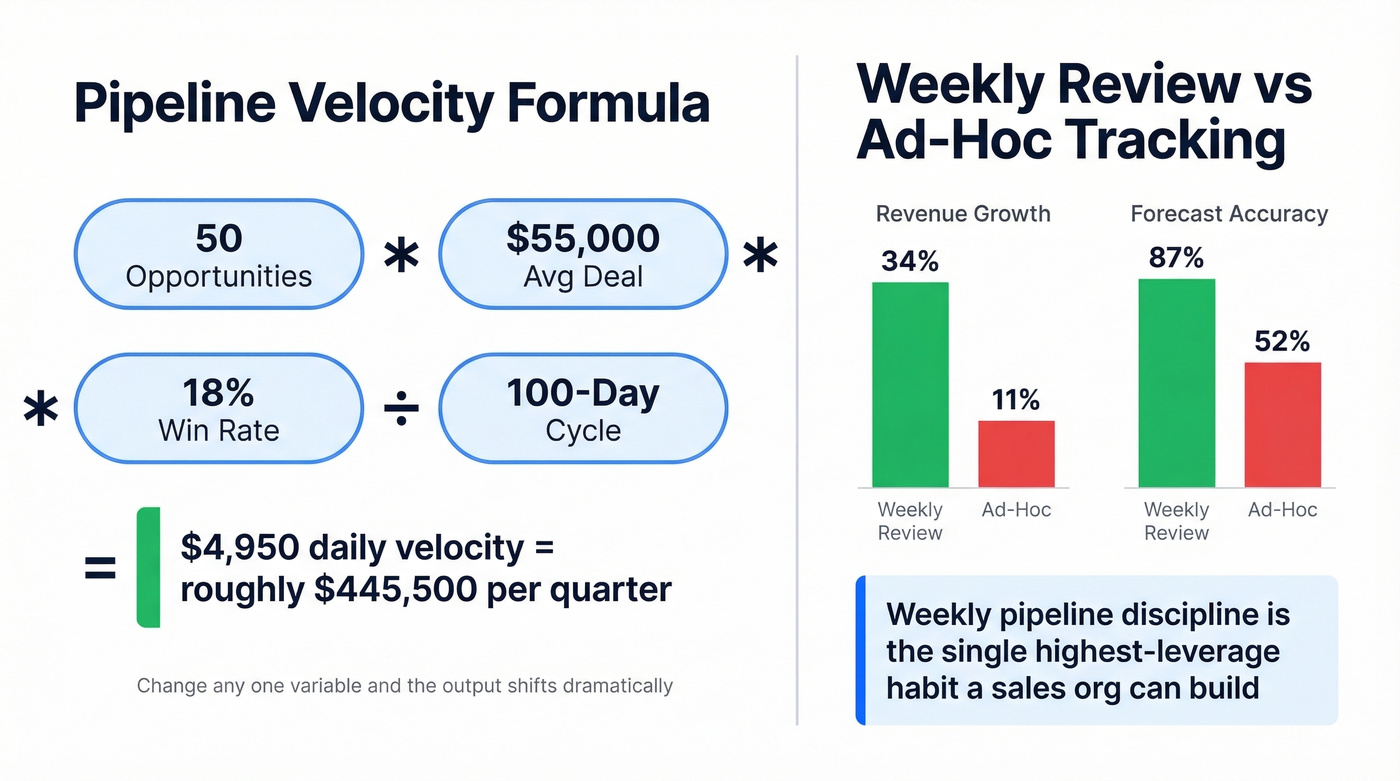
Pipeline velocity ties the metrics together: (Opportunities x Average Deal Size x Win Rate) / Cycle Length. An enterprise team with 50 qualified opportunities, $55,000 average deal size, 18% win rate, and a 100-day cycle generates roughly $4,950 in daily pipeline velocity - or about $445,500 per 90-day quarter. Change any one variable and the output shifts dramatically, which is why tracking all four matters.
David Sacks recommends breaking pipeline metrics by segment - SMB, mid-market, enterprise - and tracking cohorted win rates by the month opportunities were created. This prevents the common mistake of blending a 40% SMB win rate with a 17% enterprise win rate and calling it "28% overall." That blended number is useless for forecasting. Segment everything. (If you want a clean KPI set, use these pipeline health metrics.)
The tracking frequency correlation is stark. Teams that review pipeline weekly see 34% revenue growth and 87% forecast accuracy. Ad-hoc trackers? 11% growth and 52% accuracy. Weekly discipline isn't optional in enterprise - it's the single highest-leverage habit a sales org can build.
Waterfall Analysis for Global Visibility
The pipeline waterfall is how enterprise RevOps teams explain forecast movement to executives. Between any two snapshots - start of quarter and today, for example - every deal falls into one of six categories: Won, Lost, Increased, Decreased, Pushed, or Pulled, plus new deals created in between. Pushed means the close date moved out of the current quarter. Pulled means it moved in.
Building one is mechanical. Take your pipeline snapshot from date A, compare to date B, and classify every deal's movement. The power is in the pattern recognition. If you're consistently seeing 30% of pipeline value get pushed each month, you don't have a closing problem - you have a qualification problem. The waterfall makes that visible in a way a standard pipeline report can't. For organizations selling across multiple regions, this kind of global visibility is what prevents regional sandbagging from distorting the consolidated forecast.
Benchmarks by Company Size
These benchmarks come from a study of 247 B2B organizations in North America.
| Segment | Avg Deal Size | Win Rate | Cycle Length |
|---|---|---|---|
| $500M+ revenue | $57,600 | 17% | 118 days |
| $100M-$500M | $35,300 | 19% | 95 days |
Industry-specific benchmarks add another layer:
| Industry | Win Rate | Cycle Length |
|---|---|---|
| Manufacturing | 19% | 124 days |
| Financial Services | 18% | 89 days |
| Real Estate | 16% | 147 days |
Let's be honest: if your enterprise win rate is significantly above 20%, you're probably not qualifying hard enough. Most teams that claim 30%+ enterprise win rates are including deals that should've been disqualified at stage two. A high win rate in enterprise usually means your pipeline is too small, not that your team is exceptional.
The Pipeline Review Cadence
73% of forecast misses trace back to poor pipeline reviews. Not bad data, not bad reps - bad review processes. The fix is a four-tier governance model that creates accountability at every level.
| Review | Frequency | Duration | Focus |
|---|---|---|---|
| Rep-Manager 1:1 | Weekly | 30-45 min | Deep-dive on 3-5 deals |
| Team Review | Bi-weekly | 60-90 min | Cross-team learning, SE/exec allocation |
| Forecast Review | Monthly | 90-120 min | Commit defense, coverage, risk |
| Pipeline Planning | Quarterly | Half-day | Process improvement, capacity |
The weekly 1:1 is where the real work happens. Don't review every deal - pick the 3-5 highest-value or highest-risk opportunities and inspect them deeply. For each deal: what's changed since last week, qualification validation against MEDDPICC, progression evidence based on customer action, risk assessment for what could kill the deal, and an action plan for the next 7 days. If the rep can't point to a specific customer action from the past week, that deal is stalling - and you need to name it.
Bi-weekly team reviews serve a different purpose. This is where you allocate scarce resources - solution engineers, executive sponsors, legal review slots - across the team's pipeline. It's also where reps learn from each other's deals, which doesn't happen in 1:1s.
Monthly forecast reviews are where managers defend their commit number. The CRO or VP should be asking: what's your commit, what's your best case, what's your coverage ratio, and what are the three deals most likely to slip? If a manager can't answer those questions with evidence, the review process below them isn't working.
Quarterly planning zooms out. Is the process itself working? What are the stage conversion rates, average time per stage, where deals are dying, and do you have the capacity to cover next quarter's target? (If you run formal quarterly reviews, align this with your QBR questions.)
Common Enterprise Pipeline Mistakes
Subjective stage criteria. If your stages are defined by seller activity instead of customer evidence, your pipeline is inflated. Every deal looks further along than it actually is. "Sent proposal" tells you what the rep did. "Buyer confirmed evaluation criteria in writing" tells you where the deal actually stands.
Single-threading. 78% of reps do it. 73% of single-threaded enterprise deals stall in legal or procurement. This is the most predictable failure mode in enterprise sales, and it's fixable with coaching and accountability.
Ignoring procurement timelines. The Paper Process - legal review, security questionnaire, procurement approval - isn't a formality. It takes 3-8 weeks in enterprise. If you're not mapping it early, you're building a forecast on a timeline that doesn't exist.
Pipeline bloat from zombie deals. That 4x coverage ratio looks great until you realize half the pipeline hasn't had a customer interaction in two months. Purge deals with no buyer activity in 6+ weeks. Your real coverage is probably 1.5-2x, and you need to know that now, not at quarter end. (For a deeper breakdown, see these sales pipeline challenges.)
Building Your Enterprise Pipeline Tech Stack
The enterprise pipeline stack has three layers. Most teams overspend on layers one and two while ignoring layer three - and layer three is what determines whether your coverage ratio means anything.
Layer 1: CRM
Salesforce is the default for enterprise. Sales Cloud pricing runs $25/user/month (Starter Suite), $165/user/month (Enterprise), and $330/user/month (Unlimited). HubSpot Sales Hub starts at $20/user/month (Starter) and $100/user/month (Professional) - it suits mid-market teams moving upmarket. Microsoft Dynamics 365 typically lands at $65-$135/user/month depending on edition and is a common pick for Microsoft-heavy environments.
The evaluation criteria that matter at enterprise scale: SOC 2 compliance, GDPR readiness, SSO, role-based access control, and the ability to enforce stage exit criteria programmatically. If your CRM can't block a stage transition without required fields, you can't enforce MEDDPICC governance. Skip any CRM that treats stage gates as optional. (If you're comparing options, start with these examples of a CRM.)
Layer 2: Revenue Intelligence
Clari typically starts around $75/user/month and often lands $100-$125/user/month depending on package. It's the forecasting and pipeline analytics layer that automates waterfall analysis and gives RevOps teams the snapshot-to-snapshot visibility described above. Gong at roughly $100-150/user/month handles conversation intelligence and deal inspection - it's how managers validate whether reps actually met the Economic Buyer or just said they did. Outreach at roughly $100-130/user/month manages engagement sequencing and multi-touch cadences. (If you're shopping, here are sales forecasting solutions worth benchmarking.)
Layer 3: Prospecting Data
This is the layer that separates teams with real pipeline from teams with inflated spreadsheets. Your CRM and forecasting tools cost $100-300/user/month. The data layer costs a fraction of that and directly controls whether your outbound reaches actual decision-makers or bounces into the void.
In our experience, the data layer is where we've seen the biggest ROI gap. One team we worked with was spending $250/user/month on Salesforce and Gong but feeding both systems with contact data that bounced at 35%. Prospeo covers 300M+ professional profiles with 98% email accuracy and 125M+ verified mobile numbers delivering a 30% pickup rate. The 7-day data refresh cycle matters here - the industry average is six weeks, and in enterprise sales where people change roles constantly, stale data means bounced emails and wasted sequences. Snyk saw the impact firsthand: 50 AEs watched bounce rates drop from 35-40% to under 5%, and AE-sourced pipeline increased 180%. Credit-based pricing starts at roughly $0.01/email with no contracts. (If you're evaluating vendors, compare against these data enrichment services.)

| Tool | Category | Starting Price | Enterprise Fit |
|---|---|---|---|
| Salesforce | CRM | $25/user/mo | ★★★★★ |
| HubSpot | CRM | $20/user/mo | ★★★☆☆ |
| Clari | Revenue Intel | ~$75/user/mo | ★★★★★ |
| Gong | Conversation Intel | ~$100/user/mo | ★★★★☆ |
| Outreach | Engagement | ~$100/user/mo | ★★★★☆ |
| Prospeo | Prospecting Data | ~$0.01/email | ★★★★☆ |
Your MEDDPICC fields are only as good as your ability to actually reach the Economic Buyer. Prospeo's 30+ search filters - including job title, department headcount, and buyer intent across 15,000 topics - let you identify and verify the right contacts before your deal stalls at Business Case/ROI.
Verify the Economic Buyer before your pipeline becomes fiction.
Enterprise Sales Pipeline Management FAQ
What coverage ratio should enterprise teams target?
Enterprise teams need 4-5x pipeline-to-quota coverage at minimum. Win rates for $500M+ companies average 17% with 118-day cycles, so you need significantly more pipeline than mid-market or SMB teams running shorter, higher-conversion motions. Below 4x, you're under-generating - and you'll feel it at quarter end.
How does enterprise pipeline management differ from SMB?
Three structural differences: buying committees of 6-10 decision-makers versus 1-2, additional stages for security review, procurement, and legal approval, and cycle lengths of 90-120+ days versus 30-60. Generic pipeline advice ignores all three, which is why forecasts built on SMB frameworks consistently miss.
How do you keep pipeline data accurate?
Enforce objective stage exit criteria in your CRM so deals can't advance without customer evidence. Purge opportunities with no buyer activity in 6+ weeks - they're zombie deals inflating your coverage ratio. And verify contact data before it enters the pipeline so your outbound reaches real buyers instead of bouncing at 30%+.