

8 Examples of Personal Selling That Actually Worked (With the Numbers to Prove It)
You spend 45 minutes crafting a personalized video for a VP of Engineering. Custom demo, their logo on the slide, a genuine insight about their tech stack. Then the email bounces. 96% of prospects research your company before they'll talk to you - but that research is worthless if your outreach never lands. The best examples of personal selling share one thing in common: the fundamentals, starting with accurate contact data, are locked down before anyone hits send.
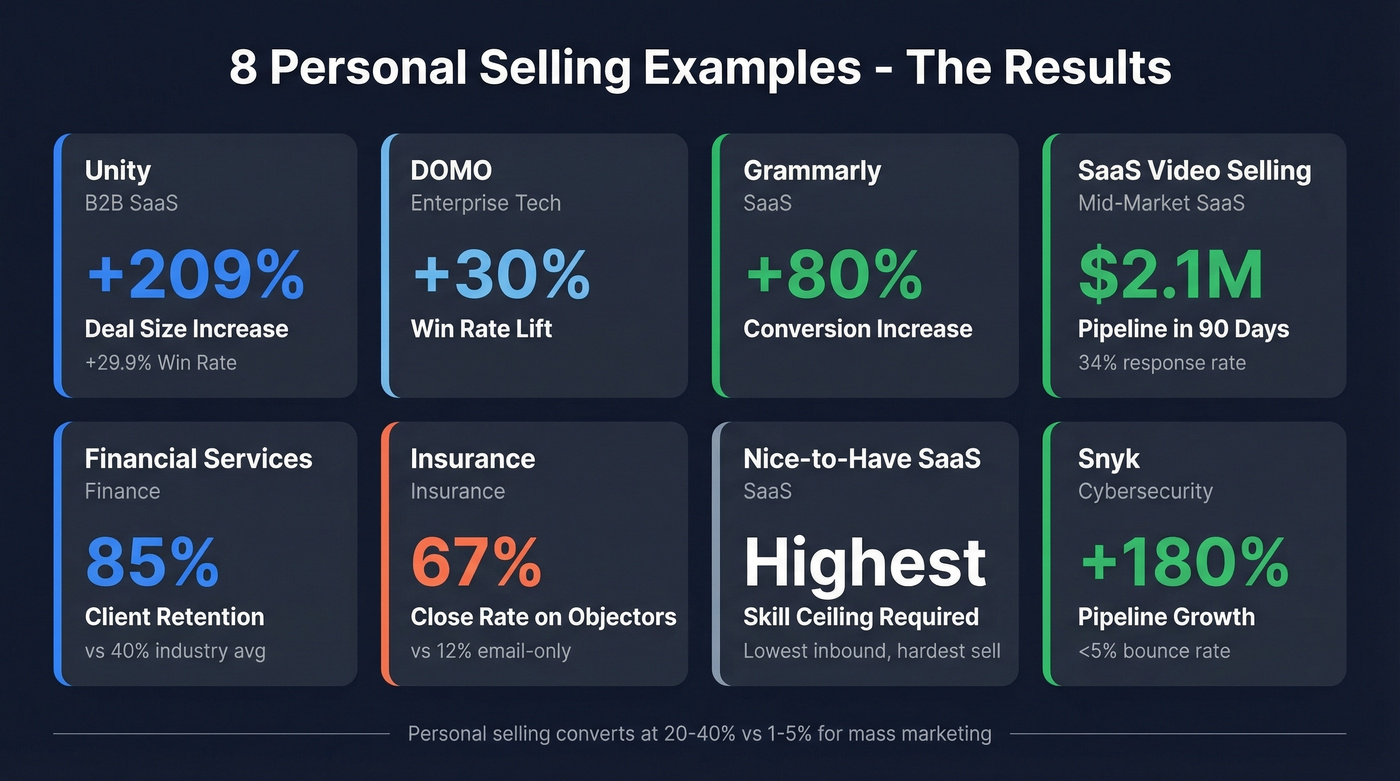
Personal selling is any one-to-one sales interaction tailored to a specific buyer. It converts at 20-40% vs. 1-5% for mass marketing and costs $50-200 per contact. The 8 examples below include named companies with measurable outcomes - from a 209% increase in deal size to 180% pipeline growth.
What Is Personal Selling?
Personal selling is any one-to-one sales interaction where a rep tailors the conversation to a specific buyer's needs. In 2026, that means personalized video, async walkthroughs, multi-threaded email sequences, phone calls, and social outreach - often all in the same deal cycle.
The numbers are hard to ignore. One-to-one selling converts at 20-40% vs. 1-5% for mass marketing. The cost per contact runs $50-200, which sounds expensive until you compare it to blasting 10,000 generic emails and hoping 50 people respond.
Why One-to-One Selling Still Works in 2026
Buyers don't want to talk to reps anymore - that's half-right. 71% prefer independent research, but they still need a human to close the deal. A 6sense study of 2,509 B2B buyers found that 69% of purchase decisions are made before a rep gets involved. The window for influence is narrow, which means every interaction has to count.
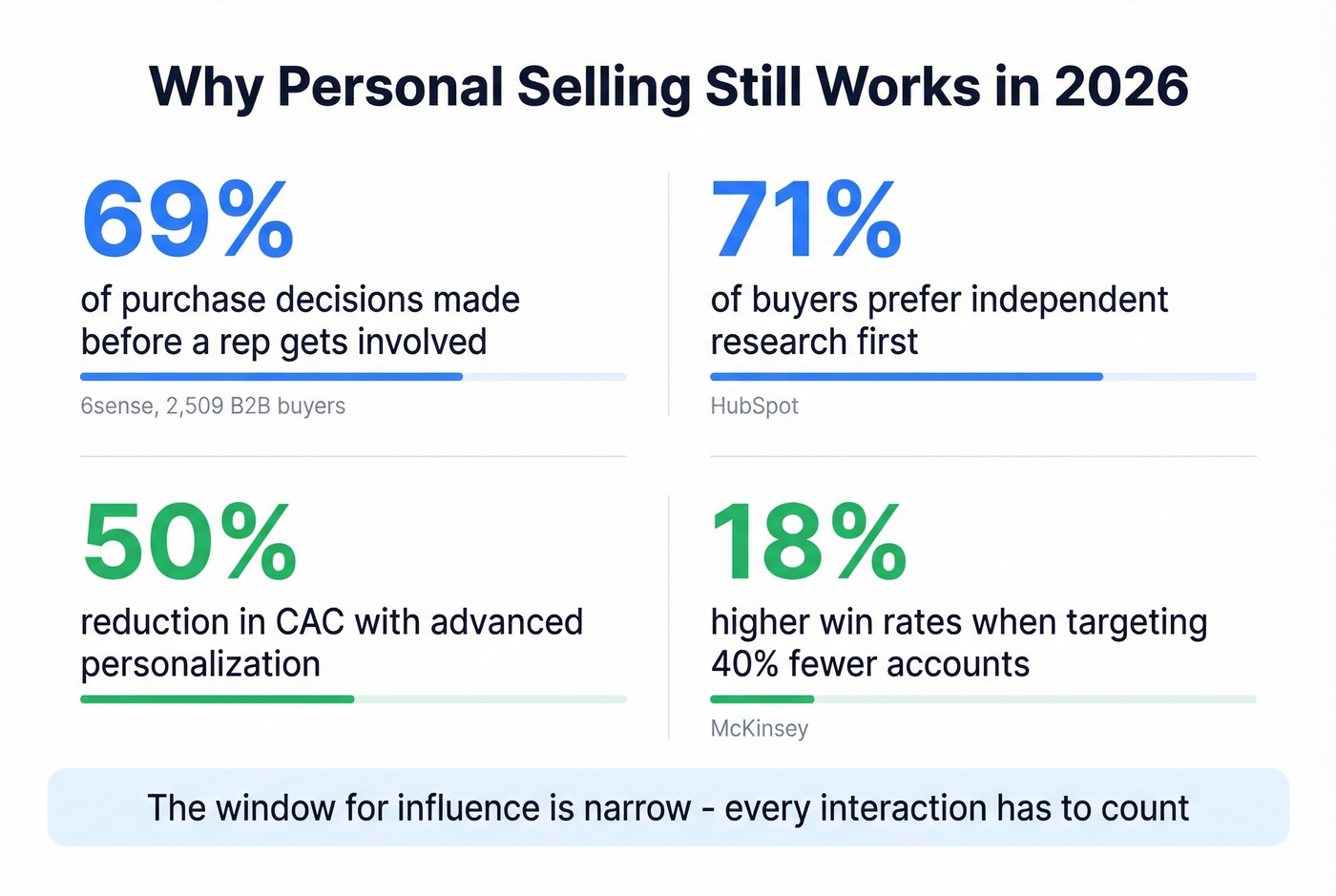
HubSpot's survey of 1,000 sales professionals found 91% of teams report win rates that are stable or improving. Separately, Gong found that 81% of revenue leaders say deals are more complex than ever. These two facts aren't contradictory - the reps who invest in deep, consultative selling are winning, while the spray-and-pray crowd loses ground. Advanced personalization reduces CAC by up to 50% while driving 10-15% revenue increases, which is why the "personal selling is dead" narrative has always been wrong.
McKinsey's "less is more" research backs this up: teams that target 40% fewer accounts but spend 2.5x more time per target see 18% higher win rates and 35% faster deal cycles. Personal selling isn't dying. It's concentrating.
8 Real Examples of Personal Selling With Results
| Example | Industry | Key Result |
|---|---|---|
| Unity | B2B SaaS | +29.9% win rate, +209% deal size |
| DOMO | Enterprise Tech | +30% win rate |
| Grammarly | SaaS | +80% conversion |
| SaaS Video Selling | Mid-Market SaaS | $2.1M pipeline in 90 days |
| Financial Services | Finance | 85% retention vs 40% avg |
| Insurance | Insurance | 67% close on initial objectors |
| "Nice-to-Have" SaaS | SaaS | Lowest inbound, highest skill ceiling |
| Snyk | Cybersecurity | Pipeline +180%, <5% bounce |
Unity - Consultative Selling With Deal Intelligence
Unity's sales team implemented deal intelligence through Clari and saw results that are hard to argue with: win rates jumped 29.9%, slipped deals dropped 30.2%, and average deal size increased 209%. The ops team saved 4 hours per week without adding headcount.
Reps used the intelligence to have sharper conversations - knowing exactly which deals were at risk and which stakeholders needed attention. The tool didn't replace the human interaction. It made every human interaction more precise, which is the entire point of investing in sales infrastructure.
DOMO - Outcome-Focused Selling Over Volume Metrics
DOMO saw a 30% lift in win rate after one strategic shift: they stopped measuring reps on activity metrics like calls made and emails sent, and started measuring outcomes like deals advanced and revenue influenced. This is personal selling at the organizational level - giving reps permission to spend real time with fewer accounts instead of chasing vanity numbers.
The benchmark that top sellers spend 68% more time per account isn't just a talking point. It's a business case for slowing down.
Grammarly - Personalized Lead Scoring at Scale
Grammarly used Salesforce Einstein to build a lead scoring model that identified which trial users were most likely to convert to paid plans. The result: an 80% increase in conversion rates. The scoring model told reps exactly who to call and when, so every conversation was with someone who'd already demonstrated buying intent.
Reps weren't cold-calling a list. They were having warm, personalized conversations with people ready to listen.
SaaS Video Selling - $2.1M Pipeline From 100 Accounts
A mid-sized SaaS company switched from automated sequences to personalized video for their top 100 accounts. In 90 days, they booked 34 meetings - a 34% response rate compared to their prior 8% email response rate - and created $2.1M in additional pipeline.
This is the clearest proof we've seen that tailored outreach at low volume crushes mass outreach at high volume. The math is simple: 34 meetings from 100 accounts beats 80 meetings from 1,000 emails, because those 34 meetings actually close.
Financial Services - Consultative Selling That Retains
Financial advisors who use consultative selling - asking deep questions about goals, risk tolerance, and life circumstances before recommending products - achieve 85% client retention rates versus a 40% industry average. The upfront investment in understanding the client pays dividends for years.
Personal selling in financial services isn't about closing the first transaction. It's about earning the next twenty. For context, wealth management firms pay $2,167-$4,056 per acquired client, which makes retention the entire game.
Insurance - Face-to-Face Needs Assessment
Insurance agents who conduct in-person needs assessments close 67% of prospects who initially objected, compared to just 12% conversion for email-only follow-up. That gap is staggering.
Buying insurance is emotional, complex, and high-stakes - an email can't read body language, adjust the pitch in real time, or walk someone through their specific coverage gaps. The same dynamic applies to real estate, enterprise software, and any sale where trust outweighs convenience. This is where the cost-per-contact premium pays for itself many times over.
"Nice-to-Have" SaaS - The Hardest Sell
Here's the thing: personal selling is easy to celebrate when you're selling something people already know they need. The real test is selling a "nice-to-have." One practitioner on r/sales described the contrast as "massive" - minimal inbound, insanely low response rates, and marketing that struggles to create compelling messaging.
You can't rely on urgency or obvious pain. You have to create the narrative, articulate value the buyer hasn't considered, and earn every meeting through sheer outreach quality. This scenario demands the strongest selling skills you'll find anywhere - storytelling, objection reframing, and the patience to nurture deals that don't have built-in urgency. If you're selling something nobody's actively shopping for, skip the mass email playbook entirely and go deep on 20-30 accounts at a time.
Snyk - Outbound Prospecting With Verified Data
Snyk had 50 AEs each spending 4-6 hours per week on outbound prospecting. The problem? Their email bounce rate was running 35-40%. More than a third of every rep's effort - the research, the personalization, the tailored messaging - was never reaching an inbox.
After switching to Prospeo for email verification, bounce rates dropped below 5%. AE-sourced pipeline jumped 180%, and the team generated 200+ new opportunities per month. One-to-one selling doesn't work if the email bounces. That's not a philosophical point - it's arithmetic.


You just read how a bounced email killed a 45-minute personalized video. Prospeo's 98% email accuracy and 7-day data refresh mean your consultative outreach reaches real inboxes - not dead ends. At $0.01 per email, bad data is no longer an excuse.
Stop crafting perfect pitches for invalid email addresses.
The Personal Selling Process (7 Steps)
Let's be honest: if your average contract value is under $15K, you probably don't need a seven-step process. A two-call close with a solid demo will outperform an elaborate multi-touch sequence. Save the full playbook for deals worth the investment.
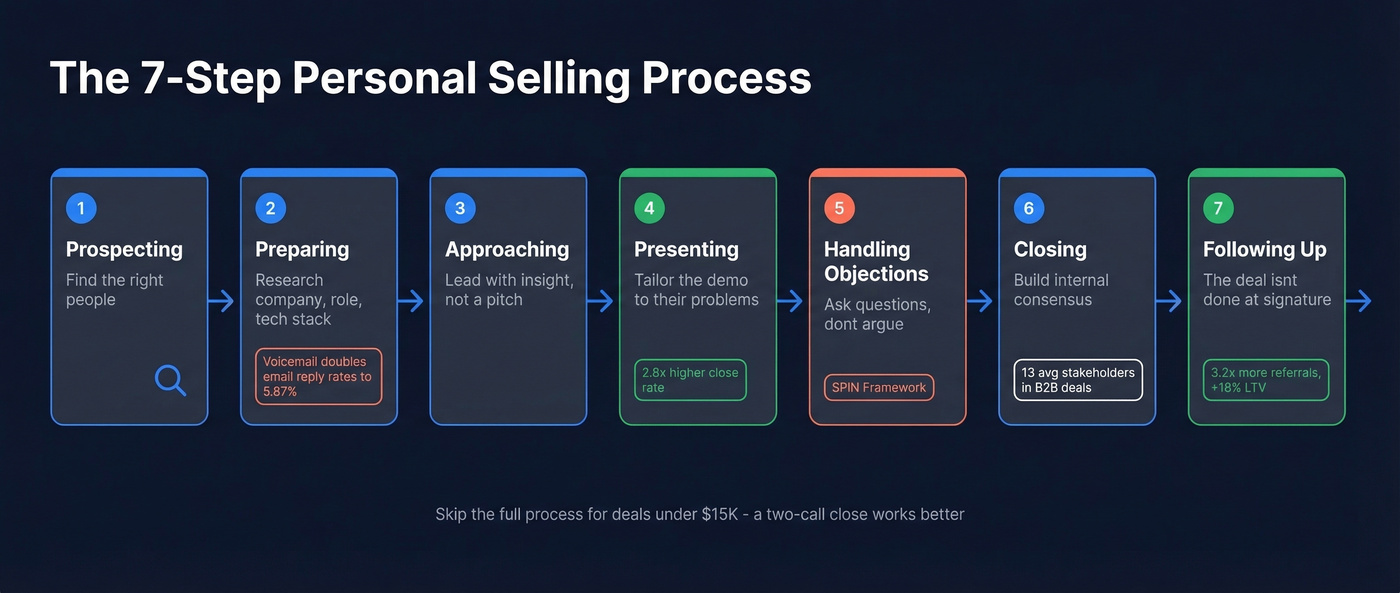
1. Prospecting. Find the right people. This is where most teams leak value - bad data means wasted effort. We've seen teams burn thousands on personalized outreach that never reaches an inbox because they skipped verification. If you want a tighter system, start with proven sales prospecting techniques.
2. Preparing. Research the prospect's company, role, tech stack, and recent news. A Gong study found that leaving a voicemail doubles email reply rates from 2.73% to 5.87% - but only if you say something relevant.
3. Approaching. Lead with insight, not a pitch. Earn 30 seconds of attention.
4. Presenting. Tailor the demo to the specific problems you uncovered. Personalized demos close at 2.8x the rate of generic presentations - use a simple product demo checklist to stay consistent.
5. Handling objections. Don't argue - ask questions. The SPIN framework (Situation, Problem, Implication, Need-Payoff) gives you a repeatable structure for turning objections into buying signals. If objection handling is a bottleneck, build a plan to reduce sales objection rate.
6. Closing. With 13 stakeholders in the average B2B deal, "closing" often means building internal consensus, not getting a single signature. If you need a tighter framework, follow these steps to close a sale.
7. Following up. Customers acquired through personal selling refer 3.2x more new customers and spend 18% more over their lifetime. The deal isn't done at signature. Use structured sales follow-up templates to keep momentum without sounding generic.
When the Cost Is Worth It
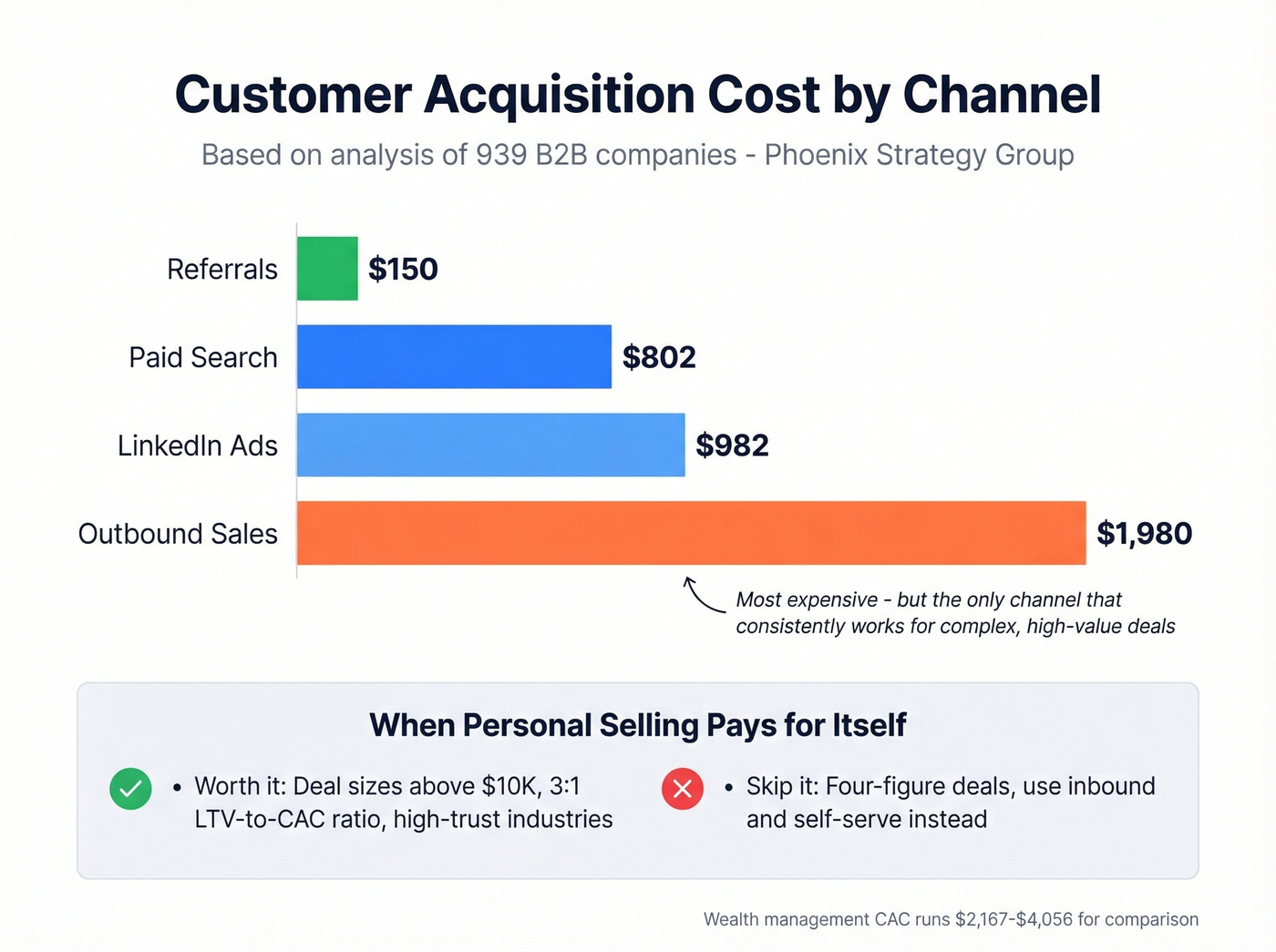
A Phoenix Strategy Group analysis of 939 B2B companies found these average customer acquisition costs by channel:
| Channel | Avg CAC |
|---|---|
| Referrals | $150 |
| Paid Search | $802 |
| LinkedIn Ads | $982 |
| Outbound Sales | $1,980 |
Outbound sales is the most expensive channel in this breakdown. But it's also the only channel that consistently works for complex, high-value deals. In high-trust industries like wealth management, CAC runs $2,167-$4,056, which makes the $1,980 outbound average look reasonable by comparison. If you want to pressure-test your math, start with a clean definition of cost to acquire customer.
The decision rule is straightforward: personal selling pays for itself when deal sizes exceed $10K and you can maintain a 3:1 LTV-to-CAC ratio. For deals in the four-figure range, you're better off with inbound and self-serve motions.
5 Mistakes That Kill Deals
1. Talking more than listening. The best reps listen 60-70% of the time. If you're doing most of the talking, you're presenting, not selling.
2. Rushing to demo before understanding the problem. Every prospect has a different pain point. A generic demo wastes their time and yours.
3. Using scarcity and urgency tactics in B2B. One sales leader reported a 20% win rate increase over two quarters after replacing urgency-based CTAs with data-backed proposals and tailored value maps. Artificial urgency damages trust in complex sales.
4. Ignoring multi-stakeholder reality. The average B2B deal involves 13 stakeholders. Selling to one champion and hoping they'll convince the rest is a recipe for stalled deals.
5. Bad contact data. If 35% of your emails bounce, your $200-per-contact investment is literally getting wasted on non-delivery. Snyk proved this - bounce rates dropped from 35-40% to under 5% with verified data, and pipeline jumped 180%. Clean data isn't a nice-to-have. It's the foundation everything else sits on. If you're diagnosing deliverability, start with email bounce rate benchmarks and fixes.
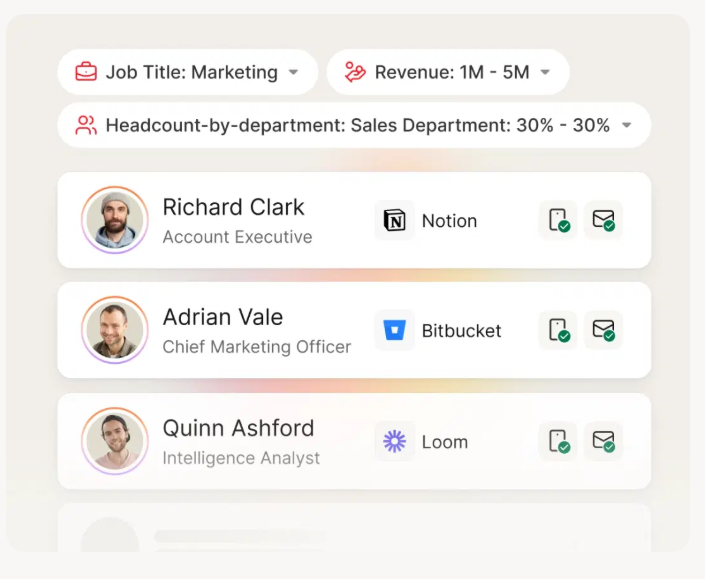
Snyk's 50 AEs grew pipeline 180% because their data connected them to real buyers. Prospeo delivers 300M+ verified profiles with 30+ filters - intent data, tech stack, job changes - so every personal selling conversation starts with the right person.
Target fewer accounts with better data and close more deals.
FAQ
What are the main types of personal selling?
Three core types: order takers (processing existing demand), order getters (hunting new business), and order creators (generating demand where none exists). Modern B2B frameworks add consultative, transactional, and relationship selling. Most reps blend two or three depending on deal stage and buyer readiness.
Is personal selling only face-to-face?
No - modern personal selling happens across phone, video, async video, social outreach, and personalized email. The defining characteristic isn't the channel but the one-to-one, tailored nature of the interaction. A Salesforce overview confirms this broader definition.
How do you measure personal selling success?
Track five core metrics: conversion rate, customer acquisition cost, sales cycle length, retention rate, and revenue per rep. Compare these quarterly to separate skill improvement from market shifts. One prerequisite - your contact data has to be accurate for any of these metrics to mean anything. A 35% bounce rate skews every downstream number.
What's the cheapest way to start personal selling with verified data?
Prospeo's free tier includes 75 verified emails and 100 Chrome extension credits per month - enough to run a focused campaign against your top 20-30 accounts. Paid plans start at roughly $0.01 per email. For comparison, ZoomInfo contracts typically start at $15K+/year with annual commitments.