Explicit vs Implicit Buying Signals: How to Score, Prioritize, and Act on Each
Signal-based outreach hits 18% response rates. Generic cold email? 8.5% on a good day, and most teams land closer to 3.4%. The gap between those numbers isn't about better copy or more sequences - it's about understanding explicit vs implicit buying signals, knowing how to weight each, and moving fast enough to matter.
The first seller to contact after a trigger event is 5x more likely to win the deal. Smartling operationalized this approach and generated $1.87M in new pipeline while cutting 97% of manual prospecting work. Your scoring model and response speed matter more than your subject line.
The Short Version
Explicit signals - demo requests, pricing inquiries, RFP submissions - need a response SLA measured in minutes, not hours. Forrester's research shows the vendor ranked first on day one wins roughly 80% of the time. Someone raises their hand, you run.
Implicit signals - content downloads, page visits, social engagement - need a scoring model before anyone picks up the phone. Acting on a single blog visit is how you waste rep time. 58% of sales meetings aren't valuable to buyers, and most of those happen because someone chased a weak signal.
Data quality is the foundation. Signals are worthless if the email bounces or the phone number's dead. Start with a scoring rubric, a response SLA by signal tier, and verified contact data so outreach actually lands.
What Are Buying Signals?
A buying signal is any action, behavior, or event indicating a prospect is moving toward a purchase decision. In B2B, where the typical buying group involves six to ten decision-makers, signals rarely come from a single person. You're reading patterns across an entire buying committee - some members sending direct intent signals, others leaving behavioral breadcrumbs.
Here's what makes this harder now than five years ago: AI is flooding inboxes. Human-timed outreach based on real signals is the differentiator. Gartner predicts that by 2030, 75% of B2B buyers will prefer sales experiences that prioritize human interaction over AI. The teams that win won't be the ones sending the most emails - they'll be the ones sending the right email at the right moment.
Explicit Buying Signals
Explicit signals are direct, unambiguous expressions of purchase intent. The prospect is telling you - sometimes literally - that they're evaluating solutions. Low volume, high reliability.
| Signal | Score Weight | Why It Matters |
|---|---|---|
| Demo request | +50 | Clearest intent signal |
| "Contact sales" click | +50 | Active hand-raise |
| RFQ / RFP submission | +50 | Formal evaluation |
| Pricing page (repeated) | +30 | Comparing costs |
| Budget questions | +30 | Confirming spend |
| Vendor shortlist mention | +25 | You're being evaluated |
| Contract / legal questions | +25 | Near-decision stage |
| Reference requests | +20 | Final validation |
When you see an explicit signal, the clock starts. There's no "let's wait and see."
Implicit Intent Signals
Implicit intent signals are behavioral indicators that suggest interest without a direct declaration. They're higher volume and noisier, which is why they need scoring rather than immediate action. Factors.ai breaks these into three useful categories: fit data (firmographic alignment), opportunity data (funding rounds, leadership changes), and intent data covering both behavioral and contextual signals.
| Signal | Score Weight | Notes |
|---|---|---|
| Blog / content visits | +10 | Weak alone, strong in clusters |
| Webinar attendance (live) | +15 | Live > recording |
| Webinar recording view | +5 | Lower commitment |
| Email opens / clicks | +10 | Pattern matters more than one-off |
| Social engagement | +10 | Decision-maker > intern |
| Job postings (relevant roles) | +15 | Hiring = budget allocated |
| Funding round | +20 | New money, new initiatives |
| Tech stack changes | +15 | Evaluating alternatives |
| Competitor research activity | +20 | Active comparison shopping |
A single implicit signal is noise. Two or three from the same account within 7-14 days? That's a pattern worth acting on. Third-party intent data alone is too noisy unless you layer it with first-party signals and ICP fit. The signal itself isn't the trigger - the cluster is.

Scoring signals without verified contact data is like spotting the buyer and losing their number. Prospeo tracks 15,000 intent topics via Bombora and pairs them with 98% accurate emails and 125M+ verified mobiles - so when implicit signals cluster into a pattern, you reach the right person instantly.
Detect the signal. Reach the buyer. Close the gap in minutes.
Side-by-Side Comparison
| Dimension | Explicit | Implicit |
|---|---|---|
| Clarity | Unambiguous | Requires interpretation |
| Reliability | High | Moderate (needs pattern) |
| Volume | Low | High |
| Urgency | Respond in minutes | Score, then escalate |
| Typical source | First-party (forms, chat) | Mix of first + third-party |
| Action | Direct outreach | Nurture, then escalate on cluster |
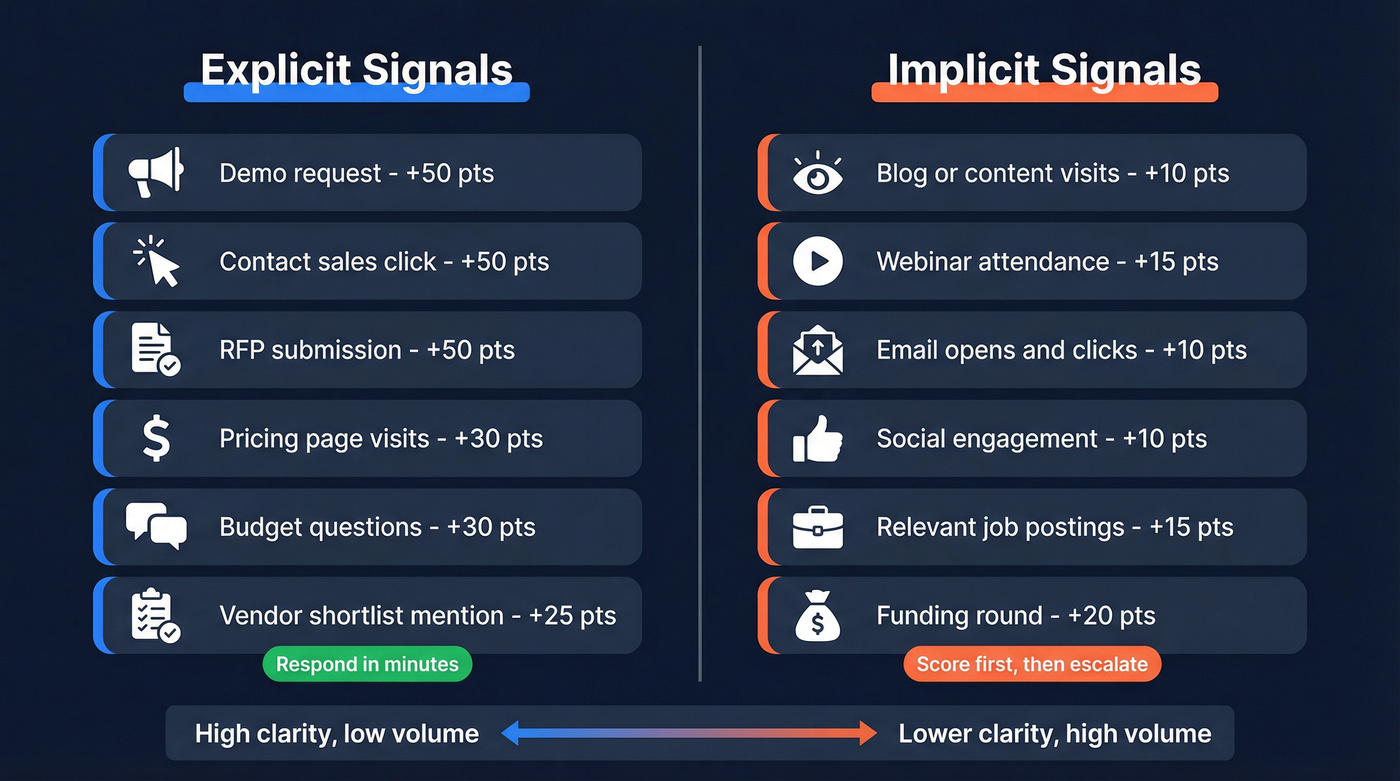
Explicit signals tell you who's ready. Implicit signals tell you who's getting ready. You need both. The mistake is treating them the same way.
How to Score Both Signal Types
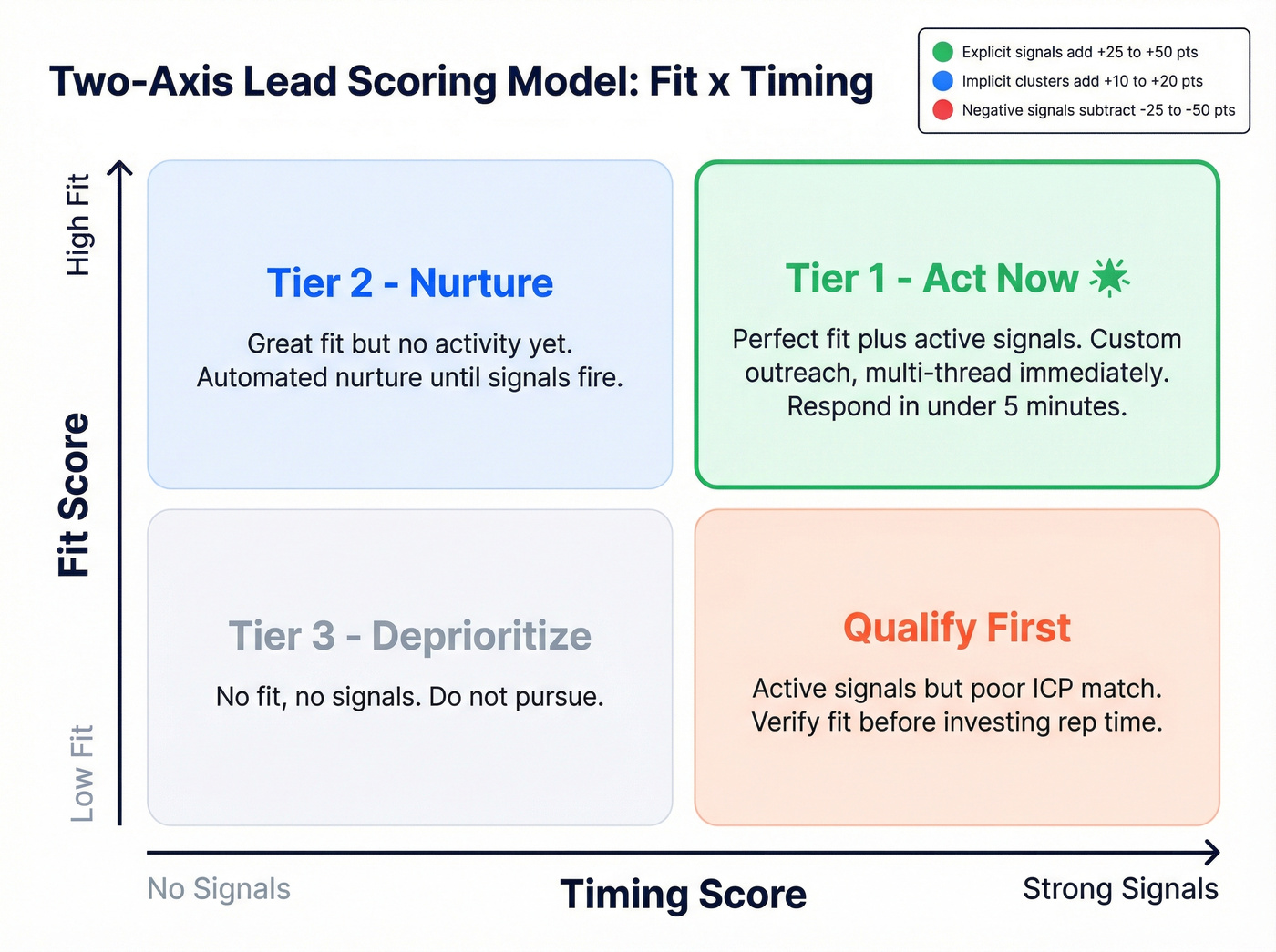
A scoring model prevents your team from chasing every website visitor while ignoring the prospect who just requested a demo and got lost in a queue. We've tested several approaches, and the simplest one that actually works is a two-axis model: fit score and timing score. Here's a starter rubric you can copy directly into your MAP or CRM.
Positive signals:
| Action | Points | Type |
|---|---|---|
| Demo request | +50 | Explicit |
| Pricing page (2+ visits) | +30 | Explicit |
| Decision-maker title (VP+) | +30 | Fit |
| Tech stack match | +15 | Fit |
| Webinar attendance (live) | +15 | Implicit |
| Content download | +10 | Implicit |
| Email click | +10 | Implicit |
Negative signals:
| Action | Points |
|---|---|
| Competitor domain | -30 |
| Unsubscribe | -25 |
| Student / intern title | -50 |
Don't skip the negative signals. They're what keep your reps from wasting time on accounts that'll never close.
Score on two axes: a fit score (static firmographic and technographic alignment, rated 1-5) and a timing score (dynamic signals like the ones above). A perfect-fit account with no timing signals goes into Tier 2 nurture. A moderate-fit account with a demo request gets immediate attention. Aligned ABM-ABS programs using this kind of framework often move accounts through pipeline 234% faster.
Tier your accounts accordingly:
- Tier 1 (50-100 accounts): deep research, custom outreach, multi-threaded engagement.
- Tier 2 (200-500): lighter touch with escalation triggers. When implicit signals cluster, promote to Tier 1.
- Tier 3: automated nurture until signals fire.
One thing that kills even the best scoring model: stale contact data. If your database refreshes every six weeks - the industry average - scored leads decay into bounced emails before your SDR reaches out. We've seen this happen to teams with otherwise excellent signal programs, and it's genuinely frustrating to watch.
Response Playbook by Signal Type
| Signal Type | Response SLA | Action |
|---|---|---|
| Explicit (demo, RFQ) | Under 5 minutes | Personalized outreach, direct CTA |
| Implicit cluster (2+ signals, 14 days) | Same business day | Contextual email referencing their activity |
| Implicit single | No outreach | Add to nurture, monitor for pattern |
| Explicit + implicit combo | Immediate | Fast-track to AE, multi-thread the account |
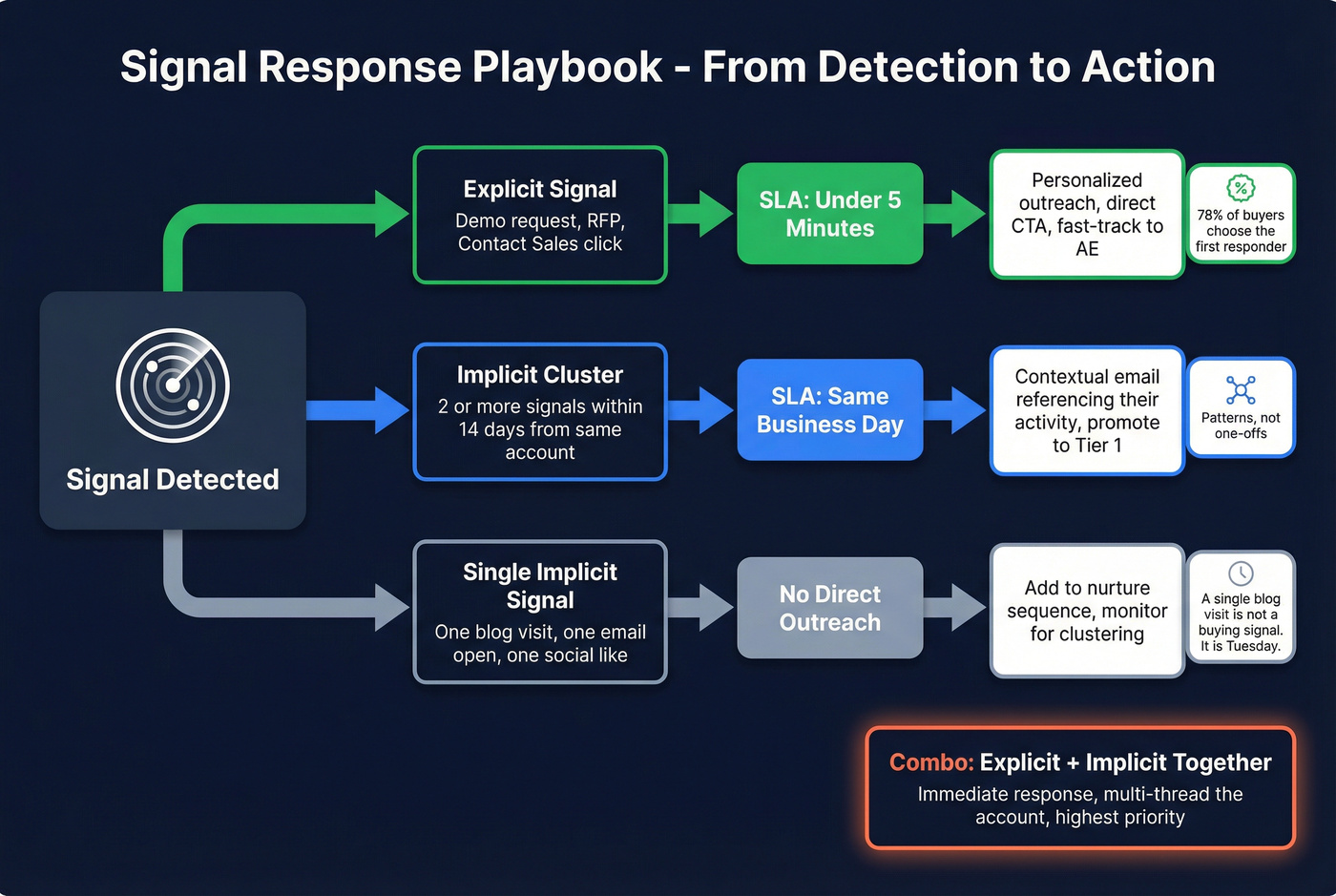
For explicit signals, speed is everything. 78% of buyers purchase from the first vendor to respond. For implicit signals, follow the DemandScience principle: patterns, not one-offs. Cross-check current behaviors against your closed-won footprints - what did successful deals look like before they closed?
Let's be honest about follow-up, too. 43% of buyers who accept meetings say five or more touches are fine. Don't give up after one email, but make every touch contextual - reference the signal that triggered the outreach. "I noticed your team attended our webinar on X and then visited our pricing page" is infinitely better than "just checking in."
Mistakes That Kill Signal Programs
Acting on one-off implicit signals. A single blog visit isn't a buying signal. It's Tuesday. Wait for a pattern before routing to sales.
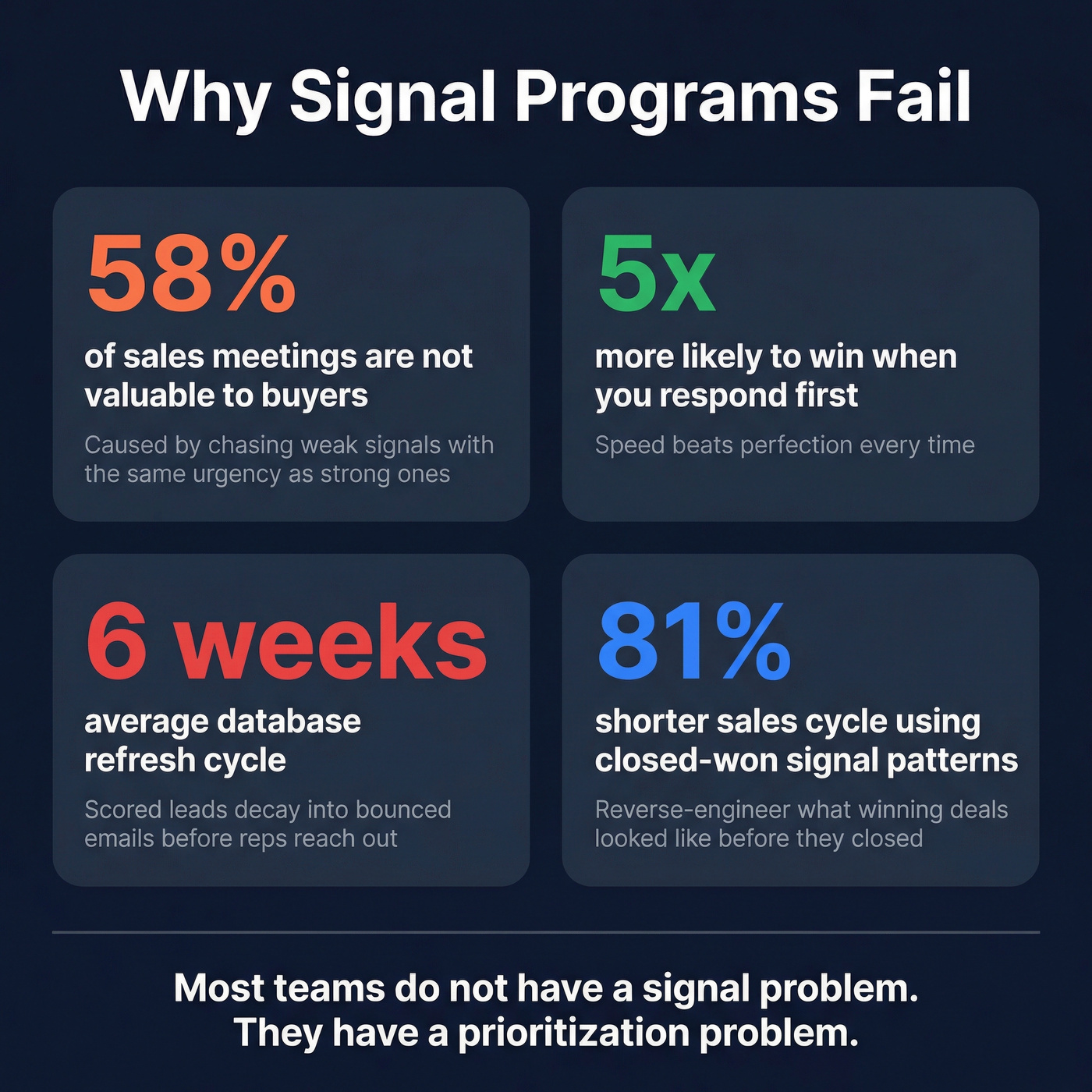
Treating all signals equally. Without scoring, a content download gets the same response as a demo request. That's how you end up with 58% of sales meetings being worthless - reps chasing weak signals with the same urgency as strong ones.
Ignoring data quality. In our experience, the most common failure mode isn't bad scoring - it's good scoring paired with stale data. Teams build sophisticated models, fire alerts in real time, and then watch emails bounce because the contact data was six months old. Signals without deliverable contact data are just interesting dashboards. Prospeo's 7-day refresh cycle exists specifically to solve this problem, keeping 300M+ profiles current so outreach actually lands when signals fire.
Not reverse-engineering from closed-won deals. Your best scoring model isn't theoretical - it's built from deals you've already won. What signals did those accounts show before they closed? That's your blueprint. Metadata used this approach and achieved an 81% shorter sales cycle.
Look, most teams don't have a signal problem. They have a prioritization problem. If your average deal size is under $15K, you probably don't need a $100K intent platform - you need a tight ICP definition, a simple scoring rubric, and contact data that doesn't bounce. Complexity is the enemy of speed, and speed is what wins deals.
Tools for Signal Capture
The intent data market is valued at roughly $4.49B in 2026 and projected to reach $20.89B by 2035. Yet only about 25% of B2B companies use intent data effectively. The gap isn't tool availability - it's operationalization.
| Category | Examples | Typical Cost |
|---|---|---|
| Cooperative intent | Bombora | ~$25-50K/yr |
| Second-party intent | G2 Buyer Intent | ~$15-30K/yr |
| Full-stack ABM | 6sense, Demandbase | $100K+/yr |
| Broad data + intent | ZoomInfo | ~$15-40K/yr |
| Job-change signals | UserGems | ~$1-3K/mo |
When evaluating any intent tool, focus on four criteria: data source breadth, signal freshness (weekly vs. near-real-time), granularity (account-level vs. prospect-level), and activation - can you route signals to reps without manual work? If you're comparing vendors, start with a shortlist of buyer intent tools and then narrow down to the right intent data platforms for your deal size and motion.
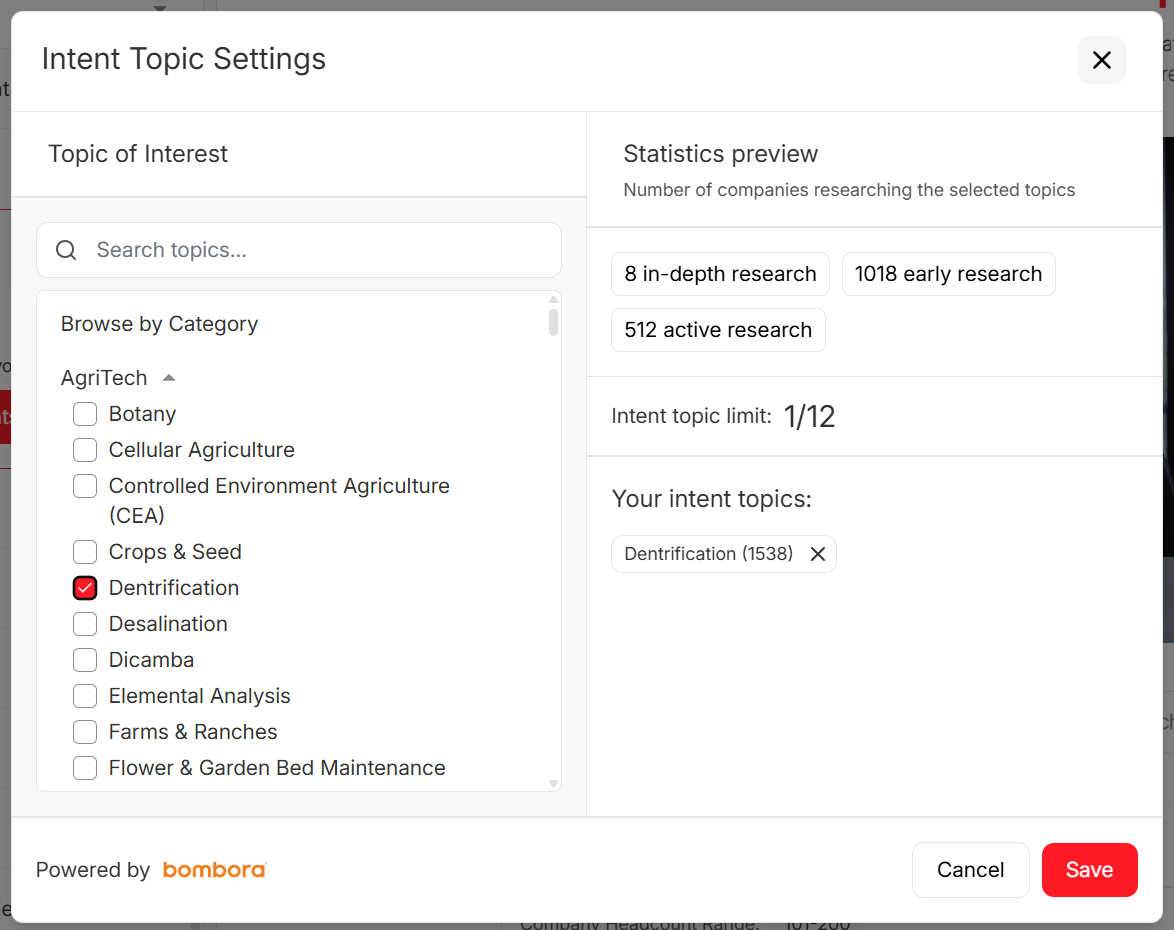
Skip the six-figure platforms if your team is under 20 reps or your average deal size is below $20K. You'll spend more time configuring dashboards than closing deals. For teams in that range, a reliable contact data source paired with one intent signal feed covers the fundamentals. Even free G2 buyer intent alerts give you a meaningful edge over competitors flying blind.
The first seller to respond after an explicit signal wins 5x more often - but only if the email lands. Prospeo's 7-day data refresh and 5-step verification keep bounce rates under 2%, so your speed-to-lead advantage doesn't die in a spam folder. At $0.01 per email, bad data is no longer an excuse.
Stop losing deals to stale data between the signal and the send.
FAQ
What's the difference between first-party and third-party buying signals?
First-party signals come from your own channels - website visits, email clicks, demo requests, chat conversations. Third-party signals come from external sources like review sites, publisher networks, or hiring and funding data. First-party signals carry higher confidence because you control the data. The best programs layer both: third-party intent identifies warming accounts, and first-party signals confirm they're engaging with you.
How many signals should trigger outreach?
One explicit signal is enough - respond immediately to demo requests and pricing inquiries. For implicit signals, wait for two or more from the same account within 7-14 days. A single blog visit is noise; a blog visit plus a pricing page view plus a webinar registration is a buying committee warming up.
How do I keep contact data accurate when signals fire?
Use a provider with weekly refresh cycles. The industry average is six weeks - by then, your scored lead may have changed roles entirely. Prospeo refreshes all 300M+ records every 7 days and runs a 5-step verification process, so when a signal fires the email you send actually lands.
Can small teams use signal-based selling without enterprise tools?
Absolutely. Teams with deal sizes under $20K don't need six-figure ABM platforms. A tight ICP definition, a simple fit x timing scoring rubric in your CRM, and a reliable contact data source cover the fundamentals. Add one intent signal source - even free G2 buyer intent alerts - and you're ahead of most competitors. The consensus on r/sales tends to agree: start simple, add complexity only when you've outgrown the basics.