

Field Sales in 2026: Benchmarks, Strategy, and the Operating Manual Nobody Wrote
Your field sales rep drove 45 minutes to a meeting last Tuesday. Got to the lobby, checked in, waited - and the receptionist said the contact left the company three months ago. That's not a bad day. That's a broken process. It's happening across outside sales teams everywhere, and we've watched it burn through pipeline at companies of every size.
Here's the thing: face-to-face selling still closes deals at 2-3x the rate of inside sales. But 49% of B2B teams are stuck in what one major 2026 survey calls a "dual crisis" - missing quota and hemorrhaging reps simultaneously. The gap between teams that are thriving and those that are drowning has never been wider.
Only 19% of B2B organizations achieve sustainable success, meaning high quota attainment with low turnover. This guide gives you the benchmarks to diagnose your team, the strategy to fix what's broken, and the tech stack to stop wasting windshield time. If you only read one section, read the KPIs - that's where most teams go wrong.
What Is Field Sales?
Field sales is face-to-face, on-site selling. Your reps leave the office (or their home), drive to the prospect's location, and sell in person. It's one of the oldest forms of selling, and in industries like medical devices, manufacturing, enterprise SaaS, and pharma, it's still the dominant motion.
The confusion usually starts when people try to draw a clean line between this and inside sales. They're not opposites - they're different tools for different deal profiles.
| Field Sales | Inside Sales | |
|---|---|---|
| Meeting type | In-person, on-site | Phone, video, email |
| Deal complexity | High | Low to moderate |
| Cycle length | Weeks to months (often longer for enterprise) | Days to weeks |
| Close rate | 2-3x higher | Baseline |
| Avg deal size | $10K-$200K+ | $1K-$25K |
| Travel | Heavy | None |
The hybrid model is blurring these lines - most reps now handle some remote meetings - but the core distinction holds. If your deal requires a handshake, a site visit, or a demo that can't happen over Zoom, that's outside sales.
Why In-Person Selling Still Wins in 2026
Every few years, someone publishes a "field sales is dead" take. It never ages well.
The close rate gap is the headline number: on-site teams close at 2-3x the rate of inside sales. For complex deals with multiple stakeholders, in-person meetings build trust that a video call simply can't replicate.
The macro numbers back it up. In a 2026 survey of 336 field sales professionals, 78% of B2B organizations reported revenue growth. The channel isn't shrinking - it's evolving. Buying committees now include 6-10 decision makers and cycles stretch 6-18+ months. That complexity is exactly where face-to-face selling thrives, because you can't multi-thread a 10-person buying committee over email sequences alone.
And 73% of B2B buyers actively avoid sellers who send irrelevant outreach. In-person selling is inherently relevant - you're sitting across the table, reading body language, adjusting in real time.
If your average contract value sits below five figures, you probably don't need reps on the road. But once deals cross six figures and require a technical evaluation, on-site selling isn't optional - it's the only motion that consistently closes.
What's Actually Broken
Let's be honest about the numbers. That 78% revenue growth stat sounds great until you look underneath it. Only 19% of B2B organizations achieved "sustainable success" - high quota attainment combined with low turnover. The other 49%? Dual crisis. Missing quota and losing reps at the same time.
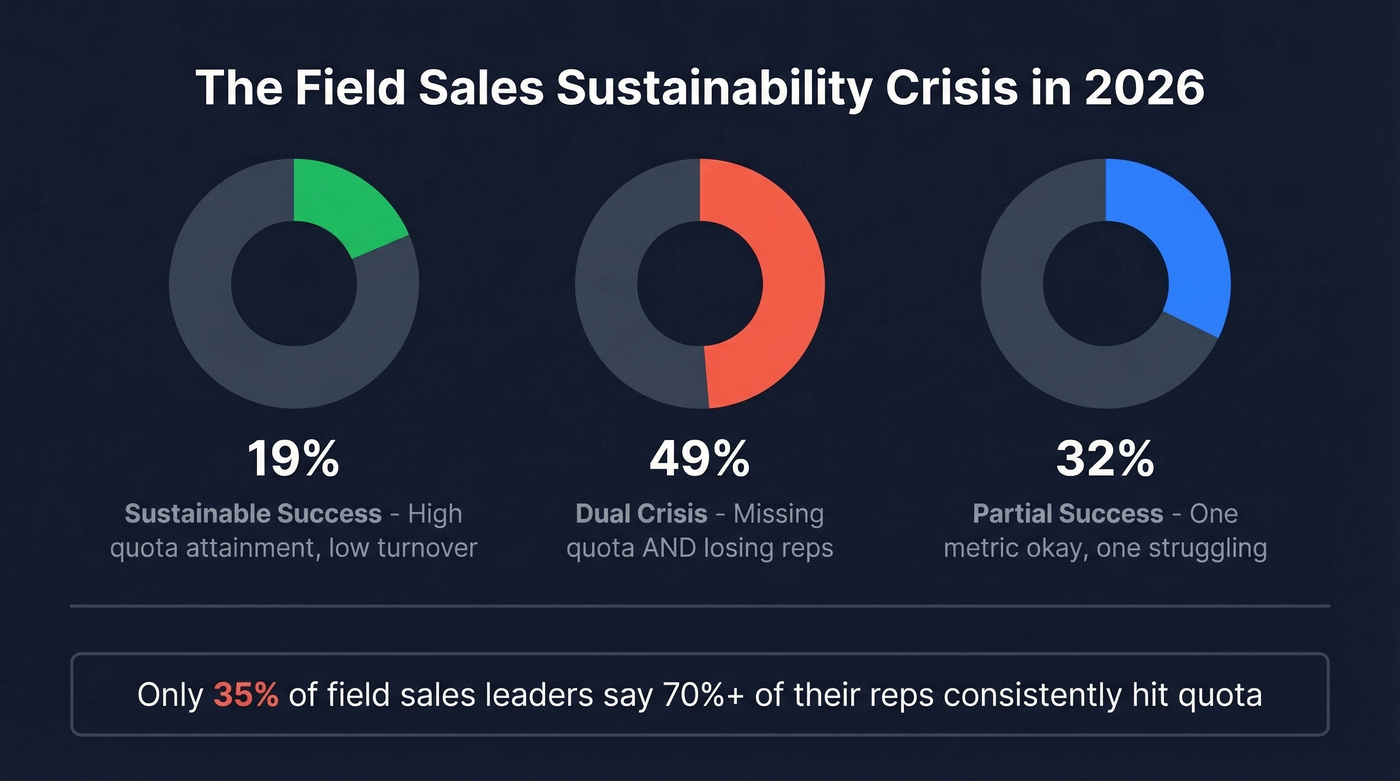
Three problems are driving this.
The Quota Gap
Only 35% of field sales leaders say 70% or more of their reps consistently hit target. At most organizations, the majority of the team is underwater. When reps miss quota quarter after quarter, they leave - which feeds the turnover side of the dual crisis.
The CRM Tax
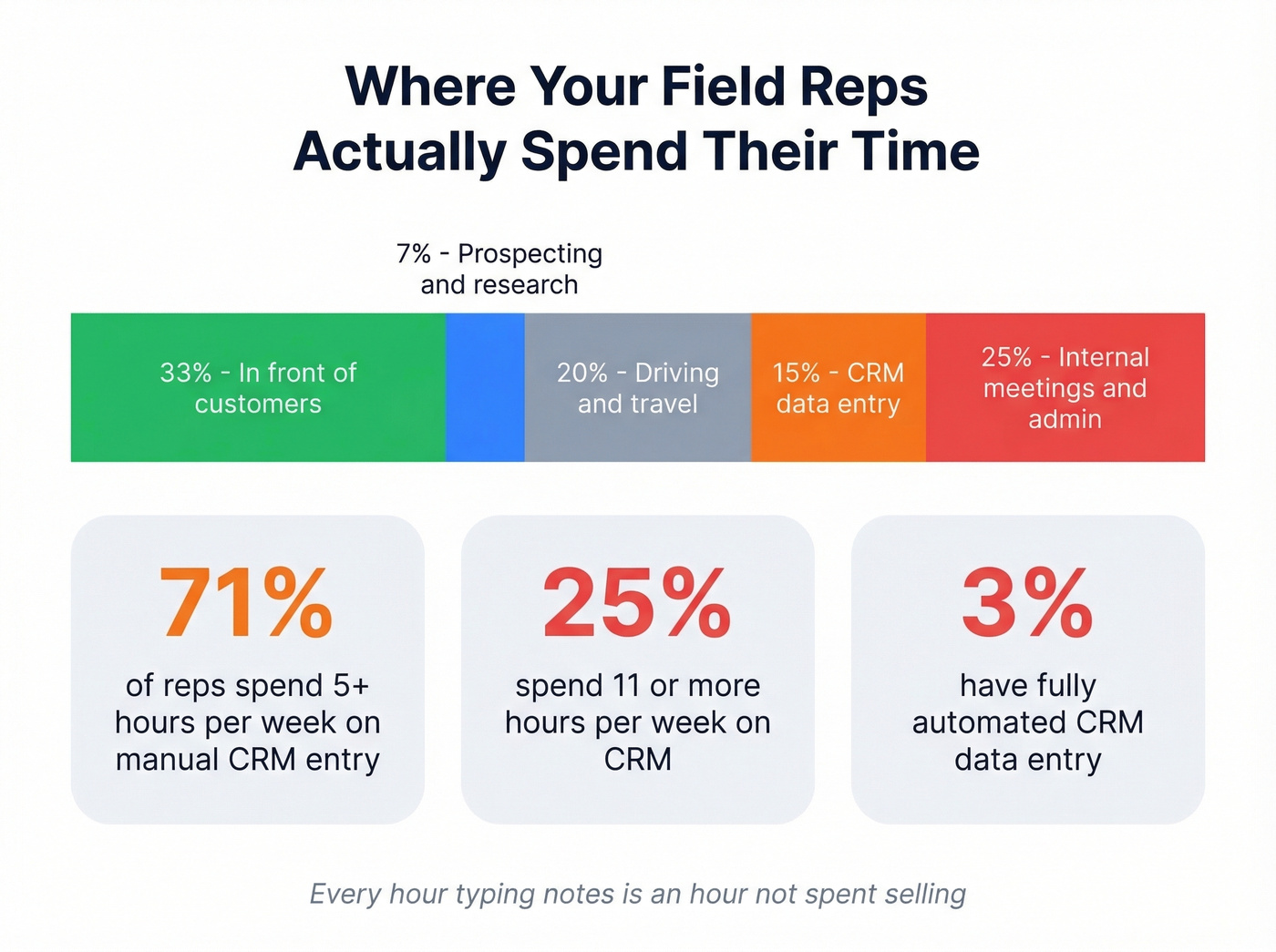
Here's the number that should make every VP of Sales furious: 71% of reps spend 5+ hours per week on manual CRM data entry. A quarter spend 11+ hours. And only 3% have fully automated CRM entry. Your highest-paid sellers are spending a full day per week typing notes into your CRM instead of sitting across from buyers.
If you're evaluating your stack, it helps to compare examples of a CRM before you commit.
The Time Allocation Problem
Reps spend 60% of their time on non-selling tasks. For reps on the road specifically, the average B2B rep spends 33% of the week in front of customers. The rest is driving, admin, internal meetings, and searching for contact information that turns out to be wrong.
The top external challenge reported? Changes in customer buying behavior. The top internal challenge? Limitations of existing processes and technology. Both are fixable - but only if you're measuring the right things.
Field Sales KPIs That Matter
Most teams track too many metrics or the wrong ones. Badger Maps recommends 6-10 KPIs max. More than that and you're measuring noise. The key distinction is leading vs. lagging indicators - revenue is lagging (it tells you what happened), while visits per day is leading (it tells you what's about to happen).
If you want a broader framework, start with sales operations metrics and then narrow down to rep-level KPIs.
Activity Metrics
These are the inputs your reps control.
| KPI | Average | Top 10% | Bottom 10% |
|---|---|---|---|
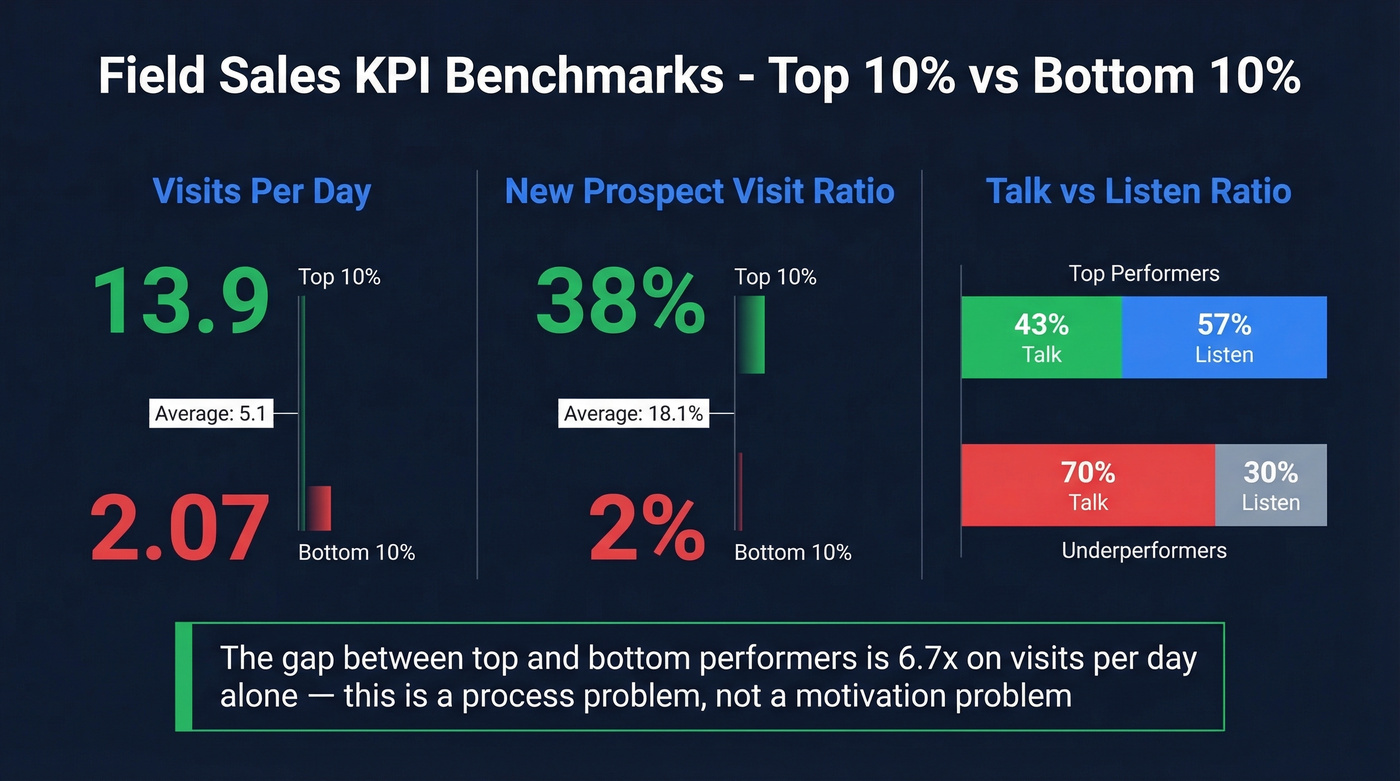
| Visits/day | 5.1 | 13.9 | 2.07 |
| New prospect visits | 18.1% | 38% | 2.04% |
| Talk/listen ratio | 43/57 | 43/57 (top reps) | Reps talking 70%+ |
The visits-per-day spread is enormous. If your team averages below 5, investigate territory design and routing before assuming it's a motivation problem. The new prospect ratio is equally telling - bottom-decile reps spend 98% of their time on existing accounts, which means pipeline is dying.
The talk/listen ratio comes from a Sales Hacker study: top-performing reps listen 57% and talk 43% in prospect meetings. The reps who talk less close more. Simple as that.
Outcome Metrics
Rep-level outcome KPIs include contact rate, conversion rate, and follow-up completion. Manager-level KPIs should focus on quota attainment percentage, territory coverage, and pipeline velocity. We've seen teams cut attrition from 34% to 23% simply by enforcing better KPI tracking - when reps can see their own numbers improving, they stay.
If you're only tracking revenue and ignoring the activity metrics that predict it, you're flying blind. By the time revenue drops, it's too late to fix the inputs.

Your reps drove 45 minutes to meet a contact who left three months ago. That's what stale data costs field sales teams. Prospeo refreshes every record on a 7-day cycle - not the 6-week industry average - so your reps walk into every meeting with verified emails, direct dials, and contacts who actually work there. 98% email accuracy. 125M+ verified mobile numbers. At $0.01 per email.
Every wasted site visit is a deal your competitor closes instead.
Seven Mistakes Reps Make on the Road
1. Talking More Than Listening
Target 60% listening, 40% talking. Most underperforming reps invert this ratio. They pitch features instead of asking questions. The fix is straightforward coaching: record ride-alongs, review the ratio, and hold reps accountable.
2. Not Researching Before Visits
Walking into a meeting cold is disrespectful to the prospect's time and yours. Spend 10 minutes reviewing the company's recent news, their tech stack, and the contact's role before you drive. This isn't optional prep - it's the bare minimum.
3. Visiting Stale Contacts
This is the most expensive mistake in outside sales. A 45-minute drive to a dead contact costs more than any data subscription. Verify every email and mobile number before you hit the road - tools like Prospeo make this a two-minute check with 98% email accuracy and a 7-day data refresh cycle.
If you're comparing vendors, use a shortlist of data enrichment services to sanity-check coverage and match rates.
4. Crisscrossing Territory
The "Windshield Test": if your reps cross their own path more than twice a day, territory design is broken. Saving 30 minutes of drive time per day adds up to 12 extra selling days per year per rep.
5. Chasing Volume Over Quality
More visits doesn't automatically mean better results. Quality of conversation and prospect fit matter more than raw door-knocks. Five great meetings beat twelve mediocre ones every time.
6. Ignoring the New Prospect Ratio
Bottom-decile reps dedicate just 2% of visits to new prospects. That's a pipeline death spiral. If your team isn't hitting at least 15-20% new prospect visits, pipeline will dry up in two quarters.
To keep pipeline healthy, borrow a few sales prospecting techniques that work well for on-the-road reps.
7. Manual CRM Entry
With 71% of reps spending 5+ hours per week on CRM data entry and only 3% fully automated, this is the biggest time thief. Every hour spent typing notes is an hour not spent selling.
How to Build a Field Sales Strategy
Territory Design
Territory planning is where most teams leave the most money on the table, and it's the area we see overlooked most often. Manual territory coverage hits about 78.2% of potential accounts. Graph-based algorithmic planning reaches 91.4%. That's a 13-point gap in coverage from a process change alone.
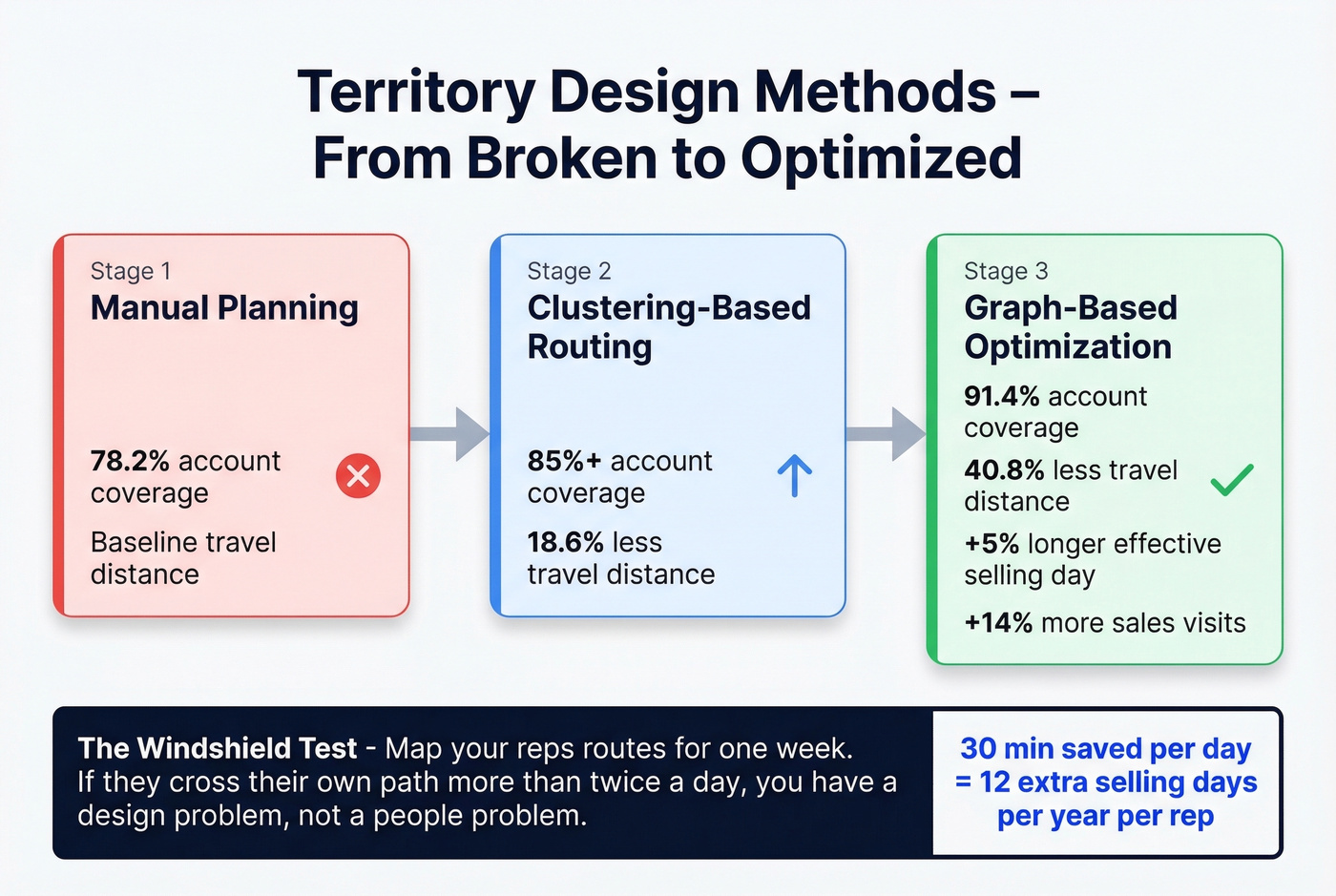
The travel reduction numbers are even more compelling. Clustering-based routing cuts travel distance by 18.6%, while graph-based optimization cuts it by 40.8% and extends the effective working day by 5%. A separate operations research study found computational territory methods increase effective sales visits by 14% and decrease travel by 17%.
Start with the Windshield Test. Map your reps' routes for a week. If they're crisscrossing, you've got a design problem - not a people problem.
If you're shopping tools, a dedicated guide to sales mapping software can help you compare routing and territory features.
Prospect List Building and Verification
Here's the upstream problem nobody talks about enough: your territory design and route optimization don't matter if the contacts at the other end are wrong. Teams invest heavily in routing software only to have reps show up to meetings with people who left six months ago.
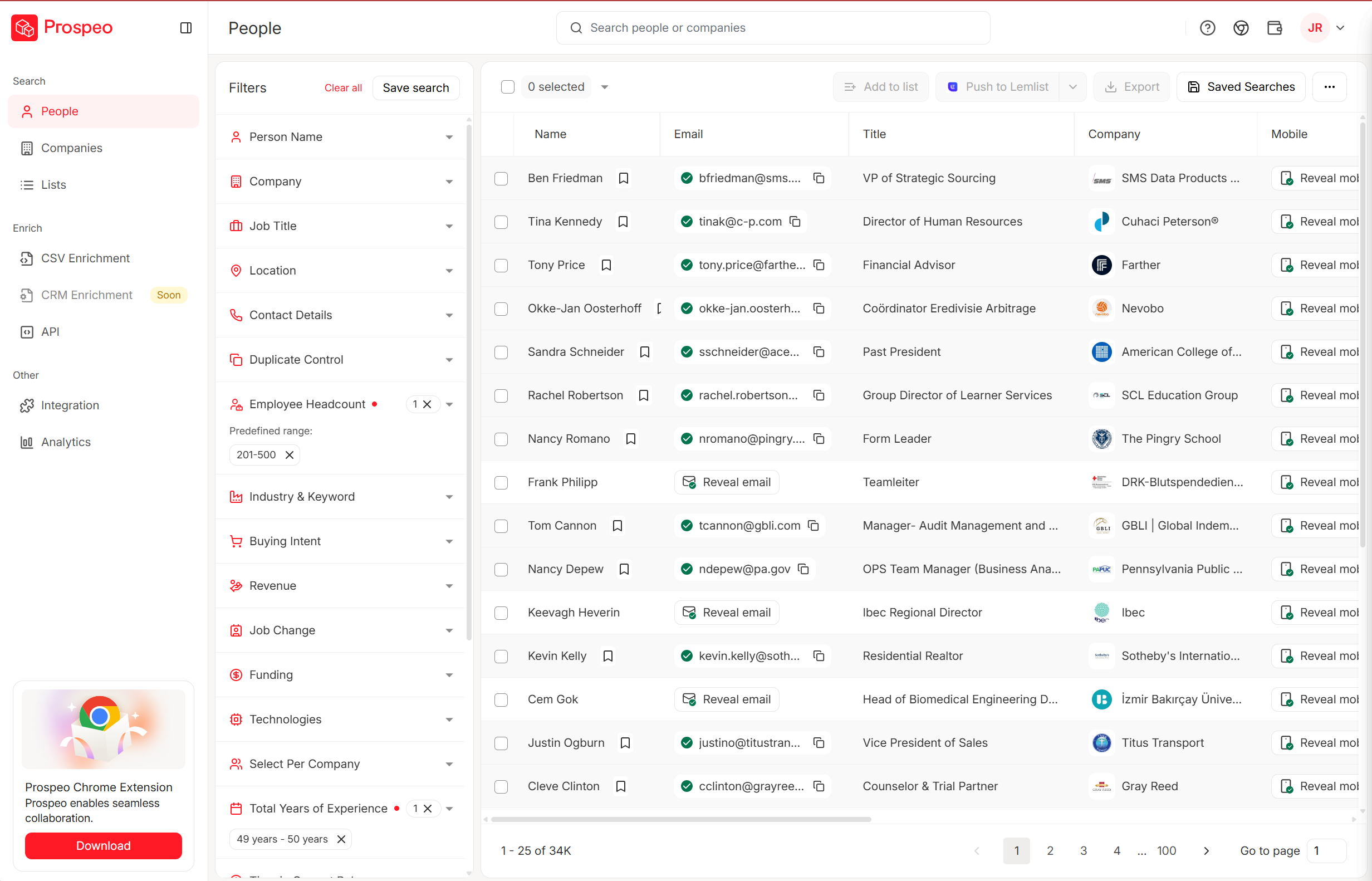
Prospeo solves this at the source. With 300M+ professional profiles, 143M+ verified emails, and 125M+ verified mobile numbers with a 30% pickup rate, your reps can verify every contact before they drive. The 7-day data refresh cycle - versus the 6-week industry average - means you're working with current information, not stale records. The free tier gives you 75 verified emails plus 100 Chrome extension credits per month to test the workflow.
If you're building lists from scratch, start with a few free lead generation tools before you pay for anything.
Meeting Execution
Coach the talk/listen ratio relentlessly. Top reps hit 57/43 listen/talk. Research the prospect before every visit. Focus on the customer's problems, not your product's features. And with buying committees of 6-10 people, identify the right stakeholders early - a great meeting with the wrong person is a wasted trip.
After the meeting, tighten your process with a repeatable set of sales follow-up templates.
Scenario Planning
Don't build a strategy that only works in a growth market. Stress-test under three scenarios: flat growth, contraction, and expansion. Watch for early warning signs - stagnant win rates, longer cycles, shrinking deal sizes, increasing discount pressure. If you see two or more of these simultaneously, your strategy needs revision, not tweaking.
Pilot new technology on a small segment first. Measure adoption and impact for 60-90 days before rolling out to the full team. The worst thing you can do is force a tool change on 50 reps at once with no transition plan.
Field reps already spend 60% of their time on non-selling tasks. Searching for accurate contact data shouldn't eat into the 33% they actually spend with buyers. Prospeo's 30+ search filters - including buyer intent, job changes, and headcount growth - let reps build territory lists in minutes, not hours. CRM enrichment returns 50+ data points per contact with a 92% match rate.
Give your reps back a full selling day every week.
The Field Sales Tech Stack
The right tools eliminate windshield time and CRM busywork. Teams without proper platforms convert at 2-5%, while teams with dedicated tools push conversion rates above 6%. Here's what to evaluate by category.
| Tool | Category | Starting Price | Best For |
|---|---|---|---|
| Prospeo | Contact data | Free tier, ~$0.01/email | Pre-visit contact verification |
| SPOTIO | Activity tracking | ~$39-79/user/mo | Full platform for reps on the road |
| Badger Maps | Route optimization | From $58/user/mo | Route planning + mapping |
| Map My Customers | Territory mgmt | From $50/user/mo | Visual territory planning |
| SalesRabbit | Mobile CRM | From $25/user/mo | Door-to-door teams |
| ForceManager | Mobile CRM | From $19/user/mo | Budget-friendly mobile CRM |
| Salesforce Maps | Territory + routes | ~$75/user/mo add-on | Salesforce-native teams |
Contact Data and Verification
Bad data is the silent killer of productivity for reps on the road. Before your rep drives 45 minutes, you need to know the contact is still at that company, their email is valid, and you have a direct dial that actually rings. Skip this step and you're gambling with your most expensive resource: rep time.
If you're standardizing your stack, consider pairing verification with best contact management software so reps can actually find and use the data.
Route Optimization
Badger Maps and SPOTIO are the two leaders here. Badger Maps users report cutting drive time by 20% and selling 22% more. For teams already on Salesforce, Salesforce Maps is the native option at around $75/user/month as an add-on. In our experience, the routing tool matters less than whether reps actually use it daily - adoption is everything.
Territory Management
Map My Customers at $50/user/month gives you visual territory planning with heat maps and account clustering. Salesforce Maps also covers territory management for teams already in that ecosystem. The goal is eliminating the crisscross problem - reps should work geographic clusters, not zigzag across the metro.
Activity Tracking and Mobile CRM
ForceManager starts at $19/user/month and handles the basics well. SalesRabbit at $25/user/month is purpose-built for door-to-door. The selection criteria that matter most: offline access (your reps will be in dead zones), CRM integration depth, and mobile UX. If the app doesn't work without cell service, skip it.
Order Capture
For teams where reps close deals on-site and need to process orders in the field, tools like Pepperi and Skynamo handle mobile order capture, catalog management, and invoicing. These matter most for distribution, wholesale, and CPG teams where the sale happens at the point of visit. Expect pricing in the $30-75/user/month range depending on feature depth.
Salary and Career Path
Compensation in field sales scales dramatically with deal complexity. Here are the 2026 ranges across the career ladder.
| Role | Base Salary | OTE | Typical Split |
|---|---|---|---|
| SDR/BDR | $45-60K | $60-100K | 60/40 to 70/30 |
| Field AE (SMB) | $60-80K | $110-150K | 50/50 to 60/40 |
| Field AE (Mid-Market) | $80-110K | $140-200K | 50/50 |
| Field AE (Enterprise) | $110-150K | $220-320K | 50/50 |
| Field Sales Manager | $100-140K | $200-280K | 60/40 to 70/30 |
The standard career path runs SDR to AE to Senior AE to Manager to Director. Enterprise AEs can earn more than their managers - that's normal and expected. The best individual contributors often stay in closing roles rather than moving to management, and they're right to do so.
One critical caveat on OTE: always ask about quota attainment percentage and clawback policies. An OTE of $300K means nothing if only 20% of the team hits target. The consensus on r/sales is to ask for the distribution curve, not just the top-line number. And with 70%+ of sales roles now offering remote or hybrid options, "field" increasingly means strategic on-site visits rather than daily windshield time.
If you want to pressure-test comp plans, use a clear definition of OTE in sales before you sign.
The Future of Field Sales
This discipline isn't dying. It's becoming more strategic and less transactional.
The hybrid model is now the default - over 70% of sales roles offer remote or hybrid work. Reps are choosing when to be in the field rather than defaulting to it daily. The visits that happen are higher-stakes and better-prepared.
Buying committees are growing. With 6-10 decision makers involved in the average B2B purchase and 57% of sales professionals reporting longer cycles, the rep's role is shifting toward orchestration. You're not just selling to one person - you're navigating a committee, and that requires in-person relationship building that inside sales can't replicate at scale.
AI adoption is wildly uneven - and that's where the advantage lives. 88% of reps using AI agents say it increases their odds of hitting targets, but only 3% of teams have fully automated CRM entry. The teams that close this gap first will have a massive productivity advantage over the next two years.
The specialization trend continues too. The "great unbundling" of sales roles - SDR, AE, SE, deal desk, CSM - means reps on the road are increasingly pure closers, supported by specialists at every stage. That's good news for AEs who want to focus on what they do best: sitting across from buyers and winning deals.
FAQ
What is field sales and how does it differ from inside sales?
Field sales means selling face-to-face at the prospect's location rather than remotely. Reps travel to the buyer, conduct in-person meetings, and build relationships on-site. Inside sales happens entirely over phone, video, and email. Most modern teams blend both, but on-site selling consistently closes at 2-3x the rate on complex, high-value deals where trust and stakeholder alignment matter most.
What's the difference between field sales and outside sales?
They're the same thing. "Field sales" and "outside sales" are interchangeable terms for selling face-to-face at the prospect's location. Some companies use "outside sales" in job titles and the other in team structure, but there's no functional difference.
How many visits should a rep make per day?
The average is 5.1 visits per day, while top performers hit 13.9. If your team falls below 5, investigate territory design and routing before blaming motivation - the gap is usually structural, not behavioral.
Is field sales a good career?
Enterprise AEs earn $220K-$320K OTE, making it one of the highest-paying individual contributor paths in B2B. The tradeoff is travel, longer sales cycles, and the self-discipline required to manage your own schedule without a manager watching.
How do I verify contact data before visits?
Run your prospect list through a verification tool before you drive. At 98% email accuracy and a 7-day data refresh cycle, you can confirm emails are valid, mobile numbers are current, and contacts still work at the company - eliminating dead leads before they waste windshield time.