

FinalScout vs ReachStream: Honest Comparison (2026)
Both tools carry a 4.8/5 on G2, neither shows up in major roundups, and both target the same buyer - someone who needs emails without paying ZoomInfo prices. So what actually separates them?
This FinalScout vs ReachStream comparison breaks down the real differences in workflow, credits, and cost per contact. But here's the thing: before you commit to either, make sure you're not overlooking tools with larger databases and better integrations (see Best Sales Prospecting Databases).
The 30-second verdict: FinalScout wins if your workflow revolves around scraping professional profiles and generating AI outreach emails (see AI Cold Email Outreach). ReachStream wins if you want a standalone database with granular company filters and generous export credits. Skip both if you need 98% verified email accuracy, native CRM integrations, and a database that refreshes weekly.
Pricing Breakdown
ReachStream is the clear value play.
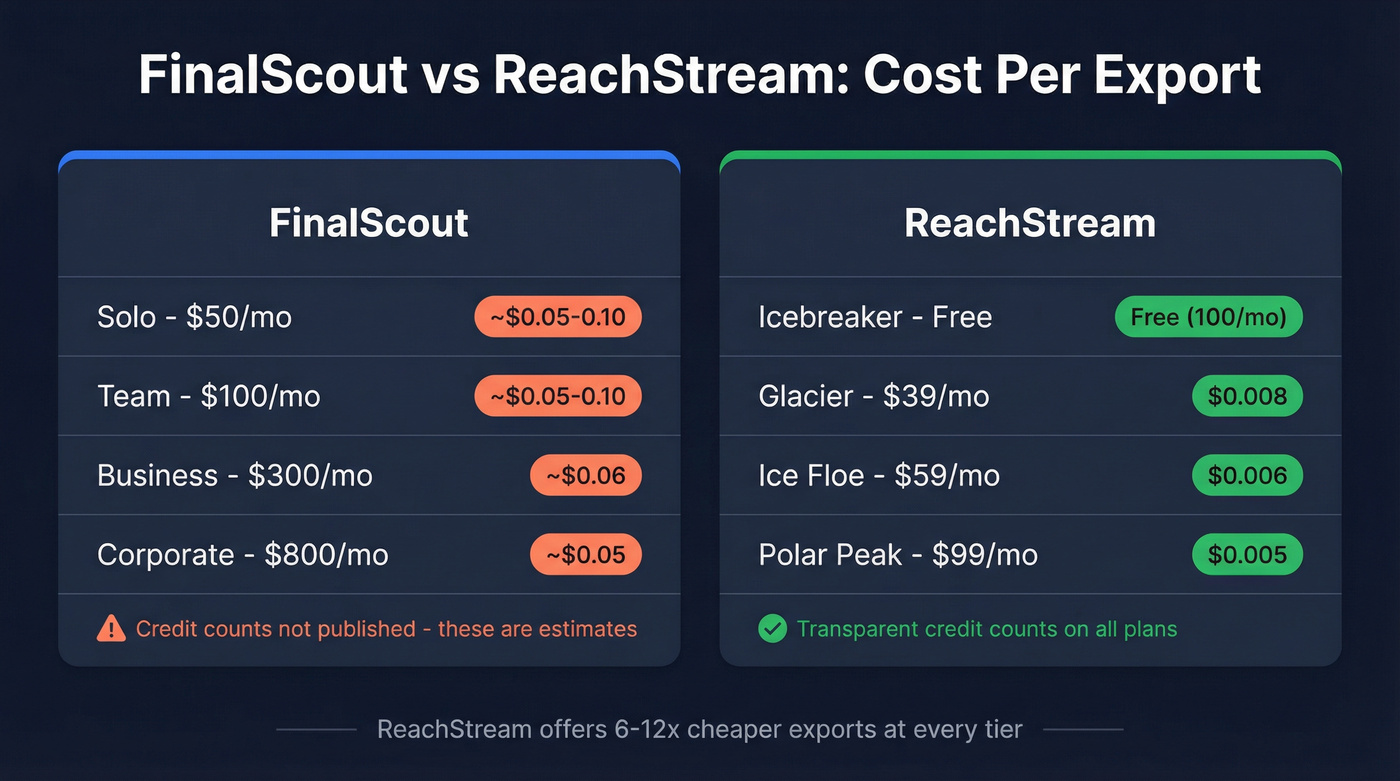
FinalScout doesn't publish credit counts for its paid plans - so you're committing $50-$800/month without a transparent view of how many bulk scrapes or exports you'll actually get. We estimate roughly 500-1,000 credits/month on Solo, scaling to ~5,000+ on Business and ~15,000+ on Corporate, based on typical credit-per-dollar ratios in this space. FinalScout does offer unlimited email verification and unlimited export on all plans, but the opacity around scrape volume is frustrating when you're trying to budget (see Lead Generation Metrics).
ReachStream's Glacier plan at $39/mo gives you 5,000 exports/month - roughly $0.008 per export. That's transparent and cheap.
| Tool | Plan | Monthly | Exports/Credits | Cost/Export |
|---|---|---|---|---|
| FinalScout | Free Trial | $0 | Max 100 profiles; 1 concurrent scrape | - |
| FinalScout | Solo | $50 | ~500-1,000 (est.) | ~$0.05-0.10 |
| FinalScout | Team | $100 | ~1,000-2,000 (est.) | ~$0.05-0.10 |
| FinalScout | Business | $300 | ~5,000+ (est.) | ~$0.06 |
| FinalScout | Corporate | $800 | ~15,000+ (est.) | ~$0.05 |
| ReachStream | Icebreaker | $0 | 1,200 export credits/year (~100/mo) | - |
| ReachStream | Glacier | $39 | 5,000/mo | ~$0.008 |
| ReachStream | Ice Floe | $59 | 10,000/mo | ~$0.006 |
| ReachStream | Polar Peak | $99 | 20,000/mo | ~$0.005 |
| Prospeo | Free | $0 | 75 emails | - |
| Prospeo | Paid | ~$39+ | 3,900+ | ~$0.01 |
Feature Comparison
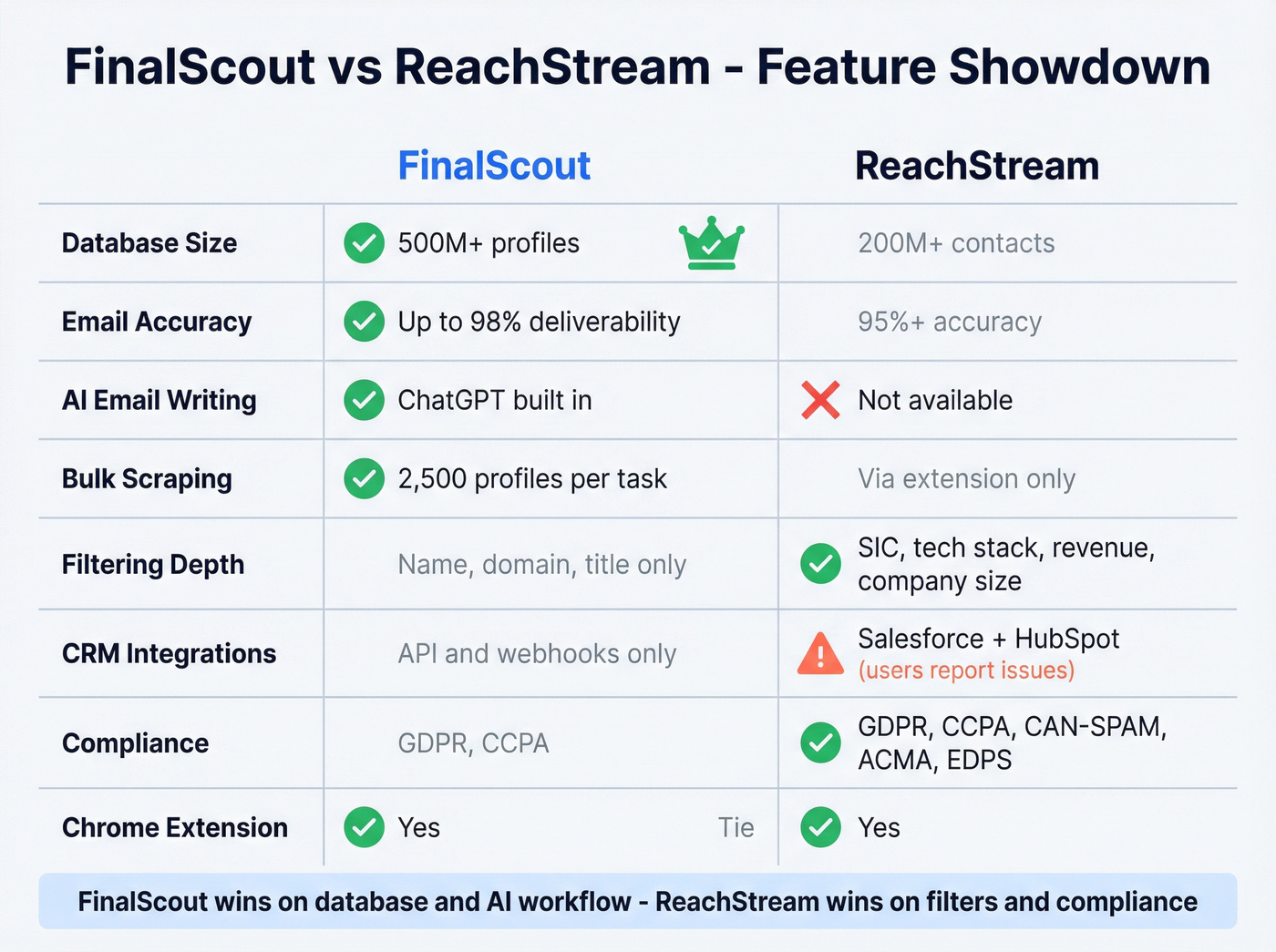
FinalScout's standout is EmailAI - ChatGPT-powered email writing built directly into the prospecting workflow. It's one of the few tools in this price range with AI drafting baked in (see AI for Sales Emails). ReachStream takes the lead on filtering with SIC codes, technographics, revenue ranges, and department-level targeting (see Firmographic and Technographic Data).
| Feature | FinalScout | ReachStream | Winner |
|---|---|---|---|
| Database Size | 500M+ profiles, 20M companies, 200M emails | 200M+ contacts, 15M companies | FinalScout |
| Email Accuracy | "Up to 98%" deliverability | "95%+" email accuracy | FinalScout (on paper) |
| AI Email Writing | Yes (ChatGPT) | No | FinalScout |
| Chrome Extension | Yes | Yes | Tie |
| Bulk Scraping | Up to 2,500 profiles per task on paid plans | Via extension | FinalScout |
| Integrations | APIs, webhooks, CSV export | Salesforce + HubSpot (with reported issues) | ReachStream (barely) |
| Filtering Depth | Name, domain, title | SIC, tech, revenue, size | ReachStream |
| Compliance | GDPR, CCPA | GDPR, CCPA, CAN-SPAM, ACMA, EDPS | ReachStream |


FinalScout won't tell you how many credits you get. ReachStream users keep flagging broken CRM integrations. Prospeo gives you 300M+ profiles at 98% email accuracy, native Salesforce and HubSpot sync, and data that refreshes every 7 days - not on some mystery cadence.
Stop guessing about credits and start closing with verified data.
What Real Users Say
FinalScout (226 G2 Reviews)
Here's the most interesting thing we found: 218 of FinalScout's 226 G2 reviews come from the Recruiting Automation category, not Sales Intelligence. It's a recruiter's tool that sales teams borrow. Praise centers on ease of use (55 mentions) and profile integration (22 mentions).
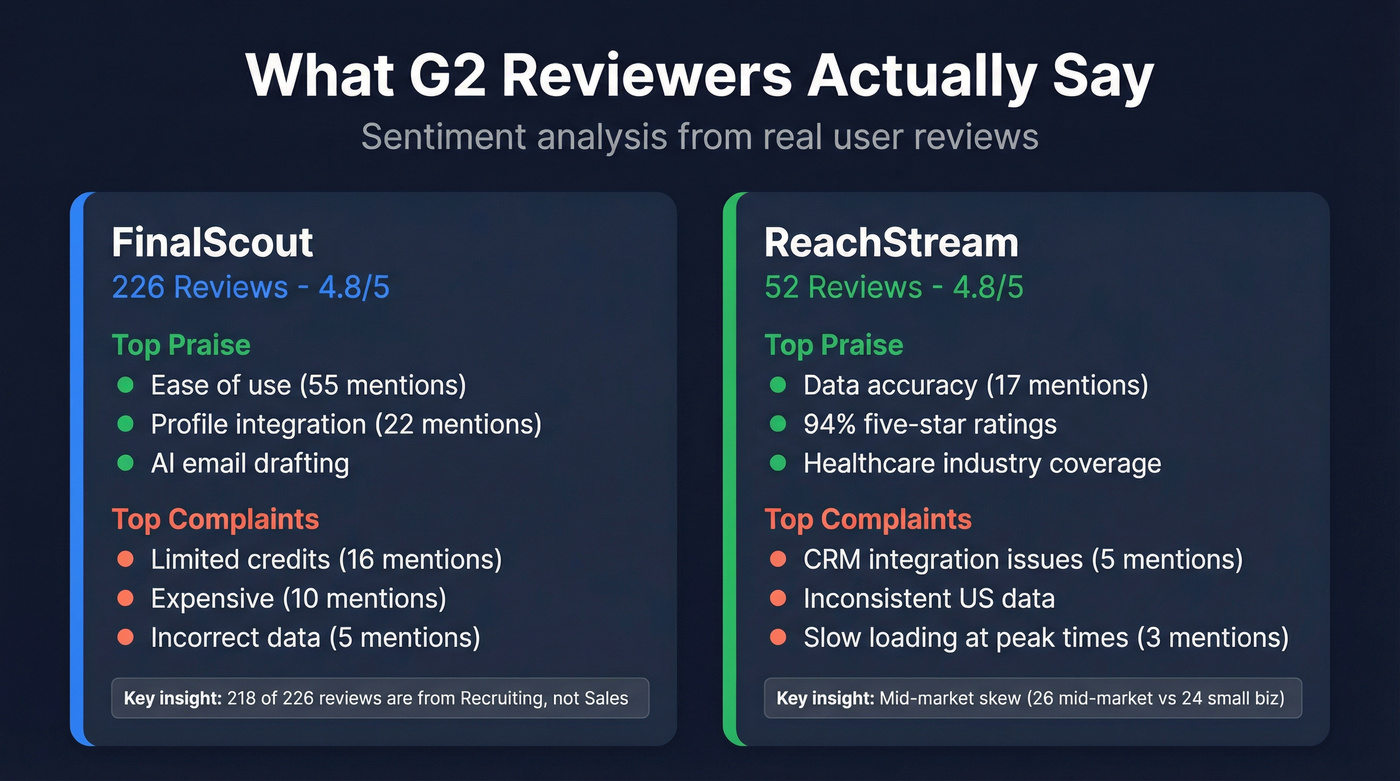
The complaints tell a sharper story. Limited credits show up 16 times - the single most common gripe. Ten reviewers call it expensive, and five flag incorrect data. The user base skews heavily small business (178 of 226 reviewers), which makes sense given the pricing tiers.
Profile-first workflow with AI email drafting? FinalScout. High export volumes or transparent pricing? Look elsewhere.
ReachStream (52 G2 Reviews)
Smaller review pool but 94% five-star. Data accuracy leads the praise (17 mentions), and one reviewer highlighted strong healthcare industry coverage. The buyer profile skews mid-market (26 mid-market vs 24 small business) - a genuinely different audience than FinalScout.
The red flags are consistent, though. CRM integration issues with HubSpot and Salesforce appear five times on G2 (see Connect Outreach Tool to CRM). One BDM gave 3.0/5, calling out inconsistent US data and outdated phone numbers. Slow loading during peak times comes up three times.
Standalone database prospecting with generous exports? ReachStream. Tight CRM sync required? Skip it.
Neither tool has meaningful Reddit discussion. Both fly under the radar of r/sales and r/SaaS, where teams tend to recommend Apollo or Lusha instead.
When to Pick Which
Let's be honest: if you're closing deals under $15k and running fewer than 500 cold emails per week, neither of these tools is wrong - but neither is particularly right either. They're solid niche picks for specific workflows, and you'll likely outgrow both within a year (see Sales Prospecting Techniques).
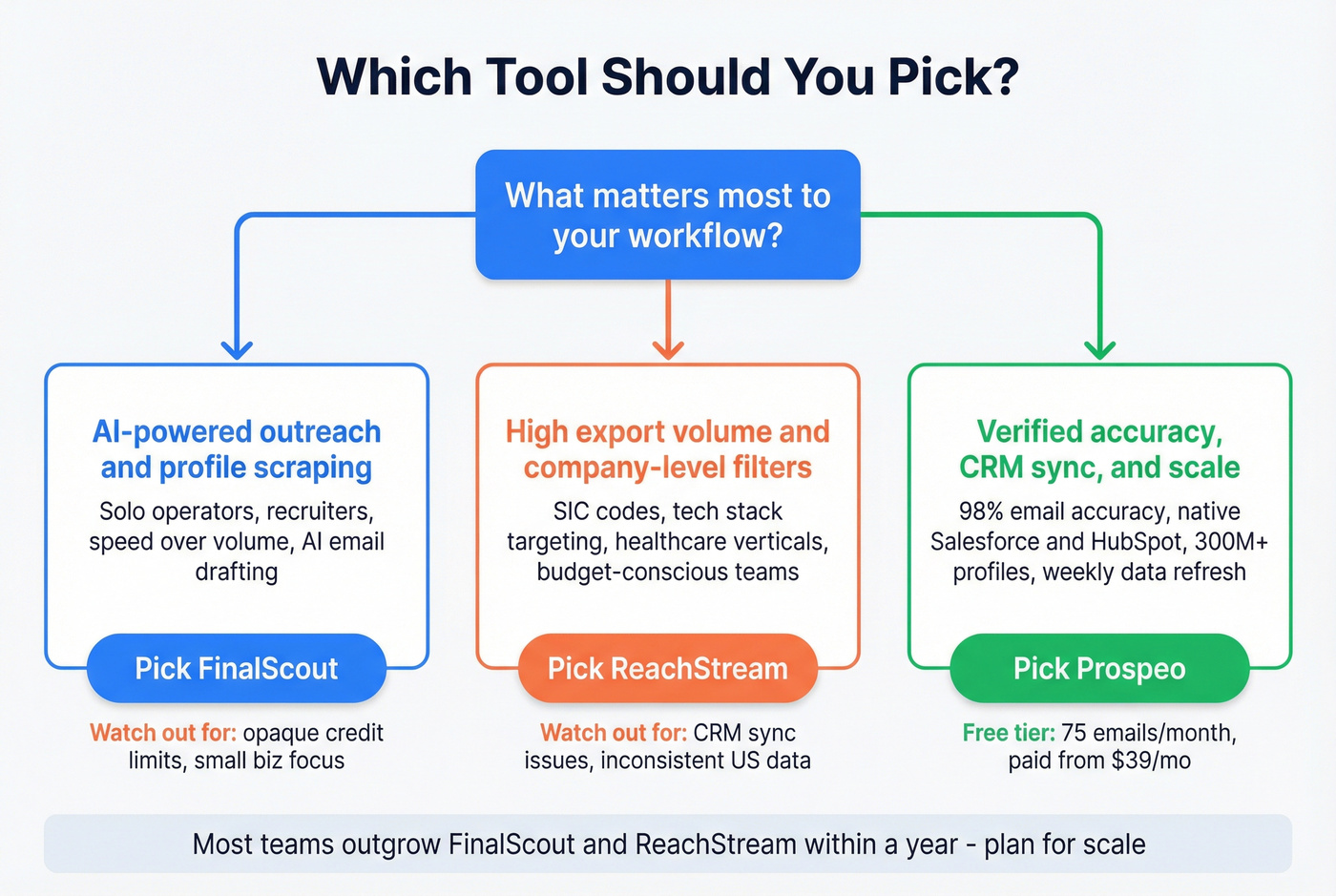
A 3-person SDR team sending 500 cold emails per week needs roughly 2,000 verified contacts per month. On ReachStream's Glacier plan ($39/mo), that's covered with room to spare. On FinalScout's Solo plan ($50/mo), you're guessing whether you'll hit a wall at 500 or 1,000 credits. That uncertainty alone would push us toward ReachStream for volume-driven outbound.
ReachStream's filters are genuinely deeper for account-based targeting, while FinalScout's AI email drafting saves real time if you're personalizing every message (see Personalized Outreach). The tradeoff is clear: volume and filtering vs. workflow speed and AI assistance.
FinalScout: Profile-first scraping, AI-written outreach, solo operators and recruiters who value speed over volume.
ReachStream: Database prospecting with company-level filters (SIC, tech stack, revenue), high export volumes at $39-99/mo, healthcare or niche vertical targeting.
A Stronger Alternative to Both
Credit opacity, CRM gaps, and accuracy concerns are the recurring pain points across both tools. Prospeo addresses all three. The database spans 300M+ professional profiles with 143M+ verified emails, and email accuracy hits 98% through a proprietary 5-step verification process (see Data Enrichment Services). Data refreshes every 7 days - neither FinalScout nor ReachStream publishes a refresh cadence at all.
Native Salesforce and HubSpot integrations work out of the box, which directly solves the exact pain point ReachStream users flag on G2. Beyond email, Prospeo includes 125M+ verified mobile numbers with a 30% pickup rate and 30+ search filters covering buyer intent, technographics, job changes, and headcount growth. The free tier gives you 75 emails/month, and paid plans start at $39/mo with no contracts.

ReachStream's cheapest export costs $0.008 but comes with outdated phone numbers and CRM headaches. Prospeo delivers 143M+ verified emails at ~$0.01 each, plus 125M+ mobile numbers with a 30% pickup rate - and 30+ filters that go deeper than SIC codes.
Teams book 35% more meetings than Apollo users. See why.
FAQ
How accurate are FinalScout and ReachStream emails?
FinalScout claims "up to 98%" deliverability - a different metric than verification rate. ReachStream claims 95%+ email accuracy. G2 reviews flag occasional bounces for both, with FinalScout picking up five mentions of incorrect data and ReachStream reviewers noting inconsistent US accuracy. In our testing, tools that don't publish their verification methodology tend to underperform their headline numbers.