

Financial Advisor Leads: What Actually Works (With Real Numbers)
A mid-size RIA we reviewed spent $48,000 on shared leads last year. They generated 1,200 "prospects" and closed exactly 9 clients - a 0.75% conversion rate and $5,333 per acquisition, for leads shared with multiple other advisors. Their referral program, which cost almost nothing, brought in 11 clients over the same period.
The gap between advisors who generate financial advisor leads effectively and those who burn cash on bad data is enormous. Advisors with a defined marketing strategy generate 168% more leads per month and onboard 50% more clients per year, according to a 2024 Broadridge study of 403 advisors. Yet the median advisor spends just $6,250/year on marketing - most of it on channels they can't measure.
The Quick Version
If you're spending money on leads and not tracking conversion rates by source, stop everything and fix that first. The overall average conversion rate is 4.3%. Top performers hit 23%. The difference isn't the lead source - it's the follow-up system.
Priority order:
- Systematize referrals - highest-converting channel, near-zero cost
- Launch seminars or webinars - education-based selling fills the pipeline for retirement and wealth management niches
- Build outbound with verified data - target your exact ICP, own the list, skip the bidding war
- Add a shared lead service only after the first three are running - volume play, not a quality play
How Many Leads Do You Actually Need?
Let's work through the math most advisors skip. The average advisor acquires 15 new clients per year at $609 per client. That's your baseline.
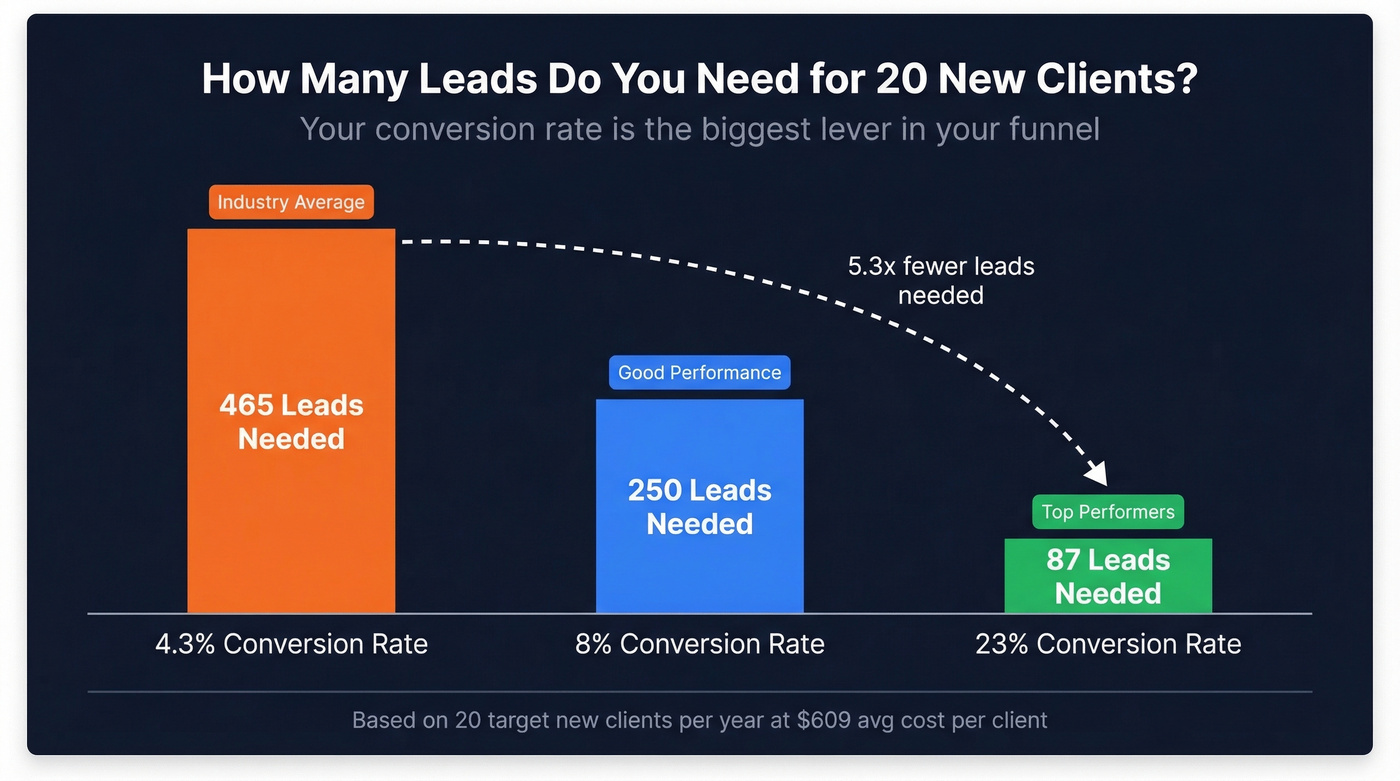
Say you want 20 new clients this year. At a 5% conversion rate - the middle of the 5-8% benchmark range - you need 400 qualified leads, roughly 33 per month. At $609 per client, your total marketing budget lands around $12,180, actually below the $15,908 average.
Now run the same math at 4.3% (the overall average): you'd need 465 leads. At 23% (top performer territory): just 87. The conversion rate is the single biggest lever in your funnel. Improving from 4.3% to 8% cuts your required lead volume nearly in half.
Here's the uncomfortable truth: most advisors don't know their conversion rate. They know how much they spent and roughly how many clients they added. That's not funnel math - that's guessing. Track leads by source, measure contact rate, appointment rate, and close rate separately, and you'll immediately see which channels deserve more budget (and which funnel metrics are actually moving).
Lead Channels Ranked by ROI
Client Referrals & Centers of Influence
Referrals are the highest-ROI channel for financial advisors. Full stop. Cerulli Associates finds that referrals from existing clients represent 56% of a firm's pipeline today. The cost per acquisition is essentially zero.
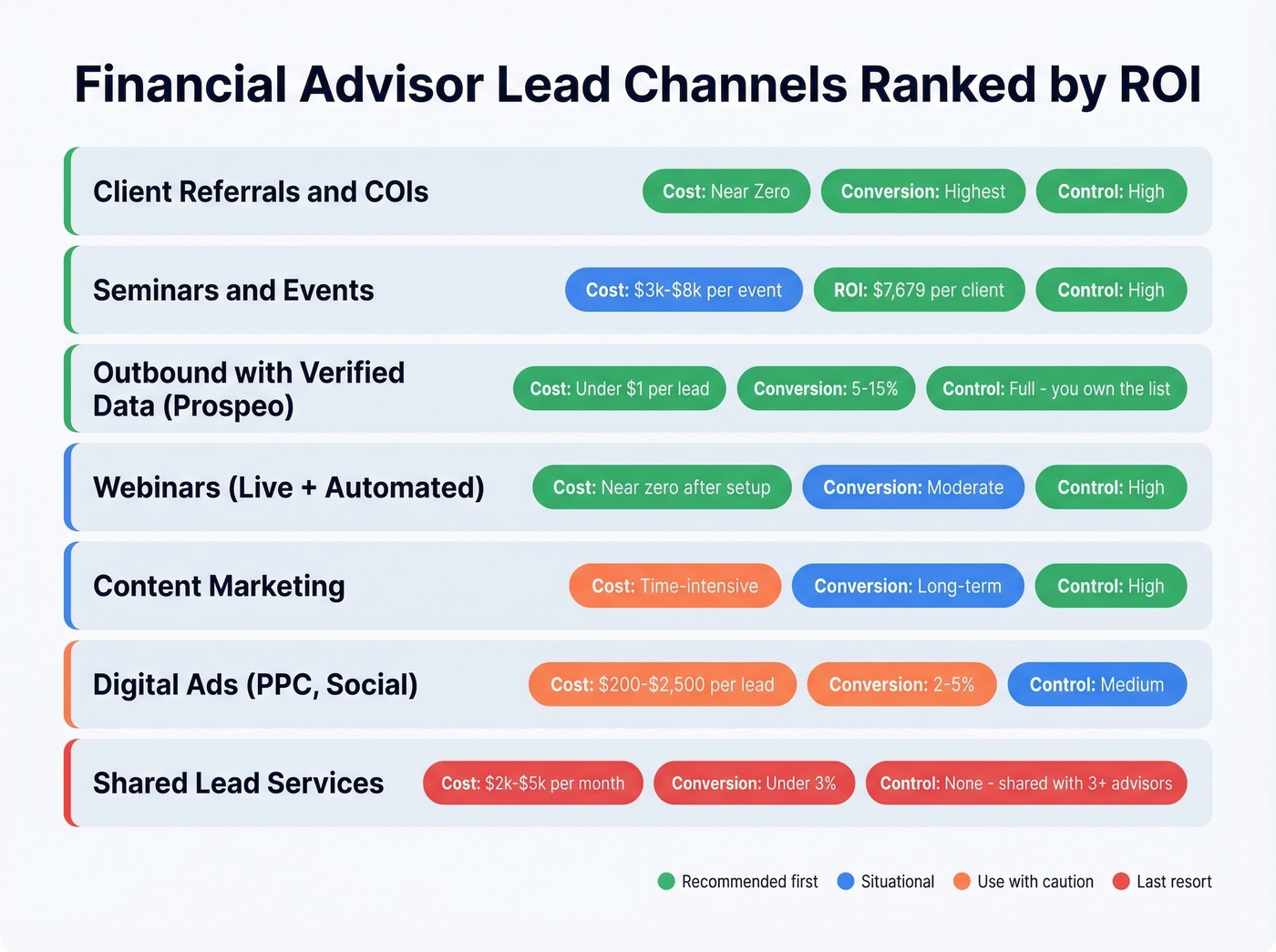
The problem? Most advisors leave referrals entirely to chance. They wait for clients to spontaneously mention them to friends. That's hope, not strategy. The advisors who generate consistent referral flow have a system: quarterly review meetings that end with a specific ask, COI partnerships with estate attorneys and CPAs that include reciprocal introductions, and a client experience worth talking about. If you're not systematically asking for referrals at defined touchpoints, you're leaving your best channel on autopilot.
Seminars & Events
Seminars are the second-best ROI channel. Kitces Research found seminars deliver $7,679 per new client in ROI - second only to client appreciation events at $10,000 per client.
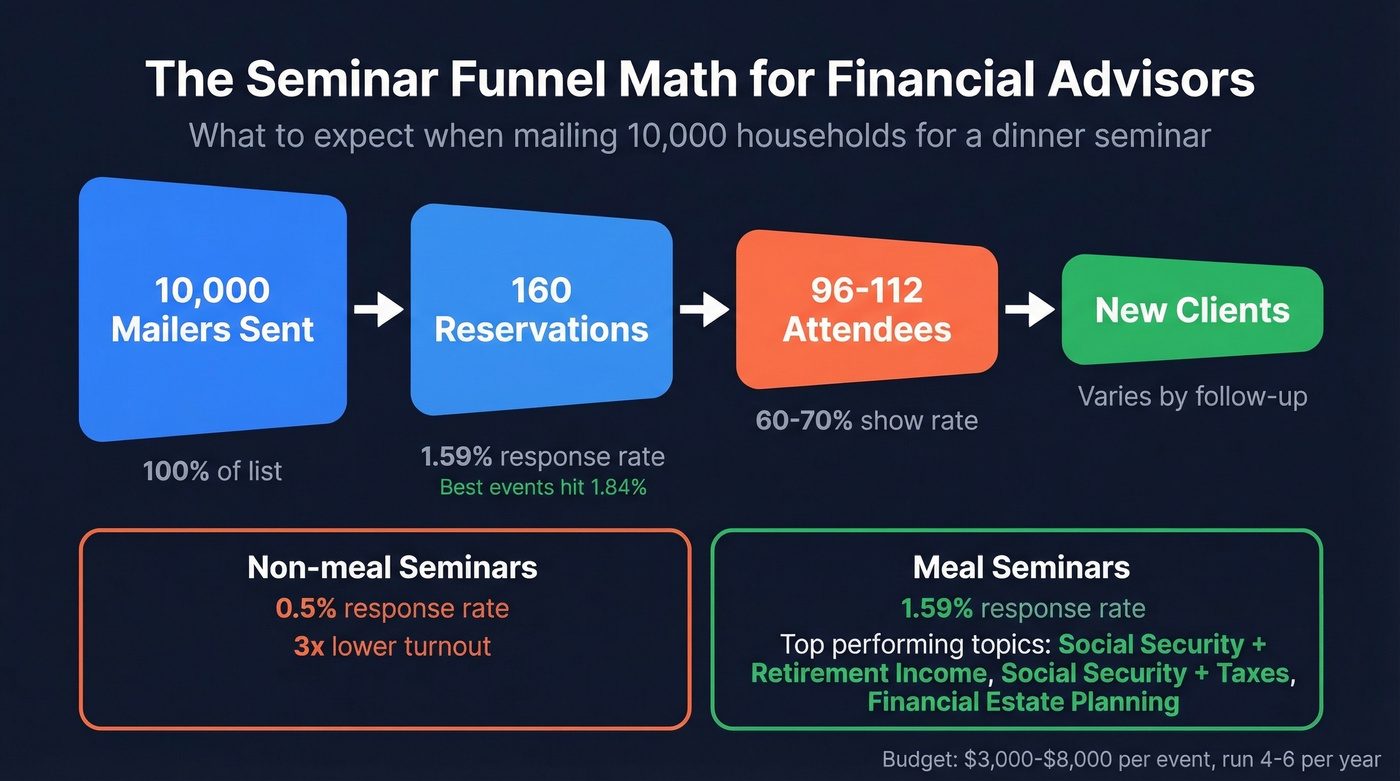
The direct mail math is worth knowing. Meal seminars average a 1.59% reservation response rate, with the best recent events hitting 1.84%. Non-meal seminars run about 0.5% - roughly 3x lower. If you're mailing 10,000 households for a dinner seminar, expect around 160 registrations. Factor in a 60-70% show rate and you're looking at 96-112 attendees per event.
The top-performing topics right now: Social Security + retirement income, Social Security + taxes, and financial estate planning. Not sexy, but they fill seats. Budget $3,000-$8,000 per event and plan to run at least 4-6 per year to build momentum.
Outbound Prospecting With Verified Data
Use this if: You want full control over who you target, you're comfortable with cold outreach, and you have a clear ICP - say, business owners with $2M+ liquid assets within 50 miles of your office (use an ideal customer profile so your targeting stays consistent).
Skip this if: You don't have a follow-up sequence built, your compliance team hasn't approved your outreach templates, or you're not willing to make 30+ dials per day.
Outbound is the lowest-cost, highest-control channel available. You build a list of people who match your ICP - no waiting for someone to fill out a marketplace form. The list is yours. Nobody else is calling the same prospect simultaneously.
What really sets outbound apart for fee-only and fiduciary advisors: you can layer in buyer intent data. Tracking 15,000 topics via Bombora lets you prioritize prospects actively researching retirement planning, estate planning, or business succession - not just people who match a demographic profile. That's trigger-based prospecting, and it's the approach high-net-worth platforms charge five figures for (more on how to track sales triggers if you want to operationalize it).

Content Marketing & Thought Leadership
Hot take: content marketing is overrated for most financial advisors. Not because it doesn't work - it does - but because it requires consistency that 80% of advisors can't sustain. Advisors spend just 2.1 hours per week on marketing, and 85% say finding time is a challenge.
A blog post every six weeks and an occasional social update isn't a content strategy. It's noise. Content works best as an amplifier - a seminar follow-up email linking to a relevant article, or a nurture sequence delivering genuine insight. If you can commit to weekly publishing, go for it. If you can't, spend that time on referrals and outbound instead.
Webinars (Live + Automated)
Webinars are seminars without the venue cost and the steak dinner. They scale better and the cost per event drops to near zero after you've built the presentation. The tradeoff is engagement - in-person events create stronger rapport and higher appointment-set rates.
For advisors in rural areas or those targeting a niche demographic, webinars are a smart proving ground. Record them, gate the replay, and you've got a lead magnet that works for months.
Digital Advertising (PPC, Social)
Paid ads can work, but the economics have gotten worse year over year. Landing page conversion rates for financial services run 2-5%, and cost-per-click for "financial advisor near me" sits at $10-$50+ in competitive metros. That's about $200-$2,500 per lead.
The advisors who make digital ads work treat them as a funnel entry point - drive traffic to a webinar registration or a free retirement assessment, then nurture with email. Running ads straight to a "schedule a call" page rarely converts cold traffic.
Shared Lead Services (SmartAsset, Ramsey, etc.)
SmartAsset is the 800-pound gorilla here, and results are polarizing. On the positive side, one advisor closed $5M AUM after $24k in total spend, and some have built entire practices on sustained $5k/month budgets. SmartAsset leads come with stated investable assets and financial goals, which is genuinely useful for qualification.
The downsides are real, though. Leads are shared with 3+ advisors, turning every opportunity into a speed-to-dial race. Contact rates under 10% and conversion rates under 2% are common. On r/CFP, fake email addresses and bad phone numbers are a recurring complaint - one advisor described SmartAsset as an "unmitigated disaster" costing thousands with zero ROI. Most advisors invest $2,000+ per month, and $5,000/month isn't uncommon. Budget for a long ramp before seeing meaningful results.
One counterintuitive tactic from the Reddit threads: calling older leads weeks later, after the initial blitz subsides, actually improved contact rates for some advisors. The prospect has stopped getting hammered and is more willing to pick up.
What Lead Services Cost in 2026
| Service | Pricing Model | ~Monthly Cost | Lead Type | Exclusive? | ~Conversion |
|---|---|---|---|---|---|
| SmartAsset | Per-lead | $2k-$5k | Shared (3+) | No | 2-3% |
| Prospeo | Per-credit | ~$39+/mo | Self-built | Yes | 5-15% |
| Ramsey SmartVestor | Territory fee | $1k-$3k | Shared territory | No | Varies |
| Zoe Financial | Rev-share | Varies | Matched | Semi | Varies |
| WiserAdvisor | Per-lead | $50-$200/lead | Shared | No | Varies |
| NAPFA | Membership | ~$200-$500/year | Directory | Yes | Varies |
| Seminar marketing | Per-event | $3k-$8k | Self-generated | Yes | Varies |
The more control you have over the list, the higher your conversion rate. Shared leads are a volume game. Self-built lists cost a fraction per contact and you're the only one calling.

You don't need 465 leads if the right 87 people already match your ICP. Prospeo's 30+ filters let you target by job title, company revenue, location, and headcount - then layer Bombora intent data across 15,000 topics to find prospects actively researching retirement planning or wealth management. 98% email accuracy means your outreach actually lands.
Own your prospect list instead of renting leads shared with five other advisors.
The Data Quality Problem Nobody Talks About
A recurring complaint about shared lead services on r/CFP isn't just the price - it's the data quality. Fake emails. Disconnected phone numbers. Prospects who never actually submitted a form. This isn't just a SmartAsset problem. It's structural to any lead service that prioritizes volume over verification.
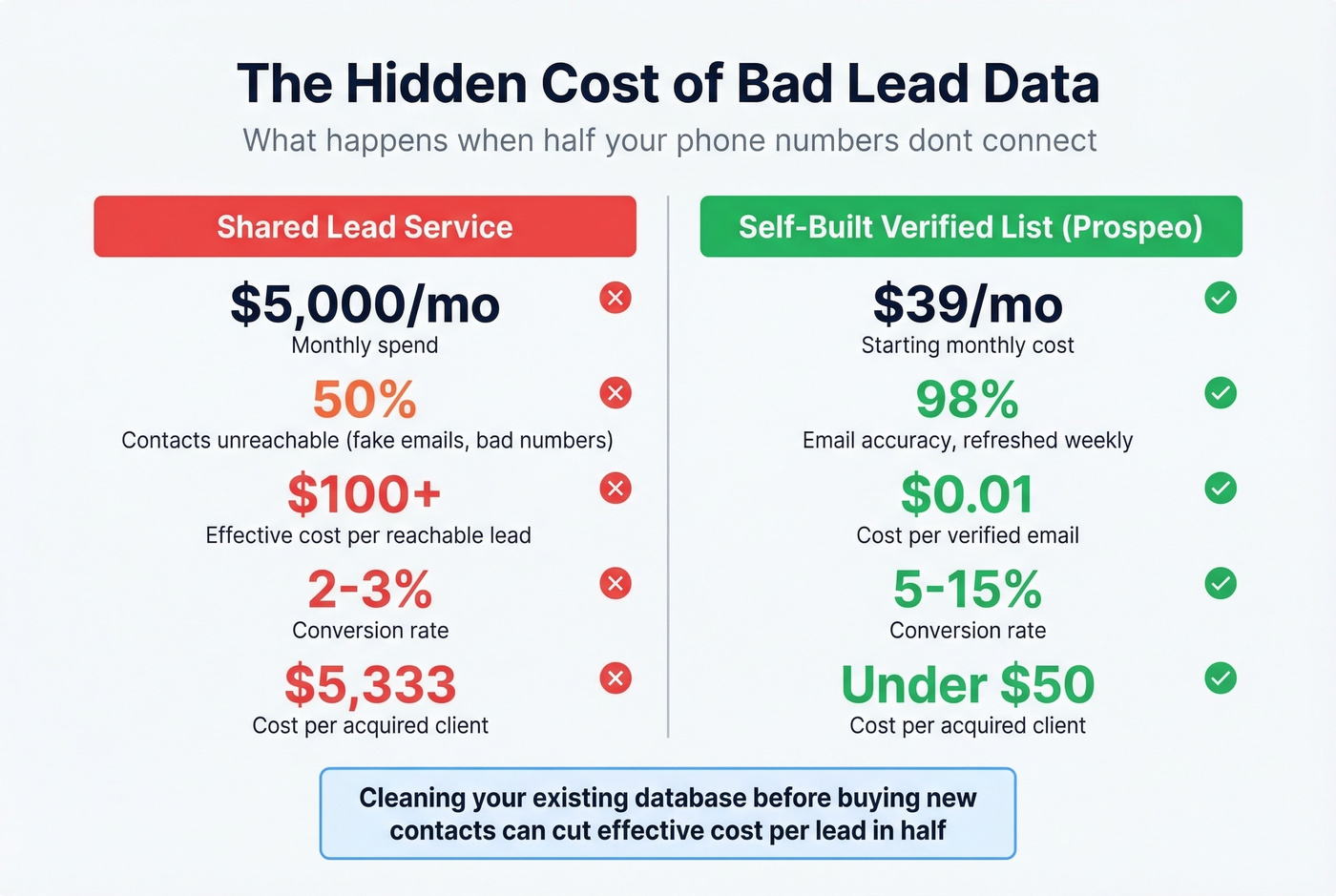
When you're paying $2,000-$5,000 per month and half the phone numbers don't connect, your effective cost per reachable lead doubles overnight. We've seen advisors cut their effective cost per lead in half just by cleaning their existing database before buying new contacts (see data enrichment services for options). Upload your current lead list as a CSV to Prospeo - you'll know within minutes which contacts are actually reachable. The free tier lets you test with 75 emails before committing anything.

At $0.01 per verified email, building a 400-lead list costs $4 - not the $609-per-client average advisors pay through shared services. Prospeo refreshes data every 7 days, so you're reaching prospects at current firms with current titles. Add 125M+ verified mobile numbers with a 30% pickup rate for direct dials that actually connect.
Cut your cost per lead from $609 to under a dollar with data you control.
Fix Your Follow-Up First
If your conversion rate is below 4%, buying more leads is pouring water into a leaky bucket.
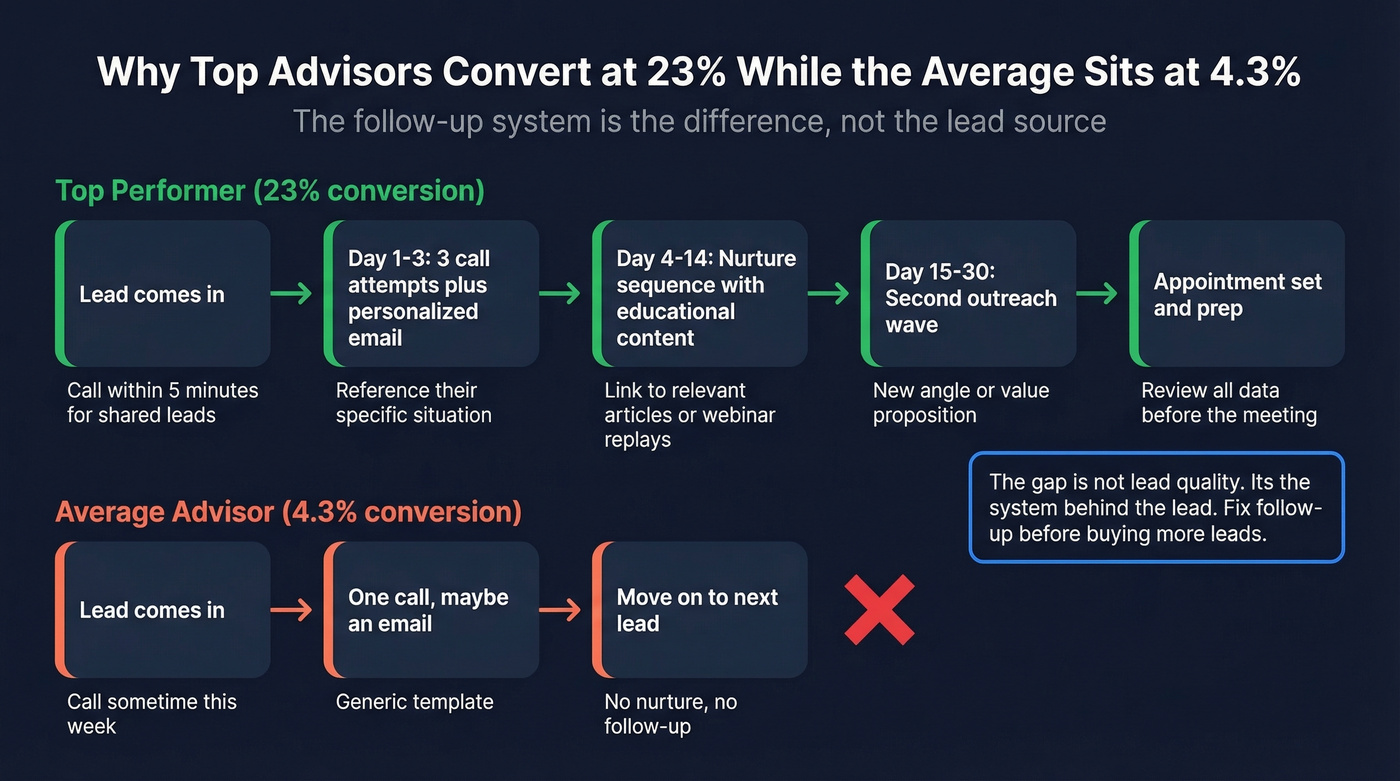
The gap between the 4.3% overall average and 23% top-performer conversion rate is almost entirely explained by follow-up systems, not lead quality. Speed-to-lead matters enormously for shared leads - the first advisor to call has a massive advantage. But speed alone isn't enough.
Build a nurture sequence that runs automatically: a 5-touch email sequence over 21 days, followed by a monthly newsletter, keeps you in front of prospects who aren't ready today but will be in 6 months. Use a CRM that tracks every interaction - Redtail and Wealthbox are built for advisors, and AI-assisted lead scoring tools like Catchlight are emerging to help prioritize which prospects deserve your time first. If you need copy you can deploy quickly, keep a set of sales follow-up templates and a simple sequence management process.
The advisors hitting 23% conversion aren't using magic lead sources. They're following up faster, more often, and with more relevant content than everyone else (the importance of follow-up in sales is the unsexy edge).
SEC Marketing Rule Compliance
The 2026 SEC enforcement environment has shifted from "do you understand the Marketing Rule?" to "can you prove you're following it?" For lead generation specifically, there are a few things that trip advisors up.
Testimonials and endorsements now include client reviews, Google ratings, and any third-party content you share. If a client leaves a review you promote, that's an endorsement under Rule 206(4)-1 and requires proper disclosure. Disclosure prominence is under scrutiny - burying disclosures in footnotes isn't sufficient. Lead-gen partners count as promoters - if SmartAsset or any marketing partner sends you leads, that arrangement requires disclosure as an endorsement. And recordkeeping across digital channels means retaining records showing when and how disclosures were delivered, in their original context.
If you're running any form of digital marketing, seminar follow-up emails, or working with lead vendors, audit your disclosure and recordkeeping practices now.
Financial Advisor Leads FAQ
How many leads does a financial advisor need per month?
At 5% conversion with a goal of 15 new clients per year, you need roughly 25 qualified leads per month. Top performers converting at 23% need fewer than 6. Track your actual conversion rate before setting a volume target - it's the single variable that changes everything.
What's a good conversion rate for advisor leads?
The overall average is 4.3%, and a solid benchmark is 5-8%. Top-performing advisors with strong follow-up systems hit 23%. Below 4%, improving your nurture process delivers more ROI than buying additional contacts.
Are SmartAsset leads worth the cost?
They can be - one advisor closed $5M in AUM after $24k in spend. But typical results are under 10% contact rate and 2-3% conversion. Budget $2k-$5k/month and expect a 3-6 month ramp before meaningful results. The consensus on r/CFP is mixed, with success heavily dependent on speed-to-dial and long-term nurture.
How can I verify lead data before calling?
Upload a CSV to Prospeo and get verification results in minutes. With 98% email accuracy and 125M+ verified mobile numbers, you'll know which contacts are actually reachable before spending a single hour dialing. Even cleaning your existing database before buying new leads will improve contact rates immediately.
How much should a financial advisor spend on marketing?
The average is $15,908/year, but the median is just $6,250. Advisors with a defined strategy onboard 50% more clients annually. Start with a documented plan and measurable goals - allocate budget to your two highest-converting channels first, then expand.