From Profile to Pipeline
You send 500 cold emails. Three people reply - two to say "wrong person." The problem isn't your copy or your cadence. It's that you haven't figured out how to find your ideal customer.
McKinsey research shows companies using customer behavioral insights outperform peers by 85% in sales growth and 25% in gross margin. That's not a rounding error. The gap between teams that grow and teams that grind starts right here, with knowing exactly who to talk to.
The Short Version
- Build a 3-layer ICP - firmographics, technographics, and intent signals. Industry and headcount alone won't cut it.
- Validate against profitability, not revenue. Your biggest customer isn't always your best one.
- Put it to work with a B2B database. Turn your ICP filters into a verified prospect list you can actually email today.
Teams with a defined ideal customer profile see up to 20% higher sales productivity and 15% shorter sales cycles. That lift comes from focus, not from working harder.
What an ICP Actually Is (And Isn't)
An ICP is a data-backed blueprint of the perfect-fit company for your product. It's not a buyer persona.
| ICP | Buyer Persona | |
|---|---|---|
| Scope | Company-level | Individual-level |
| Data | Firmographic, tech, intent | Demographics, goals, pain |
| Example | "B2B SaaS, 50-200 employees" | "VP Sales, 8 yrs experience" |
Your ICP tells you which companies to target. Your persona tells you which person inside that company to reach. You need both, but the ICP comes first - always.

A 3-layer ICP is only useful if you can act on it. Prospeo's 300M+ profiles are filterable by intent signals across 15,000 Bombora topics, technographics, headcount growth, and funding - the exact layers you just defined. Data refreshes every 7 days, not 6 weeks.
Go from ICP document to verified prospect list in under 30 minutes.
The 3-Layer ICP Framework
Most guides stop at firmographics. That's why most ICPs are useless. You need three layers stacked together, each one tightening your target until you're looking at best-fit customers that actually convert.
Layer 1 - Firmographics
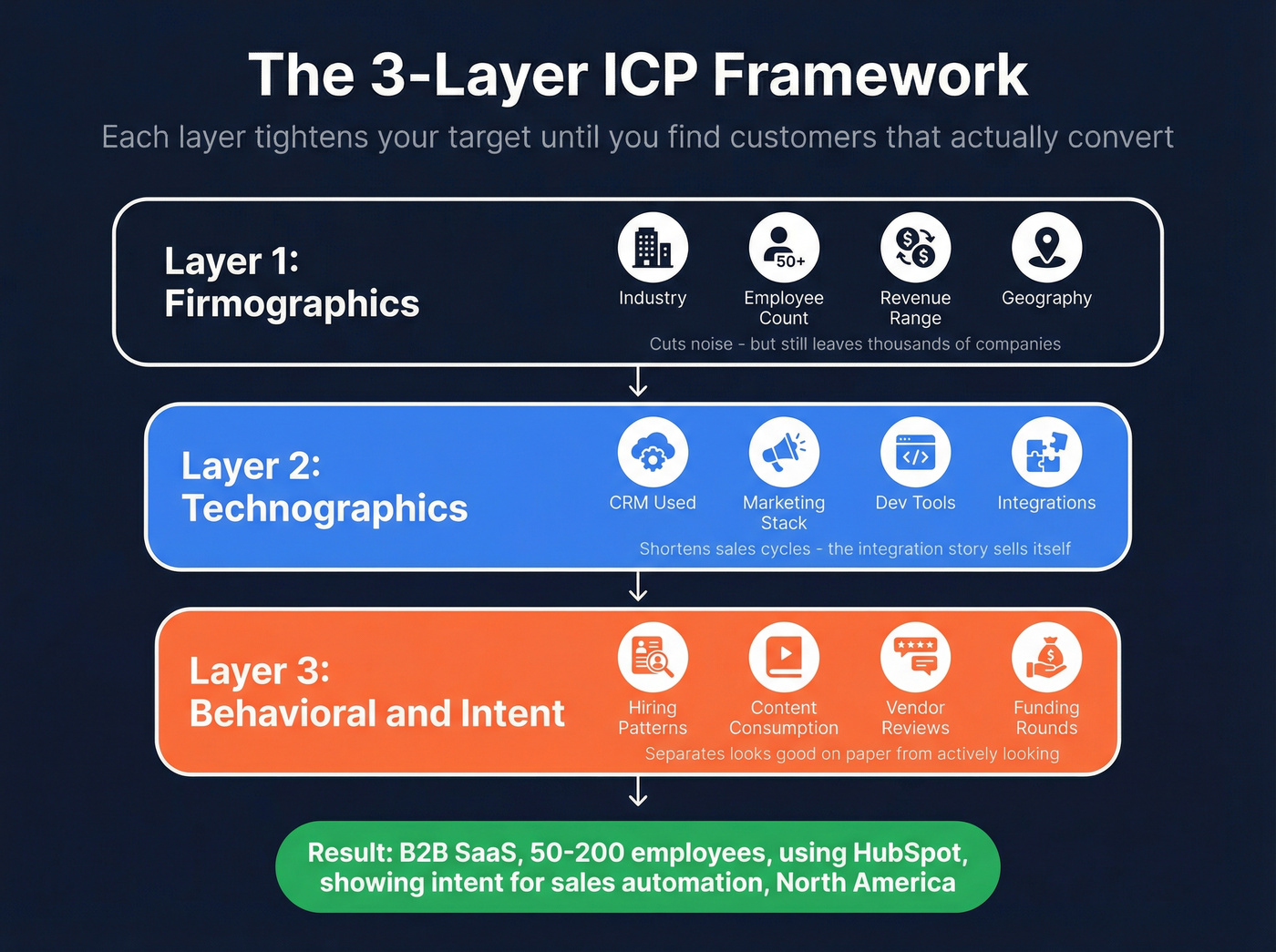
This is the foundation: industry, employee count, revenue range, geography. A solid filter might look like "B2B SaaS, 75-300 employees, $10M+ ARR, North America." For regulated industries, add compliance requirements like SOC 2 or HIPAA - it eliminates mismatches before the first call. Firmographics cut noise, but alone they still leave thousands of companies that'll never buy from you.
Layer 2 - Technographics
A company running a modern CRM and marketing automation stack is a fundamentally different buyer than one managing contacts in spreadsheets. If your product integrates with Salesforce, filter for Salesforce shops. You'll shorten your sales cycle and improve win rates because the integration story sells itself.
Layer 3 - Behavioral and Intent
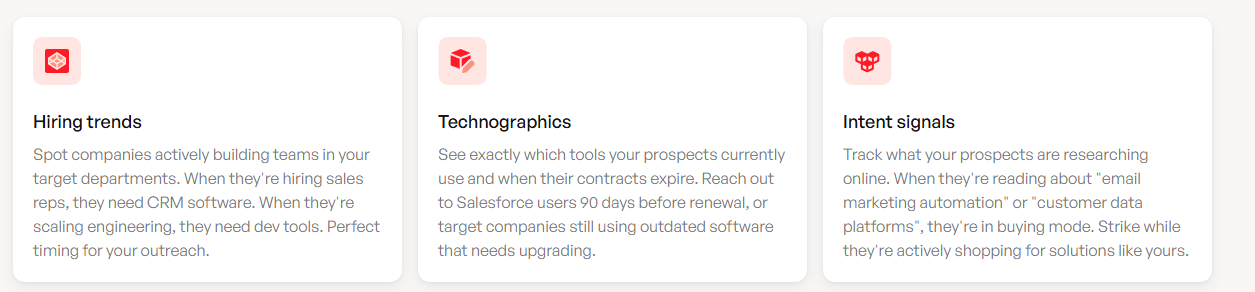
Here's where it gets interesting. This layer separates "looks good on paper" from "actively looking." Hiring patterns, content consumption, vendor review activity, funding rounds - these are buying signals. Bain research shows ICP-aligned companies grow revenue 2.5x faster than peers, and companies using first-party behavioral data report up to a 2.9x revenue improvement. Intent data is what makes alignment actionable. It helps you attract the right prospects instead of chasing everyone.
A complete ICP statement looks like this: "B2B SaaS companies, 50-200 employees, using HubSpot, showing intent for 'sales automation,' based in North America." One sentence. That's all you need.
Validate With Profitability, Not Revenue
Your biggest accounts aren't always your best accounts. We've seen teams chase enterprise logos that eat 80% of support resources while contributing 20% of margin. It's a trap that feels like winning until you look at the numbers.
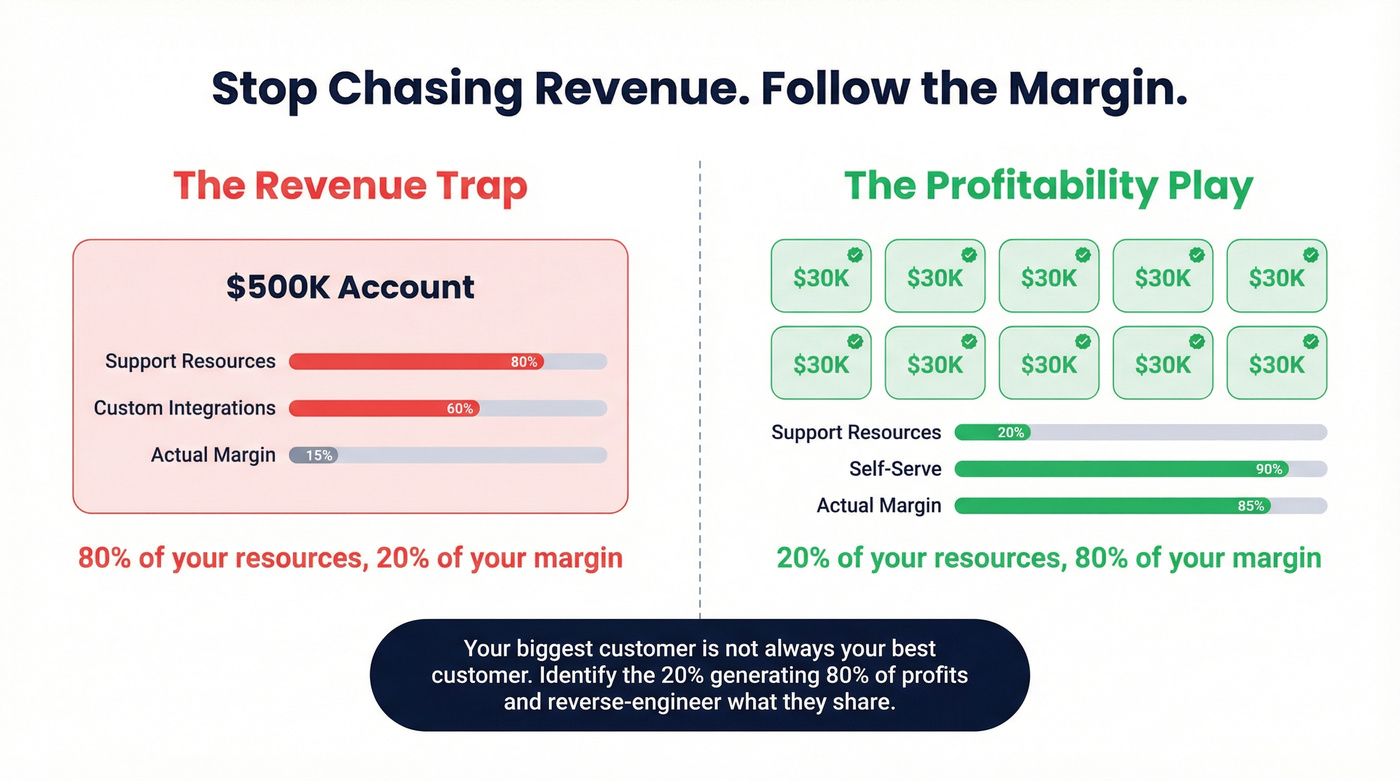
Identify the 20% of customers generating 80% of profits and reverse-engineer what they have in common. Cross-reference your ICP against NPS scores - high-revenue accounts with low NPS are churn risks, not ideal customers. Follow the margin, not the logo.
A specialized medical practice learned this the hard way: they'd been marketing to patients (users) when referring physicians (deciders) controlled the pipeline. Once they shifted focus to deciders, they hit 40% YoY growth for three consecutive years. The product didn't change. The targeting did.
Common ICP Mistakes
Too broad. Firmographics only gives you a list of thousands. Without technographic and intent layers, you're back to spray-and-pray. The consensus on r/sales is that "wrong ICP" is one of the top reasons pipeline stalls - and we'd agree.
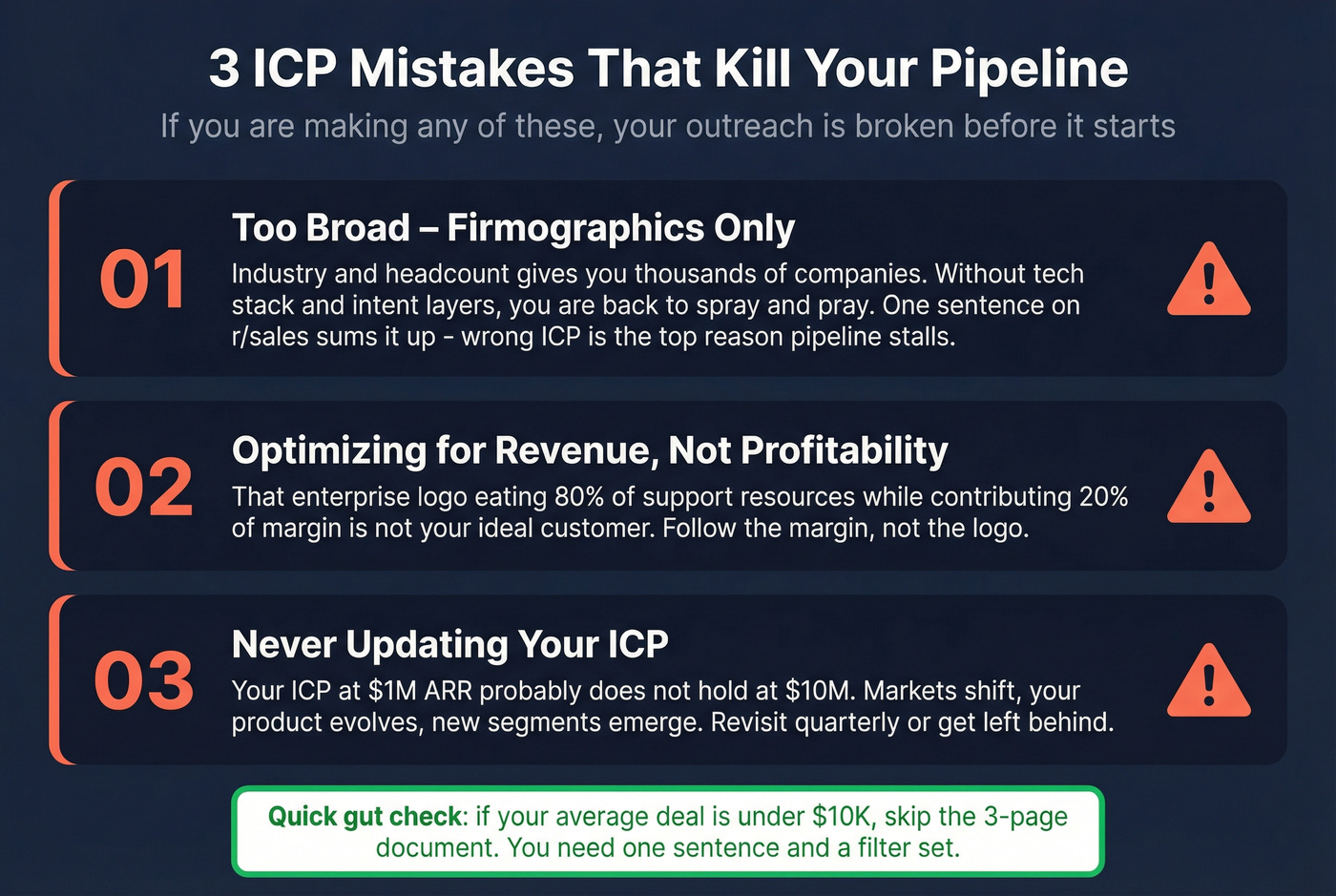
Optimizing for revenue, not profitability. That $500K account requiring a dedicated CSM and custom integrations is often less profitable than ten $30K accounts that self-serve.
Never updating. Your ICP at $1M ARR probably doesn't hold at $10M. Revisit quarterly (and document it in an internal QBR).
Let's be honest: if your average deal size is under $10K, you don't need a 3-page ICP document. You need one sentence and a filter set.
How to Actually Find These People
Most ICP guides end at "create a persona document" and never mention how to locate these companies in the real world. That's the gap. Once you've defined your target customer, the next step is translating that profile into a live, searchable filter set inside a sales prospecting platform.
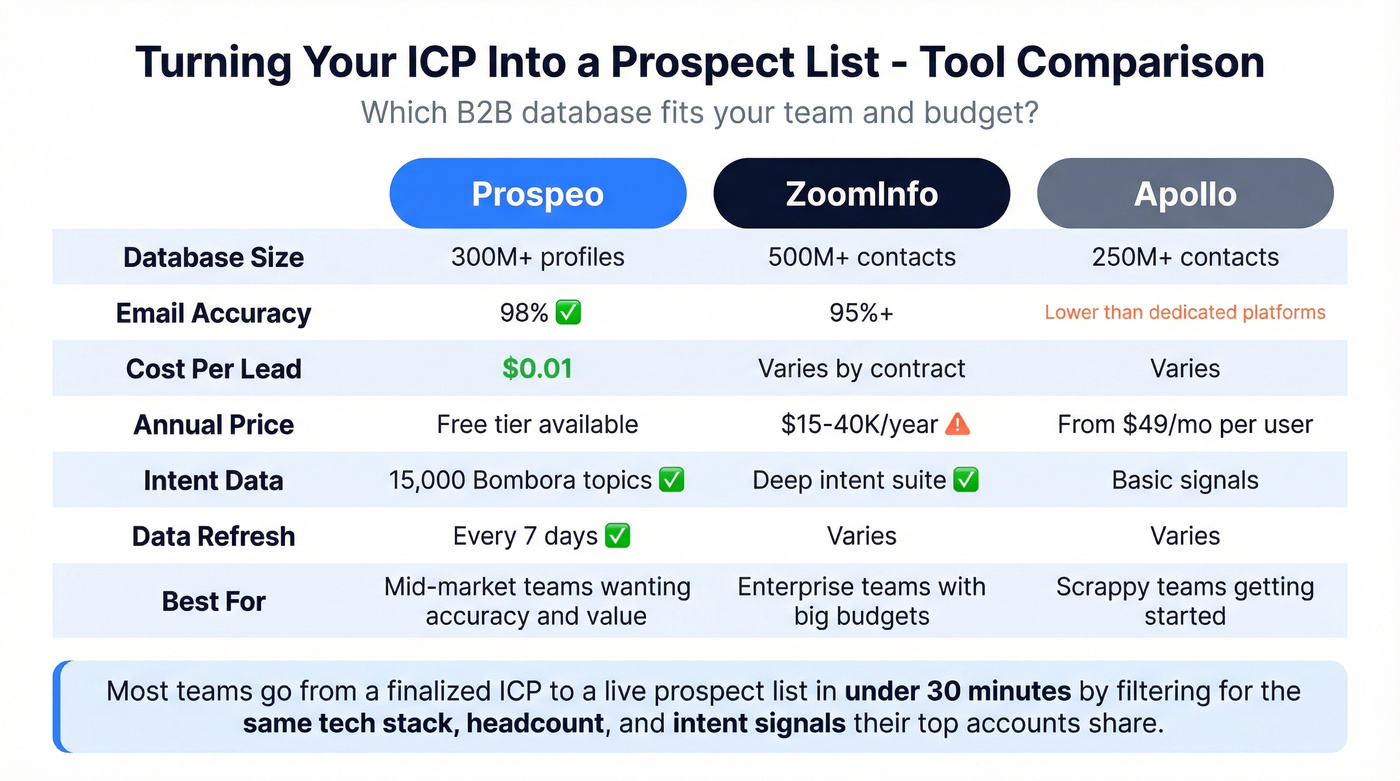
Prospeo is where we'd start. Its 300M+ professional profiles are searchable across 30+ filters - buyer intent via 15,000 Bombora topics, technographics, headcount growth, funding, job changes, and more. Data refreshes every 7 days, email accuracy runs 98%, and you're paying roughly $0.01 per lead. A free tier lets you test before committing anything. In our experience, most teams go from a finalized ICP to a live prospect list in under 30 minutes by filtering for the same tech stack, headcount range, and intent signals their top accounts share.
ZoomInfo is the enterprise default - 500M+ B2B contacts, deep intent data, the full GTM suite. But a mid-market contract runs $15-40K/year, and most teams use maybe 20% of the platform. Skip this if you just need accurate contact data without the enterprise overhead.
Apollo offers a solid free tier and combines prospecting with sequencing. Good for scrappy teams getting started, though email accuracy typically won't match what you'd get from a dedicated data platform. Paid plans start around $49/mo per user. If you're building sequences, pair it with a deliverability-first outbound email campaign process.
Every filter in your ICP framework - industry, tech stack, buyer intent, headcount - maps directly to Prospeo's 30+ search filters. At $0.01 per email with 98% accuracy, you stop paying for bounces and start filling pipeline with best-fit accounts.
Stop defining ideal customers. Start emailing them.
FAQ
How many customers do I need before building an ICP?
Even 10-15 profitable customers is enough to spot patterns. Supplement with competitor case studies and intent data if your sample is small. A directional ICP beats no ICP every time.
What's the difference between an ICP and a buyer persona?
An ICP describes the ideal company at the account level - industry, size, tech stack, buying signals. A buyer persona describes the decision-maker inside that company. Build the ICP first, then layer personas on top to reach the right people.
What's the fastest way to find prospects matching my ICP?
Use a B2B database with advanced filters. Search by industry, headcount, tech stack, and buyer intent, then export verified emails. Most teams go from ICP to live prospect list in under 30 minutes.
How do I find my ideal client if I'm just starting out?
Study your competitors' case studies and review sites to identify which customer segments get the most value from similar products. Combine that research with intent data from a prospecting tool, and you'll have a working ICP even before your first ten closed deals. Start with a hypothesis, test it against real outreach data, and refine from there.