

The Only First Cold Email Template You Need in 2026
Every ranking page dumps 17 to 55 templates on you. That's the problem - you don't need options, you need one first cold email template that works and the infrastructure to make it land.
Your first email is statistically your best shot. 58% of all replies come from the first touch. Most people blow it on infrastructure mistakes, not bad copy. We've watched teams rewrite subject lines for weeks when the real issue was an 11% bounce rate torching their domain.
Here's the thing: the template itself is four sentences. Everything else is about making sure those four sentences actually reach an inbox.
The Four-Sentence Framework:
- Who you are - one line, tied to their world
- How you help - specific outcome, not features
- Why they should believe you - proof point
- What happens next - one soft CTA
Under 80 words. Tuesday through Thursday, 8-11 AM recipient timezone. Verify every email before sending.
2026 Cold Email Benchmarks
Based on billions of tracked sends, here's where the bar sits:
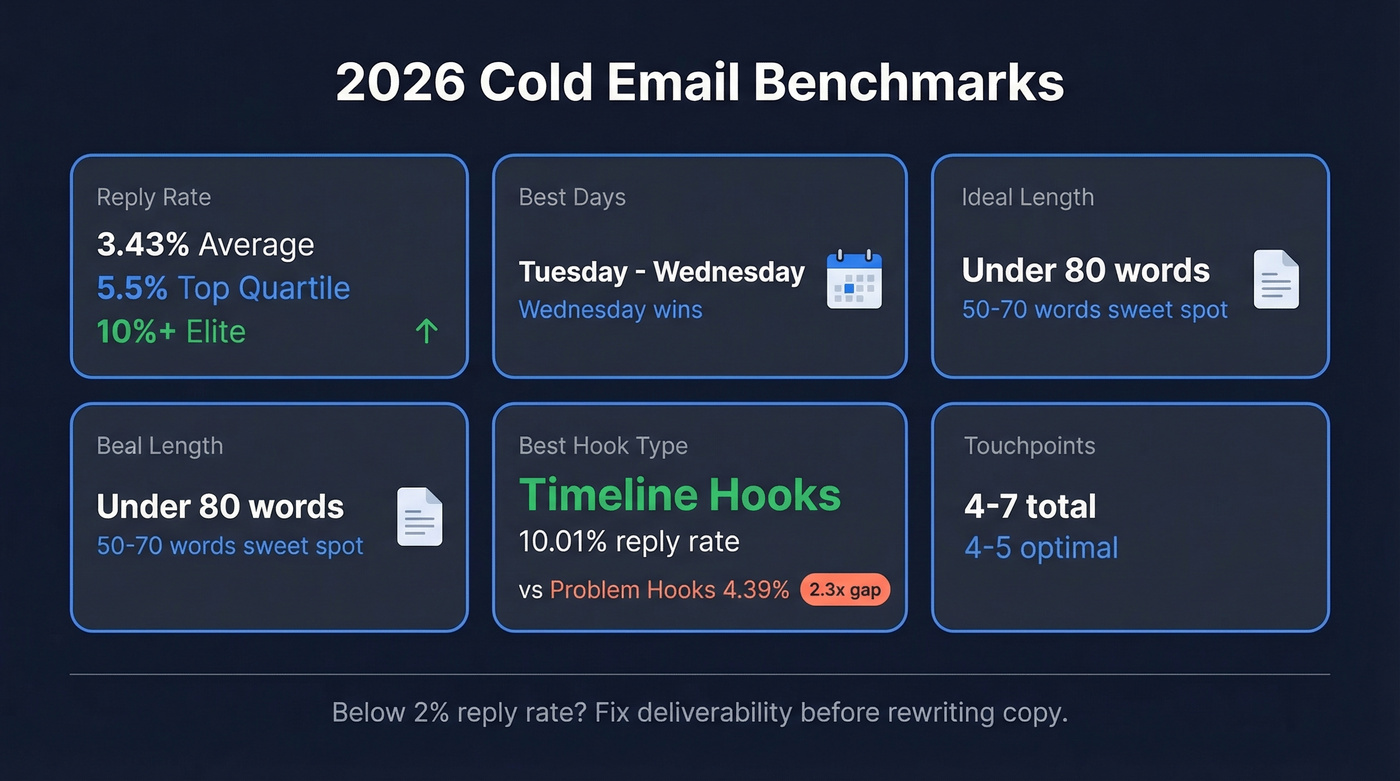
| Metric | Average | Top Quartile | Elite |
|---|---|---|---|
| Reply rate | 3.43% | 5.5% | 10%+ |
| Best days | Tue-Wed | Tue-Wed | Wednesday |
| Ideal length | <80 words | <80 words | 50-70 words |
| Best hook type | Timeline (10.01%) | Timeline | Timeline |
| Touchpoints | 4-7 | 4-5 | 4-5 |
The widely accepted range is 1-5%, with personalized emails pulling 2x+ the replies of generic ones. If you're below 2%, fix deliverability before rewriting copy.
The hook data is the most underused insight here. Timeline-based hooks - referencing a funding round, a new hire, a product launch - pull a 10.01% reply rate versus 4.39% for problem hooks. That's a 2.3x gap. "Problem hooks" start with "Struggling with X?" - which is exactly what every other cold email in your prospect's inbox sounds like. Timeline hooks reference something happening now, and they crush.
The Template That Lands Replies
Your prospect decides in 2.7 seconds whether to read or delete. No preamble survives that window.
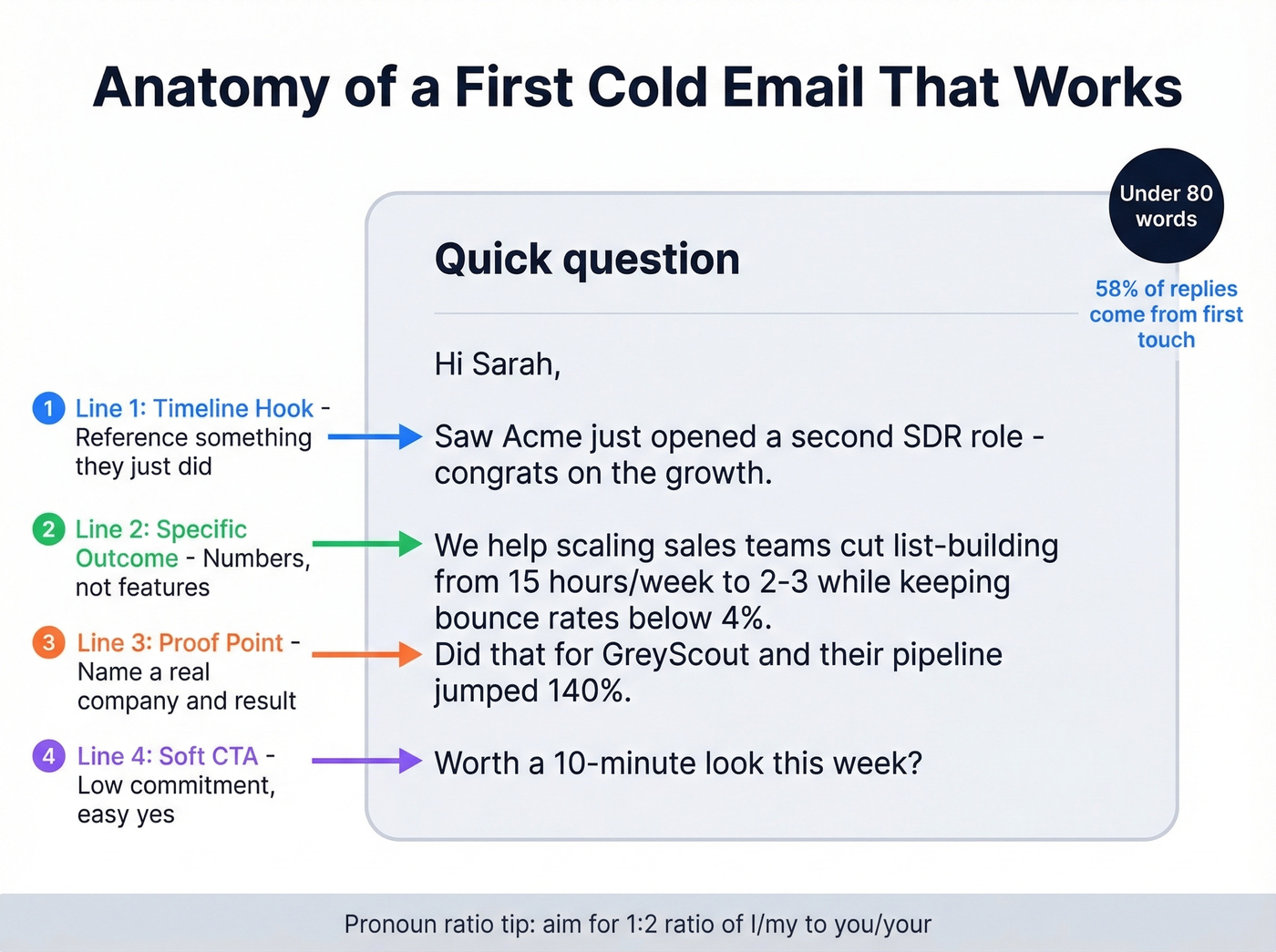
Subject line: Keep it 2-5 words, six or seven max. "Quick question" pulled 39% opens in one practitioner's campaign - 39% versus under 19% for "Partnership opportunity." Your subject line is the first filter, so bland or clickbait subjects kill you before the body loads. If you want more options, steal from these email subject line examples.
Body:
Hi {{firstName}},
Saw {{company}} just opened a second SDR role - congrats on the growth. We help scaling sales teams cut list-building from 15 hours/week to 2-3 while keeping bounce rates below 4%. Did that for GreyScout and their pipeline jumped 140%.
Worth a 10-minute look this week?
One timeline hook, one outcome, one proof point, one CTA. A controlled test showed 95-word emails outperformed 170-word emails by 5.81% in CTR. Shorter wins. Stay under 80. If you want to systematize this, use an AI cold email outreach workflow.
Hot take: If you're selling deals under $10k, you probably don't need a multi-touch 14-email sequence. Nail this single template, fix your infrastructure, and you'll outperform teams running elaborate cadences on dirty data.
One more tip worth stealing: aim for a 1:2 ratio of I/my to you/your pronouns. The email above hits it naturally. If your draft is full of "I" and "we," flip sentences to lead with the prospect's world. (If you need help tightening language, this email copywriting guide is a solid reference.)

That template above works - but only if it reaches an inbox. Meritt cut their bounce rate from 35% to under 4% with Prospeo's 5-step verification and tripled their pipeline to $300K/week. At $0.01 per email and 98% accuracy, verifying your list costs less than one bounced send costs your domain.
Fix your data before you fix your copy. Start verifying free.
Three Scenario Variations
Sales Lead Introduction
Hi {{firstName}},
Noticed {{company}} shipped a new pricing page last week - looks like you're moving upmarket. We helped [similar company] increase outbound pipeline 180% in 90 days by fixing their contact data layer. Their AE-sourced opps went from ~50/month to 200+.
Open to a quick call Thursday?
When to use: Your prospect's company just did something visible - a product launch, a new integration, an expansion. The timeline hook here is the pricing page change, which signals strategic intent. This variation often pulls the highest reply rates of the three because it proves you actually looked. If you’re still building your targeting, start with an ideal customer profile.
Agency or Services
Hi {{firstName}},
Your Google Ads account is spending on 14 keywords that haven't converted in 6 months (I checked). We run free 15-minute audits for {{industry}} agencies - last one saved the client $4,200/month in wasted spend.
Want me to send the audit?
This one uses a pain hook deliberately. When you have specific data about their account, specificity beats the timeline approach. The "I checked" parenthetical does the heavy lifting: it signals effort, not a mass blast.
Job Seeker or Networking
Hi {{firstName}},
{{mutualConnection}} mentioned you're building out the RevOps function at {{company}}. I've spent the last 3 years doing exactly that at two Series B companies and just wrapped a migration from HubSpot to Salesforce.
Would love to hear how you're thinking about the role - coffee sometime next week?
No sell, no CTA disguised as a question. The mutual connection does the trust-building that a case study does in the other templates. If you don't have a mutual connection, swap in a specific observation about their company's growth stage - it works almost as well.
Before You Hit Send
Templates don't fail. Infrastructure does.
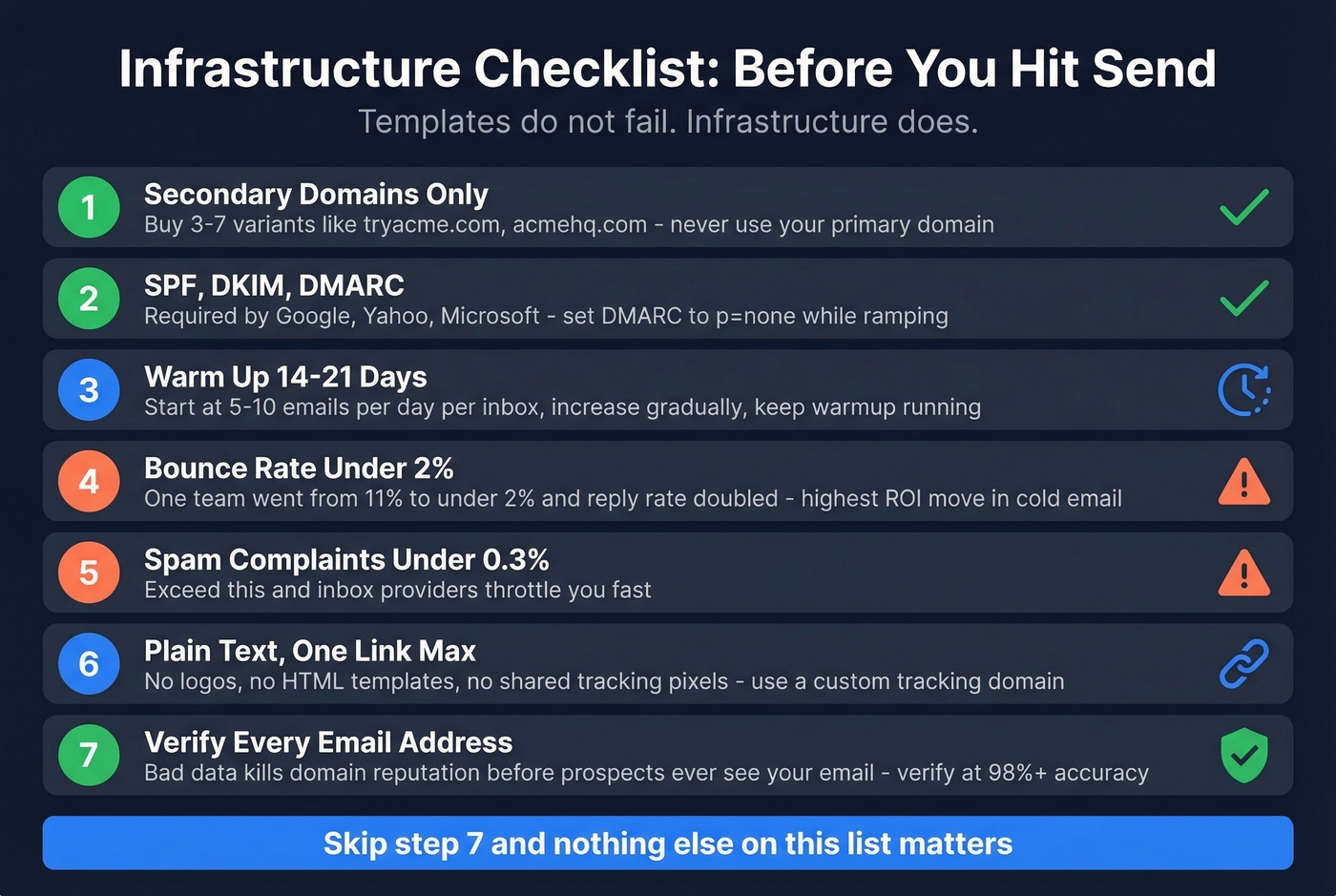
The consensus on r/coldemail is blunt: "greatest cold email ever written - if your infrastructure is broken nobody will ever read it." Let's break down what "not broken" actually looks like.
Secondary domains only. Never send cold email from your primary domain. Buy 3-7 variants (tryacme.com, acmehq.com) and spread volume across them.
SPF, DKIM, DMARC. Google, Yahoo, and Microsoft require all three for bulk senders. Set DMARC to p=none with reporting while you ramp. (If you want the technical nuance, read up on DMARC alignment.)
Warm up 14-21 days. Start at 5-10 emails/day per inbox and increase gradually. Keep warmup running between campaigns. If you need tooling, compare unlimited email warmup tools.
Bounce rate under 2%. One team went from 11% bounce to under 2% and watched their reply rate double. We've seen the same pattern repeatedly - fixing bounce rate is the single highest-ROI move in cold email. Meritt went from a 35% bounce rate to under 4% after switching to Prospeo's 5-step verification, which catches spam traps, honeypots, and catch-all domains at 98% accuracy. If you want the deeper breakdown, see email bounce rate.
Spam complaints under 0.3%. Exceed this and inbox providers throttle you fast.
Plain text, one link max. No logos, no HTML templates, no tracking pixels from shared domains. Use a custom tracking domain to isolate your reputation. For setup details, use this tracking domain guide.
Verify every address before sending. Bad data kills domain reputation before your prospect ever sees the email. Skip this step and nothing else in this article matters. If you’re evaluating vendors, start with these data enrichment services.
You just built a killer first cold email. Now you need verified contacts to send it to. Prospeo's database gives you 300M+ profiles with 30+ filters - buyer intent, job changes, headcount growth - so your timeline hooks write themselves. Every email is verified at 98% accuracy, refreshed every 7 days, and costs about $0.01.
Find the right prospects and never bounce again.
What Comes After the First Touch
42% of replies come from follow-ups. The sweet spot is 4-7 touchpoints spaced 3-4 days apart. A "3-7-7" cadence - Day 0, Day 3, Day 10, Day 17 - captures 93% of replies by Day 10. If you want plug-and-play options, use these sales follow-up templates.
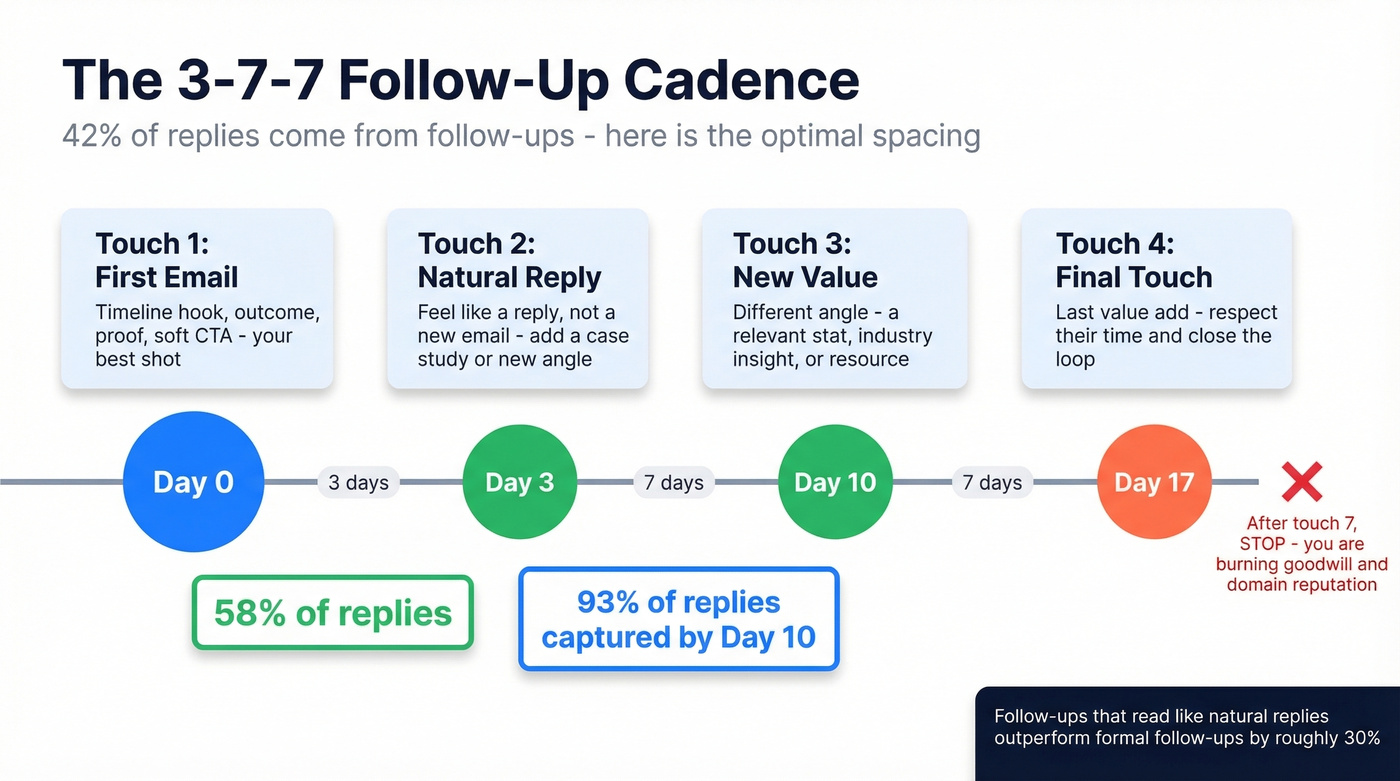
Your second touch should feel like a reply, not a new email. Follow-ups that read like natural replies outperform formal follow-ups by roughly 30%. Each subsequent touch adds new value - a case study, a relevant stat, a different angle. Never just "checking in." (More on timing: when should you follow up on an email.)
After touch 7, stop. You're burning goodwill and domain reputation at that point, and no amount of clever copy fixes that math.
FAQ
What should a first cold email template include?
Four elements: a timeline hook tied to their company, one specific outcome you deliver, a proof point, and a single soft CTA. Keep the total body under 80 words - 95-word emails outperform 170-word emails by 5.81% in CTR.
How do I write a cold email introduction that gets replies?
Lead with the prospect, not with you. Open with a timeline hook - something their company did recently - then connect it to a specific outcome you've delivered for a similar business. Skip "I'm reaching out because..." entirely. It wastes the 2.7-second decision window. One proof point and a soft CTA close it out.
What's a good reply rate for cold email in 2026?
The benchmark is 3.43%. Top-quartile campaigns hit 5.5%, and elite senders exceed 10%. Below 2% means your deliverability needs fixing, not your copy.
How do I stop cold emails from going to spam?
Configure SPF, DKIM, and DMARC on every sending domain. Warm up for 14-21 days. Keep bounce rates under 2% by verifying emails before sending - a 5-step verification process that catches spam traps and honeypots makes a real difference here. Send plain text with one link max and a custom tracking domain.
What's the difference between an introduction email and a follow-up?
An introduction email carries the full weight of first impressions - it needs a hook, a value prop, proof, and a CTA in under 80 words. Follow-ups assume the prospect saw your opener and add a new angle: a case study, a stat, or a different benefit. The introduction does the heavy lifting; follow-ups keep the conversation alive.