

Follow Up Email After a Week: Templates + Timing
It's Wednesday. Your interview was last Wednesday. The hiring manager said "we'll be in touch early next week." Your inbox is empty, and you're refreshing it every 20 minutes like it owes you money.
Take a breath. Research from Careery analyzing 1,000+ job seekers found the median response time is 6.7 days, and 75% of responses arrive within 8 days. One week of silence isn't a rejection - it's normal. Right now is the perfect moment to send a follow up email after a week of waiting.
Why One Week Is the Sweet Spot
Here's the cadence that works:
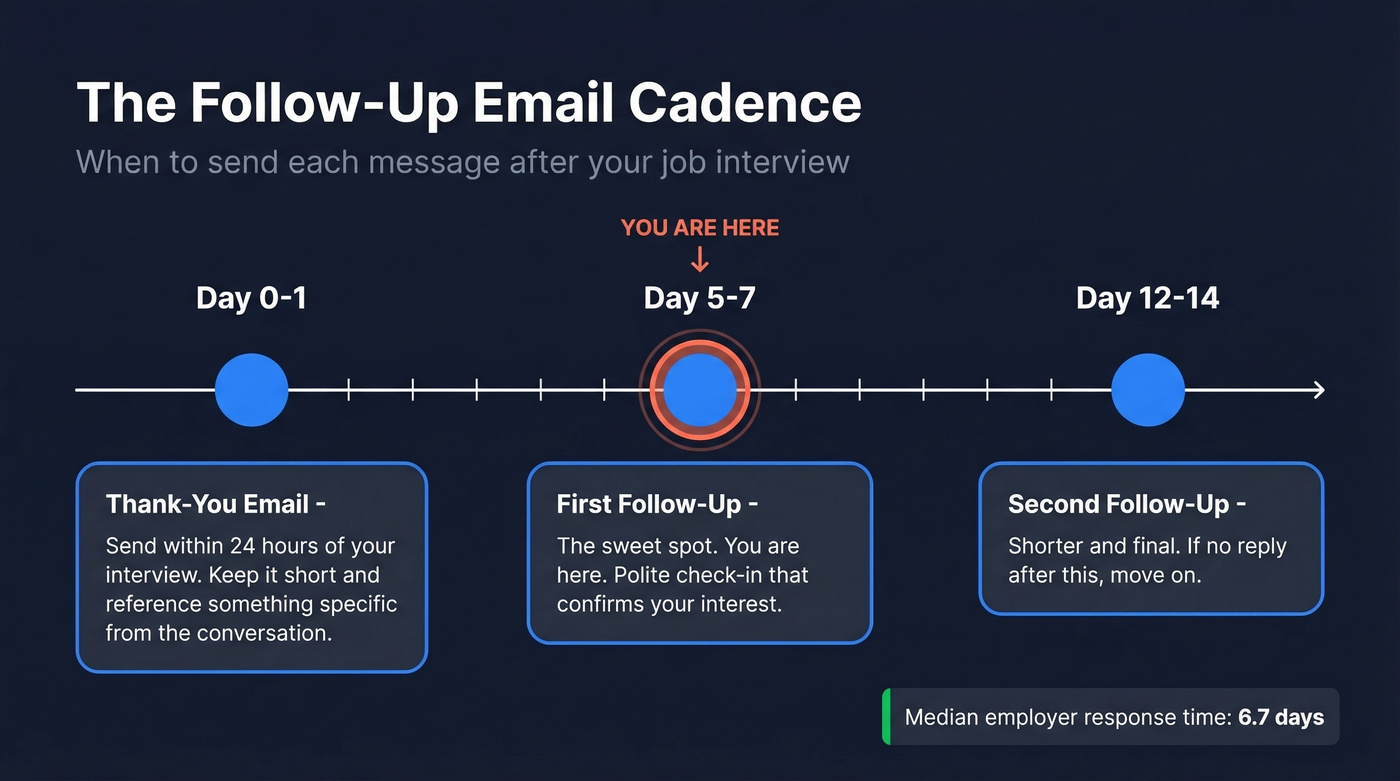
- Day 0-1: Thank-you email (within 24 hours)
- Day 5-7: First follow-up - you're here
- Day 12-14: Second follow-up if still no reply
A Belkins study of 16.5 million outreach emails found that one initial email plus one follow-up produces the highest reply rates, around 8%. After that, each additional email has diminishing returns, and four or more triples your spam complaint rate. Worth noting: hiring moves fastest in May-June (median 6.0 days) and slowest around October (7.2 days).
Those Careery benchmarks cover application-to-first-response timing. The Belkins numbers are about email follow-ups and reply rates - useful for knowing when to stop, but not a direct measure of how fast a hiring team makes decisions.
After a final-round interview, a decision typically takes 1-2 weeks. Interviewing for a senior or executive role? Add extra days because those decisions involve more stakeholders and more calendars. If you're working through a recruiter, follow up with them first - they can nudge the employer without it feeling pushy.
Three Templates That Actually Work
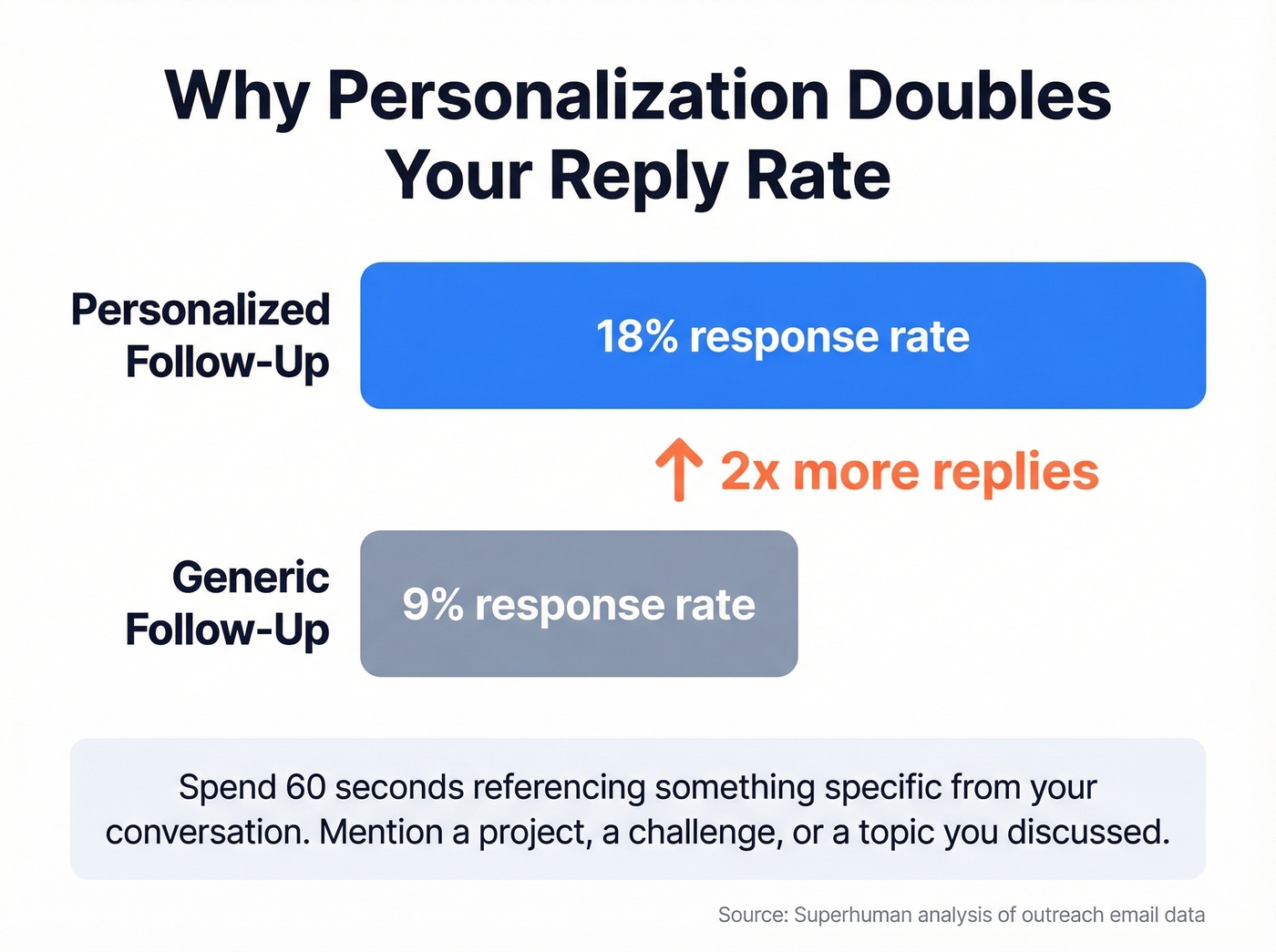
Personalized follow-ups get 18% response rates vs. 9% for generic ones. We've seen it over and over in our own outreach: the people who get replies aren't the ones with the fanciest templates. They're the ones who reference something specific from the conversation. Spend 60 seconds customizing before you hit send. If you want more options, borrow a few ideas from these follow-up templates and adapt the tone for hiring.
They Gave a Timeline and It Passed
They said "next week" and it's been a week. Your follow-up is completely reasonable.
Subject: Re: [Original email thread]
Hi [Name],
I hope your week's going well. I wanted to check in on the [Job Title] role - I really enjoyed our conversation about [specific topic you discussed], and I'm still very excited about the opportunity.
I understand timelines shift, so no rush at all. Just wanted to confirm I'm still very interested and happy to provide anything else that would be helpful.
Best, [Your name]
One candidate on r/interviews sent a candid follow-up acknowledging they'd been nervous during the interview. They got a reply in two hours with a second interview scheduled. Authenticity beats polish every time.
No Timeline Was Given
When they didn't commit to a date, your message needs to feel like a check-in, not a demand. If you’re stuck on phrasing, here are a few ways to say just checking in without sounding needy.
Subject: Following up - [Job Title] conversation
Hi [Name],
Thank you again for meeting last [day]. I've been thinking about [specific thing they mentioned - a challenge, a project, a team goal] and I'm genuinely excited about the possibility of contributing.
Would love to know if there are any updates on next steps. Happy to provide references or additional information.
Thanks, [Your name]
Second Follow-Up (Still Nothing)
Keep this shorter. If two follow-ups don't get a response, stop. (If you’re curious about the data behind that, see follow-up email reply rate benchmarks.)
Subject: Quick check-in - [Job Title]
Hi [Name],
Just a brief follow-up on my previous note. I'm still very interested in the [Job Title] role and would welcome any update when you have a moment.
Thanks for your time, [Your name]

The best follow-up emails go to the right inbox. If your message bounced or you're missing the hiring manager's direct email, Prospeo's Email Finder pulls verified addresses from 300M+ profiles at 98% accuracy - so your follow-up actually lands.
Stop guessing email addresses. Verify before you send.
Subject Lines That Get Opened
Your best move is replying to the existing email thread. But if you're starting a new thread, keep it under 40 characters - that's where iPhone Mail truncates. Aim for 6-8 words. For more inspiration, swipe a few from these email subject line examples:
- "Following up - [Job Title] interview"
- "Checking in on next steps"
- "Quick follow-up from last [day]"
Your first sentence matters too because it shows up as preview text on mobile. Don't waste it on "I hope this email finds you well." Lead with context. (More on that in email preview text testing.)
Why You Haven't Heard Back
Let's be honest: the hiring process is broken on the employer side. 40% of job seekers report being ghosted after a second or third round interview. 65% don't receive consistent communication during the hiring process, and only 26% of North American job seekers rate their candidate experience as "great." That's not a "you" problem.
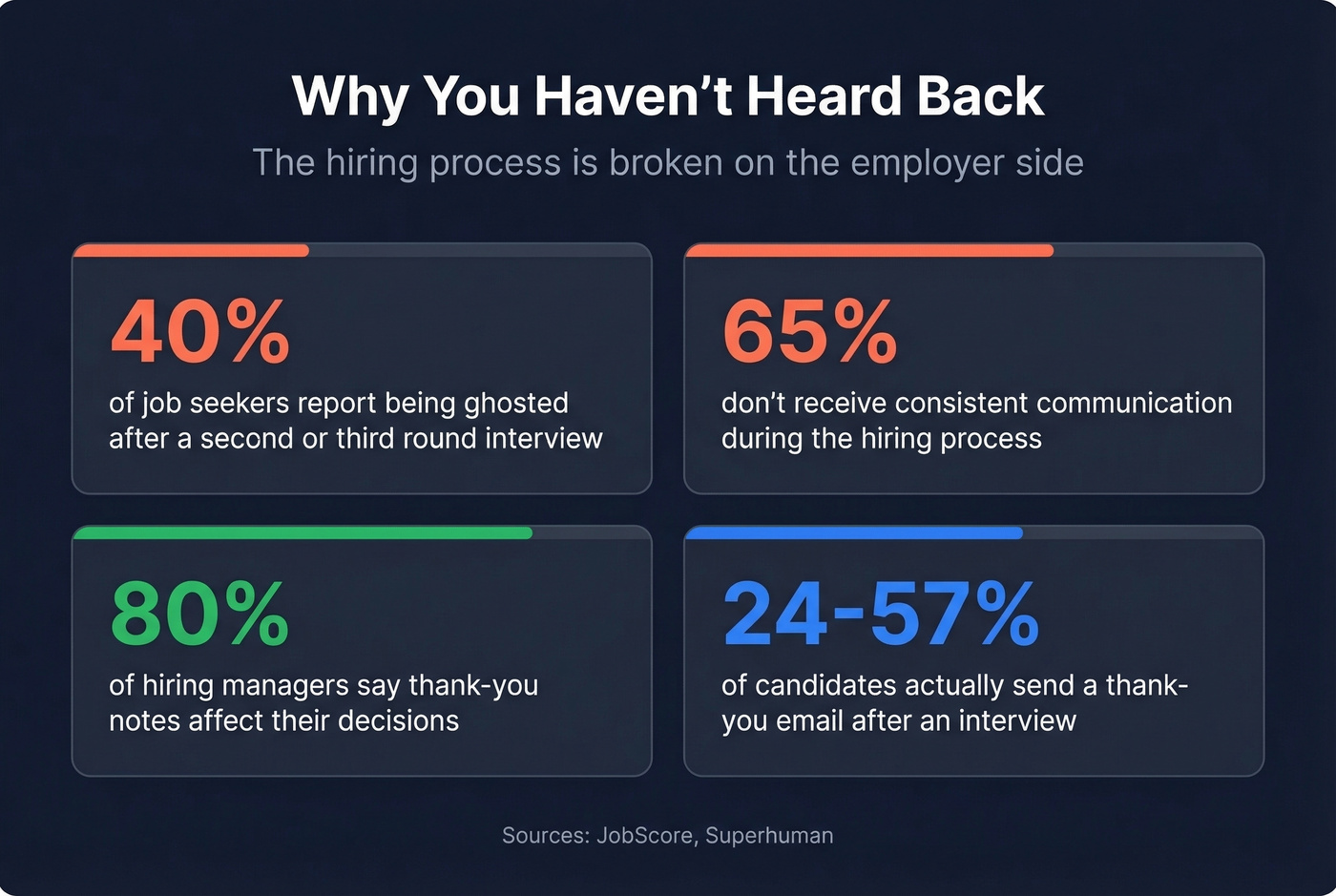
80% of hiring managers say thank-you notes affect their decisions, yet only 24-57% of candidates send them. One candidate on Reddit had a great final interview, sent thank-you emails to both HR and the hiring manager, heard nothing, and ultimately didn't get the job. Silence after a thank-you is common and not a reliable signal either way. Don't read into it.
If They Still Don't Reply
After two follow-ups with no response:
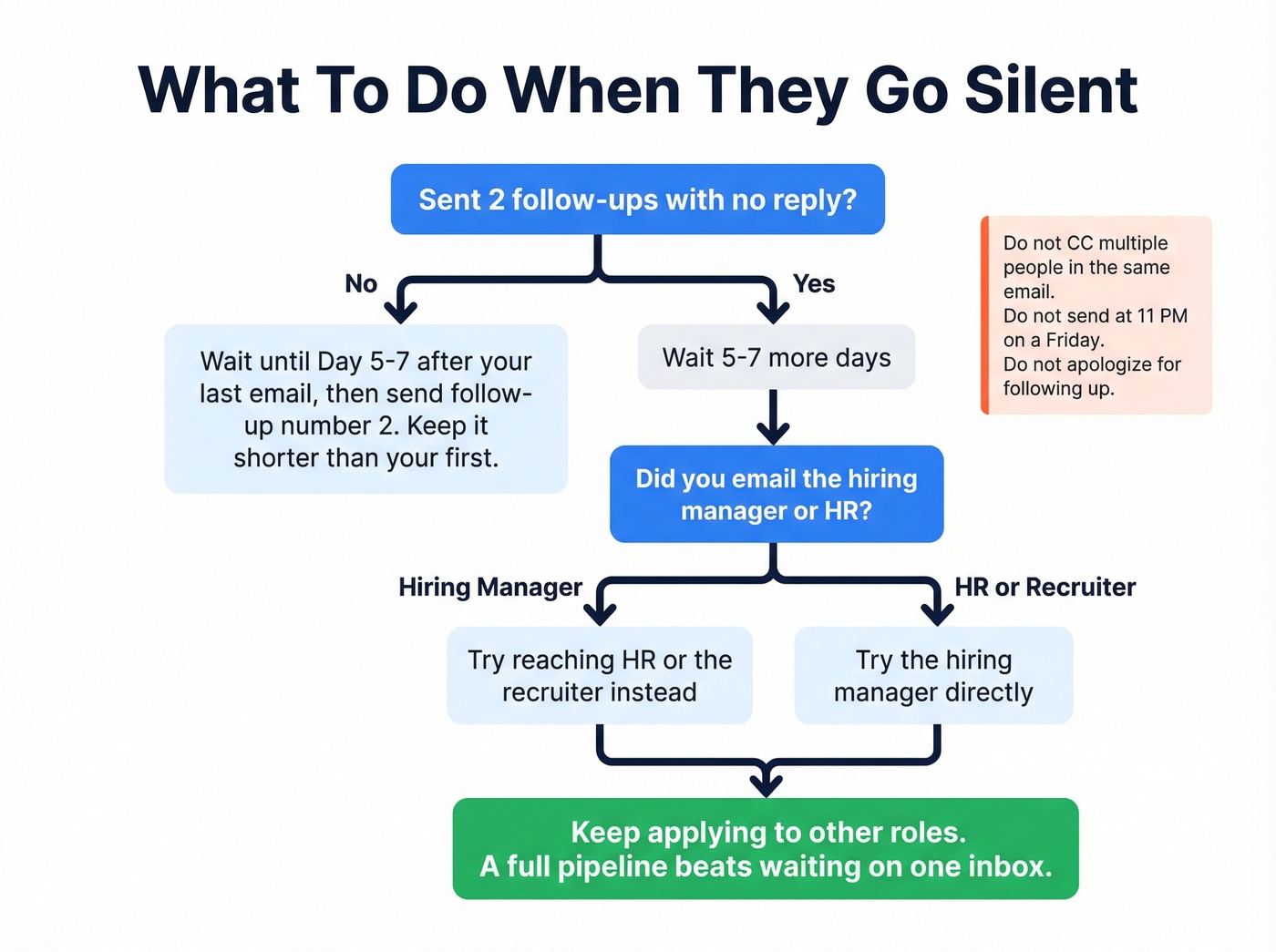
- Wait 5-7 more days. Send one final, brief note. (If you want a timing framework, see when should you follow up on an email.)
- Try a different contact. If you emailed the hiring manager, try HR. If you emailed the recruiter, try the hiring manager directly.
- Don't have their email? Prospeo's email finder lets you look up verified work emails for the hiring manager, HR contact, or anyone else at the company - the free tier gives you 75 lookups per month. If you’re trying to track down a specific person, this guide on finding a direct email address can help too.
- Keep applying. With 40% of candidates getting ghosted after advanced rounds, waiting on one company is a losing strategy.
Don't apologize for following up - it isn't rude. Don't send it at 11 PM on a Friday. And don't CC multiple people at the company in the same email; it looks desperate. Email is the default follow-up channel, but if your message bounces or goes unanswered, a brief note on a professional network is a reasonable Plan B - only if you're already connected. If deliverability is the issue, start with an email deliverability guide and a quick email bounce rate check.
Here's the thing: the best follow up email after a week you'll ever send is the one you write while actively interviewing at three other companies. Desperation leaks into tone. A full pipeline doesn't.
40% of candidates get ghosted after advanced rounds. When the recruiter goes silent, reach the hiring manager directly. Prospeo gives you 75 free verified email lookups per month - no contracts, no sales calls.
Don't wait on one inbox. Find every contact at the company.
FAQ
Is one week too soon to follow up?
No - one week is the sweet spot. The median employer response time is 6.7 days, and 75% of replies arrive within 8 days. Following up at the one-week mark shows genuine interest without being pushy. If they gave you a specific timeline, wait until that date passes before reaching out.
How many follow-up emails should I send?
Two, maximum. One initial email plus one follow-up produces the highest reply rates. Sending four or more triples spam complaint rates and risks annoying the hiring team. After two unanswered messages, redirect your energy to other opportunities.
Should I follow up by phone instead of email?
Skip the phone call unless they specifically told you to call. Most hiring managers prefer email because it's asynchronous - they can respond between meetings. A phone call puts them on the spot, and if they don't have an update yet, it creates an awkward conversation that doesn't help your candidacy.