

How to Write a Follow-Up Email After Getting No Response
You sent the email. It was good - clear ask, relevant context, decent subject line. Three days later, nothing. No reply, no open, no sign of life.
Sending a follow-up email after email silence is the most common and most mishandled move in professional communication. Most people either wait too long, say the wrong thing, or give up entirely. The fix is simpler than you think.
Why Your First Email Didn't Get a Reply
Your email wasn't bad. It was buried. HubSpot found that 40% of people have 50+ unread emails sitting in their inbox at any given time. Your carefully crafted message is competing with Slack notifications, calendar invites, and seventeen SaaS renewal reminders.
A Belkins study of 16.5 million cold emails across 93 business domains found the highest reply rate within a sequence - 8.4% - comes on the first email. That means 91.6% of people don't respond to email number one. In one r/b2bmarketing thread, a cold emailer pegged baseline response rates at 2-3%. That's not failure. That's the starting line.
Here's the encouraging part: adding just one follow-up after your initial message increases your cumulative response rate by 22%. Per-email reply rates actually decline with each send, but your sequence as a whole performs better with follow-ups baked in. Most people quit after one send. Don't be most people.
What You Need (Quick Version)
- Wait 2-3 business days before following up on business emails. For interviews, send your thank-you within 24 hours.
- Keep it short. Under 56 words for cold outreach, 50-125 words for warm follow-ups.
- Every subsequent email must add new value. "Just checking in" is the fastest way to get ignored or flagged as spam (here are better options than “just checking in”).
- Verify the email address before you follow up. Bounced emails silently destroy your sender reputation.
When to Send Your Follow-Up
Timing depends entirely on context. A post-interview follow-up and a cold outreach follow-up operate on completely different clocks (if you want a deeper timing breakdown, see when you should follow up on an email).
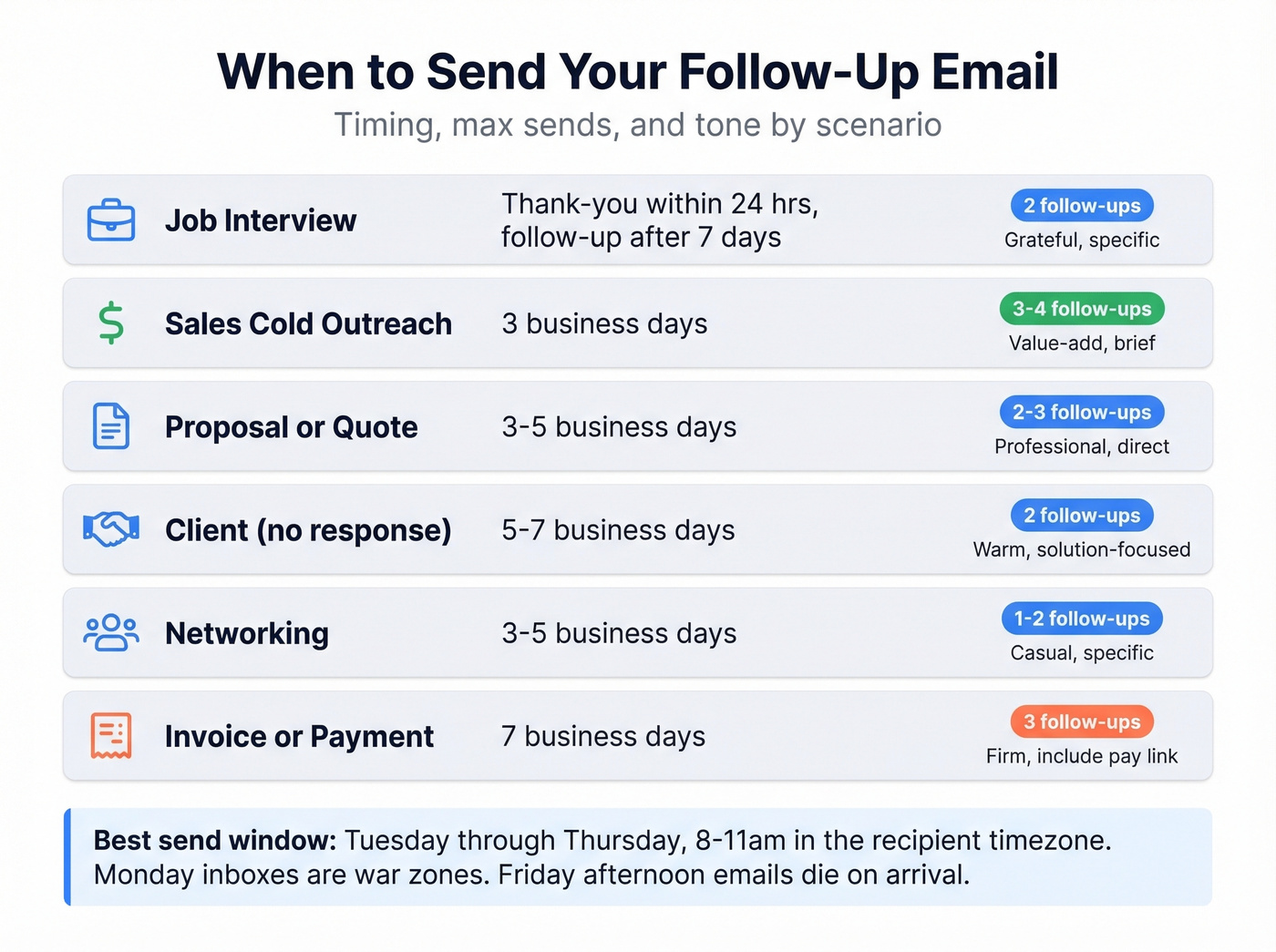
| Scenario | Wait Time | Max Follow-Ups | Tone |
|---|---|---|---|
| Job interview | Thank-you within 24 hrs; follow-up after 7 days | 2 | Grateful, specific |
| Sales cold outreach | 3 biz days | 3-4 | Value-add, brief |
| Proposal / quote | 3-5 biz days | 2-3 | Professional, direct |
| Client (no response) | 5-7 biz days | 2 | Warm, solution-focused |
| Networking | 3-5 biz days | 1-2 | Casual, specific |
| Invoice / payment | 7 biz days | 3 | Firm, include pay link |
One practitioner on r/Entrepreneur shared detailed campaign data showing that sending Tuesday through Thursday between 8-11am in the recipient's timezone improved open rates by 16%. That tracks with what we've seen across outbound campaigns - Monday inboxes are war zones, and Friday afternoon emails die on arrival.
The biggest mistake isn't sending too late. It's sending too early. If you sent yesterday, a follow-up the very next morning feels desperate. Give people two to three business days to surface your message.
How Many Follow-Ups to Send
The 16.5-million-email dataset tells a clear story: per-email reply rates decline with every additional send (more benchmarks: follow-up email reply rate).
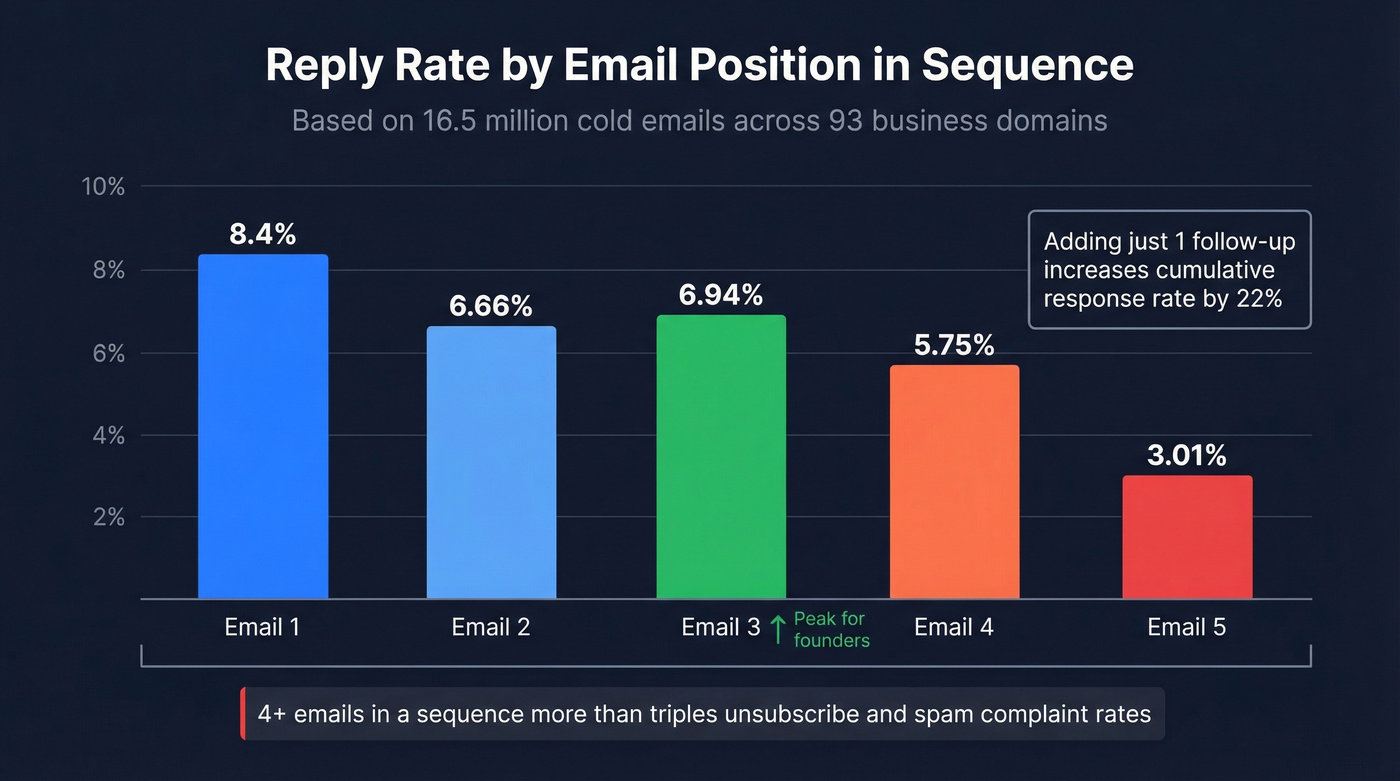
Here's what the founder-persona breakdown looks like:
| Email in Sequence | Reply Rate |
|---|---|
| Email 1 | 8.4% |
| Email 2 (first follow-up) | 6.66% |
| Email 3 (second follow-up) | 6.94% (peak) |
| Email 4 (third follow-up) | 5.75% |
| Email 5 (fourth follow-up) | 3.01% |
The risk ramps up hard after that: sending four or more emails in a sequence more than triples unsubscribe and spam complaint rates. That's not a marginal increase - it's a structural risk to your domain reputation.
Persona matters too. Founders stay relatively flat through the second follow-up, peaking at 6.94% on email three. Enterprise prospects ghost fast and punish persistence. SMBs tolerate more touches.
Let's be honest: if your deal size is under $5k, three follow-ups is your ceiling. The domain reputation damage from a fourth email costs more than the deal is worth. Save the aggressive sequences for enterprise deals where one reply pays for a year of outreach.
Practical caps:
- Interviews: 1-2 follow-ups max. After that, you have your answer.
- Warm business (proposals, clients, networking): 2-3 follow-ups.
- Cold outreach: 3-4 max, then switch channels or move on.

Every follow-up you send to a bad email address silently tanks your sender reputation. Prospeo's 5-step verification catches invalid addresses, spam traps, and honeypots before they damage your domain - with 98% email accuracy and a 7-day data refresh cycle.
Stop following up with ghosts. Verify every address at $0.01 per email.
How to Write a Follow-Up That Gets Replies
Start with the subject line. That same Reddit practitioner tested multiple approaches and found "Quick question" pulled ~39% opens, subject lines with the company name hit ~33%, and salesy lines like "Partnership opportunity" dropped below 19%. Curiosity and specificity beat formality every time (more ideas: email subject line examples).
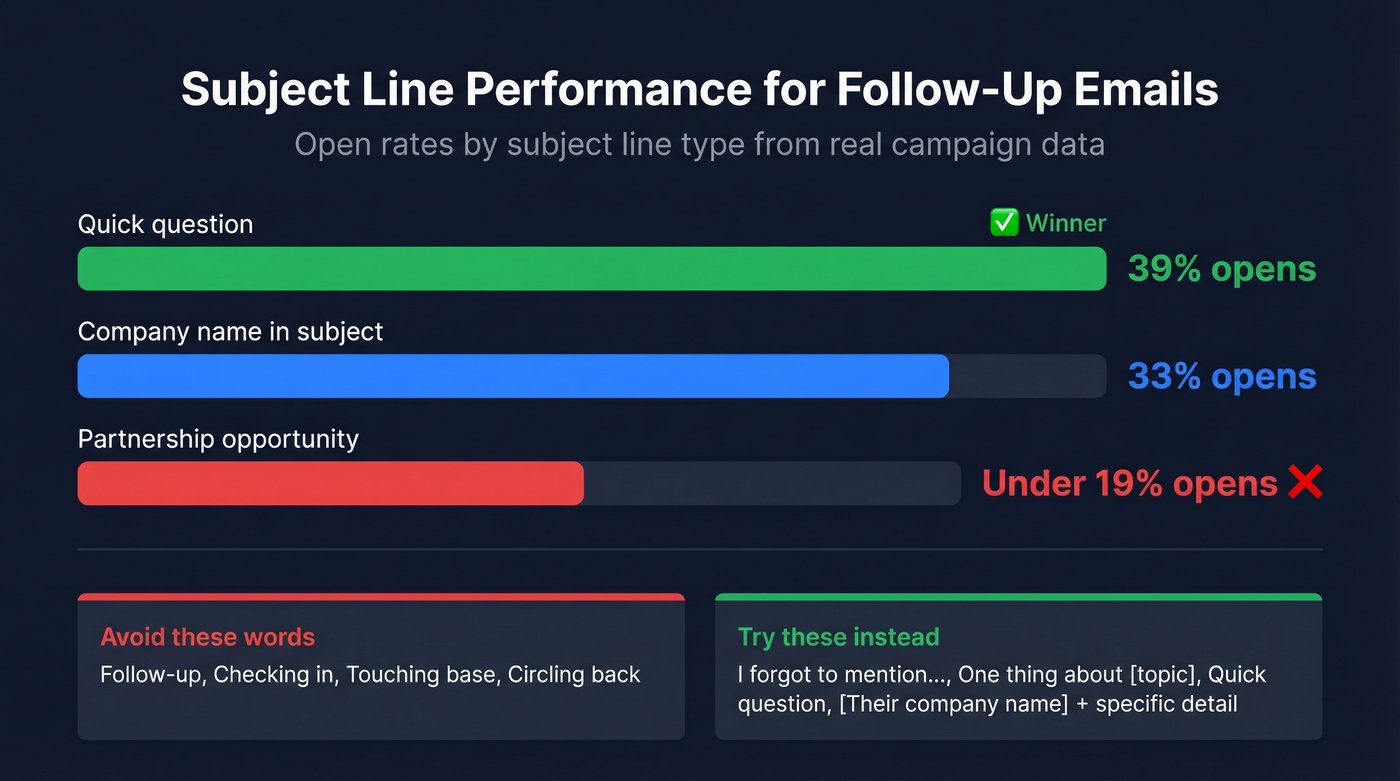
Don't put the word "follow-up" in your subject line. As NetHunt's follow-up-mistakes breakdown points out, it signals that you're chasing, not adding value. Try "I forgot to mention..." or "One thing about [specific topic]" instead.
For length, the data is clear: cold follow-ups perform best when they're extremely short. Warm follow-ups hit the sweet spot at 50-125 words. That Reddit practitioner cut their emails from 141 words to under 56 and watched reply rates double. We've seen similar patterns in our own outbound testing - shorter almost always wins.
Format matters as much as the words. Plain text outperforms HTML templates. Reply in the same thread so they can see the original context without digging.
One clear ask per email - not three questions and a calendar link. Kill the filler phrases. "Touching base," "circling back," and "just wanted to check in" are the email equivalent of dead air. If you don't have something new to say, don't send the email. A useful framework: map each follow-up to a different objection - need, cost, urgency, trust (more on value-first messaging: how to add value in sales). If your first email addressed need, your next message should tackle a different angle entirely.
Follow-Up Email Templates
After a Job Interview
Send your thank-you within 24 hours. Reference something specific from the conversation - not a generic "great to meet you." For a video call, mention something you discussed on screen; for a phone screen, reference a specific phrase they used.
Subject: The [specific topic] point you raised
Hi [Name],
Thanks for the conversation yesterday. Your point about [specific challenge or initiative] stuck with me - I've actually worked on something similar at [previous company/project] and would love to contribute to that effort.
Looking forward to the next steps. Let me know if you need anything from my end.
[Your name]
Second Interview Follow-Up
Wait at least a full week after your first follow-up. Most people send something like this:
❌ Bad: "Hi [Name], Just wanted to follow up on our interview. I'm very interested in the role and look forward to hearing back."
That says nothing. This is better:
✅ Good Subject: Still thinking about the [specific project] challenge
Hi [Name],
Since we spoke, I sketched out a rough approach to [specific challenge discussed]. Happy to share if it'd be useful. Still excited about the [role/team].
[Your name]
The difference: the good version proves you're already thinking like a team member.
Follow-Up on a Previous Proposal
Proposals stall because decision-makers get stuck on one section and never circle back. Asking about a specific deliverable gives them a low-effort way to re-engage.
Subject: Quick question on the [project name] proposal
Hi [Name],
Wanted to make sure the proposal landed and see if any section needs clarification. Specifically - does the timeline on [deliverable] work for your team's schedule?
Happy to jump on a 10-minute call to walk through anything.
[Your name]
After a Sales Call or Demo
Attaching something new reframes you as a resource, not a salesperson waiting for an answer. The case study does the selling for you.
Subject: [Resource] that's relevant to what we discussed
Hi [Name],
After our call, I pulled together a case study from [similar company] that maps closely to your [specific challenge]. Attached here - the results section on page 2 is the most relevant part.
Worth a 15-minute conversation this week?
[Your name]
Cold Outreach Follow-Up
Under 56 words. New angle, not a repeat. Plain text only.
Subject: Quick question
Hi [Name],
Noticed [company] just [specific trigger - new hire, funding round, product launch]. We helped [similar company] handle [related challenge] and cut [metric] by [number].
Worth a quick chat?
[Your name]
After Networking
Reference exactly where you met. Vague "great connecting" emails get deleted.
Subject: From [event/intro name] - the [topic] conversation
Hi [Name],
Great meeting you at [event]. Your take on [specific topic] was interesting - here's that [resource/article/contact] I mentioned.
Would love to continue the conversation. Coffee next week?
[Your name]
Invoice or Payment Reminder
Direct. Professional. Include the payment link so they can act immediately.
Subject: Invoice #[number] - payment due [date]
Hi [Name],
Following up on invoice #[number] for [amount], originally due [date]. Here's the direct payment link: [link]
Let me know if there are any questions or if the payment is already in process.
[Your name]
The Breakup Email
This one gets the highest reply rates in a sequence, and the psychology is simple: it removes pressure. The moment you signal you're about to stop emailing, the recipient's loss aversion kicks in. They suddenly have to decide whether they want the conversation to end - and that decision often triggers a reply where four previous emails couldn't.
Subject: Closing the loop
Hi [Name],
I've reached out a few times and haven't heard back - totally understand if the timing isn't right. I'll stop following up for now, but if [problem you solve] becomes a priority, I'm here.
Wishing you a great [quarter/season].
[Your name]
Five Mistakes That Kill Reply Rates
1. The empty bump. "Just checking you saw my last email" adds zero value and signals that you have nothing new to offer. Do this instead: attach a relevant article, share a new data point, or ask a specific question.
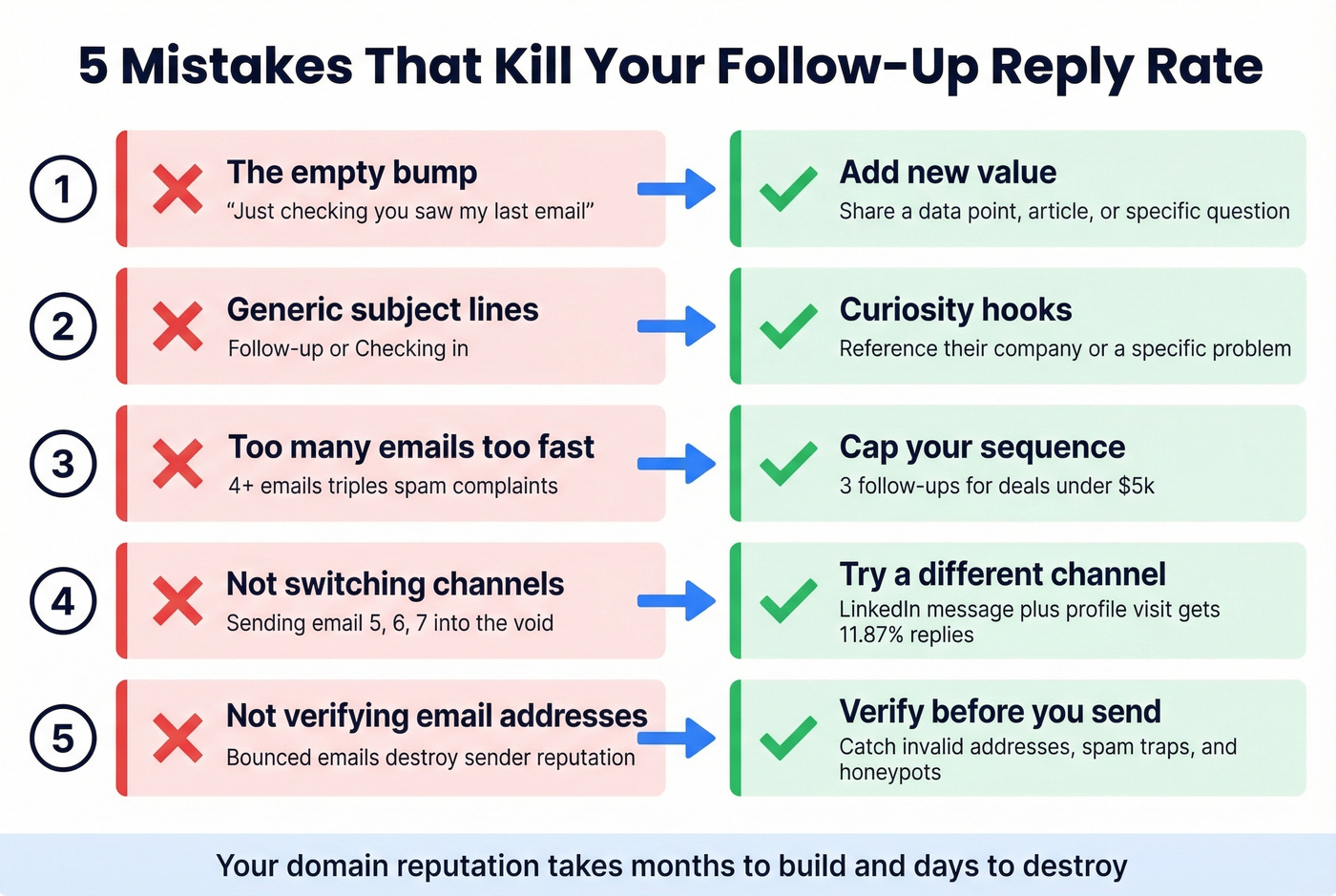
2. Generic subject lines. Putting "Follow-up" or "Checking in" in your subject line is a flag that says "skip me." Use a hook that creates curiosity - reference their company, a specific problem, or something unexpected.
3. Too many emails too fast. Four or more emails in a sequence more than triples unsubscribe and spam complaint rates. Your domain reputation takes months to build and days to destroy. Space your messages out and cap your sequences.
4. Not switching channels. After two or three unanswered emails, email isn't the problem - the channel is. A message plus profile visit combo on professional networks pulled an 11.87% reply rate in the same dataset. If email isn't working, try a different door (related: sales prospecting techniques).
5. Emailing dead addresses. This is the silent killer. Every bounced email chips away at your sender reputation, which means your follow-ups to valid addresses start landing in spam too. Verify your list before any sequence - Prospeo's 5-step verification catches invalid addresses, catch-all domains, and spam traps before they do damage.
The Follow-Up Killer Nobody Talks About
Everyone obsesses over copy, timing, and subject lines. Almost nobody talks about whether the email address is real.
That Reddit practitioner who doubled their reply rate from 3% to 6%? One of their biggest changes was list quality. They stopped buying lists, started verifying manually, and watched their bounce rate drop from 11% to under 2%. The reply rate improvement followed. We've seen the same pattern across dozens of outbound teams we work with - bad data is the number one reason follow-ups fail, and it's the last thing people check (more on deliverability fundamentals: email deliverability guide).

Your follow-up copy doesn't matter if the email bounces. Meritt, a Prospeo customer, saw their bounce rate drop from 35% to under 4% after switching their verification workflow - and their pipeline tripled. Fix the data first (benchmarks and fixes: email bounce rate).
Three follow-ups and still no reply? The problem might not be your copy - it might be the wrong contact entirely. Prospeo gives you 300M+ verified professional profiles with 30+ filters so your follow-ups land with actual decision-makers, not dead inboxes.
Find the right person first. Then your follow-up actually matters.
When to Automate (and When Not To)
Not every follow-up should be automated.
Keep it manual for job interviews, high-value prospects, and any relationship where personalization is the whole point. These emails need to reference specific conversations and feel genuinely human. Skip automation entirely for anything under five recipients - the setup time isn't worth it.
For cold outreach at scale, automation makes sense. A common practitioner cadence: Day 0 (initial email) → Day 3 (first follow-up) → Day 7 (second follow-up, new angle) → Day 14 (breakup email). Set an exit condition so the sequence stops the moment they reply. Most sequencing tools handle this natively (tooling options: follow up email software).
The danger with automation isn't the sending - it's the forgetting. I've watched teams run sequences for months without checking bounce rates, reply rates, or spam complaints. Automate the sends, but review the data weekly. If your bounce rate creeps above 3%, pause everything and clean your list before you send another message.
FAQ
How many times should you follow up after no response?
Two to three follow-ups is the sweet spot for most contexts. The first follow-up lifts your total sequence response rate by 22%, and a second is fine if you add new value. After two unanswered messages in a warm context, switch to phone or stop. For cold outreach, cap at three to four.
What if they opened my email but didn't reply?
An open without a reply means interest but not enough urgency. Send a subsequent message with a relevant resource, a direct question, or a soft deadline. Don't mention that you saw them open it - that feels surveillance-y and kills trust instantly.
How long should a follow-up email be?
Under 56 words for cold outreach; 50-125 words for warm contexts like interviews, client emails, and proposals. Every word should earn its place.
Should I follow up the day after sending?
No. A next-day follow-up almost always feels pushy. The only exception is a time-sensitive situation with a hard deadline, like a job offer response window. For everything else, wait at least two to three business days so the recipient has time to read and respond on their own schedule.
How do I make sure my follow-up actually reaches their inbox?
Verify the email address before sending. If your bounce rate exceeds ~3%, your messages are hurting your domain reputation more than helping. Run your list through a verification tool before you touch the copy - the data quality problem has to be solved first, or nothing else matters.