

How to Write a Follow-Up Email After Negotiation (Templates for 2026)
You countered three days ago. You've refreshed your inbox eleven times today. The silence feels personal, but it almost never is - Harvard's Program on Negotiation found that people dramatically overestimate how well recipients interpret tone over email. The other side is probably deliberating, not ignoring you, and your next follow-up email after negotiation needs to land with clarity, not anxiety.
With nearly 400 billion emails sent daily in 2026, your message is fighting for attention against everything else in someone's inbox. Timing and format aren't nice-to-haves. They're the whole game.
Quick Timing Cheat Sheet
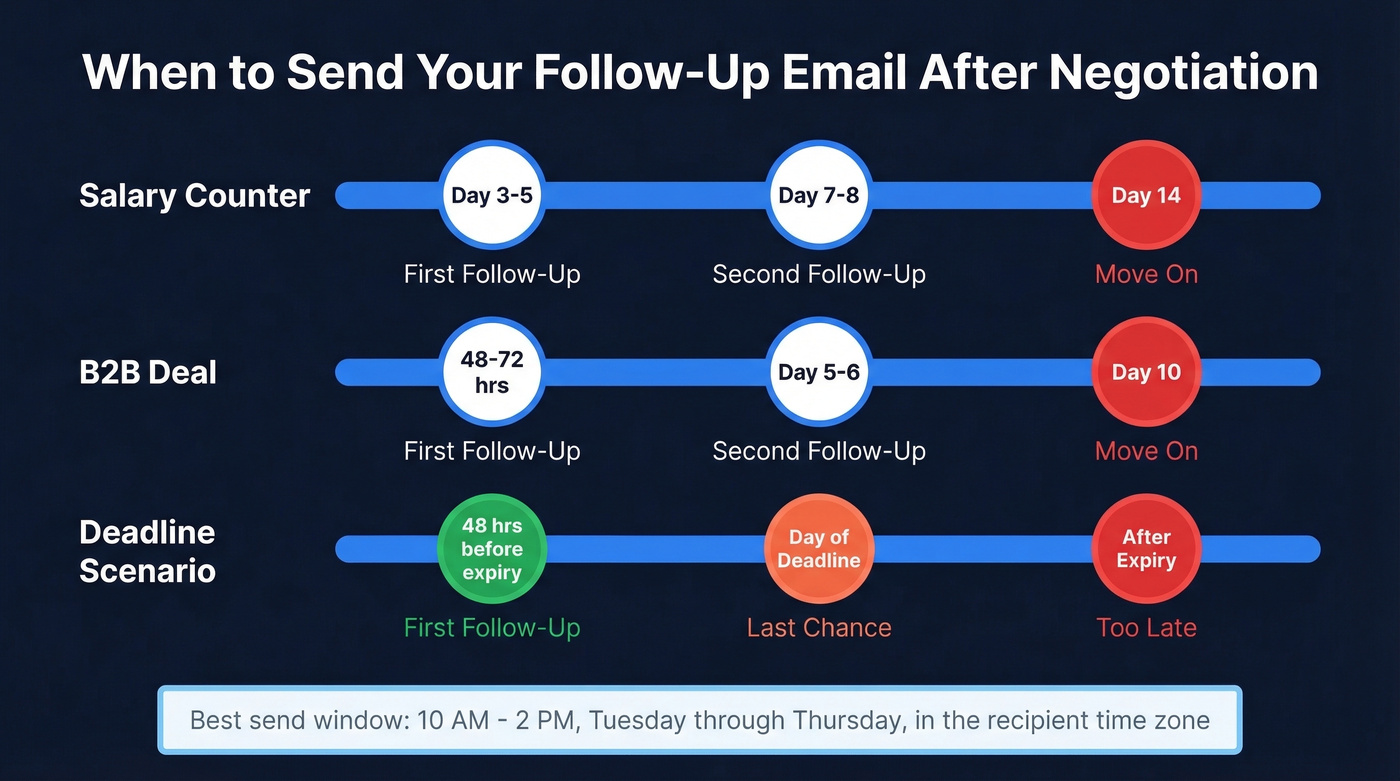
- Salary negotiation: Follow up after 3-5 business days. If a deadline looms, send it 48 hours before expiry.
- B2B deals: 48-72 hours after your last message.
- Deadline scenarios: Always follow up 48 hours before any stated deadline.
Here's the mindset shift that changes every follow-up: stop "checking in." Start confirming. "Just wanted to check in" signals uncertainty. "Confirming next steps on our discussion" signals professionalism. One phrase makes you sound unsure. The other makes you sound like someone who closes deals. (If you need better wording, see Just Checking In Professionally.)
When to Send Your Follow-Up
90% of buyers respond within two days of their most recent message. If you haven't heard back in that window, something's stalled - and a well-timed follow-up is expected, not pushy. Practitioner consensus on Fishbowl backs this up: under a week of silence is normal. Over two weeks? Cut your losses.
| Scenario | First Follow-Up | Second Follow-Up | Move On |
|---|---|---|---|
| Salary counter | 3-5 biz days | Day 7-8 | After 2 weeks |
| B2B deal/contract | 48-72 hours | Day 5-6 | After 10 days |
| Deadline approaching | 48 hrs before expiry | Day of deadline | After expiry |
Send between 10 AM-2 PM in the recipient's time zone, Tuesday through Thursday. Those windows consistently pull the highest open rates. For a deeper breakdown, compare this with the best time to send data.
The key decision rule: if there's a stated deadline, your follow-up arrives before it - not after. Following up the day after an offer expires is awkward. Following up two days before is strategic.
Follow-Up Email Templates
After a Salary Counteroffer
Use this when you've sent a counter within a reasonable range and the hiring manager encouraged negotiation. The goal isn't to re-argue your case. It's to confirm receipt and restate enthusiasm.
Subject: Following up - [Role Title] offer
Hi [Name],
I wanted to follow up on the counteroffer I sent on [date]. I want to make sure it came through on your end.
I'm genuinely excited about this role and the team. If any additional information would help as you review, I'm happy to provide it.
Best, [Your Name]
Short. Warm. No re-negotiating. That's the formula.
After Silence on a Business Deal
When a B2B deal goes quiet, the blocker is rarely "they forgot." It's usually internal approval on pricing, an implementation concern, a stakeholder who hasn't signed off, or compliance review - any of which can stall things for days without anyone thinking to loop you in.
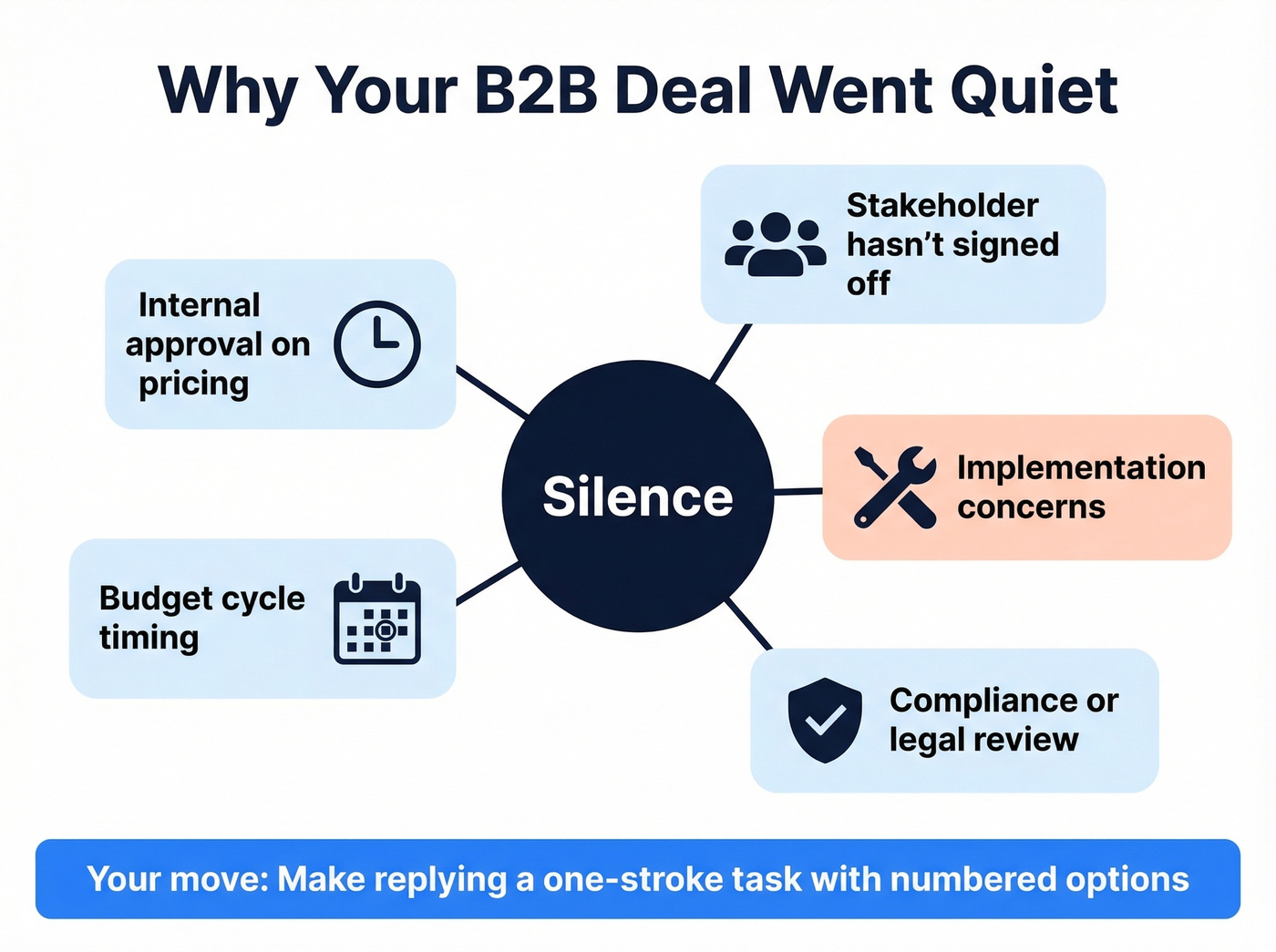
Your follow-up should make replying a one-stroke task. Reducing reply friction is the single highest-leverage move you can make when following up on a stalled deal. If you want more options, pull from these sales follow-up templates.
Subject: Quick question on [Project/Proposal Name]
Hi [Name],
I know these decisions involve moving parts. Could you let me know which applies?
- Still reviewing internally - need more time
- Need changes to pricing or terms
- Ready to move forward
Happy to jump on a quick call if that's faster.
[Your Name]
Numbered options cut friction dramatically. We've tested this format across dozens of outbound campaigns, and the reply rate jumps noticeably compared to open-ended "any updates?" messages. Restating the agreed figure in your message also anchors the conversation, keeping the negotiation where you left it. (If you're tracking performance, benchmark against a typical follow-up email reply rate.)
Confirming a Verbal Agreement
Here's the thing: "We can probably do that" evaporates fast. Send a written confirmation of any verbal agreement within 24 hours. Don't wait for the other side to send something first.
Subject: Confirming our conversation - [Role/Deal]
Hi [Name],
Thanks for the conversation today. Confirming what we discussed:
- [Title/Scope]: [Agreed terms]
- [Compensation/Rate]: [Agreed figure]
- [Start date/Timeline]: [Agreed date]
Let me know if I've captured anything incorrectly. I'll look for the formal [offer letter / contract / SOW] from your side.
Best, [Your Name]
What NOT to write: Don't add new requests, renegotiate terms, or introduce conditions that weren't discussed. The confirmation email locks in what was agreed - nothing more.
Accepting Agreed Terms
When the negotiation lands where you want it, keep the acceptance tight. The Muse's framework nails it: thank them, clearly accept, confirm key terms, ask about next steps.
Run through this before you hit send:
- Title/role and compensation stated explicitly
- Start date or timeline confirmed
- Next steps requested (paperwork, onboarding, contract)
- Tone is warm but professional - no gushing
Subject: Excited to accept - [Role/Project]
Hi [Name],
Thank you for working through this with me. I'm happy to formally accept [the role of X at $Y / the contract at the agreed terms]. To confirm: [title, compensation, start date]. What are the next steps on your end?
[Your Name]

A perfect follow-up email means nothing if it bounces. Prospeo gives you 98% accurate, verified emails for every decision-maker in your deal cycle - so your negotiation follow-ups actually land.
Stop following up into the void. Start reaching real inboxes at $0.01 per email.
Subject Lines That Get Opened
Your subject line does one job: get the email opened without sounding desperate.
- "Following up - [Role/Project Name]"
- "Quick question on next steps"
- "Any updates on [specific term discussed]?"
- "Confirming our conversation from [day]"
- "[Name], one quick thing"
Same thread or new email? If your last exchange was under a week ago, reply in the same thread. If more than a week has passed or the context shifted, start fresh. If you want more ideas, borrow from these email subject line examples.
Mistakes That Kill Negotiations
Misreading your own tone. That same Harvard research found overconfidence about tone clarity is strongest in email compared to phone or face-to-face. You think you sound confident. They read pushy. When in doubt, strip adjectives and let the facts speak. (For a tighter style, use this email copywriting checklist.)
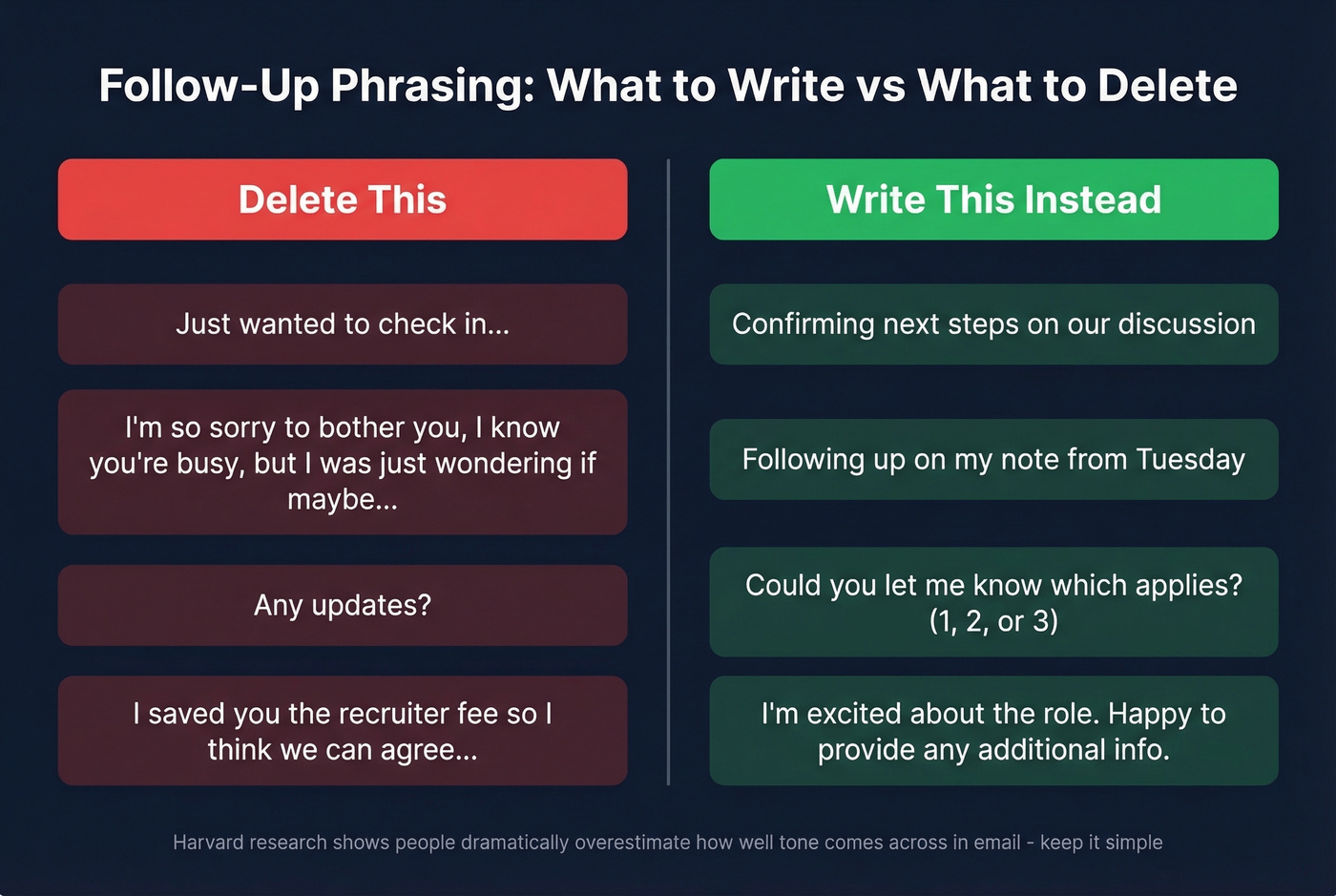
Over-justifying your position. Don't tell the employer "I saved you the recruiter fee" as leverage. Nickel-and-diming after you've stated your number undermines the goodwill you built getting there. State the number once. Let it sit.
Apologetic hedging. "I'm so sorry to bother you, I know you're busy, but I was just wondering if maybe..." Delete all of that. A clean "Following up on my note from Tuesday" respects everyone's time more than three lines of throat-clearing.
Writing novels. Your follow-up should be shorter than your original message. If the recipient needs to scroll, you've lost them.
When to Pick Up the Phone
Email is for documentation. Phone is for resolution.
Two follow-up emails with no response? Call. Emotional or complex topic? Call first, email to confirm. Hard deadline approaching? Call.
Later exchanges tend to produce better agreements because both sides share more when they've had time to think. A phone call after email silence often unlocks that deeper exchange. The Workplace Stack Exchange community echoes this: when email stalls, switching channels breaks the logjam.
For B2B deals, verify you're reaching the decision-maker's direct line before calling. Prospeo's Mobile Finder gives you verified direct dials across 125M+ numbers so you're not leaving voicemails at a front desk. If you're building a calling motion, start with a repeatable cold calling system.
How to Close a Deal With Follow-Ups
Most deals require 5-12 touchpoints before closing. One follow-up isn't enough. Two is professional persistence. Here's the escalation we recommend:
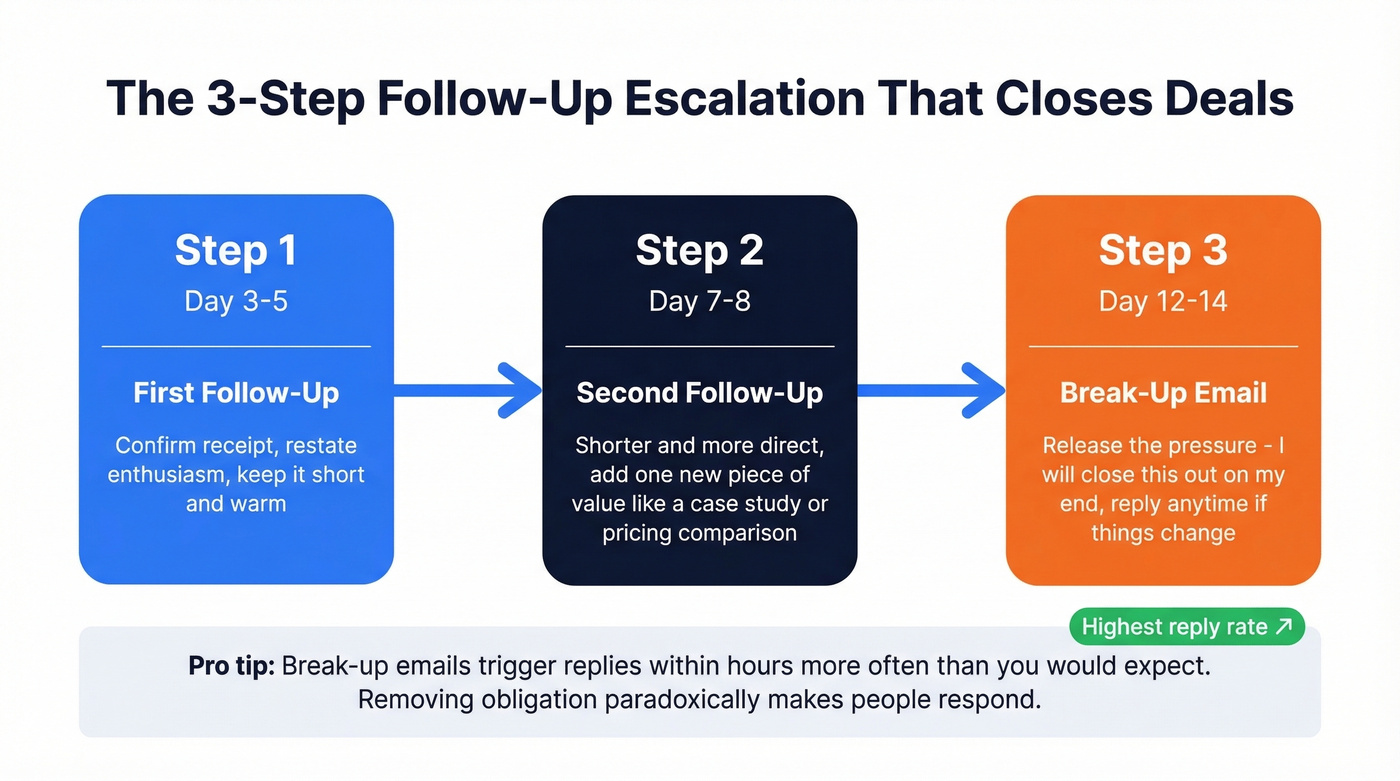
Day 3-5: First follow-up using the templates above.
Day 7-8: Second follow-up - shorter, more direct, and include one new piece of value like a relevant case study or a pricing comparison they hadn't seen. (If you need a system, use sequence management to keep touches consistent.)
Day 12-14: Break-up email. "I'm going to assume timing isn't right. I'll close this out on my end - reply anytime if things change."
In our experience, break-up emails trigger replies within hours more often than you'd expect. The pressure release works because it removes the obligation the recipient has been avoiding. People don't like feeling like they owe someone a response, and telling them they're off the hook paradoxically makes them respond.
Win or lose, debrief after every negotiation: what worked, what surprised you, what went unresolved. That reflection compounds over time.
Let's be honest about scale, though. If your typical deal is under $15k, you don't need a twelve-touch follow-up sequence. Two emails, one call, and a break-up message. Save the elaborate cadences for enterprise deals where the payoff justifies the persistence. (For bigger motions, see enterprise B2B sales.)
If your follow-up bounced, the negotiation died before it started. Skip this section if you're only doing salary negotiations, but for B2B outreach, Prospeo's Email Finder verifies addresses in real time with 98% accuracy so your message actually lands. If you're troubleshooting, start with email bounce rate basics.

Stalled B2B deals often mean your contact isn't the real blocker. Prospeo's 300M+ profile database with 30+ filters helps you find the actual decision-maker - so your follow-up reaches the person who can say yes.
Find the stakeholder holding up your deal and follow up with the right person.
FAQ
How long should I wait to follow up after a salary negotiation?
Wait 3-5 business days after sending your counteroffer. If the employer gave a decision deadline, send your follow-up email after negotiation 48 hours before that date expires. Beyond two weeks of silence, the offer has likely moved on.
Is it unprofessional to send two follow-ups?
No. Most B2B deals need 5-12 touchpoints before closing. Two follow-ups spaced 3-5 days apart signal professional persistence, not desperation. A third "break-up" email at day 12-14 often triggers the fastest replies.
Should I follow up in the same email thread or start a new one?
Reply in the same thread if your last exchange was under a week ago - it preserves context and makes it easy for the recipient to scroll up. Start a new thread if more than a week has passed or the discussion topic has shifted significantly.
What if my follow-up email bounces?
A bounced email means you never had a valid address. Use a verification tool to confirm the address before sending. For salary negotiations, try the recruiter's alternate address or call the company directly.