

How to Write a Follow-Up Email Asking for an Update (That Actually Gets a Reply)
You drafted the perfect email, hit send, and then - nothing. Three days of radio silence. You're staring at your inbox wondering whether sending a follow-up email asking for an update makes you helpful or annoying.
Here's the reality: 42% of replies come from follow-ups, not the initial email. Even conservative datasets put the number around 20%. Meanwhile, 48% of salespeople never follow up at all. The people who get responses aren't pushier - they're more systematic about it.
What Actually Gets Replies
Whether you're chasing a hiring manager, a prospect, or a client who owes you an answer, three things determine whether your follow-up works:
Timing. Use a graduated cadence (2, then 4, then 7, then 14 days between touches), not "whenever I remember." Static spacing looks automated.
Brevity. Keep it under 80 words. Elite-performing follow-ups average fewer than 80 words per Instantly's 2026 benchmarks.
Tone. Informal beats formal by 78% in positive reply rate. Drop the corporate stiffness.
For context, the average cold email reply rate sits between 1% and 5%, and personalized emails pull roughly double that. Every optimization below is designed to push you toward the top of that range.
Want templates? Jump to the template section. Want to understand why certain follow-ups work? Keep reading.
When to Send Your Update Request
The biggest mistake people make isn't what they write - it's when they send it.
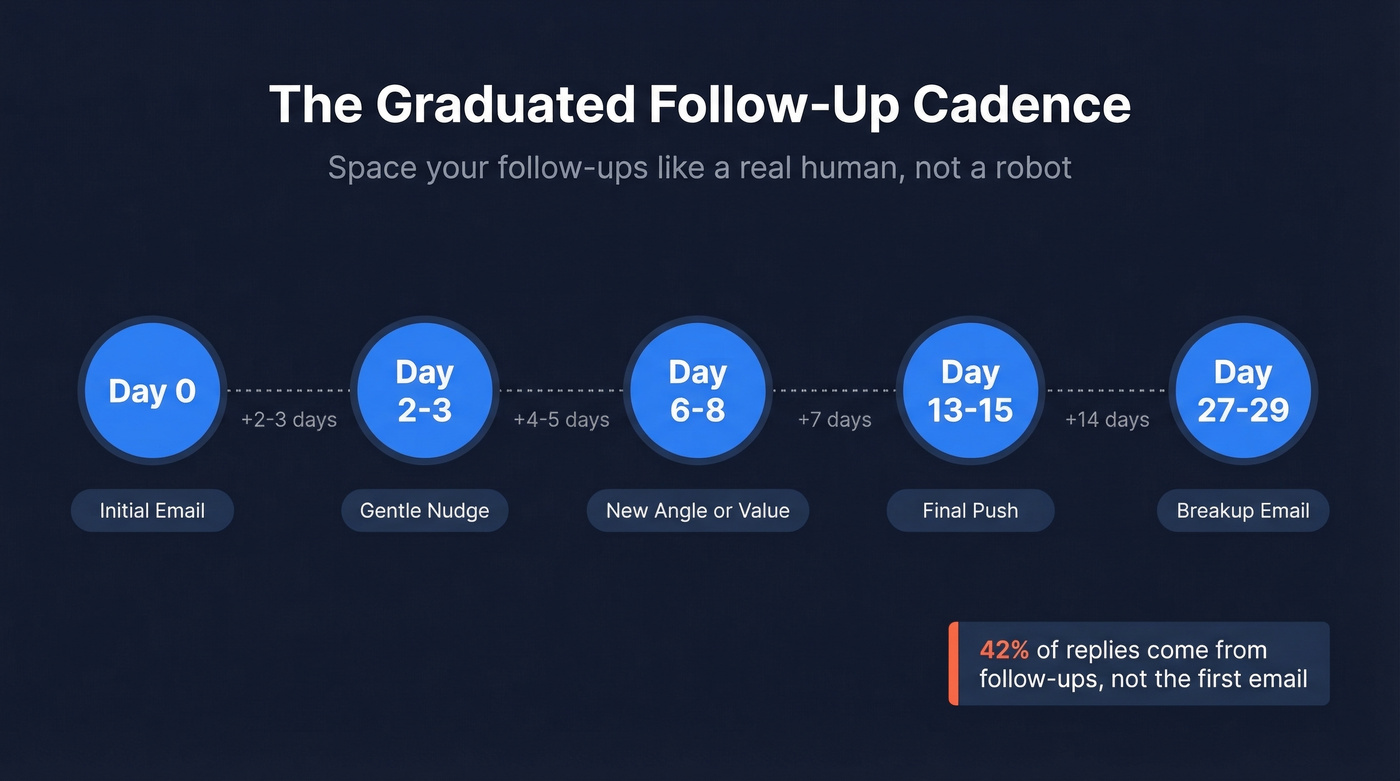
| Step | Timing | Purpose |
|---|---|---|
| 1 | Day 0 | Initial email |
| 2 | Day 2-3 | Gentle nudge |
| 3 | Day 6-8 | New angle or value |
| 4 | Day 13-15 | Final push |
| 5 | Day 27-29 | Breakup email |
This graduated spacing works because it mimics how a real human would follow up - more frequently at first, then backing off. Sending every two days like clockwork screams automation.
An alternative is the 3-7-7 rule: initial email on Day 0, first follow-up on Day 3, second on Day 10, third on Day 17.
Data from 16.5M cold emails shows reply rates peak at 8.4% on the first email and drop to 3.8% by the fifth. After four or more emails, unsubscribe rates triple and spam complaints spike even harder. Cap email-only sequences at 2-3 follow-ups unless you're adding genuine new value each time.
We've tested both fixed and graduated spacing across outbound campaigns. Graduated wins every time. Fixed intervals feel robotic to recipients, and inbox providers are increasingly flagging predictable send patterns.
For day-of-week timing, Thursday produces the highest positive-reply rate at 10.5%, while weekends drop engagement by 27%. The sweet spot is Tuesday through Thursday, 9-11 AM in the recipient's local time zone. If you want a deeper breakdown, see our guide on the best time to send cold emails.
Subject Lines That Get Opened
A Belkins and Reply.io analysis of 5.5M cold emails found clear patterns:
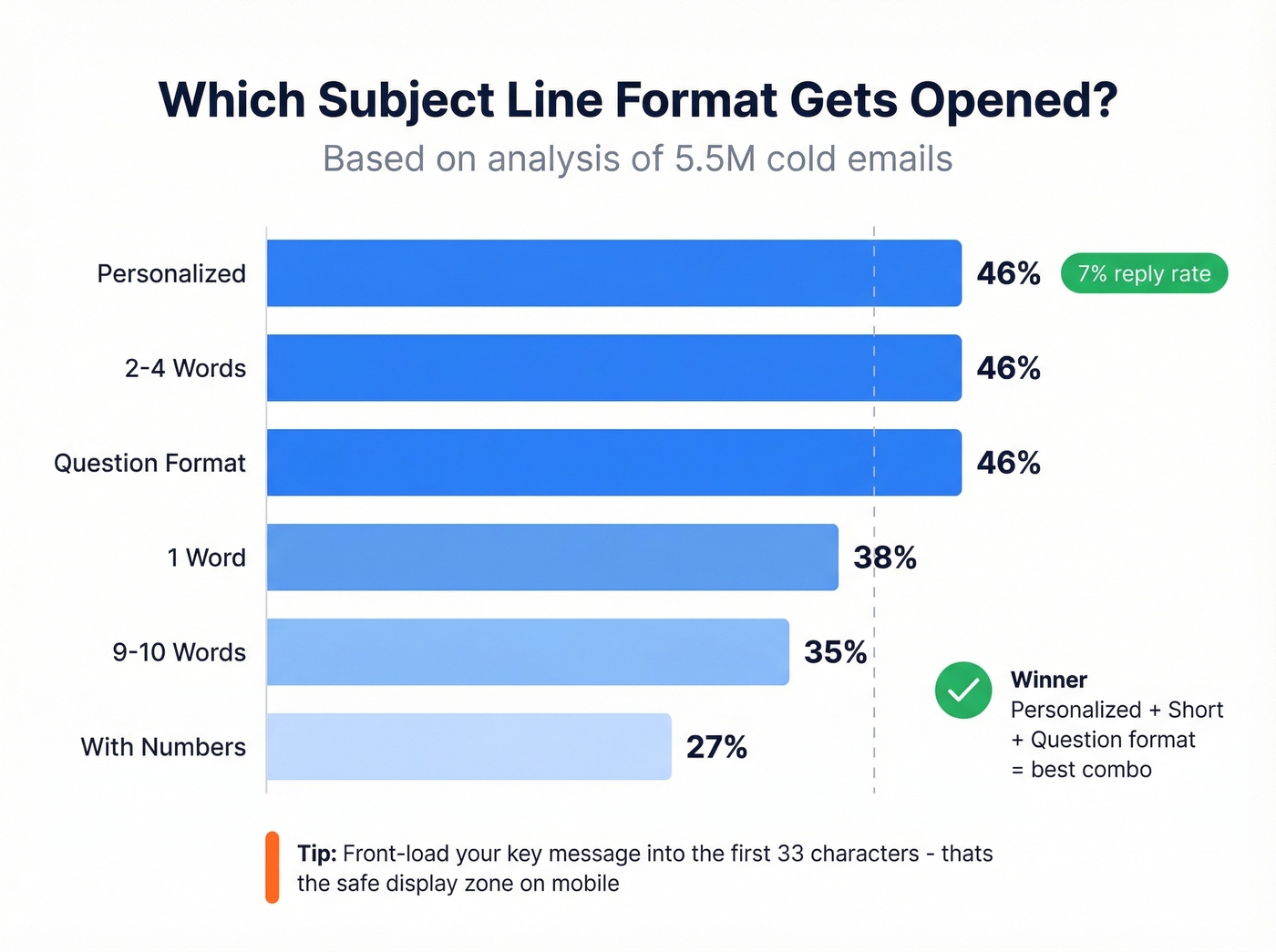
| Format | Open Rate | Reply Rate |
|---|---|---|
| Personalized | 46% | 7% |
| 2-4 words | 46% | - |
| Question format | 46% | - |
| 1 word | 38% | - |
| 9-10 words | 34-35% | - |
| With numbers | 27% | - |
One caveat: Apple Mail Privacy Protection inflates open rates by roughly 18 points, so treat reply rates as your true signal.
Front-load your key message into the first ~33 characters. That's the safe display zone across email clients and mobile devices. Anything after gets truncated. For more ideas, browse these email subject line examples.
Subject lines that work by scenario:
- After an interview: "Following up on [Role Name]"
- After a proposal: "Quick thought on the [Project] proposal"
- Project update: "[Project] - timeline check"
- Cold outreach: "[First name], one more thing"
- Networking: "Great meeting you at [Event]"
Subject lines to retire:
- "Following up" - too vague, the recipient has to guess the context
- "Quick question" - overused to the point of triggering mental spam filters
- "Just checking in" - signals you have nothing new to say
- Fake "Re:" threading - dishonest, and recipients notice
- "URGENT" or "ASAP" - unless the building is actually on fire

Follow-up emails are worthless if they bounce. 35% bounce rates kill your sender reputation and bury future emails in spam. Prospeo's 98% email accuracy means your carefully crafted follow-ups actually land in the inbox - every time.
Stop following up with dead email addresses. Start with verified data.
The 4-Part Follow-Up Framework
Every effective follow-up email asking for an update has four components. You don't need headers or bullet points in the actual email - just make sure these elements are present:
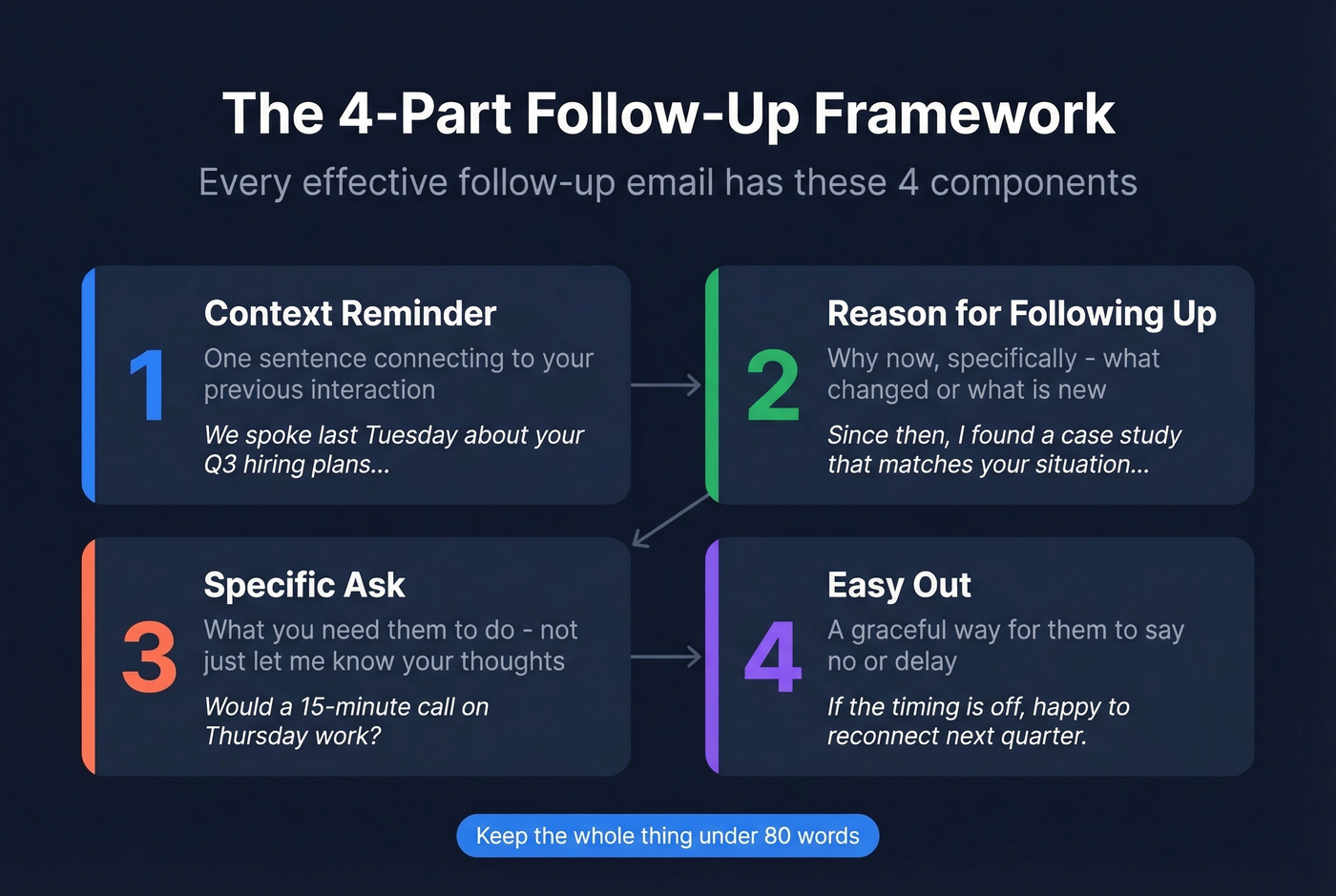
- Context reminder - one sentence connecting to the previous interaction
- Reason for following up - why now, specifically
- Specific ask - what you need them to do (not "let me know your thoughts")
- Easy out - a graceful way for them to say no or delay
Keep the whole thing under 80 words. Write like you'd talk to a colleague, not like you're drafting a legal brief.
Here's the thing: most people agonize over word choice when the real problem is they have no reason to follow up. If you can't articulate what's new or different about this touchpoint, you shouldn't be sending it. A well-timed email with a mediocre subject line will always outperform a beautifully crafted email that arrives at the wrong moment. If you want more examples, use these sales follow-up templates.
A note on cultural calibration. If you're emailing someone in Germany or Northern Europe, directness is expected - skip the softeners and get to the ask. In the US or UK, a slightly warmer tone lands better; one sentence of rapport before the request goes a long way. In Japan or South Korea, formality signals respect, so "Hi [First name]" can feel too casual. When in doubt, mirror the tone of the last email you received from that person.
8 Templates That Actually Work
After a Job Interview
The secret here is the mirror-back technique. During the interview, ask about the key attributes for success, biggest challenges, and team goals. Then reference those specifics in your follow-up. A hiring manager on r/jobsearchhacks with 1,000+ interviews says this is what separates memorable candidates from forgettable ones.
Hi [Name],
Thanks again for the conversation on [day]. You mentioned that [specific challenge or goal they shared] is a priority for the team this quarter - that's exactly the kind of problem I tackled at [Company], where I [brief result].
Happy to share more detail if it'd be helpful. Either way, looking forward to hearing about next steps.
[Your name]
After Sending a Proposal
Hi [Name],
Wanted to check in on the [Project] proposal I sent over on [date]. Any questions I can answer, or anything you'd like me to adjust?
If the timeline has shifted, no worries - just let me know and I'll follow up when it makes more sense.
[Your name]
Requesting a Project Status Update
Hi [Name],
Checking in on [Project/deliverable] - we'd originally targeted [date] for [milestone]. Can you share a quick update on where things stand? Want to make sure we stay on track for [downstream deadline].
Thanks, [Your name]
After a Meeting or Call
Hi [Name],
Good talking with you today. Wanted to recap the key point we landed on: [specific discussion item or decision]. I'll [your next step] by [date].
Let me know if anything changes on your end.
[Your name]
Cold Outreach Follow-Up
Hi [Name],
I reached out last week about [topic]. Since then, I came across [relevant insight, stat, or resource] that's relevant to [their company/role].
[One sentence on the insight.]
Worth a 15-minute call, or should I check back next quarter?
[Your name]
Overdue Invoice
Hi [Name],
Following up on Invoice #[number], sent on [date] for [amount]. Our records show it's [X days] past due. Could you confirm the payment status or let me know if there's an issue on your end?
Happy to resend the invoice if needed.
[Your name]
After a Networking Event
Hi [Name],
Great meeting you at [Event] - enjoyed our conversation about [specific topic you discussed]. I'd love to continue that discussion over coffee or a quick call.
Would [day] or [day] work for you?
[Your name]
Breakup / Final Follow-Up
Breakup emails often trigger replies precisely because they remove pressure. When someone knows this is the last email, the psychological cost of responding drops dramatically.
Hi [Name],
I've reached out a few times about [topic] and haven't heard back, so I'll assume the timing isn't right. No hard feelings - I'll close this out on my end.
If things change down the road, I'm easy to find. Wishing you a great [quarter/year].
[Your name]
Mistakes That Kill Your Reply Rate
Bumping with no new info. "Just making sure you saw my last email" tells the recipient you have nothing new to offer. Each follow-up needs to function as a standalone touchpoint with fresh value - a new angle, a relevant resource, or at minimum a clearer ask. If you're building a sequence, this B2B cold email sequence guide can help.
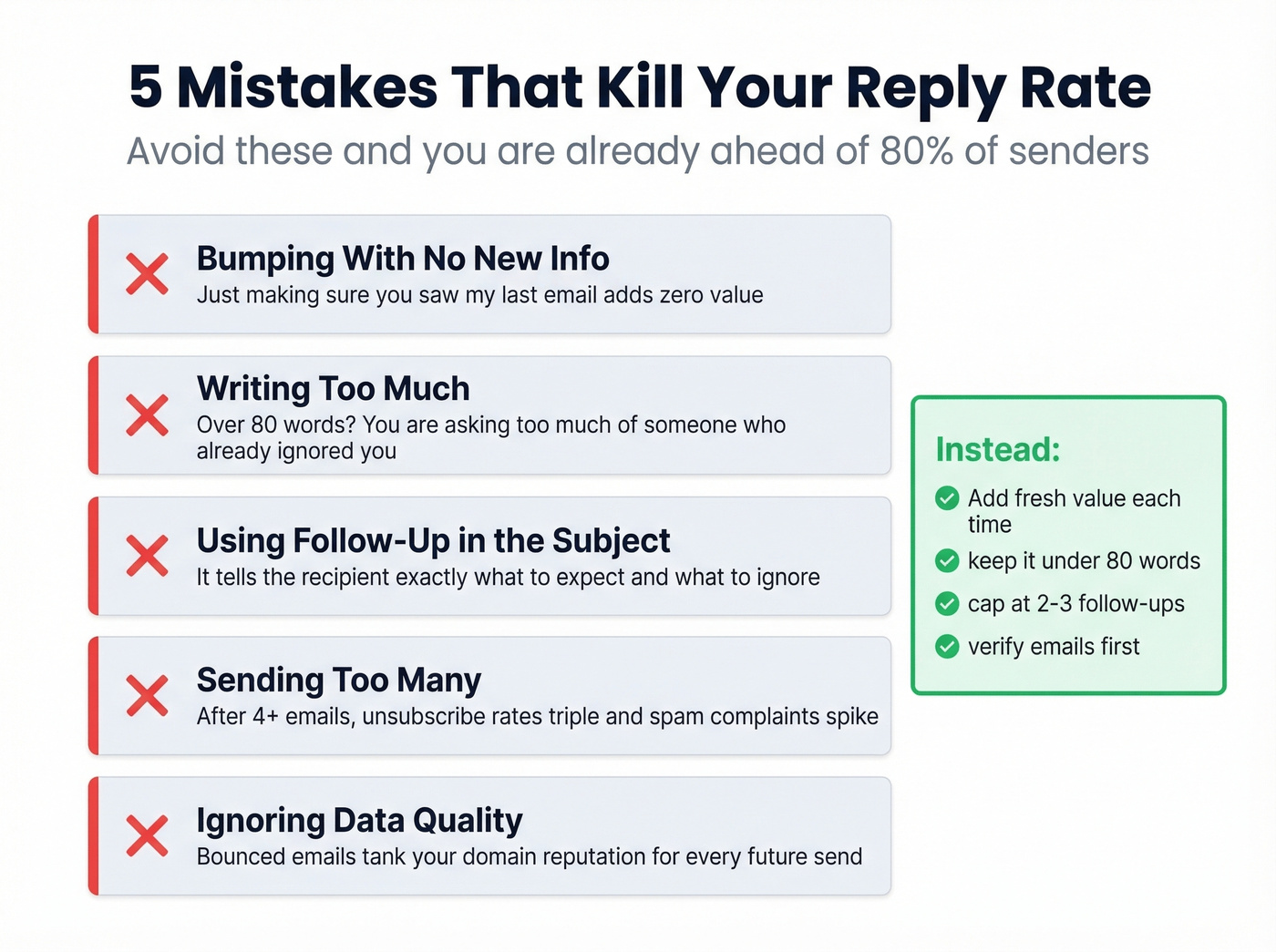
Writing too much. If your follow-up is over 80 words, you're asking too much of someone who didn't reply to the first email. Cut ruthlessly.
Using "follow-up" in the subject line. It's the email equivalent of "this is a sales call." It tells the recipient exactly what to expect - and what to ignore.
Sending too many. The data from 16.5M cold emails is clear: at four or more emails, unsubscribe rates triple and spam complaints spike. Two to three follow-ups is the ceiling for email-only sequences. After that, switch channels - phone, social, a different contact at the company.
Ignoring your data quality. You can write the perfect follow-up and it won't matter if it bounces. Bad email data is the silent killer of follow-up sequences - it tanks your domain reputation and makes future emails less likely to land, even the ones going to valid addresses. In our experience, teams that skip verification before launching sequences end up spending weeks repairing sender reputation that took months to build. If you're troubleshooting, start with email deliverability and then work on how to improve sender reputation.

You just learned the perfect follow-up cadence - but who are you sending to? Prospeo gives you 143M+ verified emails with 30+ filters so you're following up with the right decision-makers, not gatekeepers. Data refreshed every 7 days, not 6 weeks.
Find the right contact before you write the perfect follow-up.
Phrases to Retire
| Stop Saying | Say This Instead |
|---|---|
| "Just checking in" | Reference a specific reason |
| "Kindly follow up" | Drop "kindly" - it reads as condescending |
| "Touching base" | Name the specific topic |
| "Per my last email" | Restate the key point briefly |
| "I hope this finds you well" | Cut entirely - go straight to the point |
| "Any update?" | "Can you share where [X] stands?" |
None of these phrases are career-ending. But they're filler, and filler in a follow-up is the enemy. Every word needs to justify its existence when you're asking someone to respond to something they already ignored once. If you need alternatives, here’s how to say just checking in professionally.
FAQ
How long should I wait before sending a follow-up?
Two to three business days for most situations. For job interviews, wait until the timeline the interviewer gave you has passed, then add one business day. For inbound leads, respond within five minutes - research shows you're 100x more likely to connect than if you wait an hour.
How do I ask for an update without being pushy?
Reference the original request, add a brief reason why timing matters, and include an easy out like "If priorities have shifted, happy to revisit next month." This gives the recipient permission to delay without ghosting you entirely. Making it easy to respond - even with "not now" - is the key.
Is it okay to follow up more than once?
Yes - 42% of replies come from follow-ups. But cap email-only sequences at two to three touches. After four emails, unsubscribe rates triple. Each message must add new information or give the recipient a graceful exit.
What if I never hear back at all?
Send a breakup email around Day 27-29. State you'll stop reaching out, leave the door open, and move on. If it's a sales context, try a different channel - phone or social - before giving up entirely.