

Follow-Up Email Etiquette: Forget Templates - Learn the 3 Rules
Someone told you they'd get back to you Tuesday. It's Friday. You've drafted three versions of a follow-up, deleted all of them, and now you're Googling whether "just checking in" makes you sound desperate. It does - but the fix isn't a better template. Good follow-up email etiquette comes down to three rules that govern every effective message you'll ever send.
The Short Version
Three rules, stated bluntly:
- Every follow-up must contain something new - a question, a resource, a deadline.
- Two follow-ups is the ceiling for most situations. Data from 16.5 million emails backs this.
- Send Monday or Wednesday, 6-9am PST. Friday after 5pm is where follow-ups go to die.
If you remember nothing else, these three will keep you out of spam folders and off people's nerves.
Why They're Not Replying
The average office worker receives roughly 95 emails a day. That's not a metaphor for "people are busy" - it's the literal volume sitting in someone's inbox when your follow-up lands. Non-response almost never means "I hate you." It means "I haven't gotten to it."
Here's the reframe that changes everything: your follow-up isn't competing with silence. It's competing with 94 other emails. The people who win that competition aren't the ones with the cleverest subject line - they're the ones who make it easy to say yes, with the right message, at the right time, sent the right number of times.
The 3 Rules That Define Good Etiquette
Rule 1 - Every Follow-Up Needs New Value
The single biggest mistake in follow-up emails is bumping a thread with no new information. "Just making sure you saw this" adds nothing. It moves your email to the top of someone's inbox without giving them a reason to respond.
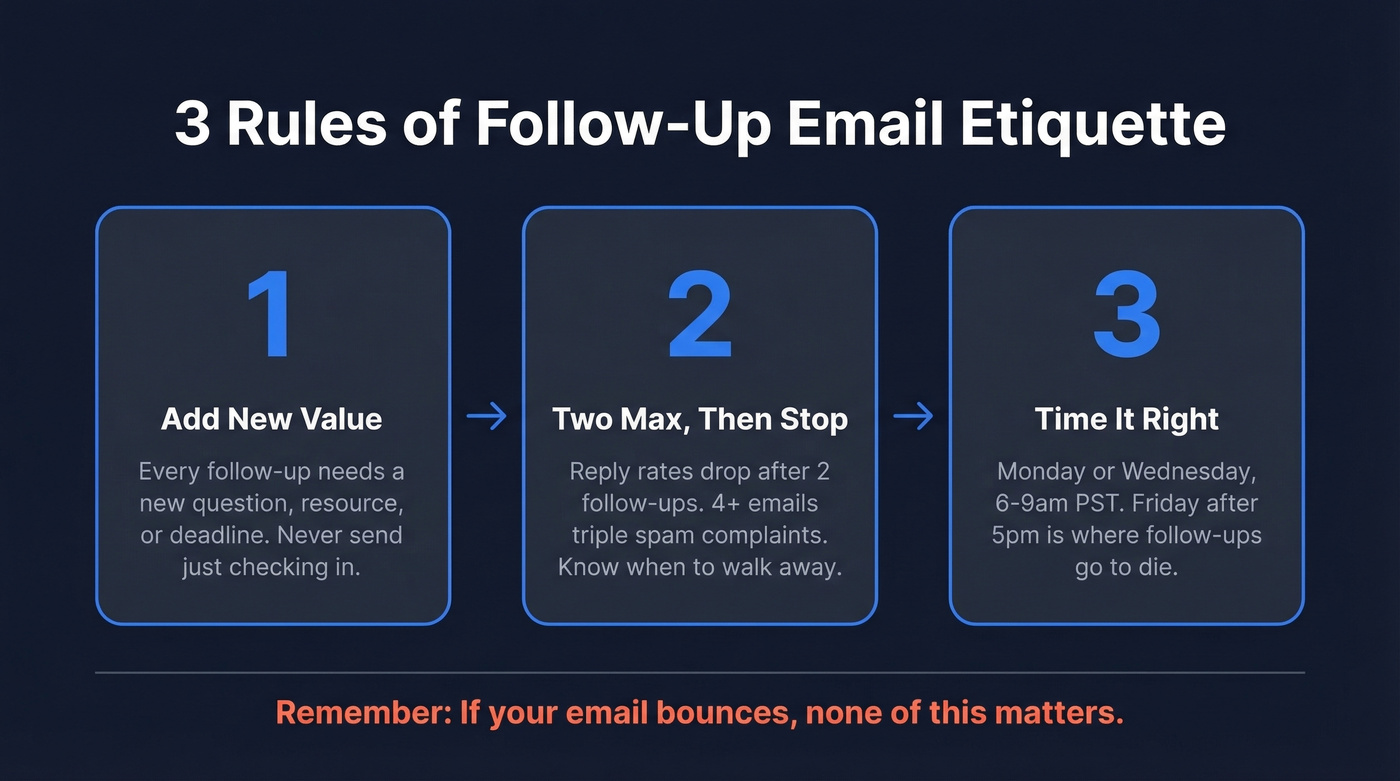
So is it ok to say "just checking in"? Not really. It's filler dressed up as politeness, and it's probably the worst phrase in professional email. Replace it with a practical pretext. One framing we've seen work well on r/sales: "I'm trying to finalize my schedule for next week - does Thursday work for you?" That's a follow-up with a built-in reason to reply.
Every follow-up should offer one of three things: a new question, a useful resource, or a deadline that creates gentle urgency. If you can't think of any of those, you probably don't have a reason to send the email yet.
If you want examples that follow this rule without sounding robotic, start with these sales follow-up templates.
Rule 2 - Two Follow-Ups, Then Stop
Belkins analyzed 16.5 million cold emails across 93 business domains. The highest reply rate - 8.4% - came from a single email. Performance declined with each additional follow-up, and sending four or more emails in a sequence more than tripled unsubscribe and spam-complaint risk.
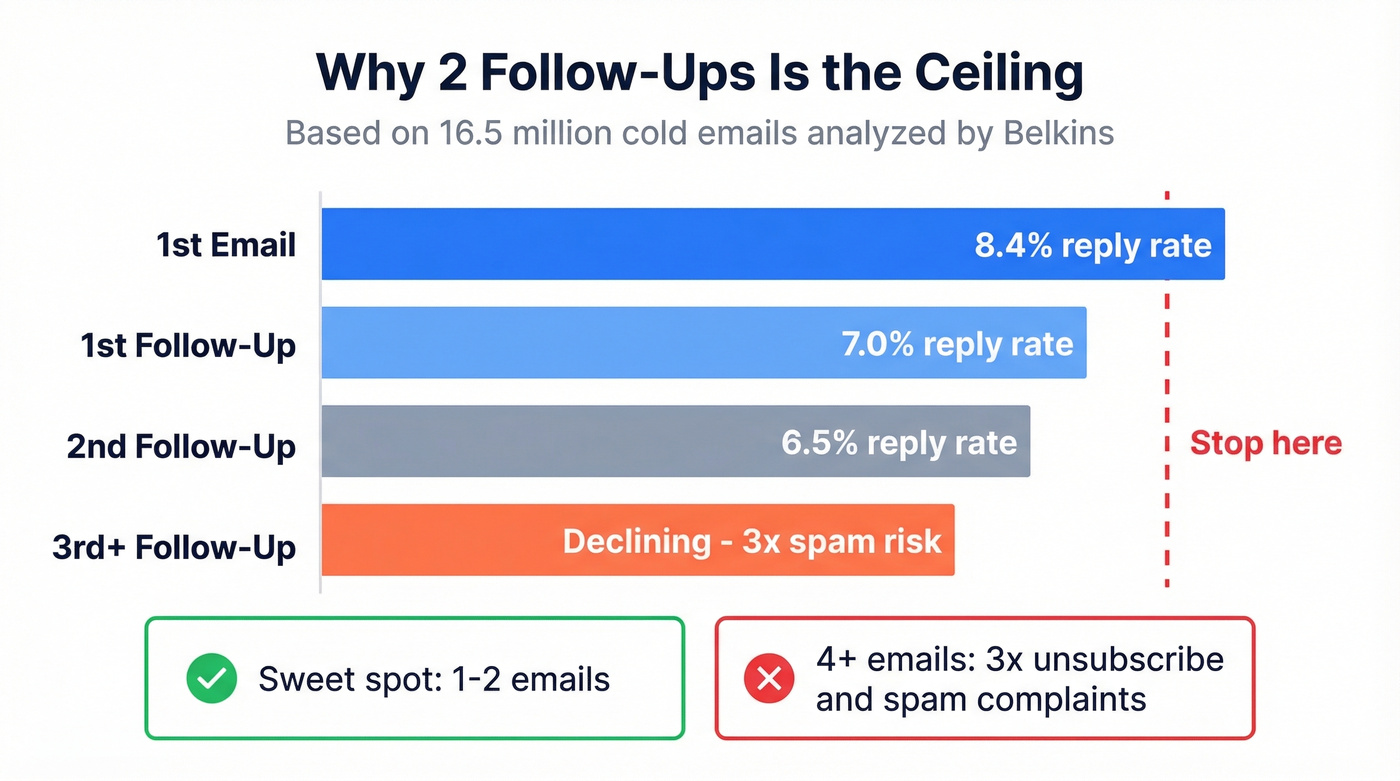
Etiquette expert Jacqueline Whitmore puts it simply: the most common faux pas is being too pushy. After two unanswered follow-ups, assume it's a pass and move on. Professionalism means knowing when to stop just as much as knowing what to say.
Company size affects tolerance slightly:
| Audience | 1st Email | 1st Follow-Up | 2nd Follow-Up |
|---|---|---|---|
| Small biz (2-50) | 9.2% reply | 8.0% | 8.4% |
| Founders | 6.6% reply | 6.7% | 6.9% |
After that second follow-up, both segments drop sharply. You're not being persistent at that point. You're becoming a notification being ignored.
If you're building a repeatable system around this, it helps to think in terms of sequence management rather than one-off emails.
Rule 3 - Timing Is Half the Battle
Siege Media analyzed 85,000+ outreach emails and found a clear winner: Monday mornings between 6-9am PST. In their dataset, that window had 20%+ open rates and a 2.8% reply rate. Wednesday came in close behind at 17.2% open and 2.6% reply.
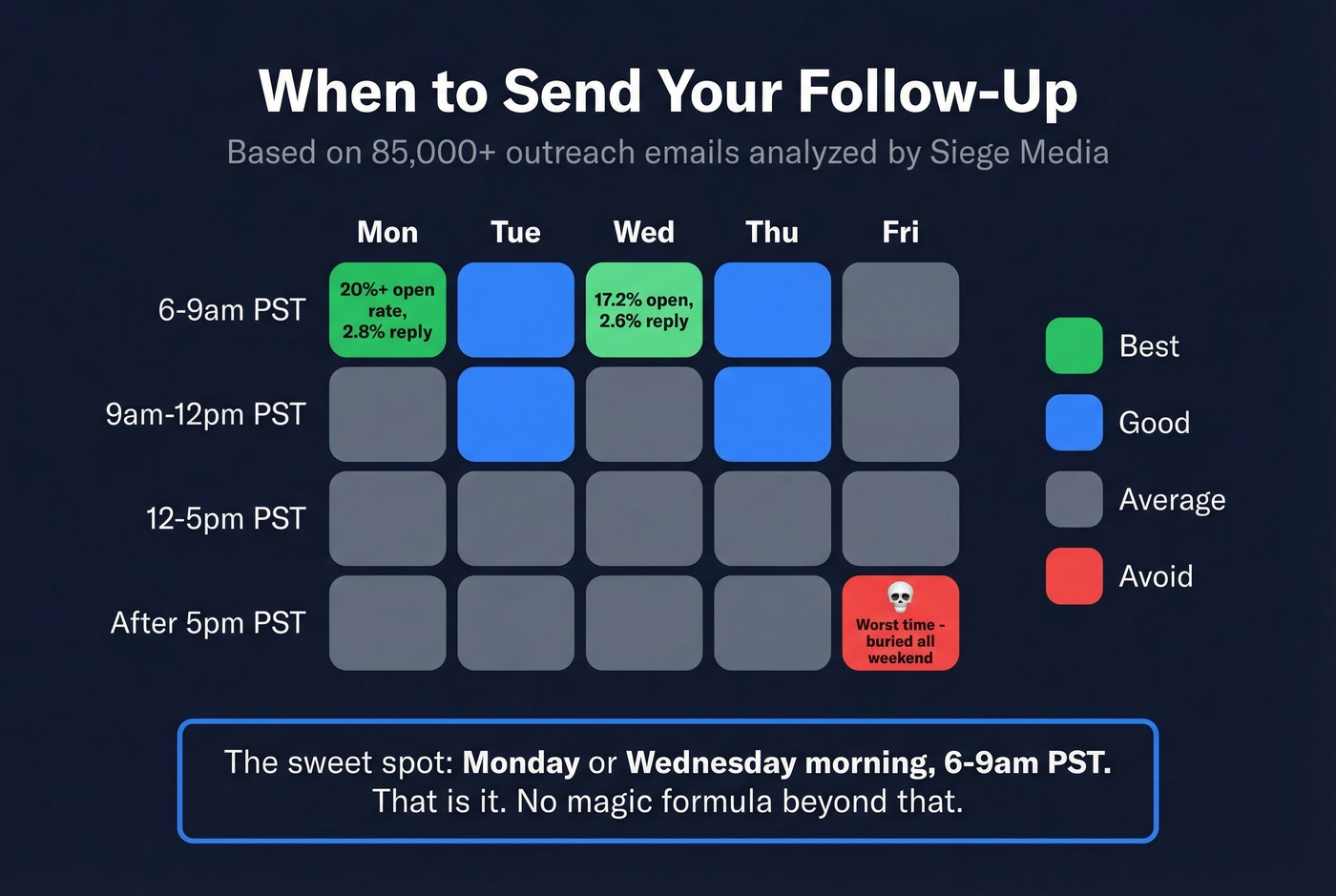
Friday after 5pm? Your email gets buried over the weekend and forgotten by Monday's inbox avalanche. If you're going to follow up, do it early in the week, early in the morning. That's it. No magic formula beyond that.
For a deeper breakdown (and how it changes for cold vs warm), see our guide on the best time to send cold emails.
Phrases That Backfire
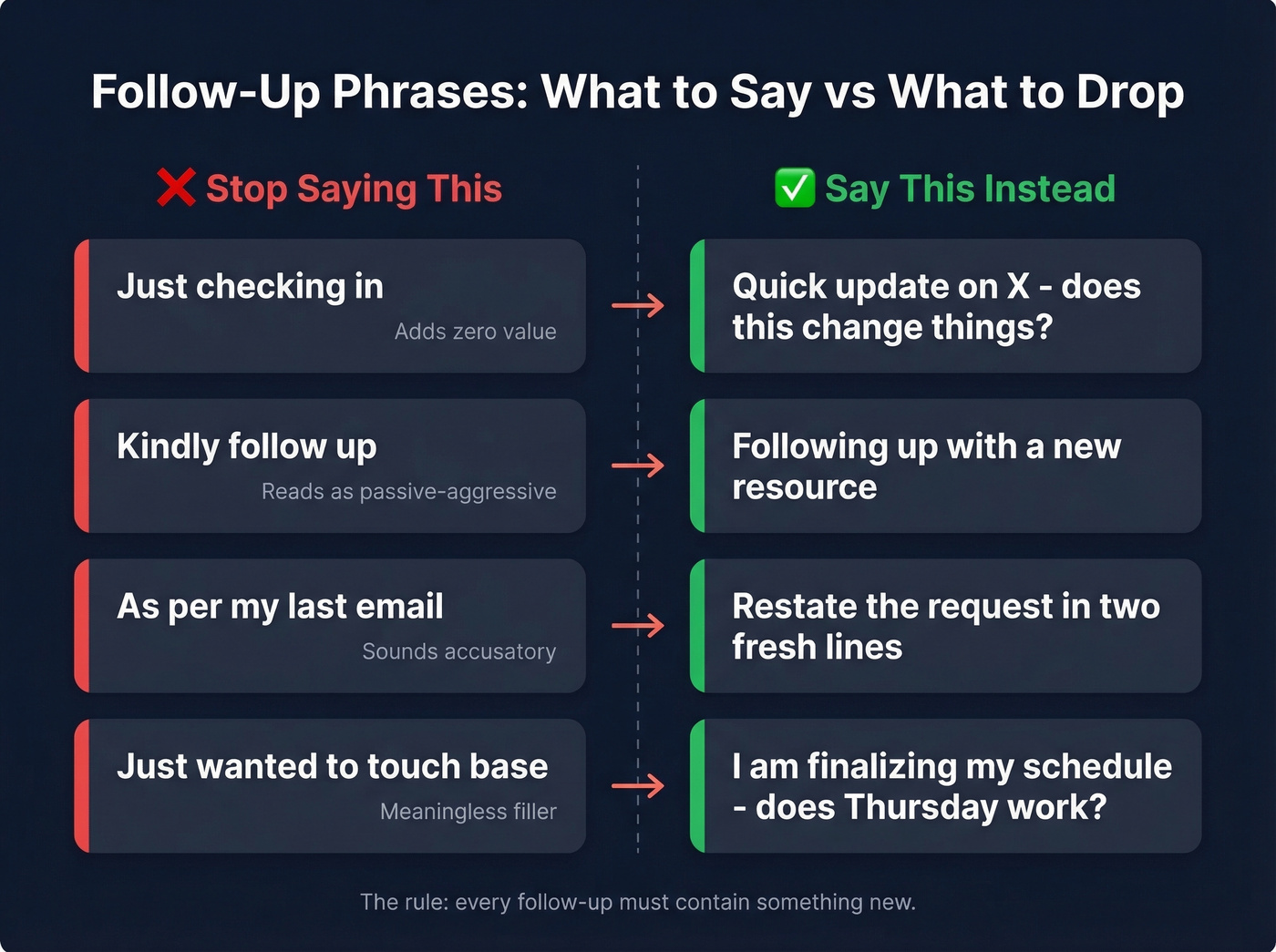
Some phrases feel polite but land poorly. Let's break down the worst offenders:
| Don't Say | Why It Fails | Say Instead |
|---|---|---|
| "Just checking in" | Adds zero value | "Quick update on X - does this change things?" |
| "Kindly follow up" | Reads as passive-aggressive | "Following up with a new resource" |
| "As per my last email" | Accusatory tone | Restate the request in two lines |
| "Just wanted to touch base" | Meaningless filler | "I'm finalizing my schedule - does Thursday work?" |
"Kindly" is a particularly sneaky one. It's often used to sound formal, but it comes off as scolding in everyday business English. Drop it entirely.
If you’re trying to keep the tone firm without sounding annoyed, these emails that get responses patterns help.

You've mastered the etiquette - now make sure your follow-ups actually land. Prospeo's 98% email accuracy and 5-step verification mean your carefully crafted messages reach real inboxes, not bounce logs. Under 4% bounce rates aren't aspirational - they're what our users actually see.
Stop perfecting emails that bounce. Start sending to verified contacts.
Etiquette Across Cultures
If you're emailing internationally, the rules shift. We've learned this the hard way running outbound across multiple regions.
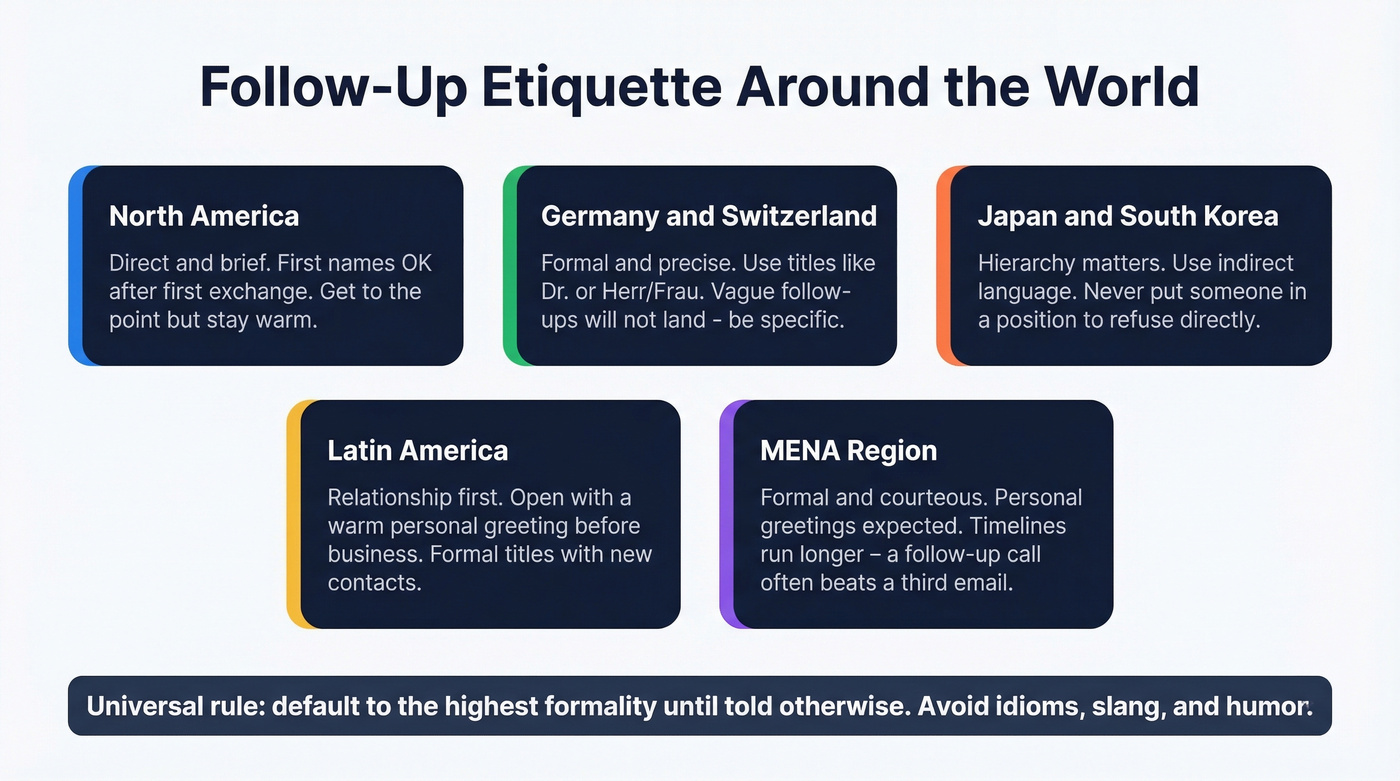
North America: Direct and brief. First names are fine after the first exchange. Get to the point, but stay warm.
Germany/Switzerland: Formal, precise, detail-oriented. Use titles (Dr., Herr/Frau) until told otherwise. Vague follow-ups won't land - these audiences want specifics.
Japan/South Korea: Hierarchy matters. Use indirect language, soften requests, and never put someone in a position where they'd have to refuse directly.
Latin America: Relationship-first. Open with a warm, personal greeting before getting to business. Formal titles with new contacts.
MENA: Formal and courteous. Personal greetings are expected. Response timelines run longer than you're used to - a follow-up call is often more effective than a third email.
The universal rule: default to the highest level of formality until the other party signals otherwise. And avoid idioms, slang, and humor in cross-cultural emails. What's funny in Chicago can be confusing in Cologne.
How to Resend an Email Politely
Sometimes the issue isn't etiquette - it's that your original message never landed or got lost in the noise. If you need to resend an email to the same person, don't just forward the original with "bumping this." Change the subject line slightly, add one line of new context, and send it at a better time slot. This resets the email's visibility without making you look like you're copy-pasting.
Skip this approach if you've already sent two follow-ups. At that point, a resend isn't a strategy - it's spam.
If you’re unsure about the right delay, our guide on when should you follow up on an email breaks it down by scenario.
Templates You Can Steal
Each template below demonstrates all three rules: new value, brevity, and appropriate timing.
After No Response (Warm Contact)
Hi [Name], wanted to share a quick update - [one sentence of new info or resource]. Does this change the timeline on your end? Happy to jump on a 10-minute call this week if it's easier.
After No Response (Cold Outreach)
Hi [Name], I sent a note last [day] about [topic]. Since then, [new data point or relevant trigger - e.g., "I noticed your team just posted a role for X"]. Worth a quick conversation? If not, no worries at all.
After Being Ghosted on a Promised Next Step
Hi [Name], I know things get hectic - just wanted to circle back since we'd talked about connecting on [day]. I'm finalizing my schedule for next week. Would [specific day] work, or should we push to the following week?
After a Meeting With No Follow-Through
Hi [Name], great conversation on [day]. I put together [deliverable - a summary, a proposal, a resource] based on what we discussed. Attached here. Let me know if [specific next step] still makes sense for [timeframe].
If you want more options tailored to specific situations, use these cold email follow-up templates.
The Mistake Nobody Talks About
Look, none of this follow-up email etiquette matters if your email bounces. A wrong or outdated email address doesn't just waste your follow-up - it damages your sender reputation. Industry benchmarks say to keep bounce rates under 5%, and in our experience, most teams are running well above that without realizing it. One client we work with went from a 35% bounce rate to under 4% just by verifying their list before sending.
Prospeo catches bad addresses before they tank your deliverability. With 98% email accuracy and a 7-day data refresh cycle, it's the pre-flight check your follow-up sequence needs.
If you’re troubleshooting deliverability, start with email bounce rate benchmarks and this email deliverability guide.

Running outbound across cultures? Prospeo gives you 300M+ professional profiles with verified emails and direct dials across every region - refreshed every 7 days so you're never following up with stale data. At $0.01 per email, bad data stops being an excuse.
Two follow-ups is the limit. Make both count with accurate data.
FAQ
How long should I wait before following up?
Two to three business days is the sweet spot for most professional contexts. Siege Media's 85,000-email dataset shows Monday and Wednesday mornings between 6-9am PST get the best response rates. Friday after 5pm buries your message under the weekend pile.
How many follow-up emails is too many?
Two is the safe ceiling for nearly every situation. Belkins' 16.5-million-email study found that four or more emails in a sequence more than triples unsubscribe and spam-complaint risk. After two unanswered messages, assume it's a pass and redirect your energy.
How do I follow up without sounding pushy?
Add something new every time - a resource, a question, or a deadline. Replace "just checking in" with a practical reason to reconnect, like "I'm finalizing my schedule for next week - does Thursday work?" And before you send, make sure the address is valid. A bounced follow-up is worse than no follow-up at all.