

Follow-Up Emails for Cold Leads: Why Yours Aren't Working (and How to Fix Them)
You just rewrote your follow-up sequence for the third time this quarter, and reply rates haven't moved. Here's the thing: the problem probably isn't your copy. A Belkins analysis of 16.5M cold emails found the highest reply rate - 8.4% - came from a single email, and sending 4+ emails in a sequence more than triples unsubscribe and spam complaint rates. Your follow-up email for cold leads isn't underperforming because of weak subject lines. It's underperforming because of bad data and broken infrastructure.
What You Need (Quick Version)
- Fix your data first. If your bounce rate is above 2%, deliverability will collapse no matter how good your templates are. Verify every list before it touches a sequencer. (If you need benchmarks, start with bounce rate.)
- Cap your sequence at 3-4 follow-ups. After that, switch channels. More emails just accelerate spam complaints.
- Keep every follow-up under 60 words and add something new each time. "Just checking in" is dead (use alternatives from just checking in).
Fix Your Data Before Following Up
Most cold lead follow-up guides skip straight to templates. That's backwards.
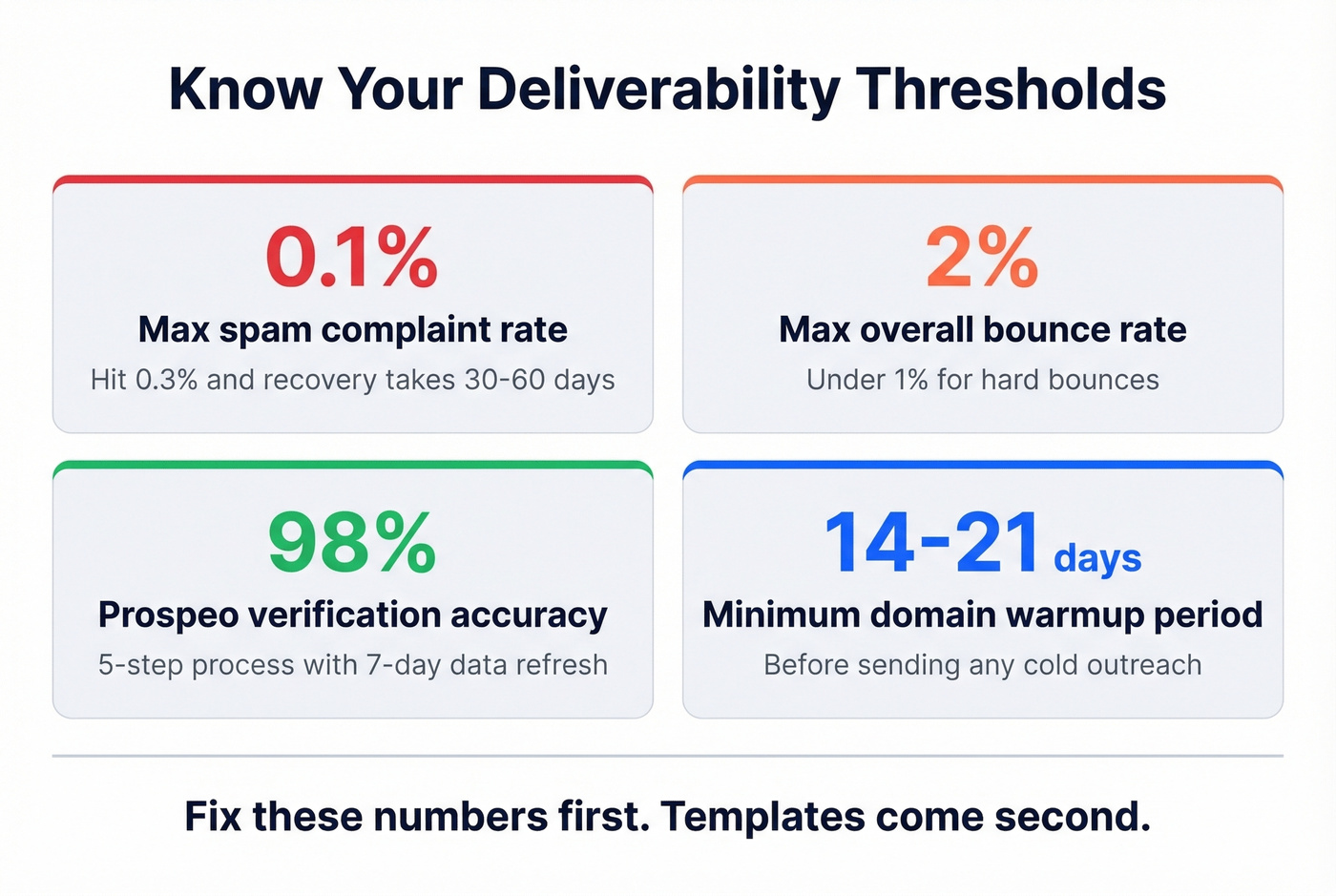
One founder on r/Entrepreneur shared their rebuild: bounce rate dropped from 11% to under 2%, and reply rates doubled from 3% to 6%. The biggest lever wasn't copy - it was list quality and infrastructure. Google and Yahoo's sender standards are unforgiving. Your spam complaint rate needs to stay below 0.1%; hit 0.3% and you're looking at severe throttling that takes 30-60 days to recover from. Bounce targets should be under 2% overall, under 1% hard bounces. Every email above those thresholds compounds the damage. And here's a data point worth internalizing: that 16.5M-email study found that Belkins stopped tracking open rates entirely because tracking pixels were hurting deliverability (more on tracking pixels). If your open tracking is doing more harm than good, kill it.

Before you send a single follow-up, verify your list. Prospeo checks emails in real-time with 98% accuracy through a 5-step verification process - catch-all handling, spam-trap removal, honeypot filtering - on a 7-day data refresh cycle while the industry average sits at six weeks. Stack Optimize built to $1M ARR running client deliverability at 94%+ with bounce rates under 3% and zero domain flags across all clients. Meritt saw bounce rates drop from 35% to under 4%.
Beyond verification, treat these as non-negotiables: secondary sending domains (never cold email from your primary), SPF/DKIM/DMARC configured on every domain, and a 14-21 day warmup before going live (see email warmup tools). We've seen teams burn through three domains in a month because they skipped these steps.
How Many Follow-Ups Should You Send?
The 16.5M-email dataset is clear: reply rates decline with each follow-up, and the 4th follow-up is the inflection point where unsubscribe and spam complaint rates spike. Only 8% of reps follow up more than five times - but that doesn't mean you should send 12 emails. It means most of your competition quits after one or two, and the window between "persistent" and "spam" is narrower than you think.
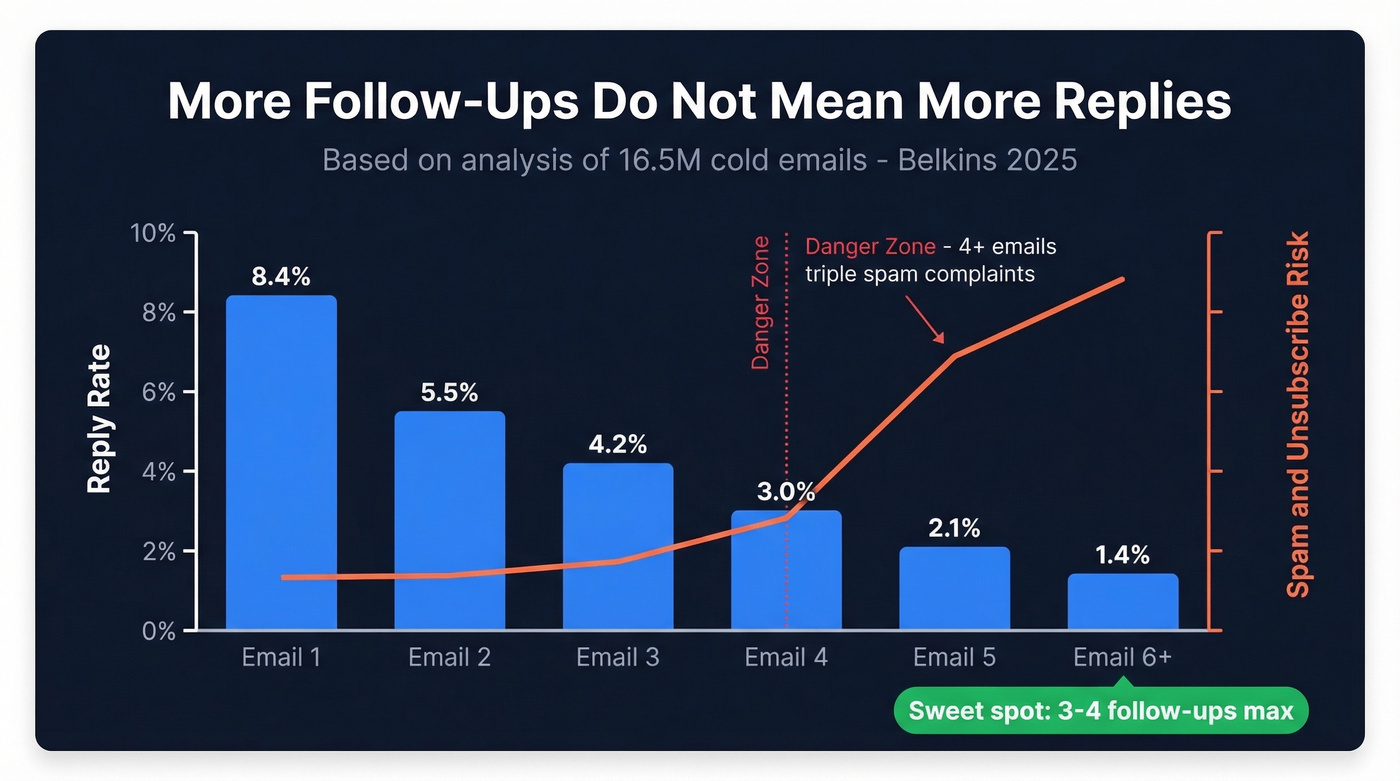
Persona matters too. SMBs tolerate more touches; enterprise prospects ghost quickly, and persistence can get your domain flagged (see the full email deliverability breakdown). Founders hold steady through early touches, but by the fourth follow-up their response rate drops to roughly 3%.
Three to four follow-ups maximum. If someone hasn't replied by then, more emails won't change their mind - they'll just train inbox providers to filter you out.
Let's be honest about deal size, too. If your average deal is under $10k, you probably don't need more than two follow-ups. The math doesn't support burning sender reputation on low-value deals that need five touches to close.

You read the data: bounce rates above 2% destroy deliverability and kill follow-up sequences before they start. Prospeo's 5-step verification - catch-all handling, spam-trap removal, honeypot filtering - delivers 98% email accuracy on a 7-day refresh cycle. Meritt dropped bounce rates from 35% to under 4%. Stack Optimize hit $1M ARR with zero domain flags.
Fix your list before you fix your follow-up copy.
Writing Follow-Ups That Earn Replies
| Touch | Day | Purpose |
|---|---|---|
| Initial email | Day 0 | First outreach |
| Follow-up 1 | Day 3 | New angle, brief |
| Follow-up 2 | Day 7 | Social proof or stat |
| Follow-up 3 | Day 14 | Final value add |
| Breakup | Day 21 | Close the loop |
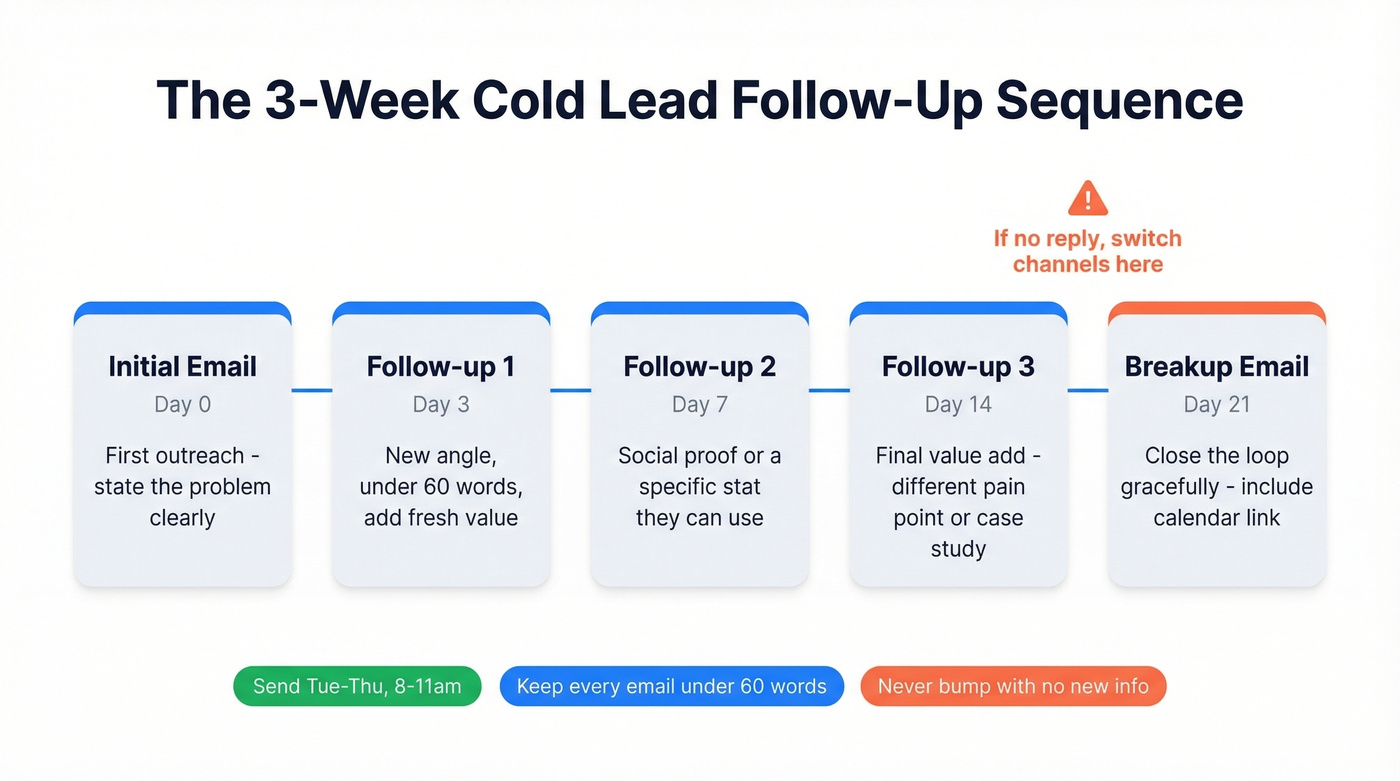
Send Tuesday through Thursday, 8-11am in the recipient's timezone. That Reddit founder who doubled their reply rate reported a 16% improvement in opens just from fixing send timing. For scenario-specific timing: follow up within 24 hours after a demo, within 2 hours after a call, and 3-5 days after an initial cold outreach with no response (see more in when should you follow up).
Every follow-up needs a simple structure: Context, Value, CTA. Remind them why you're reaching out, add something they didn't have before, and make the ask easy (tighten your email call to action). Executives receive 140+ emails per day - the under-60-word rule isn't arbitrary. That Reddit practitioner cut emails from 141 words to under 56 and saw measurably better results. Brevity forces you to lead with value instead of filler.
Each email must earn its place. Bumping with no new info is the single most common mistake in cold lead re-engagement. Map each touch to a different angle:
Follow-up 1 - Value-add (Day 3):
Saw [Company] is expanding into [market]. We helped [similar company] add 10-15 qualified leads/month in that segment. Worth a 15-min look?
Follow-up 2 - Social proof (Day 7):
Quick data point: [Customer] cut their [metric] by [X%] in 6 weeks using this approach. Happy to share the breakdown if useful.
Follow-up 3 - Breakup (Day 14-21):
Closing the loop on this. If timing's off, no worries - I'll stop reaching out. If [pain point] comes back up, here's my calendar link.
One distinction most guides miss: if these leads previously engaged - took a demo, replied once, then went silent - your approach should differ. Lead with their prior words and a specific trigger event rather than treating them like a first-touch prospect (see sales follow-up templates for variations).
For subject lines, personalized lines in the 36-50 character range perform best (use these subject line examples). Reply in-thread for the first follow-up, then switch to a fresh subject line to re-engage.
When to Switch Channels
After two or three unanswered emails, stop emailing and move to a different channel. The 16.5M-email dataset showed that a message plus profile visit combo on professional networks hit an 11.87% reply rate - significantly outperforming email follow-ups at that stage. Phone works too, especially for director-level and above.
In our experience, the breakup email at Day 21 outperforms a fifth follow-up every time. If your cold lead outreach strategy relies solely on email, more email won't fix it.
Mistakes That Kill Reply Rates
Look, we've audited dozens of sequences across our customer base. The same five problems show up over and over:
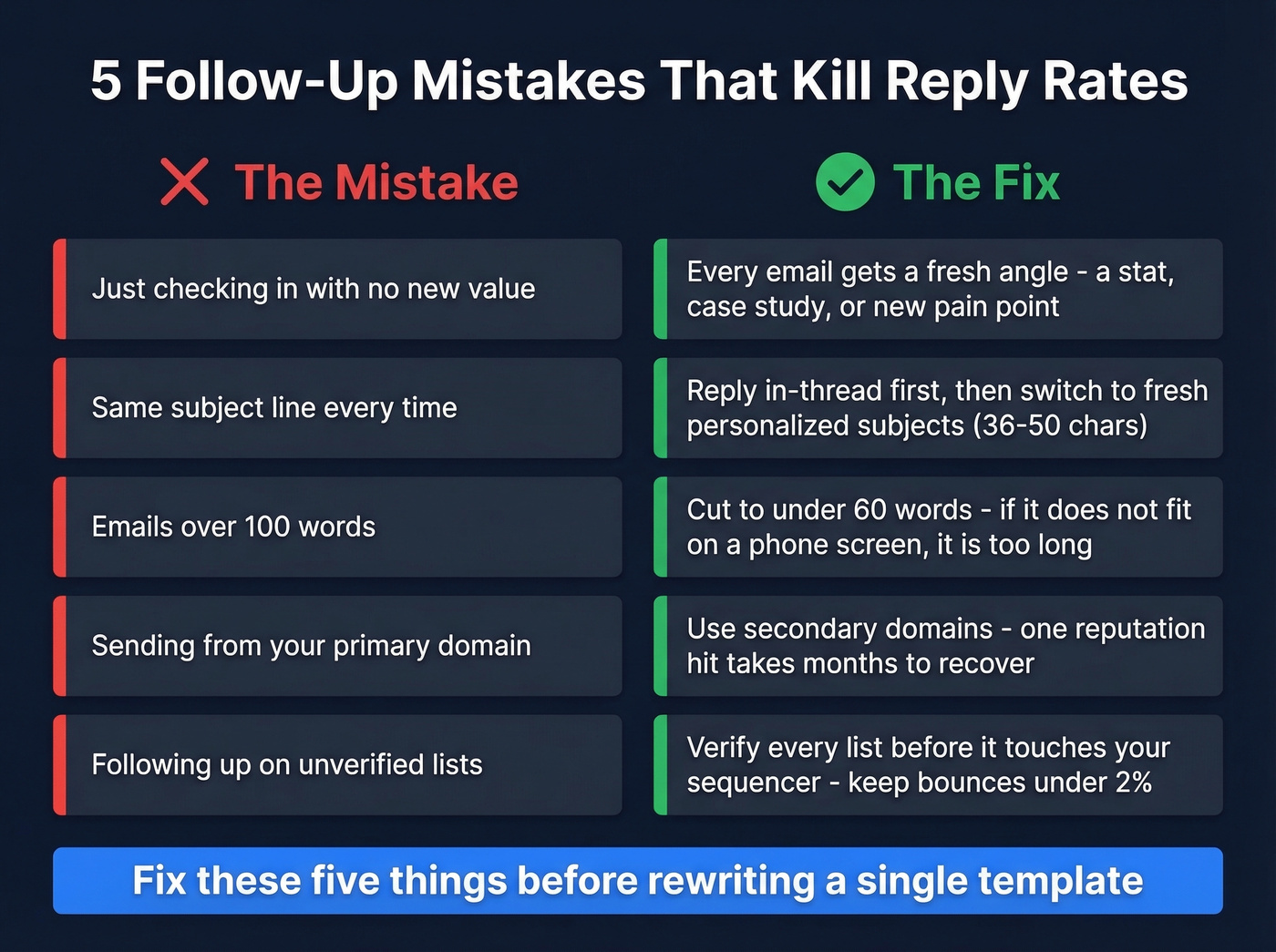
- "Just checking in" with no new value. Every email needs a fresh angle - a stat, a case study, a different pain point. If you can't articulate what's new, don't send it.
- Same subject line every time. Change it at key steps in your sequence to re-engage.
- Emails over 100 words. Cut ruthlessly. If it doesn't fit on a phone screen, it's too long.
- Sending from your primary domain. Use secondary domains. One hit to your sender reputation can take months to recover (see improve sender reputation).
- Sending follow-ups to unverified lists. This is the fastest way to burn a domain. Run every list through email verification before it touches your sequencer.
Skip the "7-touch, 21-day mega-sequence" templates you'll find on most sales blogs. For teams with deal sizes under $25k, they're overkill and the domain risk isn't worth it.
Three follow-ups max means every email has to reach the right person. Prospeo gives you 300M+ verified profiles with 30+ filters - buyer intent, job changes, technographics - so your cold lead list is accurate before the first send. At $0.01 per email, rebuilding a clean list costs less than one bounced sequence.
Stop following up with dead data. Build a list that replies.
Compliance in 30 Seconds
CAN-SPAM applies to every email in your sequence, not just the first. Each message needs a physical postal address, a clear opt-out link, and non-deceptive headers. Honor opt-outs immediately - the law says 10 business days, but best practice is instant suppression. For GDPR, B2B cold outreach typically falls under legitimate interest, but you still need to honor deletion requests and practice data minimization.
FAQ
How long should a follow-up email be?
Under 60 words. Shorter follow-ups consistently outperform longer ones - one practitioner cut from 141 to under 56 words and saw reply rates climb. When executives get 140+ emails daily, brevity is respect.
Should I use the same subject line for every follow-up?
No. Reply in-thread for the first follow-up, then switch to fresh subject lines. Personalized lines in the 36-50 character range perform best. Repeating the same subject trains recipients to ignore you.
What's a good reply rate for cold outreach in 2026?
A realistic reply rate at scale is 2-4%. The best-performing single emails in the 16.5M-email study hit 8.4%. If you're consistently below 1%, check your deliverability and list quality before rewriting copy.
What tools help automate and verify follow-up sequences?
Most sequencing tools handle automated cadences well - Instantly (~$37/mo), Smartlead (~$39/mo), Lemlist (~$69/mo), Woodpecker (~$29/mo), and GMass (~$25/mo) are popular options. For list verification before sending, Prospeo starts free with 75 emails/month and scales at ~$0.01/email - critical for keeping bounce rates under 2%.