

How to Write a Follow Up Email That Actually Gets a Response
You sent a solid email. Crickets. Across 16.5M cold emails analyzed by Belkins, the first email only pulls an 8.4% reply rate - and a popular r/b2b_sales benchmark compilation pegs 5-6% as a realistic baseline. Performance declines with each subsequent message, and once you push a sequence too far, unsubscribe and spam complaints spike. Following up isn't pushy. It's how professional communication actually works.
What You Need (Quick Version)
- Personalized subject line, 2-4 words, phrased as a question. This combination hits 46% open rates and doubles reply rates.
- Add new value in every follow-up. Each message needs a reason to exist.
- Stop at 3 follow-ups. Four-plus emails more than triples spam complaints.
Subject Lines That Get Opened
A study of 5.5M emails broke down exactly what works. Personalized subject lines hit a 46% open rate versus 35% without - a 31% lift. They also doubled reply rates: 7% versus 3% without personalization. Question-style subject lines matched that 46% open rate, and the sweet spot for length is 2-4 words. Once you hit 9-10 words, opens drop to 34-35%.
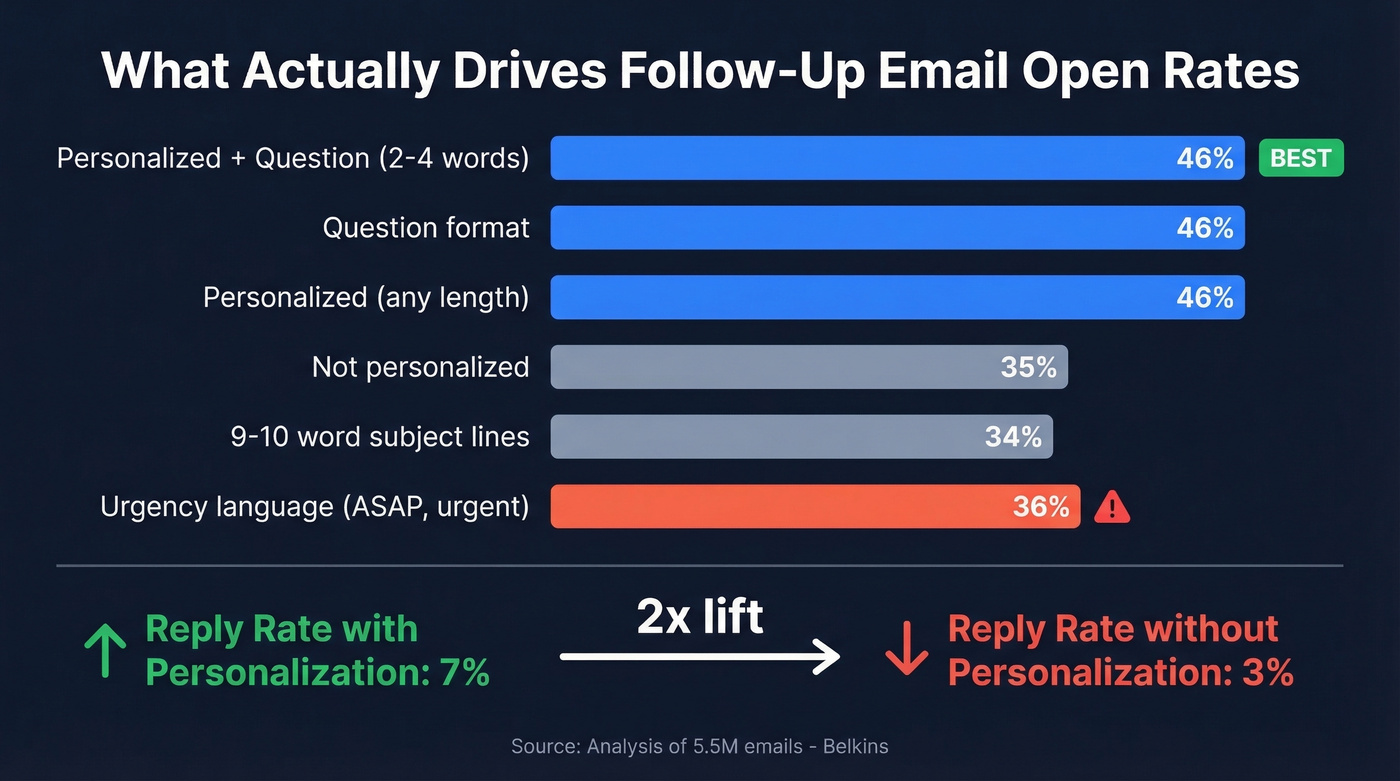
What tanks your opens: urgency language like "ASAP" drags rates below 36%. Never put "follow-up," "checking in," or "no response" in the subject line - even HBR has warned against vague subject lines like these, and they signal zero new value. Numbers in subject lines pulled slightly lower open rates too.
Short. Personal. Question. That's the formula.
When to Send Each Follow-Up
| Context | Wait Time | Max Follow-Ups |
|---|---|---|
| Cold outreach | 3-5 biz days | 3 |
| Post-meeting | 2-3 biz days | 2 |
| Job application | 7-10 biz days | 2 |
| Networking | 5-7 biz days | 2 |
| Urgent matter | 24-48 hours | 1-2 |
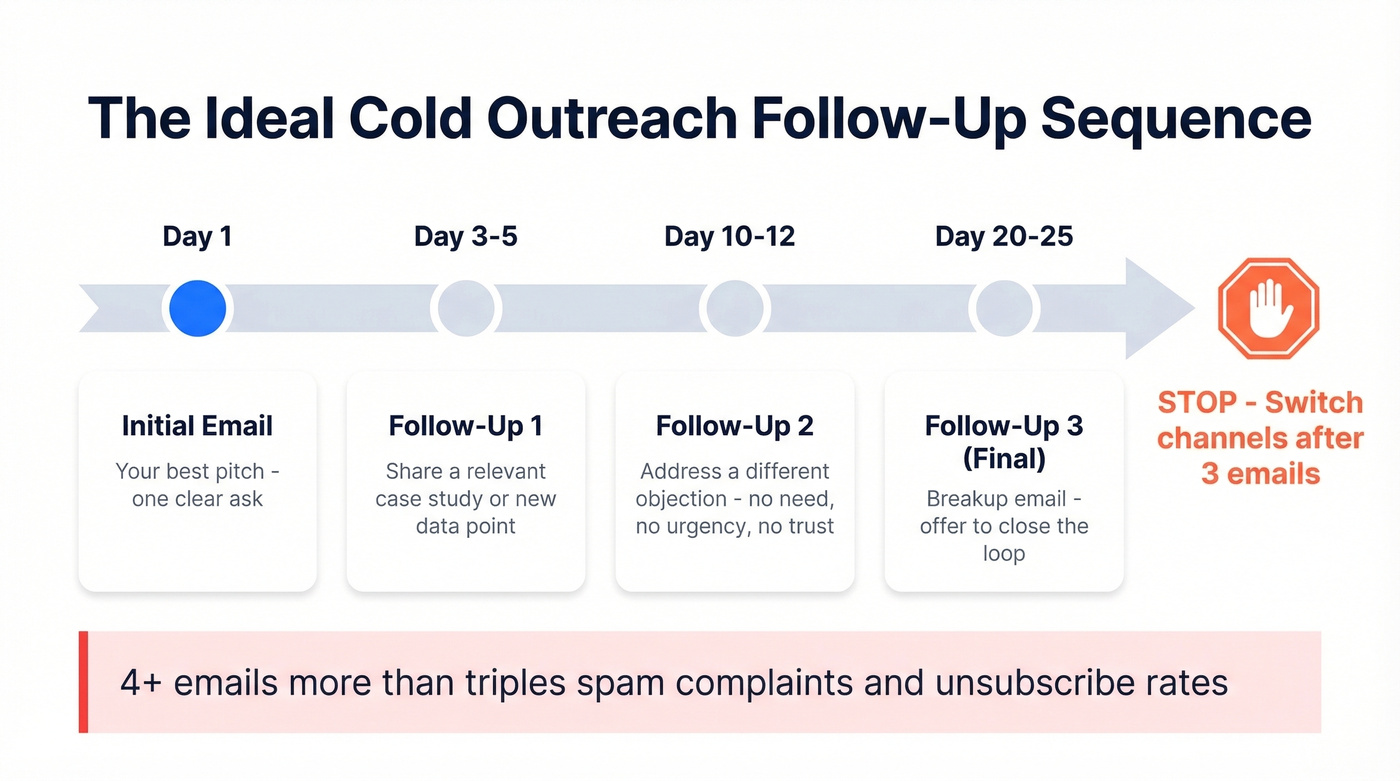
For cold outreach, space your three emails at roughly Day 3-5, Day 10-12, and Day 20-25. That's far enough apart to avoid fatigue but close enough to stay relevant. SMBs tend to tolerate more follow-ups than enterprise contacts, who ghost quickly and punish persistence with spam reports.

Great follow-up copy can't fix a 35% bounce rate. Snyk's 50 AEs dropped from 35-40% bounces to under 5% - and saw pipeline jump 180% - by verifying every email before sending. Prospeo's 98% email accuracy means your carefully timed follow-ups actually reach real inboxes.
Start verifying for free at ~$0.01/email. No contracts, no sales calls.
Templates That Actually Work
Every template below follows the same principles: reply in-thread, keep it under 100 words, plain text, lead with something new. A well-structured follow-up should never rehash your original pitch - it should give the reader a fresh reason to engage. If you want more plug-and-play options, start with these sales follow-up templates.
Cold Outreach (No Response)
Most people replay their first email. Don't. The whole point of a follow-up is to give the recipient a new reason to care, and we've seen this mistake kill reply rates more than almost anything else. Here's what a good one looks like:
Subject: [Their company] + [your value prop]?
Hey [Name],
Wanted to share something relevant - [Company similar to theirs] cut their [metric] by [X%] using [approach]. Wrote up a quick breakdown here: [link].
Worth a 15-minute call to see if the same approach fits [their company]?
Post-Meeting Follow-Up
Subject: [Specific topic you discussed]
Hi [Name],
Great conversation about [specific point]. I pulled together [deliverable] based on what you mentioned about [their challenge].
Does Thursday or Friday work to walk through it?
Reference something specific from the conversation. Generic "great meeting" emails get buried. For more examples, see a full sales meeting follow-up email breakdown.
Bad vs. Good: The Proposal Follow-Up
Bad: "Hi [Name], just checking in on the proposal I sent last week. Let me know if you have any questions!"
Good: "Hi [Name], since sending the proposal I ran the numbers on [specific concern they raised] - turns out [new finding]. Updated version attached. Worth 10 minutes Thursday to walk through it?"
The difference is obvious: the good version gives them a reason to re-engage instead of just reminding them you exist. One adds value. The other adds noise. (If you need better phrasing, here's how to say just checking in professionally.)
Job Application
Subject: [Role title] - quick update?
Hi [Name],
Since applying, I [completed relevant project / earned certification] that directly relates to [key requirement from the job posting]. Happy to share more details.
Wait 7-10 business days before sending this. Restate your value-add - don't just ask for a status update.
Mistakes That Kill Your Response Rate
"Bumping" without new value. Every follow-up needs a reason to exist. GMass recommends structuring each message around a different objection: no need, no urgency, no trust, not worth the cost, or don't want it. That's five angles before you repeat yourself. (More on the importance of follow-up in sales if you need the bigger picture.)
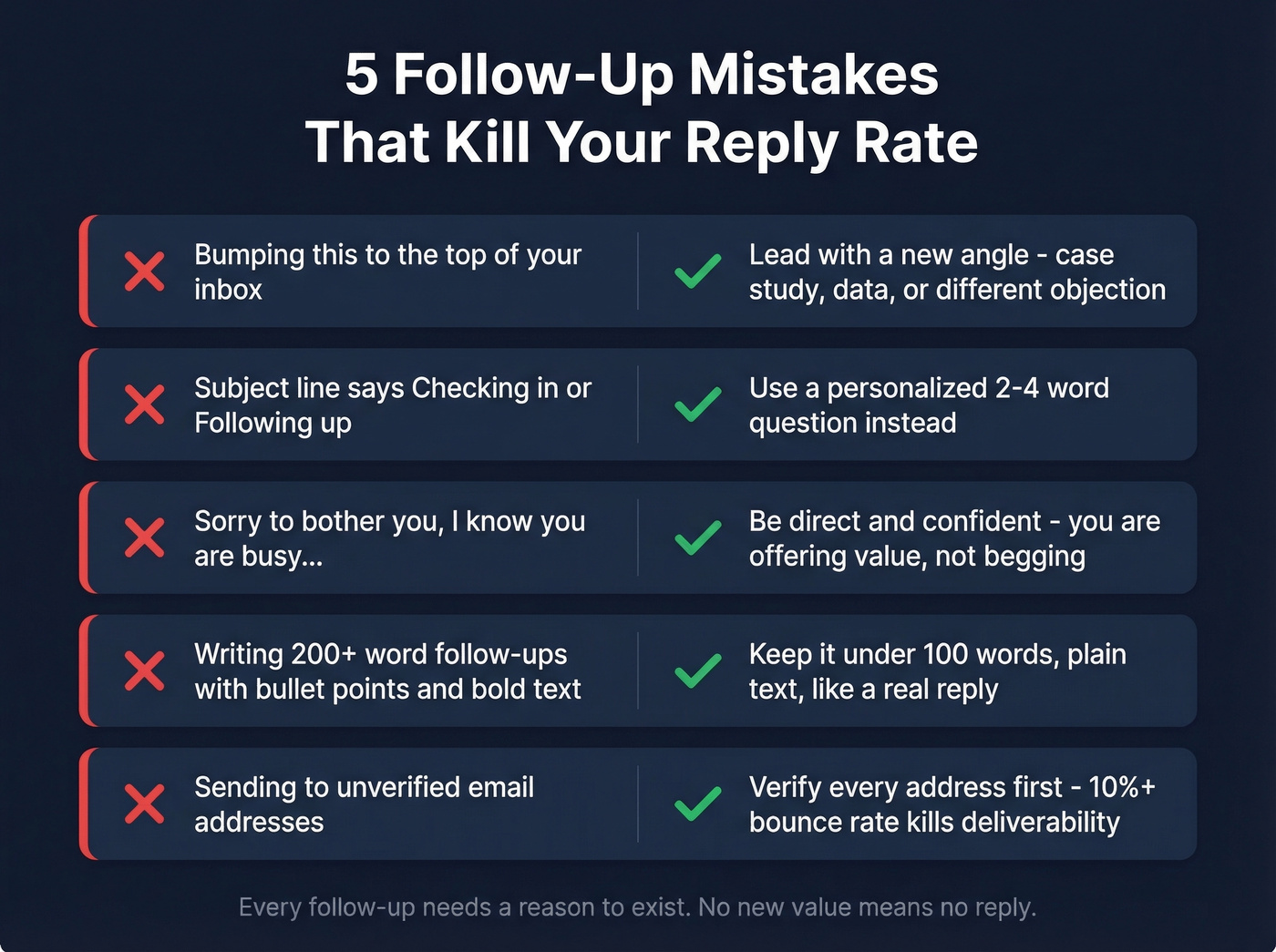
Using "follow-up" or "checking in" as your subject line. These phrases are inbox poison. They tell the recipient nothing new is inside. If you want alternatives, pull from these email subject line examples.
Apologetic tone. "Sorry to bother you" and "I know you're busy" undermine your message before it starts. Be direct.
Writing too much. Keep each follow-up under 100 words. They should look like real 1:1 replies - short, plain text, no formatting gymnastics. If you want to tighten your writing, use a simple email copywriting checklist.
Sending to unverified addresses. Here's the thing: bounced emails don't just waste your time - they damage your sender reputation. A bounce rate above 10% means inbox providers are filtering you out regardless of how good your copy is. Run your list through a verification tool like Prospeo's email finder before hitting send.

Make Sure Your Emails Actually Land
The most common reason follow-ups fail isn't bad copy. It's bad data.
Your beautifully crafted message means nothing if it bounces or lands in spam. Start with the basics: SPF, DKIM, and DMARC authentication need to be configured correctly. Without them, inbox providers don't trust your domain. Clean lists increase open rates by up to 20%. If you need a full checklist, use an email deliverability guide and track your email bounce rate by campaign.
Let's be honest - if your deal sizes are under five figures and you're not verifying emails before every send, you're burning more pipeline than you're building. We've seen this pattern repeatedly. Snyk's 50-person AE team was running bounce rates of 35-40% before switching to verified data. After cleaning their lists, they dropped under 5% and AE-sourced pipeline jumped 180%. That's not a copywriting fix. That's a data quality fix.
When to Stop Sending
Three follow-ups is the ceiling for any follow up email to get a response. The data is clear: four-plus emails more than triples unsubscribe and spam complaint rates. You're not just wasting time - you're actively damaging your sender reputation. (If you want a timing rule-of-thumb, see when should I follow up on an email.)
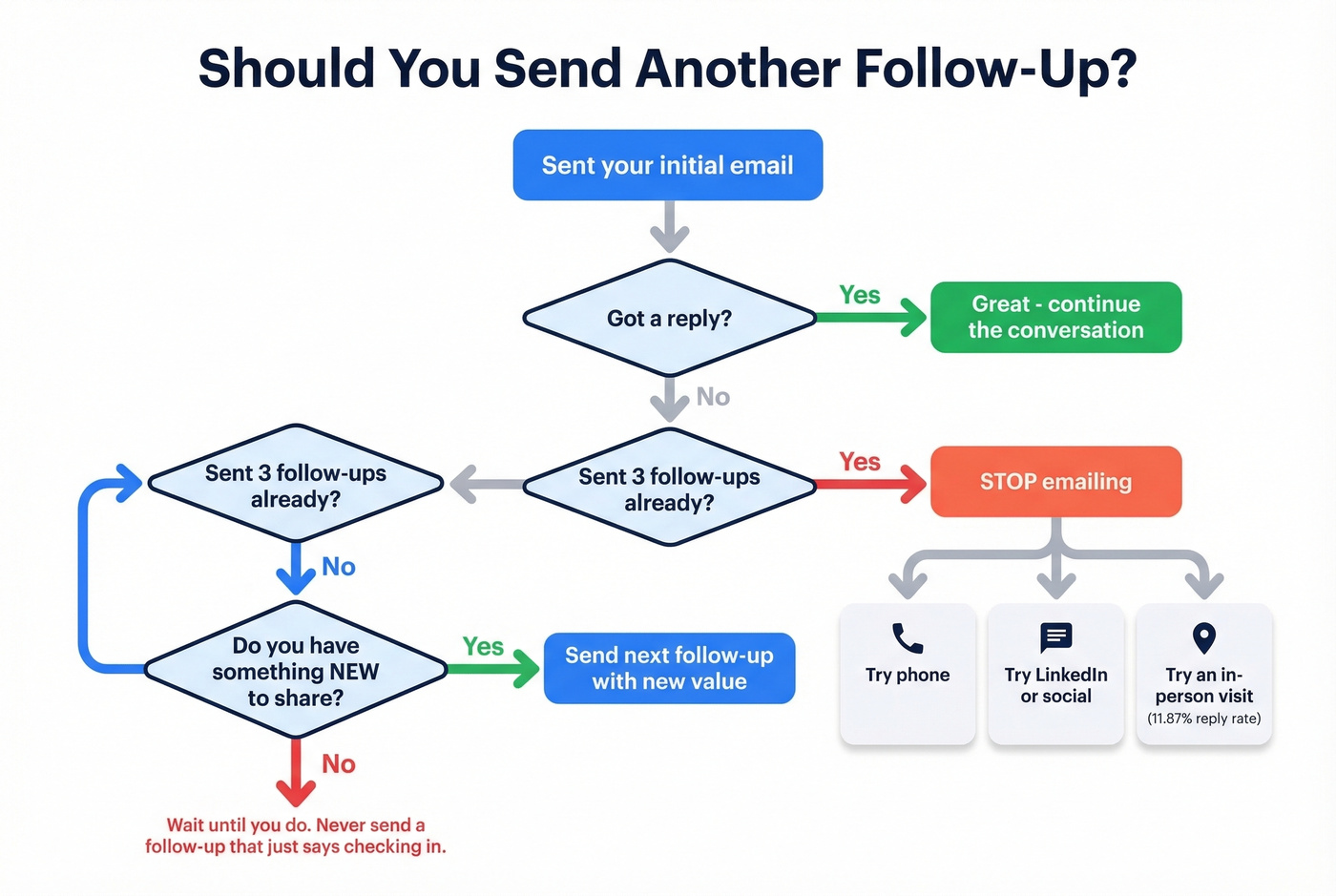
After email three, switch channels. Across 16.5M emails, a message + visit combo pulled an 11.87% reply rate - higher than any email follow-up in the dataset. When email stops working, that's your next move. Or pick up the phone. Stopping email isn't failure. It's strategy.
You only get 3 follow-ups before spam complaints spike. Don't waste a single one on a dead address. Prospeo verifies emails through a 5-step process with catch-all handling, spam-trap removal, and a 7-day data refresh - so every follow-up lands where it should.
Make all three follow-ups count. Verify your list before you send.
FAQ
How many follow-up emails should I send?
Three max. Data from 16.5M emails shows four-plus messages more than triples spam complaints and unsubscribe rates. After three with no response, switch to a different channel - phone, social, or in-person visit - rather than sending a fourth email.
What's the best subject line for a follow-up?
A personalized question in 2-4 words. Personalized subject lines hit 46% open rates and double reply rates versus generic ones. Avoid "checking in" or "following up" - they signal zero new value and get ignored.
Why aren't my follow-up emails getting responses?
Most likely your emails are bouncing or landing in spam. Verify addresses before sending - a bounce rate above 10% means inbox providers are filtering you out. In our experience, teams that clean their lists before every campaign see immediate lifts in both deliverability and reply rates.
Should I reply in the same thread or start a new one?
Always reply in the same thread. Threading preserves context so the recipient can quickly scan your original message without searching their inbox. It also keeps your follow-up shorter since you don't need to re-explain who you are or what you want.