

How to Write a Formal Follow-Up Email That Actually Gets a Reply
Most formal follow-up guides are thinly disguised cold email playbooks. That's not what you need. You need to write a structured, respectful formal follow-up email - after an interview, a meeting, a proposal, or a networking event - without sounding like a robot or a used-car salesperson.
Below: the tone spectrum, the words that backfire, the timing that works, and 10 templates you can steal.
The Quick Version
- Formal doesn't mean stiff. It means structured, respectful, and purposeful. You can be warm and formal at the same time.
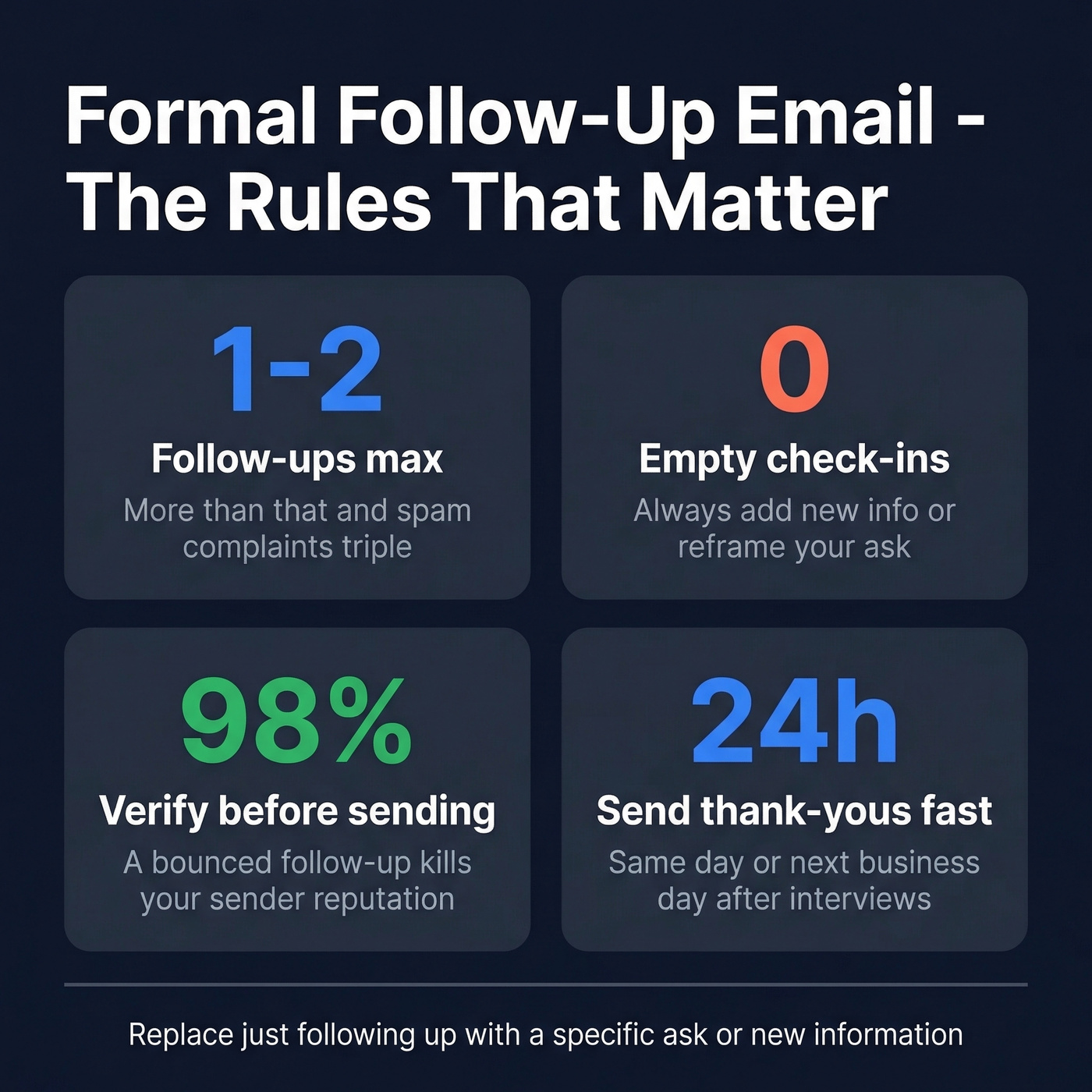
- Replace "just following up" with a specific ask or a new piece of information. Empty check-ins get ignored. (If you need alternatives, see just following up.)
- Drop "kindly," "at your earliest convenience," and other tone traps that sound polite but read as passive-aggressive.
- Send 1-2 follow-ups max. A Belkins study of 16.5M cold emails found that 4+ emails in a sequence more than triple spam complaints - and the principle holds in professional follow-up contexts too.
- Verify the email address before you send. A bounced follow-up damages your sender reputation, and future emails land in spam.
What Makes a Follow-Up "Formal"
Formal isn't a single register - it sits on a spectrum:
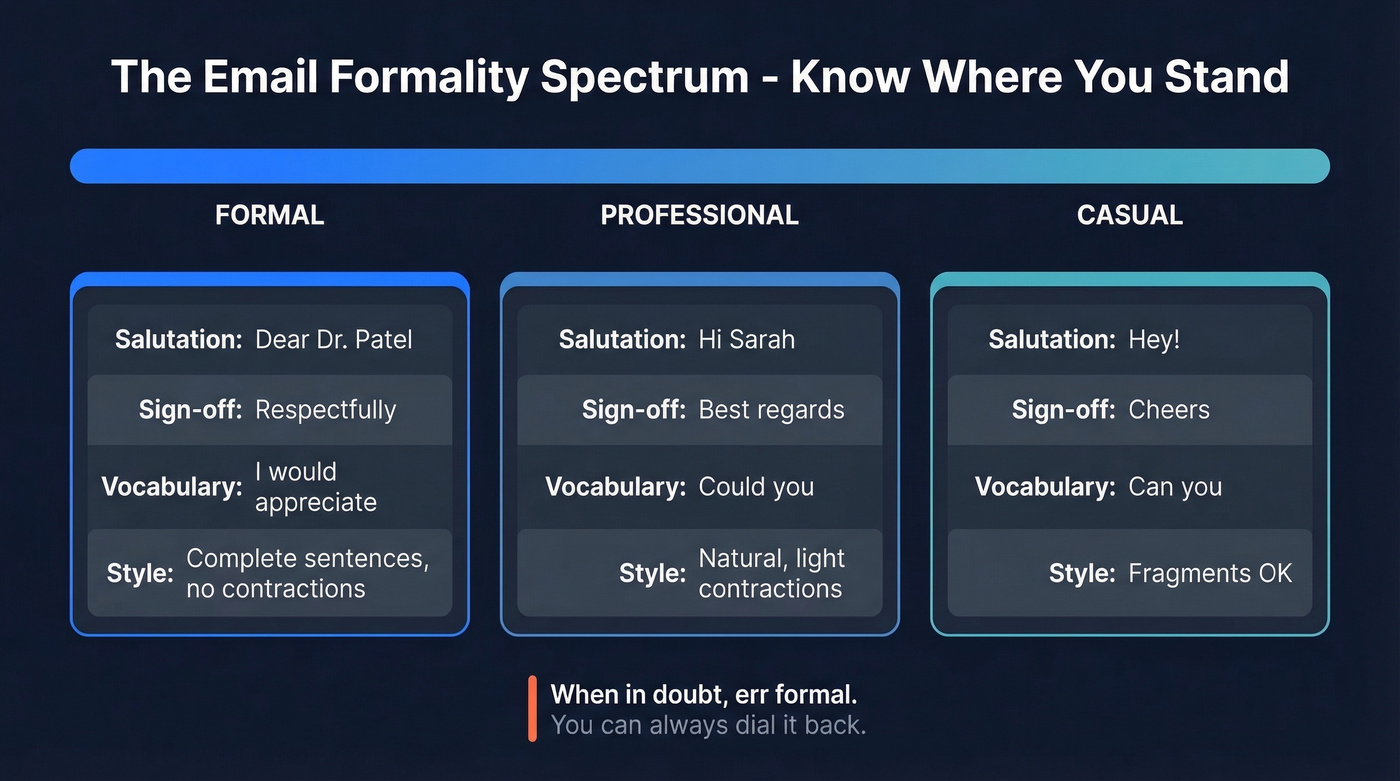
| Element | Formal | Professional | Casual |
|---|---|---|---|
| Salutation | Dear Dr. Patel | Hi Sarah | Hey! |
| Sign-off | Respectfully | Best regards | Cheers |
| Vocabulary | "I would appreciate" | "Could you" | "Can you" |
| Sentence style | Complete, no contractions | Natural, light contractions | Fragments OK |
You need the formal end when you're writing to executives you haven't met, government officials, academic committees, international counterparts in indirect cultures, or anyone you're addressing for the first time in a high-stakes context.
Cultural context matters. Grammarly's business email etiquette guide notes that in Japan, it's customary to open with a weather reference, and that expectations vary sharply across cultures. When in doubt, err formal. You can always dial it back.
Tone Traps That Backfire
Some phrases aim for politeness and land somewhere between condescending and meaningless.
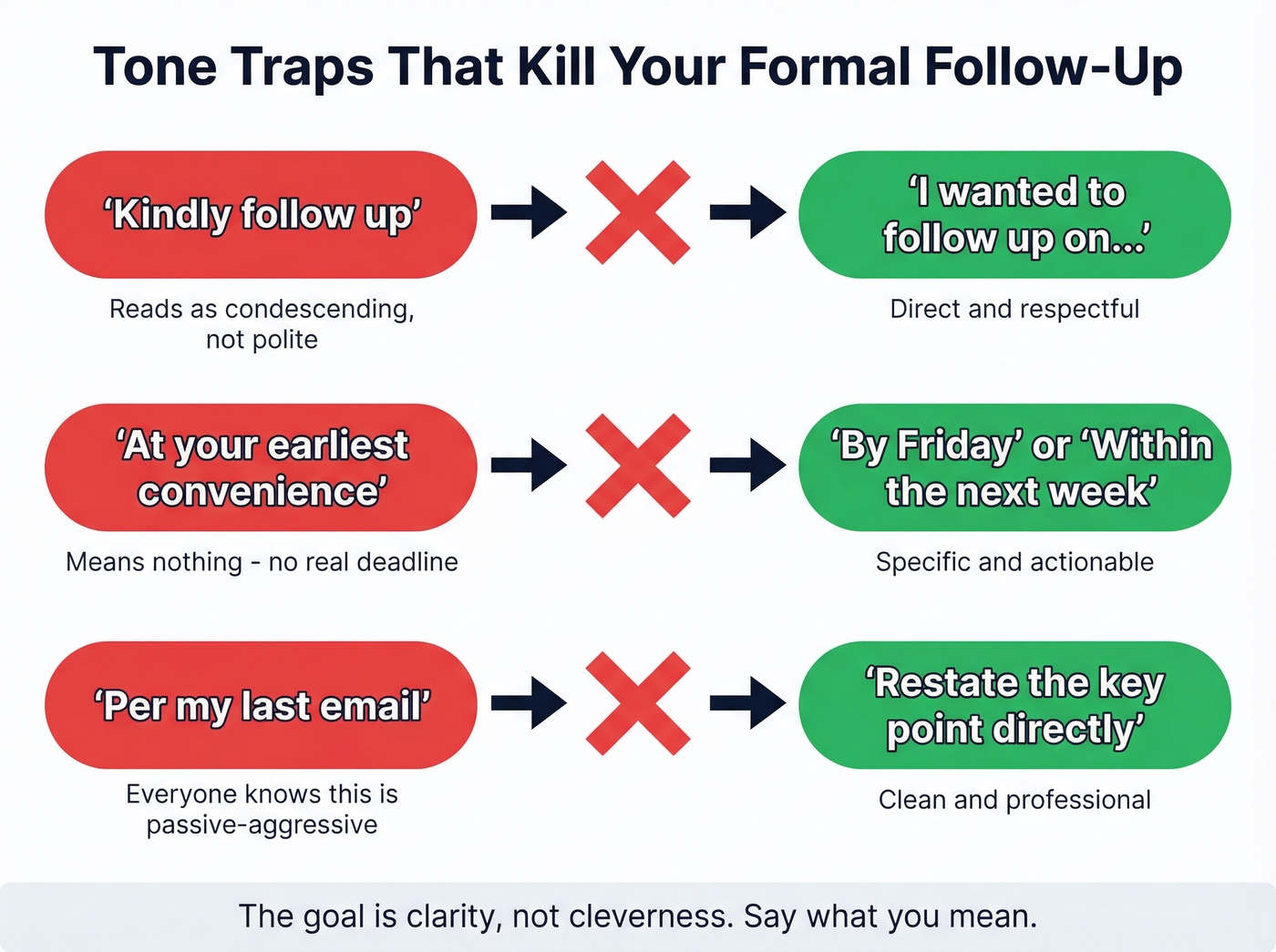
"Kindly" - A Reddit thread on r/etiquette flagged "I just wanted to kindly follow up" as condescending. In formal English, "kindly" reads as a directive ("Kindly do X"), not a softener. Drop it entirely.
"At your earliest convenience" - This means nothing. It translates to "whenever, I guess." Replace it with a specific timeframe: "by Friday" or "within the next week."
"Per my last email" - Everyone knows this is passive-aggressive. Restate the relevant point cleanly instead.
Here's a real "before" from r/AskAcademia - and a cleaner rewrite:
❌ "I understand that you are quite busy, I will be waiting for your response at your earliest convenience."
✅ "Dear Professor Nakamura, I wanted to follow up on the writing samples I sent on March 12. Would you have time this week to discuss next steps? I'm happy to work around your schedule."
Three sentences. Respectful, specific, and it gives the recipient a clear action.
How to Structure a Formal Follow-Up Email
Every professional follow-up needs five elements. Skip one and the email gets ignored or misread.
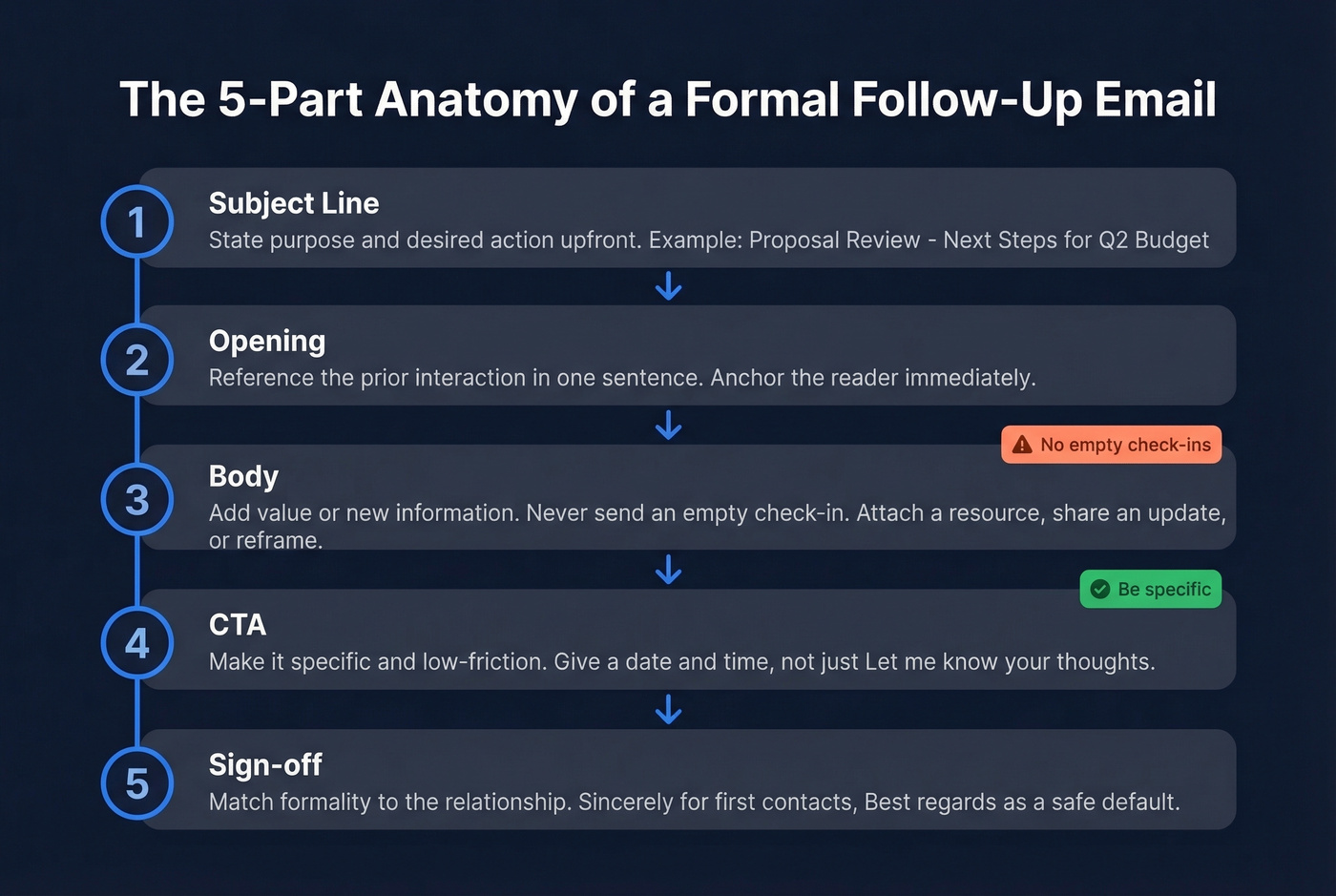
1. Subject line. HBR recommends a keyword-prefix approach: state the purpose and desired action upfront. "Proposal Review - Next Steps for Q2 Budget" beats "Following Up." (For more options, browse these email subject lines.)
2. Opening. Reference the prior interaction in one sentence. "Thank you for meeting with our team on Tuesday" or "I'm writing to follow up on the proposal I sent on April 3."
3. Body. Add value or new information. Never send an empty check-in. Attach a relevant resource, share an update, or reframe the original ask. If you've got nothing new to add, you're following up too soon.
4. CTA. Make it specific and low-friction. "Would Thursday at 2 PM work for a 15-minute call?" outperforms "Let me know your thoughts" every time. In our experience, the emails that get replies fastest are the ones that give the recipient a specific date and time to respond to - something like "I'm finalizing my schedule for next week; would Tuesday at 10 AM or Wednesday at 3 PM work for a brief call?" (More examples: email call to action.)
5. Sign-off. Match the formality to the relationship. "Sincerely" for first contacts. "Respectfully" for senior officials. "Best regards" as a safe default.

A perfectly crafted formal follow-up email is wasted if it bounces. Prospeo verifies emails with 98% accuracy through a 5-step process that catches spam traps, honeypots, and catch-all domains - so your follow-up actually reaches the inbox.
Don't let a bad email address kill your best follow-up.
10 Templates You Can Steal
1. Post-Interview Thank-You (Within 24 Hours)
Send same day or next business day. This formal follow-up email sample works for virtually any interview scenario.
Dear Ms. Rodriguez,
Thank you for taking the time to discuss the Senior Analyst role this morning. Our conversation about the team's migration to Snowflake reinforced my enthusiasm for the position - it aligns directly with the data infrastructure work I led at [Previous Company].
I look forward to hearing about next steps. Please don't hesitate to reach out if you need any additional information.
Sincerely, [Your Name]
Common mistake: Writing a generic thank-you that could apply to any company. Reference something specific from the conversation - it proves you were listening.
2. Post-Interview Status Check (5-10 Business Days)
HBS Online recommends waiting 5-10 business days before checking in.
Dear Ms. Rodriguez,
I interviewed for the Senior Analyst position on April 8 and wanted to check in on the hiring timeline. I remain very interested in the role and would welcome the opportunity to provide any additional materials.
Best regards, [Your Name]
3. Post-Meeting Recap With Action Items
Send same day or next morning. The Muse's 6-step structure works well: thank attendees, summarize decisions, list action items with owners and deadlines. (If you want more meeting-specific formats, use this sales meeting follow-up email guide as a reference.)
Dear Team,
Thank you for a productive discussion this afternoon. Below is a summary of what we agreed on:
- Brand guidelines v2: Sarah to circulate by April 18
- Vendor shortlist: James to finalize by April 22
- Budget approval: Pending CFO sign-off - Maria to follow up by April 20
I've attached the slide deck for reference. Please let me know if I've missed anything.
Best regards, [Your Name]
4. Executive/Board Summary (BLUF Style)
For senior stakeholders, lead with the decision - then provide supporting context. This is the BLUF (Bottom Line Up Front) approach.
Dear Mr. Whitfield,
Decision: The board approved the $2.4M expansion budget with a Q3 launch target.
Key conditions: headcount capped at 12 new hires, monthly burn reviewed at the July board meeting. Full minutes are attached.
Respectfully, [Your Name]
Skip this format if the meeting ended without a clear decision or the outcome is politically sensitive. BLUF works when the news is straightforward.
5. After Sending a Proposal or Quote
Wait 3-5 business days. Reference specific proposal details and add one new piece of value.
Dear Dr. Okafor,
I wanted to follow up on the implementation proposal I sent on April 10 for the patient records migration. Since we last spoke, we completed a similar project for [Reference Client] that reduced migration time by 30% - I've attached the brief in case it's helpful.
Would you have 20 minutes this Thursday or Friday to discuss next steps?
Sincerely, [Your Name]
6. After No Response (First Follow-Up)
Here's the thing: most people just resend their original email with "bumping this to the top of your inbox" tacked on. That's lazy, and it doesn't work. Add new information or reframe the ask. (More patterns here: follow-up email to a busy person.)
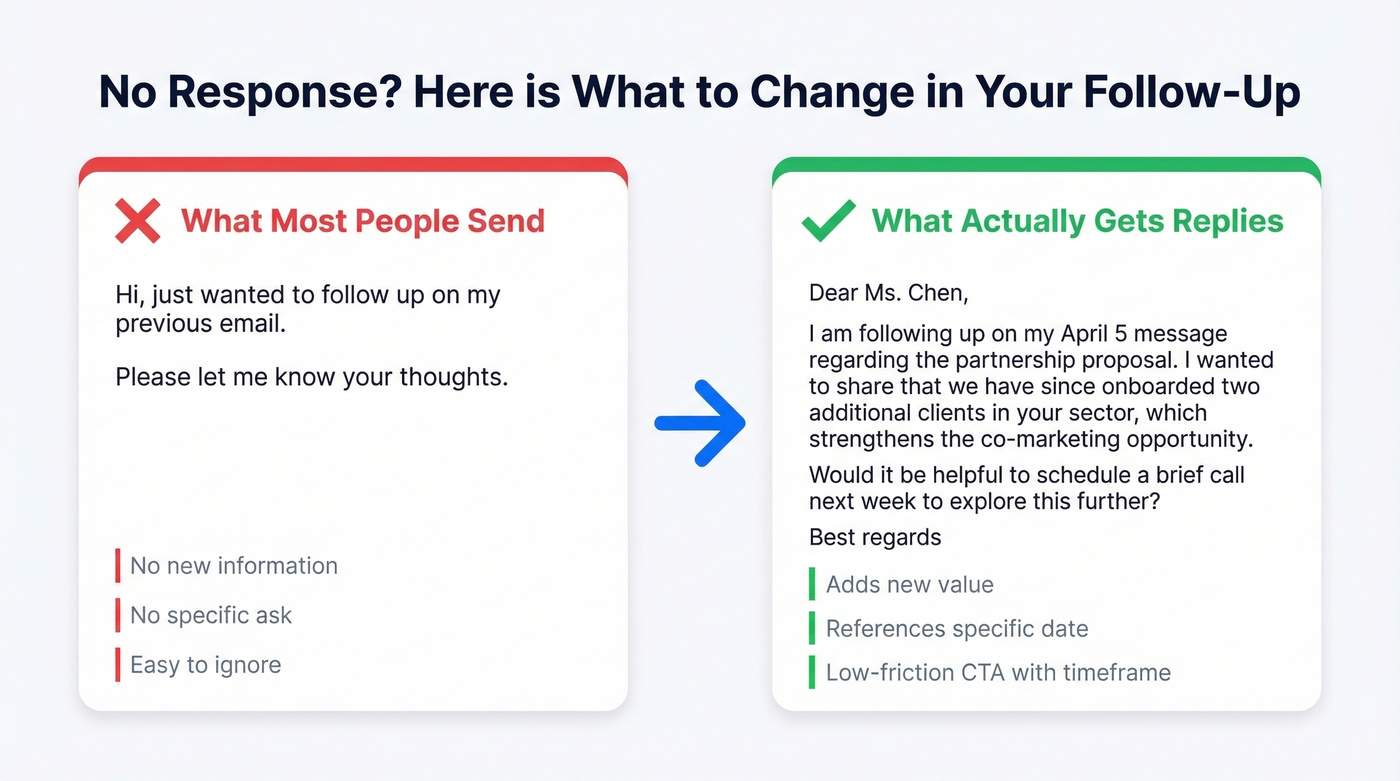
Before (what most people send):
"Hi, just wanted to follow up on my previous email. Please let me know your thoughts."
After (what actually works):
Dear Ms. Chen,
I'm following up on my April 5 message regarding the partnership proposal. I wanted to share that we've since onboarded two additional clients in your sector, which strengthens the co-marketing opportunity.
Would it be helpful to schedule a brief call next week to explore this further?
Best regards, [Your Name]
The difference: the second version gives the recipient a reason to re-engage.
7. After No Response (Final / Break-Up Email)
State clearly that you'll assume they're not interested unless you hear back. Keep the door open without being needy.
Dear Ms. Chen,
I understand priorities shift, and I don't want to clutter your inbox. If the partnership proposal isn't a fit right now, I completely understand - no response needed.
If circumstances change, I'd welcome the chance to reconnect. Wishing you and the team a strong quarter.
Respectfully, [Your Name]
8. Networking Event Follow-Up
Reference a specific detail from your conversation and propose a concrete next step. Collected a business card at a conference? Verify the email first - we've seen too many people craft a great follow-up only to have it bounce because the card had a typo or the person switched companies. (If you need help finding the right address, start with direct email address.)
Dear Mr. Alvarez,
It was a pleasure meeting you at the FinTech Summit on Thursday. I enjoyed our conversation about cross-border payment compliance - your point about the EU regulatory timeline was particularly insightful.
Would you be open to a 20-minute call next week to continue the discussion?
Best regards, [Your Name]
9. Academic Follow-Up (Professor or Committee)
Short, respectful, and free of over-deferential language. Professors are busy - make it easy to say yes.
Dear Professor Nakamura,
I'm writing to follow up on the research assistant application I submitted on March 28. I remain very interested in your lab's work on computational linguistics and would be glad to provide any additional materials.
Would you have a few minutes this week to discuss the position?
Sincerely, [Your Name]
10. Payment or Invoice Follow-Up
Firm but professional. Reference the invoice number, amount, and due date.
Dear Accounts Payable Team,
I'm writing to follow up on Invoice #4821 for $12,500, which was due on March 31. As of today, we haven't received payment.
Could you confirm the status and provide an expected processing date? If there are any discrepancies, I'm happy to resolve them promptly.
Best regards, [Your Name]
Subject Lines That Get Opened
The subject line determines whether your follow-up gets opened or buried. Avoid generic openers like "Follow-up," "Checking in," or "Touching base" - GlockApps flags these as adding zero value. Keep subject lines under 41 characters when possible, per Zendesk's benchmarks. (You can also compare against our subject lines that get opened breakdown.)
| Scenario | Subject Line | Why It Works |
|---|---|---|
| Interview thank-you | Thank You - Senior Analyst Interview | Specific role, clear purpose |
| Interview status | Application Status - Senior Analyst | Direct, scannable |
| Meeting recap | April 15 Meeting - Action Items | Date anchors context |
| Executive summary | Board Decision - Q3 Expansion | BLUF in the subject |
| Proposal follow-up | Proposal Next Steps - Records Migration | Names the deliverable |
| No response (first) | Partnership Proposal - Quick Update | "Update" signals new info |
| No response (final) | Closing the Loop - Partnership Proposal | Signals finality |
| Invoice | Invoice #4821 - Payment Status | Number makes it searchable |
Timing and Frequency
When you send matters as much as what you write. (If you want a deeper timing playbook, see when should i follow up on an email.)
| Scenario | First Follow-Up | Second Follow-Up | Max Total |
|---|---|---|---|
| Interview thank-you | Same day / next morning | N/A | 1 |
| Interview status | 5-10 business days | Another 5-10 days | 2-3 |
| Meeting recap | Same day | N/A | 1 |
| Proposal/quote | 3-5 business days | 5-7 more days | 2 |
| Networking | 24-48 hours | 1 week later | 2 |
| Invoice/payment | Day after due date | 7 days later | 3 |
Let's be honest about the data here. The Belkins dataset showed that one email produced the highest reply rate at 8.4% in cold outreach, and four or more emails tripled spam complaints. Enterprise contacts ghost quickly and punish persistence. The sweet spot for most formal contexts is one initial email plus one follow-up. A second follow-up is acceptable for high-stakes scenarios like job applications or large proposals. Beyond that, you're hurting yourself.
Make Sure Your Follow-Up Actually Lands
You just spent 15 minutes crafting the perfect formal follow-up email. If the address is wrong, all of that effort bounces - and the damage goes beyond one missed message. Bounced emails hurt your sender reputation, which means your future emails are more likely to land in spam. This is especially risky with new contacts: networking connections, first-time business correspondents, addresses scribbled on business cards. (If you're troubleshooting bounces, start with email bounce rate.)
Prospeo's email verification checks addresses in real time with 98% accuracy, and the free tier covers 75 verifications a month - enough to cover every important follow-up without spending a dime.
Writing a formal follow-up to someone you met at a conference or interview? Prospeo's Chrome extension lets 40,000+ users find verified professional emails from any LinkedIn profile or company website in one click - so you're never guessing at an address.
Find the right email address in seconds, not hours.
FAQ
How long should a formal follow-up email be?
Aim for 50-125 words - three to five sentences. State your purpose, add one piece of value, and include a specific ask. The templates above average 60-80 words each, which is the sweet spot for getting a reply without overwhelming the recipient.
Is "Dear Sir or Madam" still appropriate in 2026?
Only when you genuinely don't know the recipient's name or title - government forms, general inquiries, large organizations with no public directory. In every other case, use their name. "Dear Ms. Chen" or "Dear Dr. Patel" is always stronger. If you can't find a name, an email finder tool can surface verified contact details from a company domain, often including the person's full name and title.
Should I follow up if I don't have a direct email address?
Yes, but find the right address first. Sending to a generic inbox (info@, hello@) in formal contexts signals you didn't do your homework. Locate the individual's direct address, then send your follow-up there. The extra two minutes of research dramatically increases your chances of getting a reply.
How does formal tone differ from casual in a follow-up?
A formal follow-up email uses complete sentences, avoids contractions, and opens with a proper salutation like "Dear" rather than "Hey." The key difference isn't vocabulary - it's structure. Formal emails state the purpose immediately, provide context efficiently, and close with a clear, respectful ask. Casual emails can meander; formal ones can't.