

Best Free Email Validation Checkers in 2026 (Tested)
A 7.2% bounce rate doesn't sound catastrophic until your sender reputation drops from 95 to 68 overnight and half your outbound sequences land in spam. That's not hypothetical - it's what happens when you skip verification on a list that's even a few months old. Between 23% and 25% of email lists decay every year, and with global inbox placement sitting around 84%, you're already fighting headwinds before you hit send.
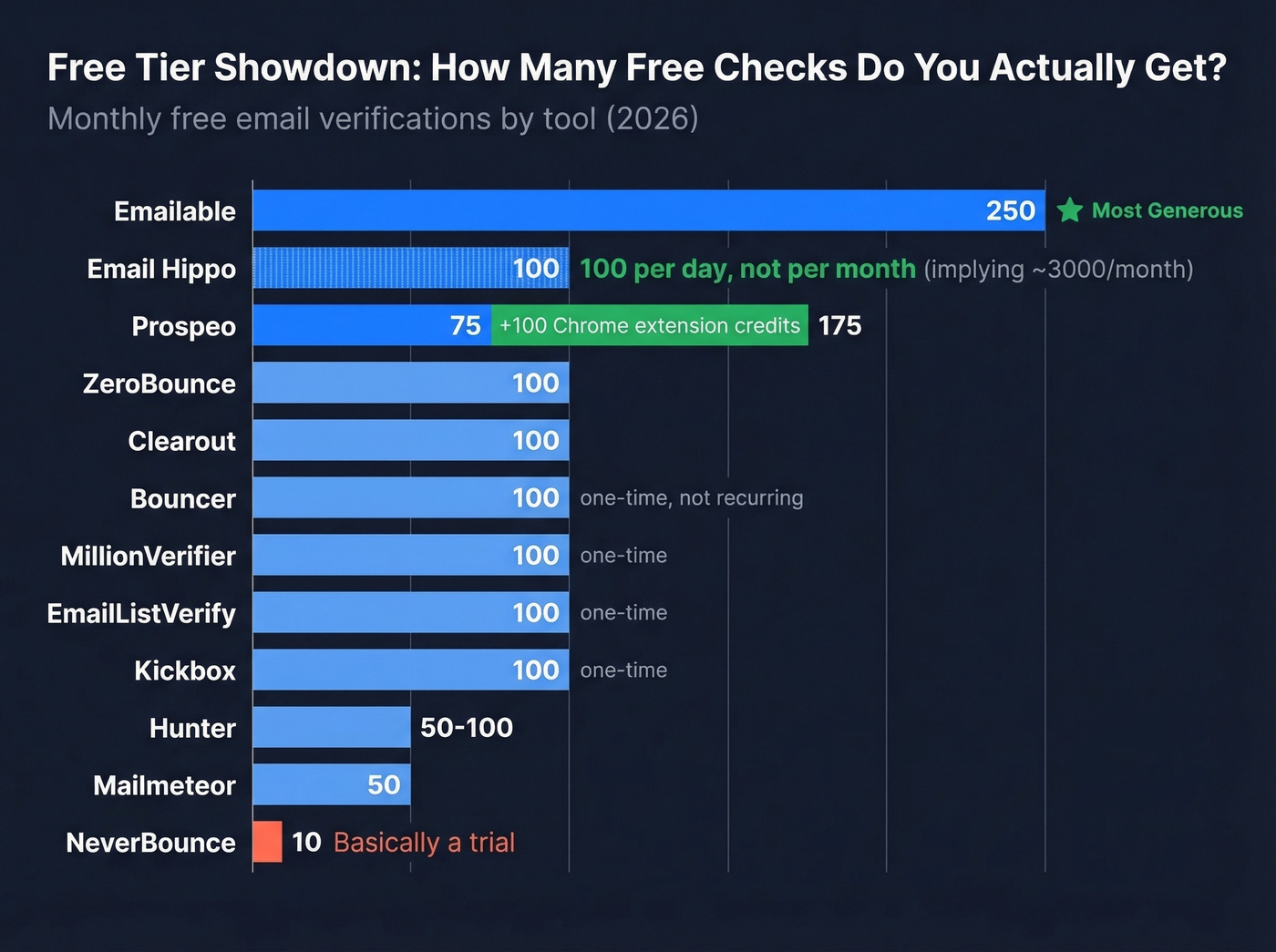
Here's the thing: you don't need to spend hundreds of dollars to fix this. Some free email validation checkers offer 100-250 checks per month, which is plenty for targeted campaigns. But most "free" tools are glorified syntax checkers that miss catch-all domains, disposable addresses, and the edge cases that actually tank your deliverability. We tested a dozen email checkers to separate the real performers from the pretenders.
Our Picks (TL;DR)
- Prospeo - Best for finding AND verifying B2B emails in one workflow. 98% accuracy with catch-all handling. 75 free emails/month plus 100 Chrome extension credits.
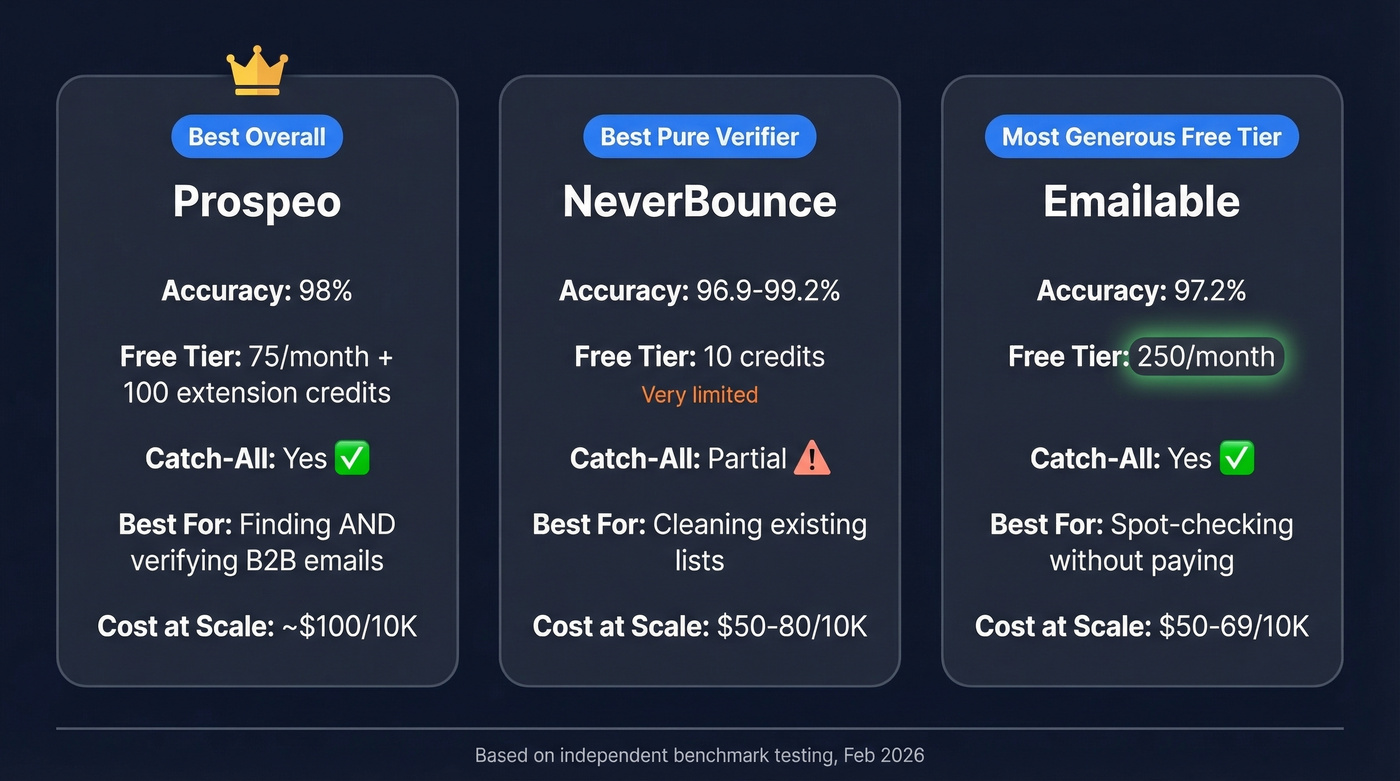
NeverBounce - Best pure verification engine for existing lists. Accuracy ranges from 96.9% to 99.2% depending on the benchmark and dataset. The free tier is stingy (10 credits), but verification quality is top-shelf.
Emailable - Most generous free tier at 250 checks/month. 97.2% accuracy in multi-tool testing, fast processing, and solid catch-all detection. If you just need to spot-check without paying, start here.
Free Tier Comparison
Not all free tiers are created equal. Some give you 250 checks a month; others give you 3. The table below pulls from multiple benchmarks, including an open-source GitHub benchmark updated February 2026 and a 90-day, 47,000-email test. Self-reported accuracy numbers are flagged - treat them as ceilings, not guarantees.
| Tool | Free Tier | Accuracy | Catch-All | ~$/10K (Paid) |
|---|---|---|---|---|
| Prospeo | 75/month | 98% | Yes | ~$100 |
| NeverBounce | 10 credits | 96.9-99.2% | Partial | $50-80 |
| Emailable | 250/month | 97.2% | Yes | $50-69 |
| ZeroBounce | 100/month | 96.5-99.3% | Partial | $65-80 |
| Hunter | 50-100/month | ~95%* | Partial | $149 |
| Bouncer | 100 credits | 96.5-99% | Partial | $49-64 |
| Clearout | 100/month | 98.4-98.7% | Yes | $40-58 |
| MillionVerifier | 100 credits | 95.8-98.9% | Weak | $3-6 |
| EmailListVerify | 100 credits | ~97.8% | Partial | $24 |
| Email Hippo | 100/day | ~97%* | Partial | ~$50-70 |
| Mailmeteor | 50/month | ~95%* | No | ~$30-50 |
| Kickbox | 100 credits | ~95%* | Partial | $70-80 |
*Self-reported; no independent benchmark data available.
Most tools here offer bulk upload and an API; Mailmeteor is primarily a Sheets-based checker. The accuracy ranges reflect different test conditions and dataset compositions - a tool scoring 99% on a clean corporate list can drop to 95% on a list heavy with catch-all domains. That's why the catch-all column matters more than most people realize.
Our take: If your average deal size is under $8K, you probably don't need a premium verifier at all. Stack a cheap bulk tool with a high-accuracy free option and you'll get 98%+ effective accuracy for pennies.
Best Free Email Checkers Reviewed
Prospeo
Prospeo is the only tool on this list that finds and verifies emails in a single workflow. Most email checkers assume you already have a list. Prospeo builds the list for you, then runs every address through a 5-step verification pipeline that includes catch-all domain verification, spam-trap removal, and honeypot filtering.
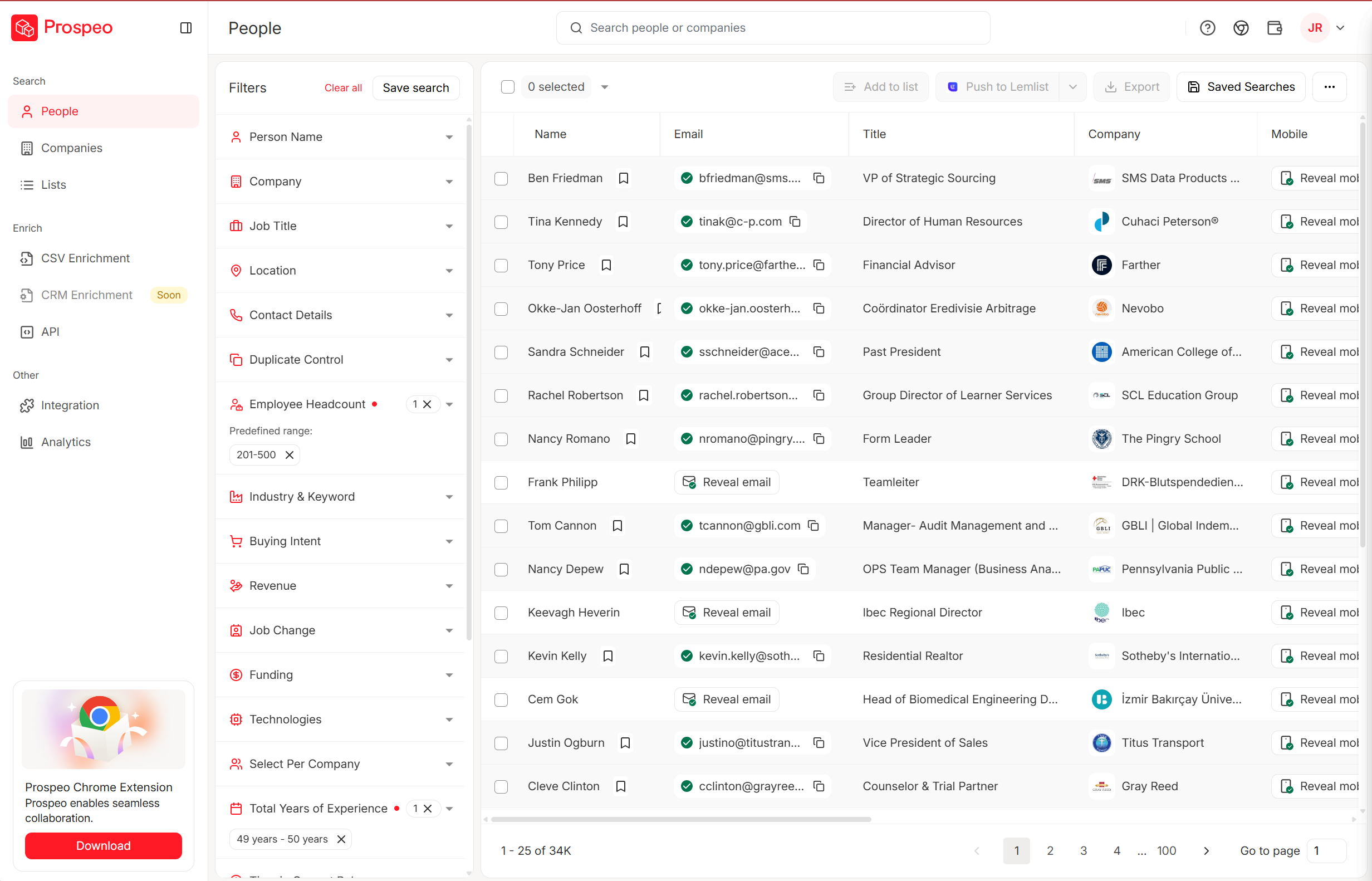
The result is 98% email accuracy across 143M+ verified emails, drawn from a database of 300M+ professional profiles refreshed every 7 days. For context, most verification tools work with whatever stale list you hand them - Prospeo's data is fresh by default. Meritt cut their bounce rate from 35% to under 4% after switching to Prospeo's verified data, and their pipeline tripled from $100K to $300K per week.
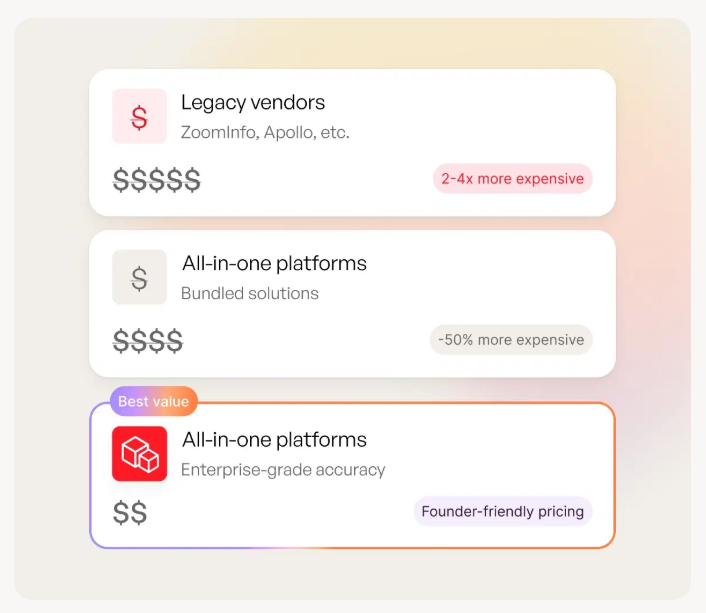
The free tier gives you 75 email lookups per month plus 100 Chrome extension credits - enough to verify a targeted campaign without spending a dollar. Paid plans run about $0.01 per email with no contracts. Integrations cover HubSpot, Salesforce, Instantly, Lemlist, and Clay, so verified contacts flow straight into your sequences without a CSV detour.
If you want a deeper comparison of tools that do both steps, see our guide to email finder and verifier platforms.
NeverBounce
Use this if: You already have a list and need the highest possible accuracy on standard domains. NeverBounce lands between 96.9% and 99.2% across independent benchmarks - the GitHub benchmark puts it at 99.2%, the La Growth Machine 90-day test at 99.1%, while the LeadMagic 10K-email bake-off measured 96.9%. The variation comes down to dataset composition. NeverBounce excels on clean corporate domains and struggles more with catch-all-heavy lists.
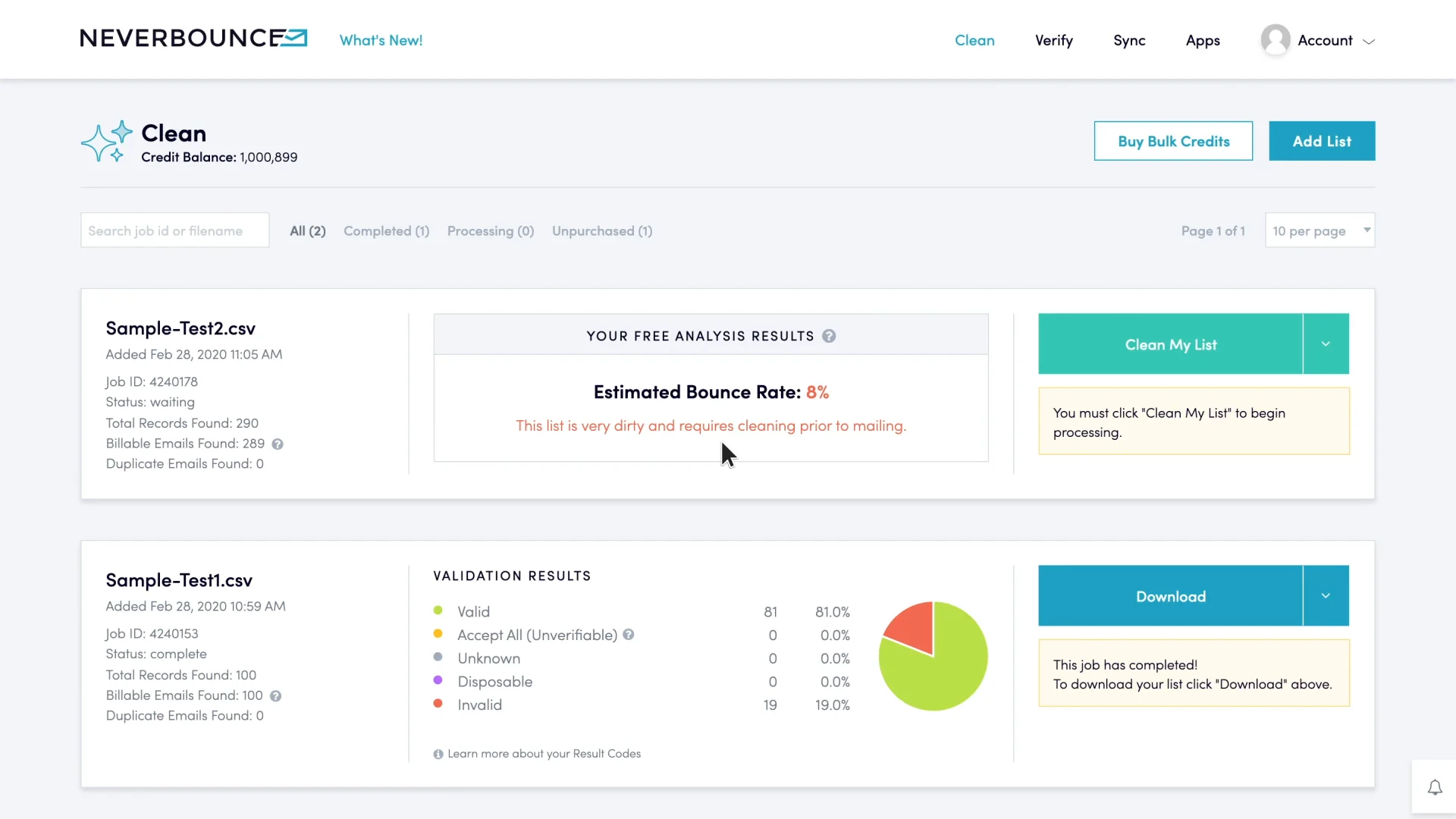
Skip this if: You need a generous free tier. NeverBounce gives you 10 free credits. Ten. Paid pricing starts at $0.008/email pay-as-you-go, which works out to $50-80 per 10K depending on volume. Catch-all handling is where NeverBounce shows its limits - only about 8% resolution in the LeadMagic test. If your list is heavy on catch-all domains, you'll get a lot of "unknown" results. The consensus on r/software is that NeverBounce ranks high for accuracy, but practitioners recommend stacking multiple verifiers for better coverage on tricky lists.
If you're specifically trying to reduce bounces, pair this with a dedicated bounce checker workflow.
Emailable
Emailable is the free email verification service we'd point most marketers toward for list cleaning. That 250/month free tier - no credit card required - is genuinely useful. Enough to verify a small campaign list or spot-check imports before they hit your CRM.
Processing speed is blazing at 0.012 seconds per email, so you'll clean a 1,000-address list in under a minute. The UI is clean and doesn't try to upsell you on features you don't need. At 97.2% accuracy in multi-tool testing, it won't match NeverBounce's peak numbers, but it's more than sufficient for most email hygiene workflows. Catch-all handling is decent without being best-in-class. Paid pricing at $50-69 per 10K sits in the middle of the pack. No email-finding capability - this is pure verification, and it does that job well.
For a broader list of options, compare against our full roundup of email verification tools.
ZeroBounce
ZeroBounce is the safe pick for regulated industries. SOC 2 Type 2, ISO 27001, and HIPAA compliance mean your legal team won't block the purchase order. If you're in healthcare, finance, or any sector where data handling certifications matter, this is your shortlist of one.
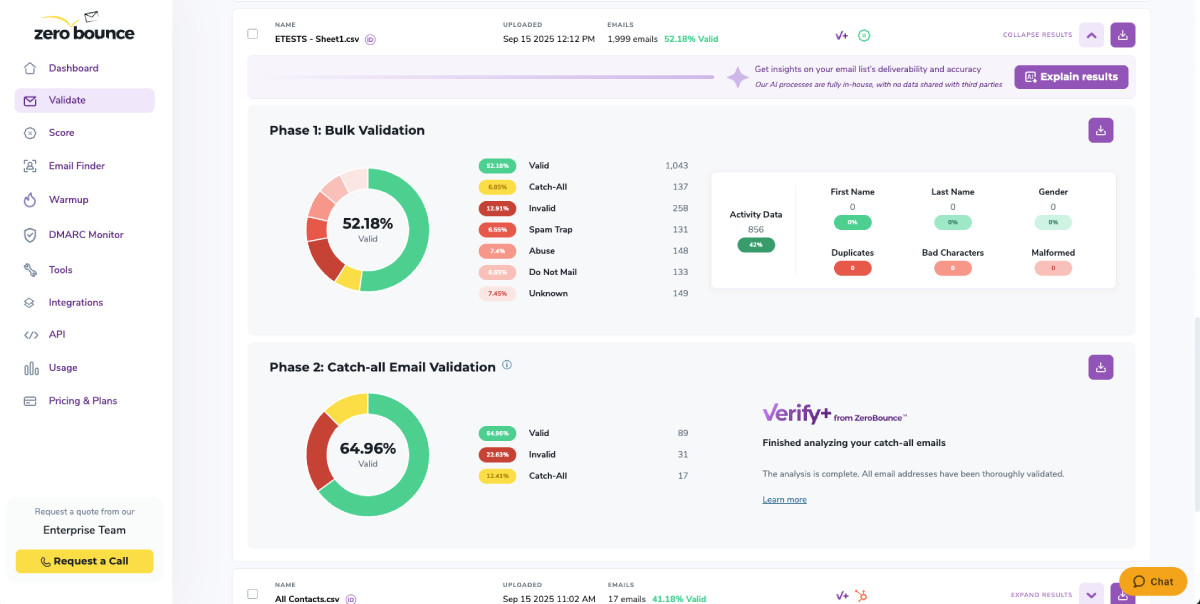
Accuracy ranges from 96.5% to 99.3% across independent tests - the spread reflects different dataset compositions and testing methodologies. The free tier gives you 100 checks per month when you sign up with a business domain, and paid pricing runs $65-80 per 10K. With 49 integrations, it plugs into most marketing stacks without custom work. Catch-all resolution sits at a mediocre 12%, which remains the main weakness for B2B-heavy lists. Still, as a compliance-first email validity checker with a usable free tier, it's hard to beat.
If you're building a repeatable hygiene process, this pairs well with an email verification list SOP.
Hunter
Use this if: You want a quick, no-signup email verifier. Hunter's free tool lets you paste an address and get a result without creating an account. For one-off checks - confirming a prospect's email before cold outreach - it's the fastest path.
Skip this if: You need bulk verification or competitive pricing at scale. Hunter gives you 50-100 free checks per month, and paid verification runs $149 per 10K - nearly 3x what Clearout or NeverBounce charges. Hunter's real strength is email finding, not verification. The Google Sheets integration is handy for small teams, but you're paying a premium for convenience.
If you're using it mainly for discovery, see our ranking of B2B email finders.
Bouncer
Bouncer is a quiet overperformer. User ratings tell the story: Capterra 4.9 across 233 reviews, G2 4.8 across 232 reviews - among the highest-rated tools here. Accuracy lands at 96.5-99% across benchmarks with 15% catch-all resolution, which beats most competitors on catch-all handling. At $49-64 per 10K, it's priced competitively for teams that need reliable verification without enterprise overhead. The one catch: once your free credits are gone, you're paying.
If you're evaluating similar products, our mailbox checker guide breaks down accuracy testing.
Clearout
Clearout is the best value play for bulk list cleaning. At $40-58 per 10K, it's the cheapest mainstream option that still delivers strong accuracy - 98.4-98.7% in the La Growth Machine test. The free tier gives you 100 credits monthly, and catch-all handling is solid. If you're cleaning lists of 50K+ addresses regularly and price sensitivity is high, Clearout should be your first call.
For more high-volume options, see our list of bulk email address list cleaners.
MillionVerifier
Use this if: You're verifying massive lists on a tight budget. At $0.0003 per email for bulk - roughly $3-6 per 10K - MillionVerifier is absurdly cheap. For a 100K-address list, you're paying $30 instead of $500+.
Skip this if: Catch-all domains make up a significant portion of your list. Accuracy ranges from 95.8% to 98.9%, and catch-all handling is its weakest point. Stack it with a second verifier for best results.
If you're setting this up as an always-on system, follow our automated email verification setup guide.
EmailListVerify
The free tier gives you 100 checks with an account (the no-signup web checker limits you to 3). At $24 per 10K at scale, it's one of the cheapest mainstream verifiers for paid plans. If you need to validate addresses before committing to a bulk purchase, the trial credits let you evaluate accuracy on your own data.
If you're deciding between vendors, our email list cleaning service roundup covers managed options too.
Email Hippo, Mailmeteor, and Kickbox
Email Hippo gives you 100 free checks per day (not month), which is actually generous for ongoing spot-checking. Its API returns 74 data points per check at 444ms response time - overkill for simple valid/invalid decisions, but useful if you want granular diagnostics on why an address failed.
Mailmeteor is a Google Sheets add-on with 50 free checks per month. If your entire workflow lives in Google Workspace and you just need to verify a handful of addresses before a mail merge, it's the path of least resistance. Don't expect the accuracy or catch-all handling of dedicated verification tools.
Kickbox offers 100 free credits, $70-80 per 10K paid, and ~95% self-reported accuracy. It's a solid mid-tier option with good API documentation, but nothing about it stands out enough to recommend over Clearout or Bouncer at similar or lower price points.
Instantly.ai (Honorable Mention)
Instantly.ai is primarily a cold email platform, but its built-in verification has earned a strong reputation among sales practitioners - one Reddit ranking on r/software placed it at #1 for sales verification workflows. If you're already using Instantly for outbound sequences, the integrated verification saves you a step. Paid pricing runs approximately $30-50 per 10K depending on your plan. Worth evaluating if Instantly is already in your stack.

Most free email validation checkers assume you already have a list. Prospeo finds verified emails and validates them in a single workflow - 98% accuracy, catch-all handling, spam-trap removal, and a 7-day data refresh so you're never validating stale records.
Stop cleaning bad lists. Start with clean data from day one.
How Email Verification Actually Works
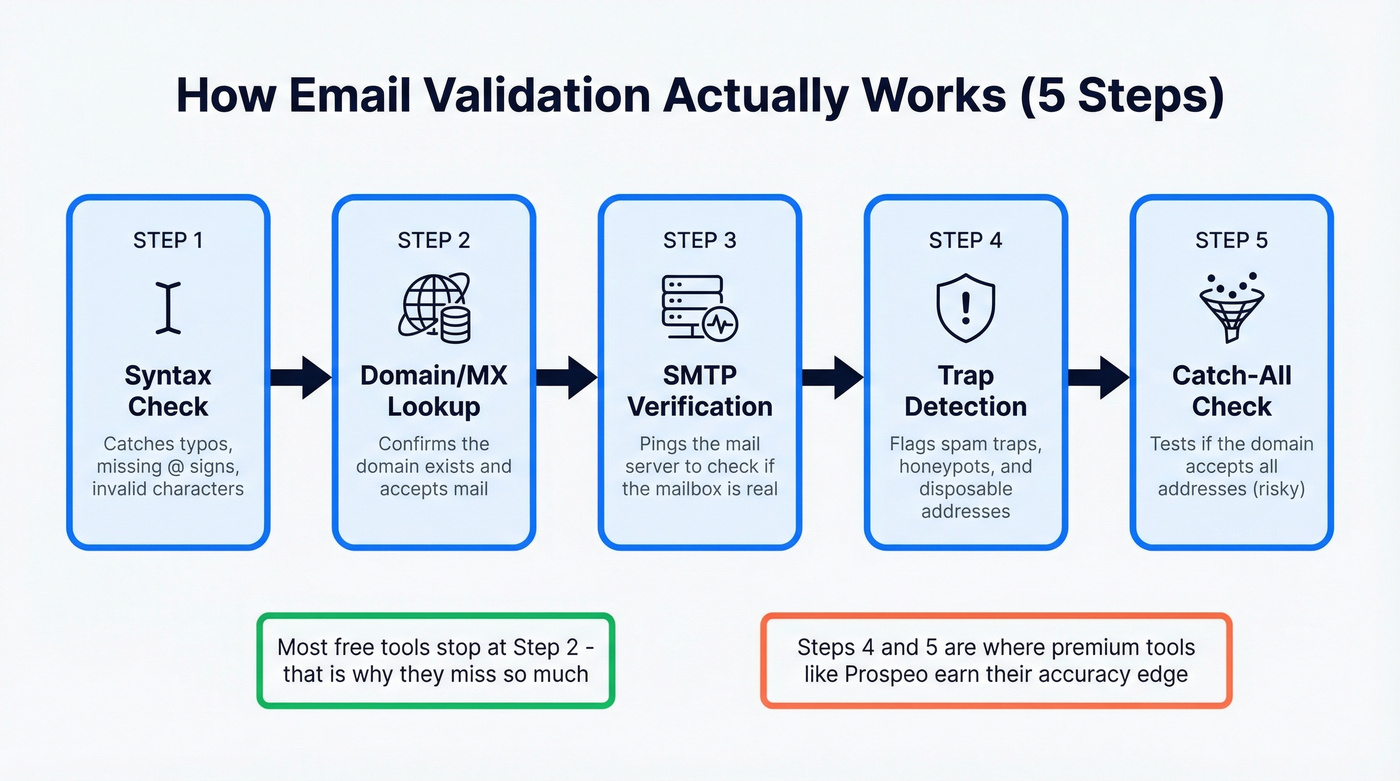
Most verification tools - free or paid - run the same three-step process. Understanding it helps you spot which checkers are doing real work versus which ones just check syntax and call it a day.
Step 1: Syntax validation. The tool checks whether the address follows proper email format - a local part, an @ symbol, and a valid domain structure. This catches typos like "john@gmial.com" or addresses missing the @ entirely. Every tool does this. It's the easy part.
Step 2: DNS and MX record lookup. The tool queries the domain's DNS records to confirm that mail servers exist and are configured to receive email. No MX record means the domain can't accept mail, full stop. This step eliminates dead domains and parked pages.
Step 3: SMTP handshake. This is where real verification happens. The tool initiates a connection with the mail server and asks whether the specific mailbox exists - without actually sending an email. The server's response codes indicate whether the address is valid, invalid, or unknown. A hard bounce means the mailbox permanently doesn't exist; remove it immediately. A soft bounce means a temporary issue like a full inbox or a server that's temporarily down - worth retrying later but not an immediate delete.
The SMTP handshake isn't foolproof. Some servers are misconfigured and confirm every address regardless of whether the mailbox exists. Others (catch-all servers) accept all mail by design. And some enterprise security gateways deliberately obscure mailbox status to prevent enumeration attacks. This is why accuracy varies between tools - they're all interpreting the same ambiguous signals differently, and the quality of that interpretation is what separates a 95% tool from a 99% one.
If you want the technical deep dive, see our guide to SMTP verification.
Why Catch-All Domains Break Verification
Catch-all domains are where most free email validation checkers fall apart. A catch-all server accepts mail sent to any address at that domain - valid or not. When your verification tool pings the SMTP server, it gets a "yes" for every address, making it impossible to distinguish real mailboxes from dead ones through standard methods.
This isn't a niche problem. In one 10,000-email B2B test, 28% of addresses sat on catch-all domains. Traditional SMTP verification only resolves about 45% of those addresses cleanly - the remaining 55% get bucketed as "catch-all" or "unknown." Even the best free verifier will struggle here without advanced techniques.
Let's break down the four methods advanced tools use to crack catch-all domains beyond basic SMTP:
- App user verification checks third-party application login flows for "account exists" signals - effective but can return stale data.
- Identity provider probing queries enterprise IdPs like Okta or OneLogin, which is authoritative when it works but can disagree with actual mailbox status.
- Email security gateway analysis infers validity from timing patterns of gateways like Proofpoint or Mimecast - fragile and constantly changing.
- Bounce detection actually sends emails and monitors for bounces, but it's widely criticized as deceptive and unreliable with enterprise servers that silently discard suspicious messages.
Most free tools simply flag catch-all addresses as "unknown" or "risky" and leave you to decide. That distinction matters when roughly a quarter of your B2B list sits on catch-all servers.
Understanding Your Results
When your verification finishes, you'll see each address tagged with a status. Here's what they mean and what to do with each:
| Status | What It Means | Action |
|---|---|---|
| Valid | Confirmed reachable | Send confidently |
| Catch-All | Server accepts all mail; risky | Send cautiously or re-verify |
| Invalid | Mailbox doesn't exist or domain is dead | Remove immediately |
| Unknown | Server unresponsive or unresolvable | Re-verify later or exclude |
| Pending | Verification still processing | Wait and re-check |
Beyond these core statuses, good verification tools also flag role-based addresses (info@, sales@, support@) and disposable email addresses from services like Mailinator or Guerrilla Mail. Role-based addresses aren't invalid, but they typically have lower engagement and higher complaint rates. Disposable addresses are almost always worthless - a checker that misses these will leave junk in your list.
If you need to go deeper on the junk-address problem, read our guide to disposable email detection.
When Free Isn't Enough
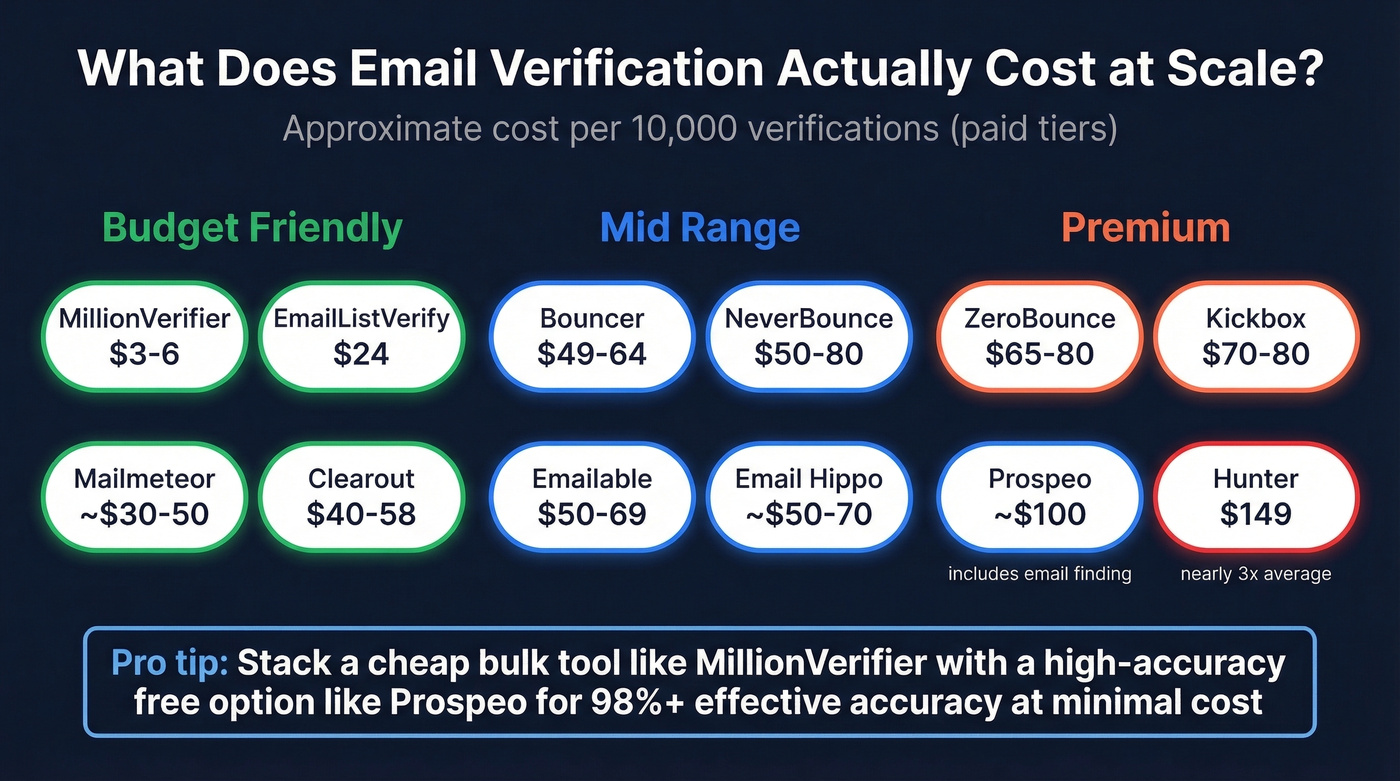
Free tiers work for spot-checking and small campaigns. But if you're running outbound at any real scale - say, 5,000+ emails per month - you'll burn through free credits in a day. Here's what the paid landscape looks like:
| Tool | ~Cost/10K | Best For |
|---|---|---|
| MillionVerifier | $3-6 | Maximum volume, tight budget |
| EmailListVerify | $24 | Large lists, basic needs |
| Clearout | $40-58 | Best value + accuracy balance |
| Bouncer | $49-64 | High accuracy, great support |
| NeverBounce | $50-80 | Top-tier accuracy on standard domains |
| Emailable | $50-69 | Generous free-to-paid transition |
| ZeroBounce | $65-80 | Compliance-heavy industries |
| Kickbox | $70-80 | Mid-tier, solid API |
The key metric to watch at scale: keep your total bounce rate below 2%, and hard bounces under 1%. Anything above that and ISPs start throttling your sending reputation. Gmail is particularly aggressive - spam complaint rates above 0.3% quickly reduce inbox placement.
The smartest approach we've seen is stacking two verifiers. Run your list through a cheap bulk tool like MillionVerifier first, then pass the catch-all and unknown results through a higher-accuracy tool like NeverBounce or Prospeo. You get 99%+ effective accuracy at a fraction of the cost of running everything through a premium tool. Teams that pair verified email with multi-channel outreach - adding direct dials or professional social touches - see response rates increase 3.5x in our experience.
For teams with strict privacy requirements, emaillistcleaner.org runs validation entirely in your browser - your list never leaves your machine. The tradeoff is no SMTP verification (it can't ping servers from your browser), so it's limited to syntax, DNS, and pattern-based checks. But for GDPR-sensitive list scrubbing where you can't upload data to a third party, it's a legitimate option.
If you're cleaning lists regularly, follow our step-by-step how to clean your email list process.
Meritt cut their bounce rate from 35% to under 4% using Prospeo's 5-step verification pipeline. At $0.01 per email with no contracts, you get higher accuracy than tools charging 8x more - plus 143M+ pre-verified emails ready to use.
Validate smarter: find, verify, and send without switching tools.
FAQ
How often should I verify my email list?
Every 3-6 months minimum. With 23-25% of email lists decaying annually from job changes, deactivated accounts, and domain migrations, quarterly verification prevents bounce rate creep that damages sender reputation. Verify again immediately before any large campaign.
Can a verified email still bounce?
Yes. Verification checks a point-in-time snapshot. Mailboxes get deactivated, servers change configurations, and catch-all policies shift between verification and send time. Always verify as close to your send date as possible; a list verified three months ago is already degrading.
What's the difference between free and paid email validation?
Free tiers give you 10-250 checks per month - enough for spot-checking individual addresses, not cleaning full lists. Paid plans unlock bulk upload, API access, faster processing, and significantly better catch-all resolution.
Is it safe to upload my list to a verification tool?
Most reputable tools encrypt data in transit and at rest, then delete uploaded lists within 7-30 days. For maximum privacy, use an in-browser tool like emaillistcleaner.org that processes everything locally. Check each tool's data retention policy before uploading sensitive lists.
How do I know if my bounce rate is too high?
Keep total bounces below 2% and hard bounces below 1%. Gmail flags senders with spam complaint rates above 0.3%, which quickly tanks inbox placement. If you're consistently above these thresholds, your list needs immediate cleaning - and you should verify before every campaign going forward.