

How to Set Up Automated Email Verification (and Stop Burning Domains)
Your first campaign goes out to 5,000 contacts. Bounce rate comes back ugly. The domain you spent weeks warming suddenly tanks across every sequence. Nobody verified the list.
Global inbox placement already sits around 84% - meaning one in six emails never reaches the inbox even under ideal conditions. Sending cold outbound to a dirty list makes that number dramatically worse.
The fix isn't manual spot-checking. It's automated email verification wired into your workflow so bad addresses never reach your outreach tool in the first place. (If you want the deeper mechanics, see how email verification works.)
What You Actually Need
- One verification tool with an API - Bouncer, ZeroBounce, Clearout, or NeverBounce all work (compare options in our best email verification tools roundup)
- One automation layer like Zapier or Make to trigger verification on new contacts and before campaigns
- A re-verification schedule - monthly minimum, weekly if you're sending at volume (more email verification best practices here)
Here's the thing most guides skip: if more than 10-15% of your list comes back invalid, your data provider is the real problem. No verification tool fixes garbage inputs. (Related: how to spot and handle invalid emails.)
How the Verification Pipeline Works
Every verification tool runs roughly the same pipeline, whether it's real-time API or bulk upload:
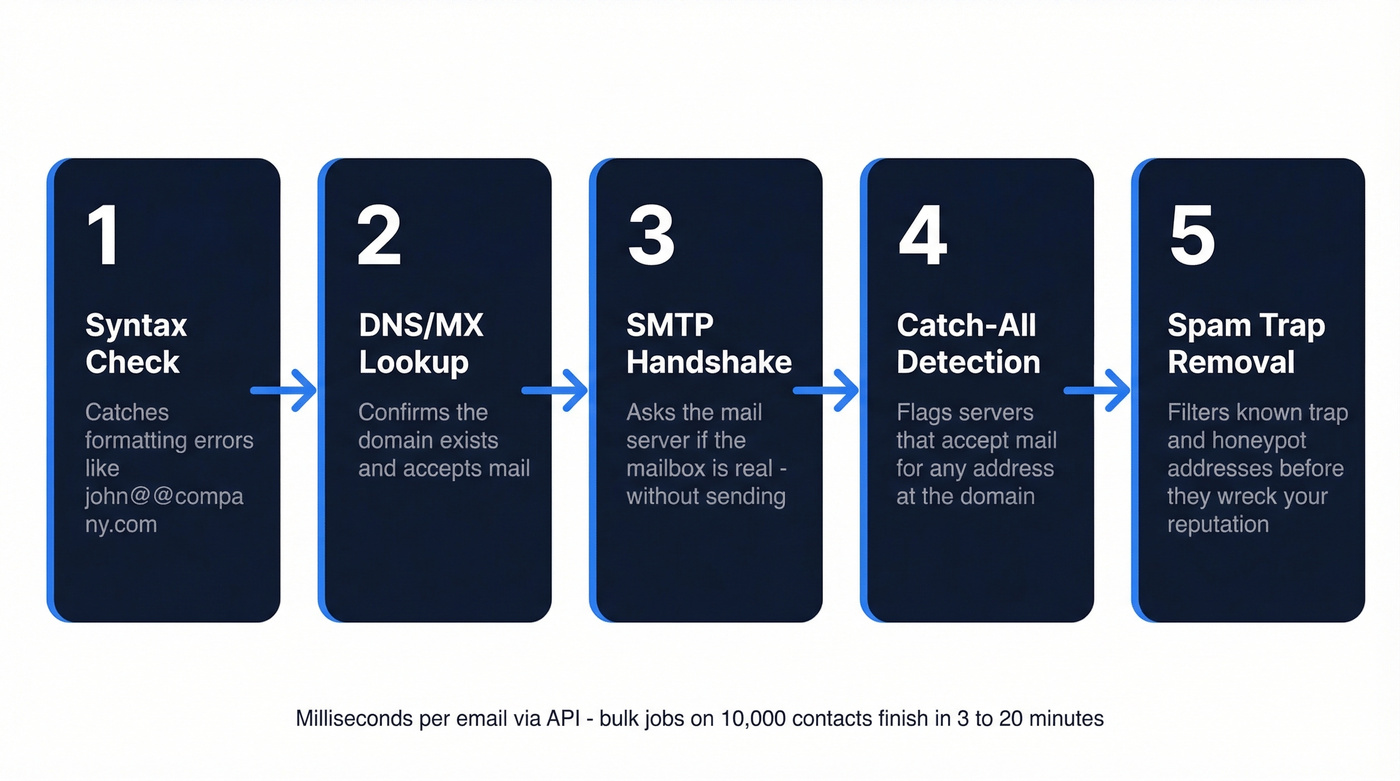
- Syntax check - is the email formatted correctly? Catches typos like
john@@company.com. (More on email syntax check.) - DNS/MX lookup - does the domain exist and accept mail? Filters out dead domains instantly. (If you’re troubleshooting, start with an email domain check.)
- SMTP handshake - the tool connects to the mail server and asks "would you accept a message for this address?" without actually sending one. (See: verify email address without sending email.)
- Catch-all detection - does the server accept mail for any address at that domain? If so, the tool flags it because it can't confirm the specific mailbox exists.
- Spam trap and honeypot removal - known trap addresses get filtered before they destroy your sender reputation.
Some vendors advertise "20-30+ verification steps." Most of these are sub-steps within these five core stages. The whole process takes milliseconds per email via API, and bulk jobs on 10,000 contacts typically finish in 3-20 minutes depending on the tool.
Why List Hygiene Can't Be Manual
Email lists rot fast. ZeroBounce's analysis of 11+ billion emails verified in 2025 found that at least 23% of an email list degrades every year. Hunter's verification guide puts a finer point on it: after just four weeks, roughly 2% of a verified list goes invalid. People change jobs, companies shut down domains, IT teams reconfigure mail servers.
The industry-standard bounce threshold is 2%. Top performers target hard bounces under 1%. (If you’re building a repeatable process, use a managing email lists playbook.)
One bad campaign on a stale list blows past both thresholds instantly. If you're sending more than a few hundred cold emails a month, you need a system that verifies without human intervention. Period.
Three Automation Patterns Worth Implementing
Most teams need at least two of these.
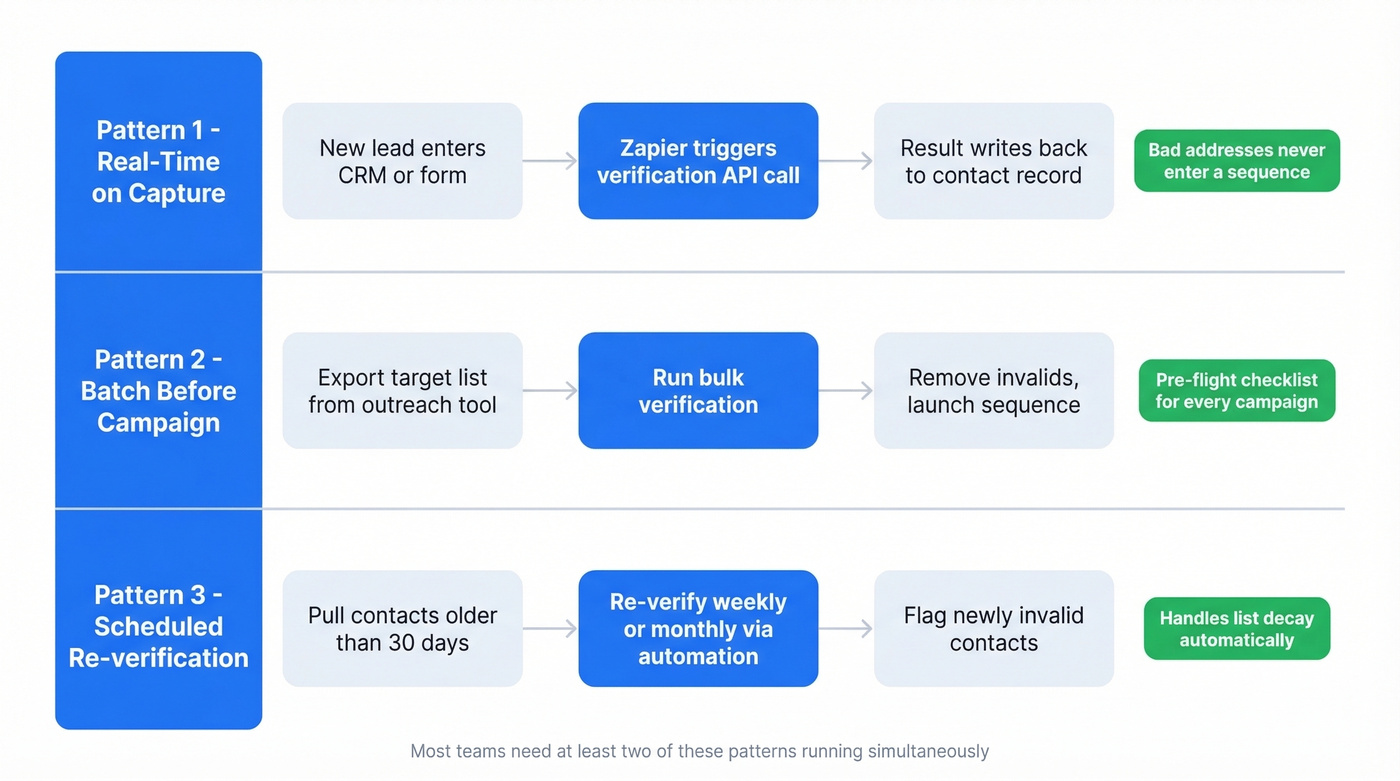
Pattern 1: Real-time on capture. New lead enters your CRM or form, Zapier triggers a verification call, and the result writes back to the contact record. Bad addresses never enter a sequence. (If you’re choosing endpoints, start with an email check API.)
Pattern 2: Batch before campaign. Before launching any outreach sequence, export the target list, run it through bulk verification, and remove invalids. Think of it as your pre-flight checklist - tedious to skip, painful when you don't. (See also: verify email list for cold email.)
Pattern 3: Scheduled re-verification. A weekly or monthly automation pulls contacts older than 30 days, re-verifies them, and flags any that have gone invalid. This handles decay automatically so you don't wake up to a bounce spike on a Tuesday morning because 200 contacts changed jobs last month.
Clay works as an alternative orchestration layer if you're already running enrichment workflows there. Make sure your verification provider is GDPR compliant - you're processing personal data every time you verify an email.

Prospeo runs every email through its own 5-step verification - syntax, DNS, SMTP, catch-all handling, and spam-trap removal - before you ever see it. 98% accuracy means you skip the costly cleanup loop entirely.
Stop verifying bad data. Start with data that's already clean.
The Catch-All Problem
No verification tool can definitively confirm a catch-all mailbox. The server says "sure, I'll accept mail for anything@domain.com," and the verifier has no way to distinguish a real inbox from a black hole. With more than 9% of all checked emails falling into catch-all territory, this isn't a niche edge case.
The only honest approach is risk-based sending. Send to catch-all addresses in small batches of 50-100, monitor bounce rates in real time, and pull back if they spike above 1%. Anyone telling you they've "solved" catch-all verification is selling you something.
How Accurate Are These Tools, Really?
Every verification vendor claims 99% accuracy. Independent tests tell a different story, and the consensus on r/sales from practitioners who've tested 10+ tools at scale is blunt: "Most tools work. None are perfect. The difference shows up at volume."
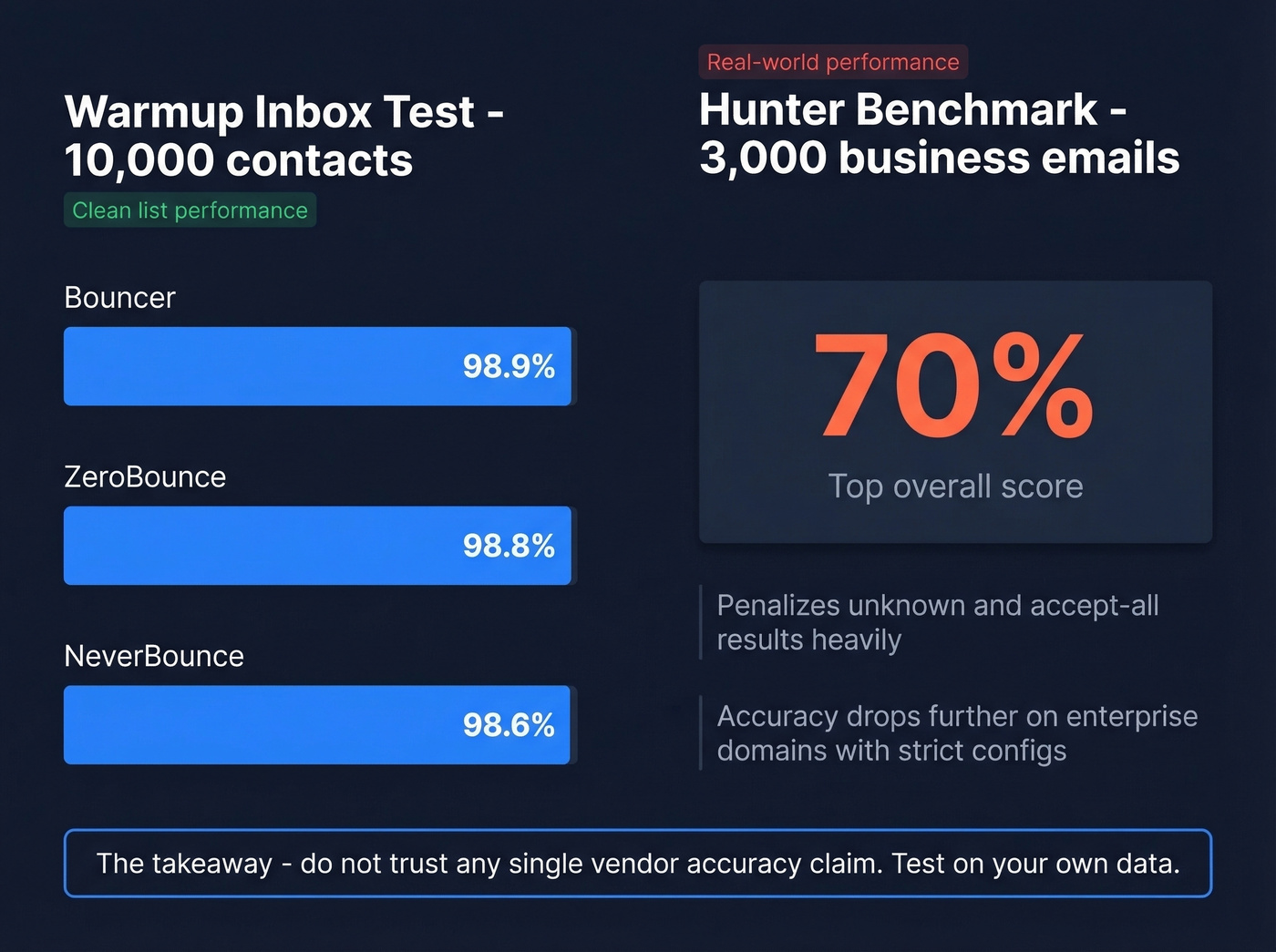
A Warmup Inbox test on a 10,000-contact list showed strong results - Bouncer hit 98.9%, ZeroBounce 98.8%, NeverBounce 98.6%. But Hunter's benchmark of 15 verifiers on 3,000 real business emails told a harsher story: the top overall score was 70%, and that metric penalizes unknown and accept-all results heavily. Accuracy dropped further on larger-company domains with stricter server configurations.
Don't trust any single vendor's accuracy claim. We've seen tools perform beautifully on clean lists and fall apart on enterprise-heavy segments. Test on your data.
Tool Pricing Compared
For budget-conscious teams doing basic list hygiene, DeBounce and MillionVerifier are hard to beat on price. For accuracy, Bouncer and ZeroBounce consistently top independent benchmarks. For automation-first workflows, prioritize tools with solid APIs and straightforward Zapier/webhook setups. (If you’re shopping broadly, start with best email validation.)
| Tool | Cost/1K | Free Tier | Model | Best For |
|---|---|---|---|---|
| Bouncer | ~$8 | 100 credits | PAYG | Accuracy-first |
| ZeroBounce | ~$8-9 | 100 credits/month | PAYG + sub | Enterprise |
| Clearout | ~$7 | 100 credits | PAYG | Automation-first |
| NeverBounce | ~$8 | 10 credits | PAYG + sub | High volume |
| Kickbox | ~$8-10 | 100 credits | PAYG | Deliverability |
| Emailable | ~$6-10 | 250 credits | PAYG | Mid-range |
| BillionVerify | ~$1-5 | 100/day | PAYG | Fast API |
| DeBounce | ~$1.50-2 | 100 credits | PAYG | Budget teams |
| MillionVerifier | ~$3.70 | None | PAYG | Bulk cleaning |
Let's be honest about what we see constantly: most teams overspend on verification because they're cleaning up after bad source data. If you're verifying 5,000 contacts and throwing away 1,800, the verification tool isn't your problem - your data provider is. Prospeo runs its own 5-step verification with catch-all handling and spam-trap removal on every record before it reaches you, pulling from 300M+ professional profiles on a 7-day refresh cycle. That turns verification into a safety net, not a rescue operation.
Verification Can't Fix Bad Data
Here's a pattern we see all the time: a team buys 5,000 leads from a list vendor, runs them through verification, 1,800 come back invalid, another 600 are catch-all. They've spent $40 on verification and still have a list that's going to bounce. Real customer results back this up - teams switching to pre-verified sourcing have seen bounce rates drop from 35% to under 4% in live outbound programs, with some agencies running zero domain flags across all their clients. (If you’re diagnosing the root cause, run a data quality audit.)
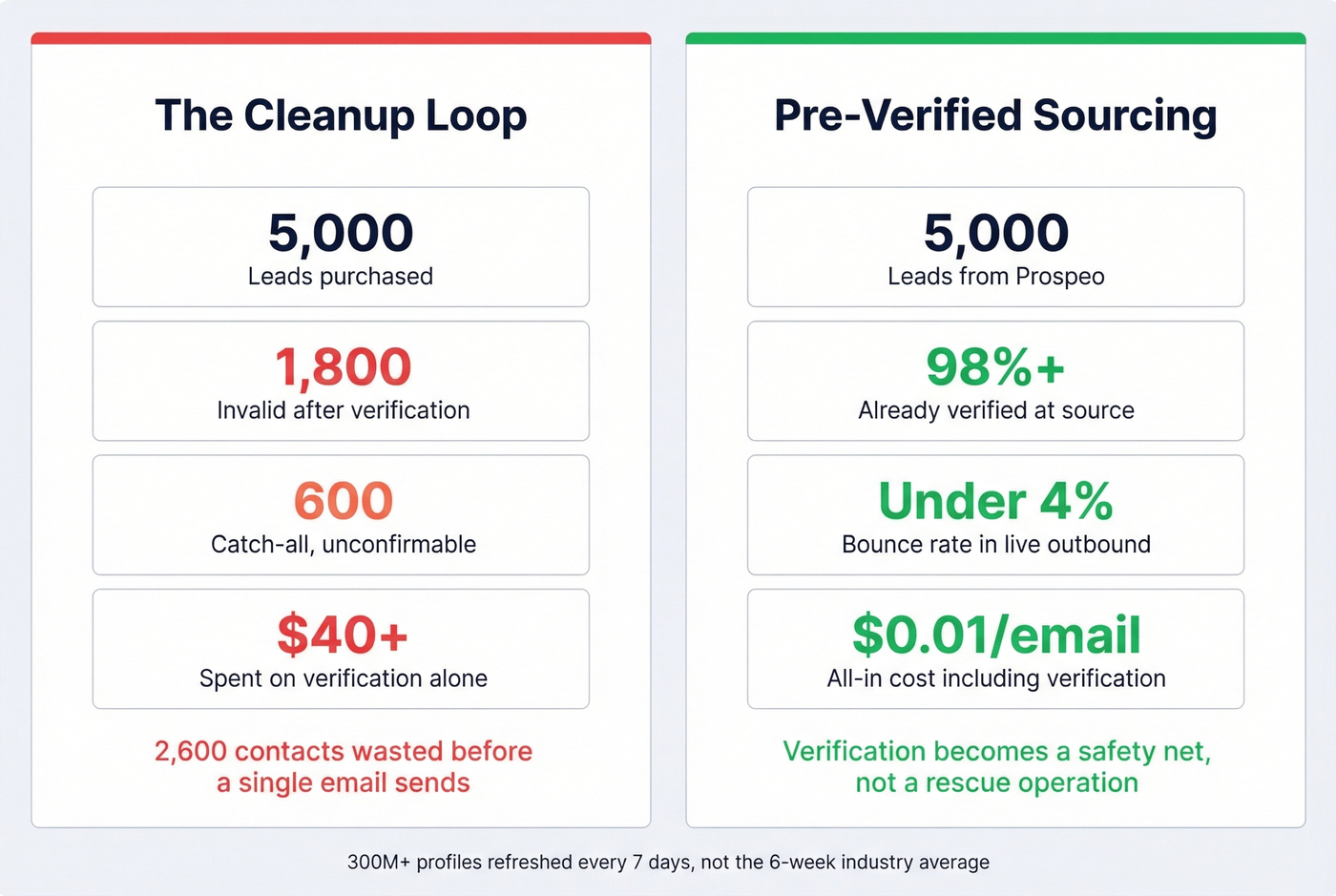
If you're spending more on verification than on sourcing, flip the equation. Start with accurate data and let automated verification serve as your final quality check - not your first line of defense. Skip standalone verification tools entirely if your data source already verifies at 98%+ accuracy; just run a batch check before major campaigns as insurance.
If you're throwing away 30%+ of every list after verification, your data provider is the bottleneck. Prospeo refreshes all 300M+ profiles every 7 days - not the 6-week industry average - so contacts stay valid between campaigns.
Eliminate list decay at the source for $0.01 per email.
FAQ
How often should I re-verify my email list?
Before every major campaign, at minimum. After four weeks, roughly 2% of a verified list goes invalid. Monthly re-verification is the floor; weekly is better at volume. Automate it with a scheduled Zap or Make scenario so it runs without anyone touching it.
What should I do with catch-all results?
Send in small batches of 50-100 and monitor bounces in real time. No verifier can definitively confirm catch-all mailboxes - the server accepts everything, so individual addresses can't be validated. Pull back immediately if hard bounces exceed 1%.
Can I set up verification workflows without code?
Yes. Zapier and Make both support verification tool integrations out of the box via modules or webhooks. A new contact triggers verification via API, then the result writes back to your CRM or spreadsheet. No engineering team required - most setups take under 30 minutes.
What's a good free option for small teams?
Prospeo's free tier includes 75 email credits per month with full 5-step verification and catch-all handling built in - enough for early-stage outbound. DeBounce and Clearout each offer 100 free verification credits for standalone list cleaning.