

The Best Free Spam Checkers - What They Actually Test (and What They Miss)
You got a 9/10 on Mail-Tester and your emails still landed in spam. That disconnect is way more common than you'd think - inbox placement rates sit around 83.5% across the industry, and nearly 17% of emails never reach recipients at all. We tested every major free spam checker, compared what each one actually evaluates, and dug into what none of them can tell you about why your emails really go to spam.
Our Picks (TL;DR)
- Fastest quick check: Mail-Tester - send an email, get a score, no signup required.
- Most actionable free test: GlockApps - seedlist inbox placement across providers, 2 free tests/month.
- Best ongoing monitoring: Google Postmaster Tools - completely free, shows Gmail's actual view of your domain.
What These Tools Actually Test
Not all spam checkers test the same thing. They fall into three distinct categories, and understanding the difference saves you from drawing the wrong conclusions.
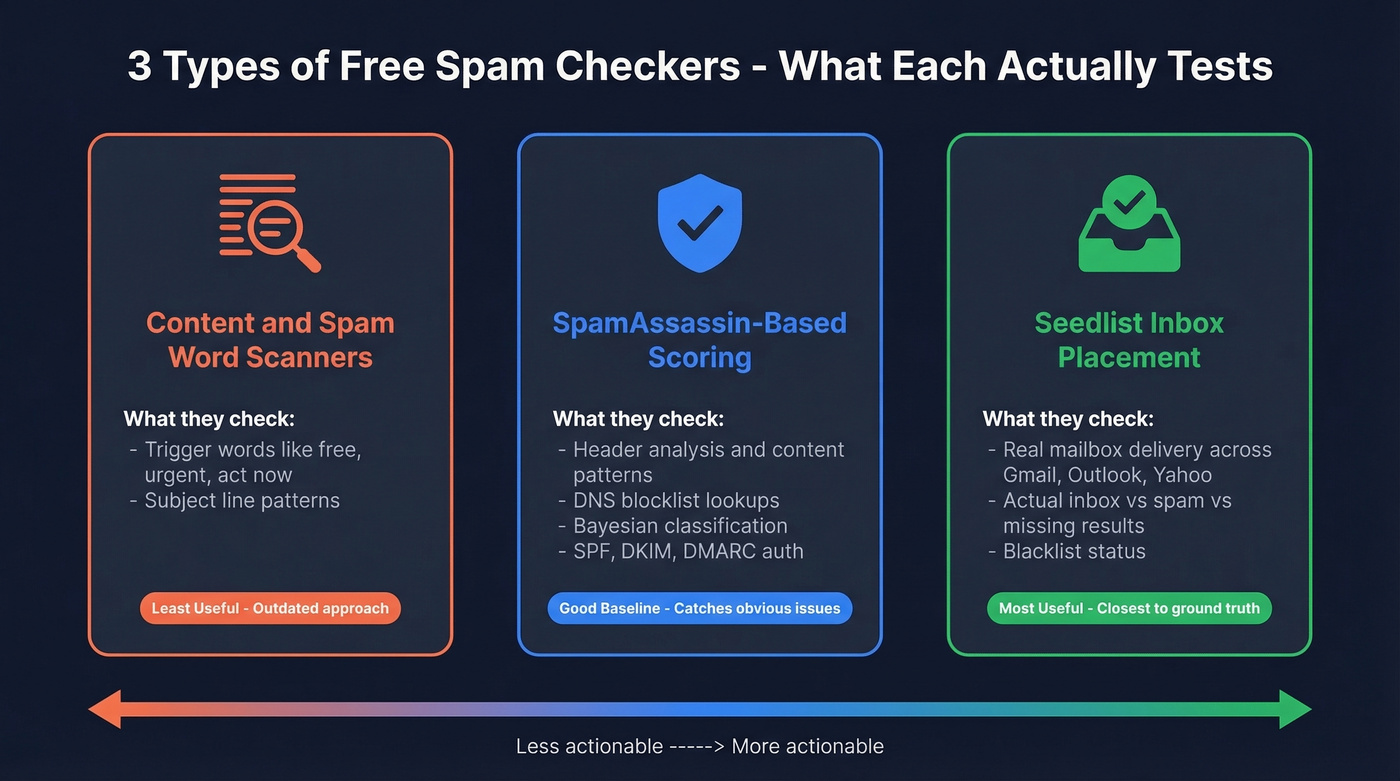
Content and spam-word scanners analyze your email copy for "trigger words" like "free," "urgent," or "act now." This is the least useful category. Modern spam filters evaluate hundreds of signals - sender reputation, authentication, engagement history, complaint rates. Trigger words are a relic of 2010-era filtering. Don't waste time obsessing over them.
SpamAssassin-based scoring tools run your email through SpamAssassin, an open-source filter maintained by the Apache Software Foundation since 2001. It applies hundreds of tests across headers, content patterns, DNS blocklists, and Bayesian classification. Scores break down into bands: 0-2.9 is low risk, 3.0-4.9 is caution, 5.0-7.9 is high risk, and 8.0+ is critical. Most systems flag at 5.0. These tools catch obvious problems but don't predict how Gmail or Outlook will actually treat your message.
Seedlist inbox placement testers send your email to a panel of real mailboxes across providers and report where it lands - inbox, spam, or missing. This is the closest thing to ground truth you'll get from a free deliverability test, though seed lists are small and results reflect cold-email conditions, not engaged-subscriber behavior.
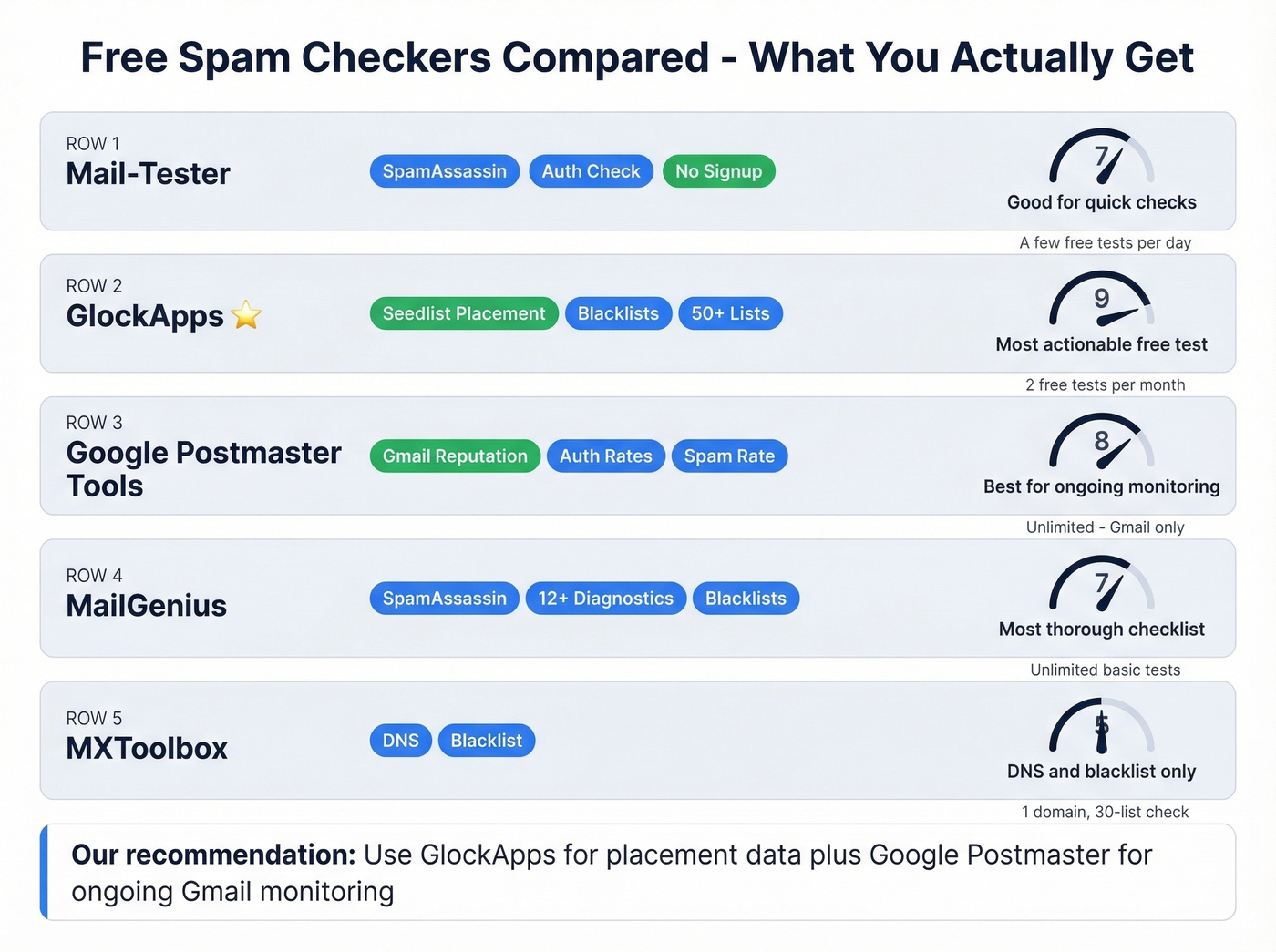
Best Email Spam Checkers Compared
| Tool | What It Checks | Free Tier Limits | Signup? | Best For |
|---|---|---|---|---|
| Mail-Tester | SpamAssassin + auth | A few free tests/day | No | Quick pre-send check |
| GlockApps | Seedlist + blacklists + auth | 2 tests/month + 10K DMARC checks | Yes | Real placement data |
| Google Postmaster | Gmail reputation + auth | Unlimited | Yes | Ongoing monitoring |
| MailGenius | SpamAssassin + 12+ diagnostics | Unlimited basic | Yes | Full diagnostic |
| Unspam | Placement + suite | Limited free tier | Yes | All-in-one testing |
| EXPERTE.com | SpamAssassin + Gmail tab | Unlimited | No | Fast, no-signup check |
| Folderly | Spam word scanning | Free word checker | No | Content-only check |
| MXToolbox | DNS + blacklist | 1 domain, 30-list check | No | Blacklist/DNS checks |
| DitLead | Content analysis | 20 checks/day | Yes | Lightweight scan |
Mail-Tester
Use this if you need a fast, no-signup sanity check before hitting send on a campaign. Send an email to a randomly generated address, and within seconds you get a SpamAssassin score plus SPF, DKIM, and DMARC authentication results. The interface is dead simple - a single score out of 10 with a detailed breakdown underneath. You get a few free tests per day, which is plenty for pre-campaign spot checks.
Skip this if you need ongoing monitoring or want to know where your email actually lands across providers. Mail-Tester tells you what SpamAssassin thinks, not what Gmail thinks. A 10/10 score and a spam folder aren't mutually exclusive - we've seen it happen plenty of times.
GlockApps
GlockApps is the most actionable option on this list. It's not close.
It sends your email to a seedlist of around 100 real mailboxes across Gmail, Outlook, Yahoo, and others, then reports actual inbox vs. spam placement. It checks 50+ blacklists in a single scan and shows authentication status alongside placement results. The free tier gives you 2 spam tests per month plus 10,000 DMARC checks/month - enough to validate a template, not enough for regular testing. Paid tiers run $59/month for Essential, $99/month for Growth, and $129/month for Enterprise.
The trade-off: that ~100-mailbox seed list is small, so don't draw sweeping conclusions from a single test. Results also reflect cold-email conditions, not how engaged subscribers experience your sends. But if you're only going to use one tool, make it GlockApps. A SpamAssassin score tells you what a filter might do. GlockApps tells you what actually happened.
Google Postmaster Tools
Here's the thing about Google Postmaster Tools: it doesn't look like a "spam checker." It looks like a boring dashboard. But the data comes straight from Google, and that makes it the most underrated tool on this list.
It's completely free and shows you what Gmail actually thinks about your domain - reputation status, spam rate, authentication pass rates, and encryption metrics. If you send any meaningful volume to Gmail addresses, you should already have this set up.
Skip this if you need multi-provider coverage. Postmaster Tools only shows Gmail and Google Workspace data. You're blind to Outlook, Yahoo, and everything else. Pair it with GlockApps for the full picture.
Setting it up takes about 10 minutes: verify your domain via DNS, wait for data to populate, and check weekly. Most teams never bother, which is why their Gmail deliverability problems go undiagnosed for months.
MailGenius
MailGenius runs one of the most thorough free diagnostic checklists available. Beyond SpamAssassin scoring, it checks SPF, DKIM, DMARC, reverse DNS, domain age, blacklist status across domain, IP, and body URLs, plus a dozen more diagnostics including HTML best practices and text-to-image ratio. Over 1M emails are tested through MailGenius per year, so the tool is battle-tested. The core tier is free with unlimited basic tests. One heads-up: tests are hosted on public links, so don't paste anything confidential.
Unspam
Unspam positions itself as an all-in-one deliverability suite - inbox placement testing, spam scoring, and design analysis rolled together. The free tier is limited but functional for occasional checks. If you want a single dashboard covering content, placement, and visual rendering without juggling three tools, Unspam is worth a look.
EXPERTE.com
EXPERTE.com's spam checker runs a SpamAssassin analysis plus a Gmail placement check - free, no signup. It's the fastest option if you want zero registration friction, making it ideal for a quick read on whether Gmail will route your email to Primary, Promotions, or Spam.
Folderly
Folderly offers a free spam word checker that scans your copy for trigger terms, plus a broader deliverability platform with a 7-day trial. Let's be honest: trigger word scanning is the least actionable type of spam check in 2026. Modern filters barely care about individual words - they care about your reputation, authentication, and engagement patterns.
MXToolbox
MXToolbox is a DNS and blacklist monitoring tool, not a spam checker in the traditional sense. The free tooling supports a one-domain workflow with a 30-list blacklist check. Deeper monitoring runs $129 for Delivery Center and $399 for Plus. Use it alongside a proper email deliverability test, not instead of one.
DitLead
DitLead offers a free content-focused checker with 20 checks per day and a broader product with monitoring and inbox placement testing. It's lightweight and content-oriented - useful as a quick second opinion, but it won't tell you anything about authentication or inbox placement.
A Note on Kickbox
You'll see Kickbox ranking for spam checker queries, but it's primarily an email verification and list-cleaning tool, not a spam content checker. For verification, it's solid. For actual spam testing, stick with the tools above.

Spam checkers diagnose problems after the damage is done. The real fix is sending to verified emails in the first place. Prospeo's 5-step verification delivers 98% email accuracy - teams using it see bounce rates drop from 35% to under 4%.
Stop diagnosing spam issues. Eliminate them at the source.
What Spam Checkers Can't Tell You
A perfect spam score means nothing if your list is full of dead addresses.
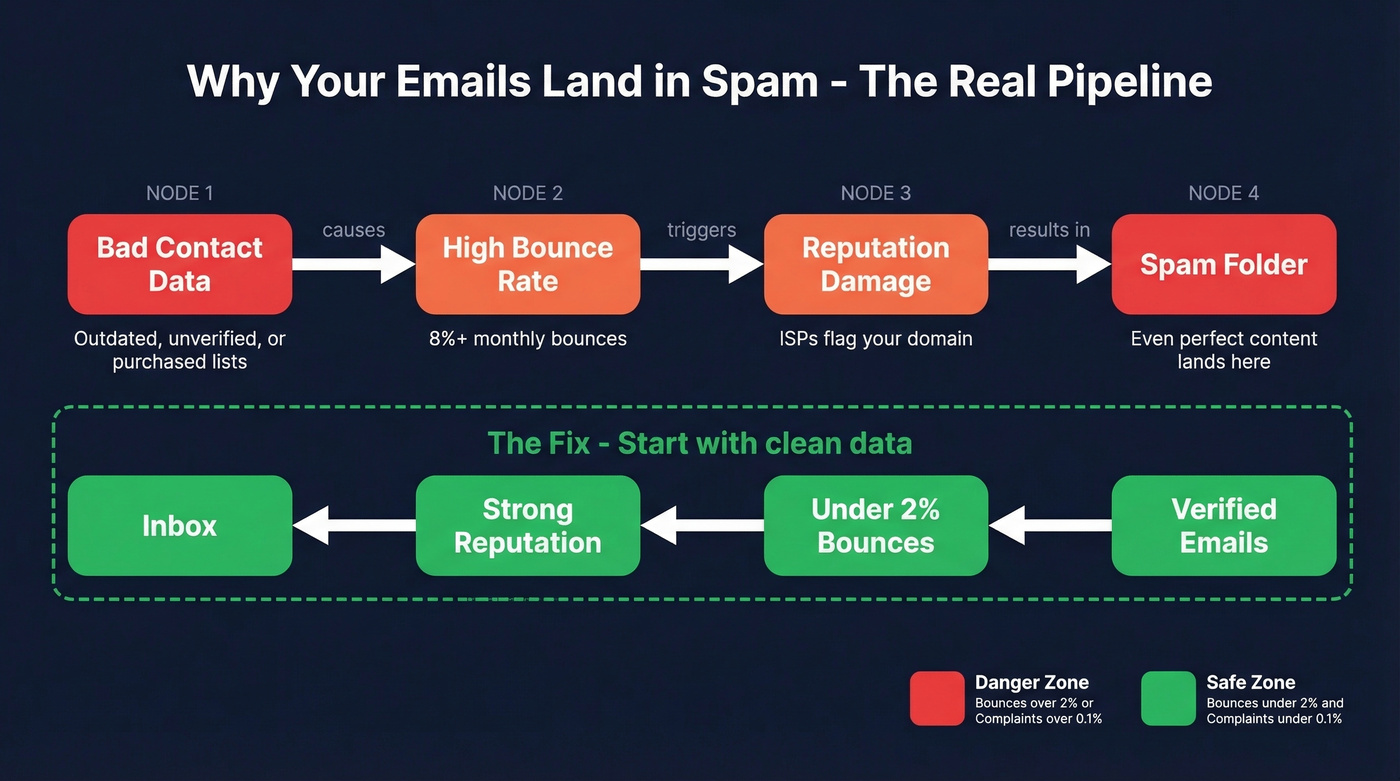
The #1 complaint on r/coldemail about deliverability tools is that they give "vague or false results" - and the reason is simple. These tools test your content and authentication. They can't see your sender reputation, your bounce history, or how recipients engage with your emails.
The chain works like this: bad contact data leads to bounces, bounces damage reputation, and damaged reputation means the spam folder. Target bounce rates under 2% and spam complaints below 0.1%. Exceed either threshold and no amount of SpamAssassin optimization will save you. (If you need to benchmark and fix bounces, start with this email bounce rate guide.)

Most teams troubleshooting deliverability are looking at the wrong end of the pipeline. They tweak subject lines and swap out "trigger words" when the real problem is that 8% of their list bounces every month. Fix the data first. Everything else is cosmetic.
What Drives Deliverability in 2026
Most free spam checkers test the wrong thing. SpamAssassin scores don't predict Gmail behavior. Gmail began stricter enforcement in February 2024, and by 2026, unauthenticated email is effectively dead.
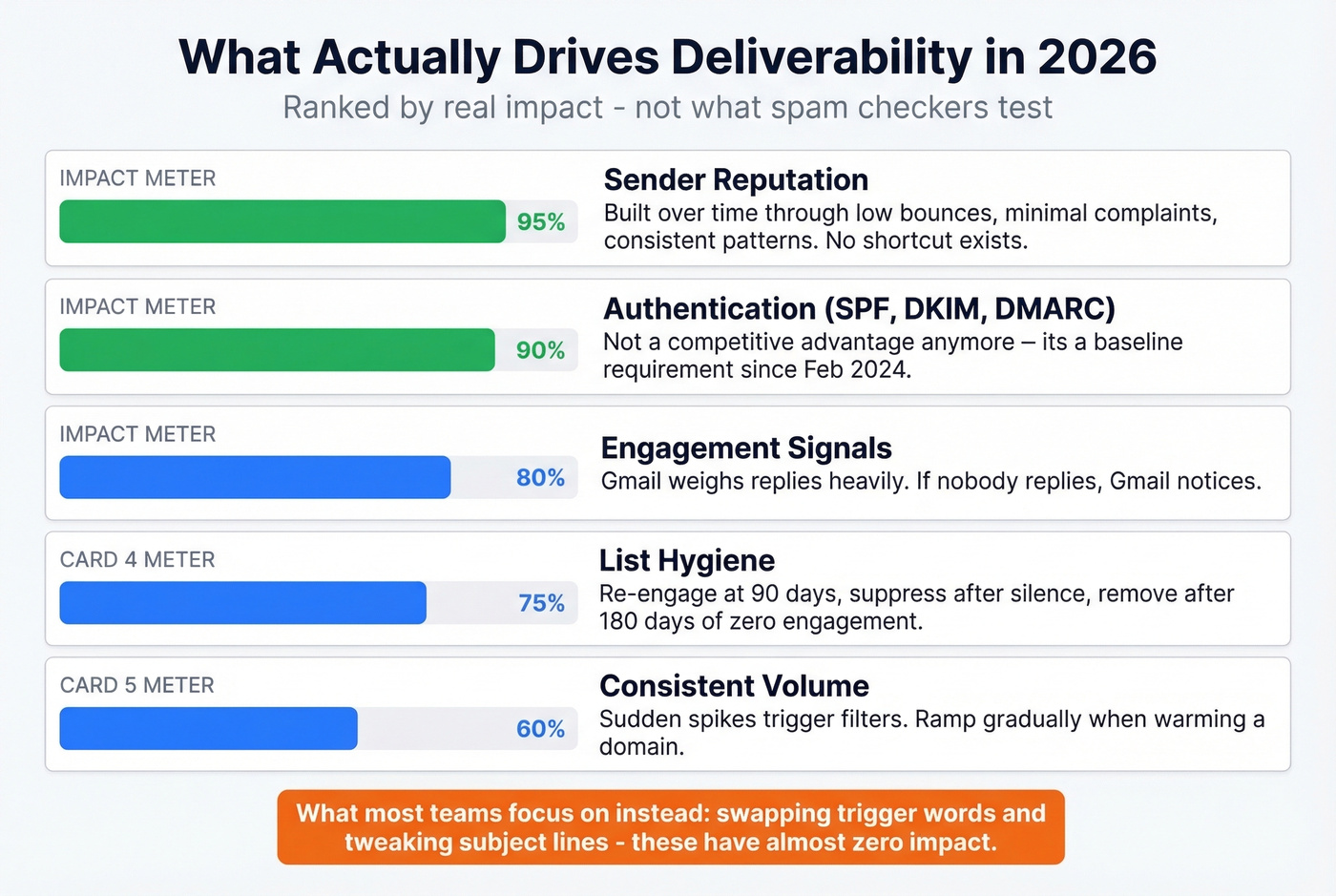
Here's what actually moves the needle:
- Authentication: SPF, DKIM, and DMARC properly configured. This isn't a competitive advantage - it's a baseline requirement. (If you're stuck, use these SPF record examples and a quick checklist on how to verify DKIM is working.)
- Sender reputation: Built over time through low bounce rates, minimal complaints, and consistent sending patterns. There's no shortcut. (More detail: how to improve sender reputation.)
- Engagement signals: Gmail weighs replies heavily. If nobody replies to your emails, Gmail notices. (Tactics that help: sales follow-up templates.)
- List hygiene: Re-engage contacts at 90 days, suppress after extended silence, remove after 180 days of zero engagement.
- Consistent volume: Sudden spikes trigger filters. Ramp gradually when warming a domain or scaling sends. (Related: email velocity.)
Inbox Placement Benchmarks
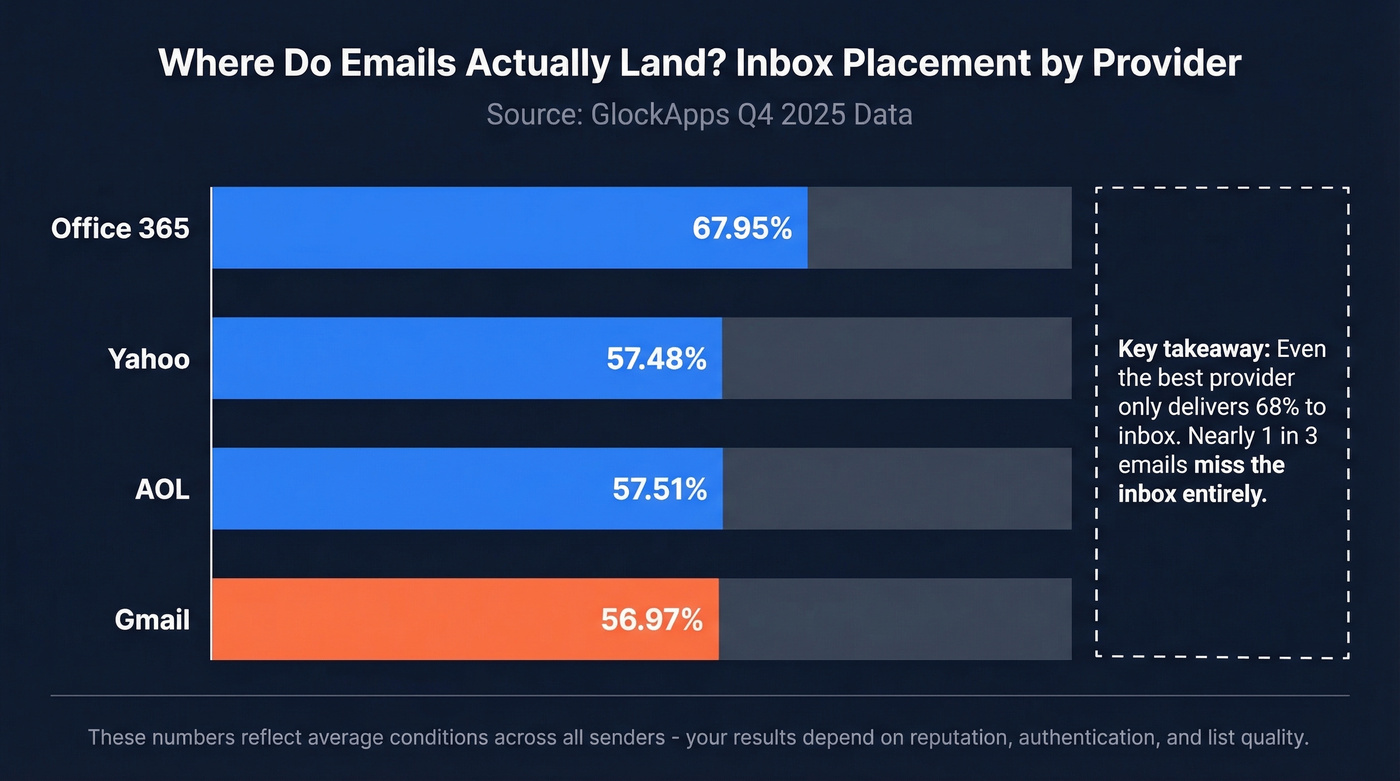
GlockApps' Q4 2025 data gives us the clearest picture of where emails actually land across providers:
| Provider | Avg Inbox Rate |
|---|---|
| Office 365 | 67.95% |
| Yahoo | 57.48% |
| Gmail | 56.97% |
| AOL | 57.51% |
| Google Workspace | 49.98% |
| Hotmail | 46.79% |
| Outlook | 45.06% |
If your Gmail inbox rate is above 57%, you're at or above average. These numbers improved from Q3 2025 - Gmail was up roughly 6 points, Office 365 up about 7 - suggesting authentication enforcement is stabilizing deliverability for compliant senders. Office 365 leads at nearly 68%, while Outlook's consumer mailboxes remain the toughest at 45%. Use these numbers to contextualize your own GlockApps results rather than panicking over a single test.
Every bounced email hurts your sender reputation and pushes future emails toward spam. Prospeo refreshes 300M+ profiles every 7 days - not every 6 weeks - so you're never sending to stale, invalid addresses that trigger spam filters.
Clean data means clean inboxes. Start with 75 free verified emails.
FAQ
What's a good spam score?
SpamAssassin scores below 3.0 are low risk, and most systems flag at 5.0+. But a good score doesn't guarantee inbox placement - a 1.0 with a trashed domain reputation still lands in spam. Use a score checker for a baseline, then pair it with reputation monitoring via Google Postmaster Tools for the full picture.
Are spam trigger words still relevant?
Barely. Modern filters evaluate hundreds of signals simultaneously. Individual words like "free" or "urgent" have minimal impact unless combined with missing DKIM, high bounce rates, or suspicious link patterns.
Why does my email pass a spam check but still land in spam?
Because these tools test your content and authentication, not your reputation. High bounce rates, low engagement, and poor list hygiene are the real culprits. Fixing data quality upstream - using a verification tool like Prospeo or NeverBounce - prevents the bounces that damage reputation in the first place.
How often should I run deliverability tests?
Test every new template or major content change with Mail-Tester or GlockApps. Set up Google Postmaster Tools for weekly reputation monitoring. Reputation trends matter more than any single test - consistent monitoring is what keeps you out of the spam folder long-term.