

Gap Selling Summary: Framework, Questions & What Actually Works
More than 65% of lost sales trace back to poor qualification. Not bad closing skills, not weak demos - bad discovery. And over 20% of B2B buyers spend up to 19 hours a month researching solutions on their own. They're doing their homework. Most sellers aren't doing theirs.
Keenan's Gap Selling framework exists to fix that imbalance, and you don't need to read the full book to use it. This gap selling summary covers the complete methodology, gives you copy-paste discovery questions, and tells you where it falls apart.
The Short Version
Gap Selling = sell to the gap between current state and future state, not to features or even pain. Pain alone doesn't drive change - quantified business impact does.
Discovery IS the sale. Keenan recommends spending roughly 25% of your sales cycle learning the buyer's current and future state. Everything after that is paperwork. Five current-state elements to uncover: Environment, Problem, Impact, Root Cause, Emotion. Skip one and your discovery gets weaker.
Quantify the gap in dollars or the buyer can't justify the purchase internally. No number, no urgency. And skip the full framework for transactional, quote-driven sales where the buyer just wants a price - it'll slow you down for no reason.
What Is Gap Selling?
Gap Selling is a sales methodology created by Keenan - yes, one name - introduced in a 2018 book. A Sales Growth Company teaches it as a training program focused on uncovering what's broken, what it's costing, and why it needs to be fixed now.
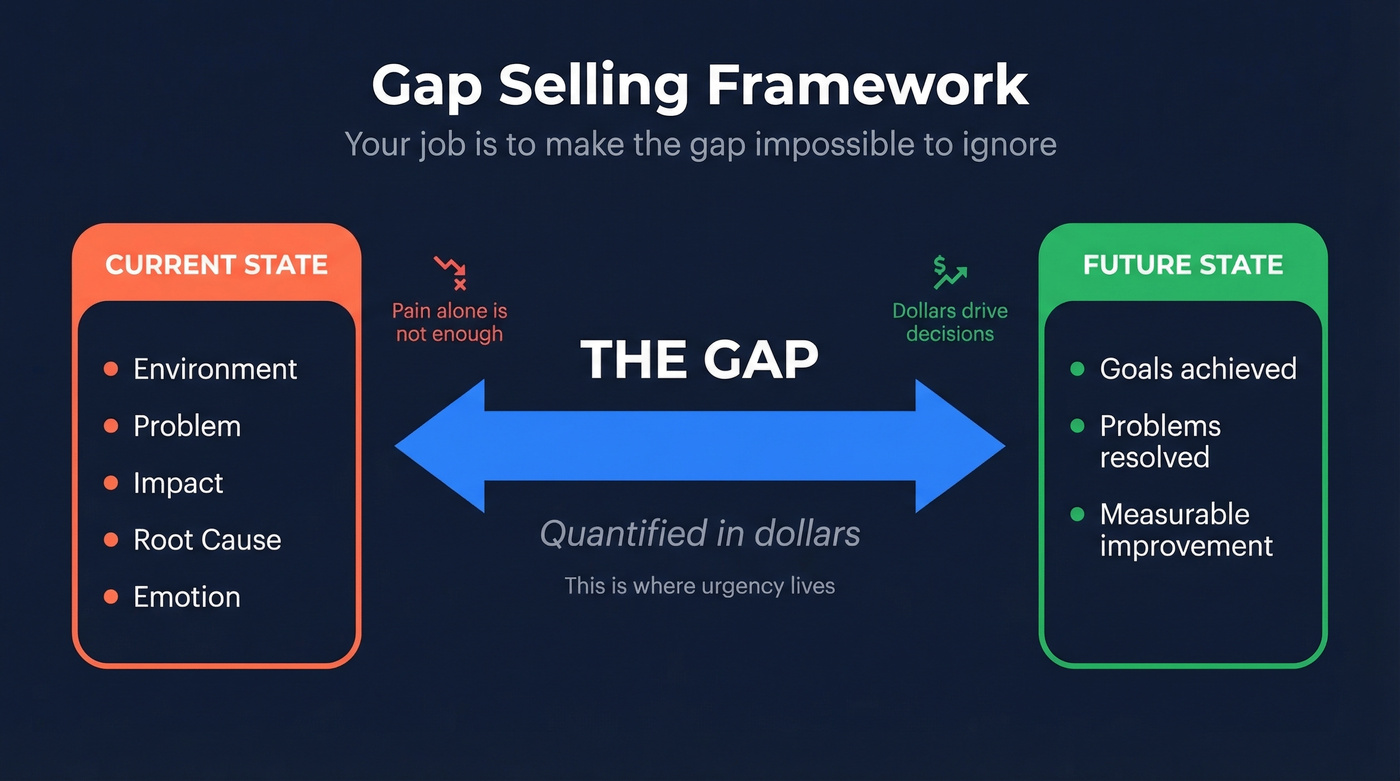
The core thesis is deceptively simple: every sale has a gap between where the buyer is today (current state) and where they want to be (future state). Your job isn't to pitch features. It's to make that gap impossible to ignore.
Keenan puts it bluntly: "Never sell to need." Problems get you to the impact, and impact is where urgency, value, and need actually live. A buyer might know they have a problem and still do nothing about it for years. But when you quantify what that problem costs - in revenue, time, or missed goals - the gap becomes an anchor. Think of it as anchoring bias applied to selling: "You pay just $X to solve a problem that's costing you $Y."
Another truthbomb worth internalizing: "Customers don't like change." Sounds counterintuitive for a methodology built on change, but that's the whole point. Buyers resist change by default. The gap has to be painful enough - in dollars, in missed targets, in daily frustration - that staying put becomes the riskier option.
Five Elements of Current State
Before you can sell the gap, you need to map the buyer's current state completely. Keenan breaks it into five elements:
| Element | What It Means | Example Question |
|---|---|---|
| Environment | The buyer's world - tools, team, processes | "Walk me through how your team handles this today." |
| Problem | What's broken or underperforming | "What's not working the way you'd want?" |
| Impact | Business consequences of the problem | "What does that cost you per quarter?" |
| Root Cause | Why the problem exists | "Why do you think this keeps happening?" |
| Emotion | How the buyer feels about the situation | "How does this affect your team day-to-day?" |
The emotion piece is the one most sellers skip. Don't. In our experience, it's the element that separates good discovery from great discovery - it's what makes the buyer feel understood rather than interrogated. If you can't name the emotion driving the buyer, you haven't finished discovery.
Discovery Questions You Can Actually Copy
Every summary of this methodology tells you to "ask good discovery questions" and then doesn't give you the questions. Here they are, organized by the four question types Keenan prescribes. The seller should talk about 20% of the time and listen 80%, and he recommends spending roughly 25% of the entire sales cycle on this phase. It's not a five-minute warm-up.
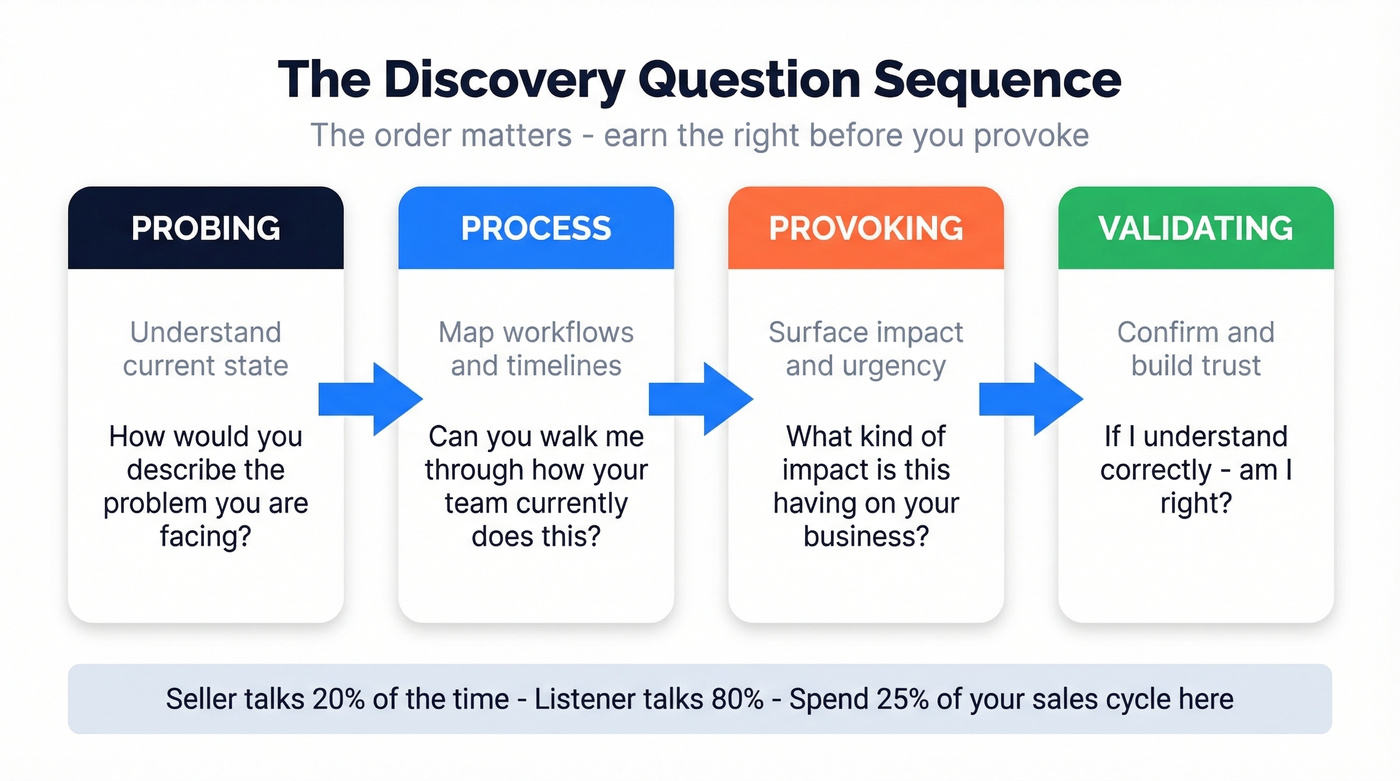
| Type | Purpose | Questions |
|---|---|---|
| Probing | Understand the current state | "Tell me about your company and how your team is structured." / "How would you describe the problem you're facing?" / "What does your current process look like?" |
| Process | Map workflows and timelines | "Can you help me understand how your company currently does this?" / "What timeline did you have in mind?" / "Who else is involved in this decision?" |
| Provoking | Surface impact and urgency | "What are you hoping to achieve?" / "What kind of impact is this problem having on your business?" / "What's currently holding you back from fixing this?" |
| Validating | Confirm understanding, build trust | "If I understand correctly, [restate]. Am I right?" / "Last time we spoke, you mentioned [X]. Is that still true today?" / "So the core issue is [Y] - does that capture it?" |
Start with probing, move through process, provoke to surface impact, then validate to lock in alignment. The sequence matters. Jumping to provoking questions before you've earned the right to ask them makes you sound like a consultant who bills by the hour, not a seller who's trying to help.
Keenan's third truthbomb ties this together: "Asking 'Why?' gets customers to 'Yes.'" Every provoking question is a variation of "why" - why does this matter, why now, why hasn't it been fixed. That's where urgency lives.

Great discovery questions don't matter if you're asking the wrong people. Prospeo gives you 300M+ verified contacts with 30+ filters - buyer intent, job changes, headcount growth - so you reach decision-makers who actually have the gap you solve.
Stop selling to the gap. Start finding buyers who already feel it.
How to Quantify the Gap
Here's where deals are won or lost. A buyer who "feels" the problem is interesting. A buyer who knows the problem costs $200K a year is motivated.
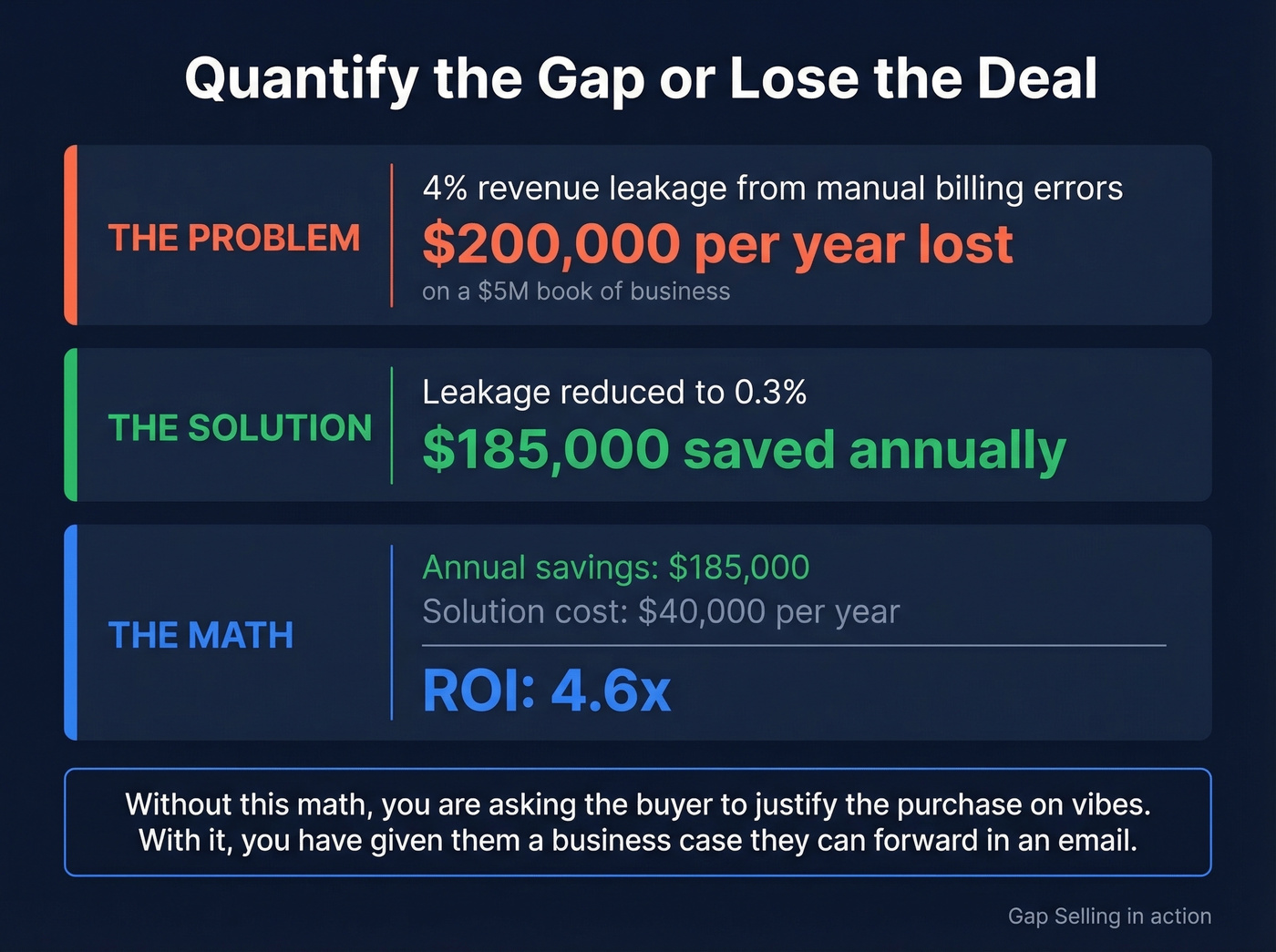
Let's walk through an illustrative example. Say your prospect has 4% revenue leakage from manual billing errors - that's $200K/year on a $5M book of business. Your solution reduces leakage to 0.3%, saving $185K annually. Your subscription costs $40K/year. That's a 4.6x ROI, and now the buyer has a number they can take to their CFO.
Without that math, you're asking the buyer to justify the purchase on vibes. With it, you've given them an internal business case they can forward in an email.
When a buyer pushes for pricing before you've established the gap, try this: "Could we quantify the impact first so any pricing discussion is meaningful?" You're not dodging the question - you're making the answer land harder when you give it.
One more concept worth stealing: the "Next Yes" framework. Instead of pushing toward a single close, you advance the deal through micro-commitments - discovery call, demo, business case, procurement review, close. Each step has a clear "next yes" that the buyer agrees to. It keeps momentum without the pressure of a hard close.
Gap Selling vs. SPIN vs. Challenger
Three methodologies, three different bets on what drives sales performance.
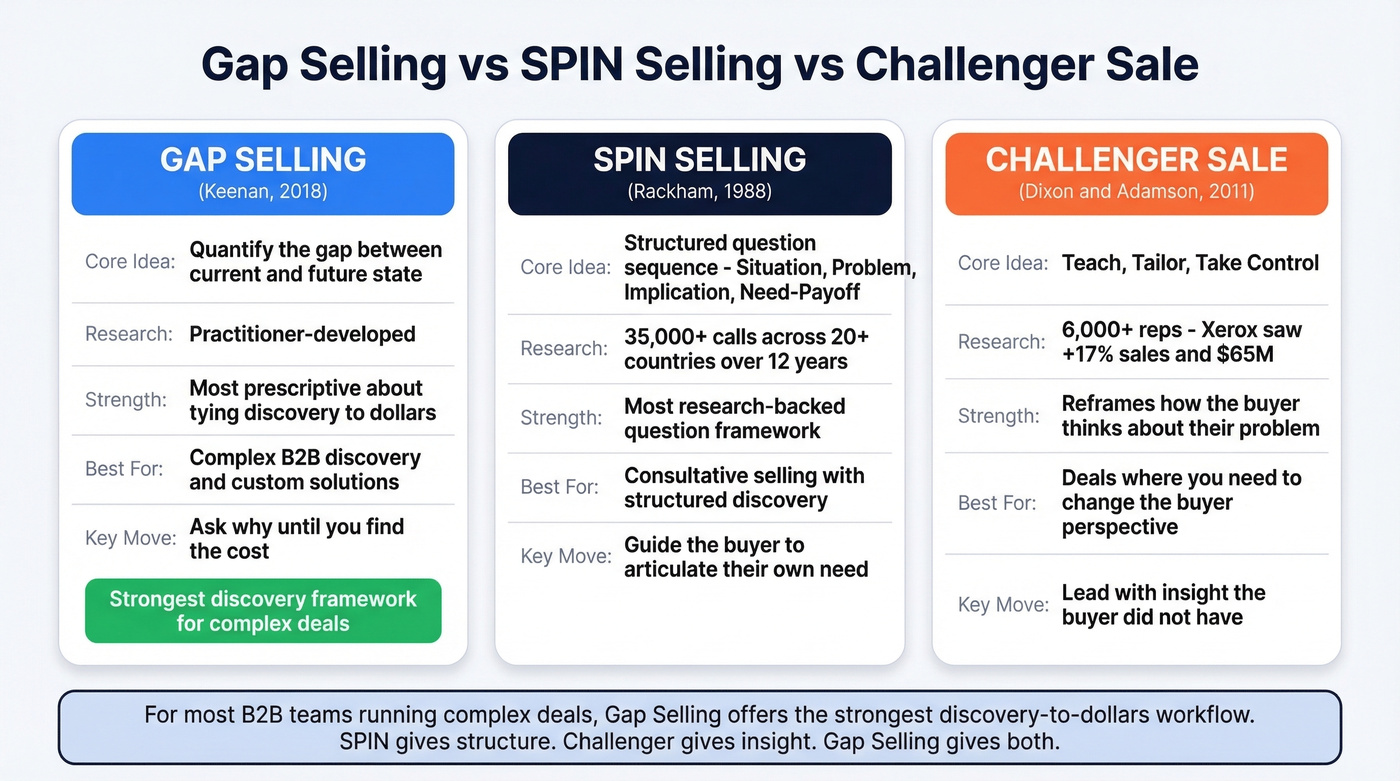
| Methodology | Core Idea | Research Basis | Best For |
|---|---|---|---|
| Gap Selling (Keenan) | Quantify the gap between current and future state | Practitioner-developed, 2018 | Complex B2B discovery and custom solutions |
| SPIN Selling | Structured question sequence: Situation, Problem, Implication, Need-Payoff | 35K+ calls, 20+ countries, 12 yrs | Consultative selling with structured discovery |
| Challenger Sale | Teach, Tailor, Take Control | 6K+ reps; Xerox: +17% sales, $65M | Deals where you need to reframe the buyer's thinking |
Here's the thing: Gap Selling is the most prescriptive about tying discovery to dollars. SPIN gives you a question framework but doesn't insist on quantification. Challenger focuses on teaching the buyer something new, which is powerful but requires serious content investment.
For most B2B teams running complex deals, we think Keenan's approach is the strongest discovery framework available right now. It's a modern synthesis that borrows the rigor of SPIN and the commercial insight of Challenger, then wraps it in a practical, deal-level workflow.
If your deal is small and simple, skip the full discovery apparatus. A streamlined discovery call and a clear demo will close faster. This framework earns its keep on deals where the buyer needs internal justification, multiple stakeholders are involved, and finance wants to see the math.
Does the Training Work?
The training program carries a 4.7 out of 5 on G2 across 73 reviews. Reviewers consistently praise the direct approach and the practical questioning skills it builds. One reviewer reported 10x ROI. That's an outlier, but the pattern of positive sentiment is consistent.
A Sales Growth Company's post-training surveys report that 98% of sales leaders believe it'll help them hit goals, 93% say reps use it daily, and 91% say the training exceeded expectations. Those are vendor-reported numbers, not independently validated - but the signal is strong.
The one consistent note: Keenan's delivery style is direct. Very direct. That's a feature for most people and a bug for some.
Common Mistakes and When It Breaks Down
Your contact can't answer the questions. The most common Reddit critique comes from sellers whose contacts are Facilities, IT, or Procurement - people gathering info to "run up the food chain." They don't know the CEO's revenue targets.
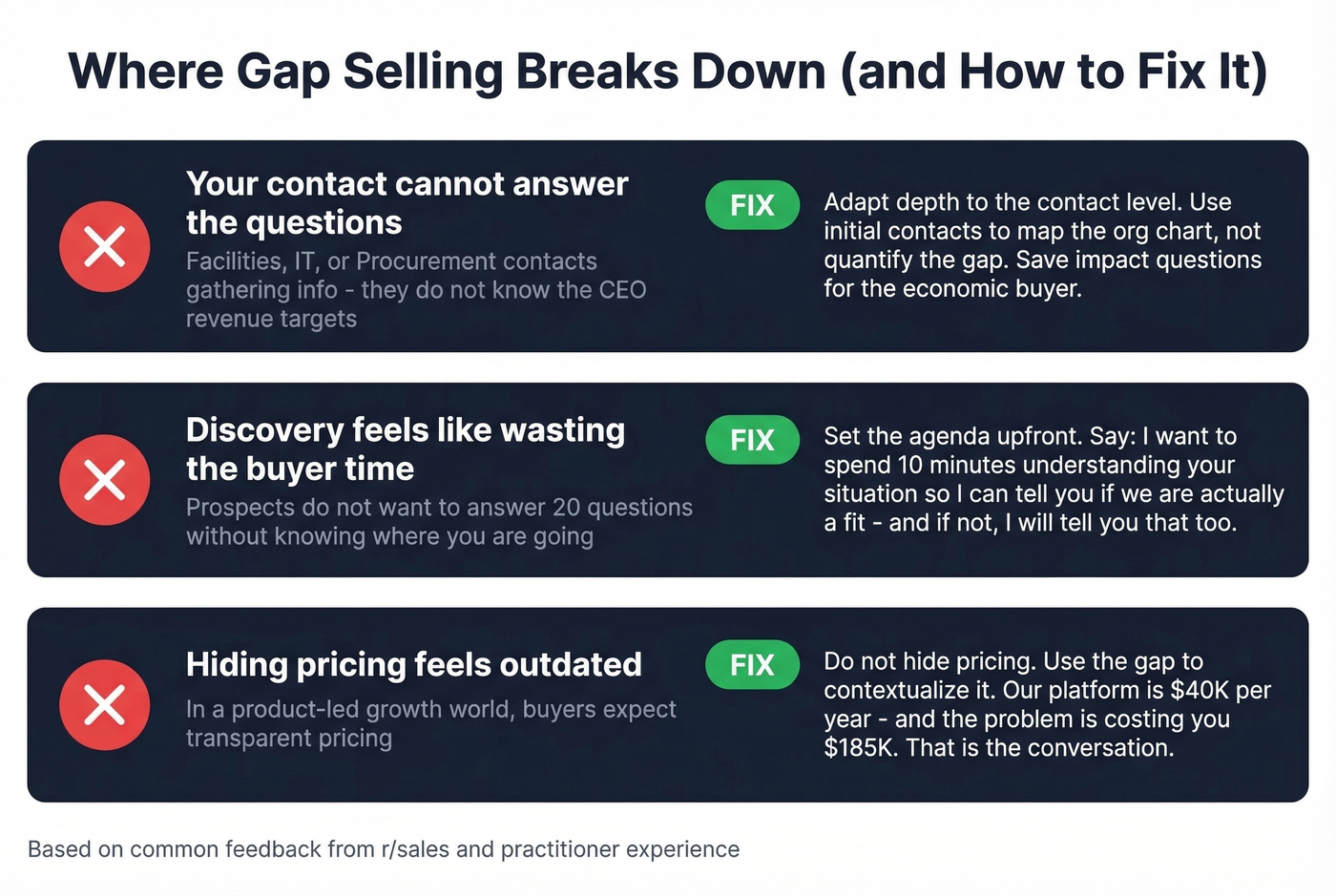
The fix: adapt depth to the contact level. With non-executive buyers, focus on environment and process questions. Save impact and root cause for the economic buyer. Use your initial contact to map the org chart, not to quantify the gap.
Discovery feels like wasting the buyer's time. Another recurring objection on r/sales: prospects don't want to answer 20 questions without knowing where you're going.
The fix: set the agenda upfront. "I'd like to spend 10 minutes understanding your situation so I can tell you whether we're actually a fit - and if we're not, I'll tell you that too." Discovery reframed as respect, not interrogation.
Hiding pricing feels outdated. Keenan's framework suggests anchoring on the gap before revealing price. In a product-led growth world where buyers expect transparent pricing, this can backfire.
Look, don't hide pricing. Use the gap to contextualize it. "Our platform is $40K/year - and based on what you've told me, the problem is costing you $185K. That's the conversation."
Implementing the Framework
Reading about this methodology and actually using it are different things. Here's a 60-to-90-day rollout for recalibrating discovery, templates, and coaching habits.
First, add current-state and future-state fields to your CRM. In Salesforce or HubSpot, create custom fields for each of the five elements plus a "quantified gap" field. If reps can't fill these out after discovery, the call wasn't good enough. We've seen teams stall at implementation because they skip this step - without structured fields, the framework stays theoretical. (If you need a refresher on CRM options, see examples of a CRM.)
Second, build a list of accounts where you can solve a real gap. This is where most teams stall. They have the framework but can't reach the right decision-makers. A platform like Prospeo helps here - you can layer buyer intent signals across 15,000 topics to identify companies already showing the pain you solve, then pull verified contact data for the right people. If you're rebuilding top-of-funnel, start with proven sales prospecting techniques and tighten your ideal customer profile before you scale volume.
Third, run discovery call reviews weekly. Record calls, score them against the five current-state elements, and track whether reps are quantifying the gap. Managers should use those same five elements as a pipeline review scorecard - if a deal's CRM fields are empty, the opportunity isn't qualified. The framework only works if it becomes muscle memory, and the training reinforces this through structured role-play and live call coaching. To keep deals moving between reviews, standardize your sales activities and use consistent sales follow-up templates.
You just learned to quantify the gap in dollars. Now quantify your prospecting: 98% email accuracy, 125M+ verified mobiles with 30% pickup rates, and data refreshed every 7 days. At $0.01 per email, bad data never eats your ROI math.
Your discovery calls need real contacts, not bounced emails.
FAQ
Is the Gap Selling book worth reading?
Yes - Keenan's voice and the real-deal examples make it worthwhile even after reading a summary. That said, this guide plus the discovery question templates cover roughly 90% of the actionable framework. The book runs $15-$25 and reads fast.
How is Gap Selling different from SPIN Selling?
SPIN uses a structured question sequence to guide buyers toward recognizing their need. Gap Selling is more prescriptive about tying every discovery conversation to a dollar figure the buyer can use internally. Both work; Keenan's method is better for teams that need a quantified business case to close deals above $25K.
Does Gap Selling work for transactional sales?
No. It's designed for complex B2B with multiple stakeholders and longer buying cycles. For quote-driven motions where the buyer just wants a price and a timeline, use a streamlined qualification framework instead - the full discovery apparatus will slow you down.
How much does Gap Selling training cost?
The book runs $15-$25. Team training through A Sales Growth Company typically costs $10K-$50K+ depending on team size and format - virtual vs. on-site, with or without ongoing coaching. Budget for the higher end if you want the full rollout with reinforcement sessions.
What tools help implement this framework?
A CRM like Salesforce or HubSpot for tracking current-state and future-state fields across deals. A conversation intelligence tool like Gong or Chorus for scoring discovery calls. And a B2B data platform for building verified prospect lists - bad contact data kills pipeline before discovery even starts.