

Generating Leads: What Actually Works, What It Costs, and What to Stop Doing
Most lead generation advice reads like a listicle written by someone who's never run a campaign. "Post on social media." "Try cold email." "Build a landing page." Thanks. Super helpful.
Here's what those guides skip: what a lead actually costs in your industry, why 92% of B2B buyers already have a vendor in mind before they talk to you, and where your budget is quietly bleeding out. We've spent years watching teams burn money on the wrong channels, and the patterns are painfully consistent. This piece breaks them down with real numbers.
The Short Version
Lead generation isn't a tactics problem - it's a timing and data problem.
- Get on the Day One shortlist. The winning vendor is on the buyer's initial shortlist 95% of the time. If you're not known before the buying cycle starts, you're fighting for the remaining 5%.
- Pick channels by ROI data, not gut. Bing Ads ROI hits 253%. LinkedIn's CPL runs 57% higher than Google but converts MQLs to SQLs at nearly double the rate.
- Clean your data constantly. Email lists decay ~28% per year. That's a quarter of your pipeline rotting every twelve months.
- Benchmark against a 3:1 LTV:CAC ratio. Below it, you're buying revenue at a loss.
What Does Generating Leads Actually Mean?
Simple definition, complicated execution. It's the process of identifying, attracting, and capturing potential buyers for your product or service.
The funnel still matters, even if people love declaring it dead. At the top, you're building awareness through content, ads, and social. In the middle, you're nurturing interest with webinars, case studies, and email sequences. At the bottom, you're converting through demos, trials, and sales conversations.
The leads themselves come in distinct flavors:
- MQL - engaged enough to signal interest (downloaded a whitepaper, visited your pricing page twice)
- SQL - vetted by your team and confirmed to match your ICP
- PQL - used your product and hit a usage threshold signaling buying intent
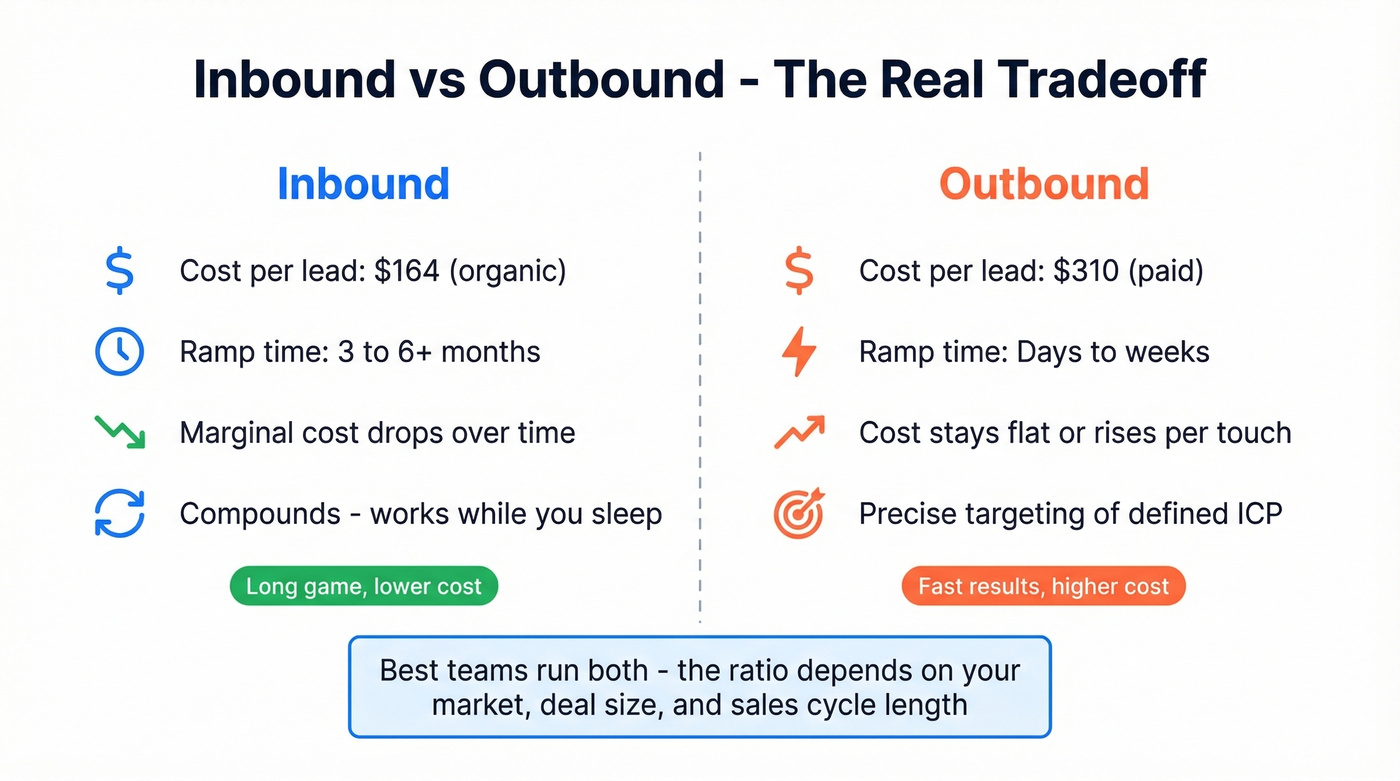
Inbound pulls prospects toward you through content, SEO, and brand. Outbound pushes your message through cold email, calling, and direct outreach. The best teams run both, but the ratio depends on your market, deal size, and sales cycle length.
Why Most Lead Gen Strategies Underperform
Here's the uncomfortable truth: by the time a prospect fills out your form, the decision is largely made.
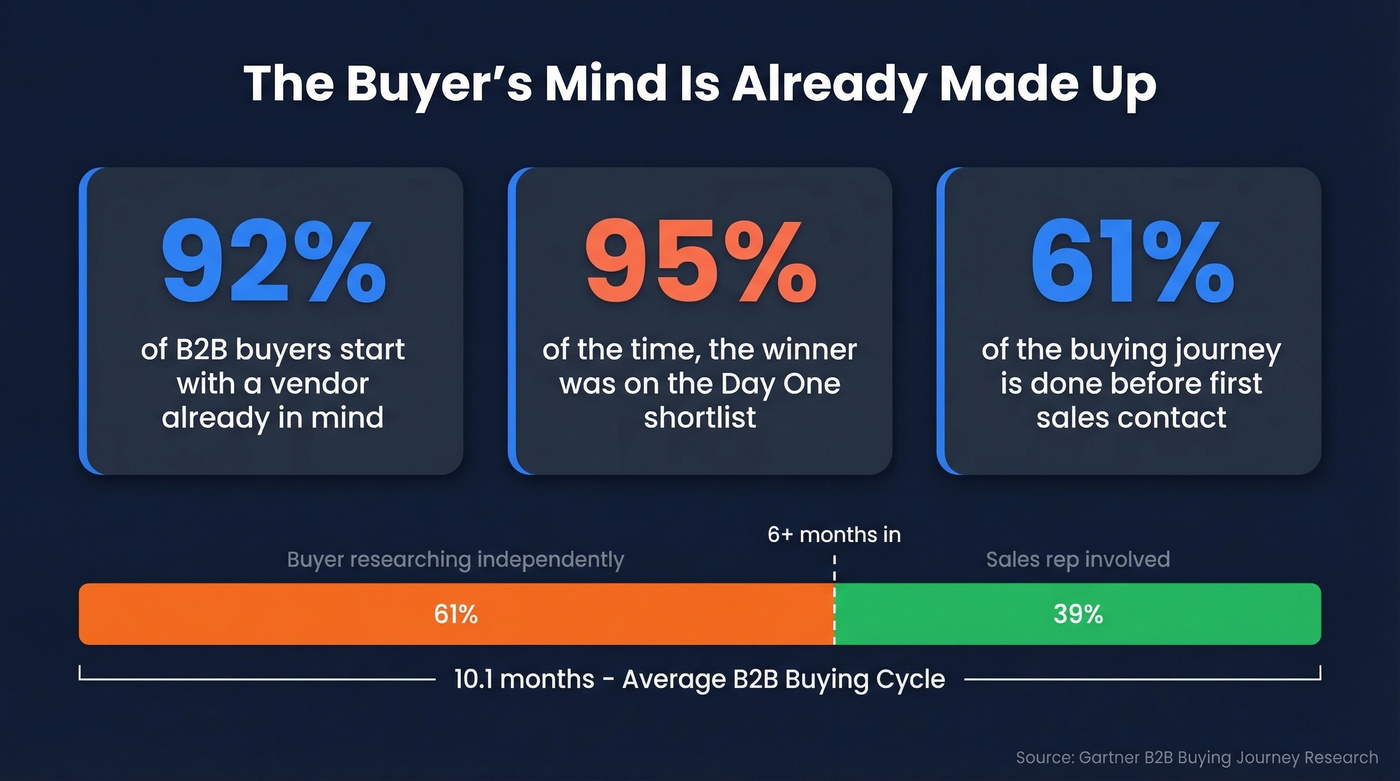
92% of B2B buyers start their buying process with at least one vendor already in mind. 41% have a preferred vendor before they even begin formal evaluation. The winning vendor sits on the buyer's Day One shortlist 95% of the time.
The average B2B buying cycle runs 10.1 months, and first contact with a sales rep doesn't happen until 61% of the journey is complete. Your prospect has been researching, comparing, and forming opinions for six months before they ever talk to you.
This reframes everything. Most teams optimize for capture - better forms, smarter CTAs, faster follow-up. Those things matter, but they're downstream fixes. The real advantage is upstream: being known, trusted, and top-of-mind before the buying cycle begins. That's why brand investment, thought leadership, and community presence aren't "nice to have" marketing activities. They're the mechanism that gets you on the shortlist. If you're not there on Day One, you're statistically playing for 5% of deals.
Your strategy needs two layers. The first is demand creation - making your market aware you exist and building preference before intent signals fire. The second is demand capture - converting that awareness into pipeline when buyers are ready. Most teams over-invest in capture and under-invest in creation. The data says that's backwards.
Inbound Strategies That Create Pipeline
Inbound is the long game, and the economics prove it. B2B SaaS companies pay $164 per organic lead versus $310 per paid lead - nearly half the cost. The tradeoff is time: organic channels take 3-6+ months to ramp, but once they're producing, the marginal cost per lead drops steadily.
SEO and Content Marketing
Content that ranks attracts prospects while you sleep. But "publish blog posts" isn't a strategy. The content needs to match buyer intent at each funnel stage - educational content for awareness, comparison and benchmark content for consideration, and product-specific content for conversion.
One tension worth noting: 73% of buyers prefer email as a communication channel, but email-only campaigns delivered 29% fewer leads year-over-year. Content needs to feed multiple channels, not just one.
Lead Magnets and Gated Content
Whitepapers, templates, calculators, and benchmark reports still work - but the bar is higher than it was five years ago. Nobody's giving you their email for a generic "Ultimate Guide." The lead magnet needs to deliver something the prospect can't easily find elsewhere: proprietary data, a usable tool, or a framework they can implement immediately.
Website Visitor Identification
Forms only capture the small percentage of visitors who actively raise their hand. Tools like Leadfeeder, Clearbit Reveal, and RB2B identify the companies visiting your site even when nobody fills out a form. Filter by high-intent pages like pricing, integrations, and case studies, alert sales via Slack, and you've got a parallel capture mechanism running alongside your forms.
Website Optimization
Your website is your highest-leverage conversion asset, and most teams barely test it. Form length, CTA copy, landing page layout, social proof placement - each variable can materially move conversion rates. Shortening forms and placing strong social proof near the CTA are two of the fastest wins we've seen.
Outbound Strategies for Driving Leads
Outbound is faster than inbound but more expensive per touch. It works best when you're targeting a defined ICP with verified contact data and a clear value proposition.
Cold Email
88% of B2B companies use email for lead generation, making it the most widely adopted channel. But adoption doesn't equal effectiveness. Cold email reply rates hover around 2%. That's not a broken channel - it's the baseline. Teams that beat it do so with hyper-personalization, intent-based targeting, and clean data.
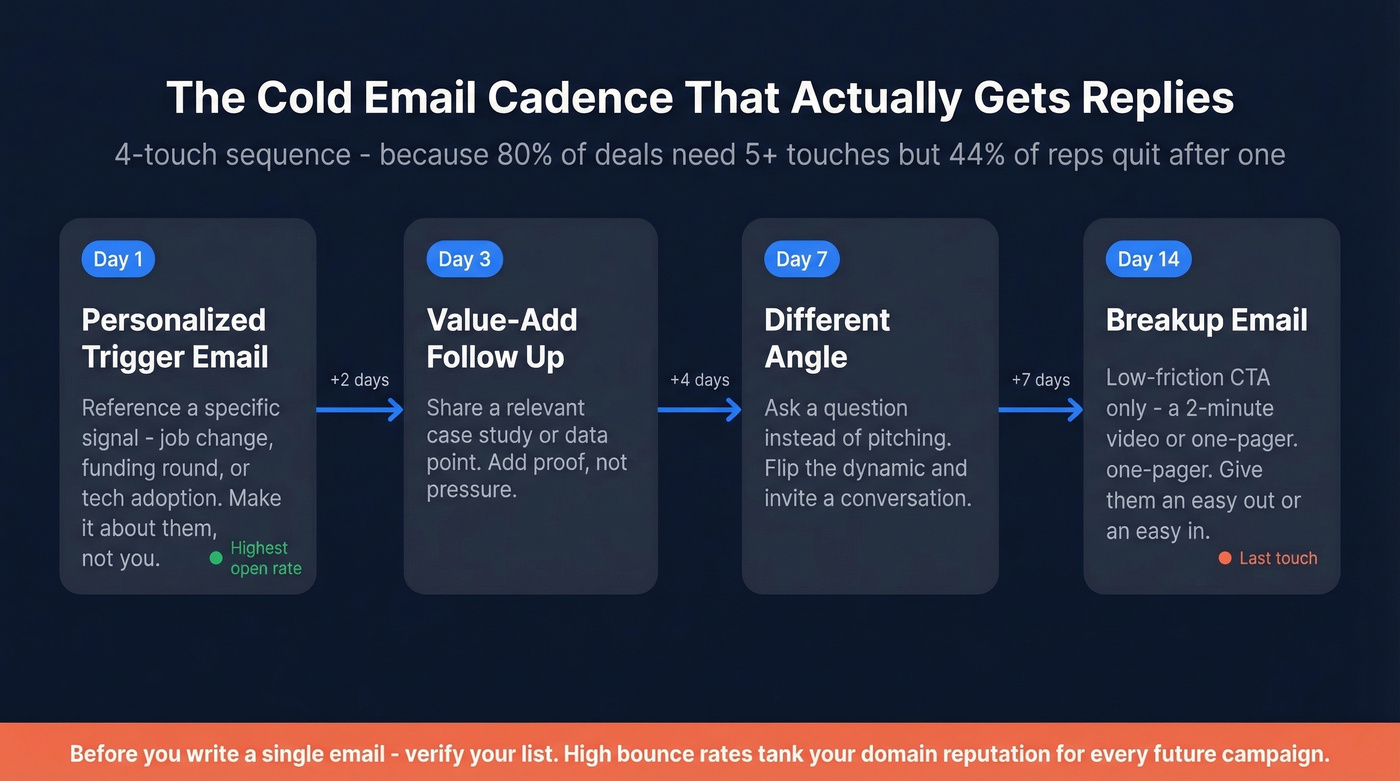
The first step in any outbound campaign isn't writing the email - it's verifying the list. High bounce rates don't just waste sends; they tank your domain reputation and drag deliverability down for every future campaign.
Here's a basic cadence that outperforms the single-touch approach most reps default to:
Day 1: Personalized email referencing a specific trigger like a job change, funding round, or tech adoption signal. Day 3: Follow-up adding a relevant case study or data point. Day 7: Different angle - ask a question instead of pitching. Day 14: Breakup email with a low-friction CTA like a 2-minute video or one-pager.
Cold Calling
Only 37% of B2B companies still use cold calling. As a standalone volume play, it's largely dead. But writing it off entirely is a mistake. When a prospect has already seen your email and engaged with your content, a well-timed call converts at dramatically higher rates than a blind dial. Cold calling works best as one channel in an orchestrated cadence, not a standalone motion.
Social Selling and ABM
78% of B2B companies use social media for lead generation, and 97% of that group is on LinkedIn. Social selling isn't posting company updates - it's building relationships through comments, DMs, and content that demonstrates expertise.
ABM flips the funnel entirely. Instead of casting a wide net and qualifying down, you start with a target account list and orchestrate multi-channel touches across the buying committee. It's resource-intensive but delivers higher deal sizes and win rates for enterprise motions.
Let's be honest about the math here: it takes 12-15 touchpoints before a B2B prospect engages. Yet 44% of reps give up after one follow-up, and 80% of deals require five or more touches. The gap between "how many touches it takes" and "how many touches reps actually make" is where pipeline goes to die.
Paid Channels - Where to Spend
Paid channels give you speed and control that organic can't match. But the cost variance across platforms is enormous.
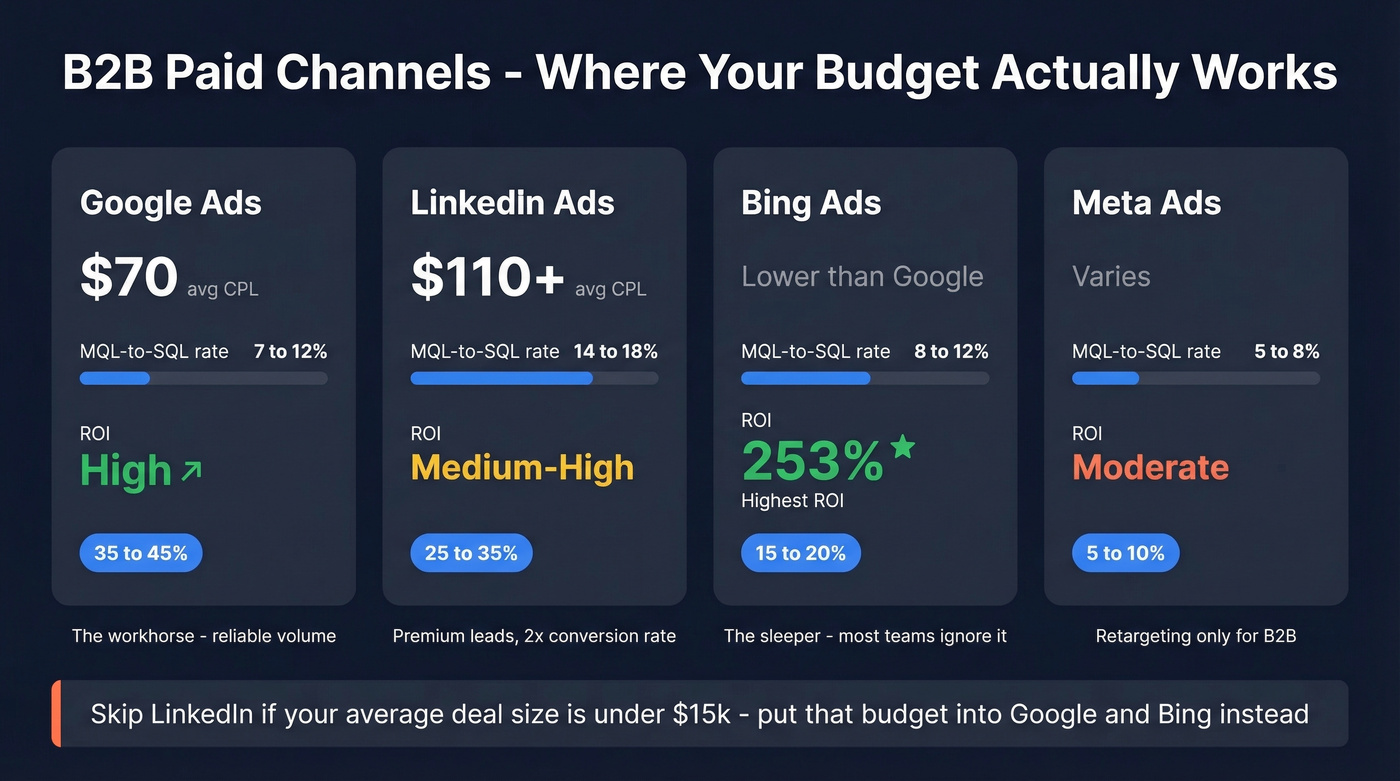
| Platform | Avg CPL | MQL-to-SQL Rate | Est. ROI | Budget Share |
|---|---|---|---|---|
| Google Ads | $70.11 | 7-12% | High | 35-45% |
| LinkedIn Ads | $110+ | 14-18% | Medium-High | 25-35% |
| Bing Ads | Not public | 8-12% | 253% (highest) | 15-20% |
| Meta Ads | Not public | ~5-8% | Moderate | 5-10% |
Google Ads averages a $70.11 CPL with solid volume, making it the workhorse for most B2B paid programs. CTR averages 3.17%, CPC runs $2.69, and conversion rates sit around 3.75%. Not glamorous, but the math works.
LinkedIn is the premium play. At $110+ per lead, it's 57% more expensive than Google. But LinkedIn's MQL-to-SQL conversion rate runs 14-18% versus Google's 7-12%. You're paying more per lead but getting leads nearly twice as likely to become real opportunities. For enterprise sales motions with high ACVs, that math is compelling.
The sleeper? Bing. It delivers an estimated 253% ROI - the highest of any major B2B PPC platform. Lower competition, lower CPCs, and a user base that skews professional since Bing is the default on corporate machines. Most teams ignore it entirely, which is exactly why it works.
Skip LinkedIn Ads if your average deal size is under $15k. The CPL premium only pays off when deal sizes justify it. Put that budget into Google and Bing, where the unit economics actually work for mid-market and SMB motions.
Meta sits at the bottom of the B2B allocation for good reason. Lead quality tends to be lower, and the targeting isn't built for B2B. Allocate 5-10% for retargeting and brand awareness, but don't expect it to drive pipeline directly.

The article says email lists decay 28% per year. Prospeo's 7-day refresh cycle means your lead data never goes stale. With 98% email accuracy and 300M+ verified profiles, you stop burning budget on bounced emails and start filling pipeline with real buyers.
Generate leads at $0.01 per email instead of $1. No contracts.
What Lead Generation Actually Costs
CPL varies wildly by industry, and most teams benchmark against the wrong numbers. Here's what the data shows per FirstPageSage's 2026 report:
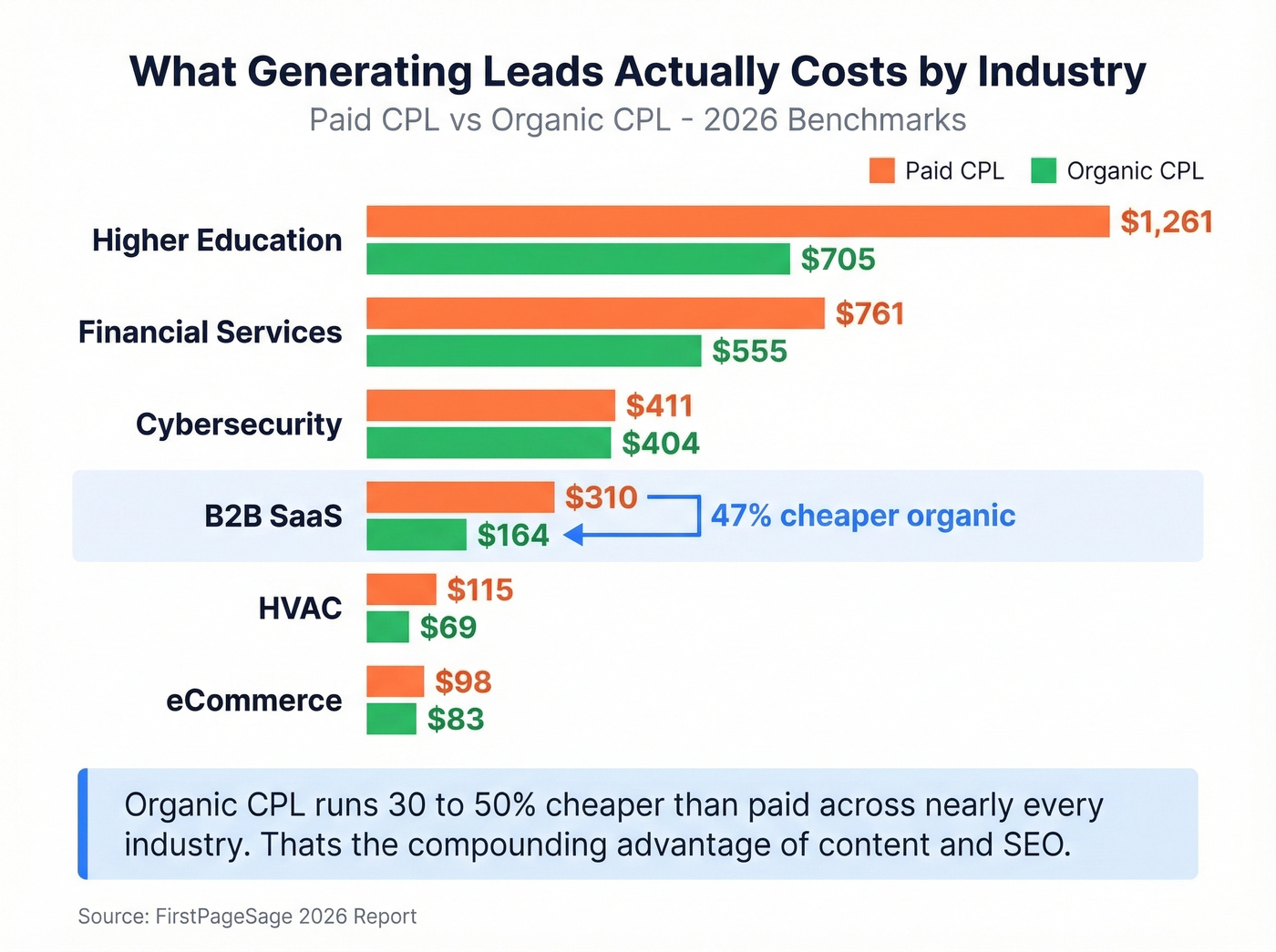
| Industry | Paid CPL | Organic CPL | Blended CPL |
|---|---|---|---|
| B2B SaaS | $310 | $164 | $237 |
| eCommerce | $98 | $83 | $91 |
| Financial Services | $761 | $555 | $653 |
| Cybersecurity | $411 | $404 | $406 |
| Higher Education | $1,261 | $705 | $982 |
| HVAC | $115 | $69 | $92 |
Organic CPL runs 30-50% cheaper than paid across nearly every industry. That's the compounding advantage of content and SEO - higher upfront investment, dramatically lower marginal cost over time.
The spread is massive. An HVAC company pays $92 blended per lead. A higher education institution pays $982. If you're benchmarking your SaaS company's CPL against "average B2B" numbers, you're comparing yourself to a meaningless average. Benchmark against your vertical.
The health metric that matters most isn't CPL in isolation - it's the LTV:CAC ratio. A 3:1 ratio is the benchmark for sustainable growth. Below that, you're buying revenue at a loss. Above 5:1, you're probably under-investing in growth.
Data Quality - The Multiplier Nobody Talks About
Every strategy in this guide - inbound, outbound, paid - falls apart when the underlying data is bad. And the data is always decaying.
Email lists lose roughly 28% of their value every year. People change jobs, companies rebrand, domains expire. If you built a 10,000-contact list in January, nearly 3,000 of those addresses are dead by December. Send to them anyway and you're not just wasting budget - you're actively damaging your sender reputation.
We've seen this play out repeatedly. A team exports 5,000 contacts from a database, loads them into their sequencer, and launches. Bounce rate spikes. The email service provider flags the domain. Deliverability drops across all campaigns - not just the bad one. The cost of bad data isn't the wasted sends. It's the invisible damage to every future campaign you'll ever run from that domain.
Prospeo's 5-step verification process - including catch-all handling, spam-trap removal, and honeypot filtering - delivers 98% email accuracy across 143M+ verified addresses. The database refreshes every 7 days, compared to the 6-week industry average. When Meritt switched to Prospeo, their bounce rate dropped from 35% to under 4%, and pipeline tripled from $100K to $300K per week. That's not a marginal improvement - it's a fundamentally different business outcome driven by data quality alone.
High bounce rates don't just waste sends - they destroy your domain reputation. Prospeo's 5-step email verification with catch-all handling and spam-trap removal keeps bounce rates under 4%. Teams using Prospeo book 35% more meetings than Apollo users.
Verify before you send. Your domain reputation depends on it.
Lead Gen Mistakes Costing You Pipeline
1. Chasing volume over intent. The cheapest leads are rarely the best leads. B2B lead costs often balloon from $40 to $300+ when you chase low-intent audiences. Shift your KPIs from raw lead volume to SALs, opportunity conversion rates, and pipeline by intent tier. Tools like 6sense, Bombora, and RollWorks help identify accounts showing active buying signals.
2. Treating all leads the same. A whitepaper download and a pricing page visit signal completely different levels of intent. Move to behavioral scoring that weights high-intent actions - pricing page views, integration page visits, comparison content engagement - above passive consumption. The difference between "downloaded an ebook" and "visited pricing three times this week" is the difference between an MQL and an SQL.
3. Giving up too early. 44% of sales reps abandon a prospect after a single follow-up. Meanwhile, 80% of deals require five or more touches. Almost half your team is quitting before the game starts. Build multi-touch, multi-channel cadences that span 12-15 touchpoints across email, phone, social, and retargeting.
4. Ignoring data decay. With 28% annual list rot, a database you built last year is already a quarter dead. Schedule quarterly data hygiene passes at minimum. Verify emails before every campaign launch. The cost of verification is trivial compared to the cost of a flagged domain.
5. Broken marketing-to-sales handoffs. Marketing generates the lead, tosses it over the wall, and sales gets a name with no context. Share the full engagement history - which content they consumed, which pages they visited, how many times they've been on your site. Gong, HubSpot, and Chili Piper automate this handoff. When sales knows the prospect watched your pricing webinar and visited the integrations page twice, the first conversation is dramatically more productive.
AI and Automation in 2026
Teams using AI-driven lead generation report a 76% increase in win rates, 78% shorter deal cycles, and 70% larger deal sizes. This isn't a future trend - it's already reshaping how the best teams operate.
Predictive lead scoring is where the impact is most tangible. AI models analyzing behavioral signals - page visits, content engagement, email interactions, firmographic fit - achieve 90%+ accuracy in identifying high-conversion leads. Top-scoring leads convert at 3.5x the rate of traditionally scored ones. That's a structural advantage.
Outreach automation saves real time. One documented case showed 25 hours per week saved with a 40% increase in efficiency and a 55% connection acceptance rate. The key is that automation handles repetitive sequencing while humans handle the personalization that actually closes deals.
Chatbots also deserve attention. One enterprise implementation drove a 496% increase in pipeline and 454% more bookings from chatbot-generated leads. That's an extreme case, but it illustrates the point: AI-powered chat captures intent at the exact moment a prospect is engaged on your site, 24/7, without headcount.
If you're not using AI for at least lead scoring and outreach sequencing in 2026, you're leaving measurable pipeline on the table. Start with scoring - it's the lowest-effort, highest-impact application.
Lead Generation Tools by Category
You don't need 15 tools. You need the right stack for your motion.
Prospecting and Enrichment
Prospeo covers 300M+ professional profiles with 143M+ verified emails, 125M+ verified mobile numbers, 98% accuracy, and a 7-day data refresh cycle. Over 30 search filters include buyer intent, technographics, job changes, and funding signals. Native integrations with Salesforce, HubSpot, Instantly, Lemlist, Clay, Zapier, Make, and more. Free tier: 75 emails/month + 100 Chrome extension credits/month. Paid plans start at roughly $0.01 per email with no contracts.

Clay takes a workflow-first approach to enrichment, letting you chain multiple data providers in sequence. Free tier available; paid plans from ~$149/mo.
6sense and Bombora are the enterprise intent data platforms, telling you which accounts are actively researching your category. Budget $25,000-75,000+/year - this is enterprise infrastructure, not a self-serve tool.
CRM and Marketing Automation
HubSpot remains the default for SMB and mid-market teams. The free CRM is genuinely useful, and Marketing Hub scales from $20/mo to $890/mo. Salesforce is the enterprise standard at $75-300/user/month depending on configuration.
Email and Outreach
Instantly and Smartlead are the go-to platforms for scaled cold email, handling inbox rotation, warmup, and multi-sender campaigns at $30-97/mo. Mailchimp handles email marketing for teams not running cold outbound - free tier covers 500 contacts, paid from ~$13/mo.
Automation and Workflow
Zapier connects everything. Free plan available; paid from $19.99/mo billed annually. If you're running any kind of multi-tool lead gen stack, Zapier or Make is the glue holding it together.
Measuring Lead Gen Success
Getting leads without measuring the right metrics is just spending money with extra steps.
Cost per lead is your starting point. Benchmark against the industry table above - if you're a B2B SaaS company paying $400 blended per lead, you're running 69% above the $237 industry average. That's either a targeting problem or a channel mix problem. For a deeper benchmark set, see lead generation metrics and funnel metrics.
MQL-to-SQL conversion rate tells you about lead quality. LinkedIn-sourced leads convert at 14-18%. Google-sourced leads convert at 7-12%. If your blended rate is below 7%, your qualification criteria or targeting needs work.
Pipeline velocity measures how fast leads move through your funnel. Track average days from MQL to SQL, SQL to opportunity, and opportunity to close. Bottlenecks here reveal process problems that no amount of lead volume will fix. If you want a tighter operational view, track pipeline health alongside sales pipeline benchmarks.
LTV:CAC ratio is the ultimate health metric. Below 3:1, you're in trouble. At 3:1, you're sustainable. Above 5:1, you're probably under-investing in growth. If you need to sanity-check your acquisition math, use this cost to acquire customer breakdown.
Lead-to-opportunity rate bridges marketing and sales. If it's below 10%, either your leads are low quality or your sales team isn't following up - and the fix is very different depending on which one it is. Tighten your process with sales prospecting techniques and sales follow-up templates.
Review these metrics monthly. Benchmark quarterly against the industry data in this guide.
FAQ
What's the average cost per lead in B2B?
The average B2B CPL across paid channels is $84, but industry variation is massive: B2B SaaS averages $237 blended, eCommerce $91, Financial Services $653, and Higher Education $982. Organic channels consistently run 30-50% cheaper than paid across every vertical.
How many touchpoints does it take to convert a prospect?
Research shows 12-15 touchpoints before a B2B prospect engages meaningfully. 80% of deals require five or more follow-ups, yet 44% of sales reps stop after a single attempt. Multi-channel cadences spanning email, phone, social, and retargeting aren't optional - they're the baseline.
What's the best channel for B2B lead generation?
It depends on your deal size and sales cycle. Email is used by 88% of B2B companies, making it the most adopted channel. Google Ads averages a $70.11 CPL with solid volume, while LinkedIn delivers nearly double the MQL-to-SQL conversion rate at a higher price point. For deals under $15k, Google and Bing tend to win on unit economics.
How do I keep lead data accurate?
Email lists decay roughly 28% per year, so quarterly data hygiene is the minimum. Verify contacts before every campaign launch using a tool with catch-all handling and spam-trap removal. Prospeo's 7-day refresh cycle and 98% accuracy rate make it a strong default for teams running regular outbound.
What's the biggest mistake teams make when generating leads?
Chasing volume instead of intent. Teams fill the top of the funnel with low-quality contacts, then wonder why nothing converts. Pair intent data from platforms like 6sense or Bombora with behavioral scoring that weights pricing-page visits and comparison-content engagement over passive downloads.