

Generect vs Apollo.io: Which B2B Data Tool Wins in 2026?
You ran your first outbound sequence off Apollo and 30% of the emails bounced. Your domain reputation took a hit, your sequencer flagged you, and now you're weighing Generect against Apollo.io. The right pick depends on whether you need a data platform or an all-in-one GTM suite - and honestly, how much you care about the emails actually landing.
30-Second Verdict
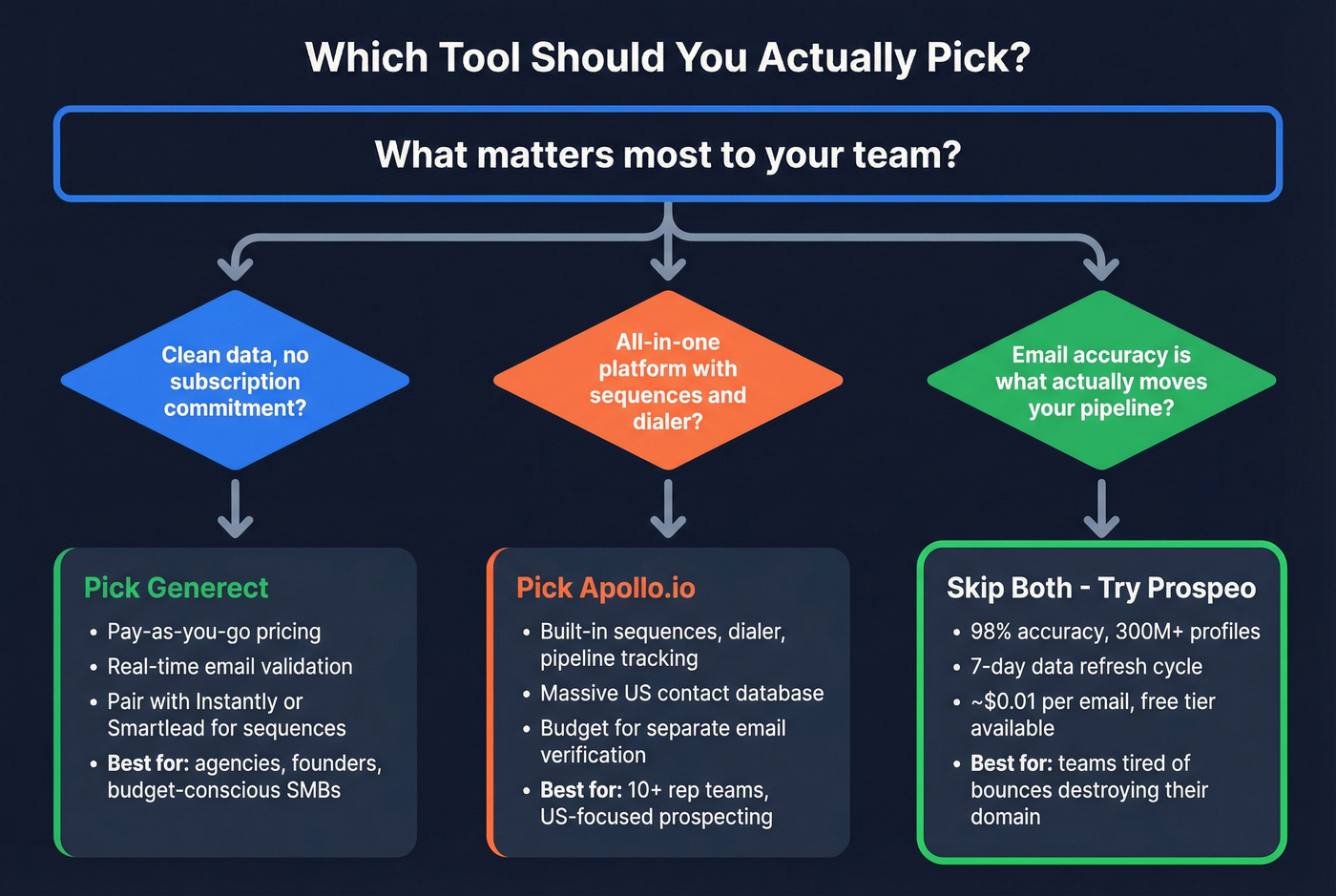
Generect if you want pay-as-you-go pricing, real-time verified leads, and don't need a built-in sequencer.
Apollo if you need sequences, a dialer, and pipeline management in one platform - and you'll accept lower data quality for feature breadth.
Neither if email accuracy is your top priority. Prospeo delivers 98% verified emails across 300M+ profiles on a 7-day refresh cycle, with no contracts and pricing around $0.01 per email.
Feature Comparison at a Glance
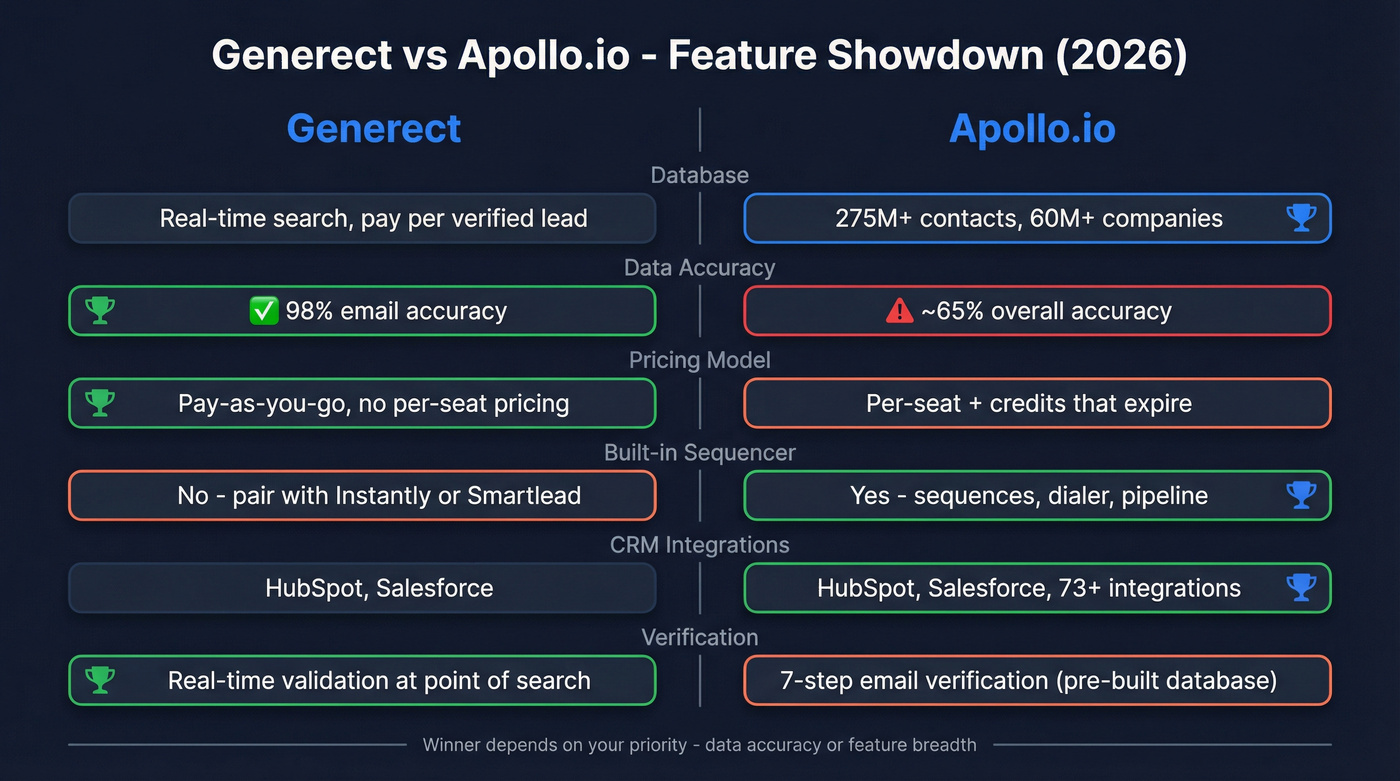
| Feature | Generect | Apollo.io | Winner |
|---|---|---|---|
| Database | Real-time search (pay per verified lead) | 275M+ contacts, 60M+ companies | Apollo (volume) |
| Data accuracy | 98% email accuracy | ~65% overall | Generect |
| Pricing model | Pay-as-you-go (no per-seat pricing) | Per-seat + credits | Generect |
| Free tier | 25 leads | Free plan available | Tie |
| G2 rating | 5.0/5 (32 reviews) | 4.8/5 (7,000+ reviews) | Different signals |
| Verification | Real-time validation | 7-step email verification | Generect |
| Built-in sequencer | No | Yes | Apollo |
| CRM integrations | HubSpot, Salesforce | HubSpot, Salesforce, plus 73+ integrations | Apollo (breadth) |
| Time to implement | <1 month (G2 data) | Varies by team and setup | Generect |

Apollo's 32-38% bounce rates destroy domain reputation. Generect fixes accuracy but lacks features. Prospeo gives you both: 300M+ profiles at 98% email accuracy, 30+ filters including buyer intent and technographics, and a 7-day data refresh cycle - all at ~$0.01 per email.
Stop choosing between accuracy and features. Get both free.
Pricing Breakdown
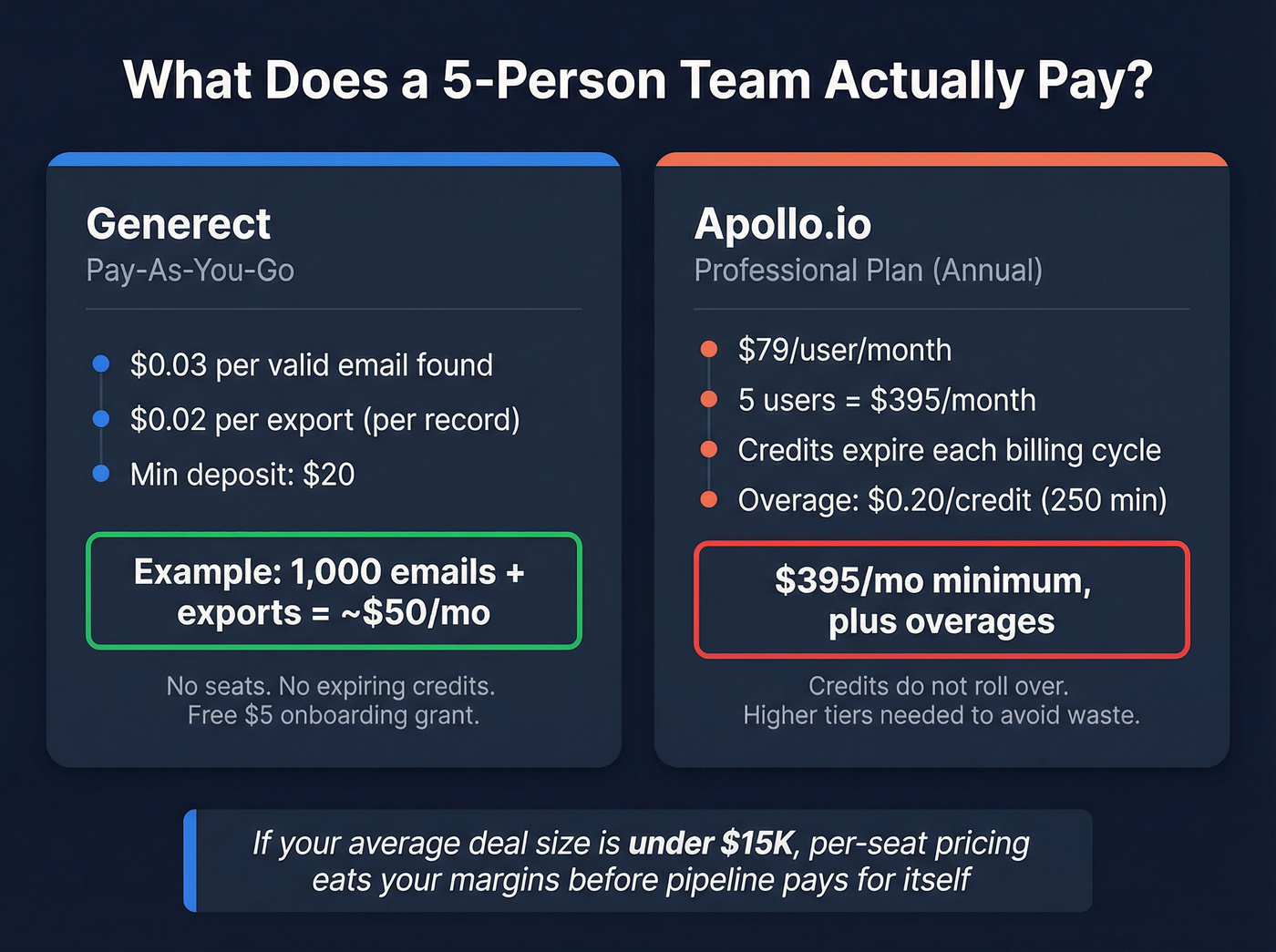
Apollo uses per-seat pricing with credits that expire every billing cycle. Generect is pay-as-you-go: searches are free, you pay for verified results.
Generect (pay-as-you-go):
- $0.03 per valid email found
- $0.02 per export (per record)
- Minimum deposit: $20
- Includes a free $5 onboarding grant
Apollo (annual billing):
| Plan | Monthly | Notes |
|---|---|---|
| Free | $0 | Free plan available |
| Basic | $49/user | Per seat |
| Professional | $79/user | Per seat |
| Organization | $119/user | Min. 3 seats |
A 5-person team on Apollo Professional pays $395/mo ($79 x 5 seats), plus $0.20 per overage credit with a 250-credit minimum when you burn through your allotment. Generect's model stays simple: you pay per verified email and per export, with no seat multiplier. Apollo credits don't roll over, which often pushes teams into higher tiers just to avoid waste.
Here's the thing: if your average deal size sits below $15k, Apollo's per-seat math will eat your margins before the pipeline pays for itself. Generect's pay-as-you-go model makes more financial sense for most SMB teams running lean outbound.
Data Quality: Where This Comparison Gets Real
Feature breadth doesn't matter if your emails bounce. And Apollo's bounce rates are a well-documented problem.

Apollo's overall data accuracy runs about 65%, with US accuracy at 80-88% and international data dropping to 60-73%. That gap alone should give any team running global campaigns serious pause.
If you're trying to keep deliverability stable while scaling, it helps to track your email bounce rate and follow a proper email deliverability guide before you ramp volume.
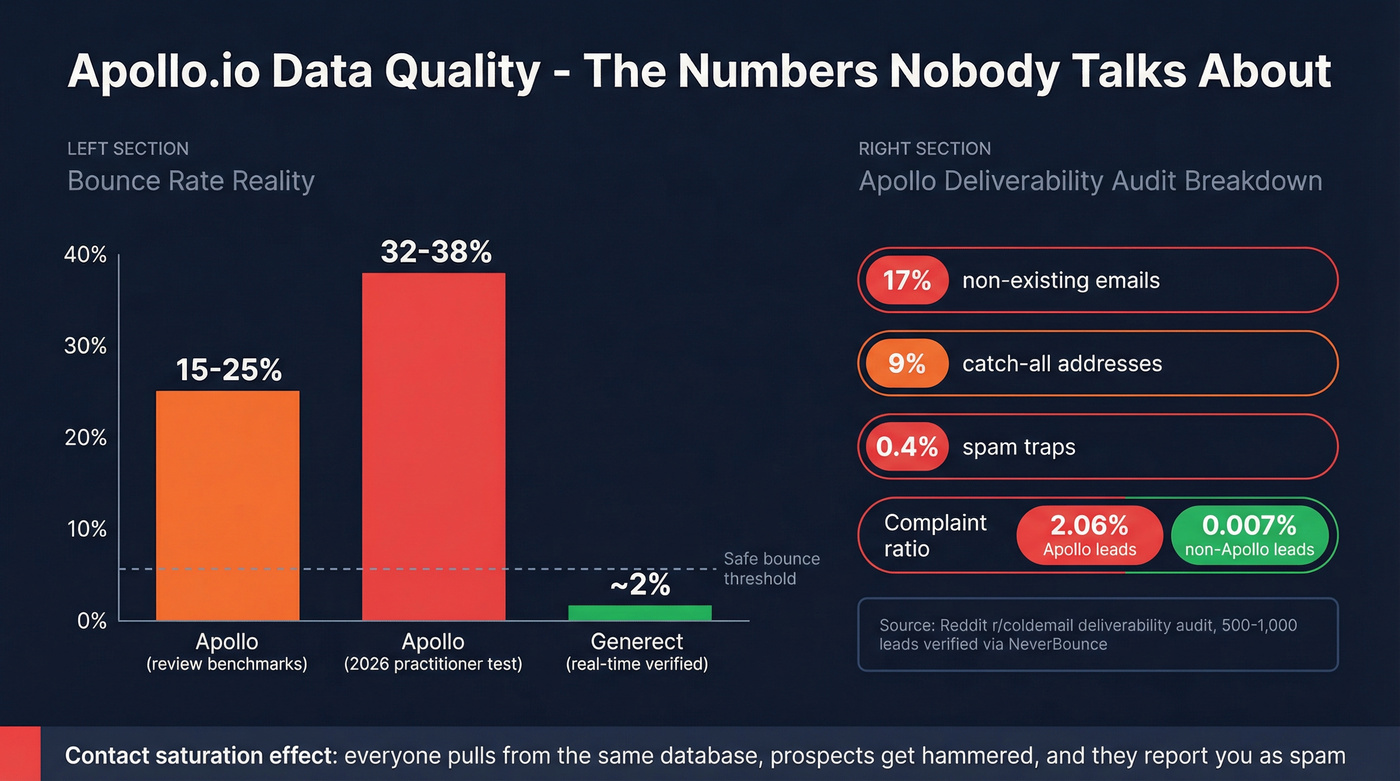
A 2026 practitioner test on r/coldemail - 500-1,000 leads verified through NeverBounce - reported bounce rates of 32-38%. That's a domain reputation killer, full stop.
A separate deliverability audit on Reddit found 17% non-existing emails, 9% catch-all addresses, 0.4% spam traps, and a complaint ratio of 2.06% on Apollo-sourced leads versus 0.007% for non-Apollo leads. The contact saturation effect is real: everyone pulls from the same pond, so prospects get hammered and report you as spam. We've seen this pattern repeatedly with teams that rely on a single large database without layering in additional verification.
Generect sidesteps this with real-time validation, delivering 98% email accuracy by verifying at the moment of search rather than relying on a pre-built database. G2 reviewers back this up, with one noting that "contact data is more accurate than what we've experienced with some other sources." In our testing, Apollo's search filters are genuinely strong - the data behind them is the problem. If you go Apollo, pair it with a waterfall enrichment approach to compensate for single-source accuracy limits.
When to Pick Each Tool
Pick Generect
This is the right call for clean data without a subscription commitment. Generect's pay-as-you-go model works for budget-conscious teams, agencies billing per client, and founders who don't need a dialer baked in. Real-time validation means you're far less likely to pay for emails that bounce. It integrates with HubSpot and Salesforce, and G2 data shows implementation takes less than a month with ROI at around 10 months. Pair it with a standalone sequencer like Instantly or Smartlead for a lean, high-accuracy stack.
If you're building a repeatable outbound motion, it also helps to standardize your sales prospecting techniques and tighten your lead generation workflow so good data actually turns into meetings.
Pick Apollo
You need sequences, a dialer, pipeline tracking, and a massive contact database in one login - primarily for US prospecting. Budget for a separate verification step before you hit send. Be aware that some users report sequencing gaps where nothing sends for 2-3 hours, so test thoroughly before going all-in on Apollo as your delivery layer. For teams with 10+ reps who want everything under one roof and can tolerate the data quality tradeoff, it's a reasonable choice.
If you're evaluating broader stacks, compare it against other outbound lead generation tools and SDR tools so you don't overpay for features you won't use.
Skip Both
If data accuracy is what actually moves your pipeline, Prospeo covers 300M+ profiles with 98% email accuracy and 125M+ verified mobile numbers, all on a 7-day refresh cycle versus the six-week industry average. Meritt went from 35% bounces to under 4% after switching, and their pipeline tripled from $100K to $300K per week. At ~$0.01 per email with a free tier and no contracts, the risk of testing is basically zero. You also get 30+ search filters - buyer intent powered by Bombora, technographics, job-change signals - plus native integrations with Salesforce, HubSpot, Instantly, Smartlead, and Clay.
If you're comparing providers more broadly, start with data enrichment services and the best sales prospecting databases to benchmark accuracy, refresh rate, and total cost.
Meritt switched from bouncing 35% of emails to under 4% - and tripled pipeline to $300K/week. With 125M+ verified mobiles, native Instantly and Smartlead integrations, and no per-seat pricing, Prospeo replaces both tools in this comparison.
75 free emails per month. No credit card. No contracts. Test it now.
FAQ
Is Generect's data really more accurate than Apollo's?
Generect delivers 98% email accuracy using real-time validation at the point of search. Apollo's bounce rates show up as 15-25% in review-style benchmarks and 32-38% in a 2026 practitioner test. Generect's G2 reviews (5.0/5, 32 reviews) consistently cite data accuracy as a top strength.
Do Apollo credits roll over between billing cycles?
No. Credits expire each cycle. Overage credits cost $0.20 each with a 250-credit minimum - a common frustration teams hit after their first quarter.
What's the most accurate alternative to both tools?
Prospeo offers 98% email accuracy across 300M+ profiles with a 7-day data refresh cycle, catch-all handling, and spam-trap removal. Pricing runs ~$0.01 per email with a free tier of 75 emails per month - no contracts, no seat minimums.
Can I use Generect or Apollo without a built-in sequencer?
Generect has no built-in sequencer by design - pair it with Instantly, Smartlead, or Lemlist. Apollo includes sequences, but many teams still route Apollo data through a dedicated sending tool for better deliverability control and mailbox rotation. Let's be honest: if you're serious about cold email, you probably want a specialized sending tool regardless of where your data comes from.