

Gentle Reminder Emails That Actually Get Replies: 12 Polite Follow-Up Samples
The average professional spends 3.1 hours a day buried in work email. Your polite follow-up after no response didn't get ignored because it was bad - it got ignored because it's competing with a hundred-plus other messages. Only 8.5% of outreach emails get any response at all.
That makes a gentle reminder not optional, but essential. And the good news: follow-ups work absurdly well when you get the timing, tone, and length right.
The Quick Version
Before you dig in, here's the cheat sheet:
- The only cadence you need: Day 3, Day 7, Day 14, Day 21. Four touches, increasing gaps.
- Keep every follow-up under 80 words. Reply in the same thread. Add one new piece of value each time.
- Informal tone outperforms formal by 78% in positive reply rate. Stop writing follow-ups that sound like legal briefs.
Why Follow-Ups Work
Most people send one email, get silence, and assume the conversation is dead. The data says otherwise.
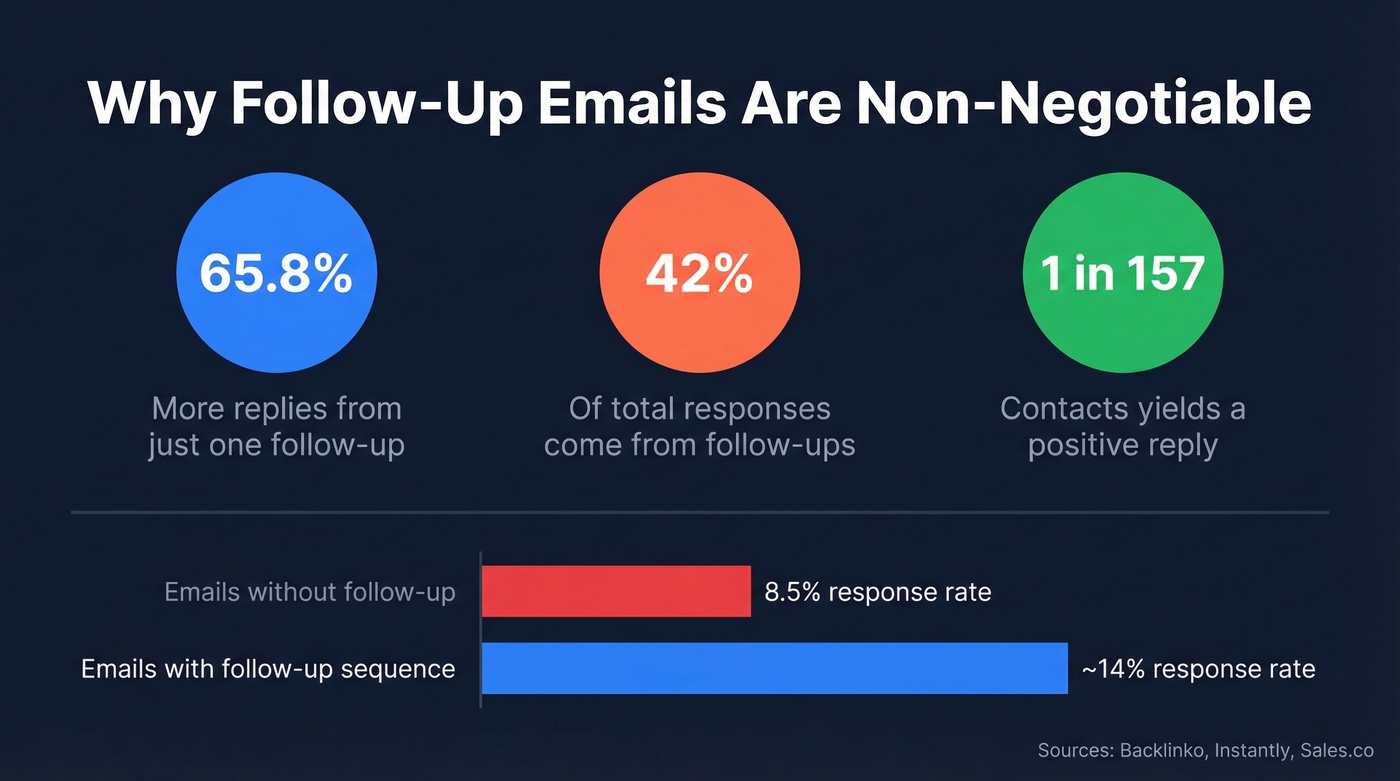
A Backlinko study of 12 million outreach emails found that a single follow-up boosts replies by 65.8%. Sending three or more messages to the same contact produced the highest overall response rates. Depending on the dataset, the initial email drives 58-79.4% of replies, with follow-ups contributing the rest - Instantly's 2026 benchmark report puts follow-up contribution at 42%, while Sales.co's dataset of 2M+ emails shows a more conservative 20.6%. Either way, a meaningful chunk of your total responses come from emails you almost didn't send.
Now for the reality check. Only 14.1% of replies are actually positive, which works out to roughly 1 interested reply per 157 contacts. Follow-ups don't change the math dramatically, but they squeeze meaningful extra value from effort you've already invested. We've seen this play out across hundreds of outbound campaigns - skipping follow-ups is leaving replies on the table for no reason.
Here's the thing: most teams obsess over subject lines and copywriting when the single highest-leverage move is simply sending the follow-up they keep putting off. The bar is that low.
How to Write a Polite Follow-Up After No Response
Six principles, backed by data. Nail these and your gentle reminders will outperform most of what lands in your recipient's inbox.
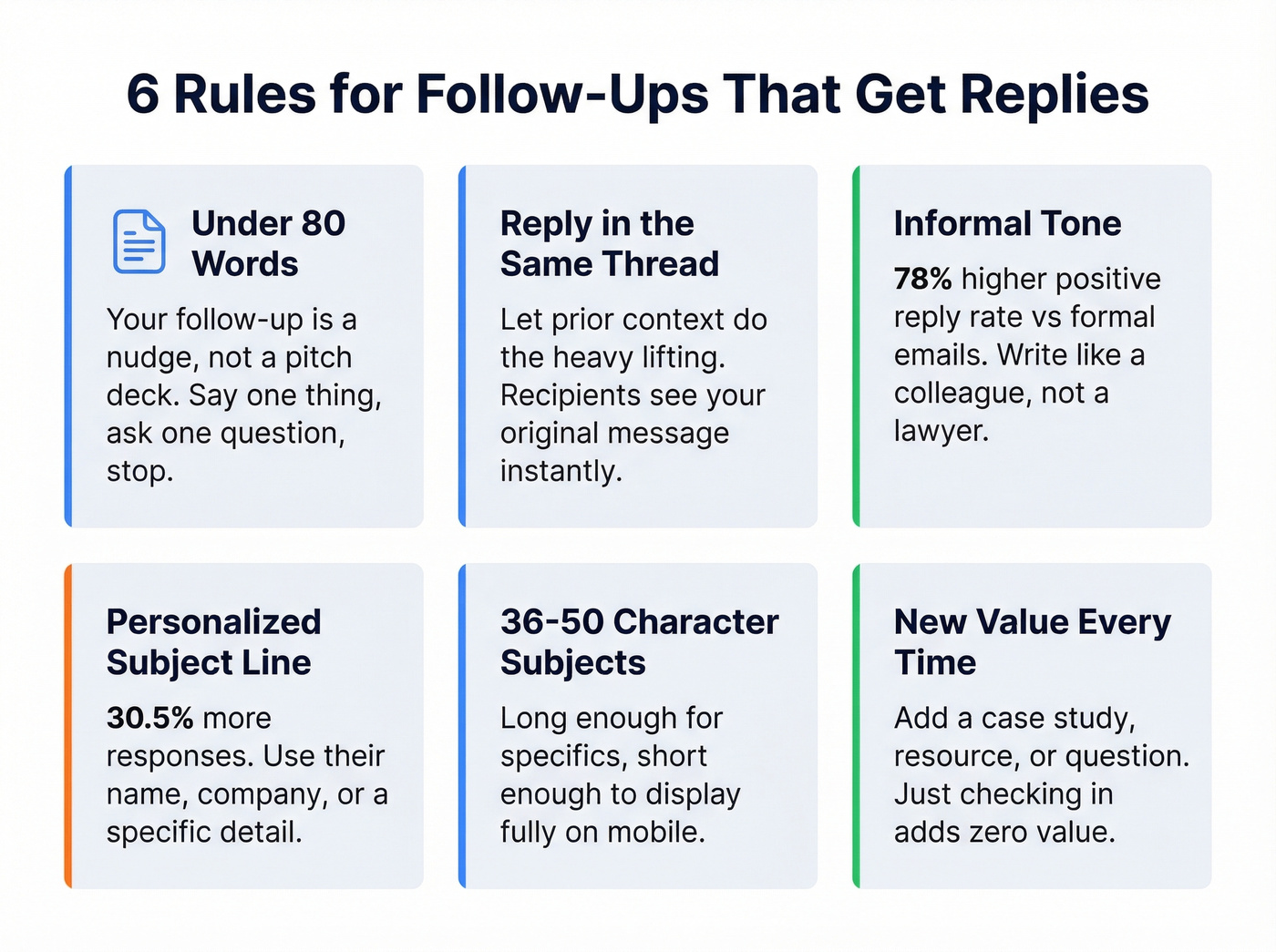
Keep it under 80 words. The best-performing campaigns in Instantly's 2026 benchmarks all share this trait. Your follow-up isn't a pitch deck - it's a nudge. Say one thing, ask one question, stop.
Write in a reply style. Follow-ups that feel like natural replies - short, conversational, referencing the original note - outperform formal follow-ups by roughly 30%. Reply in the same thread so the recipient sees context instantly and you inherit the subject line they've already scanned. The prior context does half the work for you.
Use an informal tone. Informal emails earn a 78% higher positive reply rate than formal ones. Write like you're messaging a colleague, not drafting a contract. This single shift matters more than any template.
Personalize the subject line. When you do start a new thread, personalized subject lines lift response rates by 30.5%. A name, a company, a specific detail - anything that signals "this isn't a blast." If you want more options, borrow from these email subject lines.
Hit the subject line sweet spot. Aim for 36-50 characters. Long enough to convey specifics, short enough to display fully on mobile.
Add new value every time. Each follow-up should include something the previous email didn't: a relevant resource, a case study, a specific question. "Just checking in" adds zero value, and recipients can feel it. (More ideas: how to add value in sales.)

Follow-ups can't get replies if they bounce. Prospeo's 98% email accuracy means your gentle reminders actually land in real inboxes - not spam traps. 143M+ verified emails, refreshed every 7 days.
Stop following up with dead email addresses.
When to Send Your Gentle Reminder
Timing matters more than most people think, and getting it wrong is the difference between persistent and annoying.
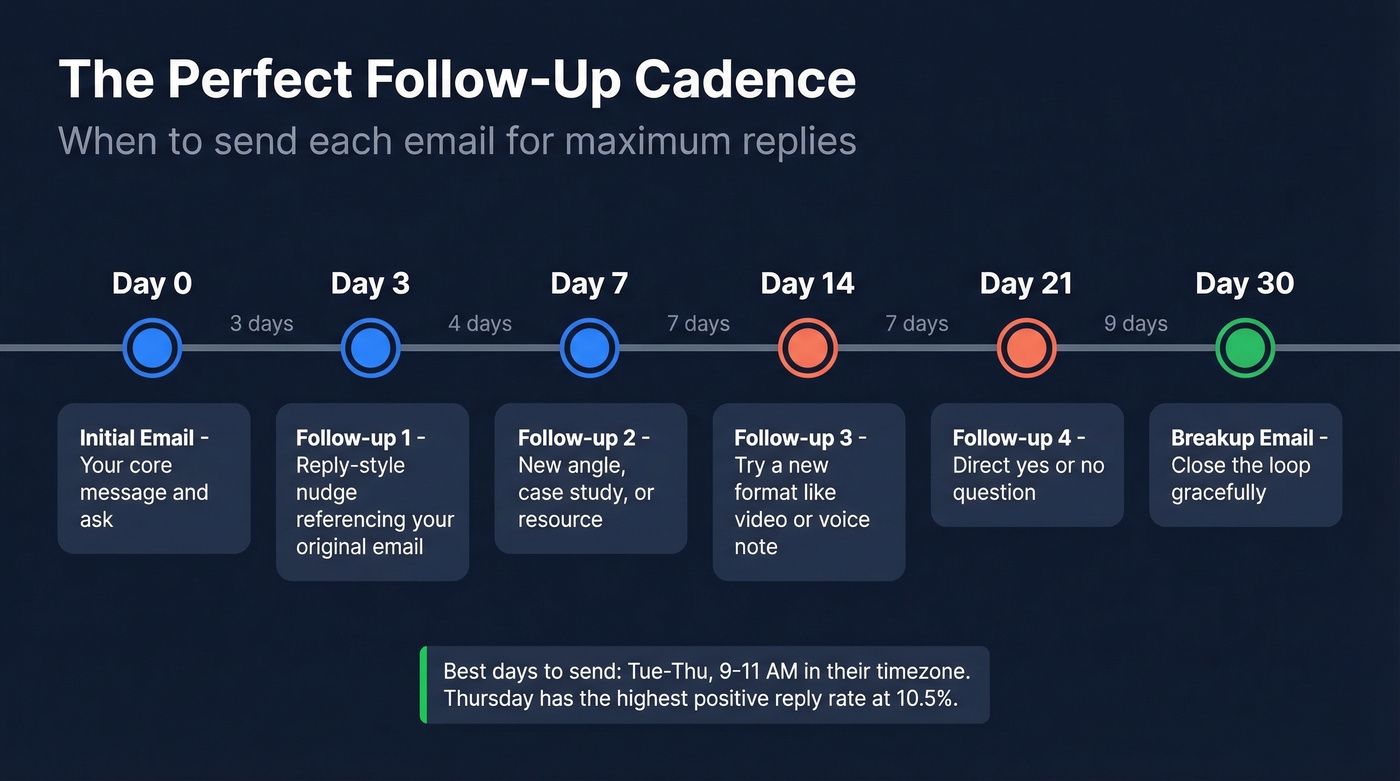
| Step | Day | What to Send |
|---|---|---|
| Initial email | Day 0 | Your core message |
| Follow-up 1 | Day 3 | Reply-style nudge referencing original email |
| Follow-up 2 | Day 7 | New angle, case study, or resource |
| Follow-up 3 | Day 14 | New format - video, voice note, or different CTA |
| Follow-up 4 | Day 21 | Direct yes/no question |
| Breakup email | Day 30 | Close the loop gracefully |
For cold outreach, a strong default is Tuesday through Thursday, between 9-11 AM in the recipient's timezone. Monday gets the most replies overall, but Thursday has the highest positive reply rate at 10.5% - so if you're optimizing for quality over quantity, aim for Thursday. (More data: best time to send cold emails.)
Automate the cadence. If you're sending follow-ups at any volume, set up sequences in tools like Instantly, Lemlist, or your CRM's built-in workflow builder. Manual follow-ups are fine for one-off situations, but they fall apart past 20-30 active conversations. If you're evaluating tooling, start with follow up email software or AI tools for automating sales follow-ups.
Compliance basics. Google's sender guidelines require spam complaint rates below 0.3%. For CAN-SPAM compliance, include a physical mailing address and a clear unsubscribe mechanism in any commercial email. If you're reaching EU contacts, you need a lawful basis for B2B outreach under GDPR - legitimate interest typically covers cold outreach to business contacts, but keep records and honor opt-outs immediately.
12 Email Samples That Get Replies
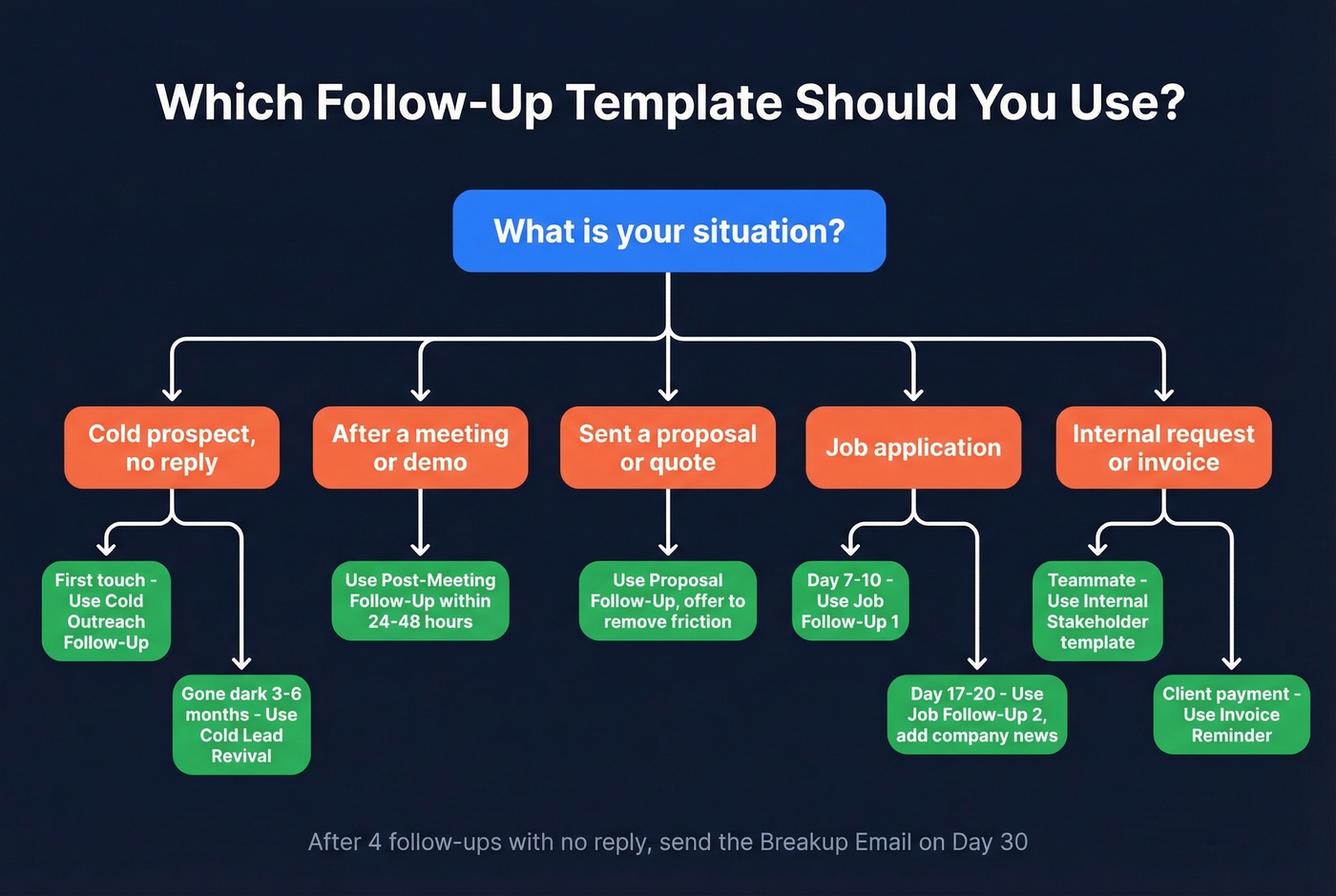
Every template below is under 80 words, uses informal tone, and avoids the phrases that kill response rates. Copy, customize, send. (If you want more variations, see these sales follow-up templates.)
First Follow-Up After Cold Outreach
When to use: 3 days after your initial email, no response.
Hi {{firstName}},
Quick follow-up on my note below - figured it might've gotten buried.
We help {{companyType}} teams {{specific outcome}}. Would it make sense to grab 15 minutes this week to see if there's a fit?
Either way, no pressure.
{{yourName}}
Reply-style framing, specific outcome, easy out. This handles 80% of first-touch situations.
Second Follow-Up: The Value Add
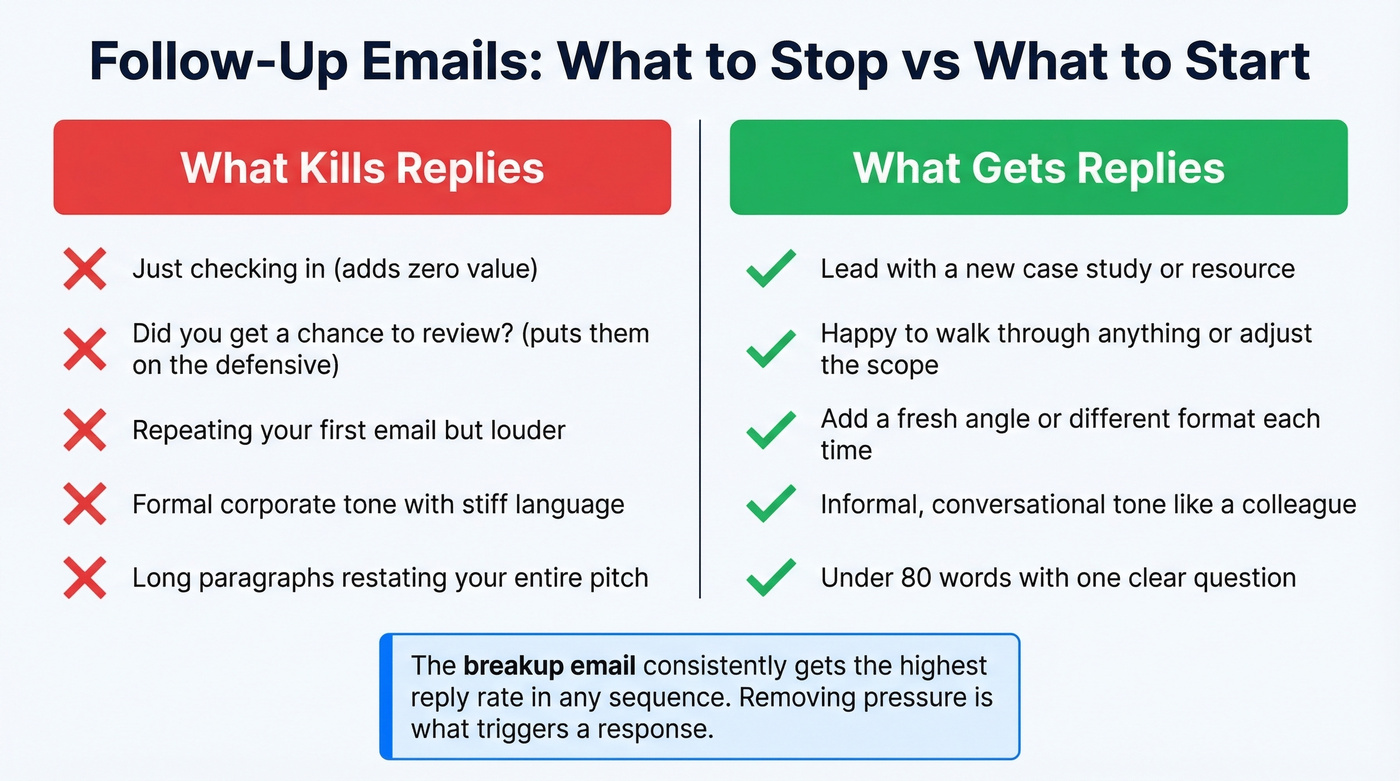
Most people just repeat their first email louder. Don't. Lead with something new.
Hi {{firstName}},
One thing I didn't mention - we helped {{similar company}} cut their onboarding time by 40%.
Thought that might be relevant given {{something specific about their company}}.
Worth a quick chat?
{{yourName}}
The case study does the selling. You're not asking again - you're giving a reason to care.
The Breakup Email
In our experience, this one consistently pulls the highest reply rate of any template in a sequence. The psychology is simple: loss aversion.
Hi {{firstName}},
I've reached out a few times and haven't heard back - totally understand if the timing's off.
I'll close the loop on my end, but if {{specific problem}} comes back on your radar, happy to pick this up.
All the best, {{yourName}}
Removes pressure entirely. People reply to breakup emails precisely because you've stopped asking. That signal of finality is exactly what triggers a response.
Post-Meeting Follow-Up
When to use: 24-48 hours after a demo or discovery call.
Hi {{firstName}},
Great chatting yesterday. Wanted to recap the two things you flagged: {{pain point 1}} and {{pain point 2}}.
I've attached {{resource}} that addresses both. Want to loop in {{stakeholder}} for a next step?
{{yourName}}
References specific conversation details and proposes a concrete next step. Generic "great meeting you" emails get deleted. For more, use these sales meeting follow-up email templates.
Proposal or Quote Follow-Up
Common mistake: asking "did you get a chance to review?" This puts the recipient on the defensive. Instead, offer to remove friction.
Hi {{firstName}},
Following up on the proposal I sent on {{date}}. Happy to walk through anything or adjust the scope.
Would a 10-minute call this week help?
{{yourName}}
Job Application Follow-Up (First)
When to use: 7-10 days after submitting your application.
Hi {{hiringManagerName}},
I applied for the {{role}} position on {{date}} and wanted to follow up. I'm particularly excited about {{specific thing about the company or role}}.
I recently {{relevant accomplishment or project}} that I think maps well to what you're building. Happy to share more details.
Thanks, {{yourName}}
Job Application Follow-Up (Second)
When to use: 7-10 days after your first follow-up. Two thoughtful follow-ups show genuine interest. Five generic ones show you can't take a hint.
Hi {{hiringManagerName}},
Following up once more on the {{role}} position. I noticed {{recent company news or industry development}} - I'd love to discuss how my experience with {{relevant skill}} could help.
Completely understand if the timeline has shifted. Either way, I appreciate your time.
{{yourName}}
New context through company news, plus a graceful acknowledgment that timelines slip.
Payment or Invoice Reminder
Hi {{firstName}},
Quick heads-up - invoice #{{number}} for {{amount}} was due on {{date}}. We haven't received any response yet, so I wanted to make sure it didn't slip through the cracks.
I've reattached it here for convenience. Let me know if there are any questions on your end.
Thanks, {{yourName}}
Assumes good intent - it "slipped through" - and provides the attachment again so they don't have to dig.
Internal Stakeholder Follow-Up
Skip this template if you sit within arm's reach of the person. Walk over. Seriously. For remote teams or cross-department requests:
Hi {{name}},
Circling back on {{specific item}} - I need your input before I can move forward with {{next step}}.
Can you take a look by {{specific day}}? If it's easier, I can hop on a quick call.
Thanks, {{yourName}}
States the dependency clearly, offers an alternative channel, and sets a deadline.
Networking or Event Follow-Up
Hi {{firstName}},
Great meeting you at {{event}}. Our conversation about {{topic}} stuck with me - especially {{specific detail}}.
I came across {{relevant article or resource}} and thought of you. Would love to stay in touch.
{{yourName}}
Specific callback to the conversation, and it gives before asking. Send within 1-3 days while the event is still fresh.
Client Document Request
Hi {{firstName}},
Just a quick nudge - we haven't heard from you on {{specific document}} and need it to keep the {{project name}} timeline on track.
Could you send it over by {{date}}? If someone else on your team handles this, happy to reach out to them directly.
Thanks, {{yourName}}
Ties the request to a shared deadline and offers to contact someone else - removing the "I'm too busy" excuse.
Cold Lead Revival
When to use: Re-engaging a prospect who went dark 3-6 months ago.
Hi {{firstName}},
We chatted back in {{month}} about {{topic}}. A lot's changed since then - we just {{new feature, case study, or milestone}}.
Curious if {{original pain point}} is still on your radar. Worth a fresh conversation?
{{yourName}}
Acknowledges time has passed, leads with something new, and asks a low-commitment question. Revival emails work best when you genuinely have news - don't fake it.
Bonus: Multi-Channel Follow-Up Scripts
After two to three unanswered emails, switching channels often breaks through. Contacting multiple people at the same organization increases response rates by 93%.
Voicemail script (under 30 seconds):
"Hi {{firstName}}, it's {{yourName}} from {{company}}. I sent you an email about {{topic}} - just wanted to put a voice to the name. I'll follow up with a quick note. Talk soon."
Professional network message:
"Hi {{firstName}} - I sent a note to your work email about {{topic}} but wanted to make sure it landed. Would love to connect here if that's easier."
Keep both short. The goal isn't to pitch - it's to get them to open your email.
Phrases That Kill Your Follow-Up
The wrong phrase turns a polite reminder into something that reads as passive-aggressive or lazy.
| Don't Write This | Write This Instead |
|---|---|
| "Just wanted to kindly follow up..." | "Following up on [topic]--" |
| "Per my last email..." | "Building on what I shared on [date]--" |
| "I hope this finds you well" | Skip the filler. Start with value. |
| "Just checking in" | "Quick question about [specific thing]" |
| "I haven't heard back from you" | "Wanted to make sure this didn't get buried" |
| "Please advise" | "Would [option A or B] work better?" |
| "As previously mentioned..." | "One thing worth highlighting--" |
| "Not sure if you saw my last email" | "Circling back with [new context]" |
A word on "kindly" - it's a common concern on Reddit and for good reason. In many professional contexts, "kindly" reads as condescending rather than polite. It's especially tricky for non-native English speakers who use it to soften a request. Drop it entirely. Your email is polite because of what you say, not because you inserted the word "kindly." If you need alternatives, here’s how to say just checking in professionally.
Before You Hit Send
The best follow-up template in the world fails if the email bounces. Think of verification as step zero - it comes before subject lines, before timing, before tone.
Bounce rates on unverified lists are brutal. Meritt, a sales agency, was running a 35% bounce rate before switching to verified data - they got it under 4% and tripled their pipeline from $100K to $300K per week. That's not a template improvement. That's a deliverability improvement.
Let's be honest about something else: deliverability hygiene matters just as much as copy. Before you send any follow-up sequence at volume, make sure your domain has SPF, DKIM, and DMARC records properly configured. Warm your sending domain gradually before ramping up volume. Skip this step and your carefully written follow-ups land in spam, not inboxes. (If you want a deeper checklist, use this email deliverability guide and these email reputation tools.)
Prospeo runs every email through a 5-step verification process - syntax check, domain validation, catch-all handling, spam-trap removal, and honeypot filtering - delivering 98% email accuracy across 143M+ verified addresses. There's a free tier with 75 emails per month so you can test it before committing. If you're sending follow-ups at any kind of volume, verify first. Everything else is wasted effort without it.
You just saw that only 1 in 157 contacts replies positively. The fastest way to improve that ratio? Start with verified contact data. Prospeo delivers 98% accurate emails at $0.01 each - so every follow-up in your sequence reaches a real person.
Send fewer emails, get more replies - start with better data.
FAQ
How many reminder emails should I send after no response?
Four to seven touchpoints is the sweet spot for most outbound sequences. Fewer than four gives up too early, while going beyond seven has diminishing returns unless each touch adds genuinely new value. For job applications, cap it at two to three follow-ups before you risk annoying the hiring team.
How long should I wait before following up?
Three to five business days for your first follow-up. After that, extend gaps to seven to fourteen days between subsequent touches. The increasing interval signals persistence without desperation, and it gives the recipient time to deal with whatever buried your first message.
Is it okay to follow up on a job application twice?
Yes - space them seven to ten days apart and add new context each time. A relevant project, an industry insight, a connection to recent company news. Two thoughtful follow-ups show genuine interest; five generic ones signal you can't read the room.
What's the best way to start a follow-up email?
Lead with context, not filler. Open with "Following up on [specific topic]" so the recipient immediately knows why you're writing and can locate the thread. From there, add one new piece of value or ask a direct question. Skip openers like "I hope this finds you well" - they waste your strongest real estate.
What if my follow-up emails keep bouncing?
Bounces mean the address is invalid or outdated, and they actively damage your sender reputation. Verify emails before sending - Prospeo's 5-step verification delivers 98% accuracy with a free tier of 75 emails per month - so your carefully written follow-ups actually reach an inbox instead of vanishing.