

GetEmail.io vs LeadsForge: Which Email Finder Is Worth Your Money in 2026?
Nobody's compared these two tools side by side. If you're weighing GetEmail.io against LeadsForge for your outbound stack, let's fix that right now.
The 30-second verdict:
- GetEmail.io wins for simple, standalone email lookups with no ecosystem commitment.
- LeadsForge wins if you're already in the Salesforge stack and want native lead-gen integration.
GetEmail.io and LeadsForge at a Glance
GetEmail.io is a straightforward email finder: plug in a name and domain, get an email back. It holds a 4.6/5 Capterra rating across 755 reviews, markets "over 80% accuracy," and offers Chrome extensions for Gmail and Sales Navigator. It's built to keep email lookup and verification simple without forcing you into a bigger outbound suite.
LeadsForge takes a different approach. It's a conversational lead search engine where you describe your ICP in natural language and the tool translates that into filters across 500M+ contacts. It carries a 4.5/5 on G2 from 12 reviews and a 4.0/5 on Trustpilot. The catch: it's part of the Salesforge ecosystem, which shapes both how you'll use it and what you'll pay.
Side-by-Side Feature Comparison
| Starting price | $49/mo | $49/mo | Free; paid is credit-based (~$0.01/email) |
| Credits included | 300 | 2,000 | 75 emails + 100 Chrome extension credits/mo |
| Cost per email | ~$0.16 | ~$0.025* | ~$0.01 |
| Verification included? | Yes (single + bulk) | Validation requires additional credits | Yes, built-in |
| Accuracy claim | "Over 80%" | Not published | 98% |
| Database size | Not published | 500M+ contacts | 300M+ profiles |
| Free tier | 10 credits/mo | 100 on signup | 75 emails/mo |
| Chrome extension | Yes | No | Yes (40,000+ users) |
| Integrations | Zapier, Make, API | Salesforge native | Salesforce, HubSpot, Smartlead, Instantly, Lemlist, Clay, Zapier, Make, + more |
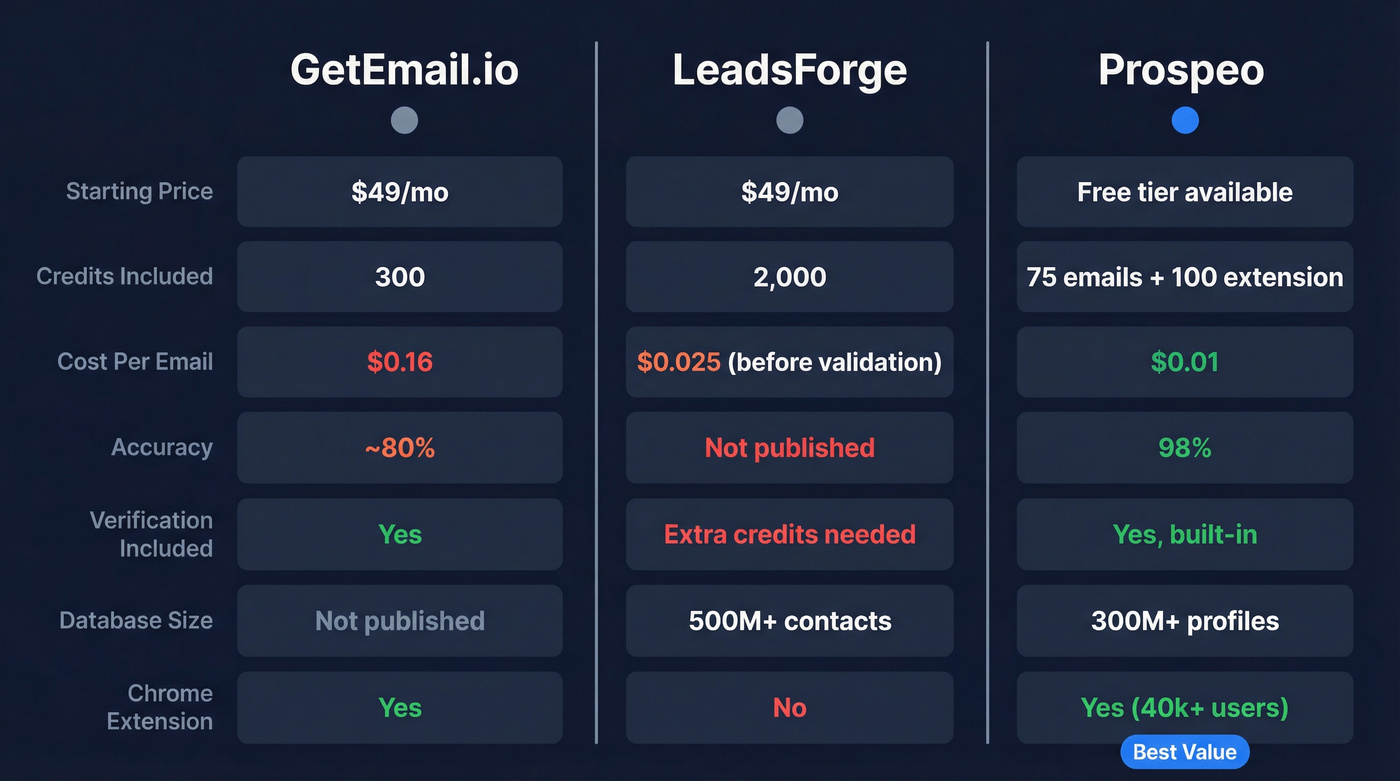
*LeadsForge's $0.025/lead doesn't include validation - real cost is higher.
Pricing - The Real Math
We've run the numbers on both tools, and the gap is wider than it looks at first glance.
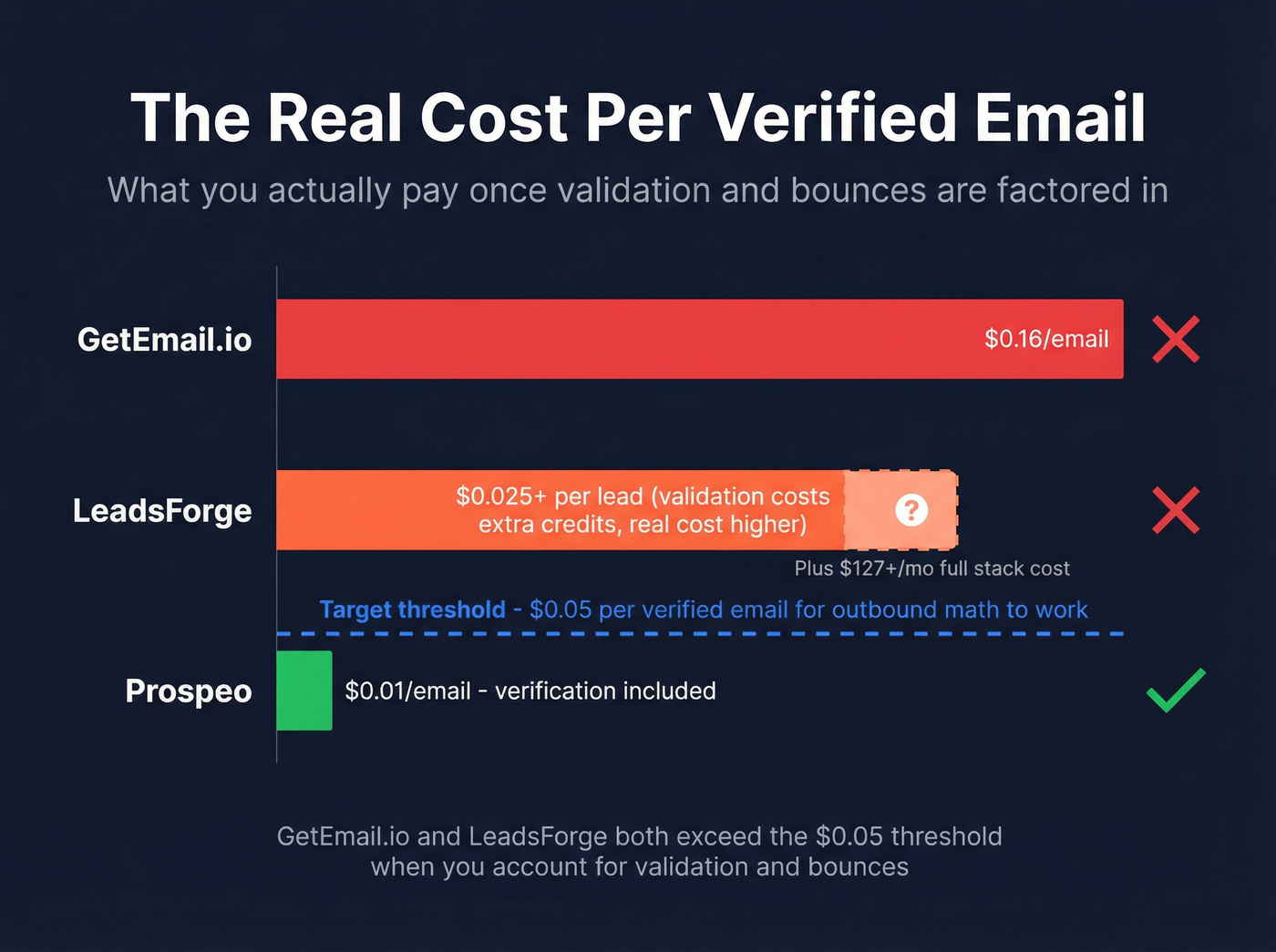
LeadsForge seems like the better deal: $49 gets you 2,000 credits versus GetEmail.io's 300. But LeadsForge's email validation costs extra credits. A G2 reviewer flagged that found emails "might not be 100% reliable until you run the validation process," and that validation eats into your balance. Your effective cost per verified lead is meaningfully higher than $0.025.
GetEmail.io has its own pricing trap. The Ultra tier costs $399/mo for 2,000 credits - the exact same count as the $149/mo Premium tier. You're paying $250 extra for 24/7 phone support. That's a hard sell for anyone watching their budget.
Here's the thing most people miss about LeadsForge: you need to factor in the full stack. Running outbound through Salesforge means Salesforge Pro ($48/mo) + LeadsForge ($49/mo) + Mailforge ($30/mo minimum). That's $127+/mo before you've sent a single email.
If your average deal size is under $15k, neither tool's credit economics make sense at scale. Our rule of thumb: you want cost-per-verified-email under $0.05 for outbound math to work, and both tools blow past that threshold once you account for validation and bounces.
If you're pressure-testing your outbound economics, it also helps to track lead generation metrics and map them to your cost to acquire customer.

GetEmail.io charges ~$0.16/email at 80% accuracy. LeadsForge hides validation behind extra credits. Prospeo delivers 98% accurate emails at ~$0.01 each - verification built in, no upsells. One customer dropped bounce rates from 35% to under 4% and tripled their pipeline.
Stop subsidizing bad data. Get 75 verified emails free today.
What Users Actually Say
GetEmail.io
The review volume here is solid - 755 Capterra reviews gives you a real signal. Users consistently praise the Chrome extension for fitting naturally into existing workflows, and the interface is dead simple. It does the core job without complexity.
On the flip side, 10 free credits is barely enough to evaluate anything. Users on Capterra repeatedly flag "expensive subscription options," and aggressive upselling shows up as a recurring complaint. For a tool that claims "over 80%" accuracy, the per-email cost feels steep.
LeadsForge
One agency reported saving 10 hours of manual research per week, which is the kind of result that justifies the price on its own. The conversational ICP search is genuinely clever - it translates vague targeting descriptions into real filters, and one user claimed personal email coverage for roughly 90% of found leads.
But the frustrations are real too. Validation costing extra credits annoys users on both G2 and Trustpilot. The product naming across the "-forge" ecosystem confuses people. And on Reddit, users report bugginess across the Salesforge stack - exports that "never work" and slow support responses.
Accuracy: Claims vs. Reality
GetEmail.io markets "over 80%" accuracy, which is oddly modest - most competitors promise 90%+. LeadsForge doesn't publish a number at all.
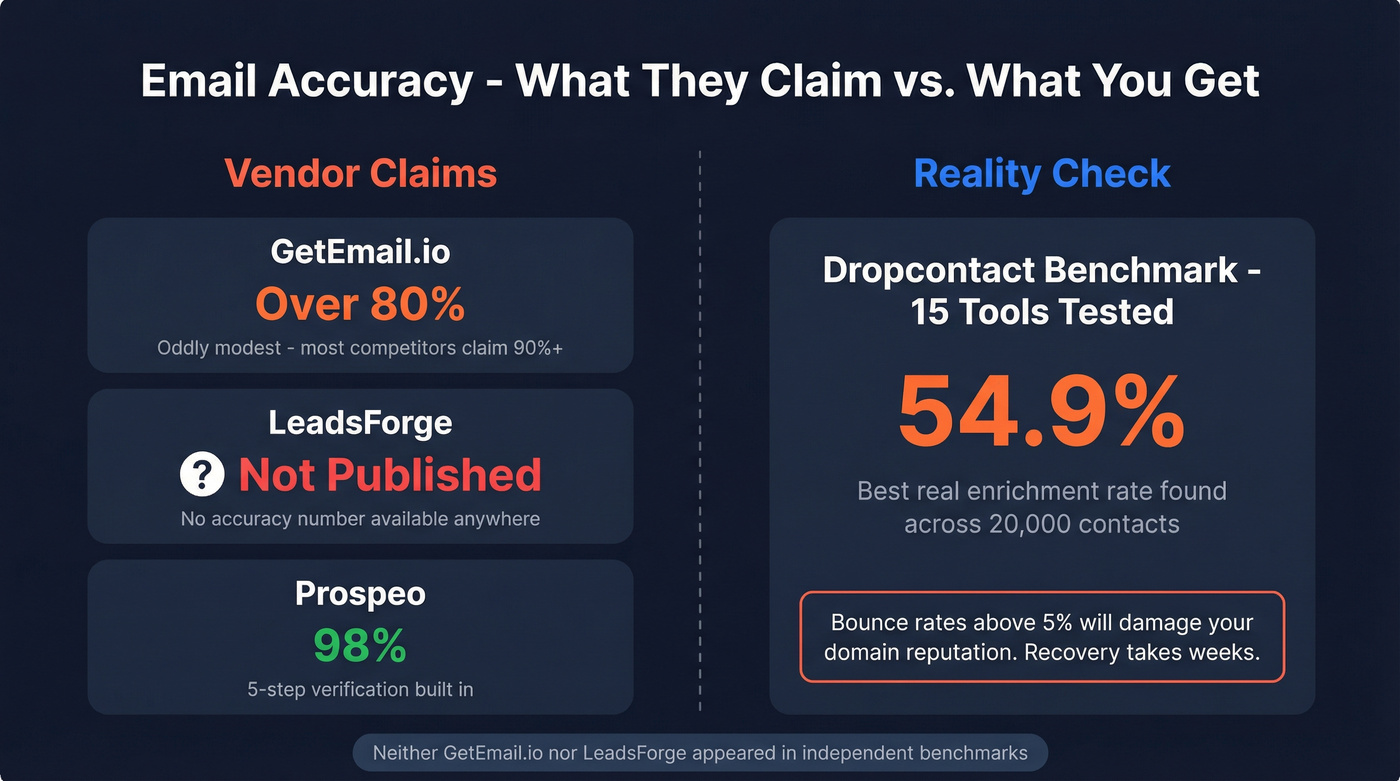
In our experience, vendor accuracy claims rarely survive contact with real inboxes. A Dropcontact benchmark testing 15 tools on 20,000 contacts found the top tool hit just a 54.9% "real enrichment rate." Dropcontact ran the benchmark and participated in it, so take absolute numbers with context - but the methodology, using live sends to measure hard bounces, is sound. Neither GetEmail.io nor LeadsForge appeared in the test.
Look: if a tool won't tell you its accuracy number or tells you it's "over 80%," verify everything before it hits your sequences. Bounce rates above 5% will torch your domain reputation, and recovering from that takes weeks.
If you want a deeper breakdown of bounce thresholds and what they do to deliverability, see email bounce rate and email deliverability.
A Better Third Option
Both tools share the same weakness: you're never sure what you're paying for verified data versus raw leads that still need validation. Prospeo eliminates that ambiguity with 98% email accuracy through a proprietary 5-step verification process - catch-all handling, spam-trap removal, honeypot filtering - all built in at ~$0.01/email.
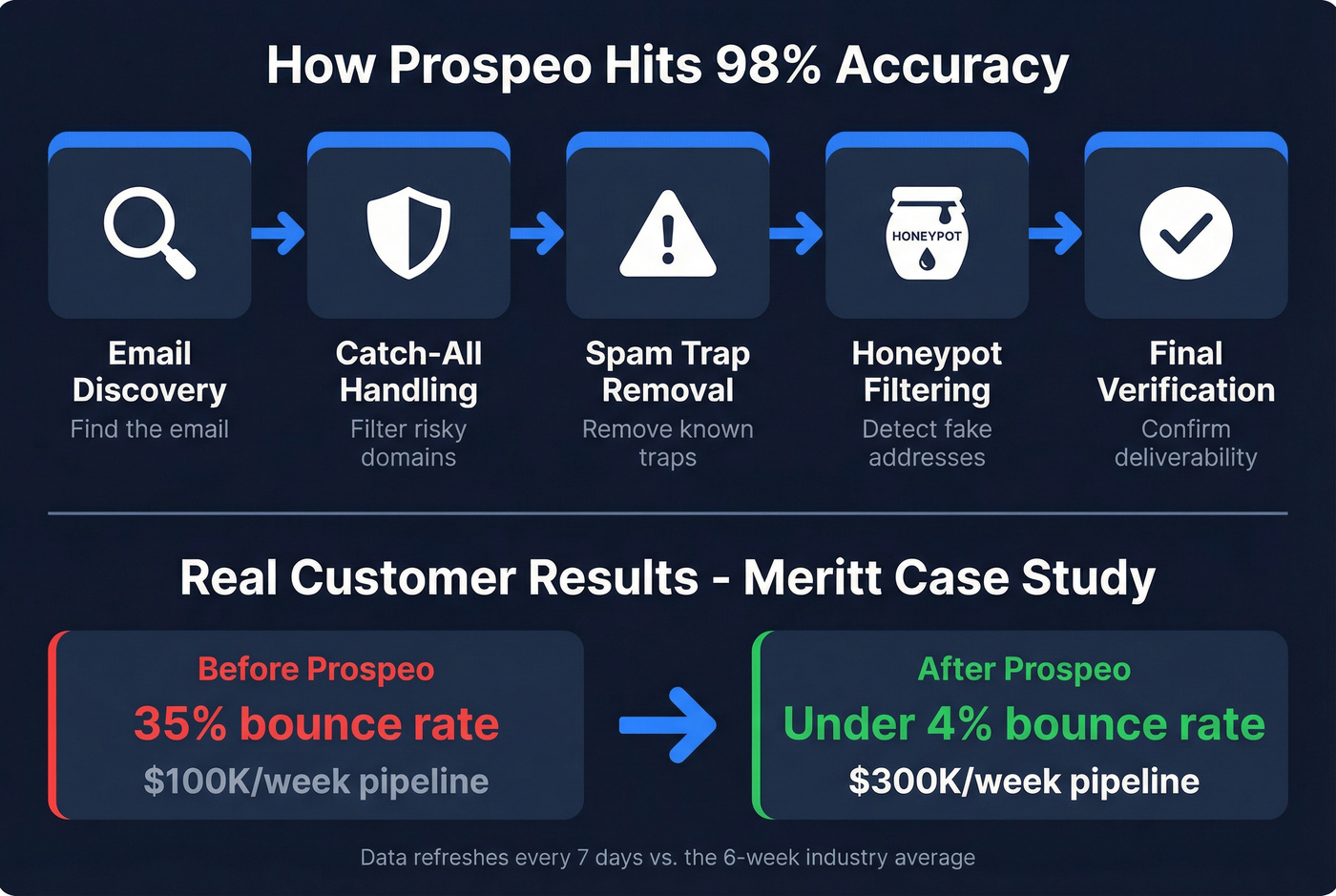
The results speak for themselves. One customer, Meritt, saw bounce rates drop from 35% to under 4% after switching, while their pipeline tripled from $100K to $300K per week. Data refreshes every 7 days (the industry average is 6 weeks), so you're not emailing people who changed jobs two months ago. The free tier gives you 75 verified emails monthly - enough to actually run a real test before committing budget.
If you're comparing more options beyond these two, start with email search tools or a broader list of outbound lead generation tools.

Neither GetEmail.io nor LeadsForge refreshes data weekly. Prospeo does - every 7 days vs. the 6-week industry average. That means you're reaching people at their current company, not their last one. With 30+ filters, intent data, and native integrations to HubSpot, Salesforce, and every major sequencer, there's no $127/mo stack to assemble.
One platform, no ecosystem lock-in, emails that actually land.
FAQ
Is LeadsForge a standalone tool?
Yes, but it's designed as a Salesforge module. You can use it independently for $49/mo, but native sequencing only works with the full stack ($127+/mo with Salesforge Pro and Mailforge). Without that integration, you're exporting CSVs manually.
Which tool has better email accuracy?
Neither publishes independently verified data. GetEmail.io claims "over 80%," which is low by industry standards. LeadsForge doesn't publish a number at all. For reference, Prospeo's 98% accuracy includes built-in verification at no extra cost - teams consistently report bounce rates under 4%.
What's a good free alternative to both tools?
Prospeo's free tier includes 75 verified emails and 100 Chrome extension credits monthly - far more generous than GetEmail.io's 10 credits or LeadsForge's one-time 100. For light prospecting or tool evaluation, that's enough to run a real test.
Can I use LeadsForge without the Salesforge ecosystem?
You can export leads as CSV and upload to any outreach tool. But without the Salesforge integration, it's just a lead database with a chat interface - and you lose the main reason to choose it over standalone finders. If you don't need the Salesforge sequencing, a dedicated email finder will serve you better for less money.