

Go-to-Market Fit: The Diagnostic Guide With Actual Numbers
You closed your first 20 customers through founder hustle - late-night demos, personal follow-ups, sheer willpower. Now the board wants you to 3x ARR and you've hired four reps who can't close at half your rate. Product-market fit gets all the glory, but go-to-market fit is where most funded startups actually die.
GTM fit means your sales motion works without founder heroics. If your Magic Number is below 0.75, step back and fix the motion before you scale headcount. Here's the diagnostic checklist and the actual numbers to know where you stand.
What Is Go-to-Market Fit?
Go-to-market fit is the point where your sales and marketing motion produces repeatable, scalable revenue - not one-off wins driven by a charismatic founder or a lucky referral. It bridges "people want this product" and "we can predictably acquire and retain customers at a cost that makes the business work."
74% of high-growth startups fail because they scale prematurely - hiring reps, blasting ads, expanding territories - before the underlying motion is proven. That's not a product problem. That's a GTM fit problem.
GTM fit isn't the same as having a GTM strategy. A strategy is a deck. As one r/SaaS founder put it, "GTM is not a deck" - it's evidence that the strategy actually works in the field, with people who aren't founders running it.
GTM Fit vs Product-Market Fit
PMF validates the product. GTM fit validates the motion. You can have strong PMF - users love the product, retention is solid, NPS is high - and still have zero GTM fit because you can't acquire those users efficiently or predictably.
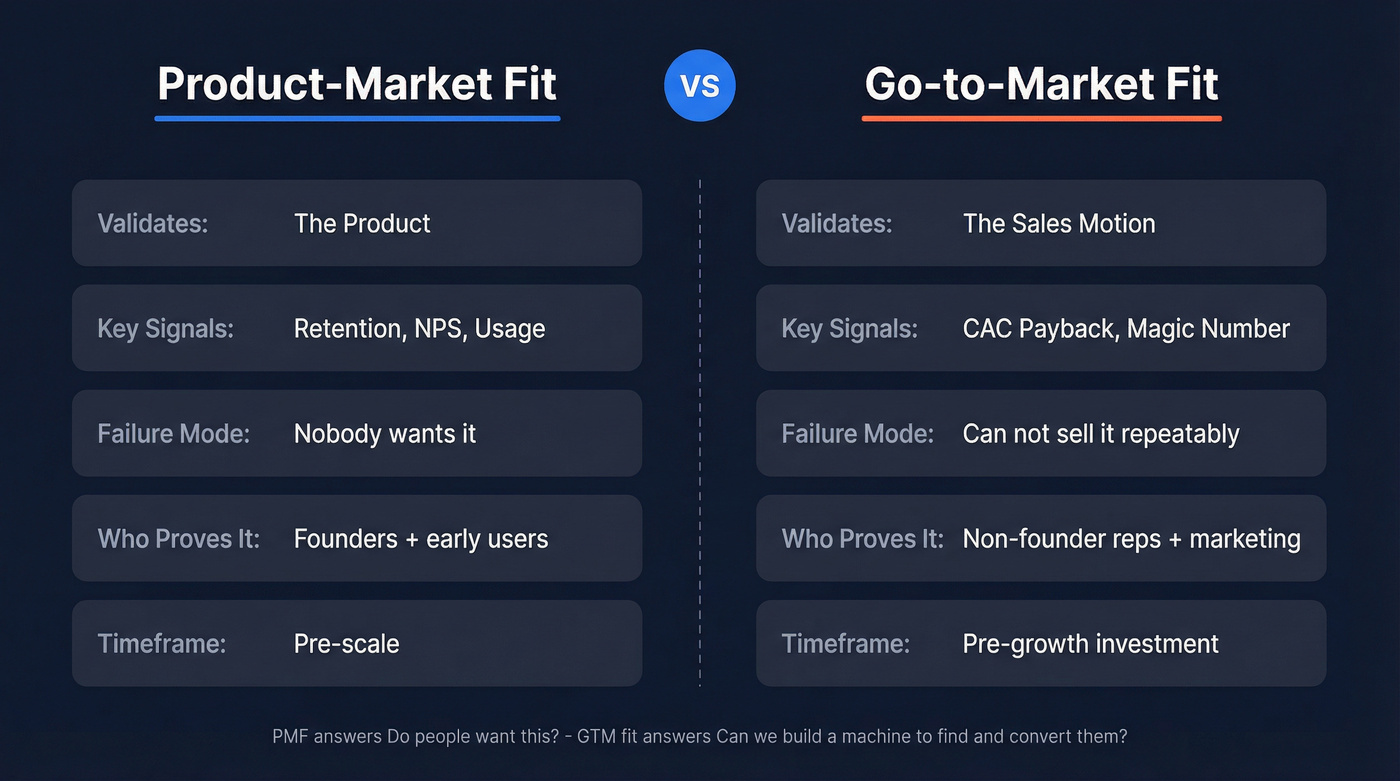
| Dimension | Product-Market Fit | Go-to-Market Fit |
|---|---|---|
| Validates | The product | The sales motion |
| Key signals | Retention, NPS, usage | CAC payback, Magic Number |
| Failure mode | Nobody wants it | Can't sell it repeatably |
| Who proves it | Founders + early users | Non-founder reps + marketing |
| Timeframe | Pre-scale | Pre-growth investment |
OPEXEngine frames it well: PMF answers "do people want this?" while GTM fit answers "can we build a machine that finds and converts those people without the founders doing it themselves?"
Signs You Have PMF but No GTM Fit
If you recognize three or more of these, you've got a GTM fit problem:
- Inconsistent revenue growth. One great quarter, one terrible quarter, no pattern.
- High churn despite strong usage. Users love the product but contracts don't renew - pricing or buyer alignment is off.
- Long, unpredictable sales cycles. Some deals close in two weeks, others drag for six months.
- Heavy discounting to close. Reps give away 30-40% to hit quota.
- CAC rising faster than ARR. You're spending more to acquire each incremental dollar.
- Early-adopter success, mainstream difficulty. Innovation-friendly buyers signed up easily. Everyone else stalls.
This is the classic "chasm" problem. Your product works. Your go-to-market doesn't - yet.

You can't diagnose GTM fit when 20% of your emails bounce. Prospeo's 98% email accuracy and 7-day data refresh cycle give your reps clean lists - so your CAC payback and Magic Number reflect your actual motion, not your data vendor's decay rate.
Isolate what's broken: your motion or your list.
How to Measure GTM Fit
Every GTM article tells you to "track your metrics." Nobody tells you what the actual numbers should be. Let's fix that.
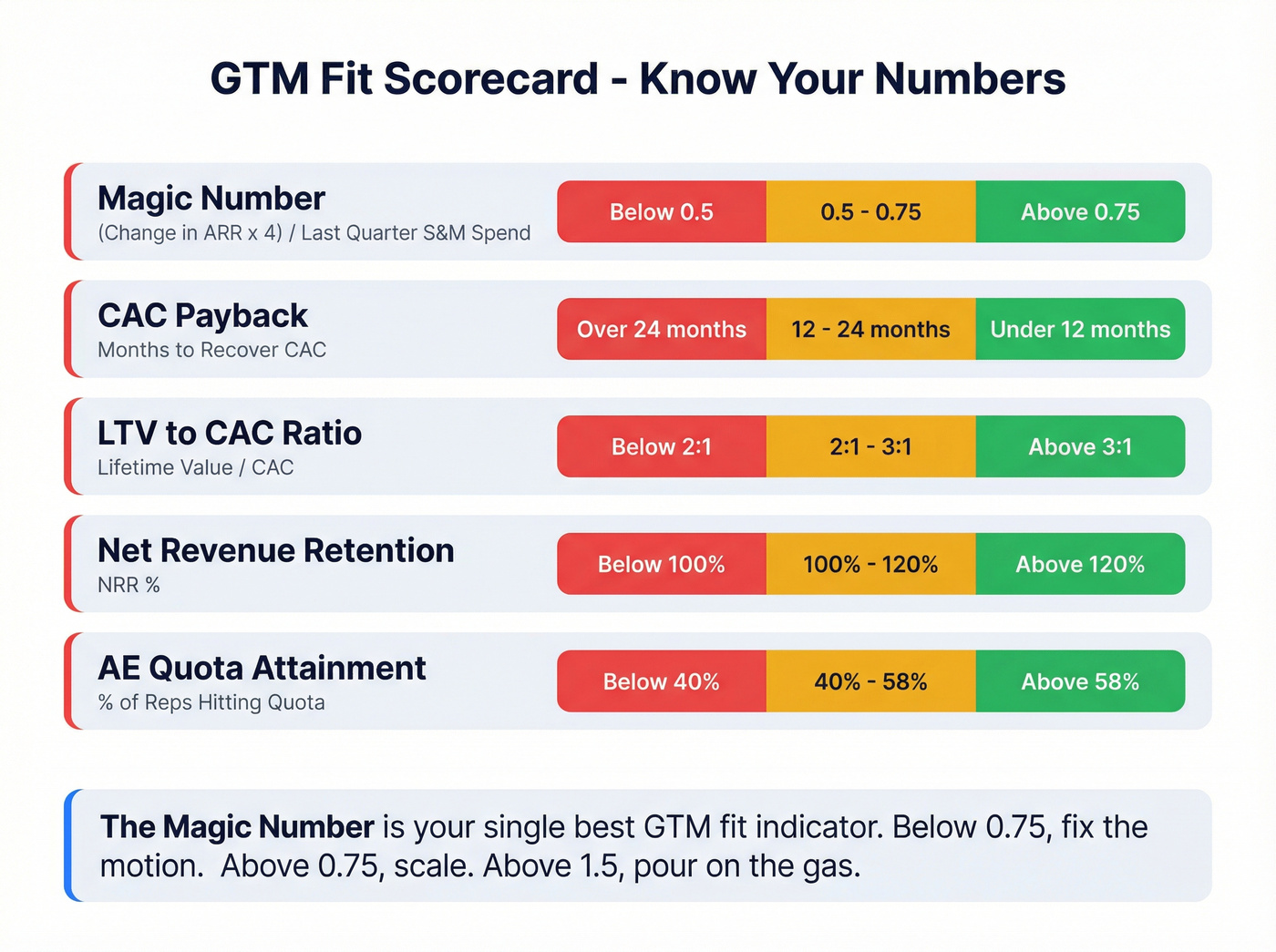
| Metric | Formula | Red | Yellow | Green |
|---|---|---|---|---|
| Magic Number | (ΔARR x 4) / last Q S&M expense | <0.5 | 0.5-0.75 | >0.75 |
| CAC Payback | Months to recover CAC | >24mo | 12-24mo | <12mo |
| LTV:CAC | Lifetime value / CAC | <2:1 | 2-3:1 | >3:1 |
| NRR | Net revenue retention | <100% | 100-120% | >120% |
| AE Quota Attainment | % of reps hitting quota | <40% | 40-58% | >58% |
The Magic Number is your single best GTM fit indicator. In our experience, it's the fastest diagnostic you can run - one number that tells you whether to hire or hold. As investor Lars Leckie put it: below 0.75, step back and fix the motion. Above 0.75, pour on the gas. Above 1.5, "call me immediately."
For a more granular view, track cohort-based CAC trends rather than blended averages. They'll reveal whether your motion is improving or degrading over time, which a blended number hides completely.
AE quota attainment sits at 58% YTD, and top-quartile companies in the $25M-$100M ARR band are growing at 93% year-over-year. If your reps are attaining below 40%, the problem isn't the reps. It's the motion.
Revenue quality matters too. OXX's framework ranks contracted recurring revenue above usage-based repeating revenue, which ranks above one-off revenue. All else equal, a business with mostly contracted recurring revenue has stronger GTM fit than one propped up by one-off services fees.
And if you're measuring outbound, data quality is the prerequisite for trustworthy metrics. A 2% reply rate means something very different when 20%+ of your emails bounce versus 1%. We've seen teams blame their messaging for months when the real culprit was stale contact data - tools like Prospeo with 98% email accuracy and a 7-day refresh cycle help isolate whether it's your copy or your list that's broken.
A Framework for Getting There
The Survival to Thrival framework breaks the path to go-to-market fit into three steps:
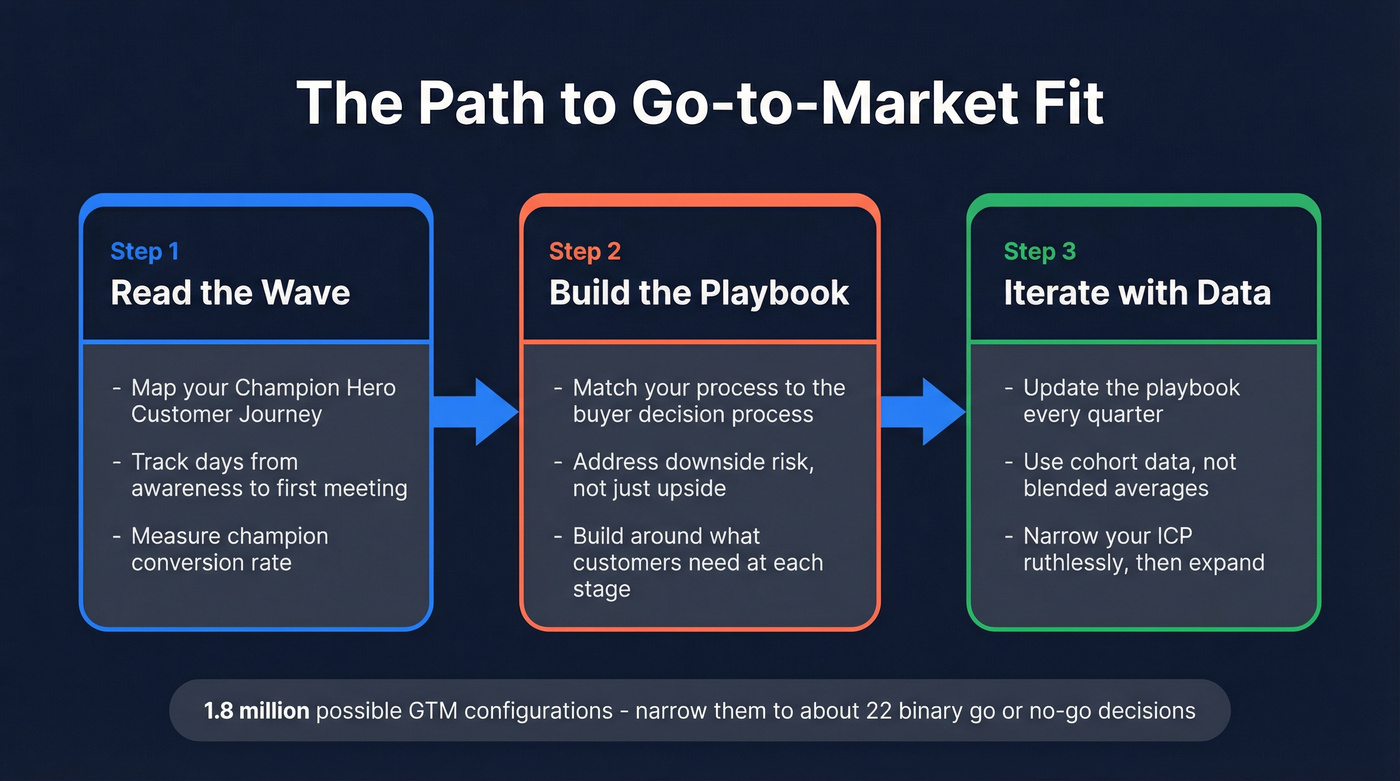
Read the Wave. Map your Champion's Hero Customer Journey - the internal advocate who stakes their reputation on buying your product. Track days from awareness to first meeting, champion conversion rate, and committee approval rate.
Build the Playbook. Match what your team does to what customers actually need at each stage. Playbooks fail when they're built around your sales process instead of the buyer's decision process. Here's the thing: buyers focus on downside risk while founders focus on upside. Your playbook needs to address both.
Iterate with Data. This is where most teams stall. They build the playbook once and never update it. The playbook isn't a document you laminate - it's a living system that changes every quarter based on what the numbers say.
Monetisation Matters estimates a typical B2B company faces roughly 1.8 million possible GTM configurations. The path to GTM fit is reducing that to about 22 binary go/no-go decisions. The single highest-leverage move? Narrowing your ICP ruthlessly. Slack nailed PLG with developers, then layered enterprise sales. Datadog refined its ICP to DevOps teams with usage-based pricing. HubSpot started with SMB inbound, then expanded multi-segment only after the core motion was proven.
Narrow first, expand later.
Common GTM Fit Mistakes
Confusing founder-led sales with a repeatable motion. If only the CEO can close, you don't have GTM fit. Fix: have a non-founder rep close 5 deals before scaling headcount.
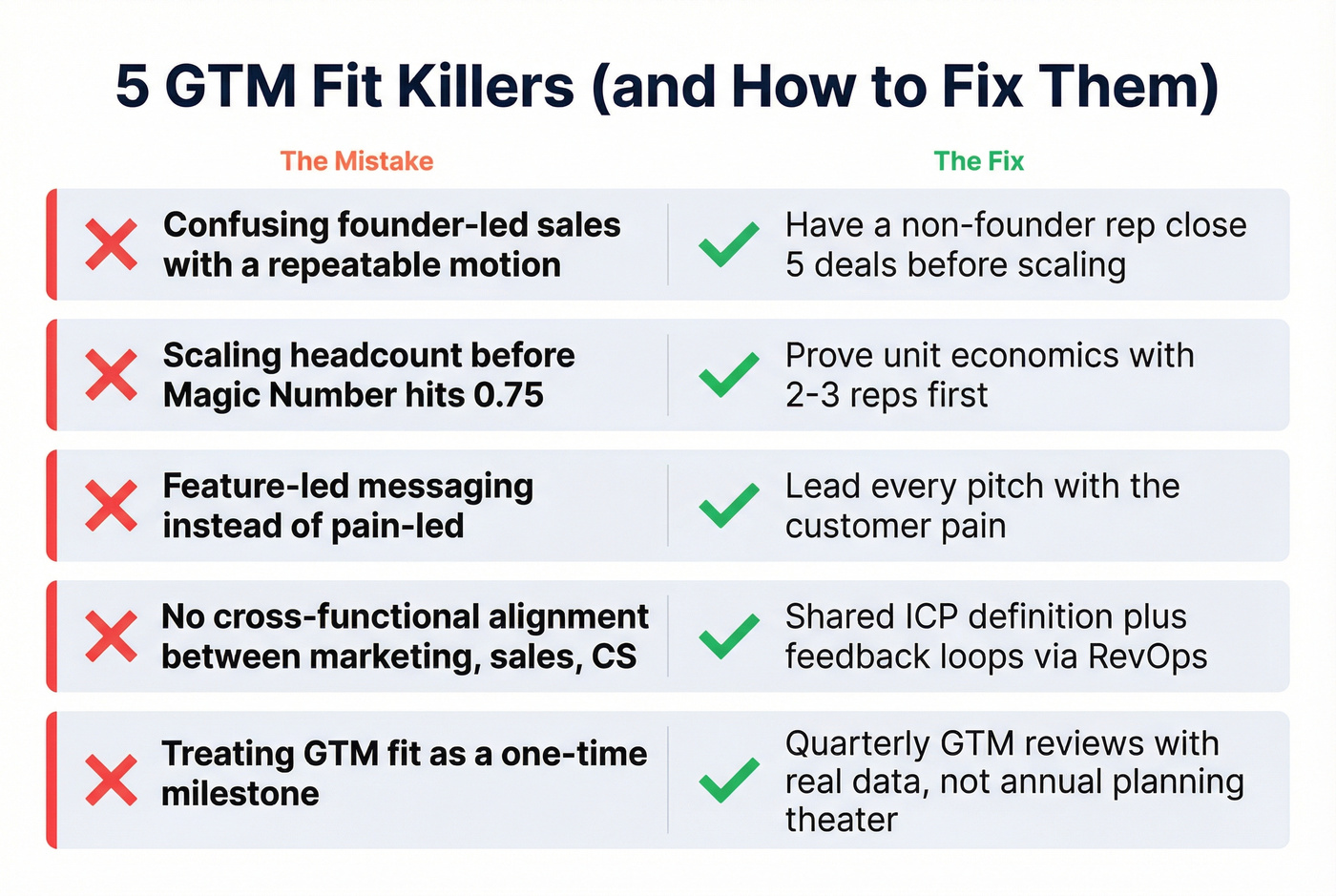
Scaling headcount before Magic Number >0.75. More reps don't fix a broken motion - they amplify it. We've seen this pattern repeatedly: teams that prove unit economics with 2-3 reps first save themselves months of painful unwinding later.
Feature-led messaging instead of pain-led. Nobody cares about your feature list. Lead every pitch with the customer's pain, not your product's capabilities.
No cross-functional alignment. Marketing generates leads that sales says are garbage. Sales closes deals that CS can't retain. The fix isn't a meeting - it's a shared ICP definition and feedback loops between all three teams, enforced through RevOps.
Treating GTM fit as a one-time milestone. Skip this mindset entirely. It's not a box you check. It's a state you maintain through quarterly GTM reviews with real data, not annual planning theater.
Maintaining Go-to-Market Fit
GTM fit degrades whenever you change segments, territories, pricing, or product scope. The JTBD community calls it ABIC - Always Be Interviewing Customers - and it's the best insurance policy against drift. Institutionalize customer interviews through customer interviews, not as a one-off founder exercise.
Here's our hot take: most teams don't lose GTM fit because the market changed. They lose it because they stopped paying attention.
Cold email reply rates dropped from 6.8% to 5.8% in a single year. About 70% of GTM teams now report moderate or full AI adoption. What "fit" looks like in 2026 isn't what it looked like in 2024. The companies that win aren't the ones who found go-to-market fit once - they're the ones who keep re-finding it.
If you're tightening your outbound loop, start with cold email reply rates and email prospecting hygiene before you change messaging.
Scaling from founder-led sales to a repeatable motion requires data your reps can trust without you. Prospeo gives non-founder AEs 300M+ verified profiles with 30+ filters - intent, technographics, headcount growth - so they hit quota without heroics.
Stop amplifying a broken motion. Start with data that works at $0.01/email.