

Cold Outreach Response Rate: What the Data Actually Shows in 2026
Stop optimizing your subject lines. Start auditing your bounce rate. In 2026, most teams land in the 3-8% range for cold outreach response rate, and the gap between teams at the bottom and top of that range has almost nothing to do with copywriting. It's infrastructure, data quality, and targeting precision - in that order. The playbook that worked in 2023 and early 2024, when 15-25% reply rates were achievable with decent targeting, doesn't work anymore.
Here's the short version: The average cold email reply rate dropped roughly 15% year-over-year, landing at 5.8% across 16.5M emails in the latest Belkins benchmark. If you're below 3%, the problem is almost certainly data quality or deliverability - not your copy. Fix your bounce rate first, then optimize targeting and follow-up cadence.
Reply Rates by the Numbers
Let's ground this in actual datasets, not vibes.
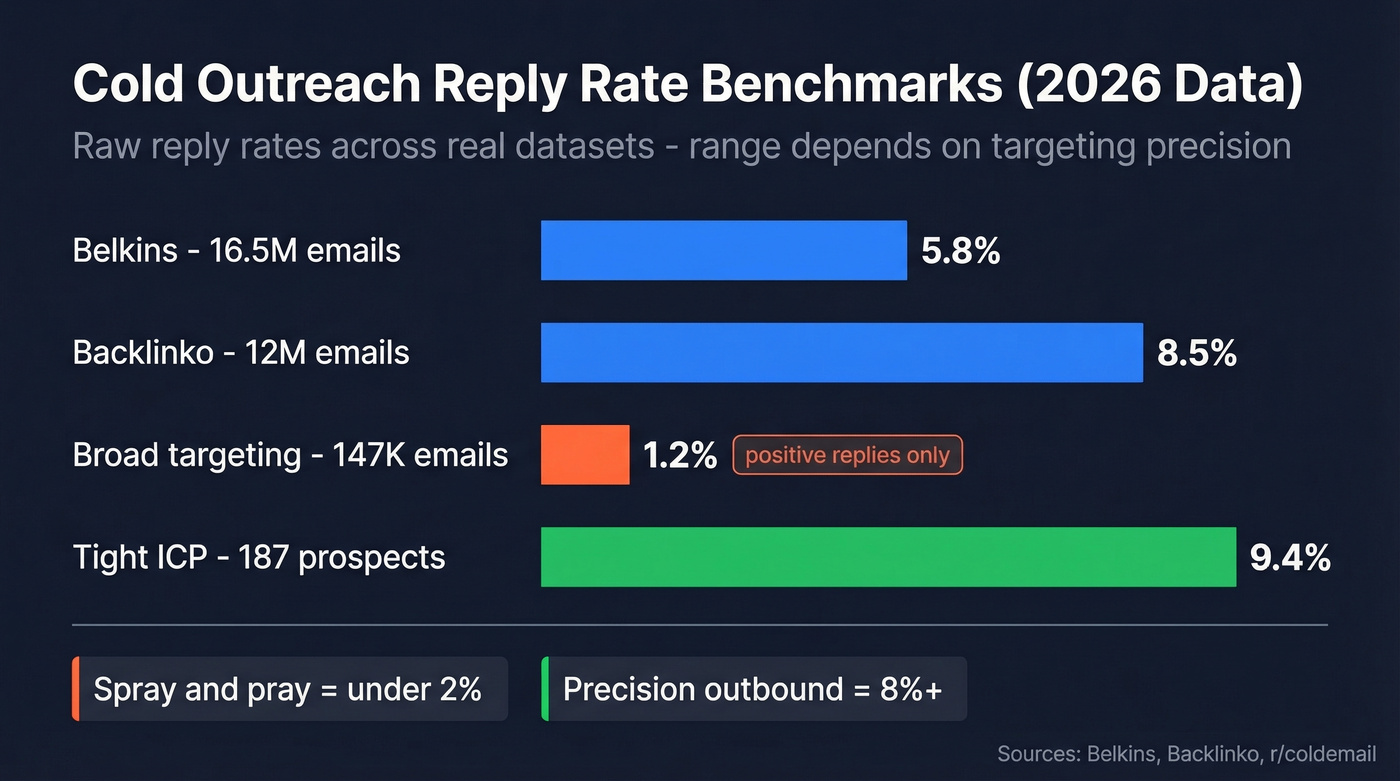
| Benchmark | Dataset | Avg Reply Rate | Notes |
|---|---|---|---|
| Belkins (Jan-Dec 2024 dataset) | 16.5M emails | 5.8% | Down from 6.8% in 2023 |
| Backlinko/Pitchbox | 12M emails | 8.5% | Outreach (often PR/link-building) |
| Practitioner low-end | 147K emails | 1.2% positive | Broad targeting, high volume |
| Practitioner high-end | 187 prospects | 9.4% | Tight ICP, short copy |
The range is enormous - and that's the point. A 1.2% positive reply rate from 147K sends and a 9.4% rate from 187 targeted prospects aren't measuring the same activity. One is spray-and-pray; the other is precision outbound. The "1-5% average" most guides cite blends both approaches together, which makes it nearly useless as a benchmark for your specific situation.
One distinction most guides bury: raw reply rate includes "not interested" and auto-replies. Positive reply rate - the number that actually matters - is usually much lower. When someone tells you they're getting 10% replies, ask whether that includes the polite "please remove me" responses. It usually does. Every number in this article refers to raw reply rate unless we say otherwise.
Why Reply Rates Are Declining
The biggest threat to cold outreach in 2026 isn't inbox fatigue or bad copy. It's Microsoft 365 inbox placement, which collapsed 26.73 percentage points year-over-year - from 77.43% down to 50.70%. Outlook and Hotmail are even worse: 49.33% to 26.77%. Half your emails to Microsoft-hosted domains aren't reaching the inbox at all.

Layer on top of that: warm-up timelines have roughly doubled, from about three weeks to 6-8 weeks before you can trust a new domain with real volume. Practitioners on r/coldemail consistently flag this - "spam filters feel sharper," especially at enterprise targets. And spam complaints escalate fast through a sequence: 0.5% on the first email, 1.6% by the fourth. Even pixel tracking is hurting you - turning off tracking pixels produced 3% higher response rates in the 16.5M-email dataset.
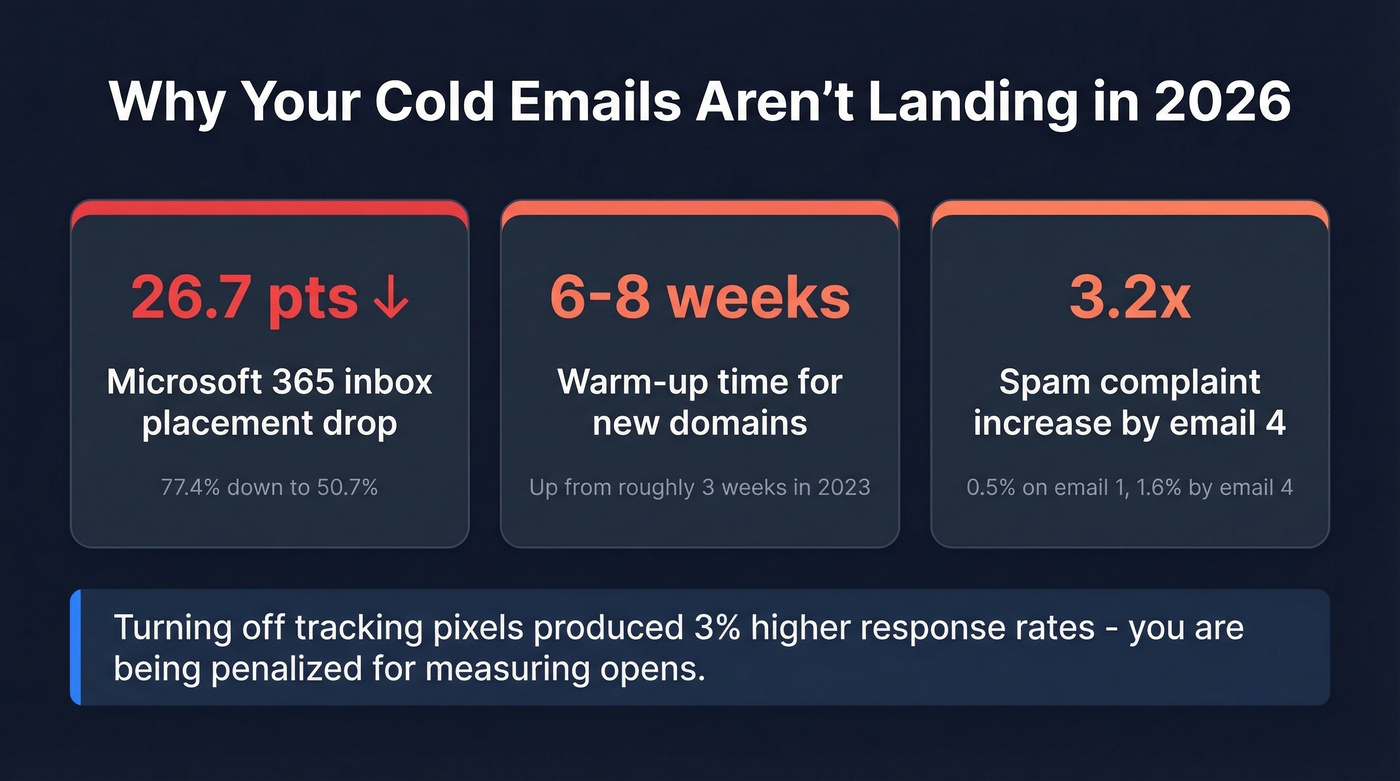
You're literally being penalized for trying to measure opens.
Here's the thing: none of this is about your writing. It's plumbing. And most teams are still trying to fix a plumbing problem with better subject lines.

You just read it: the gap between 2% and 10% reply rates starts with data quality, not copywriting. Prospeo's 5-step verification delivers 98% email accuracy and a 7-day refresh cycle - so you're never sending to stale addresses that torch your domain reputation.
Stop burning domains. Start reaching real inboxes at $0.01 per email.
What Separates 2% From 10%
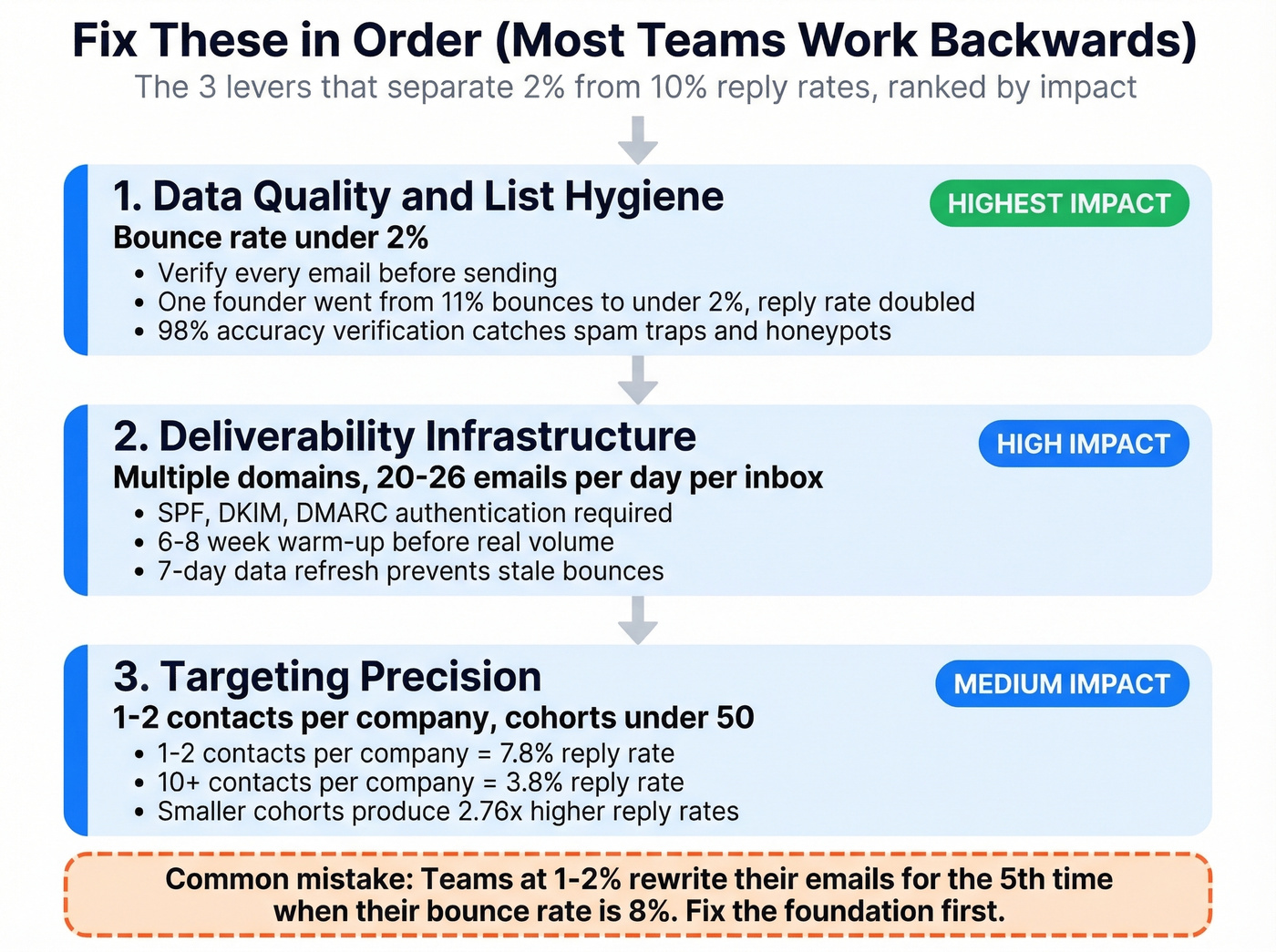
Three levers, ranked by impact. Most teams work them in reverse order - starting with copy when they should start with data. If you want higher response rates in B2B outreach, the order matters more than any individual tactic.
Data Quality and List Hygiene
Your bounce rate needs to be under 2%. Full stop. One founder documented their recovery from 11% bounces down to under 2%, and watched their reply rate climb from 3% back to 6%. The cascade is straightforward: high bounces damage your domain reputation, which tanks inbox placement, which kills replies. Every bad email you send makes the next good email less likely to land.
The fastest way to fix this is to verify every email before it enters your sequence. Prospeo's 5-step verification catches invalid addresses, spam traps, and honeypots before they torch your sender reputation - at 98% email accuracy, it's the tightest verification we've found. Meritt dropped their bounce rate from 35% to under 4% after switching. If your list isn't verified, nothing else in this article matters. If you need a deeper breakdown of bounce thresholds and remediation, start with bounce rate.
Smaller, verified lists outperform massive spray-and-pray campaigns by 2.76x. Prospeo's 30+ search filters - including buyer intent, job changes, and headcount growth - let you build the 200 perfect contacts that beat 50,000 unverified ones.
Send fewer emails. Get more replies. That's the math.
Deliverability Infrastructure
One domain sending 200 emails a day is a recipe for the spam folder. The playbook that's working right now: multiple domains (one founder scaled from 3 to 7), each capped at roughly 20-26 emails per day per inbox. Missing SPF/DKIM/DMARC authentication can drop deliverability up to 30% on its own. Warm-up isn't optional - budget 6-8 weeks before you trust a new domain with real volume. If you want the full checklist, use an email deliverability audit and validate your sender reputation before scaling.
Stale data compounds the problem. An email that was valid six weeks ago might bounce today. A 7-day data refresh cycle - versus the 6-week industry average - prevents bounces before they happen, which is cheaper than repairing a burned domain.
One founder runs their full stack (7 domains + tools + verification) for about $420/month and generates 16 qualified leads - roughly $26 per lead. That's the economics when your infrastructure is clean.
Targeting Precision
The 16.5M-email dataset makes this clear: 1-2 contacts per company yields 7.8% reply rates; 10+ contacts per company drops to 3.8%. Cohorts of 50 or fewer contacts produce reply rates 2.76x higher than larger cohorts. The math is counterintuitive - sending fewer emails gets more replies.
The founder who sent 147K cold emails at 1.2% eventually pivoted to joining conversations prospects were already having and hit 34% reply rates. That's not cold email anymore, but it illustrates the spectrum. The tighter your targeting, the closer you get to a warm conversation. If your team doesn't have a consistent definition of "tight," build an ICP and score accounts before you write a single email.
If your average deal size is under $10K, you probably don't need a 50,000-contact list. You need 200 perfect contacts, verified data, and three well-timed follow-ups. Most teams would double their reply rate by cutting their list in half.
Copy and Cadence That Move the Needle
Once your infrastructure and targeting are solid, copy optimization actually makes a difference.
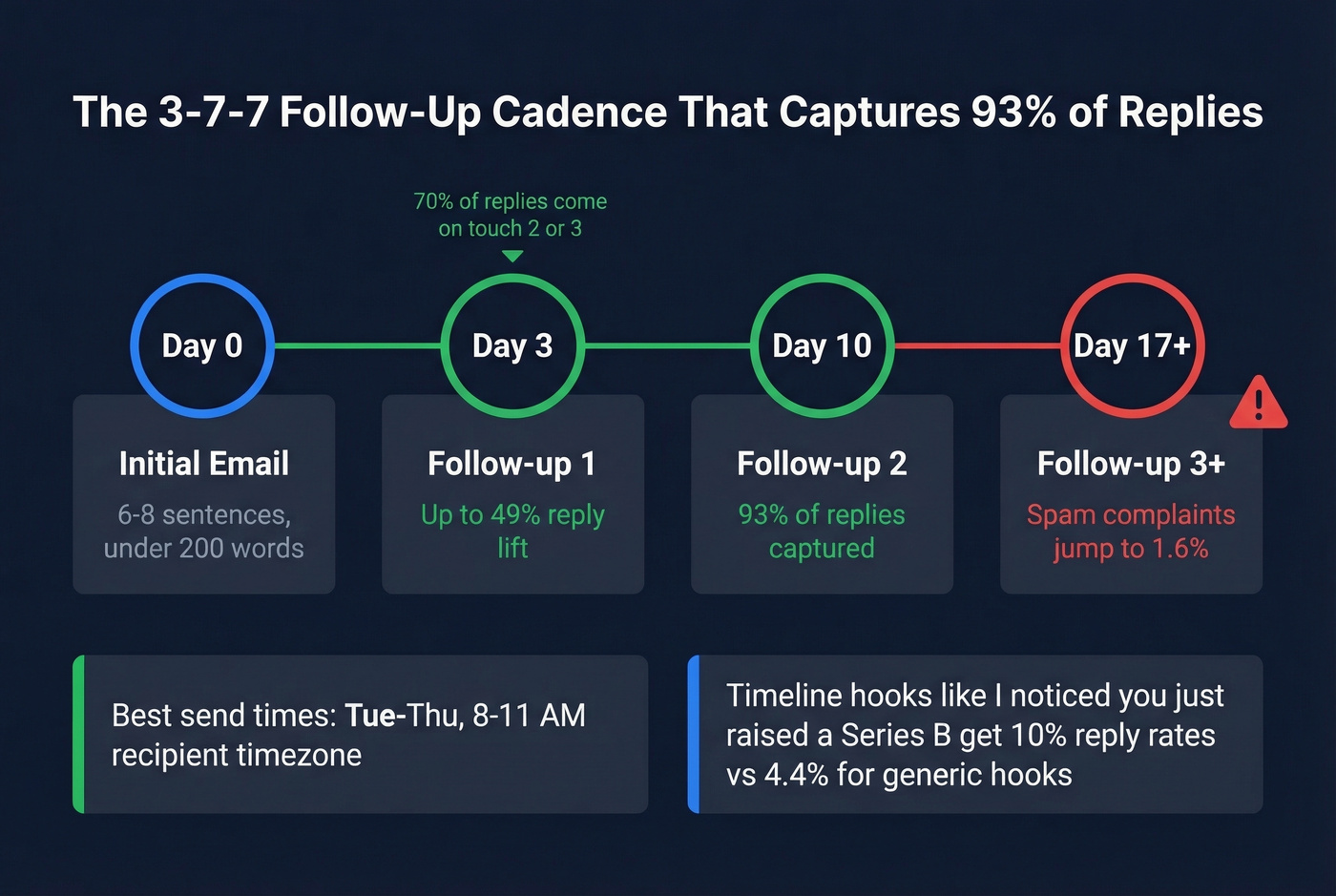
Hook type matters more than you'd think. Timeline-based hooks like "I noticed you just raised a Series B" or "since you expanded into EMEA last quarter" average 10.01% reply rates versus 4.39% for generic problem hooks. That's a 2.3x gap from the opening line alone, and it holds across verticals: Consulting (10.67%), SaaS (9.91%), Healthcare (10.21%), Financial Services (9.26%). If you want more frameworks beyond hooks, start with cold email sequence structure.
Keep it short. The best-performing emails run 6-8 sentences, under 200 words. One founder cut from 141 words to under 56 and saw immediate improvement. The instinct to explain more is almost always wrong - your prospect doesn't owe you their attention, and every extra sentence is a reason to stop reading. If you're still iterating on messaging, use proven cold email subject line examples and tighten your email copywriting fundamentals.
Follow up, but don't overdo it. The first follow-up lifts replies significantly: the 16.5M-email study found up to 49%, while Backlinko's broader outreach study found up to 65.8%. In one founder's campaign, roughly 70% of replies came on touch #2 or #3. A 3-7-7 day cadence (first follow-up at day 3, second at day 10) captures 93% of replies by Day 10. By the fourth email, spam complaints jump from 0.5% to 1.6% and you're actively hurting yourself. If you need plug-and-play language, keep a set of follow-up templates ready.
Personalization does help - +30.5% with personalized subject lines, +32.7% with personalized bodies - but it's the third lever, not the first. If half your emails never reach the inbox, no subject line saves you. One founder reported +16% opens after switching to Tuesday-Thursday sends in the 8-11 AM window (recipient's timezone), with 8-11 PM also showing strong performance. For enterprise targets where email alone isn't cutting it, adding multichannel touches can lift reply rates around 25%. If you're testing send windows, use a dedicated best time to send cold emails plan.
Diagnostic: Find Your Bottleneck
Most teams don't know why their reply rate is what it is. Use this to diagnose before you optimize.
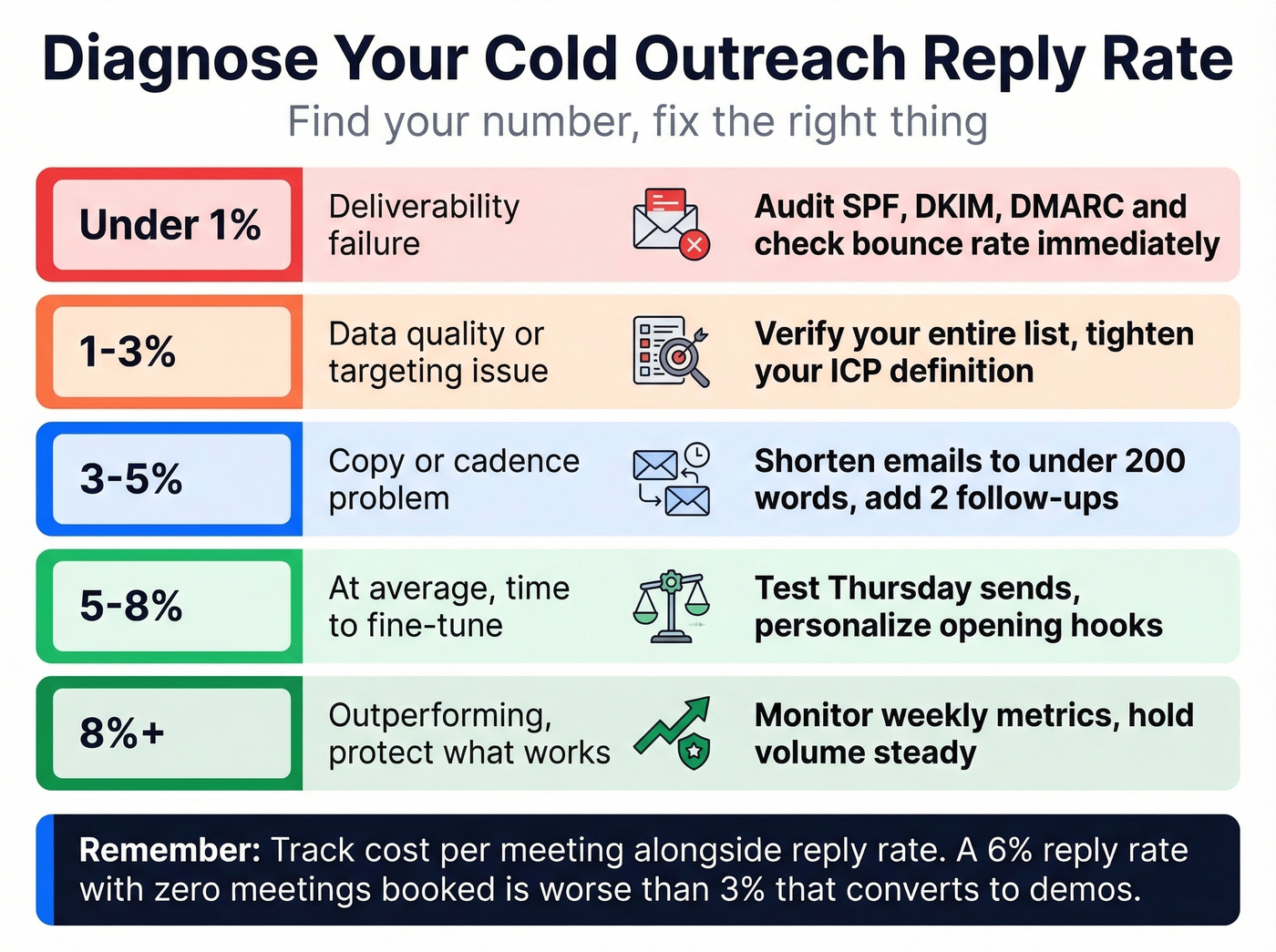
| Your Reply Rate | Likely Problem | First Fix |
|---|---|---|
| <1% | Deliverability failure | Audit authentication + bounce rate |
| 1-3% | Data quality or targeting | Verify list, tighten ICP |
| 3-5% | Copy or cadence issues | Shorten emails, add follow-ups |
| 5-8% | At average - fine-tune | Test Thursday sends, personalize hooks |
| 8%+ | Outperforming - protect it | Monitor weekly, hold volume steady |
Reply rate alone doesn't tell you enough. Track cost per meeting and time-to-first-meeting alongside it - a 6% reply rate that converts to zero meetings is worse than a 3% rate that books demos. If you want to tie outreach performance to pipeline outcomes, track lead generation metrics alongside reply rate.
The single most common mistake we see: teams at 1-2% reply rates rewriting their emails for the fifth time when their bounce rate is 8%. Fix the foundation first. The copy can wait.
FAQ
What's a good cold outreach response rate in 2026?
5-8% raw reply rate is solid for targeted B2B cold email. Above 8% means your targeting and infrastructure are dialed in. Below 3% signals a structural problem - usually data quality or deliverability. Positive reply rate (excluding "not interested") runs roughly 40-60% of raw reply rate.
How many follow-ups should I send?
Two to three. The first follow-up lifts replies up to 49%, but by the fourth email spam complaints jump from 0.5% to 1.6%. A 3-7-7 day cadence captures 93% of replies by Day 10. More touches past three hurt more than they help.
Does personalization actually improve reply rates?
Yes, but less than fixing your data and deliverability. Personalized subject lines boost replies 30.5% and personalized bodies 32.7%. That matters - but if half your emails never reach the inbox because of bad data or missing authentication, no amount of personalization saves you. Clean data first, then personalize.