

Email Prospecting in 2026: Infrastructure, Copy, and Cadence
One practitioner sent 17 million cold emails in 2024 and concluded that short, plain-text messages to groups of 20-50 people crushed every mass blast they'd ever tried. That's email prospecting right now: the channel works, but the playbook has completely flipped. Infrastructure and targeting matter more than subject lines - and most teams still get this backwards.
What Is Email Prospecting?
Email prospecting is sending targeted, one-to-one emails to potential buyers who haven't opted in to hear from you. It's how outbound sales teams start conversations with decision-makers who don't know they exist yet.
Don't confuse it with email marketing. Marketing emails go to opted-in subscribers, hit 35%+ average open rates, and live inside platforms like Mailchimp. Cold prospecting emails go to strangers, land 15-28% opens, and succeed or fail based on deliverability infrastructure and list quality - not design or branding. 80% of buyers prefer email as the initial contact method. The channel isn't dead. Lazy, spray-and-pray outreach is dead.
The teams getting 8-15% reply rates are running tight lists, authenticated domains, and plain-text messages that read like a colleague wrote them.
The Three Things That Actually Matter
- Fix your infrastructure first. SPF, DKIM, DMARC, a secondary sending domain, and a 4-6 week warmup. This matters more than your subject line.
- Build a verified list before you write a single email. Bad data is one of the biggest reasons prospecting fails.
- Send plain-text emails to micro-segments of 50 contacts or fewer. Not mass blasts to thousands. Micro-segmentation lifts reply rates by 2.76x.
Get those three right and you're ahead of 90% of outbound teams.
B2B Prospecting Benchmarks
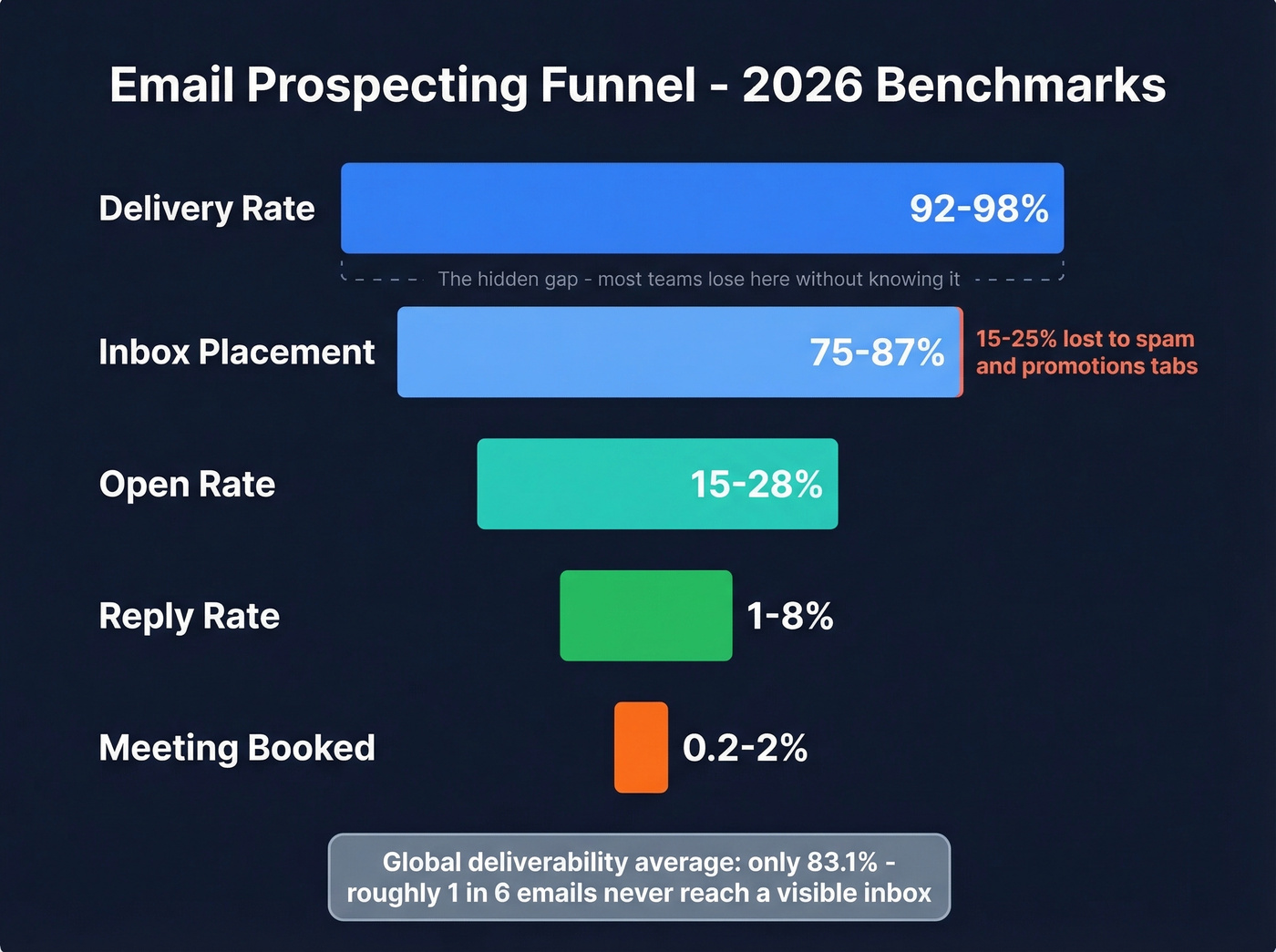
Cold outreach has its own funnel, and every stage leaks. Here's what the 2026 waterfall looks like:
| Stage | Range |
|---|---|
| Delivery rate | 92-98% |
| Inbox placement | 75-87% |
| Open rate | 15-28% |
| Reply rate | 1-8% |
| Meeting booked | 0.2-2% |
The gap between "delivery" and "inbox placement" is where most teams lose without realizing it. Your ESP says 96% delivered - but 15-25% of those land in spam or promotions tabs. Global deliverability averages just 83.1%, meaning roughly 1 in 6 emails never reaches a visible inbox.
Provider-level placement varies too. Google sits at 87.2%, Yahoo at 86%, and Outlook at 75.6%. If your prospect list skews toward corporate Outlook domains, expect tighter margins.
Build a Clean, Verified List
Every deliverability problem traces back to list quality. We've seen teams with perfect authentication and great copy still land in spam because too many emails bounced on the first send. That bounce rate poisons your domain reputation, and recovery takes weeks.
Start with your ICP definition. Nail down the job titles, company sizes, industries, and signals - hiring, funding, tech stack - that define your buyer. Sourcing contacts without an ICP is just collecting names. (If you need a framework, use an Ideal Customer Profile template to score accounts consistently.)
For sourcing and verification, Prospeo covers 143M+ verified emails across 300M+ professional profiles, all refreshed on a 7-day cycle. The 5-step verification process handles catch-all domains, strips spam traps, and filters honeypots, which is why accuracy runs at 98%. You can search by 30+ filters including buyer intent, technographics, and job changes, then push leads directly into tools like Smartlead, Instantly, or Lemlist.
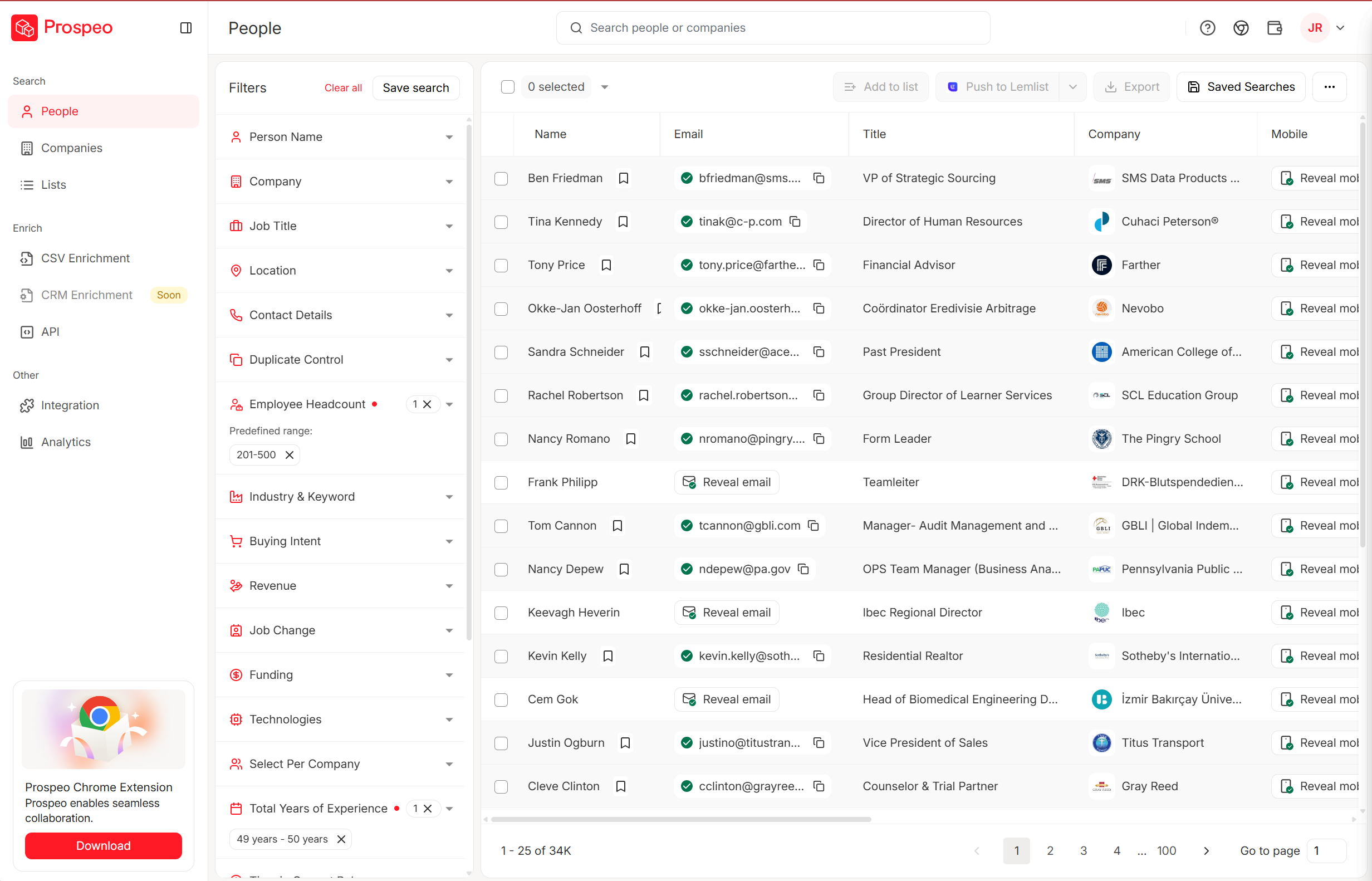
The results back this up. Meritt dropped their bounce rate from 35% to under 4% after switching, and Snyk - with 50 AEs prospecting daily - went from 35-40% bounces to under 5% while growing AE-sourced pipeline 180%.
One tip from practitioners on r/salesdevelopment: run your list through two verifiers minimum. Your primary data tool plus a secondary safety net like Kickbox. The cost of double-verifying is trivial compared to the cost of a burned domain. (More on bounce thresholds and fixes in our email bounce rate guide.)

Your infrastructure is perfect and your copy is sharp - but none of it matters if 35% of your emails bounce. Prospeo's 5-step verification catches spam traps, honeypots, and catch-all domains before they torch your sender reputation. 98% email accuracy at $0.01/lead.
Stop burning domains. Start with verified data.
Set Up Deliverability Infrastructure
Even with verified data, broken sending infrastructure will land you in spam. (If you want the full checklist, see our email deliverability guide.)
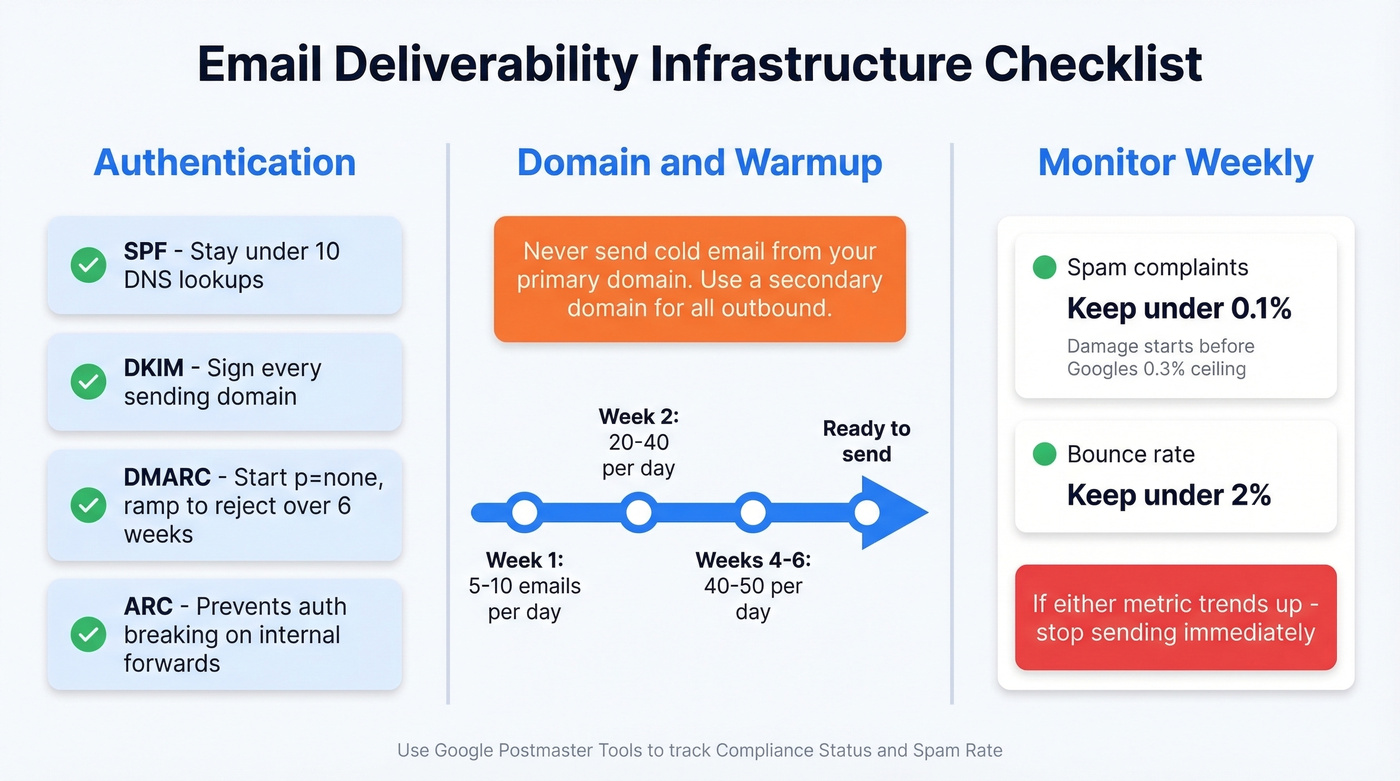
Authentication is non-negotiable. Set up SPF, DKIM, and DMARC on every sending domain. SPF has a 10 DNS lookup limit - exceed it and authentication silently fails. ARC (Authenticated Received Chain) is worth configuring too, since it prevents authentication from breaking when emails get forwarded internally at your prospect's company.
For DMARC, start with p=none for 2-3 weeks to monitor, then ramp quarantine at 25% to 50% to 100%, and finally move to p=reject once all legitimate sources pass. Since Gmail and Yahoo's February 2024 enforcement and Microsoft's early-2025 rollout, senders hitting 5,000+ emails per day without proper authentication face SMTP rejections. RFC 8058 one-click unsubscribe is also required for bulk senders. (If you're troubleshooting policy and alignment, see DMARC alignment.)
Use a secondary domain for all outbound. Never send cold email from your primary domain. Period. If something goes wrong, your primary domain's reputation stays clean.
Warmup properly. Start new domains at 5-10 emails per day. Ramp to 20-40/day by week two, then 40-50/day by weeks four through six. Set up a custom tracking domain via CNAME to isolate your reputation from shared tracking infrastructure. (Related: email velocity and what counts as “safe speed.”)
Monitor weekly. Google Postmaster Tools is your dashboard - watch the Compliance Status and Spam Rate tabs. Keep spam complaints under 0.1% (damage starts well before Google's 0.3% ceiling) and bounce rate under 2%. If either metric trends up, stop sending immediately. (To remediate, use this playbook on how to improve sender reputation.)
The article says it: micro-segments of 50 contacts crush mass blasts. Prospeo's 30+ filters - buyer intent, technographics, job changes, funding - let you build those tight segments in minutes, not hours. Snyk's 50 AEs grew pipeline 180% because every email hit a real inbox.
Build laser-targeted prospect lists that actually convert.
Write Emails That Get Replies
Here's the thing: pretty, branded HTML emails are over for cold outbound. The consensus across every practitioner community we follow is clear. Plain text wins. Short wins. Relevant wins. (If you want a deeper framework, see our guide to email copywriting.)
Keep every prospecting email under 100 words. Subject lines should stay under 50 characters. Aim for about 20% of your email body to be personalized - a specific reference to the prospect's company, role, or a recent trigger event. Generic "I noticed your company..." openers get archived instantly. (Need options? Use these cold email subject line examples.)
Avoid spam-trigger words and phrases like "act now," "limited time," "free consultation," "guaranteed," and "click here." Even "Dear" as a salutation flags some filters. Write like you're emailing a colleague, not writing ad copy.
One unconventional tactic that works: CC a second stakeholder at the prospect's company. It signals you've done your research and creates social pressure to respond.
Schedule sends for 6-7am in the prospect's time zone so you're at the top of their inbox when they start their day. Video prospecting - short, under-90-second clips where you say the prospect's name - drives 8x open-to-reply rates compared to text-only emails, though it doesn't scale as easily.
A Template That Works
Subject: Quick question about [specific initiative]
Hi [First Name],
Saw [Company] just [trigger event - hiring, funding, product launch]. When teams hit that stage, [specific problem] usually becomes a bottleneck.
We helped [similar company] [specific result] in [timeframe]. Worth a 15-min call to see if it applies?
[Your name]
Every email gets a single, clear CTA. Not two options. Not a link to a resource plus a meeting request. One ask.
Design a Multi-Touch Cadence
A single email isn't a strategy. Six to eight touchpoints across email, phone, and social over 2-3 weeks is the sweet spot:
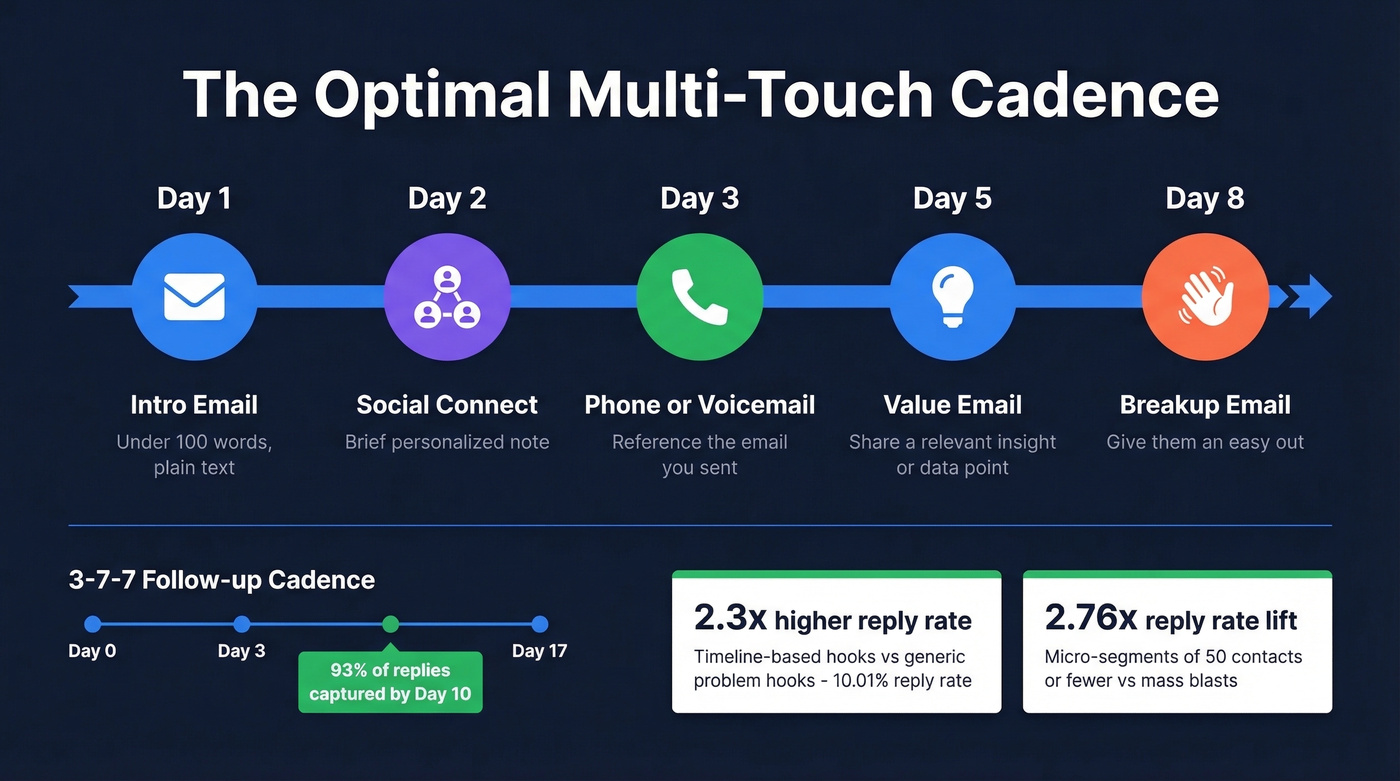
- Day 1: Intro email, under 100 words, plain text
- Day 2: Social connection request with a brief note
- Day 3: Phone call or voicemail referencing the email
- Day 5: Value email - share a relevant insight or data point
- Day 8: Breakup email - give them an easy out
The 3-7-7 follow-up cadence (Day 0, Day 3, Day 10, Day 17) captures 93% of replies by Day 10. After that, you're chasing diminishing returns. (If you want plug-and-play copy, use these cold email follow-up templates.)
Two stats worth building your entire strategy around: timeline-based hooks ("We're reaching out because [event] just happened") average a 10.01% reply rate and 2.34% meeting rate - roughly 2.3x higher than generic problem-based hooks. And micro-segmentation into cohorts of 50 contacts or fewer lifts reply rates by 2.76x. That's not marginal. That's the difference between a pipeline that works and one that doesn't.
Let's be honest about deal size too. If you're closing deals under $10k, you probably don't need a $40k/year data platform or a 15-step sequence. A verified list of 200 ideal-fit accounts, a tight 5-touch cadence, and a compelling reason to reach out will outperform the enterprise playbook every time. Outbound isn't about scale - it's about precision.
Mistakes That Kill Results
The most common failures aren't copywriting problems - they're infrastructure problems. Not warming your sending accounts before going live tops the list, followed closely by using your primary domain for outbound and skipping list verification.
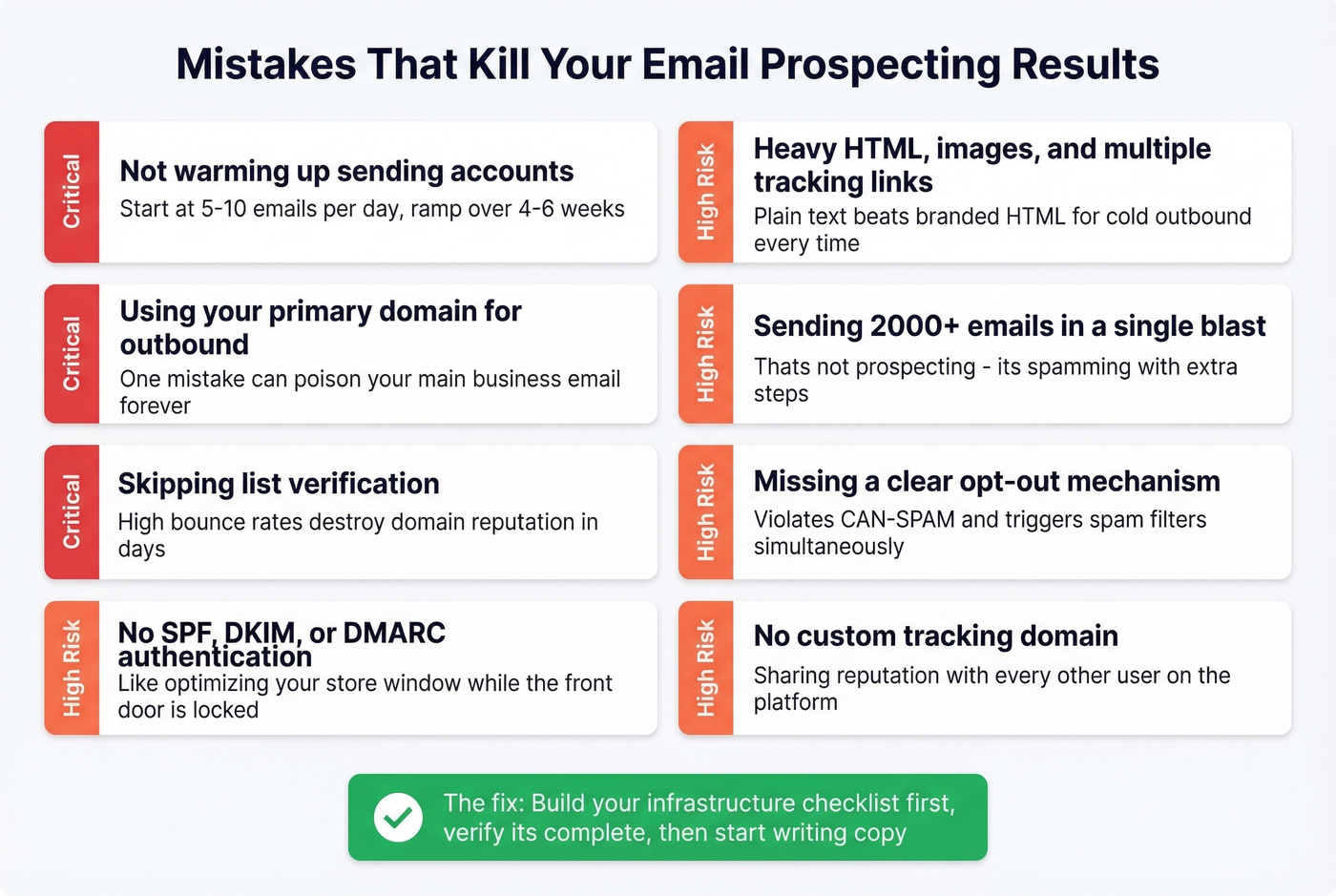
We see teams obsess over subject line A/B tests while sending from unauthenticated domains with no SPF, DKIM, or DMARC records. That's like optimizing your store's window display while the front door is locked. It's genuinely frustrating to watch, because the fix is so straightforward.
Heavy HTML, images, and multiple tracking links trigger spam filters. So does sending 2,000+ emails in a single campaign blast - that's not prospecting, it's spamming with extra steps. Missing a clear opt-out mechanism violates CAN-SPAM and acts as a spam trigger simultaneously. And skipping a custom tracking domain means you're sharing reputation with every other user on the platform. (If you suspect list poisoning, start with spam trap removal.)
The fix: build your infrastructure checklist, verify it's complete, and only then start writing copy.
Tools and Pricing for 2026
Your outbound stack breaks into three layers: data and verification, sending, and monitoring. (If you’re comparing categories, here are the best SDR tools for 2026.)
| Tool | From | G2 | Best For |
|---|---|---|---|
| Instantly | $30/mo | 4.9/5 | Sending + warmup |
| Smartlead | $39/mo | 4.6/5 | Inbox rotation |
| Lemlist | $55/mo | 4.4/5 | Visual personalization |
| Saleshandy | $25/mo | 4.5/5 | Budget-friendly teams |
| Reply.io | $60/mo | 4.6/5 | Multi-channel sequences |
| Woodpecker | $49/mo | 4.5/5 | Agency sending |
| Mailshake | $44/mo | 4.3/5 | Non-technical teams |
| Klenty | $50/mo | 4.3/5 | CRM-heavy workflows |
| QuickMail | $49/mo | 4.5/5 | Deliverability focus |
| La Growth Machine | ~EUR50/mo | 4.7/5 | Social + email combos |
Instantly is the best pure sending tool at this price point. Unlimited email accounts, built-in warmup, and a clean UI that doesn't require a PhD to configure. Smartlead edges ahead for teams managing multiple inboxes - its rotation engine distributes sends across accounts automatically, which matters once you're running 5+ sending domains.
Teams already running outreach through HubSpot can connect most of these tools via native integrations or Zapier, keeping their CRM as the single source of truth while offloading cold sends to a dedicated platform.
On Reddit, practitioners also recommend ReachInbox for deliverability-focused sending and Kickbox as a standalone verification layer. Both are worth evaluating if you want alternatives to the mainstream stack.
The budget stack that actually works: Prospeo + Instantly + Google Postmaster Tools. That's around $30-80/mo total and covers sourcing, verification, sending, warmup, and monitoring. Skip this section if you've already got a working stack - don't fix what isn't broken.
Compliance: CAN-SPAM, GDPR, CASL
CAN-SPAM (US)
CAN-SPAM applies to all commercial messages - there's no B2B exemption. Penalties run up to $53,088 per violating email. Requirements: no misleading headers, include a valid physical postal address, provide a clear opt-out mechanism, and honor opt-outs within 10 business days. You're liable even if a third party sends on your behalf.
GDPR (EU/UK)
B2B cold email under GDPR relies on Article 6(1)(f) - legitimate interest. You need a documented Legitimate Interest Assessment covering purpose, necessity, and balancing tests. In the UK, PECR Regulation 22 treats B2B and B2C identically - don't assume corporate emails get a free pass.
CASL (Canada)
CASL requires express or implied consent. Implied consent covers existing business relationships within the past 24 months or conspicuously published email addresses where your message relates to the recipient's role.
Email Prospecting FAQ
Is email prospecting still effective in 2026?
Yes. Plain-text emails to micro-segments with proper authentication outperform mass blasts by a wide margin. Top performers hit 15-25% reply rates using tight targeting, verified data, and multi-touch cadences across email, phone, and social.
How many follow-ups should I send?
Six to eight touchpoints over 2-3 weeks, mixing email with phone and social. The 3-7-7 cadence captures 93% of replies by Day 10 - anything beyond that yields diminishing returns.
What's a good open rate for cold emails?
15-28% is the realistic range for cold outbound. Don't compare to marketing benchmarks (35%+) - those go to opted-in subscribers with established sender reputation. Different game entirely.
How do I keep prospecting emails out of spam?
Set up SPF, DKIM, and DMARC on a secondary domain. Warm it over 4-6 weeks. Verify your list to keep bounces under 4% and spam complaints below 0.1%. Use a custom tracking domain to isolate reputation.
What's a good free tool for finding prospect emails?
Prospeo offers 75 free verified emails per month plus 100 Chrome extension credits - enough to test a real campaign. For small teams running actual outbound, that free tier covers more ground than most alternatives at the same price (free).