

The McKinsey Go-to-Market Framework: What They Actually Published (and How to Use It)
Your VP of Sales forwarded a McKinsey article and asked you to "build something like this" by Friday. You went looking for a McKinsey go-to-market framework and found a solutions landing page, a GE Matrix explainer, and a dozen articles that say "McKinsey" without citing a single McKinsey publication.
Here's the frustrating part: McKinsey has published real, data-backed GTM research across three major pieces from 2020 to 2023, but nobody stitches them together. The typical company grew 2.8% per year in the decade before COVID. Only 1 in 8 exceeded 10%, and only 1 in 3 top-quartile growers sustained that rate over the next five years. We read all three publications, pulled the benchmarks, and built the synthesized framework your VP actually wants.
The McKinsey GTM Framework in 30 Seconds
The synthesized five-step model, drawn from three McKinsey publications:
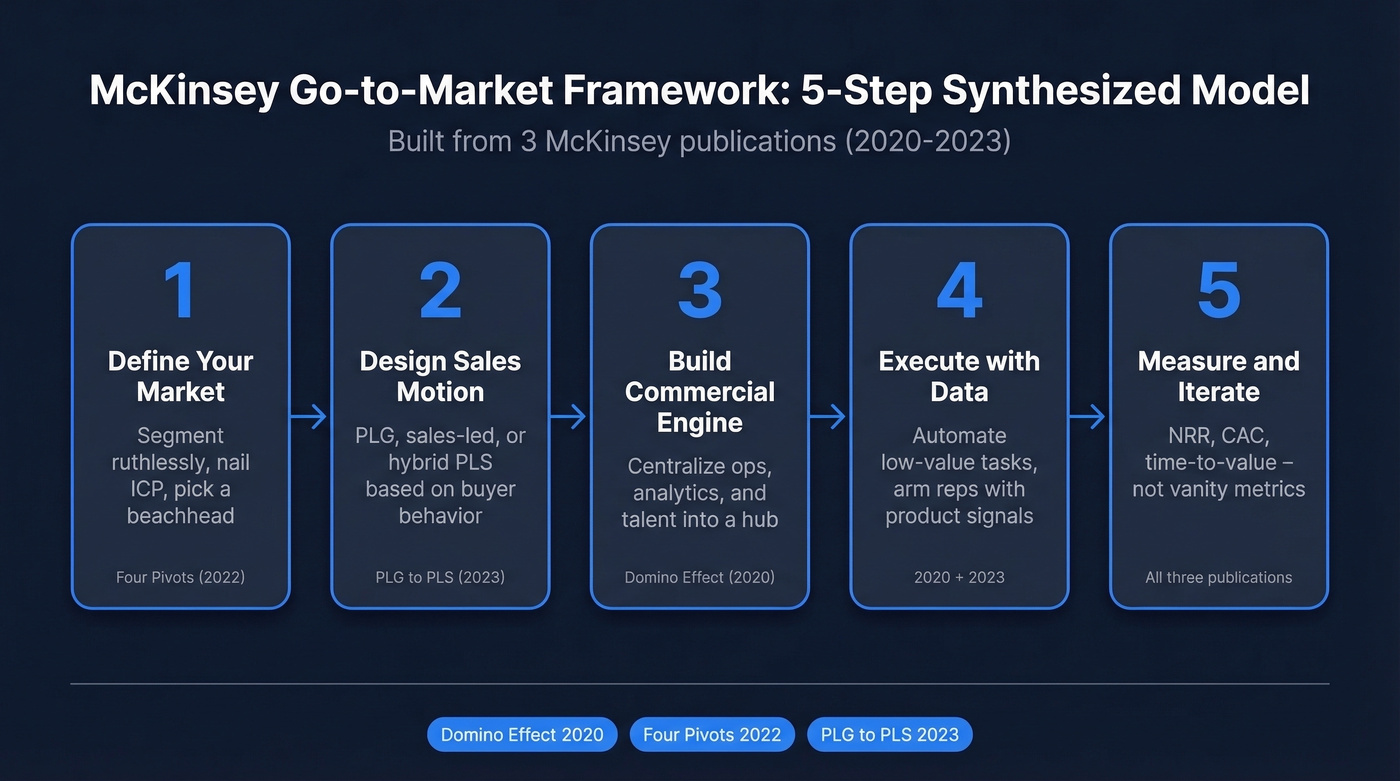
- Define your market - segment ruthlessly, nail your ICP, pick a beachhead (2022: Four Pivots)
- Design your sales motion - PLG, sales-led, or hybrid PLS based on buyer behavior (2023: PLG to PLS)
- Build the commercial engine - centralize ops, analytics, and talent into a hub (2020: Domino Effect)
- Execute with data - automate low-value tasks, arm reps with product and usage signals (2020 + 2023)
- Measure and iterate - NRR, CAC, time-to-value, not vanity metrics (all three publications)
Below, we cite the actual McKinsey publications behind each step - with the benchmarks nobody else includes.
What McKinsey Actually Published on GTM
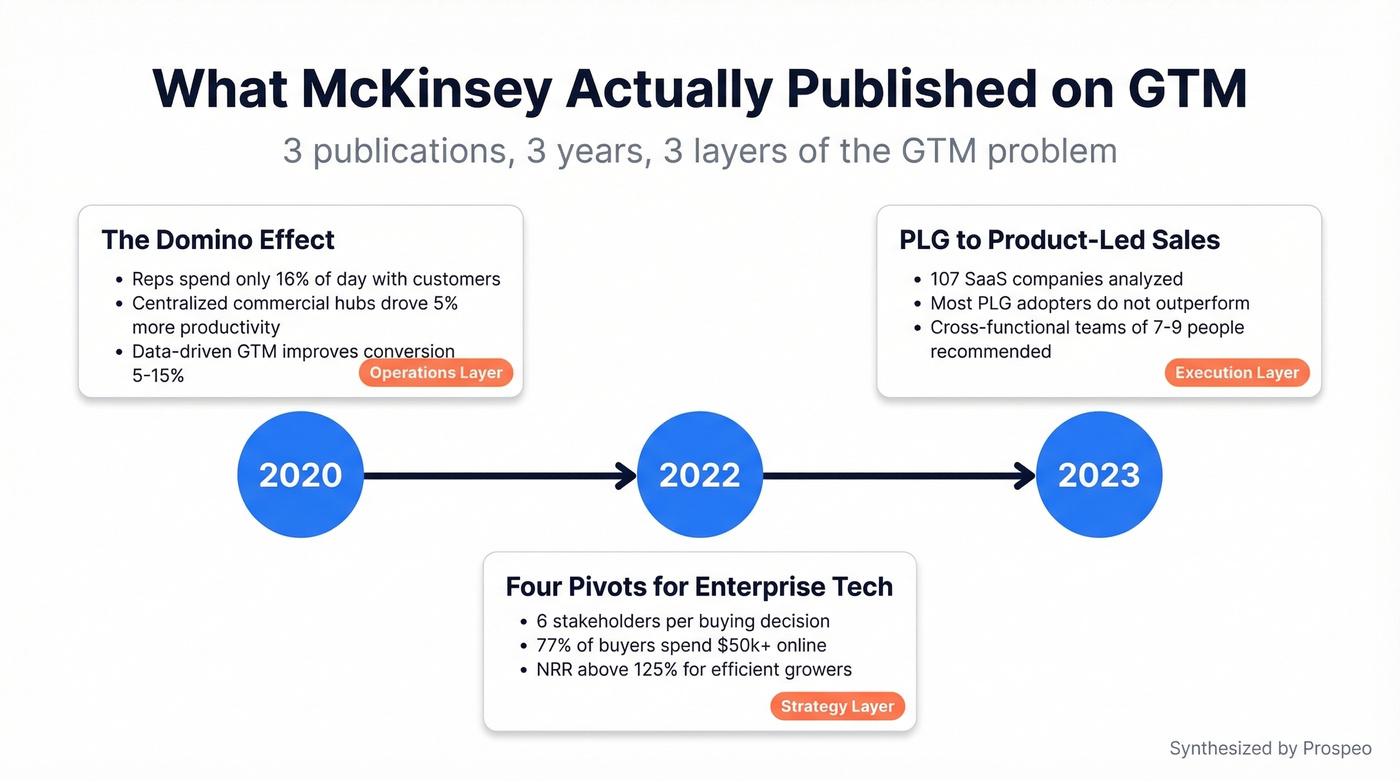
McKinsey's GTM guidance lives across multiple articles rather than one downloadable PDF. Three distinct pieces across three years, each tackling a different layer of the go-to-market problem. BCG, Bain, and Deloitte have each weighed in on go-to-market strategy too, but McKinsey's publications are the most data-rich and operationally specific.
The "Domino Effect" (2020)
McKinsey's Domino Effect article frames GTM reinvention as a four-step chain reaction: centralize commercial operations, enable an agile GTM model, automate sales processes, reskill the front line. Each domino triggers the next.
Top sales innovators who embedded data and tech throughout their orgs delivered double-digit ROI gains. One software company that centralized a commercial hub - combining sales, analytics, data science, and product talent - saw 5% more productivity and greater bookings within the first year. Across the board, McKinsey found agile, data-driven GTM can improve conversion rates and lower cost to serve by 5-15%.
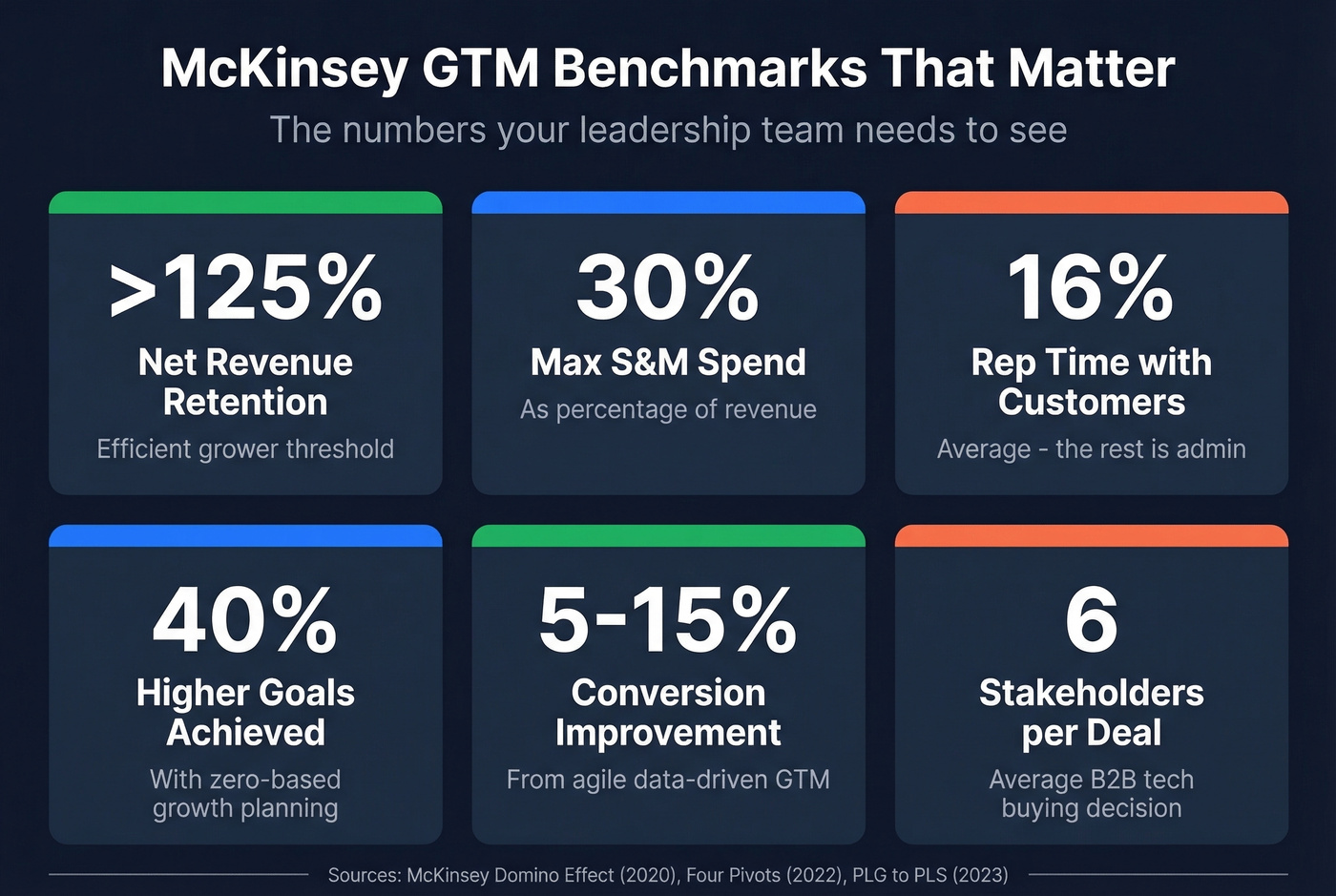
The stat that should haunt every RevOps leader: in the average company, reps spend 16% of their day in front of the customer. Sixteen percent. The rest is admin, data entry, and searching for information. The entire domino effect is about reclaiming that time.
The "Four Pivots" for Enterprise Tech (2022)
McKinsey's enterprise tech GTM piece identifies four pivots every B2B tech company needs:
- Reimagine sales coverage - shift from volume-based territories to transformation-led expertise paired with digital and product-led disruption.
- Make every marketer a seller (and vice versa) - personalization at depth and scale through omnichannel execution. 71% of consumers expect personalized interactions, and three-quarters will switch brands if they don't like their experience.
- Shift channels from scale to expertise - specialized partner ecosystems and digital-direct marketplaces replace generic reseller networks.
- Embrace a lifecycle approach - customer success becomes a growth engine, not a cost center.
The buying-side benchmarks are striking. Six stakeholders are involved in the average tech buying decision. 77% of buyers will spend $50k+ online; 35% will spend $500k+ online. Customer experience ranks as the second most important buying factor - above both price and brand.
For SaaS specifically, McKinsey analyzed 60 top performers and defined "efficient grower" benchmarks: NRR above 125%, S&M spend at or below 30% of revenue, and more than 15% of growth from new customers.
Most PLG Adopters Don't Outperform (2023)
McKinsey's PLG reality check is the most contrarian of the three. They analyzed 107 publicly listed B2B SaaS companies and found that most PLG adopters don't actually outperform. The winners run a product-led sales (PLS) hybrid - using product signals and usage analytics to qualify accounts (product qualified accounts, or PQAs), then layering a sales motion on top.
McKinsey recommends cross-functional growth teams of 7-9 people: product managers, data scientists, demand gen, content, designers, and marketing strategists. Pure PLG without a sales overlay leaves enterprise revenue on the table. Pure sales-led without product data leaves reps flying blind.
Let's be honest: if your average contract value sits below $15k and you're running a pure sales-led motion in 2026, you're overspending. Layer product signals into your pipeline before you hire another SDR.
How McKinsey Compares to BCG, Bain, and HBR
BCG's approach centers around "commercial excellence" - optimizing pricing, channel mix, and salesforce effectiveness as an integrated system. Where McKinsey starts with market definition and works outward, BCG tends to start with the commercial model and optimize inward.
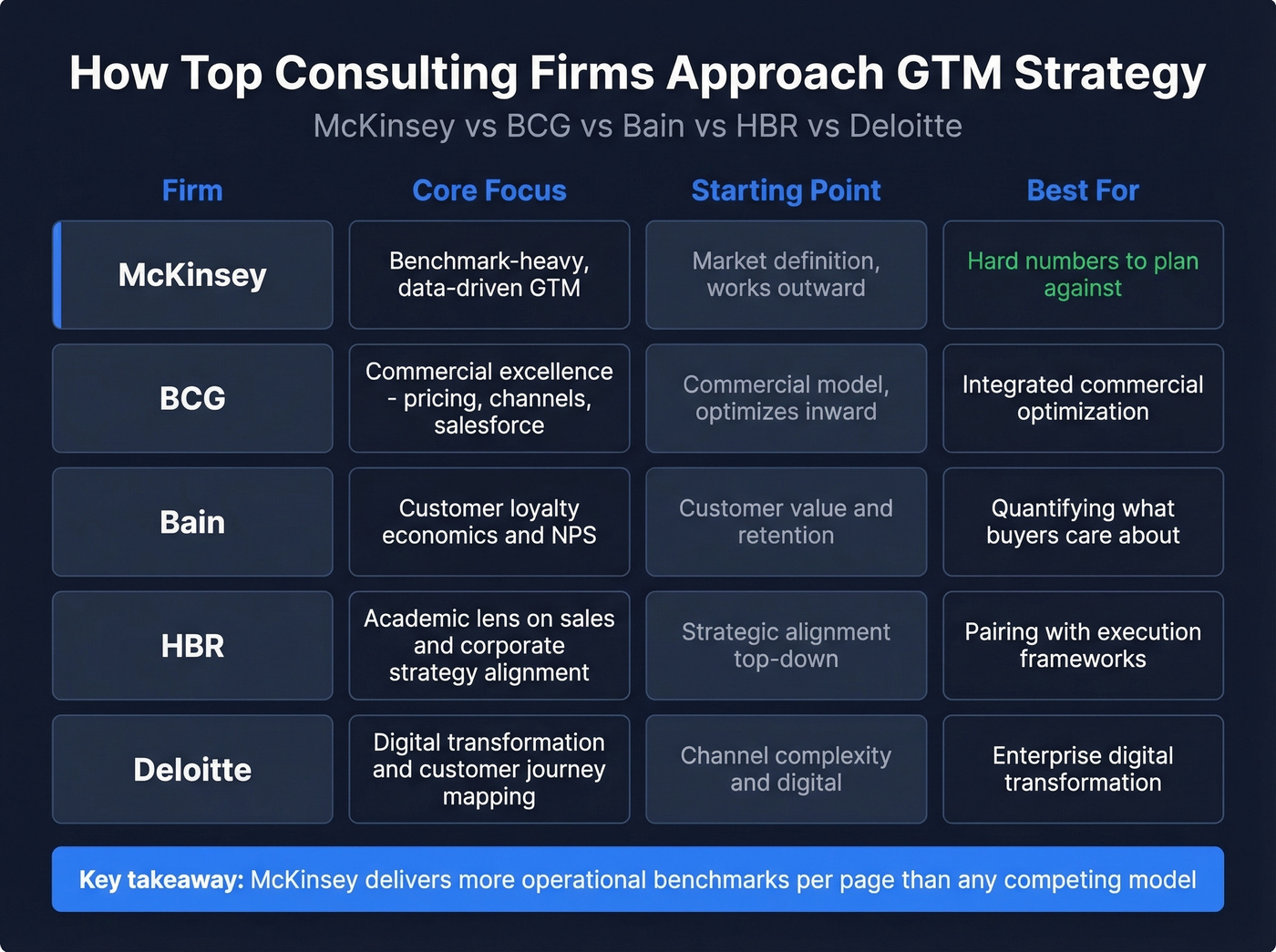
Bain focuses heavily on customer loyalty economics and NPS as leading indicators of GTM health. Their "Elements of Value" research complements McKinsey's lifecycle pivot by quantifying what buyers actually care about beyond product features. HBR takes a more academic lens - particularly Frank Cespedes' work on aligning sales strategy with corporate strategy, which pairs well with McKinsey's data-driven execution layer.
Deloitte's work leans toward digital transformation and customer journey mapping for enterprise organizations navigating channel complexity.
The key difference: McKinsey's publications are the most benchmark-heavy. If your leadership team wants a consulting-grade framework because they want hard numbers to plan against, that instinct is correct - the three publications above deliver more operational benchmarks per page than any competing model we've found.

McKinsey's domino effect starts with centralizing data and arming reps with signals. Prospeo gives you 300M+ profiles with 30+ filters - buyer intent, technographics, job changes, funding - so your GTM engine runs on the benchmarks McKinsey actually recommends.
Stop planning frameworks and start executing with data that's refreshed every 7 days.
GTM Framework Benchmarks for 2026
Here's where McKinsey's data meets 2026 operational reality:
| Metric | McKinsey Benchmark | 2026 Operational Reality |
|---|---|---|
| NRR | >125% (efficient growers) | >120% median top quartile |
| S&M spend | ≤30% of revenue | Industry median 35-40% |
| New customer growth | >15% of total growth | 10-20% for Series B+ |
| Lead-to-deal time | 0-20% reduction via GTM optimization | Still the biggest RevOps bottleneck |
| GTM channels | Expertise-led, not volume-based | ~5 core + 5.5 experimental |
| Cold email reply rate | - | Declined from 6.8% to 5.8% |
| PLG activation | - | >65% (top) vs 33% (avg) |
Two more McKinsey data points worth pinning to your wall. Companies using zero-based growth planning - building targets from scratch rather than adding 10% to last year - set and meet goals 40% higher than traditional strategies produce. And every 5 percentage points of additional revenue growth per year correlates with 3-4 percentage points of additional total shareholder return. Over a decade, that's 33-45% higher market cap.
Five GTM Mistakes the Framework Prevents
Targeting too broadly. McKinsey's Four Pivots explicitly calls for expertise-led coverage, not spray-and-pray territories. Define your ICP through proper market segmentation. Pick a beachhead. Dominate it. Expand from there.
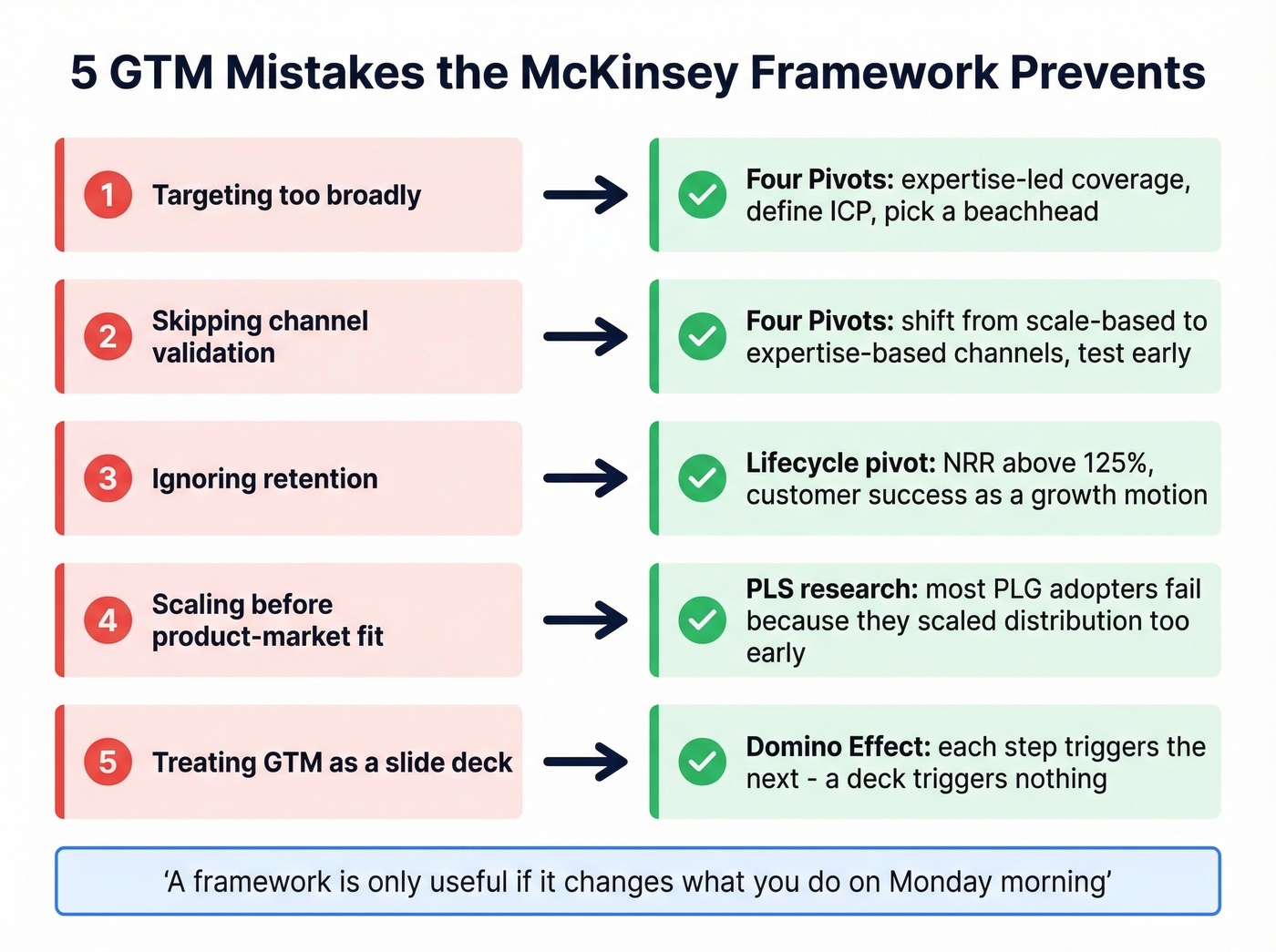
Skipping channel validation. The Four Pivots framework demands a shift from scale-based channels to expertise-based ones. Test channels early - don't assume what worked at your last company works here.
Ignoring retention. McKinsey's lifecycle pivot and NRR >125% benchmark exist because acquisition-only GTM is a leaky bucket. Customer success isn't a department - it's a growth motion. BCG's research reinforces this; both firms independently arrived at retention as the highest-leverage GTM lever.
Scaling before product-market fit. McKinsey's PLS research found that most PLG adopters don't outperform precisely because they scaled distribution before the product earned it. This is the most expensive mistake on the list.
Treating GTM as a deck. The blunt takeaway from r/SaaS is that GTM isn't a PDF. It's an executable system with explicit goals - revenue, market share, CAC targets - that produces campaigns, not slides. McKinsey's domino effect reinforces this: each step triggers the next. A deck doesn't trigger anything.
From Framework to Pipeline
A framework that stops at the slide deck stops working. Every GTM plan needs to answer four questions before anything else: What exact problem are we solving? Who needs it, and how big is that market? Why are we better than the alternatives? How will prospects find us?
The metrics that matter are CAC, LTV, NRR, and time-to-value. Not MQLs. Not "pipeline created." Real revenue efficiency metrics.

None of this works if your contact data is bad. McKinsey's own stat - reps spend 16% of their day with customers - gets worse when a chunk of your outbound bounces or hits dead numbers. We've seen teams build beautiful GTM strategies that collapse at the "reach the prospect" step because their data was stale. Data quality is the foundation the entire commercial engine sits on, and tools like Prospeo exist specifically for this layer: 98% email accuracy on a 7-day refresh cycle, 143M+ verified emails, and intent data across 15,000 Bombora topics so you're targeting accounts that are actually in-market.
If you're tightening outbound performance, start with sales prospecting techniques and then fix the plumbing: data enrichment, lead scoring, and pipeline health.
McKinsey's PLS model requires product and usage signals to qualify accounts. But your sales layer still needs verified contact data. Prospeo delivers 98% email accuracy and 125M+ verified mobiles at $0.01/lead - 90% cheaper than ZoomInfo - so your cross-functional growth team converts PQAs into pipeline, not bounces.
Teams using Prospeo book 26% more meetings than ZoomInfo users.
FAQ
What is the McKinsey go-to-market framework?
It's a synthesized five-step model from three McKinsey publications (2020-2023): define your market, design your sales motion, build a centralized commercial engine, execute with data, and measure with revenue-efficiency metrics like NRR and CAC. McKinsey never published a single downloadable template - you have to stitch together insights from the Domino Effect, Four Pivots, and PLG-to-PLS articles.
How does McKinsey's GTM approach differ from HBR's?
HBR's go-to-market writing focuses on strategic positioning and competitive advantage at a conceptual level. McKinsey's framework is more prescriptive, giving specific targets like NRR >125% and S&M spend ≤30% of revenue. Use HBR for strategic framing and McKinsey for operational execution with hard benchmarks.
Why do most go-to-market strategies fail?
Teams target too broadly, skip channel validation, and treat GTM as a static slide deck rather than an executable system. McKinsey's research shows agile, data-driven GTM can improve conversion 5-15%, but most companies never operationalize their strategy - reps still spend only 16% of their day selling.
What tools support McKinsey-style GTM execution?
You need a CRM for pipeline management, intent data for timing outreach, and verified contact data for outbound. The commercial engine McKinsey describes falls apart without accurate data feeding it - bounce rates above 5% erode domain reputation and kill deliverability, which is why data freshness and verification matter more than database size.