

What Is a Go-to-Market Strategist? The Definitive Role Guide
Your CEO just told the board you'll 3x pipeline next quarter. Marketing thinks it's a messaging problem. Sales says the leads are garbage. Product wants to launch a new tier. CS is drowning in churn from customers who never should've been sold in the first place - and nobody owns the system connecting all of it.
That's the gap a go-to-market strategist fills. Not as a project manager, not as a product marketer with a shinier title, but as the person who turns disconnected departmental efforts into a repeatable revenue engine. A lot of companies that try to launch without real GTM ownership end up stalling out, burning cash on motions that don't compound.
Most explanations of this role are either ebook pitches or generic strategy overviews that never explain what the person actually does on a Monday morning. Let's fix that.
The Short Version
A GTM strategist owns the entire revenue system - not just messaging, not just pipeline. They're the person who orchestrates product, marketing, sales, and customer success into a repeatable engine for finding, winning, and keeping customers. Median US comp: $214K. Core skill: cross-functional alignment. Must-have tool: accurate prospect data. Full breakdown below.
What Does a Go-to-Market Strategist Actually Do?
Here's a distinction most people miss. "GTM strategy" is the plan - the cross-functional blueprint spanning product, marketing, sales, CS, pricing, and distribution. A go-to-market strategist is the person who builds, owns, and iterates on that plan.
Role definition: A go-to-market strategist designs and orchestrates the end-to-end customer journey from awareness through retention, aligning product, marketing, sales, and customer success around a repeatable revenue motion.
Where does this role sit in the org? It depends on company stage. At startups, the GTM strategist typically reports to the CEO or CRO. At growth-stage companies, they sit under a VP of Marketing or a Chief Revenue Officer. The common thread is that the role is inherently cross-functional - it doesn't belong to any single department.
Who hires them? Primarily B2B SaaS companies that have found product-market fit and need to scale. You don't need a dedicated GTM strategist until you have clear PMF signals and an emerging repeatable motion. Hiring one at pre-seed to "figure out GTM" is premature and expensive. The role creates the most value when there's something to scale, not something to discover.
One concept worth understanding: early customers often don't look like your scaled ICP. Your first customers are frequently opportunistic, founder-network-driven, or anchored to a narrow use case. A strong GTM strategist knows when to shift from early discovery to ICP-driven growth - and that transition is where most companies stumble.
Day-to-Day Responsibilities
Here's what the responsibility set looks like in practice:
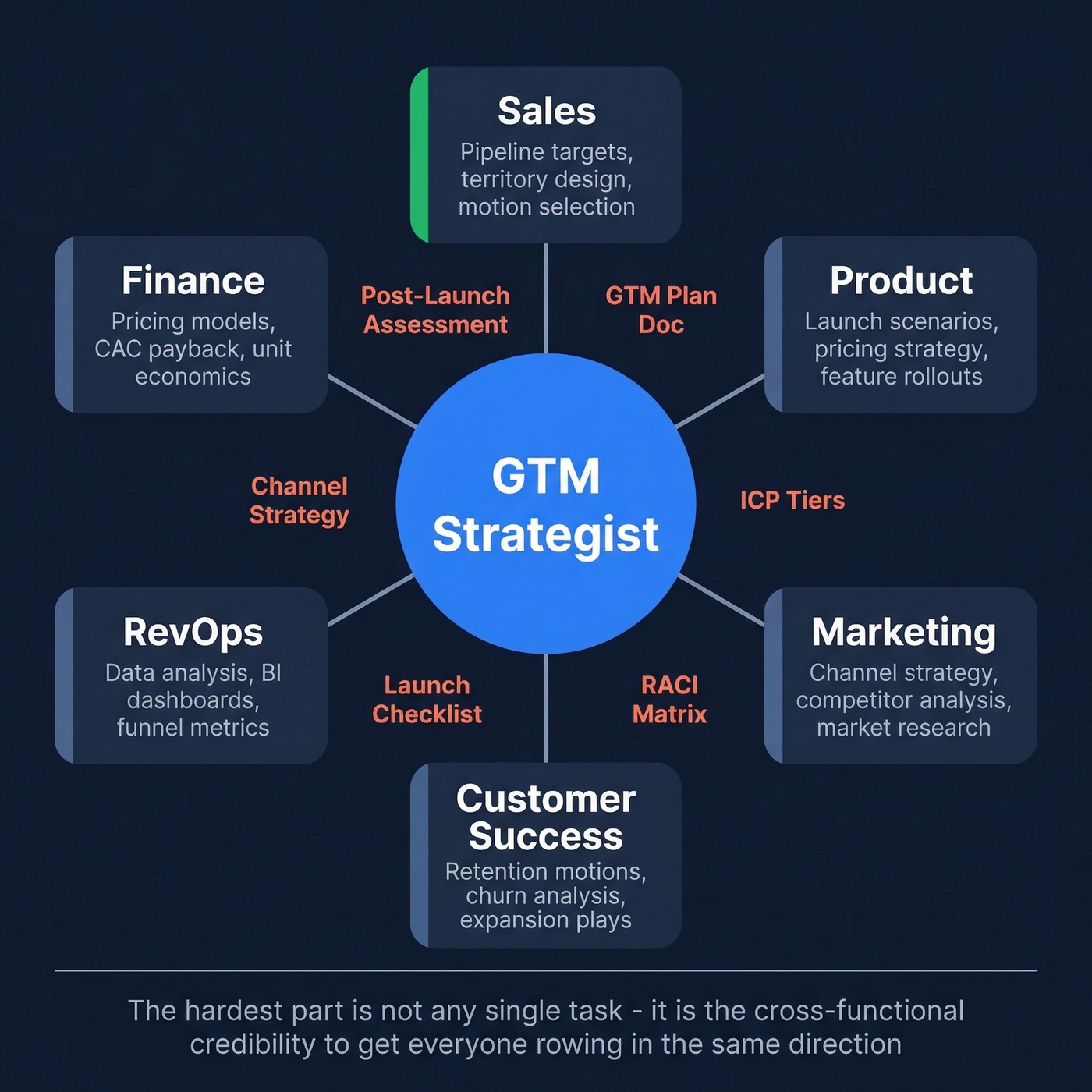
- Own the GTM strategy - not just write it, but maintain and iterate on it as market conditions shift
- Partner with sales on pipeline targets, territory design, and motion selection
- Design launch scenarios for new products, features, and market entries
- Set pricing and promotion strategy in collaboration with product and finance
- Run competitor analysis - not just a battlecard, but ongoing positioning intelligence
- Conduct market research to validate ICP assumptions and identify whitespace
- Identify risks and build mitigation plans before launches, not after
- Analyze marketing data and BI to measure what's working and kill what isn't
- Lead cross-functional planning across product, marketing, sales, RevOps, and CS
- Coordinate launches with phased rollouts, readiness checklists, and post-launch assessments
Typical deliverables include a GTM plan document, ICP definition with tiering (Tier 1/2/3), channel strategy, launch readiness checklist, a RACI matrix, and post-launch assessment. If someone in this role isn't producing these artifacts, they're either too junior or the company hasn't scoped the role correctly.
The hardest part isn't any single task. It's the cross-functional credibility required to get product, marketing, and sales rowing in the same direction. That's a political skill as much as a strategic one.
GTM Strategist vs. PMM vs. Growth PM
This is where titles get messy. Let's clean it up.
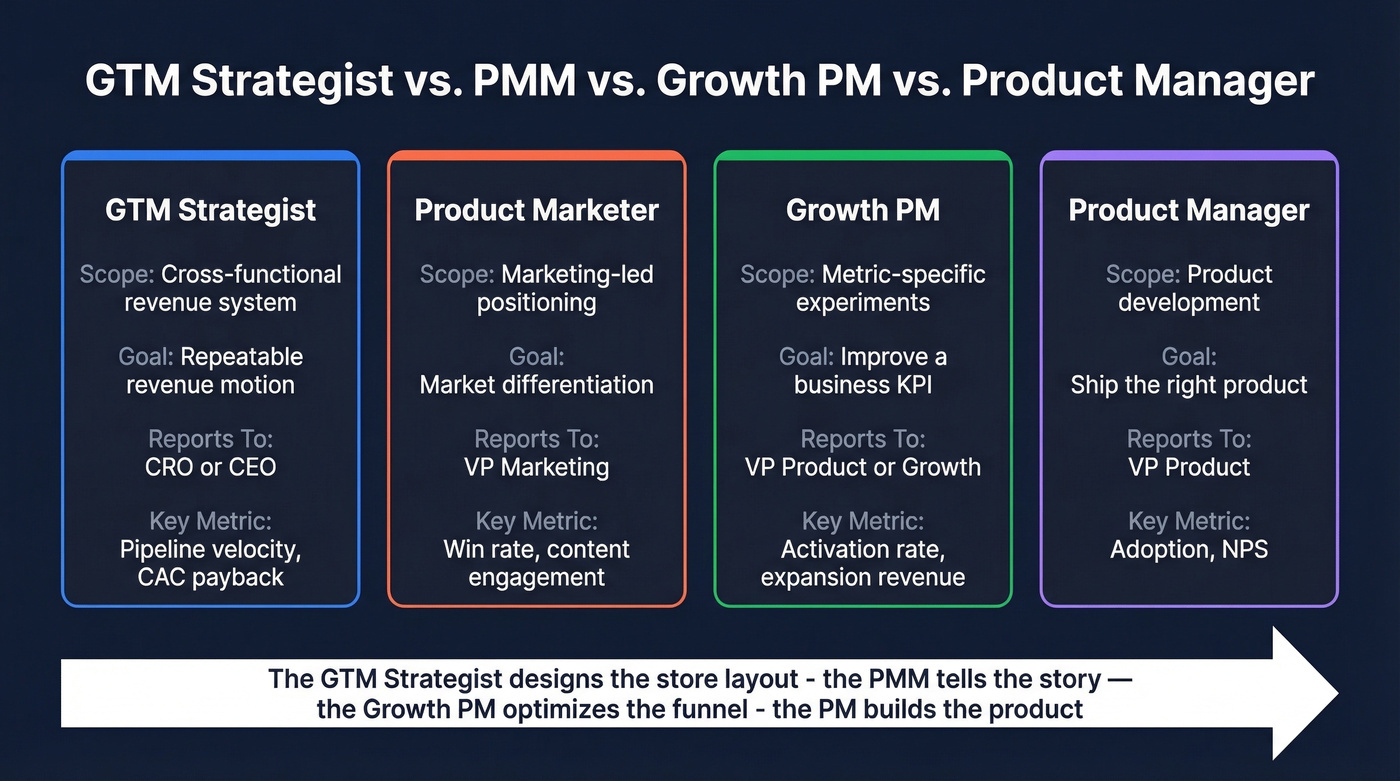
| GTM Strategist | Product Marketer | Growth PM | Product Manager | |
|---|---|---|---|---|
| Scope | Cross-functional revenue system | Marketing-led positioning | Metric-specific experiments | Product development |
| Primary Goal | Repeatable revenue motion | Market differentiation | Improve a business KPI | Ship the right product |
| Key Activities | Motion design, ICP, launches | Messaging, enablement, competitive | A/B tests, activation, retention | Roadmap, specs, delivery |
| Reports To | CRO, VP Marketing, or CEO | VP Marketing | VP Product or Growth | VP Product |
| Success Metric | Pipeline velocity, CAC payback | Win rate, content engagement | Activation rate, expansion revenue | Adoption, NPS |
There's a memorable analogy from Evelyn Hartz that captures the PM/PMM boundary well: the product manager gets the product "on the shelf," and the product marketer gets it "off the shelf." The GTM strategist? They designed the store layout, chose which shelf, set the price, trained the sales team, and are measuring foot traffic.
Here's the thing: if your GTM strategist is writing blog posts and updating battle cards, you've hired a PMM and given them the wrong title. Product marketing tells the product's story; GTM strategy designs the end-to-end customer journey. The GTM strategist consumes PMM's work as an input - positioning, competitive intel, messaging - and weaves it into a broader system that includes sales motions, pricing, channel strategy, and post-sale retention.
Salary & Compensation in 2026
The range is wide because "GTM strategist" means wildly different things at different companies.
Title-Specific US Compensation
| Role | Median Total Pay | Range | Sample Size |
|---|---|---|---|
| GTM Strategy | $214K/yr | $164K-$287K | 34 salaries |
| GTM Strategy Manager | $234K/yr | $178K-$314K | 16 salaries |
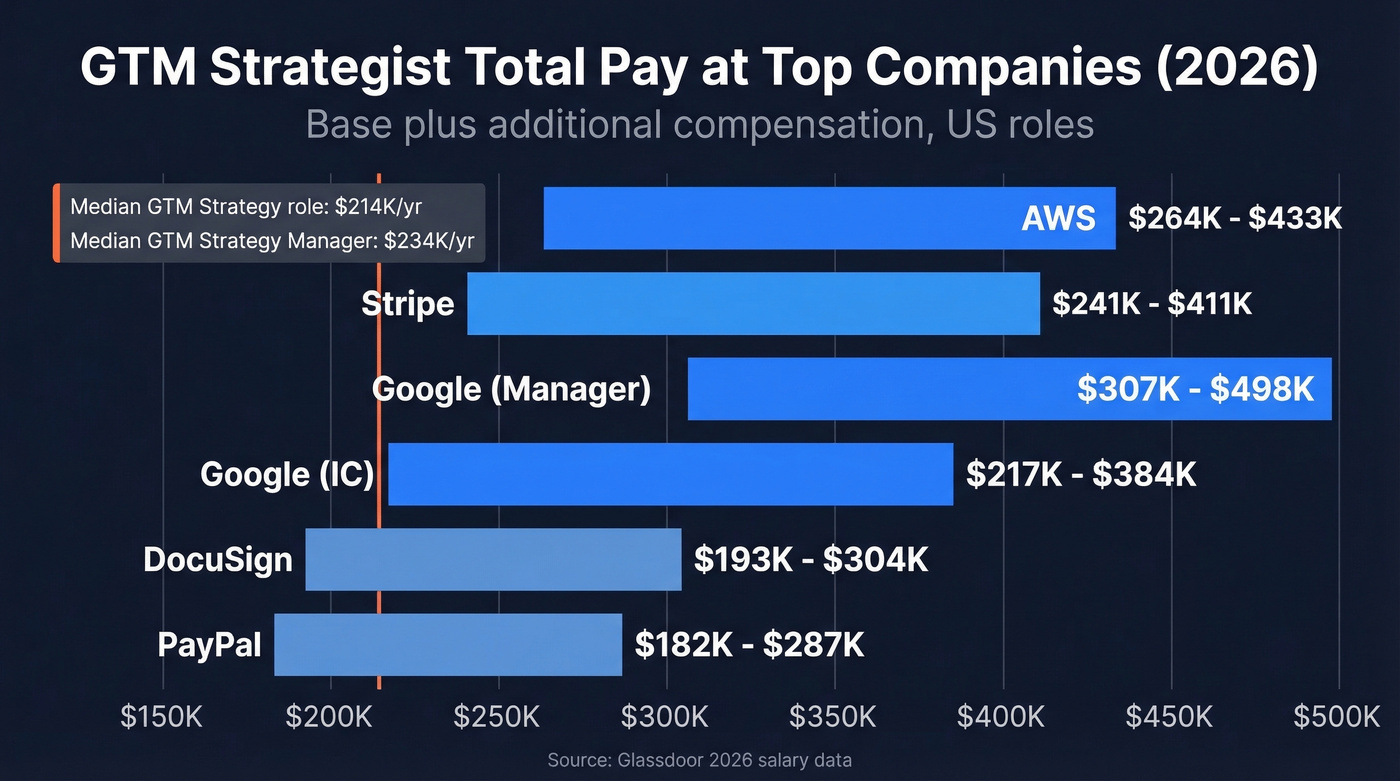
Top-paying companies push these numbers much higher. AWS pays $264K-$433K for GTM Strategy roles. Stripe runs $241K-$411K. Google pays $217K-$384K for GTM Strategy ICs and $307K-$498K for GTM Strategy Managers. DocuSign ($193K-$304K) and PayPal ($182K-$287K) round out the top tier. These are total pay figures including base plus additional compensation.
Global GTM Professional Compensation
| Metric | Value |
|---|---|
| Average base salary | $123,976 |
| Average total comp | $138,683 |
| North America base | $167,800 |
| Europe base | $68,906 |
| Australia base | $87,752 |
| North America bonus | $22,481 |
| Europe bonus | $4,203 |
The spread from $68,906 in Europe to $433K at AWS tells you everything about how differently companies define this role.
Seniority matters enormously. VP-level GTM professionals earn roughly 68% more than director-level. Managers overseeing 7-9 people average $229,400 in total comp. Company context matters too - GTM professionals at companies serving both B2B and B2C earn 31.4% more than those focused on one segment, and companies with established product-market fit pay about 75% more than early-stage companies, which makes sense because the role is fundamentally about scaling what works.
One trend worth noting: base salaries dropped 3.3% year-over-year, and total comp fell 6.7%. The inflated GTM comp packages from 2021-2022 are behind us.

Your GTM strategy is only as good as the data feeding it. Prospeo gives strategists 300M+ profiles with 30+ filters - buyer intent, technographics, headcount growth, funding - so your ICP tiers aren't guesses. 98% email accuracy means sales actually trusts the leads you hand them.
Stop building GTM plans on bad data. Start with Prospeo free.
The 4-Stage GTM Framework
Every go-to-market strategist needs a mental model for where a company sits in its GTM journey. The cleanest framework breaks it into four stages:

Stage 1: Problem-Solution Fit. You've identified a real problem and built something that solves it. The GTM strategist's job here is minimal - this is founder-led discovery. Don't hire a GTM strategist at this stage.
Stage 2: Product-Market Fit. You have repeatable signals. The strategist starts defining ICP tiers (Tier 1/2/3), validating positioning, and mapping the buyer journey. ICP tiering is a core mechanic - Tier 1 is your ideal buyer, Tier 2 is adjacent, Tier 3 is opportunistic. This tiering drives everything from content strategy to sales territory design.
Stage 3: Go-to-Market Fit. This is where the role gets critical. The goal is finding a predictable, scalable motion, and most companies should run 2-3 motions at this stage - not seven. The strategist is testing channels, measuring CAC payback, and killing what doesn't work. This is the chasm where 95% of innovation fails, and it's where a good GTM strategist earns their salary.
Think of Slack's trajectory: they found PLG traction with developer teams in Stage 2, then had to figure out how to sell top-down to enterprise buyers without killing the bottom-up motion in Stage 3. That orchestration - running two motions simultaneously without cannibalizing either - is pure GTM strategist territory.
Stage 4: Scaling. New markets, new motions, new products. Growth loops become the primary lever - templates, sharing, referrals, collaboration loops. The GTM strategist at this stage is more of a systems architect, designing how motions compound rather than running individual campaigns.
The reason 49% of GTM teams can't collect research fast enough is that they're trying to skip stages. You can't design a scalable motion at Stage 3 if you haven't validated your ICP at Stage 2. The framework isn't optional - it's the sequence that prevents expensive mistakes.
The GTM Motion Decision Tree
One framework we use when advising on motion selection:
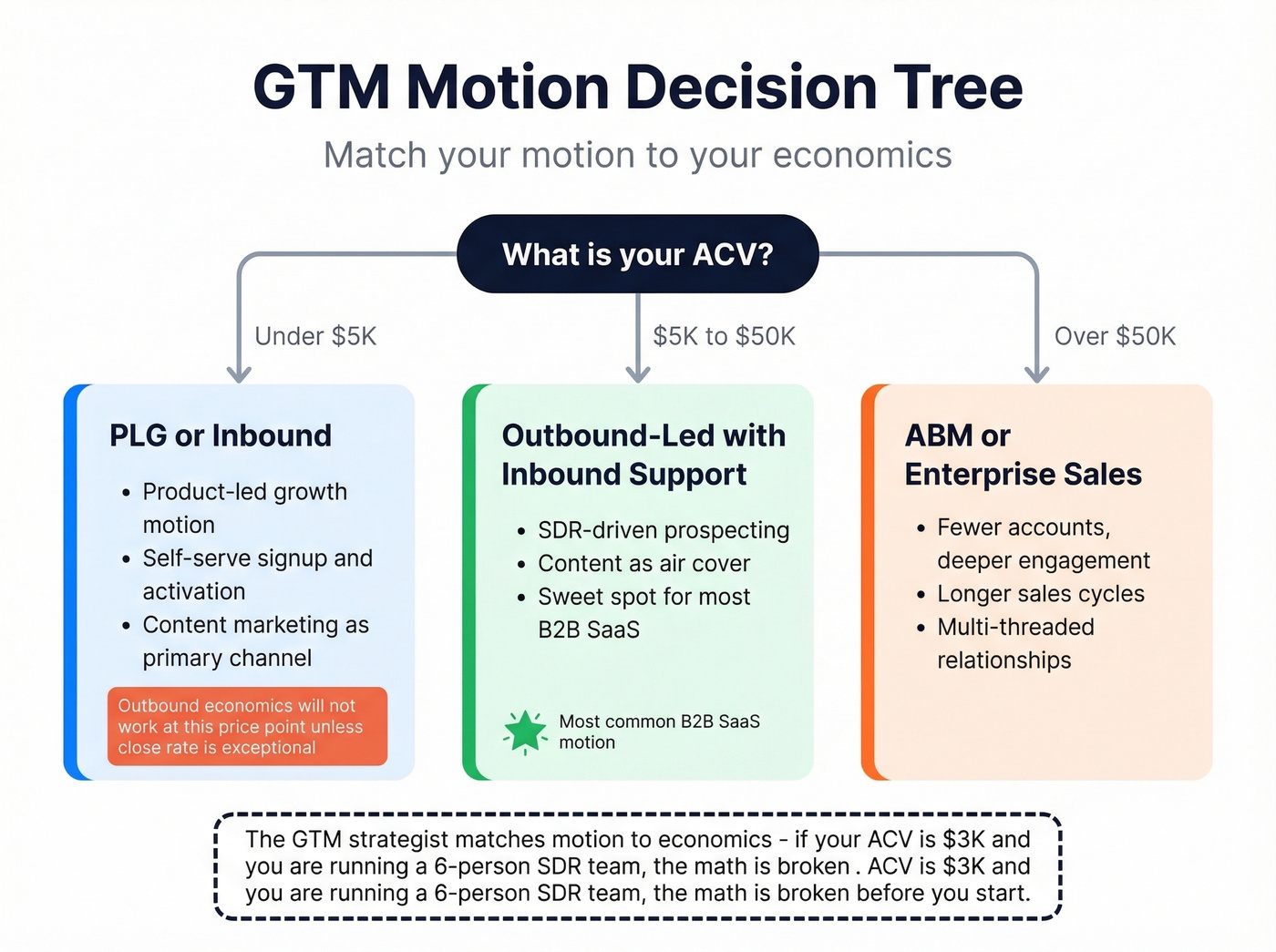
ACV under $5K - Start with PLG or inbound. Outbound economics won't work at this price point unless your close rate is exceptional.
ACV between $5K-$50K - Outbound-led with inbound support. This is the sweet spot for SDR-driven motions with content as air cover.
ACV above $50K - ABM or enterprise sales. Fewer accounts, deeper engagement, longer cycles.
The GTM strategist's job is matching motion to economics. If your average contract value is $3K and you're running a 6-person SDR team, the math is broken before you start.
2026 Benchmarks Every Strategist Needs
Numbers ground strategy in reality. Here are the benchmarks that belong on every GTM strategist's dashboard this year.
Motion volume is out of control. The average software company runs 10.5 simultaneous GTM efforts - 5 core channels plus 5.5 experimental initiatives. That's insane. Most early-stage teams should run 2-3 motions max. Spreading resources across 10+ initiatives is how you end up with nothing working at scale.
Pipeline is the top challenge. 36% of GTM leaders cite scaling motions and pipeline as their #1 problem. Another 19% say it's increasing conversions. Only 11% cite GTM efficiency, which suggests most teams haven't even gotten to the optimization stage yet.
Outbound is getting harder - and more nuanced. Cold email reply rates dropped from 6.8% to 5.8% year-over-year. But the type of hook matters dramatically: timeline-based hooks pull a 10.01% reply rate vs. 4.39% for problem-focused hooks - that's 2.3x. Meeting rates tell an even starker story: 2.34% vs. 0.69%, a 3.4x difference. When reply rates are falling, every bounced email is a wasted touch. That's where data accuracy becomes a GTM lever, not just a nice-to-have.
PLG activation separates winners from losers. Top-performing PLG companies hit >65% activation rates. The average sits at 33%. If you're running a product-led motion, activation rate is the single metric that predicts everything downstream.
AEO is the new SEO. 51% of GTM teams plan to increase investment in answer-engine optimization vs. just 14% for traditional SEO. If your product doesn't show up in ChatGPT or Perplexity answers for your category, your GTM strategist needs an AEO plan yesterday.
The GTM Strategist's Tech Stack
The right stack depends on your stage. We've seen teams waste months evaluating 15 tools when they only need three to start.
| Category | Startup (~$0-$2M ARR) | Mid-Market ($2-$20M) | Enterprise ($20M+) |
|---|---|---|---|
| CRM | HubSpot | HubSpot / Salesforce | Salesforce |
| Outbound | Instantly | Instantly + Smartlead | Outreach or Salesloft |
| ABM | Manual | Demandbase | Demandbase or 6sense |
| Analytics | HubSpot built-in | HockeyStack | HockeyStack or Dreamdata |
| Revenue Intel | - | Gong | Gong |
| Enablement | Google Docs | Seismic | Seismic |
| Partnerships | Manual | PartnerStack | PartnerStack |
| Middleware | Zapier | Clay + Zapier | Clay + Make + custom |

The middleware layer is the trend to watch. Tools like Clay and Zapier are becoming the connective tissue between data sources, CRMs, and outbound tools. They let you build dynamic enrichment workflows that would've required a full-time RevOps engineer two years ago.
Never use your primary domain for cold outbound. Set up separate sending domains, warm them properly, and keep your main domain's reputation clean. We've seen teams tank their deliverability in a week by ignoring this. (If you need the technical checklist, start with email deliverability and sender reputation.)
If we were building a GTM stack from scratch, the non-negotiables are a CRM, a data platform with verified contacts, and an outbound sequencer. Everything else is a nice-to-have until $5M ARR.
A GTM strategist's hardest job is cross-functional alignment. Nothing kills that faster than sales bouncing 35% of marketing's leads. Prospeo's 7-day data refresh and 5-step verification keep bounce rates under 4% - so pipeline targets stay on track and nobody blames the data.
Give your revenue engine the fuel it deserves at $0.01 per verified email.
7 GTM Mistakes That Kill Launches
Most GTM strategy guides are written by people selling GTM strategy courses. The actual mistakes happen in execution, not in frameworks.
1. Skipping market research. 49% of GTM teams can't collect consumer research fast enough, so they skip it entirely. Then they launch into a segment that doesn't exist or a buyer who doesn't care. Real talk: if you haven't talked to 20+ prospects in your target segment before building your GTM plan, you're guessing.
2. Sales and marketing misalignment. Marketing generates MQLs that sales ignores. Sales blames marketing for lead quality. Nobody agrees on ICP. This is the #1 organizational failure in GTM, and it's the strategist's job to fix it with shared definitions and shared metrics.
3. Unclear value proposition. If your sales team can't articulate why a buyer should choose you over the status quo in two sentences, your value prop isn't clear enough. Not "over competitors" - over doing nothing.
4. No customer journey mapping. You can't optimize what you haven't mapped. Every stage from awareness to expansion needs defined touchpoints, owners, and conversion benchmarks.
5. Inflexible pricing. Pricing is a GTM lever, not a finance decision. If you can't experiment with packaging, tiers, and usage-based models, you're leaving revenue on the table.
6. Weak competitive positioning. Knowing your competitors' features isn't positioning. Knowing why a specific buyer segment would choose you is positioning.
7. Poor launch execution and timing. A phased rollout with a readiness checklist beats a big-bang launch every time. Build a RACI matrix, run a soft launch, and schedule a post-launch assessment at day 30, 60, and 90.
The execution artifacts that prevent these mistakes - launch readiness checklists, RACI matrices, phased rollouts, post-launch assessments - aren't glamorous. They're what separates a skilled GTM strategist from someone who just writes strategy decks.
How to Become (or Hire) One
Career Path
The typical trajectory runs through product marketing or demand gen: PMM or Demand Gen Manager, then Senior PMM or Growth Lead, then GTM Strategist, then Director of GTM, then VP of GTM/Growth.
The skills that matter most aren't what you'd find on a generic job posting. Cross-functional leadership is table stakes. Beyond that, you need data analysis fluency (can you build a cost to acquire customer model from scratch?), ICP definition expertise, channel strategy experience, pricing intuition, and competitive intelligence chops. The skill that's hardest to teach? Willingness to kill channels. A GTM strategist who can't shut down an underperforming motion because "we already invested in it" will burn budget indefinitely.
Hiring Checklist
When interviewing candidates, ask one question: "What's your framework for choosing GTM motions?"
A strong candidate will answer with stages, selection criteria, and kill metrics. They'll talk about ICP tiering, channel economics, and how they'd sequence motions based on company stage. Skip candidates who can't name specific metrics they've moved, who only talk about messaging and positioning (that's a PMM), who have no experience with post-launch iteration, or who've never killed a channel or motion that wasn't working.
Look, if they can't answer with stages, criteria, and kill metrics - they're not getting the offer. The role is about systems thinking, not storytelling. Storytelling is one input. The system is the job.
Our honest take: Most companies under $5M ARR don't need a full-time go-to-market strategist. They need a senior PMM who thinks in systems and a founder who's willing to own the cross-functional orchestration. The dedicated role pays for itself when you're scaling what works - not when you're still figuring out what works.
FAQ
What's the difference between a GTM strategist and a GTM manager?
A GTM strategist is typically an IC or senior IC focused on strategy design and cross-functional orchestration, while a GTM manager implies people management and execution oversight. Compensation data shows GTM Strategy Managers earn about $20K more at median, reflecting the management premium. In practice, titles vary wildly by company.
How much does a go-to-market strategist make?
US median total compensation is $214K for GTM Strategy roles and $234K for GTM Strategy Managers, based on Glassdoor data. At top-paying companies like AWS and Google, total pay can exceed $400K. Globally, North American GTM professionals average $167,800 base vs. $68,906 in Europe.
When should a startup hire a GTM strategist?
Hire after you have clear product-market fit signals and evidence of a repeatable sales motion - typically post-Series A. Before PMF, the founders are the GTM strategy. Once you're ready to scale, bringing in a dedicated strategist or fractional advisor turns founder intuition into a repeatable system.
What tools does a GTM strategist use daily?
Core stack includes a CRM (HubSpot or Salesforce), a verified data platform for accurate contact enrichment, an outbound sequencer (Instantly or Smartlead), and analytics tools. More mature teams add ABM platforms like Demandbase, revenue intelligence through Gong, and middleware like Clay and Zapier to connect everything.
Is GTM strategy the same as product marketing?
No. Product marketing focuses on positioning, messaging, and competitive differentiation - getting the product "off the shelf." GTM strategy is the cross-functional blueprint spanning product, marketing, sales, CS, pricing, and distribution. PMM is one critical input, but the GTM strategist weaves it into a broader revenue system that includes sales motions, channel economics, and post-sale retention.