

The 10 Go to Market Strategy Components That Actually Matter
Ask five people on a GTM team what belongs in a go-to-market strategy and you'll get six answers. A thread on r/gtmengineering captured this perfectly - a team with an AI-driven research stack couldn't even agree on what their GTM deliverables should be. At its core, GTM answers four questions: what problem you solve, who has it, why you're better, and how prospects will find you.
Here are the go to market strategy components that separate teams who launch from teams who gain traction.
Nail These Three First
Most GTM plans fail because teams try to do too many things at once instead of doing a few fundamentals exceptionally well. Before getting into go to market design, nail these three essentials:
- Validated ICP - run 20-30 structured interviews before committing resources. Skip this and everything downstream is guesswork. (If you need a starting point, use an ICP scoring rubric.)
- Motion-specific pricing - PLG packaging looks nothing like sales-led packaging. Pick your motion first.
- A weekly metrics baseline - CAC, LTV:CAC, and one pipeline health metric. Three numbers to start.
Get those right and the rest falls into place. Get them wrong and no amount of demand gen will save you.
The 10 GTM Strategy Components
1. Market Research & Validation
This is where most teams cut corners. Here's a useful heuristic: 20-30 structured interviews or a beta test will uncover what users actually value, what they ignore, and why they'd switch. TAM slides don't tell you whether anyone will pay. Understanding your market at this stage prevents expensive pivots later - the kind that burn a quarter and half your team's morale.
2. Ideal Customer Profile (ICP)
There's a massive gap between an assumed ICP and a validated one. We've seen teams burn entire quarters targeting "mid-market SaaS companies" when their best customers were all in fintech with 50-200 employees. Specificity wins. Vague ICPs produce vague results.
3. Value Proposition
Feature-led messaging is the default, and it's almost always wrong. "We have AI-powered analytics" means nothing to a VP of Revenue who needs to know why their pipeline is leaking. If your value prop doesn't finish the sentence "so that you can..." it isn't a value prop yet. (If you want a tighter structure, start with a few sample elevator pitches and adapt them to your buyer.)
4. Competitive Positioning
Build a value matrix mapping your solution against competitors for each ICP pain point - and update it quarterly. The competitor who was irrelevant six months ago may have shipped the exact feature your prospects keep asking about. Stale competitive intel is barely better than no competitive intel. If you need a process, borrow a competitive intelligence strategy cadence.
5. Pricing & Packaging
Your growth model dictates packaging complexity. Self-serve requires simpler tiers users can understand without talking to anyone. Sales-led adds deal desk review, CPQ, and configuration. Guesswork pricing is one of the top failure modes we see - test early, iterate often, and don't be afraid to change your pricing three times in the first year.
6. Sales Motion & Channels
Your sales motion is only as good as the data feeding it. Bad prospect data kills outbound before your messaging ever gets tested - if a big chunk of your emails bounce, you're burning domain reputation and learning nothing about what actually resonates. Solid data sourcing and verification are what separate productive outbound from wasted effort. (If you're building the stack, start with a shortlist of SDR tools.)

Prospeo handles this with 98% verified email accuracy on a 7-day refresh cycle, so you're never launching sequences against stale records. The free tier gives you 75 verified emails per month to test before committing.
7. Marketing & Demand Generation
Channel selection should follow your motion, not the other way around. PLG companies win with content, community, and product virality. Sales-led orgs lean into ABM, events, and outbound. Pick one channel, prove it works, then expand. Trying to run all of them at once is how early-stage teams spread themselves too thin and measure nothing well. (For outbound, keep a few proven sales prospecting techniques on hand.)
8. Sales Enablement & Support
Missing training, playbooks, and case studies is a recurring failure mode that kills otherwise solid GTM plans. Reps can't sell what they don't understand, and they can't handle objections they haven't practiced. Enablement means arming every customer-facing role with the materials they need before launch day, not after. (If you're formalizing it, build a lightweight marketing enablement hub.)
9. Retention & Time-to-Value
Retention is a GTM component, not a post-launch problem. Practitioners on r/SaaS consistently emphasize onboarding and time-to-value as critical strategy elements. If customers churn in the first 90 days, your acquisition metrics are meaningless. Full stop. (To diagnose the why, run a simple churn analysis.)
10. Metrics & Measurement
Pick 3-5 KPIs and optimize one at a time:
| Metric | Formula | Target |
|---|---|---|
| CAC | Sales + Mktg costs / new customers | Payback < 12 mo |
| LTV:CAC | Lifetime value / CAC | 3:1 or better |
| MQL to SQL | SQLs / MQLs x 100 | Improve over time |
| New user growth | (New - churned) / start x 100 | Positive trend |
Component Dependency Map
Here's something no framework tells you: these components aren't a flat checklist. They have dependencies. Get the order wrong and you're building on sand.
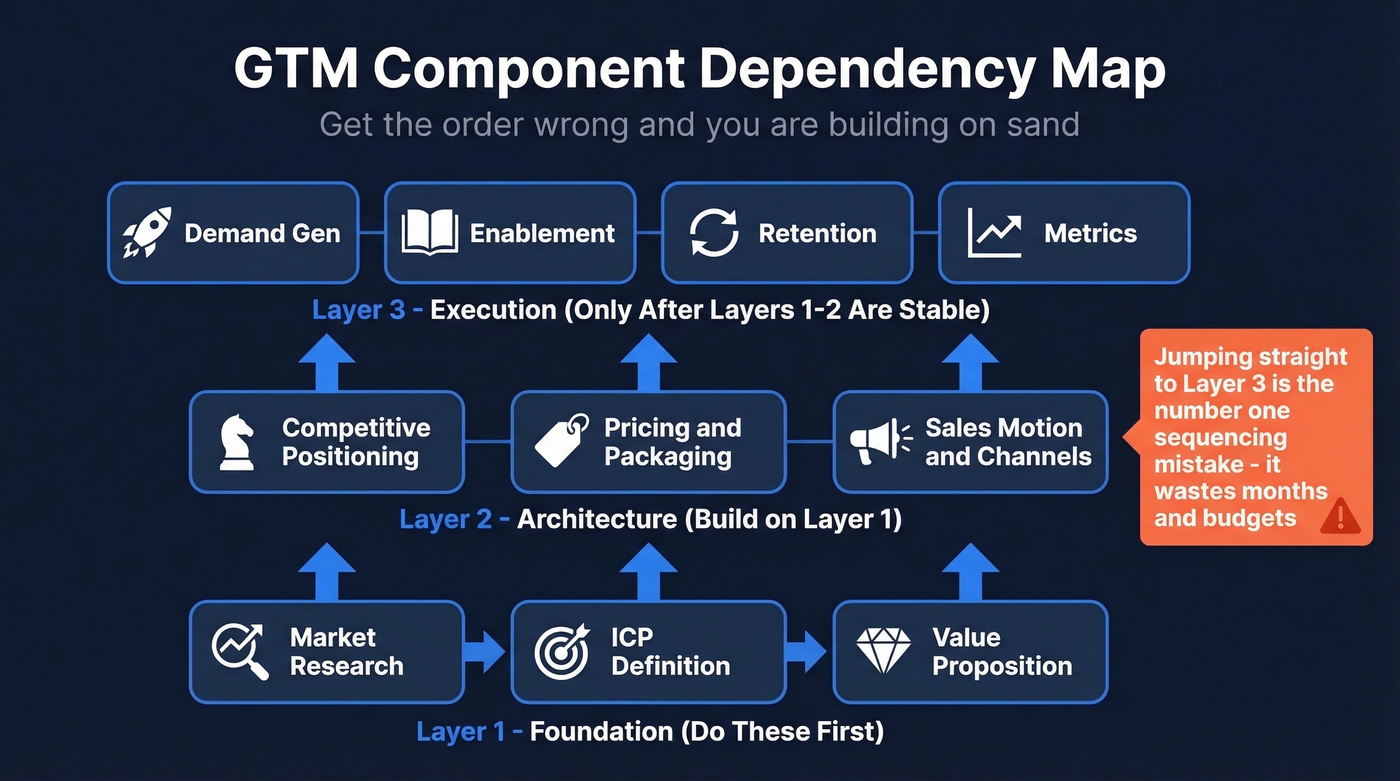
Layer 1 - Foundation (do these first): Market Research, then ICP, then Value Proposition. You can't position what you haven't validated, and you can't validate without talking to the market.
Layer 2 - Architecture (build on Layer 1): Competitive Positioning, Pricing, and Sales Motion. These three shape each other - your pricing constrains your motion, and your motion determines which competitive angles matter. This is where your GTM structure takes shape.
Layer 3 - Execution (only after Layers 1-2 are stable): Demand Gen, Enablement, Retention, and Metrics. Teams that jump straight to Layer 3 - running ads before nailing ICP, hiring SDRs before fixing pricing - waste months and blame "execution" for what was actually a sequencing problem. We've watched this play out at least a dozen times in our own network, and it's frustrating every single time.

Component #6 is where most GTM strategies silently fail. Bad data means bounced emails, burned domains, and zero signal on what messaging actually works. Prospeo delivers 98% verified email accuracy on a 7-day refresh cycle - so your outbound motion tests messaging, not data quality.
Stop debugging your data and start validating your GTM motion.
How Components Shift by Motion
Not every component carries the same weight. ACV is the clearest signal for which motion fits:
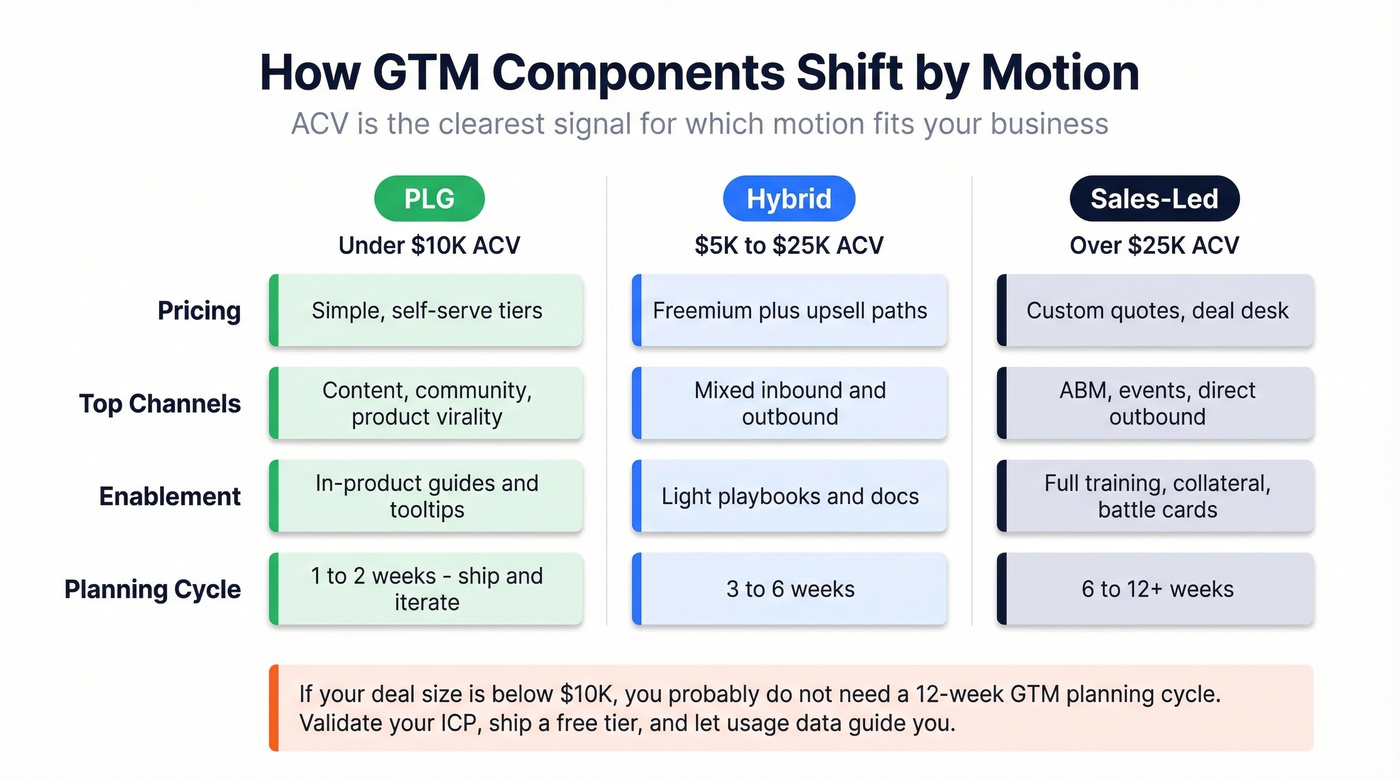
| Dimension | PLG (<$10K ACV) | Hybrid ($5K-$25K) | Sales-Led (>$25K) |
|---|---|---|---|
| Pricing | Simple, self-serve | Freemium + upsell | Custom, deal desk |
| Channels | Content, product | Mixed inbound/outbound | ABM, events, outbound |
| Enablement | In-product guides | Light playbooks | Full training + collateral |
Let's be honest: if your deal size sits below $10K, you probably don't need a 12-week GTM planning cycle. Validate your ICP, ship a free tier, and let usage data tell you what to build next. Over-planning at low ACV is a form of procrastination.
GTM Benchmarks Worth Knowing
Top-quartile vs. median numbers across SaaS:
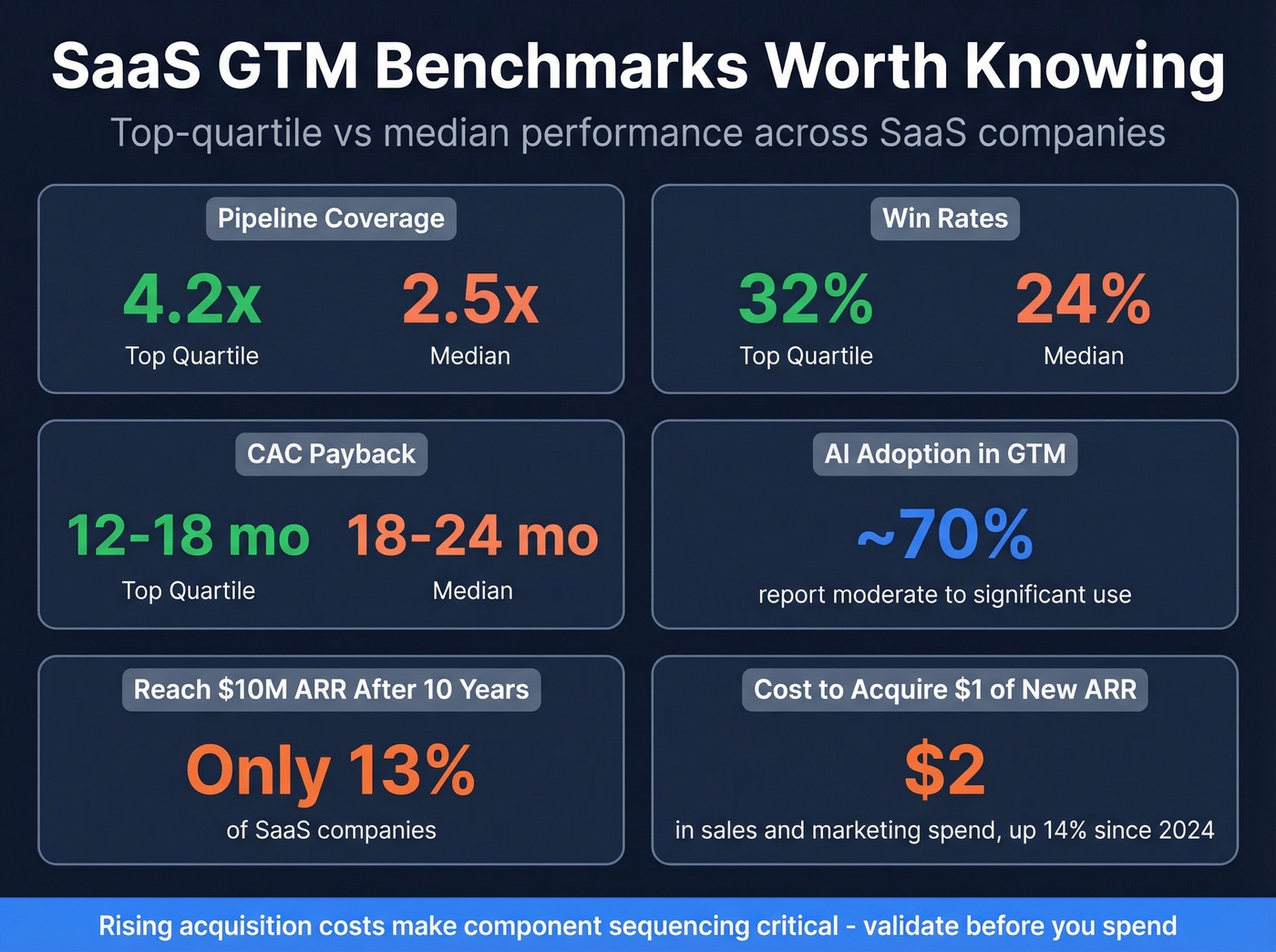
- Pipeline coverage: 4.2x vs. 2.5x
- Win rates: 32% vs. 24%
- CAC payback: 12-18 months vs. 18-24 months
- AI adoption in GTM workflows: ~70% report moderate-to-significant use
- Only 13% of SaaS companies reach $10M ARR after 10 years
- Average cost: $2 in sales and marketing for every $1 of new ARR, up 14% since 2024
That last stat is why component sequencing matters so much. When acquisition costs are rising, you can't afford to waste budget on channels you haven't validated or prospects who don't match your ICP.
Why GTM Strategies Fail
Five failure modes show up repeatedly across launches of all sizes:
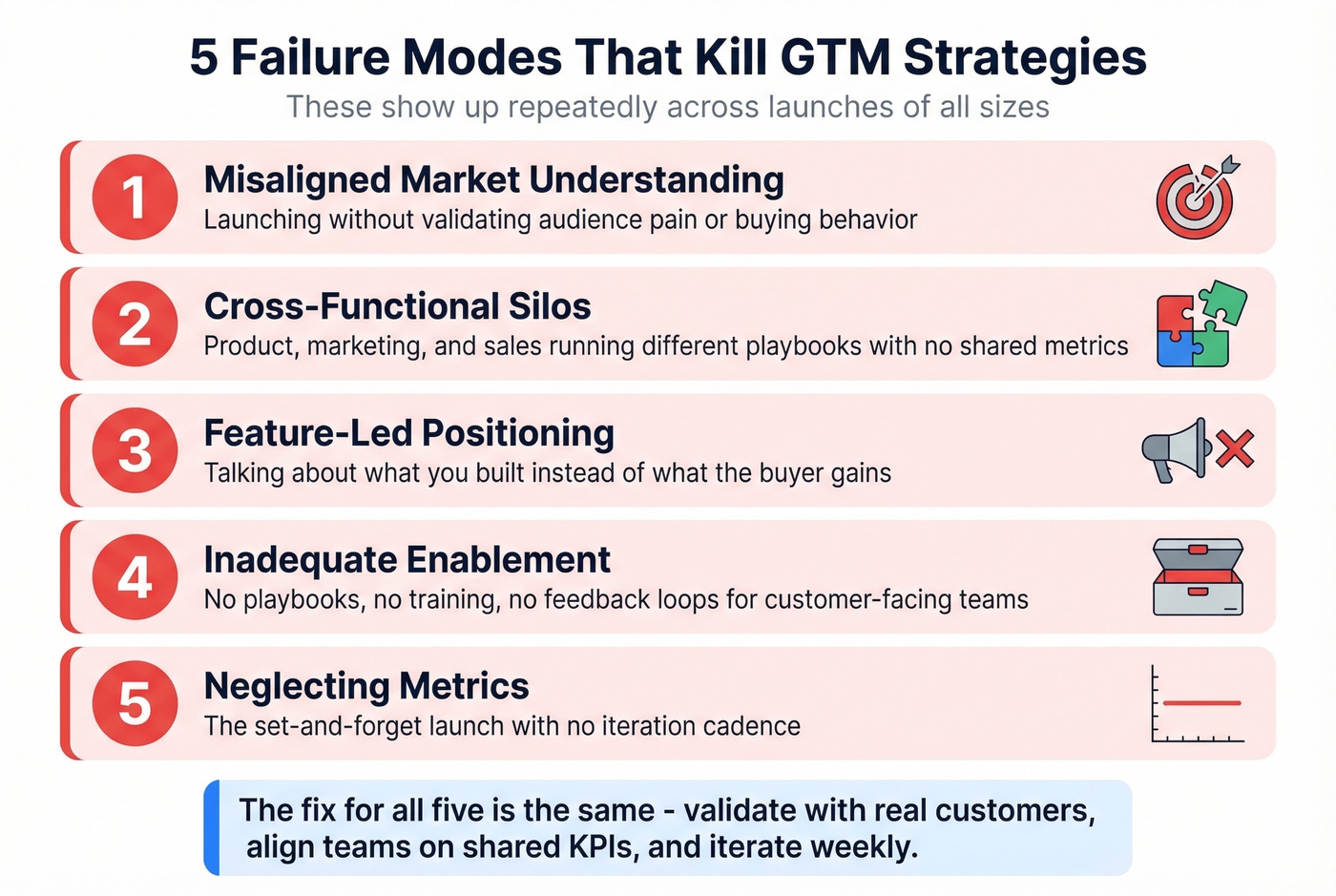
- Misaligned market understanding - launching without validating audience pain or buying behavior.
- Cross-functional silos - product, marketing, and sales running different playbooks with no shared metrics.
- Feature-led positioning - talking about what you built instead of what the buyer gains.
- Inadequate enablement - no playbooks, no training, no feedback loops.
- Neglecting metrics - the "set-and-forget" launch with no iteration cadence.
Coca-Cola's C2 is the textbook example: launched in 2004 targeting low-carb dieters, priced too high, with positioning that confused everyone - and the low-carb trend was already fading by launch day. Skip this if you want a positive case study, but the lesson is worth remembering: timing and ICP alignment trump everything.
GTM Examples That Worked
Slack hit 8,000 users in 24 hours by making the product the GTM engine - word-of-mouth driven by an experience people genuinely wanted to share. That's PLG at its purest.
Zoom's 2019 10-K revealed that 55% of customers contributing over $100K in revenue started with at least one free host. HubSpot rode the inbound marketing category it helped create to $100M ARR by 2012, proving that owning a narrative beats owning a feature. In our experience, the companies that win aren't the ones with the most features - they're the ones who pick a motion, commit to it, and iterate faster than everyone else.
You just mapped 10 GTM components and their dependencies. Layer 2 - your sales motion - lives or dies on prospect data quality. Prospeo gives you 300M+ profiles with 30+ filters including buyer intent, technographics, and headcount growth to match your validated ICP precisely.
Build your GTM on verified data, not assumptions.
FAQ
What's the difference between a GTM strategy and a marketing plan?
A GTM strategy covers the full path to market - ICP, pricing, sales motion, channels, retention, and metrics. A marketing plan is one component within it, focused specifically on demand generation and channel tactics. Marketing is a subset; GTM is the whole system.
How long does it take to build a GTM strategy?
Early-stage teams can build a solid GTM plan in 2-4 weeks; enterprise launches with multiple stakeholders typically take 6-12+ weeks. The bottleneck is usually ICP validation - the interviews and data analysis - not the document itself.
Which components matter most for startups?
Validated ICP, a clear value proposition, and one acquisition channel you can measure. Skip elaborate enablement and multi-channel marketing until you've proven the first channel works. For outbound-heavy startups, pairing ICP validation with a verified data source lets you test targeting before committing budget.
How do you choose between PLG and sales-led GTM?
ACV is the clearest signal. Under $10K, PLG works - users self-serve. Above $25K, sales-led wins because buying committees need human guidance. Between $5K-$25K, hybrid motions combine PLG acquisition with sales-assisted expansion.