

The Data-Backed Go-to-Market Strategy for B2B SaaS
The median SaaS company spends $2.00 to acquire every dollar of new ARR. That means you're burning twice what you earn before retention even kicks in - and if churn sits above 3% monthly, payback becomes brutal. Average B2B sales cycles have stretched to 134 days, up from 107 in early 2022. Put those together and you get the real reason most go-to-market strategies for B2B SaaS companies fail: they burn cash on the wrong channels for too long before revenue shows up.
There's no shortage of GTM frameworks floating around - quadrant models, mission matrices, growth taxonomies. Most look great on a slide and tell you nothing about where to spend your next dollar. We've built this guide differently. Every recommendation is anchored to CAC benchmarks, conversion data, and payback timelines from studies covering 100-400+ SaaS companies, plus agency datasets across roughly 120 firms.
Here's the thing: most B2B SaaS companies don't have a strategy problem. They have a unit economics problem dressed up as a strategy problem. Fix the math first, and the strategy becomes obvious.
The Three Decisions That Define Your GTM
Everything else is execution detail.
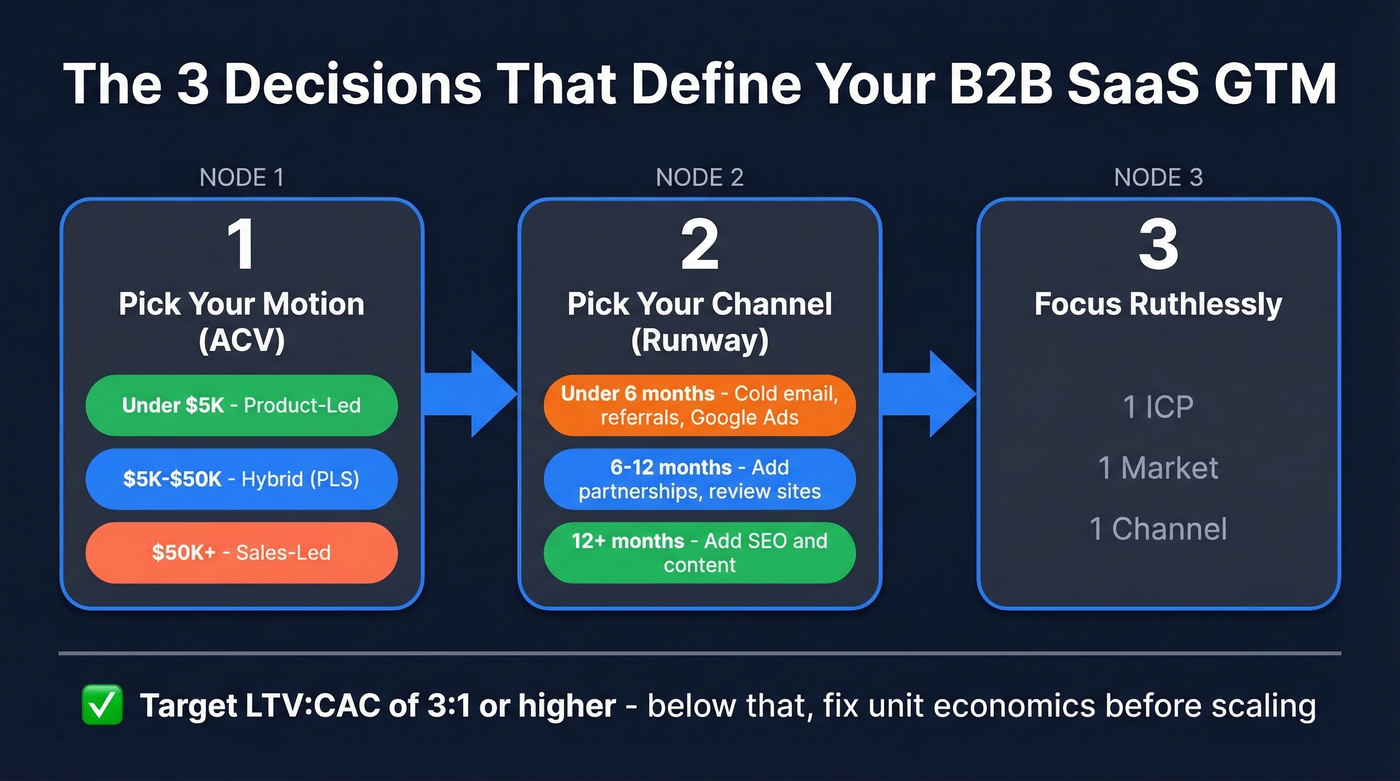
Pick your motion based on ACV. Product-led if your average contract value is under $5K. Hybrid if it's $5K-$50K. Sales-led if it's $50K+. Don't overthink this - the economics force the answer.
Pick your first channel based on runway. Less than 6 months of cash? Your channels are cold email, referrals, and Google Ads. Twelve-plus months? Add SEO and partnerships. Funding a 6-12 month SEO play with 3 months of runway is how companies die.
Target one ICP, one market, one channel. Everything else is a distraction until you've closed your first 20 customers. The LTV:CAC ratio target is 3:1. Below that, you don't have a growth problem - you have a unit economics problem. Expect 2-5% free-to-paid conversion for freemium and 15-25% for free trials; if you're below those ranges, fix onboarding before scaling spend.
What a B2B SaaS GTM Strategy Actually Is
A go-to-market strategy isn't a marketing plan. It's the full path from product to revenue: who you're selling to, how you reach them, what you charge, and how the sale actually happens. Marketing is one component. So is sales. So is pricing. A GTM strategy without a sales motion or pricing model is just a slide deck with a Notion template.
SaaS GTM is harder than traditional software GTM for three reasons. Revenue is recurring, so you need retention economics - not just acquisition. B2B buying cycles involve 6-10 stakeholders. And buyers now complete roughly 70% of their evaluation before ever talking to sales, which means your product and content do the selling long before your reps get a shot. If your product experience can't carry that weight, no amount of SDR activity will save you.
Choose Your GTM Motion
The ACV Decision Rule
Your ACV dictates your motion. This isn't a suggestion - it's math. A $3K ACV product can't support a $10K CAC. An enterprise deal can't close through a self-serve checkout page.
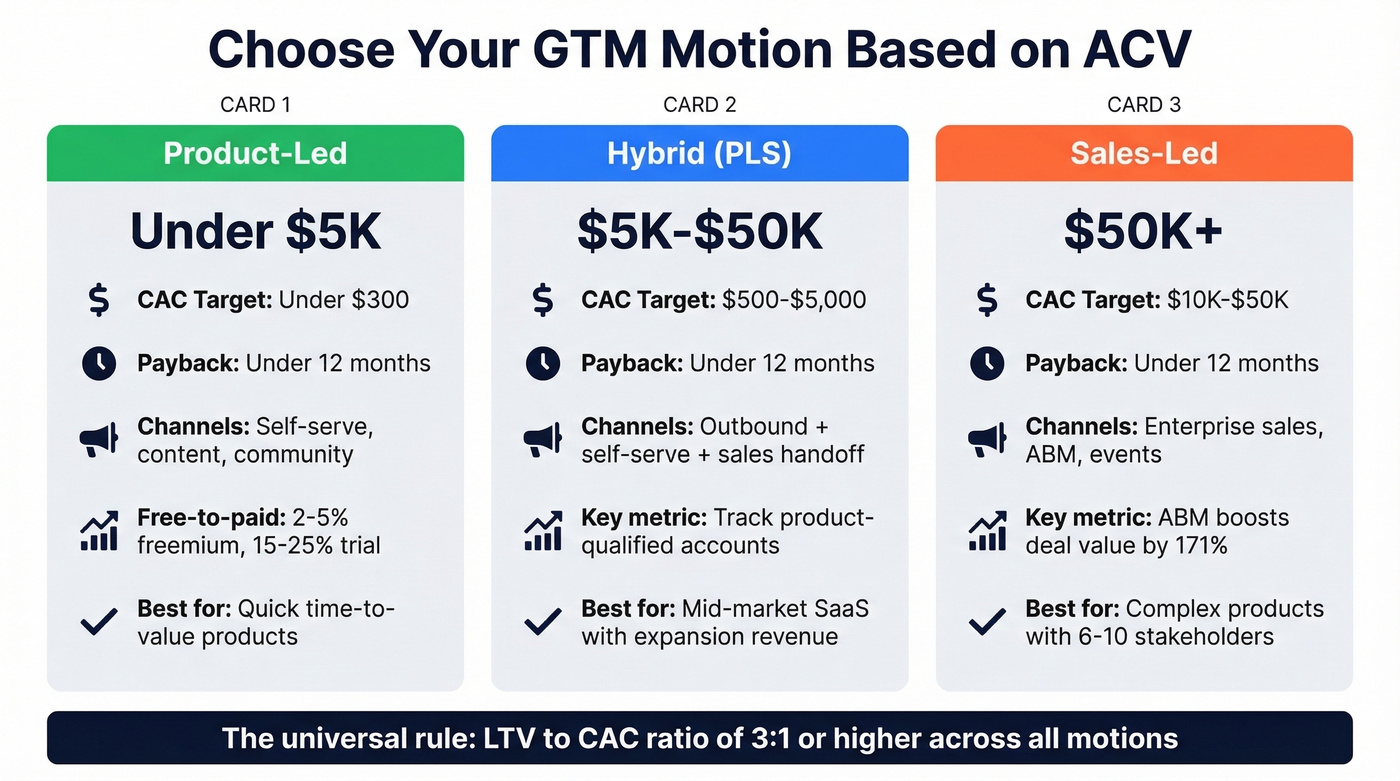
| ACV Range | GTM Motion | CAC Target | Primary Channels | LTV:CAC Target |
|---|---|---|---|---|
| Under $5K | Product-led | Under $300 | Self-serve, content, community | 3:1+ |
| $5K-$50K | Hybrid (PLS) | $500-$5,000 | Outbound + self-serve | 3:1+ |
| $50K+ | Sales-led | $10K-$50K | Enterprise sales, ABM, events | 3:1+ |
The payback period target across all motions is under 12 months. If your CAC payback is 18+ months, your pricing, retention, or channel mix needs to change. These numbers also shift dramatically by vertical - Fintech SMB CAC averages around $1,461 while eCommerce SMB can be as low as $299, so benchmark against your specific market, not just the aggregate.
PLG vs Sales-Led - What the Data Says
A ProductLed study of 446 B2B SaaS companies found that 68% of companies with even modest self-serve revenue ($100K-$500K) reported profitability, versus 36.4% of those without any self-serve. Nearly double. They also saw 25.9% better free-to-paid conversion and 18.3% faster time-to-value.
But PLG doesn't mean free. An Extruct analysis of 474 Series A startups found that 39% enable PLG or self-serve, but only 25% offer a free tier. Many PLG companies charge from day one - they just let users start without talking to sales. PLG is a distribution strategy, not a pricing strategy. The distinction matters.
The practical readiness test: can a user reach your core value in under 30 minutes? Does activation-to-paid conversion stabilize across cohorts? If yes, PLG is viable. If your product requires a 45-minute onboarding call to make sense, you're sales-led whether you like it or not.
The Hybrid Model That Actually Works
Most B2B SaaS companies between $5K and $50K ACV end up hybrid - and McKinsey's analysis of 107 public B2B SaaS companies confirms this is the right call. They call it Product-Led Sales: let users self-serve, track product usage to identify product-qualified accounts, then route high-intent accounts to sales.
The execution model is a cross-functional growth team of 7-9 people - PMs, data scientists, demand gen, content, and design - running experiments on the PLG-to-sales handoff. It's not cheap to build, but it's the motion that scales best for mid-market SaaS. Remember that 70% buyer self-education stat: if buyers are doing most of the work before they talk to your team, you need a product experience that captures that intent, not just a landing page.
Pick Your Channels (With CAC Data)
Acquisition Cost by Channel
Not all channels cost the same. A First Page Sage study across ~120 firms provides the clearest B2B CAC benchmarks we've seen:
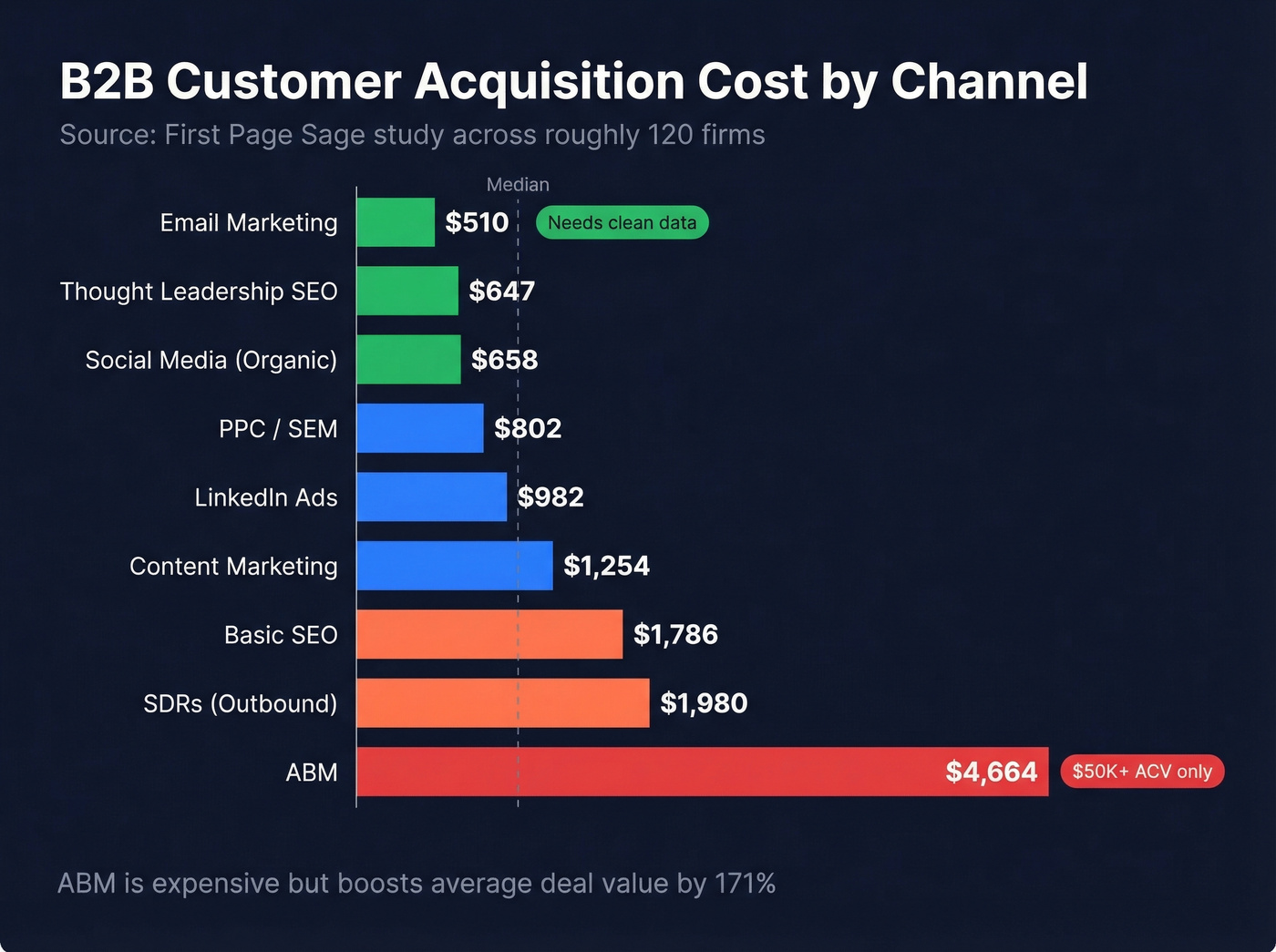
| Channel | B2B CAC | Notes |
|---|---|---|
| Email Marketing | $510 | Lowest CAC; needs clean data |
| Thought Leadership SEO | $647 | 6-12 month ramp |
| Social Media (Organic) | $658 | Paid is much higher |
| PPC/SEM | $802 | Fast but expensive at scale |
| LinkedIn Ads | $982 | Strong for mid-market |
| Content Marketing | $1,254 | Long-term compounding asset |
| Basic SEO | $1,786 | Generic; less effective |
| SDRs | $1,980 | Data quality is everything |
| ABM | $4,664 | $50K+ ACV only; 171% deal uplift |
Email marketing at $510 CAC is the lowest-cost channel in this dataset - but only if your contact data is clean. Sending to a list with high bounce rates doesn't just waste money; it damages your sending domain and inflates your CAC fast. (If you want a deeper playbook on deliverability, see our email deliverability guide.)
ABM at $4,664 per customer only makes sense for enterprise deals. But when it works, ABM boosts average deal value by 171%. That's why it's a $50K+ ACV play, not a growth hack for startups. SDRs at $1,980 per customer work for mid-market ACVs where the deal size justifies the human cost.
Time-to-Revenue by Channel
CAC alone doesn't tell you which channel to pick. You also need to know when the revenue shows up - and this is where a solid B2B SaaS go-to-market plan separates from guesswork.
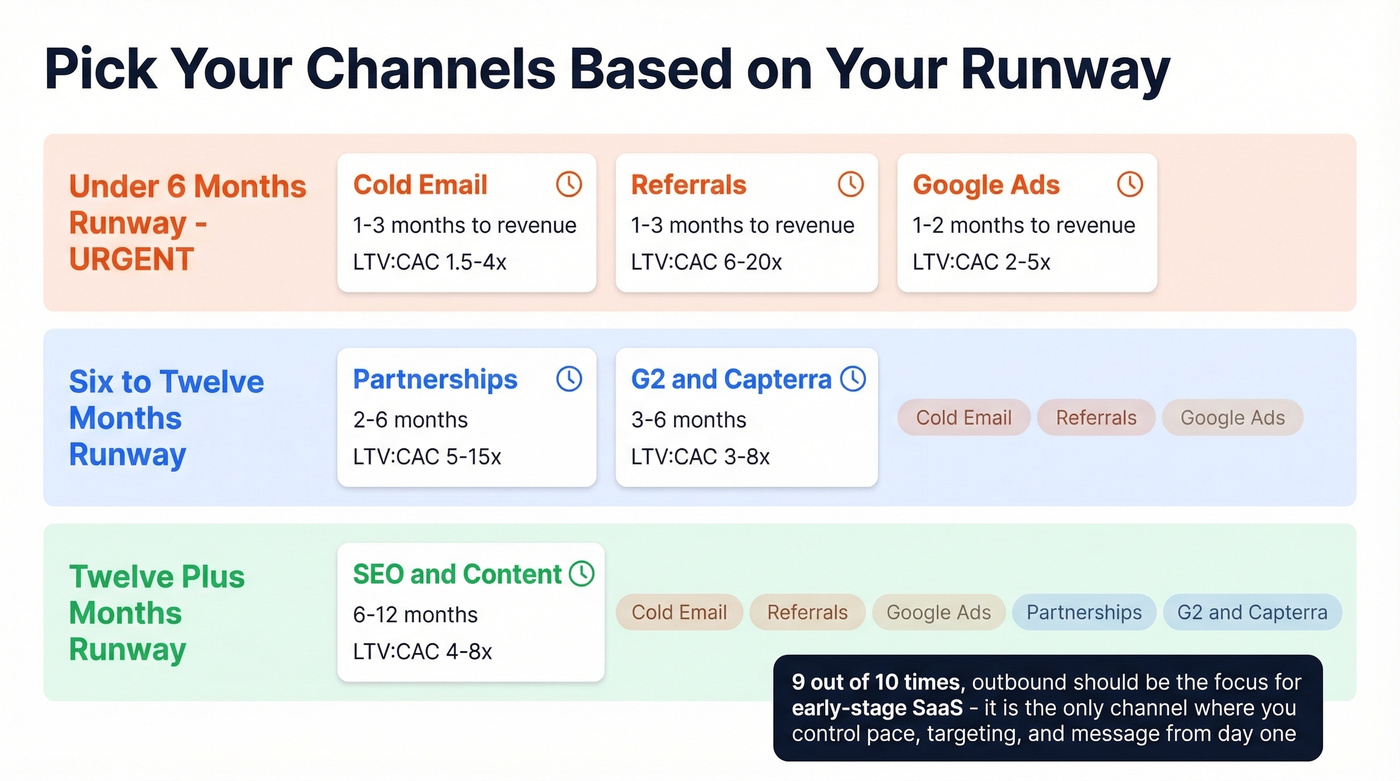
| Channel | Time to Revenue | Expected LTV:CAC |
|---|---|---|
| Referrals | 1-3 months | 6-20x |
| Cold Email | 1-3 months | 1.5-4x |
| Google Ads | 1-2 months | 2-5x |
| Partnerships | 2-6 months | 5-15x |
| G2/Capterra | 3-6 months | 3-8x |
| SEO | 6-12 months | 4-8x |
Three months of runway? Your channels are cold email, referrals, and Google Ads. That's it. SEO is a fantastic long-term play, but it takes 6-12 months to compound. Partnerships sit in the middle: slower to start, but the LTV:CAC ratios are exceptional once they're running.
In our experience, 9 out of 10 times outbound should be the focus for early-stage SaaS. It's the only channel where you control the pace, the targeting, and the message from day one. Any GTM plan for a SaaS startup should treat outbound as the default until inbound catches up. (For tactics, see these sales prospecting techniques.)

Email marketing has the lowest B2B CAC at $510 - but only with clean data. Prospeo's 98% email accuracy and 7-day refresh cycle keep bounce rates under 4%, so your outbound doesn't torch your domain or inflate your CAC.
Fix your data before you scale your GTM motion.
Set Your Pricing and Packaging
Freemium vs Free Trial vs Hybrid
A free trial gives full access for a limited time, typically 7-14 days. It works when your product delivers clear value quickly but needs time pressure to drive conversion. Well-optimized funnels see 15-25% trial-to-paid conversion rates.
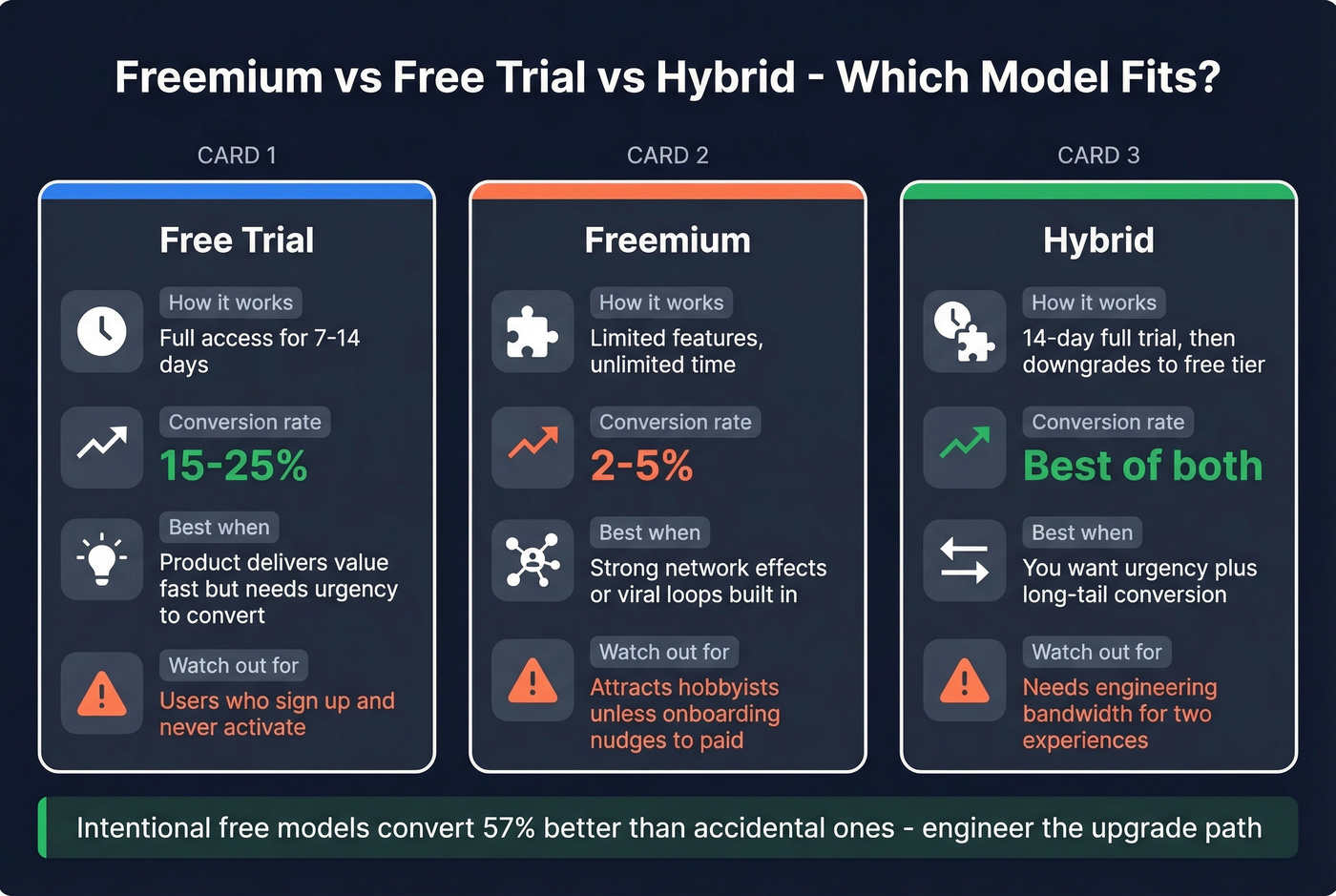
Freemium gives limited features for unlimited time. It works when you have strong network effects or viral loops. But it attracts hobbyists unless your onboarding aggressively nudges toward paid. Expect 2-5% free-to-paid conversion.
The hybrid approach combines both: a 14-day full-access trial that downgrades to a freemium tier if the user doesn't convert. This pattern captures both urgency and long-tail conversion. Skip it if you don't have the engineering bandwidth to build two separate experiences well - a half-baked hybrid is worse than a clean free trial.
Pricing Models for Each Motion
PLG products lean toward usage-based or tiered pricing - low entry point, expansion revenue built in. Sales-led products use seat-based pricing with annual contracts. Hybrid models often start with a self-serve tier and add enterprise pricing for larger accounts.
The ProductLed data shows that intentional free models - where the free tier is deliberately designed to drive upgrades - convert 57% better than accidental ones. If you're offering a free plan, engineer the upgrade path. Don't just strip features and hope for the best.
Building the Outbound Engine
Your first 10 customers come from founder-led sales, not marketing funnels. The founder picks up the phone, sends the emails, runs the demos. There's no shortcut here. (If you need a structure for the first hires, use a 30-60-90 day plan for sales reps.)
Once founder-led sales validates the motion, outbound becomes your scaling engine. But most teams blow it at the same point: they invest in SDRs, sequencing tools, and playbooks - then feed the machine garbage data. Bounced emails don't just waste SDR time at $1,980 per customer. They damage your sending domain, tank deliverability, and create a compounding problem that gets worse every week. (Benchmarks and fixes: email bounce rate.)
Data quality is the #1 execution risk in outbound. It's not the scripts. It's not the cadence. It's whether the emails actually land. (If you're building the stack, start with the right SDR tools.)
One proof point we keep coming back to: Meritt went from a 35% bounce rate to under 4% after switching their data source, and their pipeline tripled from $100K to $300K per week. That's not a tool story - it's a unit economics story. Clean data turned a broken outbound motion into a growth engine.
SDRs cost $1,980 per customer when they're dialing bad numbers. Prospeo gives your reps 125M+ verified mobiles with a 30% pickup rate - cutting ramp time and driving pipeline from day one.
Stop paying enterprise CAC on startup budgets.
Measure What Matters
The metrics that predict GTM success aren't vanity numbers. Track these:
- CAC efficiency ratio - Top-quartile SaaS companies spend $1.00 to acquire $1 of new ARR. Median is $2.00. Bottom quartile is $2.82. Know where you sit.
- LTV:CAC ratio - Target 3:1 minimum. Below that, you're burning cash faster than you're building value.
- CAC payback period - Under 12 months. If it takes 18 months to recoup acquisition costs, your pricing or your channels need to change.
- Free-to-paid conversion - 2-5% for freemium, 15-25% for free trials. Below these ranges, your onboarding is broken.
- Churn - Monthly churn above 3% signals a product or fit problem, not a GTM problem. No amount of acquisition spend fixes a leaky bucket. (If you want a framework, use this churn analysis guide.)
One metric most teams ignore entirely: measuring activity instead of impact. Tracking emails sent, calls made, and demos booked feels productive. But if none of those activities correlate with closed revenue, you're optimizing for motion, not results. Bad contact data is the silent version of this problem - it wastes SDR time, hurts deliverability, and the team never sees it because the activity metrics still look busy. Let's be honest: a go-to-market strategy that doesn't track data quality alongside pipeline metrics is flying blind. (More on what to track: pipeline health.)
GTM Mistakes That Kill SaaS Companies
Hiring a VP of Sales who can't demo the product. We've watched this play out more times than we can count. A founder hires a "proven closer" from a bigger company, hands over the pipeline, and watches 12 months pass with zero closed deals. The first sales hire needs to be a player-coach who can run the full cycle, not a manager who builds org charts. (Use a product demo checklist to keep demos tight.)
Founders leaving sales too early. The moment a founder stops selling, pipeline collapses within a quarter. The handoff needs to be gradual - the founder should co-sell with the first 2-3 reps until the playbook is genuinely repeatable, not just documented.
Cutting marketing to $0. It happens every downturn. The board panics, marketing gets zeroed out, and six months later there's no inbound pipeline. Content and SEO compound - killing them resets the clock entirely.
Targeting enterprise prematurely. A 5-person startup trying to sell to Fortune 500 procurement teams will burn 6-12 months on a single deal that probably won't close. Start with the segment that can buy in 30 days, not the one with the biggest logo.
Trying to sell to everyone. As the Mission Matrix framework puts it: thinking you can sell to everyone means you sell to no one. One ICP, one segment, one channel. Expand after you've won.
FAQ
What's the difference between a GTM strategy and a marketing strategy?
A go-to-market strategy covers the full path to revenue - ICP selection, sales motion, channel mix, pricing, and the actual sales process. Marketing strategy is one component within that. If your "GTM strategy" doesn't include how the deal actually closes or what you charge, it's a marketing plan with a fancier name.
How long does it take to see results from a B2B SaaS GTM plan?
Cold email and referrals produce pipeline in 1-3 months. SEO takes 6-12 months. Most early-stage SaaS companies should expect first revenue within 90 days if they focus on outbound and founder-led sales. The channel you pick determines the timeline more than anything else.
Should an early-stage SaaS company start with PLG or sales-led?
If your ACV is under $5K and time-to-value is under 30 minutes, PLG. Over $50K, sales-led. Most companies in between should run a hybrid motion - let users self-serve, then route high-intent accounts to sales via product-qualified account signals.
How do I build a GTM strategy from scratch?
Start with your ACV to pick your motion, then select one channel based on your runway. Validate with 20 customers through founder-led sales before investing in scalable channels. Set your pricing model, define your ICP tightly, and track CAC payback from day one. The biggest mistake is trying to build a complete strategy before closing a single deal - start narrow, learn fast, expand once unit economics prove out.
What tools do I need for B2B SaaS outbound?
A B2B data platform for verified contact data, a sending tool like Smartlead, Instantly, or Lemlist, and a CRM. That's the stack. Don't over-tool before you have product-market fit - three tools is enough to generate pipeline.