

Go-to-Market Strategy for Marketplace: The 2026 Playbook
A RevOps lead we worked with spent six months "building demand" for a services marketplace - then discovered she had twelve buyers and two suppliers. It died in week 26 because neither side had a reason to show up first.
Marketplaces are eating commerce: 72% of global e-commerce revenue now flows through marketplace platforms. If you're building a go-to-market strategy for marketplace growth in 2026, you need a two-sided plan that creates liquidity fast - not a prettier funnel.
The Short Version
Seed supply first. Always. Demand without supply is a ghost town.
Launch narrow, then expand - density beats breadth every time. And track liquidity, not vanity volume. If buyers can't match fast, nothing else matters.
The Marketplace Cold Start Problem
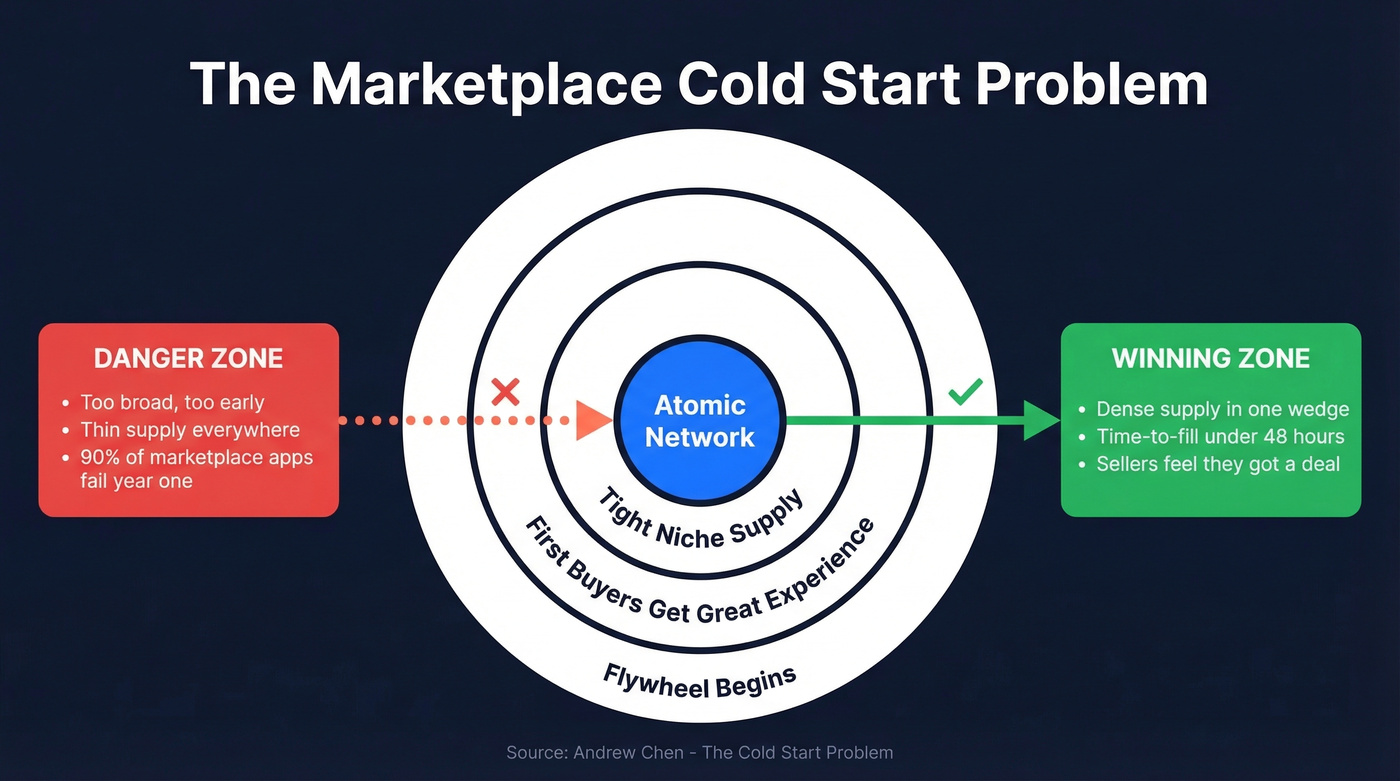
Andrew Chen calls it the "atomic network": the smallest cluster that reliably delivers value. For marketplaces, that means enough relevant supply in a tight niche so the first buyers get a great experience. Until you hit that threshold, you aren't scaling. You're guessing.
Identify the Hard Side
Every marketplace has a hard side - the group that's harder to recruit but creates the initial value. Your early GTM should be built entirely around making that side feel like they're getting a deal: better earnings, better tools, less hassle than whatever they're doing now.
Here's our rule: if you can't name your hard side in one sentence, you aren't ready to spend on acquisition.
Seed Supply Before Anything Else
This phase is unglamorous and manual on purpose. Airbnb recruited hosts one by one and learned professional photos converted roughly 40% better, then operationalized it. Etsy pitched sellers booth-by-booth. OpenTable signed restaurants before diners cared.
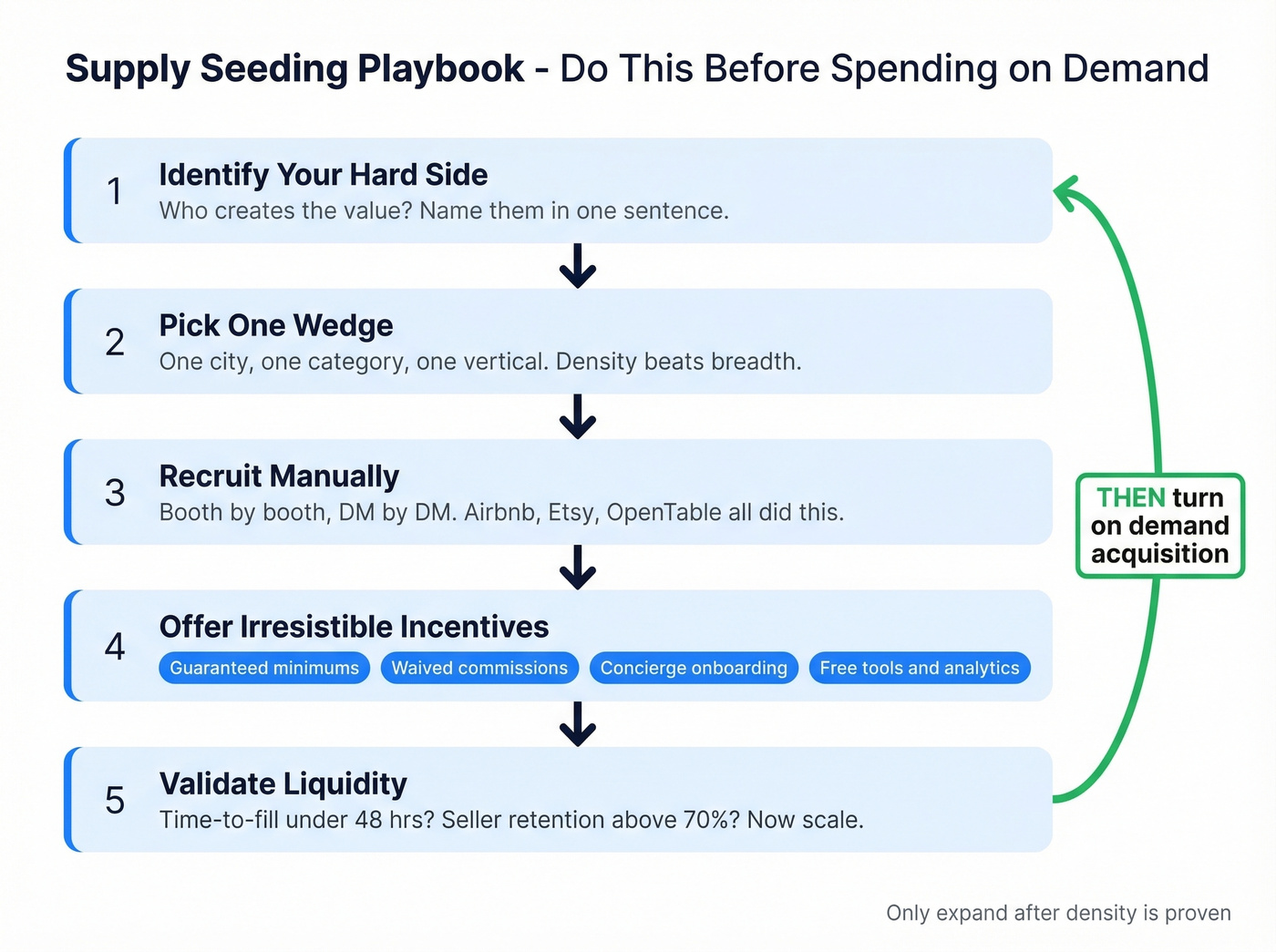
Use a short, proven toolkit: guaranteed minimum earnings or demand, temporarily waived commissions, concierge onboarding, and supplier-side utilities like scheduling, inventory tools, and analytics dashboards. You're not "building a marketplace" yet - you're building a roster that makes buyers trust the platform on day one.
Launch Narrow, Then Expand
Uber worked as "a vast worldwide network of smaller networks." That's the right mental model: marketplaces aren't one network, they're many small ones stitched together over time.
The failure mode is predictable. Spreading across too many categories or geographies before you have density anywhere. First-year failure for two-sided marketplace apps sits at 90%, and "thin liquidity everywhere" is the classic cause.
Pick one wedge - one city, one category, one vertical - and win it. Amazon started with books. Vinted started narrow and proved the model before scaling to new markets. Expansion is a reward for density, not a strategy for finding it.
Let's be honest: if your marketplace needs "national coverage" to be interesting, it's probably not a marketplace yet. It's a directory with checkout.

Scaling past manual supplier outreach is where most marketplaces stall. Prospeo gives you 300M+ professional profiles with 30+ filters - industry, headcount, tech stack, funding - so you can build targeted supplier lists for your exact wedge. 98% email accuracy means your outreach actually lands.
Stop recruiting suppliers one by one. Systematize your supply-side GTM.
Pick a Monetization Model
Most marketplaces start simple and layer complexity later. Here are the core options:
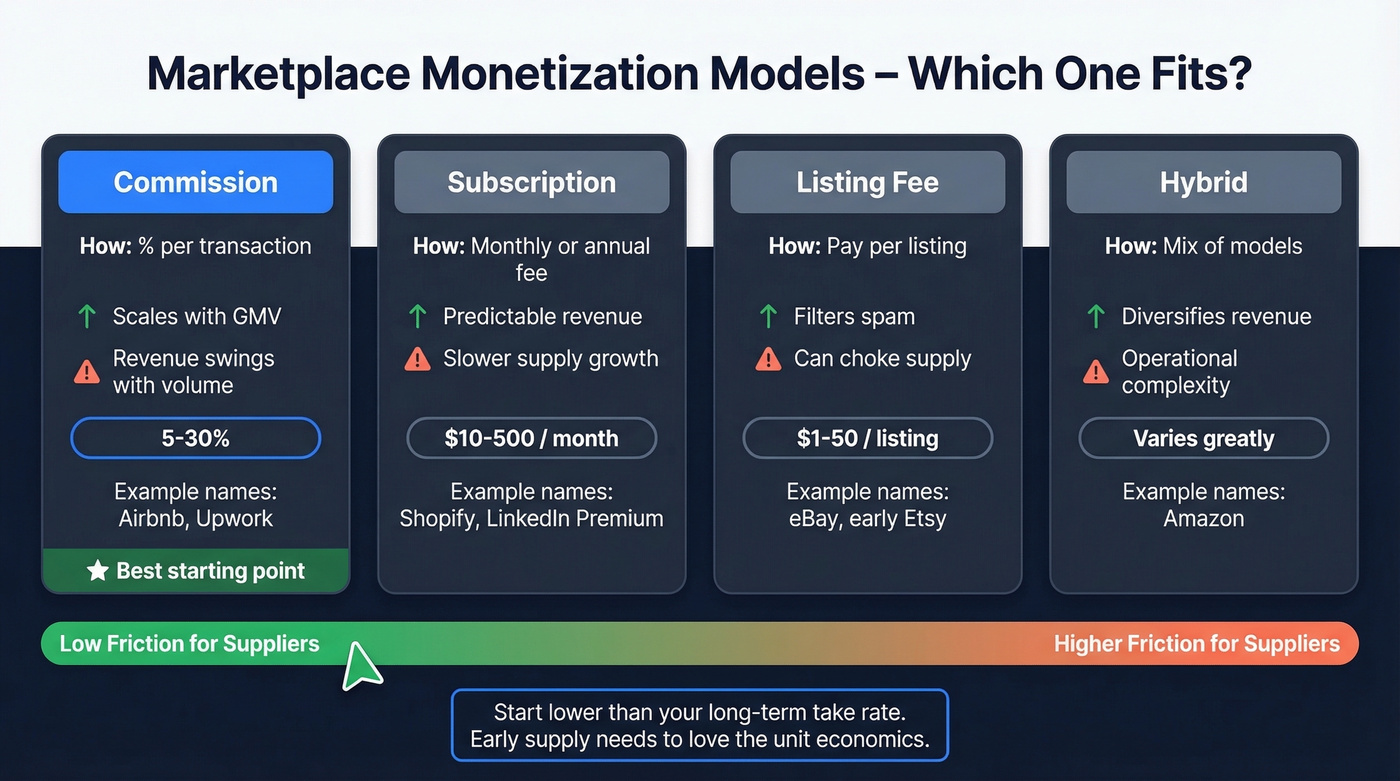
| Model | How It Works | Upside | Tradeoff | Example |
|---|---|---|---|---|
| Commission | % per transaction | Scales with GMV | Revenue swings with volume | Airbnb, Upwork |
| Subscription | Monthly/annual fee | Predictable revenue | Slower supply growth | - |
| Listing fee | Pay per listing | Filters spam | Can choke supply | eBay, Etsy (early) |
| Hybrid | Mix of the above | Diversifies revenue | Operational complexity | Amazon |
Start with commission unless you have a strong reason not to. It aligns incentives, keeps onboarding friction low, and lets you earn more only when your sellers earn more. That alignment matters more than you think in the first 12 months.
Typical take rates: services often land around 15-30%, physical goods 10-20%, and many B2B marketplaces 5-15%. Start lower than your long-term target. Early supply needs to love the unit economics before you optimize your cut.
Build Trust and Safety Early
Trust and safety isn't a post-launch concern. It's GTM. If the marketplace feels sketchy, you'll pay for it forever in refunds, churn, and support load.
Keep the launch bar high: KYC and identity verification at onboarding, a fraud taxonomy that matches your model (triangulation fraud, overpayment scams, bait-and-switch, referral abuse), clear policies for spam and fake listings, and dispute resolution that handles common cases without a human in the loop. The marketplace that feels safe wins. Full stop.
Marketplace KPIs That Actually Matter
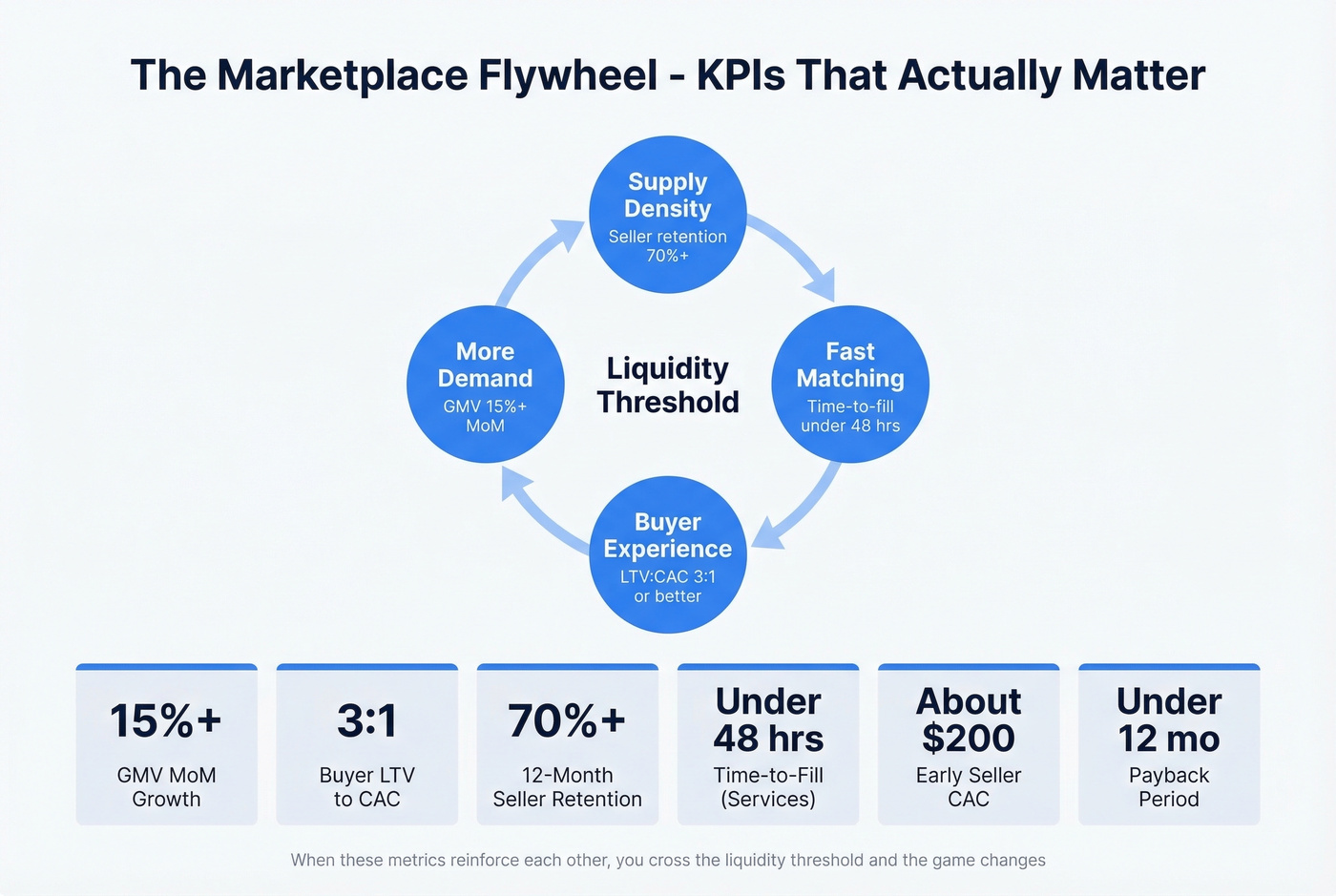
We've watched teams celebrate GMV while their marketplace quietly dies from slow matches and supplier churn. Track liquidity like your business depends on it - because it does.
| KPI | What It Tells You | Target |
|---|---|---|
| GMV | Volume moving through the market | 15%+ MoM early-stage |
| Net Take Rate | Real margin after variable costs | 3%+ net margin |
| Buyer LTV:CAC | Acquisition efficiency | 3:1 or better |
| Seller retention | Supply staying power | 70%+ at 12 months |
| Time-to-fill | How fast buyers get value | Under 48 hrs (services), under 24 hrs (goods) |
| Seller CAC | Cost to acquire one supplier | ~$200 early |
| Buyer CAC | Cost to acquire one buyer | ~$20 early |
| Payback period | How fast CAC returns | Under 12 months |
When these reinforce each other, you get the flywheel: better supply density improves time-to-fill, which improves buyer experience, which brings demand, which attracts more supply. a16z's network-effects research frames this as a liquidity threshold - once you cross it, the game shifts from "can we match?" to "are we the best place to transact?"
The consensus on r/startups threads about marketplace metrics is pretty clear: founders who obsess over GMV too early tend to paper over liquidity problems with paid acquisition, which just accelerates the death spiral.
Scaling Past Manual Outreach
Door-to-door supplier recruiting works at 50 suppliers. It breaks at 500.
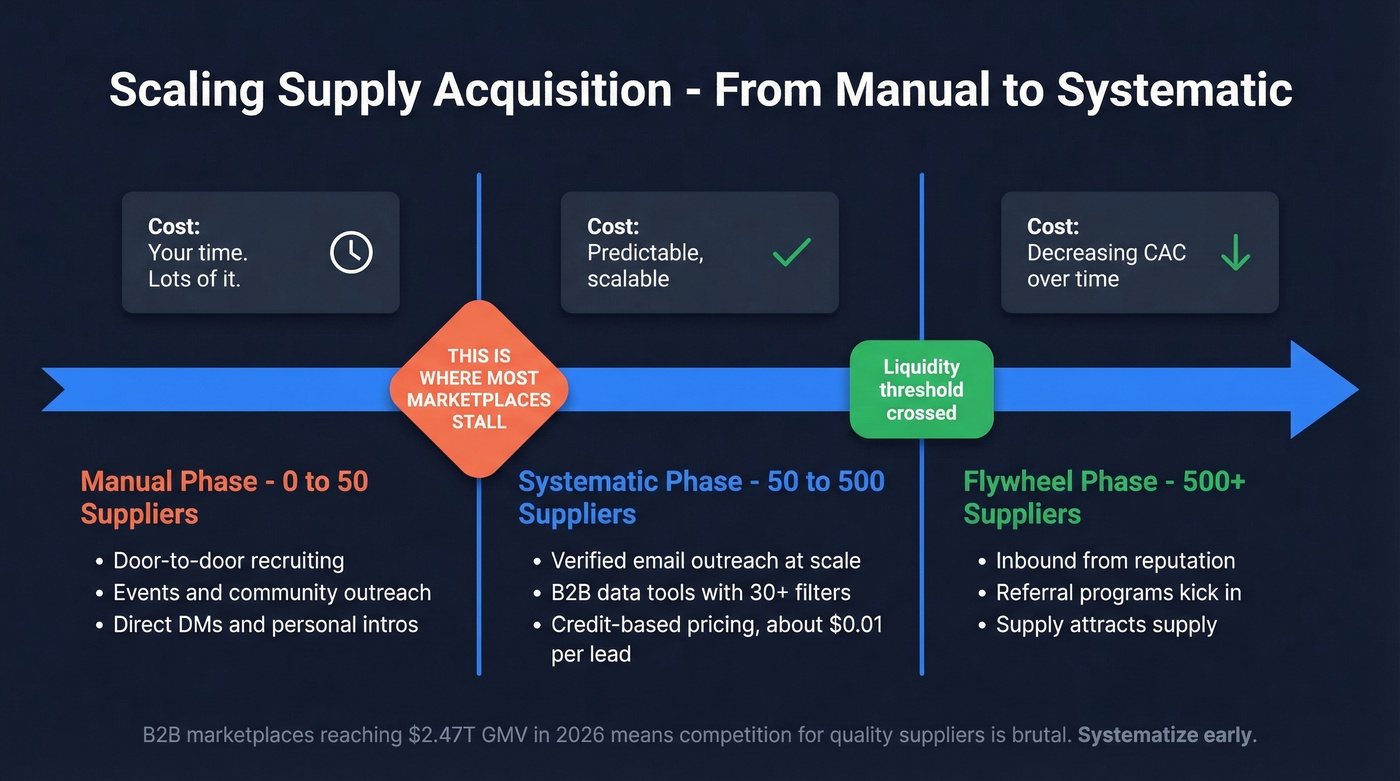
Scaling supply acquisition looks different in B2B vs B2C. B2B is slower and stakeholder-heavy, while B2C is more self-serve and emotional - so your acquisition engine needs to match your market. In 2026, B2B marketplaces are reaching $2.47T in GMV, which means competition for quality suppliers is brutal.
When you're ready to systematize B2B supply outreach, you need accurate, fresh contact data without locking yourself into an enterprise contract. We've used Prospeo for this kind of targeted seller prospecting - 300M+ professional profiles with a 7-day refresh cycle and 98% verified email accuracy mean you're not burning outreach on stale data. The free tier covers 75 verified emails per month, which is plenty for early-stage marketplace founders validating a niche before scaling spend.
If you want to go deeper on list-building mechanics, 30+ filters are only useful when your target supplier profile is tight.
Skip this approach if you're running a pure C2C marketplace where sellers self-list organically. But for any B2B or managed marketplace where you're actively recruiting supply? Systematic outbound is how you break past the manual ceiling.
To make outbound work at scale, you’ll also want a repeatable cold email sequence, strong sales prospecting techniques, and clean deliverability basics (see email deliverability and email bounce rate).
Your marketplace cold start problem is really a contact data problem. You need to reach the hard side - fast, accurately, and without enterprise contracts. Prospeo's 7-day data refresh and 92% enrichment match rate mean every outreach hits a real person, not a stale inbox. Start free with 75 verified emails per month.
Solve cold start with fresh, verified contact data at $0.01 per email.
FAQ
What's the biggest mistake in marketplace GTM?
Buying demand before supply is dense enough to deliver a great first experience. Seed supply in one niche, create liquidity, then turn on demand acquisition. Most failed marketplaces die from thin supply, not low awareness.
How long does it take a marketplace to reach liquidity?
Plan for 6-18 months in a single niche or city. If you expand before time-to-fill drops below 48 hours and seller retention tops 70%, you're multiplying your problems, not solving them.
How do I find and contact potential sellers at scale?
Start with manual channels - events, communities, direct outreach. Once the niche is proven, use a B2B data tool to pull verified emails for your target supplier profile and run outreach at volume. Credit-based pricing at roughly $0.01 per lead keeps costs predictable while you're still finding product-market fit.
Which monetization model works best for new marketplaces?
Commission in the 10-20% range for goods and 15-30% for services is the safest starting point. It keeps onboarding friction low, aligns your revenue with seller success, and avoids the supply-choking effect of upfront listing or subscription fees.