

The Go-to-Market Strategy Template Built for Founders, Not Marketers
Most go-to-market strategy templates for startups are 2,000-word essays explaining what GTM means, followed by an email gate hiding a mediocre PDF. They're built for marketing VPs at Series C companies - not the founder who's also writing code, closing deals, and answering support tickets.
A GTM strategy shouldn't take a week. It should take an afternoon. Let's build one.
What You Need (Quick Version)
Pick your speed:
- Need a GTM plan today? Duplicate a simple Notion template. Fill it in over 10-20 minutes. Ship it.
- Need an investor-ready GTM deck? Use the 12-slide structure below. Budget half a day with your co-founder and a Miro board.
- Need to go outbound now? Skip to "Build Your Prospect List" and start pulling verified contacts this afternoon.
The 12-Slide GTM Template
This structure draws from Startmate's GTM walkthrough, and it's the most practical deck framework we've found for early-stage teams. Open a Miro board, pull in the Value Proposition Canvas, an Empathy Map, and HubSpot's Buying Centre docs, fill them out with your team, then compress everything into these 12 slides.
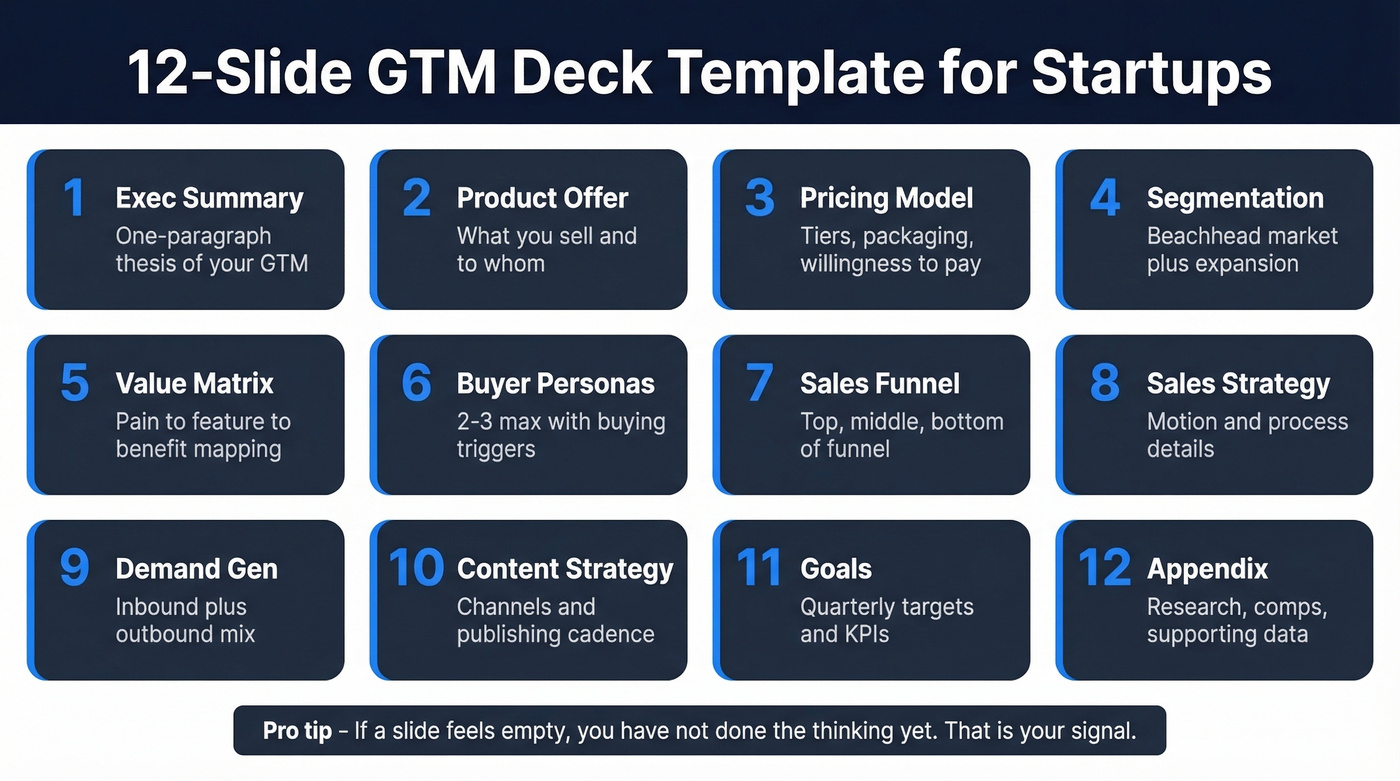
| Slide | Section | What Goes Here |
|---|---|---|
| 1 | Exec Summary | One-paragraph thesis |
| 2 | Product Offer | What you sell, to whom |
| 3 | Pricing Model | Tiers, packaging, WTP |
| 4 | Segmentation | Beachhead + expansion |
| 5 | Value Matrix | Pain → feature → benefit |
| 6 | Buyer Personas | 2-3 max, with triggers |
| 7 | Sales Funnel | TOFU / MOFU / BOFU |
| 8 | Sales Strategy | Motion + process |
| 9 | Demand Gen | Inbound + outbound mix |
| 10 | Content Strategy | Channels + cadence |
| 11 | Goals | Quarterly targets + KPIs |
| 12 | Appendix | Research, comps, data |
Twelve slides forces clarity. You can't hide behind buzzwords when each slide gets one job. If a section feels empty, that's your signal - you haven't done the thinking yet. Once the deck is complete, export it as a PDF so every stakeholder - advisors, investors, early hires - can reference the same document without needing access to your Miro board.
Choose Your GTM Motion
Your average deal size determines your motion. Don't overthink this.
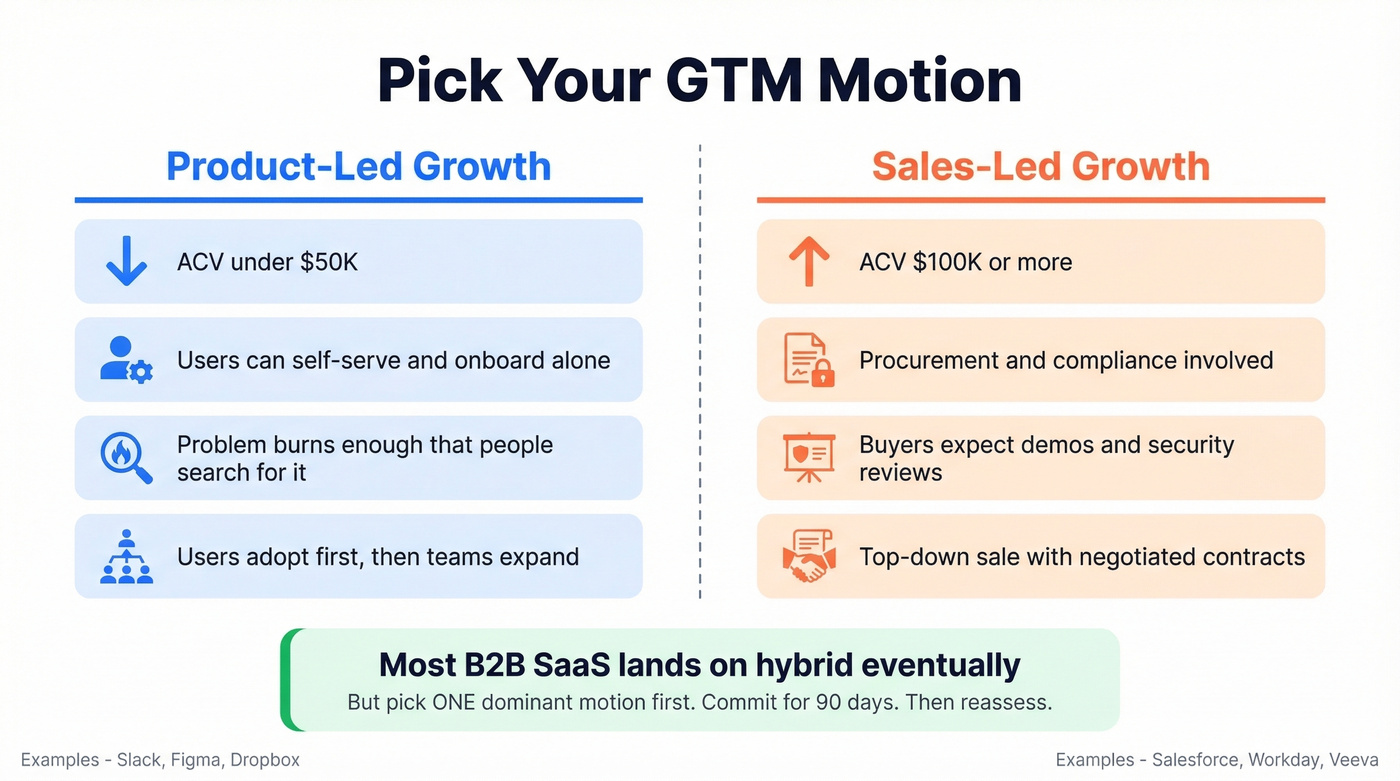
Product-led growth works when ACV is under $50K, users can self-serve, and the problem burns enough that people actively search for solutions. Think Slack, Figma, Dropbox - users adopt, then teams expand. Sales-led works when deals run $100K+, procurement and compliance are involved, and buyers expect demos, security reviews, and negotiated contracts.
Most B2B SaaS companies land on hybrid eventually - PLG for adoption, sales for expansion. The General Catalyst insight worth remembering: one motion should be dominant. Pick a lead, then layer the other as you grow. In our experience, most seed-stage founders default to hybrid and end up doing neither well. Pick one. Commit for 90 days. Then reassess.

You've picked your GTM motion. Now you need contacts that actually connect. Prospeo gives you 30+ filters - buyer intent, technographics, funding stage, headcount growth - to turn your ICP into a verified prospect list in minutes, not days. 98% email accuracy, 7-day data refresh, starting at $0.01 per email.
Stop planning your GTM and start executing it with real data.
Define Your ICP and Pick a Channel
Most founders confuse ICP with TAM. Your ICP isn't "mid-market SaaS companies." It's 200 specific accounts that match five criteria and could buy this quarter.
One GrowthX case study nailed this: a founder narrowed from "all high schools" to 200 targets filtered by sports program strength, geography, and budget signals. That's the "Mr/Ms Right Now" framework - who needs this today, not someday.
Once you've got your ICP, use the Bullseye framework to pick your channel. Brainstorm all 19 traction channels, rank them by expected impact, prioritize the top 3 for cheap tests, then focus 80% of effort on the one that works. Most companies acquire 70%+ of their customers from a single channel. Spreading budget across six channels is how you burn cash without learning anything.
| Channel Group | Channels |
|---|---|
| Paid | SEM, Social Ads, Offline Ads |
| Organic | SEO, Content, Email, Viral |
| Outbound | Sales, BD, Affiliates |
| Community | Events, Speaking, Community |
| Creative | PR, Unconventional PR, Engineering as Marketing |
| Platform | Existing Platforms, Trade Shows, Targeting Blogs |
Here's the thing: if your deal size is under $10K, you probably don't need a go-to-market checklist with 47 line items. You need 200 accounts, one channel, and a reason those people should care. Everything else is procrastination dressed up as planning.
Build Your Prospect List
This is where most GTM templates fail you. You've defined your ICP, narrowed to 200 target accounts, picked outbound as your channel - and the template says "build a prospect list" with zero guidance on how.
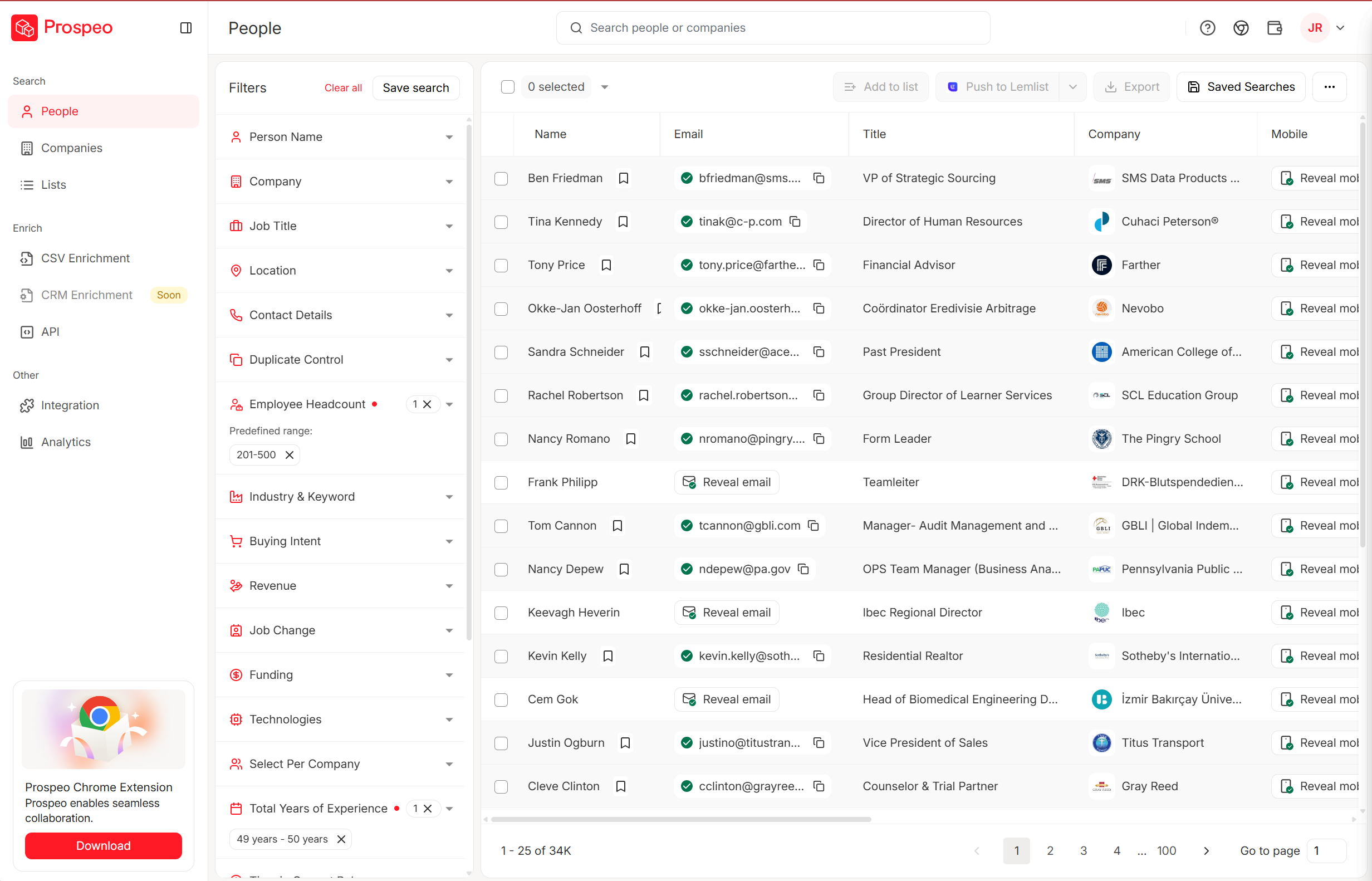
Prospeo handles this step. Upload your 200 target companies or use 30+ search filters - buyer intent signals powered by Bombora, technographics, headcount growth, funding stage - to pull verified emails and mobile numbers from 300M+ professional profiles. You get 98% email accuracy with data refreshed every 7 days. The free tier gives you 75 verified emails per month plus 100 Chrome extension credits, enough to test your outbound channel before committing budget.
Set Benchmarks and KPIs
You can't manage a GTM motion without numbers. Most startup launch guides give you blended averages - here's what each channel actually costs in 2026.
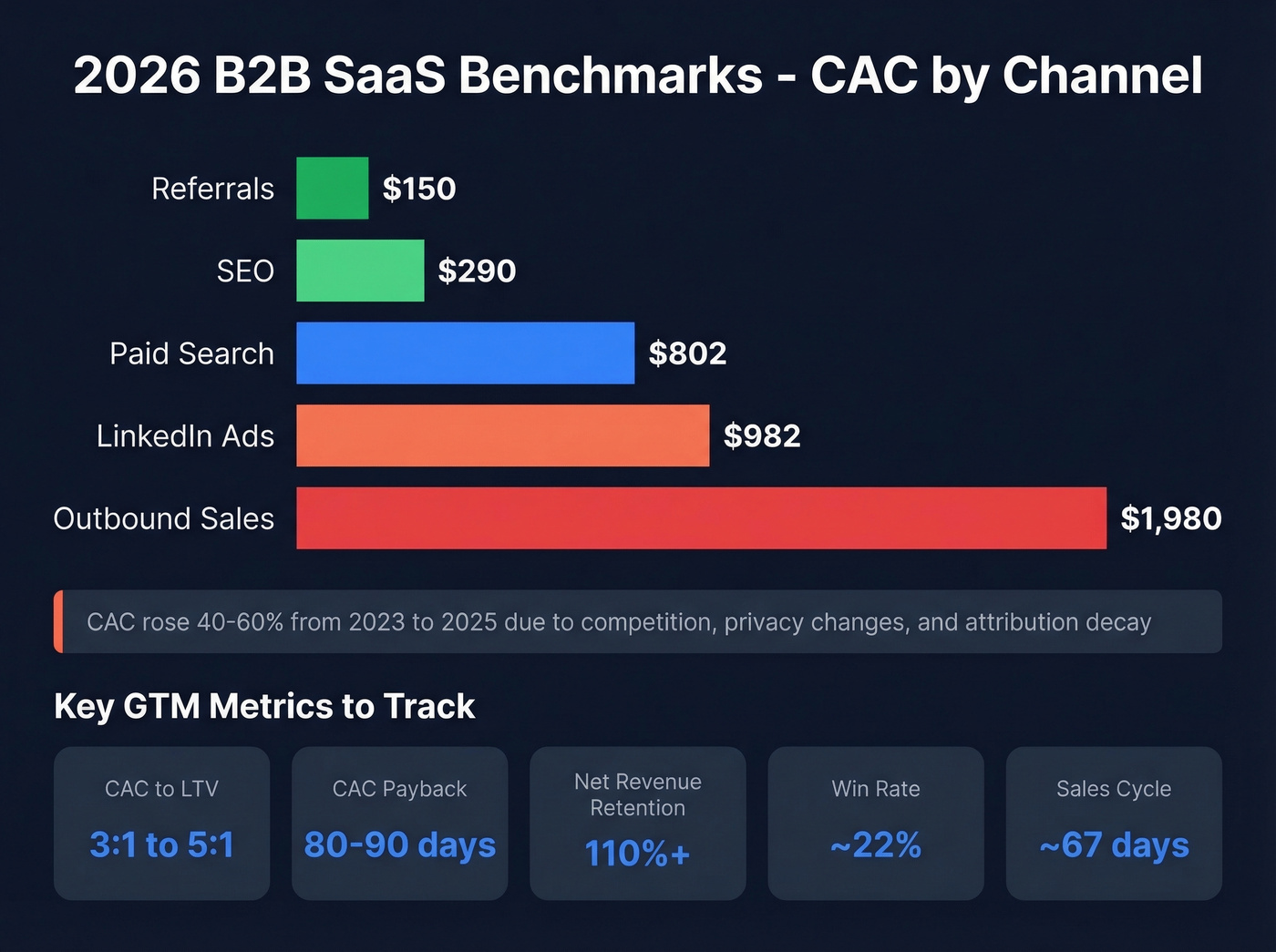
| Channel | Avg CAC (B2B) |
|---|---|
| Referrals | ~$150 |
| SEO | ~$290 |
| Paid Search | ~$802 |
| LinkedIn Ads | ~$982 |
| Outbound Sales | ~$1,980 |
These numbers have climbed sharply - CAC rose 40-60% from 2023 to 2025 thanks to increased competition, privacy changes, and attribution decay. Plan accordingly.
| Metric | Target |
|---|---|
| CAC:LTV | 3:1 - 5:1 |
| CAC Payback | 80-90 days |
| Net Revenue Retention | 110%+ |
| Win Rate | ~22% |
| Sales Cycle | ~67 days |
For funnel planning, use these as solid starting assumptions: visitor-to-trial conversion at 2-5%, trial-to-paid at 10-25%, and demo-to-close around 22%. Bad prospect data inflates your CAC before you even start measuring - one of our customers, Meritt, saw bounce rates drop from 35% to under 4% after switching to verified data, which tripled their pipeline from $100K to $300K per week.
If you want to go deeper on CAC math and what actually moves it, see our guide to cost to acquire customer.
7 GTM Mistakes That Kill Startups
1. Confusing GTM with marketing. Running ads isn't a strategy. Define your ICP, buying process, and value prop before spending a dollar on tactics.
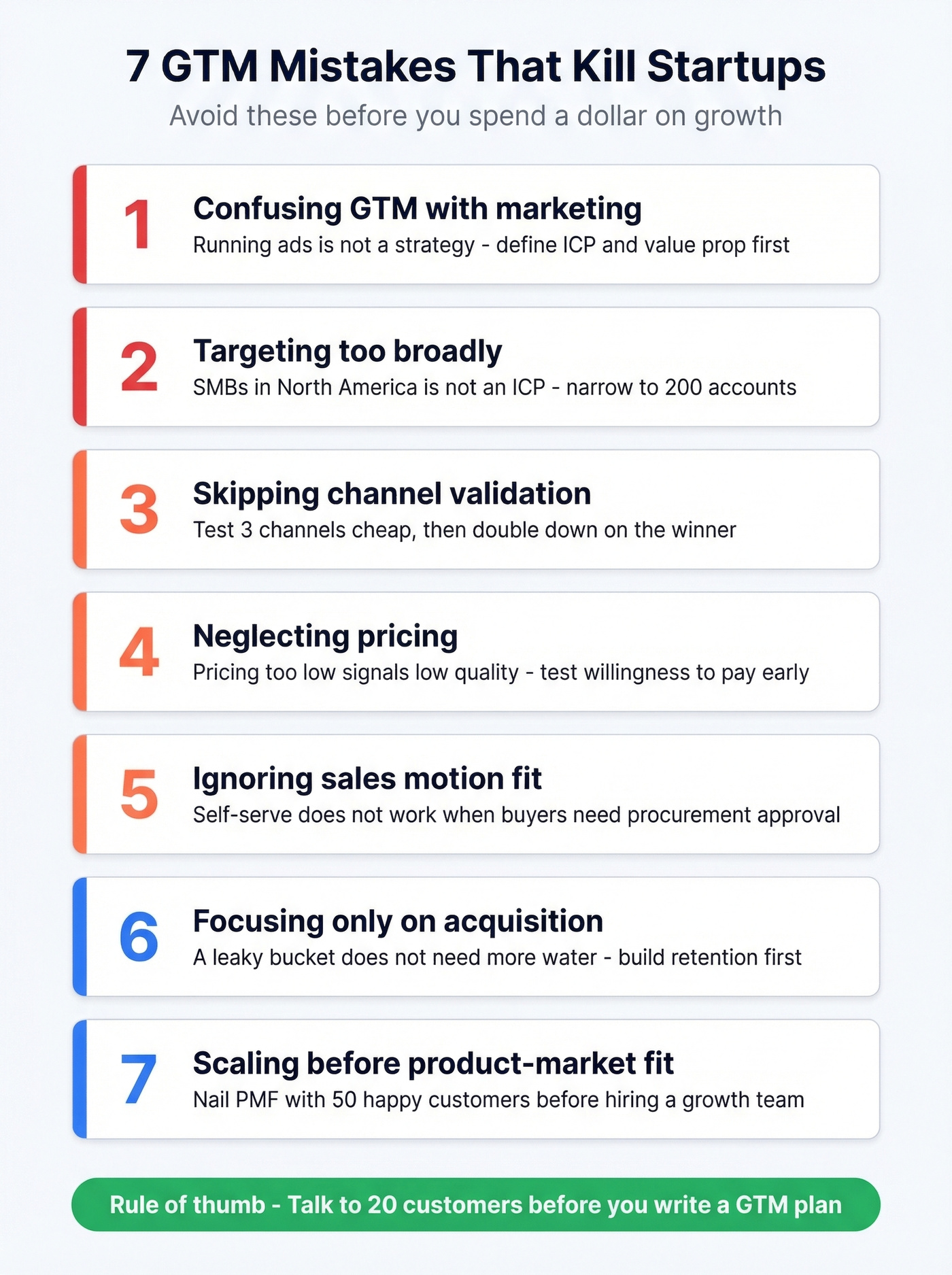
2. Targeting too broadly. "SMBs in North America" isn't an ICP. Narrow to 100-200 accounts with shared, specific characteristics. If you need a structure, use an Ideal Customer Profile Template.
3. Skipping channel validation. Your first channel works briefly, then CAC spikes. Use the Bullseye framework - test three, double down on the winner.
4. Neglecting pricing. Pricing too low signals low quality. Run willingness-to-pay tests before launch, not after. This one's surprisingly common among technical founders who feel awkward charging real money.
5. Ignoring sales motion fit. Assuming self-serve works when buyers need procurement approval. Match your motion to how customers actually buy.
6. Focusing only on acquisition. A leaky bucket doesn't need more water. Build retention and referral loops from day one. (If you're seeing churn, start with a simple churn analysis.)
7. Scaling before product-market fit. We've seen founders burn their entire seed round on growth while the product churns users. Nail PMF with 50 happy customers before you hire a growth team.
Skip the 47-item GTM checklist if you haven't talked to 20 potential customers yet. One founder on r/SaaS shared an internal strategy doc revealing $300K+ wasted on marketing before they had a real GTM plan. Every mistake above was in that doc.
If you're executing outbound, pair this with a few proven sales prospecting techniques and a tight B2B cold email sequence. When replies come in, these sales follow-up templates help you keep momentum without sounding robotic.
Bad data inflates your CAC before you send a single email. Meritt cut bounce rates from 35% to under 4% and tripled pipeline to $300K/week with Prospeo's verified contacts. Your GTM strategy deserves data that won't torch your domain on day one.
Get 75 free verified emails and test your outbound channel today.
FAQ
How long should a startup GTM strategy take?
A simple Notion template takes 10-20 minutes and gives you enough clarity to start executing. The full 12-slide deck takes half a day with your co-founder. Don't spend a week - the deck format forces brevity, which forces real thinking.
What's the difference between a GTM strategy and a marketing plan?
A go-to-market strategy covers the full motion: ICP definition, pricing, channel selection, sales motion, and success metrics. A marketing plan is one execution slice within that. Most founders confuse the two and end up with campaigns that have no strategic foundation.
How do I build a prospect list for outbound GTM?
Narrow your ICP to roughly 200 target accounts using firmographic and behavioral criteria, then use a B2B data platform to pull verified emails and direct dials for decision-makers. Prospeo's free tier lets you validate your outbound channel before committing budget - pair it with tools like Instantly or Lemlist for sequencing.
What's a good free GTM template for early-stage founders?
Erwan Derlyn's Notion template is the fastest option - duplicate and fill in 10-20 minutes. For investor-ready decks, use the 12-slide structure above in Miro or Google Slides. Both are free and built for founders, not enterprise PMMs.