

The Go-to-Market Strategy Framework That Replaces Your 40-Slide Deck
A RevOps lead we know spent six weeks building a GTM deck - 42 slides, gorgeous charts, three rounds of executive feedback. The go-to-market strategy framework behind it was broken. The product launched to crickets.
Industry estimates suggest 95% of new products fail, and it's rarely because the strategy doc wasn't polished enough. Here's the reframe that matters: a go-to-market strategy isn't a launch checklist. It's a buyer-engineering system - a theory of why a specific buyer will choose you, how they'll find you, and what will make them stay. Everything else is decoration.
The Short Version
If you're building your first GTM plan, lean on three frameworks: Crossing the Chasm for market sequencing, PLG/SLG/MLG for choosing your motion, and the 4Ps for tactical completeness. Below you'll find an 8-step process to build a testable GTM plan in days, benchmarks most guides don't include, and the 10 mistakes that kill most launches. Skip the 40-slide deck. Build a one-page GTM brief and start testing.
What Is a GTM Strategy Framework?
A go-to-market strategy framework is the structural logic behind how you bring a product to buyers. It's not a marketing plan. A marketing plan lives inside a GTM strategy - it's one department's piece of a cross-functional system that also includes product, pricing, sales motion, and channel design.
The Ansoff Matrix clarifies when you need a formal GTM framework. Selling an existing product to an existing market? Your GTM intensity is low - you're optimizing, not launching. The moment you introduce a new product or enter a new market, complexity jumps. New product into a new market? That's maximum GTM intensity, and you need a rigorous framework or you're guessing with real money.
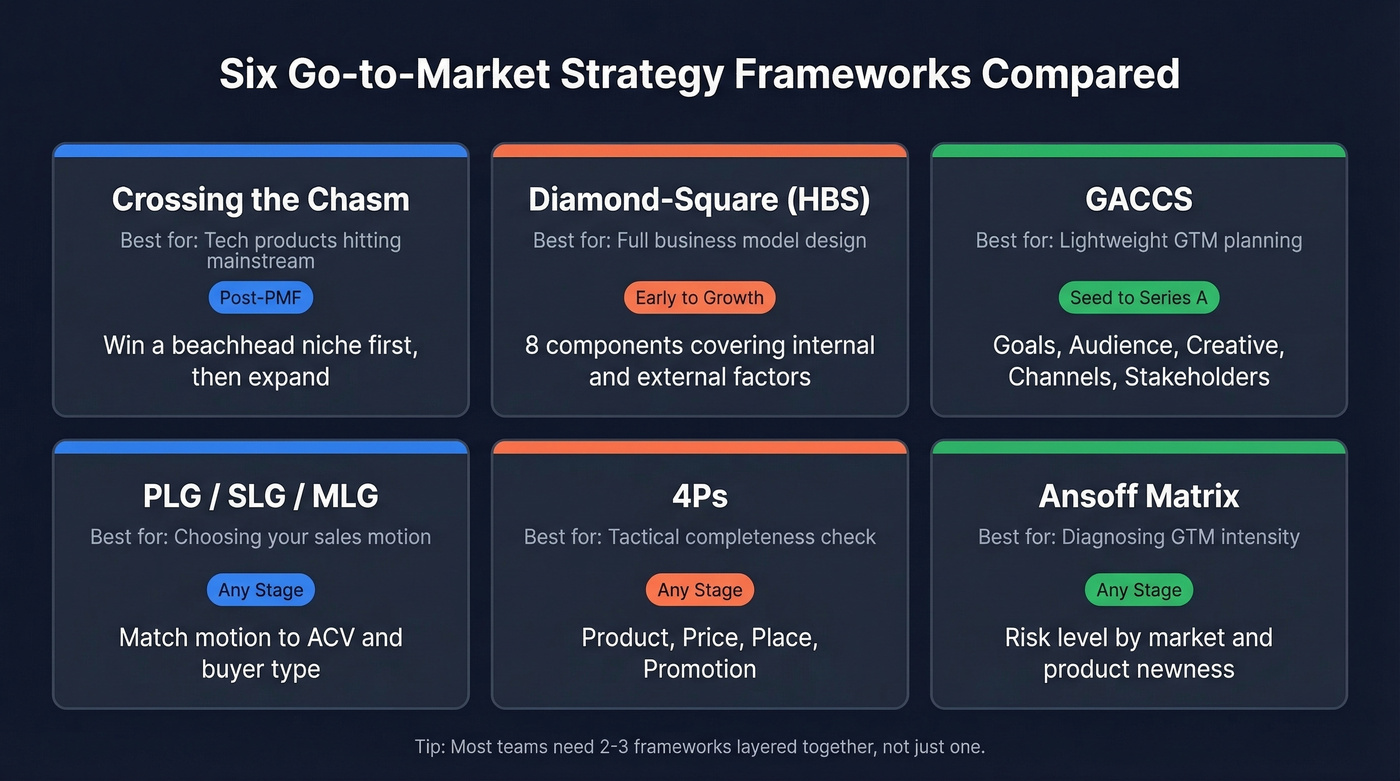
Six GTM Frameworks Compared
| Framework | Best For | Company Stage | Core Idea | Limitation |
|---|---|---|---|---|
| Crossing the Chasm | Tech products hitting mainstream | Post-PMF, pre-scale | Win a beachhead niche first | Less useful for non-tech |
| Diamond-Square (HBS) | Full business model design | Early to growth | 8 components, internal + external | Academic; heavy to implement |
| GACCS | Lightweight GTM planning | Seed to Series A | Goals, Audience, Creative, Channels, Stakeholders | Too simple for complex orgs |
| PLG / SLG / MLG | Choosing your sales motion | Any stage | Match motion to ACV and buyer type | Not a full GTM plan alone |
| 4Ps | Tactical completeness check | Any stage | Product, Price, Place, Promotion | Doesn't address sequencing |
| Ansoff Matrix | Diagnosing GTM intensity | Any stage | Risk by market/product newness | Tells you risk level, not what to do |
Crossing the Chasm
This is the most important GTM framework that most guides skip entirely. Geoffrey Moore's model breaks the market into five adoption segments: Innovators, Early Adopters, Early Majority, Late Majority, and Laggards. The "chasm" sits between Early Adopters and Early Majority - and it's where most tech products die.
Early Adopters buy on vision. The Early Majority buys on proof, reliability, and support. Completely different buying psychology. Three moves get you across: pick a beachhead niche within the Early Majority and dominate it; build the whole product - not just features, but integrations, training, support, and everything the pragmatic buyer needs to feel safe; then use reference customers and case studies relentlessly to reduce perceived risk. If you're a B2B SaaS company past initial traction but struggling to scale, this framework is probably the one you need.
Diamond-Square (HBS)
Thomas Eisenmann's model from Harvard Business School visualizes eight business model components. Internal: Customer Value Proposition, GTM approach, Profit Formula, and Technology & Operations. External: Founders, Team, Investors, and Partners. It forces you to think about GTM as part of a broader business model, not in isolation.
Best for founders building investor-facing GTM narratives or teams doing a full strategic reset. Don't use this for a quick product launch - it's overkill.
GACCS
Goals, Audience, Creative, Channels, Stakeholders. That's it. GACCS is the lightweight GTM framework for smaller teams that need structure without overhead. Seed-stage company with three people and a GTM plan due Friday? GACCS gets you there. It won't handle complex multi-segment launches, but it forces the right conversations early.
PLG / SLG / MLG
Product-led, sales-led, and marketing-led growth aren't full frameworks - they're motion choices that sit inside your broader strategy. But choosing the wrong motion is one of the most expensive GTM mistakes you can make. We break this down below.
4Ps and Ansoff
The 4Ps (Product, Price, Place, Promotion) remain useful as a tactical completeness check - run your GTM plan through them before launch to make sure you haven't missed a basic lever. The Ansoff Matrix is diagnostic. Use it to calibrate how much rigor your situation actually demands.
PLG vs. SLG vs. Hybrid
The ACV heuristic is the fastest way to narrow this down. PLG converts reliably below $5K ACV. Sales-led growth wins above $25K. The $5K-$25K range is hybrid territory, and it's where most B2B SaaS companies live.
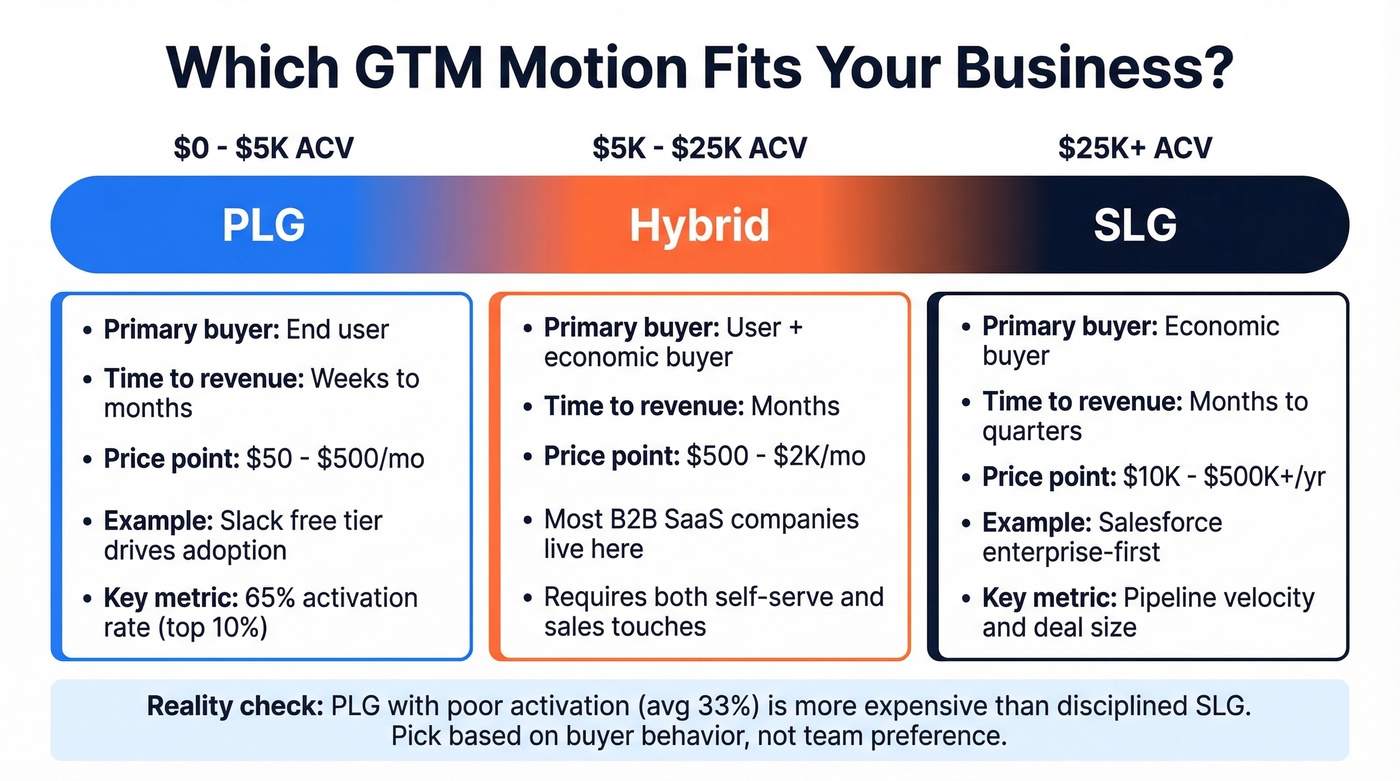
| Dimension | PLG | Hybrid | SLG |
|---|---|---|---|
| ACV range | Under $5K | $5K-$25K | $25K+ |
| Primary buyer | End user | User + economic buyer | Economic buyer |
| Time to first revenue | Weeks to months | Months | Months to quarters |
| Typical price point | $50-$500/mo | $500-$2K/mo | $10K-$500K+/yr |
Slack is the textbook PLG-to-enterprise evolution: free product drives adoption, then enterprise sales closes the big contracts. Salesforce went the other direction - sales-led from day one, then added self-serve trials later. The lesson isn't that one motion is better. It's that your motion should match your buyer's purchasing behavior, not your team's preferences.
Let's be honest about something we see constantly: most teams pick PLG because it sounds cheaper. But PLG with poor activation is more expensive than sales-led with a disciplined pipeline. Top 10% PLG companies hit 65%+ activation rates. The average sits at 33%. If you can't build a product that activates itself, don't pretend you're product-led.

Every GTM framework above assumes one thing: you can actually reach your ICP. 300M+ profiles, 30+ filters including buyer intent, technographics, and headcount growth - Prospeo gives you the targeting layer your go-to-market plan needs. 98% email accuracy means your launch outbound won't bounce.
Stop building GTM decks on bad data. Build them on verified contacts.
How to Build a GTM Plan - 8 Steps
A founder GTM breakdown on r/SaaS mirrors what we've seen work in practice: the steps below are the operational backbone, and each one maps to a decision that, if skipped, creates compounding problems downstream.
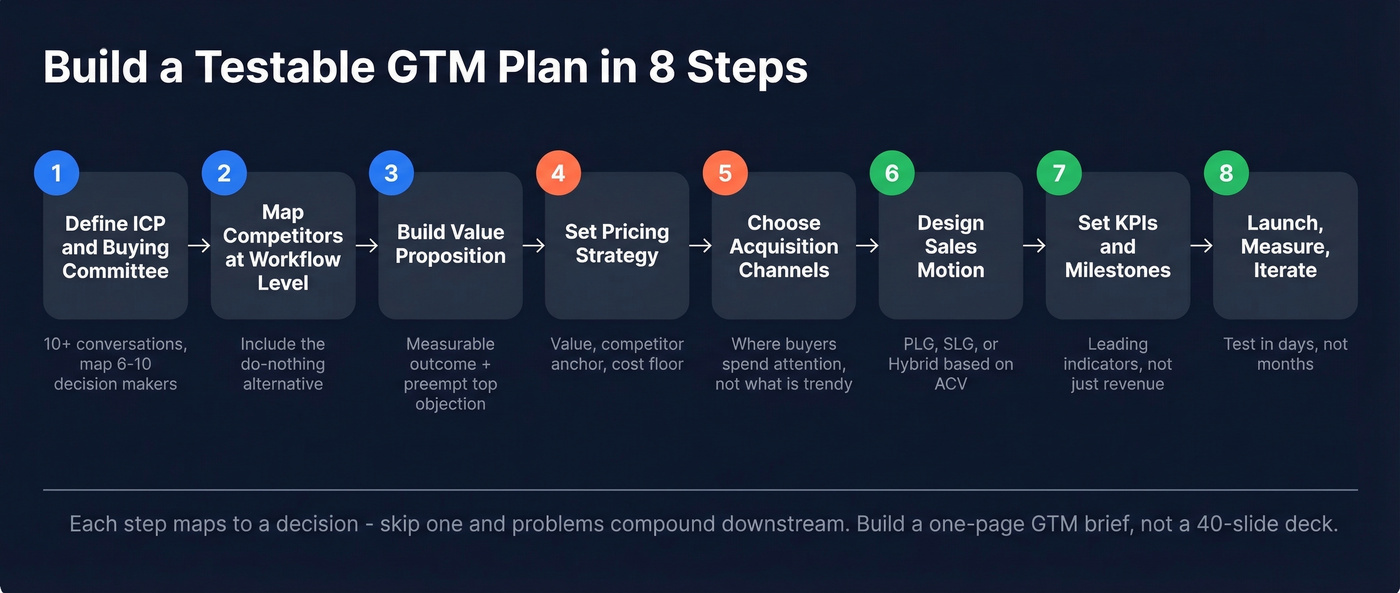
Step 1: Define Your ICP and Buying Committee
Start by talking to people who match your ideal customer profile. Aim for at least 10 conversations before you finalize anything. You're not validating your product - you're mapping the buying reality.
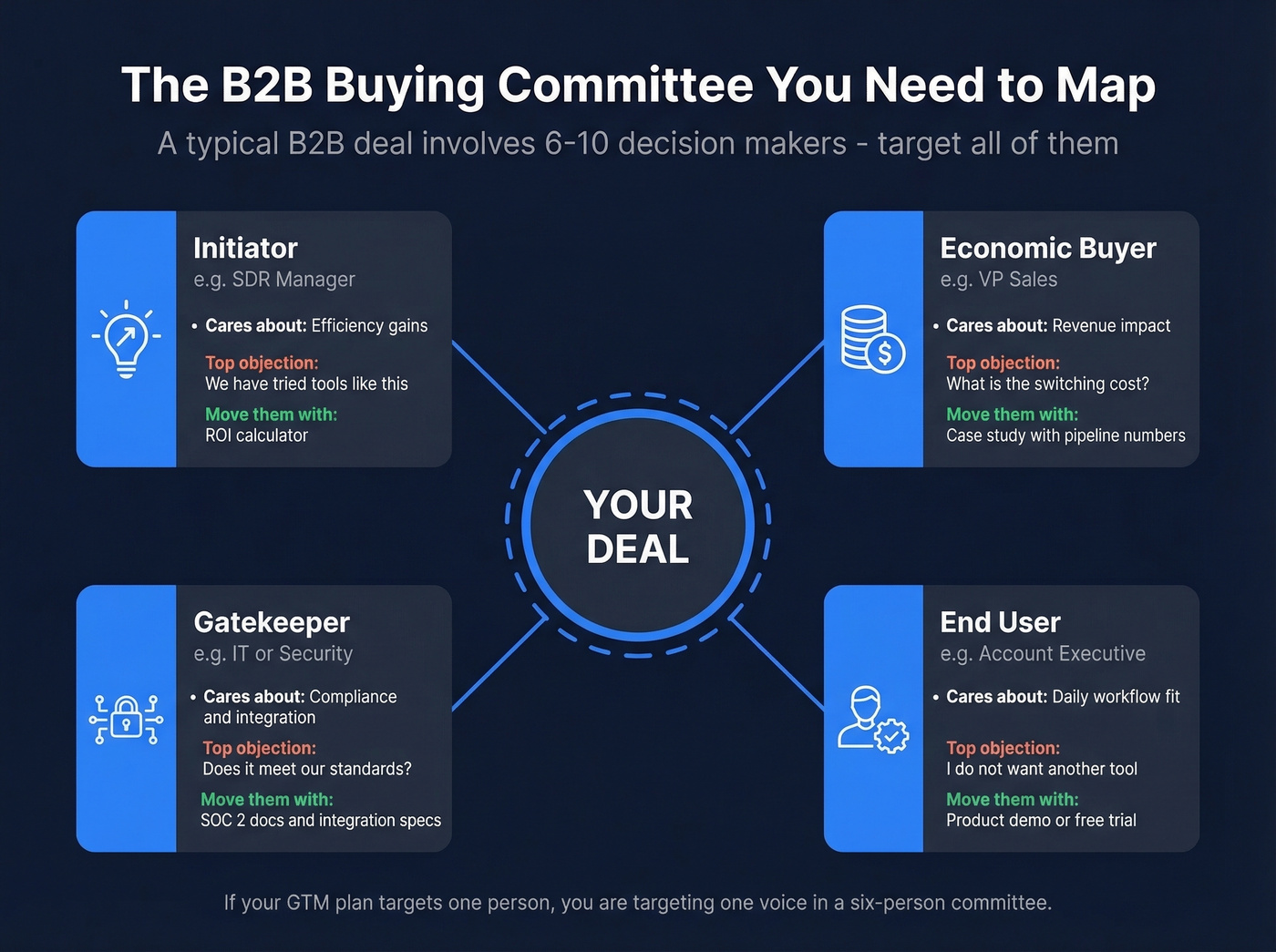
Gartner's data shows a typical B2B purchase involves 6-10 decision-makers, each with a different role. If your GTM plan targets "the VP of Marketing," you're targeting one person in a six-person committee. That's how deals stall.
Build a buying committee map for your top three ICP segments:
| Role | Priority | Top Objection | Content That Moves Them |
|---|---|---|---|
| Initiator (e.g., SDR Manager) | Efficiency gains | "We've tried tools like this" | ROI calculator, competitor comparison |
| Economic Buyer (e.g., VP Sales) | Revenue impact | "What's the switching cost?" | Case study with pipeline numbers |
| End User (e.g., AE) | Daily workflow fit | "I don't want another tool" | Product demo, free trial |
| Gatekeeper (e.g., IT/Security) | Compliance, integration | "Does it meet our standards?" | SOC 2 docs, integration specs |
This isn't optional. It's the foundation everything else sits on.
Step 2: Map Competitors at the Workflow Level
Don't just list competitors and their features. Map how your buyer currently solves the problem - including doing nothing. The "do nothing" alternative is your biggest competitor in most B2B sales cycles.
If your prospect uses a spreadsheet, three browser tabs, and a weekly meeting to accomplish what your product does, your GTM messaging needs to displace that entire workflow, not just compare features to another vendor.
Step 3: Build Your Value Proposition
Your value proposition needs to state a measurable outcome and preempt the top objection. Write this sentence: "We help [ICP] achieve [measurable outcome] without [top objection]."
If you can't fill in those blanks with specifics, your value prop isn't ready. "We help mid-market RevOps teams reduce CRM data decay by 40% without requiring a dedicated data ops hire" - that's a value prop. "We provide best-in-class data solutions" is not.
Step 4: Set Pricing Strategy
Triangulate three inputs: the value you deliver (what the outcome is worth to the buyer), competitor pricing as the market anchor, and your cost structure as the floor. Then pick a model that matches your buyer's purchasing psychology.
Consumption-based works when usage correlates with value delivered. Seat-based makes sense when every user gets roughly equal value. Tiered fits when you need to segment by company size or feature access.
Don't overthink this at launch - price to learn, not to optimize.
Step 5: Choose Acquisition Channels
Here's where most GTM plans fall apart in execution. You pick channels based on where your buyer already spends attention, not based on what's trendy.
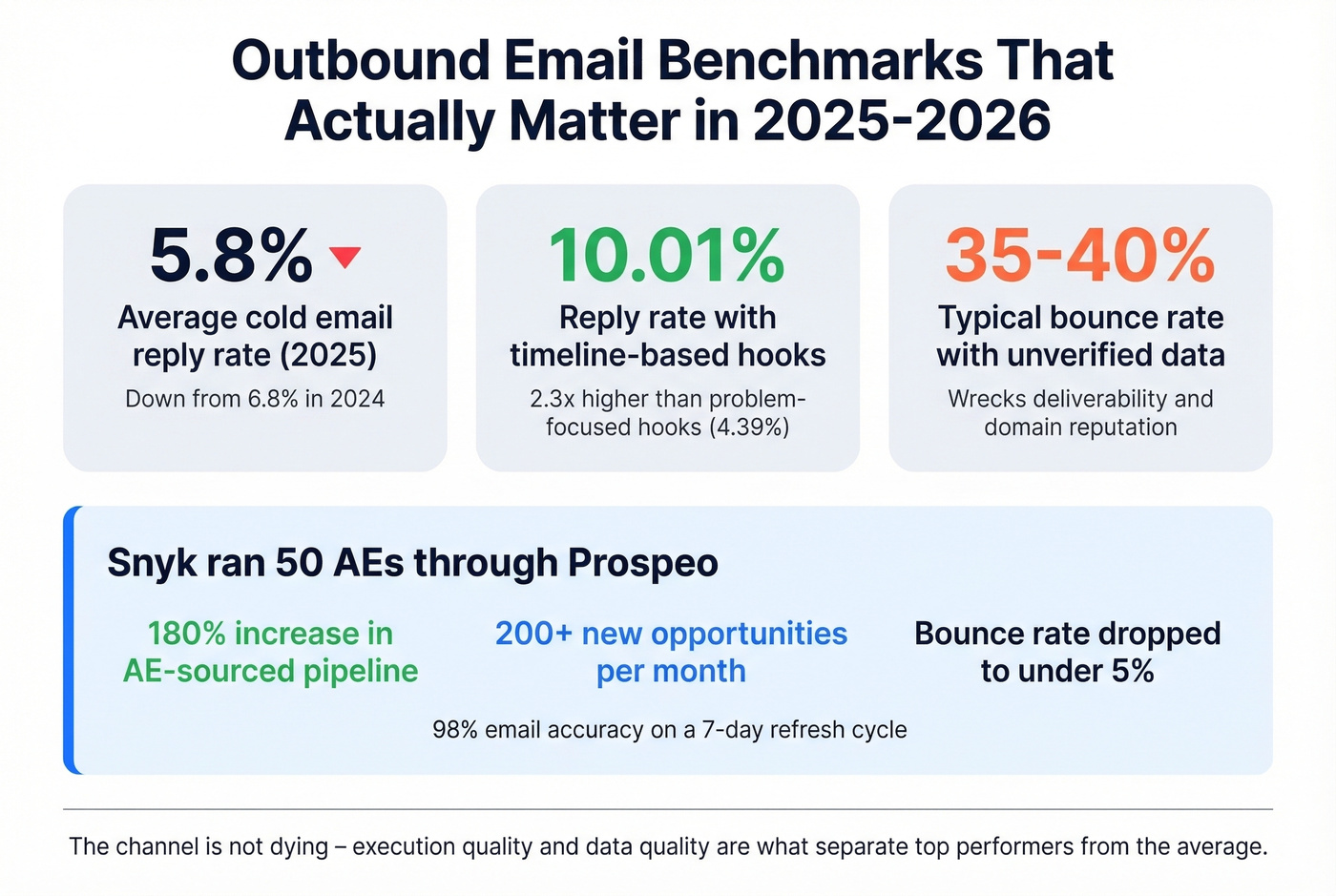
Cold email reply rates declined from 6.8% to 5.8% between 2024 and 2025. That's the macro trend. But within that average, timeline-based hooks pull a 10.01% reply rate versus 4.39% for problem-focused hooks - a 2.3x difference. The channel isn't dying. Execution is just getting more demanding.
And execution starts with data quality. We've seen this pattern over and over: teams invest in sequencing tools, copywriting, and A/B testing, then feed the whole machine with unverified contact data. A 35% bounce rate wrecks deliverability and domain reputation and tanks every campaign that follows. Snyk ran 50 AEs through Prospeo and dropped bounce rates from 35-40% to under 5%, with AE-sourced pipeline up 180% and 200+ new opportunities per month. That's what 98% email accuracy on a 7-day refresh cycle does to an outbound channel.
If you're building outbound as a core channel, treat it like a system: start with cold email marketing fundamentals, then standardize your B2B cold email sequence and keep a library of cold email follow-up templates your team can actually execute.
Seed-stage GTM budgets typically run $5K-$20K/month; Series A teams spend $30K-$100K/month across channels. Allocate budget to match buyer behavior, not team preferences.
Step 6: Design Your Sales Motion
Match your sales motion to the ACV thresholds from the previous section. Sub-$5K deals don't need field sales. Contracts above $25K don't close through self-serve. We've watched teams burn entire quarters trying to PLG their way into enterprise contracts.
Enablement checklist - fix any gaps before launch:
- ICP and buying committee training for all reps
- Playbooks for each deal stage
- Case studies segmented by industry
- Objection-handling guides addressing real objections, not strawmen
- Collateral updated within the last quarter
If your sales deck still references last year's product screenshots, your enablement is broken. (If you need a tighter narrative, borrow from sales deck storytelling frameworks.)
Step 7: Build Retention Into the Plan
GTM doesn't end at acquisition. Build three retention mechanisms into your plan from day one: a time-to-value target (how fast does the customer get their first win?), churn risk monitoring (what signals predict a customer is about to leave?), and a structured feedback loop routing customer insight back to product.
Best-in-class PLG companies maintain net revenue retention above 120%. If your NRR is below 100%, your GTM is a leaky bucket - no amount of top-of-funnel fixes that. (If you want a practical diagnostic, start with churn analysis.)
Step 8: Define Metrics
Pick 3-5 KPIs. Optimize one at a time. The average company runs 10.5 simultaneous GTM efforts - 5 core channels plus 5.5 experimental initiatives. Without disciplined measurement, you can't tell which efforts are working and which are burning budget.
Set a 90-day post-launch evaluation window and measure lift against your pre-launch baseline. If you need a clean dashboard structure, use a sales operations metrics model so teams don't argue about definitions.
You just mapped your buying committee and chose your motion. Now you need direct lines to 6-10 decision-makers per account. Prospeo delivers 125M+ verified mobiles with a 30% pickup rate and 143M+ verified emails - refreshed every 7 days, not 6 weeks. Your GTM plan deserves data that keeps up.
Launch your go-to-market strategy with contacts that actually connect.
2026 GTM Benchmarks
Most GTM guides skip the numbers. Here are the benchmarks that actually matter for planning.
| Metric | Benchmark | Context |
|---|---|---|
| Cold email reply rate | 5.8% average | Down from 6.8% YoY |
| Timeline hook reply rate | 10.01% | 2.3x vs. problem hooks |
| PLG activation (top 10%) | 65%+ | Average is 33% |
| Best-in-class PLG NRR | >120% | Below 100% = net churn |
| Healthy LTV:CAC ratio | 3:1+ | Below 3:1 signals trouble |
| Simultaneous GTM efforts | 10.5 per company | 5 core + 5.5 experimental |
| Companies with formal GTM playbook | Fewer than 33% | Most teams wing it |
The most striking number: fewer than a third of companies have a formal GTM playbook. If you're reading this and building a real plan, you're already ahead of two-thirds of the market.
The cold email decline is real but misleading. The average dropped, but teams using timeline-based hooks and verified data are pulling reply rates nearly double the mean. The gap between good and average outbound execution is widening, not narrowing.
10 GTM Mistakes That Kill Launches
- Misjudging market access. You built for a market you can't reach efficiently. Distribution is harder than product.
- Feature-first positioning. Leading with what the product does instead of what the buyer achieves.
- Targeting too broad. "All mid-market SaaS companies" isn't an ICP. Pick a beachhead and dominate it.
- Sales and marketing alignment only on paper. If the handoff between marketing and sales isn't operationalized in your CRM, it doesn't exist.
- Poor channel strategy. Defaulting to the channels you know instead of the channels your buyer uses.
- Rushing the launch. Shipping before the whole product is ready - integrations, support, onboarding - and wondering why the Early Majority doesn't bite.
- No clear metrics. If you can't define success before launch, you can't measure it after.
- Ignoring the "do nothing" competitor. Not just other vendors - the cobbled-together workflow your buyer already has.
- Underestimating buying complexity. Selling to one person when the committee has six. Your champion isn't your buyer.
- Trying to do everything in-house. Pair internal execution with specialized tools where the skill gap is measurable - verified data providers for outbound, agencies for paid acquisition, consultants for positioning.
How to Measure GTM Success
Before launch, establish baselines: current win rates, pipeline velocity, CAC, and activation rates. After launch, measure lift within a 90-day window. Don't just look at aggregate numbers - segment by customers who adopted the new product versus those who didn't, and compare ACV, retention, and expansion revenue across those cohorts.
Group metrics into three tiers. Business metrics like revenue, win rates, and CAC are your primary indicators. Engagement metrics like adoption rate and DAU are leading indicators that tell you whether business metrics will follow. Brand metrics like organic traffic and social reach confirm momentum but don't prove GTM success alone. Build a 6-step measurement loop: define success criteria, choose KPIs, set a timeline, launch, monitor, then evaluate against your original definition.
CAC formula: (Sales Costs + Marketing Costs) / Customers Acquired. A healthy LTV:CAC ratio is 3:1 or better. Below that, no go-to-market strategy framework fixes the math.
FAQ
What's the difference between a GTM strategy and a marketing plan?
A GTM strategy covers product positioning, pricing, sales motion, channel selection, and enablement - it's a cross-functional system. A marketing plan is one component focused on demand generation and brand activities. Think of GTM as the full blueprint; marketing is the electrical wiring.
How long does it take to build a go-to-market plan?
A testable one-page GTM brief takes one to two weeks. A full plan with validated ICP, pricing experiments, and channel testing takes 60-90 days. Prioritize speed of testing over completeness of documentation - a rough plan you're executing beats a perfect plan you're still editing.
Which framework works best for a new product launch?
Start with Crossing the Chasm if you're in tech - it gives you the market sequencing logic most launches lack. Layer in the 4Ps as a tactical completeness check and choose your motion (PLG, SLG, or hybrid) based on ACV. Combining two or three frameworks gives you both strategic direction and operational detail.
What are the key components of a go-to-market strategy?
Every GTM strategy needs five components: ICP definition and buying committee mapping, competitive positioning at the workflow level, a pricing model matched to buyer psychology, acquisition channels selected by buyer behavior, and a sales motion aligned to your ACV. Miss any one and the others compensate poorly.
How do you keep outbound data from tanking your GTM launch?
Verify every email before sending. A 35% bounce rate wrecks deliverability and kills every campaign that follows. Tools like Prospeo verify emails at 98% accuracy on a 7-day refresh cycle, so your outbound channel runs on fresh, deliverable contacts instead of stale data that burns your domain.